
In this article
- AI voice agent vs chatbot in 60 seconds
- What is an AI voice agent? What is a chatbot?
- Where chatbots actually shine
- Where AI voice agents win
- Side-by-side comparison
- The deciding factor: speed-to-lead
- Which to choose by industry
- How TalkWithLead fits
- A practical evaluation checklist
- Five mistakes buyers make when picking between the two
- AI voice agent vs chatbot, at a glance
- FAQ
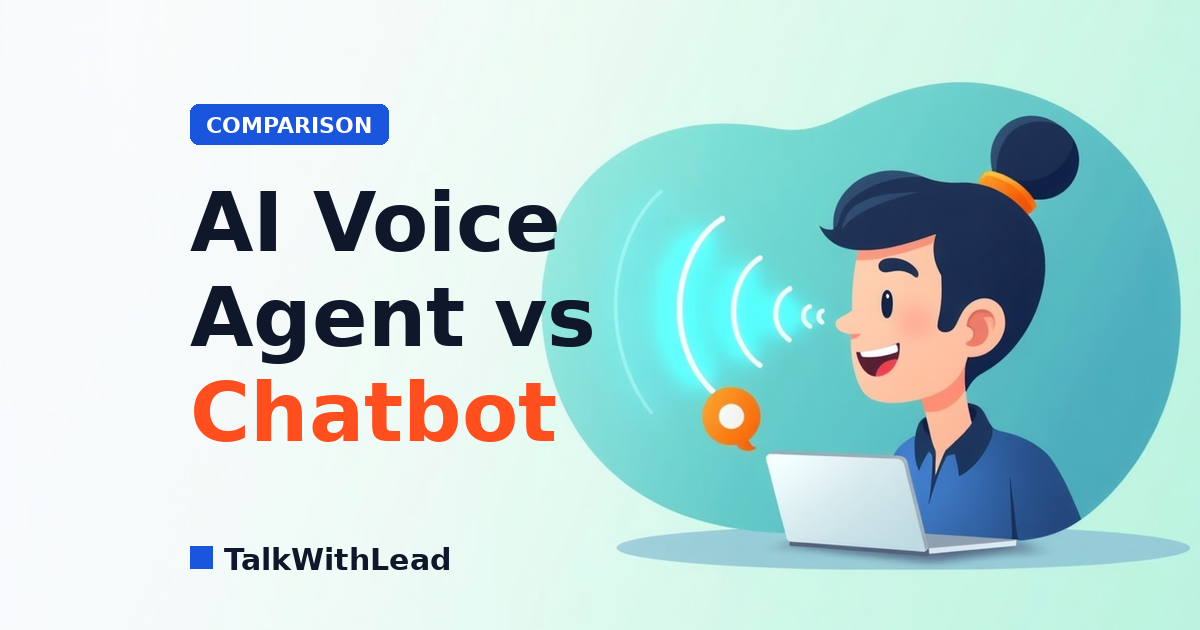
Chatbots make visitors type. AI voice agents create real conversations. If you run a business where buyers want to talk to someone now — a plumber, a real-estate agent, a mortgage broker, a lawyer, a clinic, a SaaS sales team — that one difference shows up in your pipeline.
Short answer: An AI voice agent turns a website visitor into a live phone conversation in seconds, while a chatbot makes that visitor type and wait. Chatbots are best for deflecting repetitive FAQs and self-serve support; an AI voice agent is best for converting high-intent visitors into qualified sales calls, because talking is faster and closer to how buying decisions actually happen. For most businesses chasing leads, the highest-converting setup is an AI voice agent for the buying moment, with a chatbot kept for low-stakes support questions. According to a Five9 study of 4,000 US and UK consumers, 75% of people prefer talking to a real human in person or over the phone for customer support — which is exactly the moment a human-sounding AI voice agent is built to win.
This is a practical comparison: where chatbots still earn their keep, where AI voice agents quietly outperform them, and how to decide for your own site. No fluff and no invented stats — just the trade-offs that actually move the needle on booked calls. See TalkWithLead’s widget in action on talkwithlead.com if you want to feel the difference between typing and talking before you read on.
AI voice agent vs chatbot in 60 seconds
The short version, before the detail:
- Chatbot: a typed conversation in a window on your site. Best for self-service questions, order/account lookups, and FAQ deflection.
- AI voice agent: a spoken conversation, either by callback or directly through the widget. Best for high-intent inquiries, after-hours qualification, and any industry where the next step is “get on a call.”
- The deciding factor: how ready is the visitor to take the next step? Browsing visitors will type. Decision-ready buyers want to talk.
What is an AI voice agent? What is a chatbot?
AI voice agent — how it works
An AI voice agent is a system that holds a spoken conversation with a visitor. On a website, it usually lives behind a small widget. The visitor either clicks “talk now” and speaks through the browser, or asks for an instant callback and the AI agent dials them back within seconds.
Under the hood, the agent transcribes what the visitor says, runs that through a language model to decide how to respond, then converts the response back to speech. Modern voice agents handle interruptions, recognize intent, and can hand off to a human when the conversation crosses a threshold — for example, “I want to schedule a tour this weekend” on a real-estate site, or “I have a burst pipe” on a plumber’s site.
Chatbot — how it works
A chatbot is a typed conversation in a chat window. Older chatbots followed a decision-tree (button-based) script. Modern AI chatbots use a language model to interpret typed messages and respond in natural language. Both still rely on the visitor reading and typing.
Chatbots are excellent at structured tasks: looking up an order number, surfacing a help-center article, or qualifying a visitor with a short form-style flow. They are also genuinely useful when the visitor prefers asynchronous chat — for example, when they are at work and cannot take a call.
The conversational gap that matters
A typed chatbot turns every interaction into a series of small commitments. The visitor reads a prompt, decides what to type, types it, waits for a reply, reads the reply, decides what to type next. Every step is a moment the visitor can close the tab. Speaking removes most of those steps. A short phone-style exchange usually replaces three or four chat turns and feels closer to how a normal sales or service call would go.
That gap matters most when the visitor is already in buying mode. They do not want to be educated. They want a person — or a system that sounds like one — to confirm a price, a slot, or a callback.
Where chatbots actually shine
It is unfair to call chatbots dead. They are a great default for several specific jobs:
- Self-service product questions. If your site sells software with documented features, a chatbot can resolve “does it integrate with X?” without anyone picking up the phone.
- Order tracking and account lookups. A chatbot that authenticates the visitor and surfaces order status is faster than calling support.
- Documentation and FAQ deflection. Pointing visitors to the right help article is a chatbot’s natural strength.
- Quiet hours when the visitor prefers chat. Some visitors really do prefer typing — they’re at work, the kids are asleep, they don’t want their voice picked up.
- Triage to a live agent. Chatbots are good at collecting the basics (“name, email, the gist of the problem”) before a human jumps in.
If your top KPI is “deflect support tickets” or “let visitors self-serve,” a chatbot is usually the right call. If your top KPI is “book more phone calls and demos,” keep reading.
Where AI voice agents win
AI voice agents earn their place when the next step in the funnel is a call. Several scenarios show this pattern clearly:
- High-intent service inquiries. A homeowner with a leaking water heater on a Sunday is not going to type out their problem in a chat window. They want a voice on the other end. An AI voice agent that picks up immediately, qualifies the job, and books a tech is the difference between winning and losing the work.
- High-ticket purchases. A buyer evaluating a multi-thousand-dollar service expects a conversation, not a form. Voice agents handle the discovery questions that build trust.
- Industries where phone is still the dominant channel. Real estate, mortgage, insurance, law, healthcare, and home services lean phone-heavy. Buyers in those verticals interpret “call me” as serious and “chat with us” as casual.
- After-hours qualification. Most chatbots can take a name and email after hours. Voice agents can actually answer questions, qualify the lead, and book a callback during business hours, all without a human.
- Recovering missed calls. When a missed call lands on your number, an AI voice agent can call back within seconds, ask the visitor what they need, and book a real follow-up. A chatbot cannot recover a missed phone call at all.
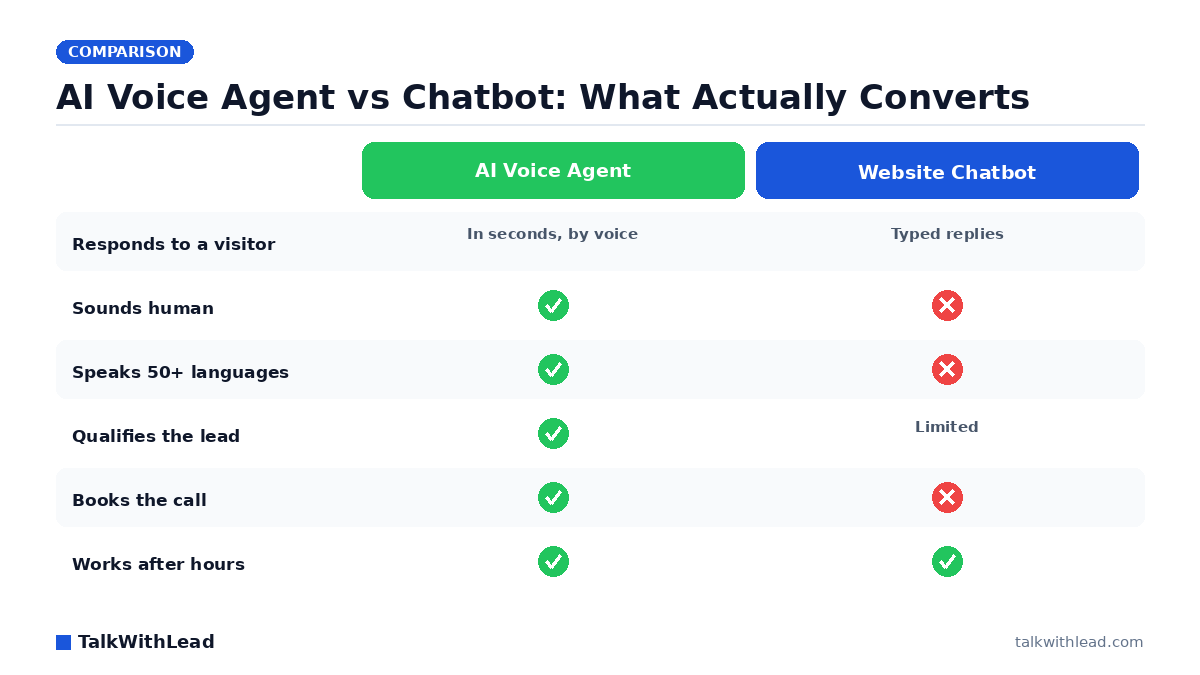
Side-by-side comparison
| Dimension | Chatbot | AI voice agent |
|---|---|---|
| Channel | Typed text in a chat window | Spoken conversation in-browser or by callback |
| Visitor effort | Read + type each turn | Talk naturally; no typing |
| Best for | Self-service, FAQ deflection, account lookups | High-intent inquiries, after-hours qualification, callbacks |
| Speed to first response | Instant | Instant (in-browser) or seconds (callback) |
| Speed to qualified lead | Minutes to hours (typed back-and-forth) | Often under 60 seconds |
| Handoff to human | Live chat agent | Live phone agent or scheduled callback |
| Tone signal to buyer | Casual | Serious; “we will actually call you” |
| Records | Chat transcript | Call recording + transcript |
| Accessibility | Excellent for typed-channel preference | Excellent for visually impaired or mobile-on-the-go users |
| Compliance considerations | Standard web/cookie/privacy practices | Plus call-recording disclosure where applicable; check local laws |
Both channels can coexist on the same site. The mistake most teams make is forcing one channel to do both jobs. A chatbot pretending to handle high-intent service calls feels slow. A voice agent answering “what time do you close?” feels like overkill.
The deciding factor: speed-to-lead
For most service businesses, the single biggest predictor of whether a lead converts is how fast you respond. Sales operators who have run inbound for years have all watched the same thing happen: response times under a minute dramatically outperform response times measured in hours. We won’t quote specific numbers without a citation, but if you have ever lost a lead to a competitor who called first, you already know the shape of the data.
Speed-to-lead is where AI voice agents pull ahead. A chatbot can collect a name and an email in 30 seconds. A voice agent can have already qualified the job, scheduled a follow-up, and texted a calendar invite by the time a competitor’s human picks up the phone.
Want to compare both on your own site? Start a free TalkWithLead trial — both callback and AI voice are included by default. You can A/B them on different pages and watch what your real visitors choose.
Which to choose by industry
Real estate
Buyers explore listings late at night and on weekends. A chatbot can grab a name; an AI voice agent can actually ask whether they want a Saturday or Sunday showing and reach out to the listing agent in parallel. For listing pages and “request a tour” flows, voice wins on intent.
Home services contractors (plumbing, HVAC, electrical, roofing)
Jobs go to whoever picks up first. Techs are on roofs, in crawl spaces, or under sinks. An AI voice agent fills the “we can’t pick up right now” gap without losing the job. Chatbots underperform here — homeowners in distress do not type.
Lawyers and law firms
Intake speed wins high-value cases. The caveat: confidentiality matters. Use a voice agent that records and stores only what your intake policy allows, and disclose recording per the law where you practice. Frame any AI conversation as preliminary qualification, not legal advice. Readers should consult their own counsel on what they can disclose to an AI intake step.
Dentists and clinics
Front desks are busy and new-patient calls leak after hours. A voice agent can take basic information and book a callback for the next business day. Anything beyond scheduling should defer to a clinician; this is not the place for diagnostic chat. Always check the privacy rules that apply to your patient communications in your jurisdiction.
Mortgage brokers
Rate-shoppers close with whoever calls first. Voice agents shave minutes off the response window. Avoid quoting specific rates or terms in the AI conversation; that is what your licensed advisors are for.
Insurance brokers and agencies
Quote-seekers want a human voice fast. AI voice handles first-touch qualification, then hands off to a licensed agent who can quote properly.
SaaS sales teams
Demo requests on pricing pages decay fast. A chatbot is fine for self-serve docs; an AI voice agent on the demo-request page can convert intent into a live or scheduled call within minutes. Use both: chatbot for product-led-growth questions, voice for “talk to sales.”
Local businesses (auto, beauty, fitness, etc.)
Owners cannot answer every call. After-hours calls are pure lost revenue. A voice agent that books appointments and answers “are you open?” turns that lost revenue back into bookings.
How TalkWithLead fits
TalkWithLead is a small widget for your website that lets visitors do one of two things: request an instant callback, or talk to an AI voice agent right now. That second option is the differentiator — the visitor does not have to wait, and you do not have to hire a 24/7 phone team.
We chose to offer both because the right channel depends on the visitor. A casual browser does not need a callback in 30 seconds — they will accept a typed exchange or no exchange at all. A serious buyer comparing three plumbers at 10 PM wants a voice. Forcing every visitor into the same channel costs conversions; meeting them where they are lifts them.
If you already have a chatbot, you do not need to rip it out. Many TalkWithLead customers run both: chat for product questions, voice for sales and service inquiries.
A practical evaluation checklist
Before you choose, ask:
- What is the most valuable conversion on my site? (Demo? Phone call? Booking?)
- How quickly does my industry expect a response?
- Do my visitors typically type or call to engage a competitor?
- What happens to inquiries that arrive after hours today?
- What is the cost of a missed lead vs. the cost of a tool that catches one?
- If I added a voice option above the fold tomorrow, would anything in my compliance or recording-disclosure policy need to change?
Walking these questions for ten minutes usually tells you whether you need a chatbot, a voice agent, or both.
Five mistakes buyers make when picking between the two
Most teams don’t pick the wrong tool because they misunderstand the technology. They pick wrong because they evaluate it against the wrong question. After watching how businesses shop for this category, the same avoidable errors come up again and again.
Mistake one: judging a chatbot demo by how smart its answers sound, instead of by how many real visitors finish the flow without bailing. Mistake two: assuming a voice agent will feel robotic, then never actually listening to one talk. Mistake three: optimizing for deflection (fewer human conversations) when your real goal is more booked calls. Mistake four: ignoring after-hours and weekend traffic, which is often when your highest-intent visitors arrive and your team is offline. Mistake five: treating language and long-distance reach as a nice-to-have, when a prospect who can’t be understood or can’t get a call back is simply a lost lead.
Composite example: a remodeling company compared a typed chatbot and an AI voice agent by reading transcripts side by side. The chatbot looked impressive on FAQs. But when they filtered for visitors who clearly wanted to hire, the voice agent had turned far more of those into actual phone conversations — because high-intent people want to talk, not type. The lesson: pick the tool that converts your ready-to-buy traffic, and let it handle the moment a visitor is most likely to become a real sales conversation.
AI voice agent vs chatbot, at a glance
| Dimension | Chatbot | AI voice agent (TalkWithLead) |
|---|---|---|
| Primary interaction | Visitor types text | Visitor speaks; instant live call or callback |
| Best job | FAQ deflection / self-serve support | Converting high-intent visitors into sales calls |
| Speed to a real conversation | Visitor must type, read, and wait between replies | Seconds to a live voice conversation or callback |
| After-hours coverage | 24/7 text replies | 24/7 voice answering and callbacks |
| Languages | Varies by setup | 50+ languages |
| Long-distance / international leads | Text only; no calling cost handled | Unlimited long-distance calling included |
| Concurrent visitors | Many at once | Unlimited simultaneous calls |
| Signal sent to a buyer | Automated, low-touch | Human-sounding, high-touch conversation |
| Where it can fall short | Stalls on nuanced or high-intent questions | Overkill for pure self-serve FAQ lookups |
Bottom line. Chatbot for support deflection; AI voice agent for turning visitors into sales calls.
Best for: Businesses that want to convert website visitors into phone conversations and qualified leads — service businesses, brokers, agencies, and any team where a fast call wins the deal. Choose the AI voice agent here.
Not the best fit for: Pure self-serve support or simple FAQ deflection on a low-intent help page — a chatbot is cheaper and sufficient. Many sites run both: voice for the buying moment, chat for routine support.
It’s worth knowing where chatbots lose people: a Five9 survey of 4,000 consumers found that 56% are frequently frustrated by AI customer-service chatbots and 48% don’t trust the information those bots provide — which is exactly why a real conversation tends to win the high-intent moment.
FAQ
Is an AI voice agent better than a chatbot?
For high-intent inquiries and businesses where the next step is a phone call, yes. For self-service product questions and FAQ deflection, a chatbot is usually a better fit. Many sites benefit from both.
Will an AI voice agent replace my sales team?
No. It handles first-touch qualification, after-hours coverage, and missed-call recovery. Your human team still owns closing, negotiation, and relationships. The voice agent’s job is to make sure no real opportunity goes silent.
Do visitors find AI voice agents annoying?
Older robocall-style systems were annoying. Modern AI voice agents handle interruptions, speak naturally, and escalate to a human when the conversation calls for it. They are not perfect, but the bar to a useful experience is much lower than it was three years ago.
How fast can an AI voice agent call a lead back?
With a callback widget like TalkWithLead’s, typically within seconds of the visitor clicking. The exact timing depends on the platform and the visitor’s connectivity.
What about compliance and call recording?
Call recording is regulated and varies by jurisdiction (one-party vs. two-party consent, sector-specific rules, and so on). If you record AI-handled calls, disclose the recording in your widget copy and follow the law where you operate. Consult counsel where the rules are not obvious.
Can I keep my existing chatbot and add a voice agent?
Yes. The two channels complement each other. Use the chatbot for self-service and FAQs, and the voice agent for “talk to a person” or “book a callback” flows.
How do I measure whether voice is working better than chat?
Track both: chatbot conversation starts vs. voice conversation starts, and then the downstream conversion rate of each — usually booked calls, qualified leads, or completed signups. The channel with the higher downstream conversion rate wins for your audience.
How does TalkWithLead handle both?
One widget on your site offers two actions: request an instant callback, or speak with an AI voice agent right now. You can see both options on talkwithlead.com, and you can book a TalkWithLead demo to walk through how to tune the flows for your industry.
Can an AI voice agent and a chatbot run on the same website?
Yes. The common setup is an AI voice agent on high-intent pages — pricing, demo, contact — to capture buying-moment visitors as calls, plus a chatbot on support and help pages for routine self-serve questions. They serve different jobs and don’t conflict, so you keep FAQ deflection while gaining live-call conversion.
Which converts more website visitors into leads, a chatbot or an AI voice agent?
For high-intent visitors, voice typically converts better, because it starts a real conversation in seconds instead of a typing exchange the visitor often abandons. Chatbots convert well for capturing low-friction support questions. The honest answer is to match the tool to the intent of the page it sits on.
Do I have to replace my chatbot to add an AI voice agent?
No. You can keep your existing chatbot and add a voice-first widget alongside it. TalkWithLead adds the voice layer without ripping out your current stack, so you keep FAQ deflection and gain live-call conversion for the buying moment.
Does an AI voice agent slow down my website?
No. TalkWithLead loads as a lightweight widget and the voice conversation runs in the cloud, so your page speed and Core Web Vitals stay intact while visitors still get an instant voice response.
What happens if the AI voice agent can’t answer a question?
It captures the visitor’s details and intent and routes the conversation to your team for a fast human follow-up, so a lead is never dropped just because a question is out of scope.
Is an AI voice agent worth it for a small business?
Often yes. A small team can’t answer every visitor in seconds, but an AI voice agent can, turning after-hours and overflow traffic into booked calls without adding headcount.
Let’s Turn More Website Visitors Into Sales Conversations
TalkWithLead is the AI voice-first lead-conversion platform behind hundreds of high-intent business websites. See it on your own number in a 15-minute live demo, or spin one up free and have it running before lunch.