AI Voice Agents That Turn Website Visitors Into Real Conversations
TalkWithLead is the AI voice-first widget that picks up the phone the moment a visitor lands on your site. Multilingual, extremely human-sounding, with unlimited long-distance calling so prospects anywhere can call you back. More calls. More leads. More closed deals.
Your SaaS pricing page gets the visit, the chatbot bubble pops up, and the buyer types “how much for 20 seats?” Twenty minutes later a rep replies to a form fill and the buyer is already demoing a competitor. That gap is the whole argument in ai voice agent vs chatbot for saas sales teams.
Short answer: a chatbot is a text-capture tool, while an AI voice agent is a conversation tool. For SaaS sales teams, the voice agent wins on high-intent traffic because it answers the pricing, security, and integration questions out loud in seconds and books the demo inside the same session. Keep the chatbot for documentation and low-intent FAQ deflection.
What is the real difference between an AI voice agent and a chatbot?
A chatbot waits for typing. It matches intent to a scripted branch, hands over an email field, and hopes the buyer stays. Every extra message is another exit point, and buyers on a pricing page are comparing three tabs at once.
An AI voice agent puts an extremely human-sounding voice in front of that same visitor. The visitor clicks once, the phone rings, and a real conversation starts — questions answered, objections heard, next step booked. TalkWithLead runs that agent in 50+ languages with unlimited long-distance calling, so a buyer in Berlin or Bogota gets the same instant answer as one in Boston. If nobody on your team is free, the agent handles it and triggers an instant callback the moment a rep is.
The distinction matters more in SaaS than almost anywhere else, because the qualifying questions are layered: seat count, current stack, integration needs, procurement timeline. Text drags that across days. Voice compresses it into four minutes.
Which converts more SaaS demo requests?
Speed is the variable that decides it. According to Harvard Business Review research, companies that reach a web lead within an hour are nearly 7× more likely to qualify it than those that wait even an hour longer. A chatbot does not reach anyone — it stores a message for a human to reach later. A voice agent reaches them while the pricing page is still open.
Consider an illustrative example. Say your site gets 1,000 pricing-page visits a month and your chatbot captures 40 emails. Assume your reps eventually connect with half of those and close 10% of the connections — that is two new accounts. Now assume a voice agent converts even 6% of those same 1,000 visits into live conversations: 60 real calls, and at the same 10% close rate that is six accounts from identical traffic. The math is illustrative, but the mechanism is not: conversations close, transcripts do not.
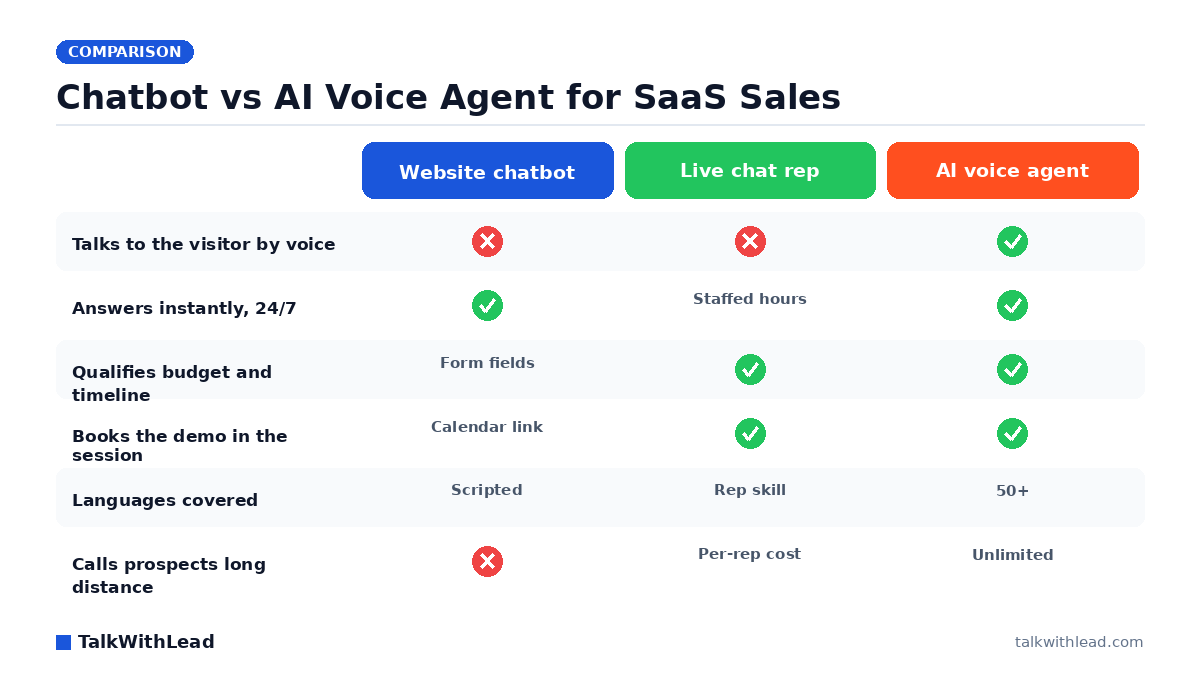
Side-by-side: chatbot, live chat, and AI voice agent
Dimension
Website chatbot
Live chat rep
AI voice agent
Channel
Typed text
Typed text
Spoken conversation
Response time
Instant, but scripted
Minutes, if staffed
Instant, conversational
After-hours coverage
Yes, capture only
No
Yes, full conversation
Qualification depth
Form fields
Good, rep-dependent
Budget, seats, timeline, stack
Demo booking
Calendar link handoff
In-session
In-session, on the call
Language coverage
Pre-scripted strings
Whoever is on shift
50+ languages
International prospects
Text only
Toll costs, time zones
Unlimited long-distance calling
Best use
Docs and FAQ deflection
Existing-customer support
High-intent buyer conversion
Read the table as a routing map, not a scoreboard. Support traffic belongs in text. Buyer traffic belongs on the phone.
How does an AI voice agent qualify a SaaS lead?
SaaS qualification is a short list of hard questions, and buyers answer them more honestly out loud than in a form. A voice agent asks how many seats, which tools the team already runs, who signs off, and when the current contract renews. It logs the answers and routes the hot ones to a rep immediately.
Intent capture at the moment of interest — the agent engages while the buyer is still reading your pricing tiers, not the next morning.
Objection handling in real time — pricing pushback, SSO questions, migration worries get answered before the tab closes.
Instant callback — if the buyer prefers a later slot, the agent schedules it and calls them, so the follow-up never depends on a rep remembering.
Language match — the agent switches to the buyer’s language, which removes the quiet drop-off that kills international pipeline.
Compare that to the chatbot path: message, email field, thank-you screen, nurture sequence, silence. Our post on live chat vs chatbot covers why even staffed text falls short at the buying moment. If you want to price the swap, see pricing before you build another nurture flow.
What does slow response actually cost a SaaS team?
Put a number on it with stated assumptions rather than a guess. Say your product runs $400 per month per account with an average 18-month lifetime — roughly $7,200 in lifetime value. Assume your site produces 30 high-intent pricing-page sessions a week and your current text-only setup converts 5% into sales conversations. That is 1.5 conversations a week. Lift that to 12% with a voice agent and you get about 3.6 a week, or roughly 8 extra conversations a month. Close a quarter of them and you have added two accounts, about $14,400 in lifetime value, from traffic you already paid for.
Run your own version with the free speed-to-lead ROI calculator — put in your real traffic, deal size, and close rate. The assumptions above are illustrative, not a promise; the calculator makes them yours.
Best for: SaaS teams with real pricing-page traffic, a deal size above roughly $100 per month, international prospects, and fewer reps than inbound demand. Not the right fit if: you sell a $9 self-serve tool where nobody expects a call, your traffic is overwhelmingly existing customers looking for docs, or your product is pre-launch with no pricing page yet. In those cases a chatbot and a good help center do more.
Should you run both a chatbot and a voice agent?
Usually yes, with clear routing. Keep the chatbot on documentation, changelog, and support pages where deflection is the goal. Put the voice agent on pricing, demo, comparison, and high-intent landing pages where a conversation is the goal. The two stop competing the moment you stop asking one tool to do both jobs.
One caution from watching sites do this badly: do not stack a chatbot bubble and a voice widget in the same corner of the same page. Pick one primary action per page type. Our comparison of click-to-call vs callback widget vs AI voice agent covers which control fits which intent.
Start where the money is. Put the voice agent on your pricing page first, measure demo bookings for two weeks, then expand. You can start free and have it live on the page today, or try the Live Demo first and hear exactly what your buyers would hear.
FAQ
Is an AI voice agent better than a chatbot for SaaS sales teams?
For high-intent buyer traffic, yes. A voice agent answers pricing and integration questions out loud and books the demo in the same session, while a chatbot mostly captures an email for later follow-up. For documentation and support traffic, a chatbot is still the cheaper, better fit.
Will an AI voice agent replace my SDRs?
It replaces the waiting, not the reps. The agent picks up every visitor instantly, qualifies on seats, budget, and timeline, and hands warm, pre-qualified conversations to your team — so SDRs spend their day on buyers who already said yes to a conversation instead of chasing cold form fills.
Can an AI voice agent handle international SaaS prospects?
Yes. TalkWithLead’s agent speaks 50+ languages and includes unlimited long-distance calling, so a prospect anywhere can have the conversation in their own language without your team covering extra time zones or paying per-minute international rates.
Where should I put the voice widget on a SaaS site?
Pricing page first, then the demo-request page and your competitor comparison pages. Those are the pages where a buyer already has a specific question and a specific objection. Leave documentation and support pages to your chatbot.
How fast do I actually need to respond to a SaaS lead?
Minutes, not hours. The MIT Lead Response Management study found you’re about 21× more likely to qualify a lead contacted within 5 minutes than one contacted at 30 minutes. A voice agent answers in seconds, which is the only reliable way to hit that window around the clock.
What does an AI voice agent cost compared with a chatbot?
Chatbots are typically the cheaper line item; a voice agent is priced as a conversion tool rather than a deflection tool. The honest way to judge it is per booked demo, not per month — current plans and tiers are on the pricing page.
A plumber’s website gets a visitor at 8:40pm with a leaking water heater. The chatbot asks for a name and email. The visitor closes the tab and calls the next company on Google. That is the whole argument in one scene.
TL;DR: For most local businesses, an AI voice agent beats a chatbot because local buying decisions are urgent and conversational. A chatbot captures text and hands you a lead to call back later; an AI voice agent talks to the visitor immediately, answers questions in a human-sounding voice, and connects them to your business as a live phone conversation. Chatbots still earn their keep for order status and repeat-customer FAQs.
What is the difference between an AI voice agent and a chatbot?
A chatbot is a text interface. The visitor types, waits, reads, types again. Even a good one is a slow-motion version of a conversation, and every extra turn is another chance for the person to give up. A form is worse — it is a chatbot with no replies at all.
An AI voice agent is a voice interface that lives on your site. The visitor clicks, speaks, and hears an extremely human-sounding voice answer back. It asks what they need, handles the qualifying questions a receptionist would ask, and turns the session into a real phone conversation — including an instant callback to their phone if they would rather talk that way. No typing, no queue, no “we’ll get back to you within one business day.”
The distinction matters most for local service businesses, where the buyer usually has a problem right now: a burst pipe, a cracked tooth, an accident, a listing they want to see this weekend.
Which one books more calls for a local business?
Speed decides it. According to Harvard Business Review research, companies that reach a web lead within an hour are nearly 7× more likely to qualify it than those that wait even an hour longer. A chatbot transcript sitting in an inbox until morning is exactly the delay that research describes.
The gap widens because most local businesses cannot answer the phone reliably in the first place. According to a 411 Locals study of 85 small businesses across 58 industries, only 37.8% of incoming calls were answered by a live person — meaning roughly 6 out of 10 calls went unattended. If the phone already leaks that badly, adding a text widget does not plug the hole. Answering the conversation instantly does.
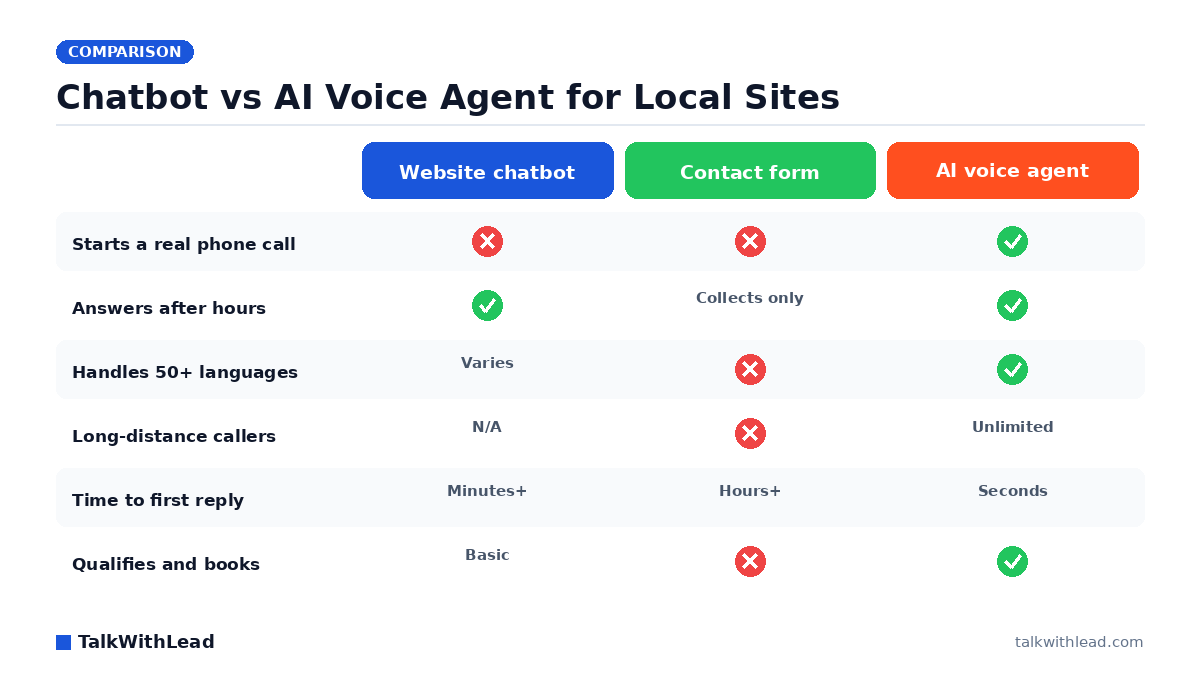
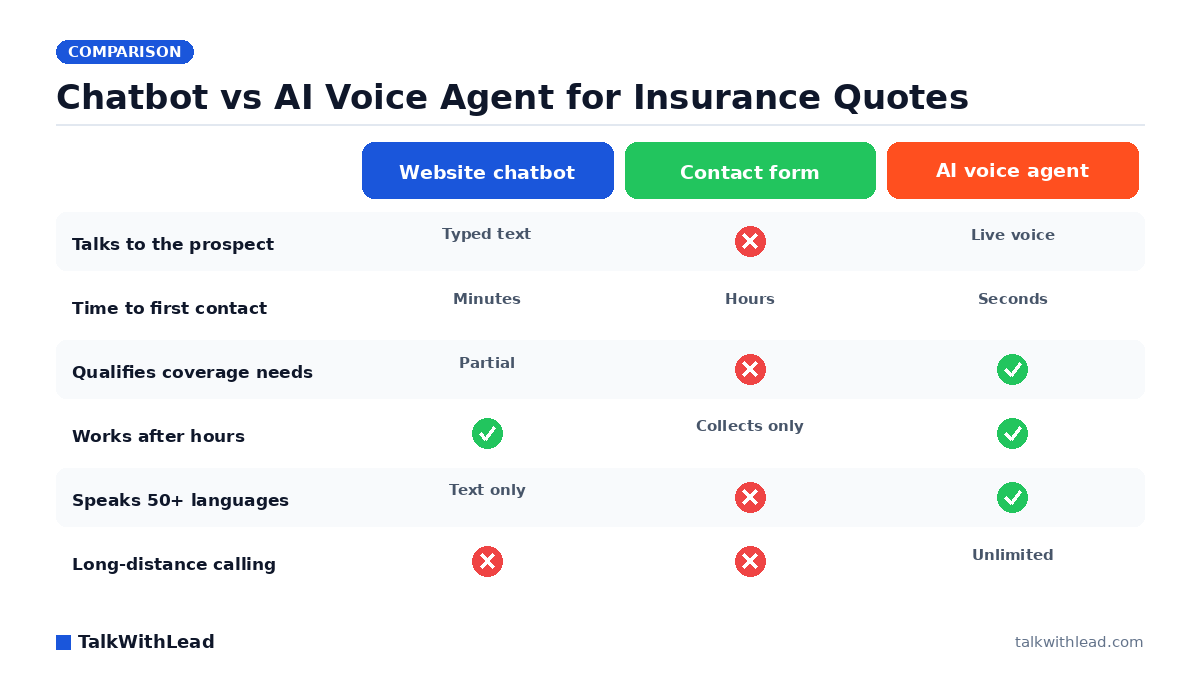
Dimension
Website chatbot
Contact form
AI voice agent
Interaction mode
Typed text
One-way submission
Spoken conversation
Time to first human-quality answer
Minutes to hours
Hours to next business day
Seconds
After-hours coverage
Yes, text only
Collects only
Yes, full conversation
Languages
Varies by vendor
None
50+ languages
Out-of-area callers
Not applicable
Not applicable
Unlimited long-distance calling
Qualifies and books an appointment
Basic scripted flows
No
Yes, conversationally
Best use
FAQ and order status
Low-urgency inquiries
New high-value leads
Want to see the voice side before you commit to anything? Take the Live Demo and talk to the agent the way a customer would. It takes about two minutes, and it settles the argument faster than any comparison chart.
How much revenue does the slower option actually cost?
Here is an illustrative model — your numbers will differ, and the assumptions are stated on purpose. Say a local contractor’s site gets 900 visitors a month and 40 of them start some kind of contact. Assume the chatbot captures 40 typed inquiries but only half get a reply before the person hires someone else, and assume an average job value of $600 with a 25% close rate on reached leads.
The other 20 go cold: $3,000 in assumed lost revenue that month
Now assume voice recovers even half of the cold half — 10 extra conversations, same close rate. That is roughly $1,500 a month recovered under these assumed rates, from traffic already on the site. Plug your own numbers into the free missed-call revenue calculator instead of trusting our example. Cost framing is simple: an AI voice agent generally lands well below the monthly cost of a part-time receptionist, and you can check the current tiers on the pricing page.
What about customers who do not speak English — or do not live nearby?
Two silent leaks hit local businesses harder than owners expect. The first is language. A roofing company in a mixed-language neighbourhood loses every caller who is not confident in English, and a chatbot in one language does nothing to fix that. A voice agent that handles 50+ languages picks up those conversations in the caller’s own words — the same pattern covered in bilingual Spanish answering for contractors.
The second is distance. Out-of-area buyers — a family relocating, an adult child arranging care for a parent, an investor buying a property two provinces away — often will not pay to call, and will not wait on a form. Unlimited long-distance calling removes that friction entirely, which is why voice, languages, and long distance work as a set rather than as separate features.
When is a chatbot still the right call?
Chatbots are not useless. They are just aimed at the wrong moment for most local lead generation. Keep the chatbot when the job is deflection rather than conversion:
Order and appointment status for existing customers who just want a quick lookup.
Repetitive policy questions — hours, service area, parking, what to bring to a first visit.
Silent environments, where the visitor genuinely cannot speak: an open-plan office, a hospital waiting room, a late-night browse next to a sleeping baby.
High-volume, low-value traffic where a human callback would not pay for itself.
The strongest setup for most local sites is both, aimed correctly: voice as the primary path for new business, text as the fallback for logistics. If you want the deeper head-to-head on conversion behaviour, read AI voice agent vs chatbot conversion rate.
Honest verdict
Best for: local service businesses — contractors, clinics, law firms, real estate agents, med spas, home services — where a single new customer is worth hundreds or thousands of dollars, the buyer is usually in a hurry, and nobody can watch the phone all day.
Not the right fit if: your visitors are mostly existing customers checking order status, your average order value is small enough that a live conversation costs more than it returns, or your audience genuinely prefers async text (some support-heavy software products fit here). In those cases a well-built chatbot is the cheaper, correct tool.
How to switch without breaking what already works
You do not have to rip anything out. Add the voice agent to the pages where high-intent visitors land — service pages, pricing, contact — and leave the chatbot on support and account pages. Watch which one produces booked conversations over two or three weeks and reallocate from there. Local businesses that have already run this play tend to follow the pattern described in this chatbot alternative guide.
Three things worth setting up on day one: an instant-callback option so hesitant visitors can be called back on their own phone, after-hours coverage so evening and weekend traffic is not wasted, and a short qualifying script so the agent captures the details your team actually needs before the call is handed over.
If the goal is more calls, more qualified leads, and more sales conversations from traffic you are already paying for, start with the Live Demo, then create your free account and put the voice agent on your busiest page this week.
FAQ
Is an AI voice agent better than a chatbot for a small local business?
For generating new business, yes in most cases. Local buyers usually have an urgent problem and want to talk to someone now, and a voice agent starts that conversation in seconds instead of collecting text you answer later. A chatbot remains useful for status checks and repeat FAQs.
Does an AI voice agent replace my receptionist?
It covers the hours and overflow your receptionist cannot — evenings, weekends, lunch breaks, and the moments when everyone is already on a call. Most businesses run both, with the agent catching what would otherwise ring out.
Will website visitors actually talk to an AI voice agent?
Many will, because the agent sounds human and answers instantly, which is what they wanted from the phone in the first place. For visitors who cannot speak right then, an instant callback lets them pick the moment instead of abandoning the site.
What languages can an AI voice agent handle?
TalkWithLead’s agent converses in 50+ languages, so a caller who is more comfortable in Spanish, French, Punjabi, or Mandarin gets the same quality of conversation as an English speaker without you hiring for each language.
How much does an AI voice agent cost compared to a chatbot?
Chatbots are often cheaper per month, but they are priced against a different outcome — deflected questions, not booked jobs. The honest comparison is cost per booked conversation, and current plans are listed on the pricing page.
Can I keep my chatbot and add a voice agent?
Yes, and that is usually the smartest first move. Put voice on high-intent pages, leave the chatbot on support and account pages, and compare booked conversations from each over a few weeks before changing anything else.
An insurance shopper lands on your quote page at 8:40 p.m., types three questions into your chat widget, gets a canned answer about “a licensed agent will follow up,” and closes the tab. By morning they have quotes from two other brokers. The choice between an AI voice agent vs chatbot for insurance brokers is really a choice between talking to that person now or emailing them tomorrow.
Short answer: a chatbot is better at answering policy questions in text; an AI voice agent is better at converting a quote-page visitor into a bound policy. Insurance is a comparison purchase with a short shopping window, so the broker who gets the prospect on the phone first usually wins. Most brokers should run voice as the primary conversion path and keep chat for support-style questions.
Why insurance leads punish slow follow-up harder than most industries
Insurance shopping is a session, not a journey. Someone whose renewal notice just arrived opens four or five tabs, requests quotes from each, and takes the first real conversation that happens. Nobody sits patiently waiting for the third broker’s callback on Thursday.
The research backs the intuition. According to Harvard Business Review research, companies that reach a web lead within an hour are nearly 7× more likely to qualify it than those that wait even an hour longer. For a broker, “qualify” means finding out whether this is a $600 auto policy or a $9,000 commercial package before a competitor does.
A chatbot does not shorten that window. It parks the lead in a CRM and waits for a human producer to notice. An AI voice agent removes the wait entirely: the visitor clicks, the phone rings, and a human-sounding voice is asking about their current carrier before they have finished reading your homepage. If you want the general version of this argument, we covered it in Speed to Lead: How Fast Should You Call a New Lead?.
What is the actual difference between an AI voice agent and a chatbot?
A chatbot is a text interface. It matches what the visitor types against a set of intents or a language model, replies in the chat window, and — at best — captures a name, email, and phone number for someone else to act on later. Everything it accomplishes happens through typing.
An AI voice agent is a phone conversation that starts from your website. The visitor asks for a call, the agent dials them (or takes an inbound call), and they speak. TalkWithLead’s agent sounds human enough that prospects treat it like an after-hours staffer, handles 50+ languages, offers unlimited long-distance calling so an out-of-state or overseas prospect can talk without a toll charge, and can fire an instant callback the moment someone shows intent on a quote page.
The practical gap shows up in qualification depth. Ask a prospect to type their current carrier, renewal date, coverage limits, prior claims, vehicle year, and property details and they abandon halfway. Ask the same questions out loud and it takes about ninety seconds.
Dimension
Website chatbot
Static quote form
AI voice agent
Contact medium
Typed text
Submitted fields
Live phone conversation
Typical time to first human-grade contact
Minutes to hours
Hours to next business day
Seconds
Depth of qualification captured
Name, email, rough intent
Whatever fields survive abandonment
Carrier, renewal date, coverage, claims history
After-hours coverage
Answers, cannot close
Collects only
Answers, qualifies, books the producer
Language coverage
Text translation, often narrow
Usually English-only
50+ spoken languages
Long-distance / out-of-state prospects
N/A
N/A
Unlimited long-distance calling
Best at
Policy FAQs, claims status, document lookup
Low-cost lead capture
Converting quote-page traffic into bound policies
You can hear the difference faster than you can read about it — the live demo lets you run an insurance-style intake conversation against the agent yourself.
Which one books more insurance quote calls?
Voice, for the traffic that matters. Chat wins on volume of interactions; voice wins on volume of conversations with a licensed producer, and only the second one writes policies.
Consider an illustrative broker site — the numbers below are assumptions for the sake of the math, not measured results. Say the site gets 1,200 visitors a month and 4% start a quote, which is 48 people. Imagine a chat widget captures contact details from 15 of them and a producer reaches 6 by phone over the following days. Now say a voice agent instead puts 20 of those 48 into an immediate call, qualifies 14, and books 9 with a producer. Same traffic, roughly 50% more real conversations — and the conversations happened while the prospect still had your tab open.
Run your own version of that math with the free speed-to-lead ROI calculator, using your own quote-start rate and average commission per policy. If you would rather size the downside first, the missed-call revenue calculator covers the calls your office already drops.
What about the calls your agency misses after 5 p.m.?
Renewal panic is an evening event. So is a fender-bender, a mortgage closing that needs proof of homeowners coverage by morning, and a contractor discovering their certificate expired. Those prospects call, hit voicemail, and dial the next broker.
A 411 Locals study of 85 small businesses across 58 industries found only 37.8% of incoming calls were answered by a live person — meaning roughly 6 out of 10 calls went unattended. An agency with three producers and no evening staff sits squarely in that pattern.
An AI voice agent covers the gap without a night shift. It answers, confirms what the caller needs, collects policy details, checks whether the situation is urgent, and either books a morning slot with the right producer or escalates immediately. A chatbot can post office hours; it cannot take an intake. Brokers who want the answering-service framing will find the cost side in AI Receptionist vs Human Answering Service Cost, and the staffing comparison in AI Voice Agent vs Human Receptionist.
Language coverage is a quiet revenue leak in insurance
Personal lines skew heavily toward households where English is a second language — new arrivals buying their first auto policy, families insuring a first home, small business owners covering a first storefront. Those buyers overwhelmingly prefer to discuss deductibles and exclusions out loud, in their own language, because the stakes are financial and the vocabulary is technical.
A translated chat widget handles the words but not the reassurance. A voice agent that speaks 50+ languages does both, and unlimited long-distance calling means a prospect calling from another state or country is not weighing the cost of the call against the value of the quote. For most brokerages this is not a niche — it is a segment competitors are silently handing over.
Should you drop the chatbot entirely?
No. Keep it, demote it. A chatbot is genuinely good at the jobs voice handles awkwardly: pulling up a policy document, checking claim status, explaining what an umbrella policy covers, linking a certificate of insurance. Those are reference tasks, and text is the better medium for reference.
The sensible setup for a broker is voice as the primary path on quote and landing pages, chat as a secondary support surface on service pages and the client portal. Route intent to voice, route lookup to text. We laid out the general version of this split in Chatbot Alternative for Small Business.
Best for: independent brokers and agencies whose quote pages already get traffic, who lose deals to whoever calls back first, and who have no evening or weekend phone coverage.
Not the right fit if: your business is almost entirely renewals of existing books with no inbound web traffic, or you are a captive agent whose carrier controls the website and forbids third-party widgets. In those cases the voice agent has nothing to convert.
What does it cost to add an AI voice agent to a broker website?
Pricing for this category generally runs from a low monthly subscription for a single-location agency up to per-seat or per-minute plans for multi-office brokerages; current TalkWithLead tiers are on the pricing page.
Here is a labeled ROI example with stated assumptions. Assume a monthly platform cost of $200. Assume your average bound personal-lines policy earns $180 in first-year commission, and your average small commercial account earns $900. If the agent produces just two extra bound personal policies a month, the tool has roughly covered itself. If it produces one extra commercial account in a quarter, the math stops being close. Your own numbers will differ — the point is that the break-even for a broker sits at a very small number of additional conversations, because insurance commissions recur.
Installation is a snippet, not a project. You can start free, drop the widget on your quote page, and watch whether visitors who would have typed at a bot start talking to a producer instead. Then compare the two side by side using AI Voice Agent vs Chatbot Conversion Rate.
FAQ
Is an AI voice agent better than a chatbot for an insurance brokerage?
For converting quote-page visitors, yes. Insurance buyers compare several brokers in one sitting, and a voice agent reaches them within seconds while a chatbot hands off to a producer who calls later. For policy-document lookups and claims-status questions, a chatbot is the better tool.
Most brokerages get the best result running both: voice on quote and landing pages, chat on service and portal pages.
Can an AI voice agent actually qualify an insurance lead?
It can capture the fields a producer needs to price and prioritize: coverage type, current carrier, renewal date, prior claims, and vehicle or property basics. Spoken answers take about ninety seconds where the same questions in a form cause abandonment.
Binding, underwriting judgment, and advice stay with your licensed producers. The agent’s job is to make sure the producer is talking to a warm, pre-qualified prospect instead of chasing a stale email address.
Will prospects realize they are talking to an AI?
The voice is close enough to human that most callers treat it as an after-hours staff member, and it can identify itself when your compliance policy requires it. What prospects notice more is that someone picked up at 9 p.m. instead of nobody.
How fast should an insurance broker respond to a web quote request?
Within minutes, and preferably within seconds while the prospect is still on the page. The MIT Lead Response Management study found you’re about 21× more likely to qualify a lead contacted within 5 minutes than one contacted at 30 minutes — a gap that matters enormously when the shopper has four other tabs open.
Does it work for commercial lines, not just personal auto and home?
Yes, and the economics are stronger there. Commercial prospects are harder to reach by email and their accounts carry far higher commission, so a single extra booked conversation covers a lot of subscription cost. The agent qualifies on business type, payroll or revenue band, existing coverage, and renewal timing, then routes to the right producer.
Can it handle Spanish-speaking and out-of-state prospects?
It speaks 50+ languages, so a Spanish-speaking household discusses deductibles in Spanish rather than fighting a translated text widget. Unlimited long-distance calling means a prospect in another state or country can have the conversation without worrying about the cost of the call.
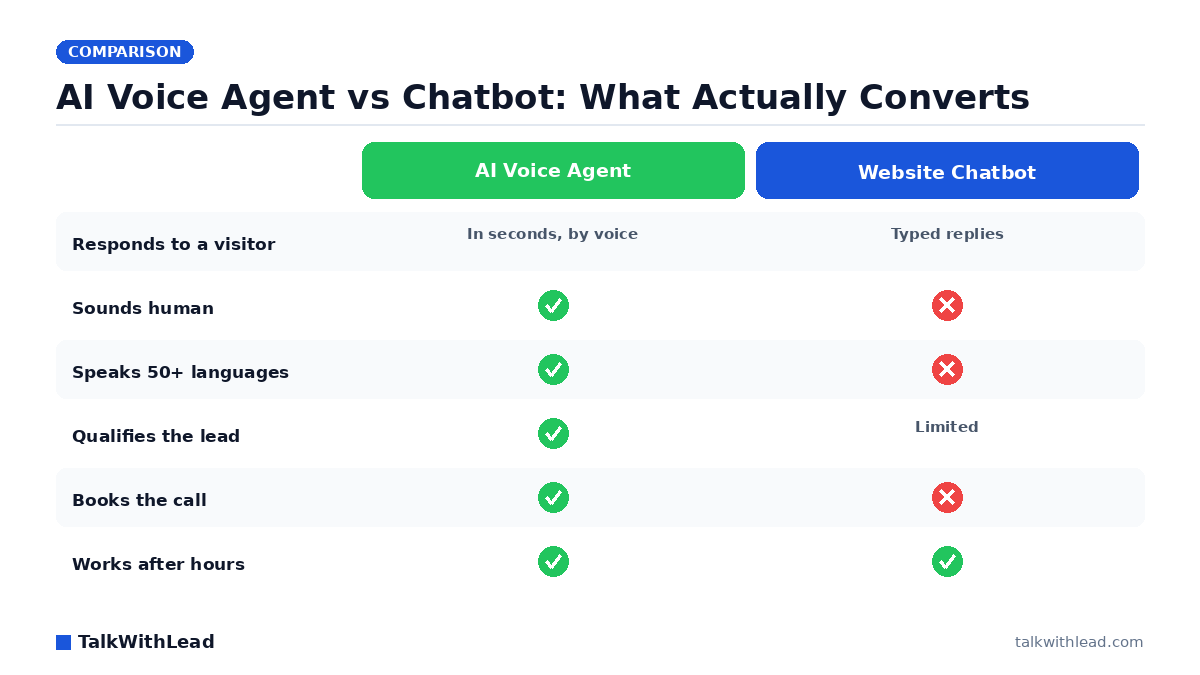
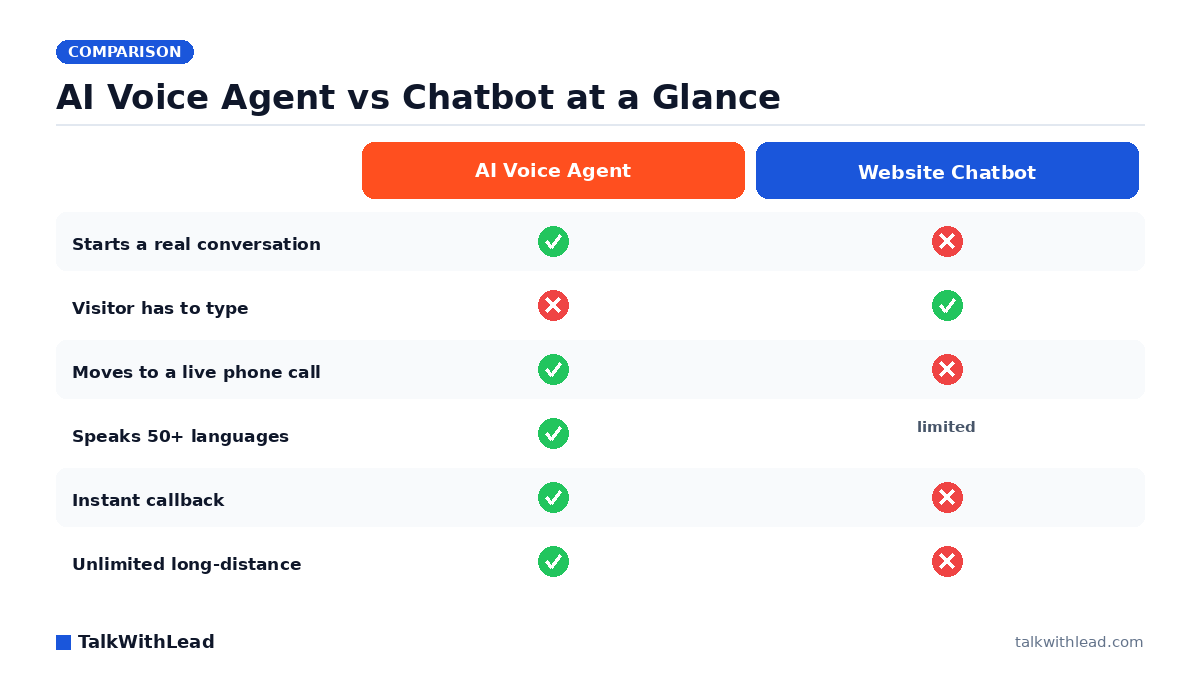
AI Voice Agent vs Chatbot at a Glance — TalkWithLead original infographic (comparison diagram).”/>AI Voice Agent vs Chatbot at a Glance
Why the conversion gap is bigger than it looks
The ai voice agent vs chatbot conversion rate question usually gets answered with a feature checklist. The real answer is simpler: a voice agent starts a conversation, and a chatbot starts a chore. One asks a visitor to speak; the other asks them to read a greeting, type a question, wait, read again, and hope the bot understood. Every one of those extra steps is a place where a ready-to-buy visitor quietly leaves.
That matters because the visitor who lands on your pricing page at 9:47 p.m. is not browsing. They are deciding. A human-sounding AI voice agent can answer them out loud in seconds and offer to put them on a call right then. A chatbot, at best, captures an email and adds them to a queue you will work tomorrow, which is often a day too late.
How a chatbot actually loses high-intent visitors
Chatbots are not useless. They deflect support tickets and answer FAQs at scale. The trouble shows up on conversion-focused pages, where the goal is not to inform a visitor but to win one. Here is where the friction stacks up:
Typing tax. Most people speak far faster than they thumb-type on a phone. Forcing a buyer to type their question slows the whole exchange to a crawl.
Scripted dead-ends. The moment a visitor asks something off-script, a rules-based bot stalls and the visitor blames your brand for it.
No handoff to a human. Even when a chatbot senses high intent, the usual next step is “leave your email” — not “talk to someone now.”
Language walls. A buyer who prefers Spanish, Tagalog, or Portuguese often gets an English-only widget and bounces.
An AI voice agent flips the interaction. Instead of waiting for the visitor to compose a message, it greets them in a natural, human-sounding voice and handles the back-and-forth out loud. The visitor talks the way they would to a salesperson on the showroom floor, and the agent listens, answers, qualifies, and offers the next step.
Three capabilities change the math:
50+ languages. The agent meets visitors in their own language, so a multilingual market stops being a leak in your funnel.
Instant callbacks. If a visitor would rather get a call in two minutes, the agent arranges it instead of dropping them into a form.
Unlimited long-distance calling. A prospect three time zones away connects with no concern about call cost on your side.
The net effect is fewer steps between “interested visitor” and “live conversation.” That compression is the whole game. You can try a live demo and hear how the voice agent handles a real exchange before you decide anything.
An illustrative conversion comparison
The following numbers are an illustrative example, not measured results from a specific customer. They show how small per-step drop-offs compound differently for typing versus talking.
Imagine 1,000 high-intent visitors hit a service page in a month. With a chatbot, suppose 12% open the widget, 60% of those actually type a question, 50% of those leave an email, and 35% of those emails turn into a booked call. That chain leaves you with roughly 13 booked calls.
Now run the same 1,000 visitors past an AI voice agent. Suppose 12% engage, but because talking is effortless, 80% complete the conversation, and 55% of those accept an offer to connect to a live call or instant callback. That chain leaves you with roughly 53 booked calls from the same traffic. Same visitors, same intent — the difference is how much effort each path demands. Even if your real percentages differ, the shape holds: removing the typing tax and the email-then-wait gap raises the ai voice agent vs chatbot conversion rate every time.
Speed is the hidden multiplier
Conversion is not only about the channel; it is about the clock. A lead contacted within the first minute is far more likely to convert than one contacted an hour later, simply because intent decays fast. A chatbot that collects an email defers the real conversation. A voice agent has the conversation now.
This is the core idea behind speed-to-lead and why the first 60 seconds win most deals. When the agent can move a visitor straight into a call, you are not racing a competitor’s callback queue — you have already started the relationship. And when a call does slip through, missed-call automation catches the lead before they dial someone else.
When a chatbot is still the right call
Voice is not the answer for every box on every page. A chatbot earns its place when:
The job is high-volume, low-stakes support (order status, password resets, store hours).
The visitor genuinely prefers async text and may be mid-meeting.
You need a searchable transcript trail for compliance or routing.
The smart setup is layered: let text tools handle routine questions, and route the high-intent moments — pricing, demo requests, “talk to sales” — to a voice agent that can close the loop with a real call. If you are weighing widgets, the callback widget versus click-to-call versus live chat comparison helps you map each tool to the right page.
How to decide for your own site
Start with one question: on this page, is a captured email good enough, or do you actually want a conversation? On a blog post, an email is fine. On a pricing page for a high-ticket service, a booked call is worth many emails. Put the voice agent where the conversation is worth the most.
Then check three things: do you serve multiple languages, do prospects reach you from far away, and does your current widget end most sessions with “we’ll get back to you”? If you answered yes to any of them, the voice path is likely leaving money on the table for you today. You can start free and put a voice agent on your highest-intent page this week, or review pricing to size it for your traffic.
FAQ
Is an AI voice agent really better than a chatbot for conversions?
On high-intent pages, generally yes. A voice agent removes the typing tax and can move a visitor straight into a live call or instant callback, while most chatbots stop at capturing an email. The ai voice agent vs chatbot conversion rate gap is widest exactly where the visitor is closest to buying.
Does the voice agent sound robotic?
No. TalkWithLead’s agent is built to sound human and conversational, so visitors talk to it the way they would talk to a person, rather than navigating a menu. The fastest way to judge it is to hear it on a live demo.
What about visitors who do not speak English?
The voice agent handles 50+ languages, so a buyer who prefers another language gets a natural conversation instead of an English-only wall. For multilingual markets, that alone can recover leads a text widget would lose.
Can I keep my existing chatbot and add a voice agent?
Yes, and that is often the best setup. Let the chatbot handle routine support questions and route high-intent moments — pricing, demo, “talk to sales” — to the voice agent that can connect a real call.
What happens if a visitor would rather be called back later?
The agent can schedule an instant callback instead of forcing a live conversation, and unlimited long-distance calling means it can reach prospects anywhere without a cost concern on your end.
How quickly can I test this on my own site?
You can sign up free and place a voice agent on your highest-intent page in a single sitting, then compare its booked-call rate against your current chatbot before rolling it out everywhere.
Chatbots make visitors type. AI voice agents create real conversations. If you run a business where buyers want to talk to someone now — a plumber, a real-estate agent, a mortgage broker, a lawyer, a clinic, a SaaS sales team — that one difference shows up in your pipeline.
Short answer: An AI voice agent turns a website visitor into a live phone conversation in seconds, while a chatbot makes that visitor type and wait. Chatbots are best for deflecting repetitive FAQs and self-serve support; an AI voice agent is best for converting high-intent visitors into qualified sales calls, because talking is faster and closer to how buying decisions actually happen. For most businesses chasing leads, the highest-converting setup is an AI voice agent for the buying moment, with a chatbot kept for low-stakes support questions. According to a Five9 study of 4,000 US and UK consumers, 75% of people prefer talking to a real human in person or over the phone for customer support — which is exactly the moment a human-sounding AI voice agent is built to win.
This is a practical comparison: where chatbots still earn their keep, where AI voice agents quietly outperform them, and how to decide for your own site. No fluff and no invented stats — just the trade-offs that actually move the needle on booked calls. See TalkWithLead’s widget in action on talkwithlead.com if you want to feel the difference between typing and talking before you read on.
AI voice agent vs chatbot in 60 seconds
The short version, before the detail:
Chatbot: a typed conversation in a window on your site. Best for self-service questions, order/account lookups, and FAQ deflection.
AI voice agent: a spoken conversation, either by callback or directly through the widget. Best for high-intent inquiries, after-hours qualification, and any industry where the next step is “get on a call.”
The deciding factor: how ready is the visitor to take the next step? Browsing visitors will type. Decision-ready buyers want to talk.
What is an AI voice agent? What is a chatbot?
AI voice agent — how it works
An AI voice agent is a system that holds a spoken conversation with a visitor. On a website, it usually lives behind a small widget. The visitor either clicks “talk now” and speaks through the browser, or asks for an instant callback and the AI agent dials them back within seconds.
Under the hood, the agent transcribes what the visitor says, runs that through a language model to decide how to respond, then converts the response back to speech. Modern voice agents handle interruptions, recognize intent, and can hand off to a human when the conversation crosses a threshold — for example, “I want to schedule a tour this weekend” on a real-estate site, or “I have a burst pipe” on a plumber’s site.
Chatbot — how it works
A chatbot is a typed conversation in a chat window. Older chatbots followed a decision-tree (button-based) script. Modern AI chatbots use a language model to interpret typed messages and respond in natural language. Both still rely on the visitor reading and typing.
Chatbots are excellent at structured tasks: looking up an order number, surfacing a help-center article, or qualifying a visitor with a short form-style flow. They are also genuinely useful when the visitor prefers asynchronous chat — for example, when they are at work and cannot take a call.
The conversational gap that matters
A typed chatbot turns every interaction into a series of small commitments. The visitor reads a prompt, decides what to type, types it, waits for a reply, reads the reply, decides what to type next. Every step is a moment the visitor can close the tab. Speaking removes most of those steps. A short phone-style exchange usually replaces three or four chat turns and feels closer to how a normal sales or service call would go.
That gap matters most when the visitor is already in buying mode. They do not want to be educated. They want a person — or a system that sounds like one — to confirm a price, a slot, or a callback.
AI Voice Agent vs Chatbot: What Actually Converts
Where chatbots actually shine
It is unfair to call chatbots dead. They are a great default for several specific jobs:
Self-service product questions. If your site sells software with documented features, a chatbot can resolve “does it integrate with X?” without anyone picking up the phone.
Order tracking and account lookups. A chatbot that authenticates the visitor and surfaces order status is faster than calling support.
Documentation and FAQ deflection. Pointing visitors to the right help article is a chatbot’s natural strength.
Quiet hours when the visitor prefers chat. Some visitors really do prefer typing — they’re at work, the kids are asleep, they don’t want their voice picked up.
Triage to a live agent. Chatbots are good at collecting the basics (“name, email, the gist of the problem”) before a human jumps in.
If your top KPI is “deflect support tickets” or “let visitors self-serve,” a chatbot is usually the right call. If your top KPI is “book more phone calls and demos,” keep reading.
Where AI voice agents win
AI voice agents earn their place when the next step in the funnel is a call. Several scenarios show this pattern clearly:
High-intent service inquiries. A homeowner with a leaking water heater on a Sunday is not going to type out their problem in a chat window. They want a voice on the other end. An AI voice agent that picks up immediately, qualifies the job, and books a tech is the difference between winning and losing the work.
High-ticket purchases. A buyer evaluating a multi-thousand-dollar service expects a conversation, not a form. Voice agents handle the discovery questions that build trust.
Industries where phone is still the dominant channel. Real estate, mortgage, insurance, law, healthcare, and home services lean phone-heavy. Buyers in those verticals interpret “call me” as serious and “chat with us” as casual.
After-hours qualification. Most chatbots can take a name and email after hours. Voice agents can actually answer questions, qualify the lead, and book a callback during business hours, all without a human.
Recovering missed calls. When a missed call lands on your number, an AI voice agent can call back within seconds, ask the visitor what they need, and book a real follow-up. A chatbot cannot recover a missed phone call at all.
Excellent for visually impaired or mobile-on-the-go users
Compliance considerations
Standard web/cookie/privacy practices
Plus call-recording disclosure where applicable; check local laws
Both channels can coexist on the same site. The mistake most teams make is forcing one channel to do both jobs. A chatbot pretending to handle high-intent service calls feels slow. A voice agent answering “what time do you close?” feels like overkill.
The deciding factor: speed-to-lead
For most service businesses, the single biggest predictor of whether a lead converts is how fast you respond. Sales operators who have run inbound for years have all watched the same thing happen: response times under a minute dramatically outperform response times measured in hours. We won’t quote specific numbers without a citation, but if you have ever lost a lead to a competitor who called first, you already know the shape of the data.
Speed-to-lead is where AI voice agents pull ahead. A chatbot can collect a name and an email in 30 seconds. A voice agent can have already qualified the job, scheduled a follow-up, and texted a calendar invite by the time a competitor’s human picks up the phone.
Want to compare both on your own site? Start a free TalkWithLead trial — both callback and AI voice are included by default. You can A/B them on different pages and watch what your real visitors choose.
Which to choose by industry
Real estate
Buyers explore listings late at night and on weekends. A chatbot can grab a name; an AI voice agent can actually ask whether they want a Saturday or Sunday showing and reach out to the listing agent in parallel. For listing pages and “request a tour” flows, voice wins on intent.
Home services contractors (plumbing, HVAC, electrical, roofing)
Jobs go to whoever picks up first. Techs are on roofs, in crawl spaces, or under sinks. An AI voice agent fills the “we can’t pick up right now” gap without losing the job. Chatbots underperform here — homeowners in distress do not type.
Lawyers and law firms
Intake speed wins high-value cases. The caveat: confidentiality matters. Use a voice agent that records and stores only what your intake policy allows, and disclose recording per the law where you practice. Frame any AI conversation as preliminary qualification, not legal advice. Readers should consult their own counsel on what they can disclose to an AI intake step.
Dentists and clinics
Front desks are busy and new-patient calls leak after hours. A voice agent can take basic information and book a callback for the next business day. Anything beyond scheduling should defer to a clinician; this is not the place for diagnostic chat. Always check the privacy rules that apply to your patient communications in your jurisdiction.
Mortgage brokers
Rate-shoppers close with whoever calls first. Voice agents shave minutes off the response window. Avoid quoting specific rates or terms in the AI conversation; that is what your licensed advisors are for.
Insurance brokers and agencies
Quote-seekers want a human voice fast. AI voice handles first-touch qualification, then hands off to a licensed agent who can quote properly.
SaaS sales teams
Demo requests on pricing pages decay fast. A chatbot is fine for self-serve docs; an AI voice agent on the demo-request page can convert intent into a live or scheduled call within minutes. Use both: chatbot for product-led-growth questions, voice for “talk to sales.”
Local businesses (auto, beauty, fitness, etc.)
Owners cannot answer every call. After-hours calls are pure lost revenue. A voice agent that books appointments and answers “are you open?” turns that lost revenue back into bookings.
How TalkWithLead fits
TalkWithLead is a small widget for your website that lets visitors do one of two things: request an instant callback, or talk to an AI voice agent right now. That second option is the differentiator — the visitor does not have to wait, and you do not have to hire a 24/7 phone team.
We chose to offer both because the right channel depends on the visitor. A casual browser does not need a callback in 30 seconds — they will accept a typed exchange or no exchange at all. A serious buyer comparing three plumbers at 10 PM wants a voice. Forcing every visitor into the same channel costs conversions; meeting them where they are lifts them.
If you already have a chatbot, you do not need to rip it out. Many TalkWithLead customers run both: chat for product questions, voice for sales and service inquiries.
A practical evaluation checklist
Before you choose, ask:
What is the most valuable conversion on my site? (Demo? Phone call? Booking?)
How quickly does my industry expect a response?
Do my visitors typically type or call to engage a competitor?
What happens to inquiries that arrive after hours today?
What is the cost of a missed lead vs. the cost of a tool that catches one?
If I added a voice option above the fold tomorrow, would anything in my compliance or recording-disclosure policy need to change?
Walking these questions for ten minutes usually tells you whether you need a chatbot, a voice agent, or both.
Five mistakes buyers make when picking between the two
Most teams don’t pick the wrong tool because they misunderstand the technology. They pick wrong because they evaluate it against the wrong question. After watching how businesses shop for this category, the same avoidable errors come up again and again.
Mistake one: judging a chatbot demo by how smart its answers sound, instead of by how many real visitors finish the flow without bailing. Mistake two: assuming a voice agent will feel robotic, then never actually listening to one talk. Mistake three: optimizing for deflection (fewer human conversations) when your real goal is more booked calls. Mistake four: ignoring after-hours and weekend traffic, which is often when your highest-intent visitors arrive and your team is offline. Mistake five: treating language and long-distance reach as a nice-to-have, when a prospect who can’t be understood or can’t get a call back is simply a lost lead.
Composite example: a remodeling company compared a typed chatbot and an AI voice agent by reading transcripts side by side. The chatbot looked impressive on FAQs. But when they filtered for visitors who clearly wanted to hire, the voice agent had turned far more of those into actual phone conversations — because high-intent people want to talk, not type. The lesson: pick the tool that converts your ready-to-buy traffic, and let it handle the moment a visitor is most likely to become a real sales conversation.
AI voice agent vs chatbot, at a glance
AI voice agent vs chatbot, at a glance
Dimension
Chatbot
AI voice agent (TalkWithLead)
Primary interaction
Visitor types text
Visitor speaks; instant live call or callback
Best job
FAQ deflection / self-serve support
Converting high-intent visitors into sales calls
Speed to a real conversation
Visitor must type, read, and wait between replies
Seconds to a live voice conversation or callback
After-hours coverage
24/7 text replies
24/7 voice answering and callbacks
Languages
Varies by setup
50+ languages
Long-distance / international leads
Text only; no calling cost handled
Unlimited long-distance calling included
Concurrent visitors
Many at once
Unlimited simultaneous calls
Signal sent to a buyer
Automated, low-touch
Human-sounding, high-touch conversation
Where it can fall short
Stalls on nuanced or high-intent questions
Overkill for pure self-serve FAQ lookups
Bottom line. Chatbot for support deflection; AI voice agent for turning visitors into sales calls.
Best for: Businesses that want to convert website visitors into phone conversations and qualified leads — service businesses, brokers, agencies, and any team where a fast call wins the deal. Choose the AI voice agent here.
Not the best fit for: Pure self-serve support or simple FAQ deflection on a low-intent help page — a chatbot is cheaper and sufficient. Many sites run both: voice for the buying moment, chat for routine support.
It’s worth knowing where chatbots lose people: a Five9 survey of 4,000 consumers found that 56% are frequently frustrated by AI customer-service chatbots and 48% don’t trust the information those bots provide — which is exactly why a real conversation tends to win the high-intent moment.
FAQ
Is an AI voice agent better than a chatbot?
For high-intent inquiries and businesses where the next step is a phone call, yes. For self-service product questions and FAQ deflection, a chatbot is usually a better fit. Many sites benefit from both.
Will an AI voice agent replace my sales team?
No. It handles first-touch qualification, after-hours coverage, and missed-call recovery. Your human team still owns closing, negotiation, and relationships. The voice agent’s job is to make sure no real opportunity goes silent.
Do visitors find AI voice agents annoying?
Older robocall-style systems were annoying. Modern AI voice agents handle interruptions, speak naturally, and escalate to a human when the conversation calls for it. They are not perfect, but the bar to a useful experience is much lower than it was three years ago.
How fast can an AI voice agent call a lead back?
With a callback widget like TalkWithLead’s, typically within seconds of the visitor clicking. The exact timing depends on the platform and the visitor’s connectivity.
What about compliance and call recording?
Call recording is regulated and varies by jurisdiction (one-party vs. two-party consent, sector-specific rules, and so on). If you record AI-handled calls, disclose the recording in your widget copy and follow the law where you operate. Consult counsel where the rules are not obvious.
Can I keep my existing chatbot and add a voice agent?
Yes. The two channels complement each other. Use the chatbot for self-service and FAQs, and the voice agent for “talk to a person” or “book a callback” flows.
How do I measure whether voice is working better than chat?
Track both: chatbot conversation starts vs. voice conversation starts, and then the downstream conversion rate of each — usually booked calls, qualified leads, or completed signups. The channel with the higher downstream conversion rate wins for your audience.
How does TalkWithLead handle both?
One widget on your site offers two actions: request an instant callback, or speak with an AI voice agent right now. You can see both options on talkwithlead.com, and you can book a TalkWithLead demo to walk through how to tune the flows for your industry.
Can an AI voice agent and a chatbot run on the same website?
Yes. The common setup is an AI voice agent on high-intent pages — pricing, demo, contact — to capture buying-moment visitors as calls, plus a chatbot on support and help pages for routine self-serve questions. They serve different jobs and don’t conflict, so you keep FAQ deflection while gaining live-call conversion.
Which converts more website visitors into leads, a chatbot or an AI voice agent?
For high-intent visitors, voice typically converts better, because it starts a real conversation in seconds instead of a typing exchange the visitor often abandons. Chatbots convert well for capturing low-friction support questions. The honest answer is to match the tool to the intent of the page it sits on.
Do I have to replace my chatbot to add an AI voice agent?
No. You can keep your existing chatbot and add a voice-first widget alongside it. TalkWithLead adds the voice layer without ripping out your current stack, so you keep FAQ deflection and gain live-call conversion for the buying moment.
Does an AI voice agent slow down my website?
No. TalkWithLead loads as a lightweight widget and the voice conversation runs in the cloud, so your page speed and Core Web Vitals stay intact while visitors still get an instant voice response.
What happens if the AI voice agent can’t answer a question?
It captures the visitor’s details and intent and routes the conversation to your team for a fast human follow-up, so a lead is never dropped just because a question is out of scope.
Is an AI voice agent worth it for a small business?
Often yes. A small team can’t answer every visitor in seconds, but an AI voice agent can, turning after-hours and overflow traffic into booked calls without adding headcount.
Related reading on the TalkWithLead blog
This article is part of a series on converting website visitors into phone calls. More from the TalkWithLead Resources hub:
How real estate agents are booking more showings with instant callback (coming soon)
Chatbot alternatives for small businesses that need to book calls (coming soon)
Next step: If you want to test voice and callback side by side on your own site, start a free TalkWithLead trial. Both are included — no separate plans, no upgrade required. Want a walkthrough first? Book a TalkWithLead demo and we’ll show you how teams in your industry are combining the two. See pricing if you want the cost side first.
Your next lead is on your site right now — ready to talk.
TalkWithLead’s AI voice agent picks up in seconds, qualifies the lead in their language, and books the call before the prospect can open a competitor’s tab. Forms are slow. Chatbots make people type. Voice closes.
This is the TalkWithLead Widget. Click to see how it will work on your website!
Live AI voice agent
Turn website visitors into phone calls
This is the same TalkWithLead widget you can add to your site — an AI voice agent that talks to your website visitors and calls leads back 24/7, in 50+ languages. Try it two ways:
 AI Voice Agent vs Chatbot at a Glance — TalkWithLead original infographic (comparison diagram).”/>