
In this article
- Why speed-to-lead matters more than nearly any other sales metric
- What “speed-to-lead” actually means
- A practical missed-lead math example
- Where teams lose minutes (and why hiring more staff isn’t the right first move)
- The four levers that actually move speed-to-lead
- Speed-to-lead by industry
- Before and after with TalkWithLead
- How to measure speed-to-lead this week
- Response time vs. outcome: what the research shows
- The verdict: what a good response time is, and who needs to automate it
- FAQ
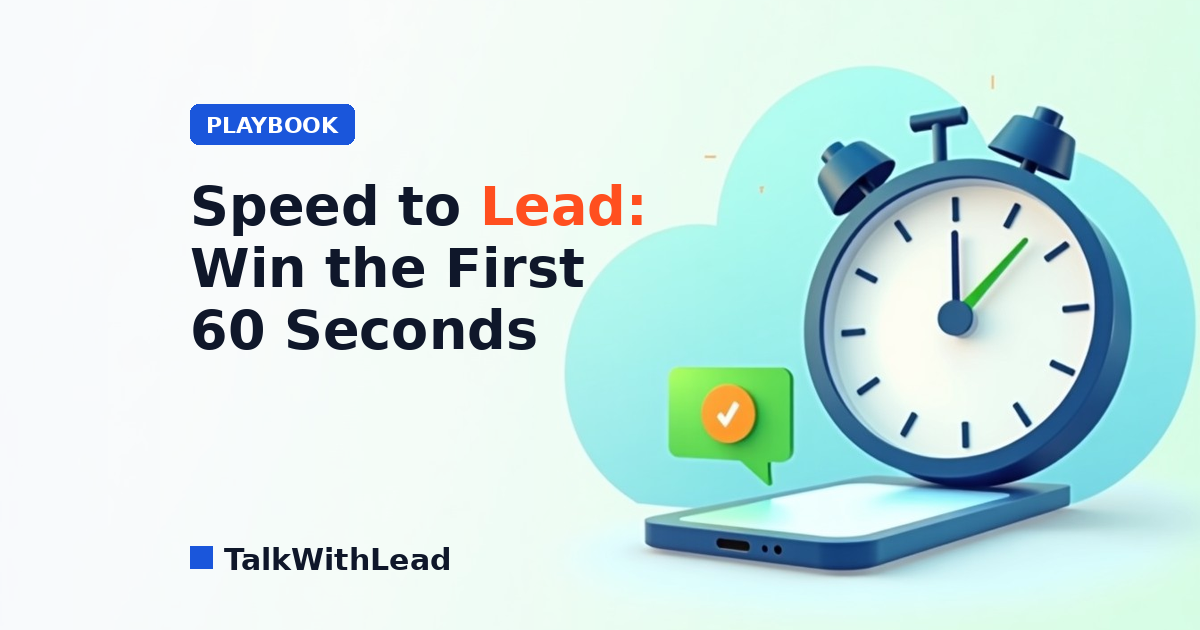
Speed-to-lead is the single biggest predictor of whether a website lead turns into a phone call, a booked job, or a closed deal. Not your offer. Not your pricing. Not your brand. How fast you respond.
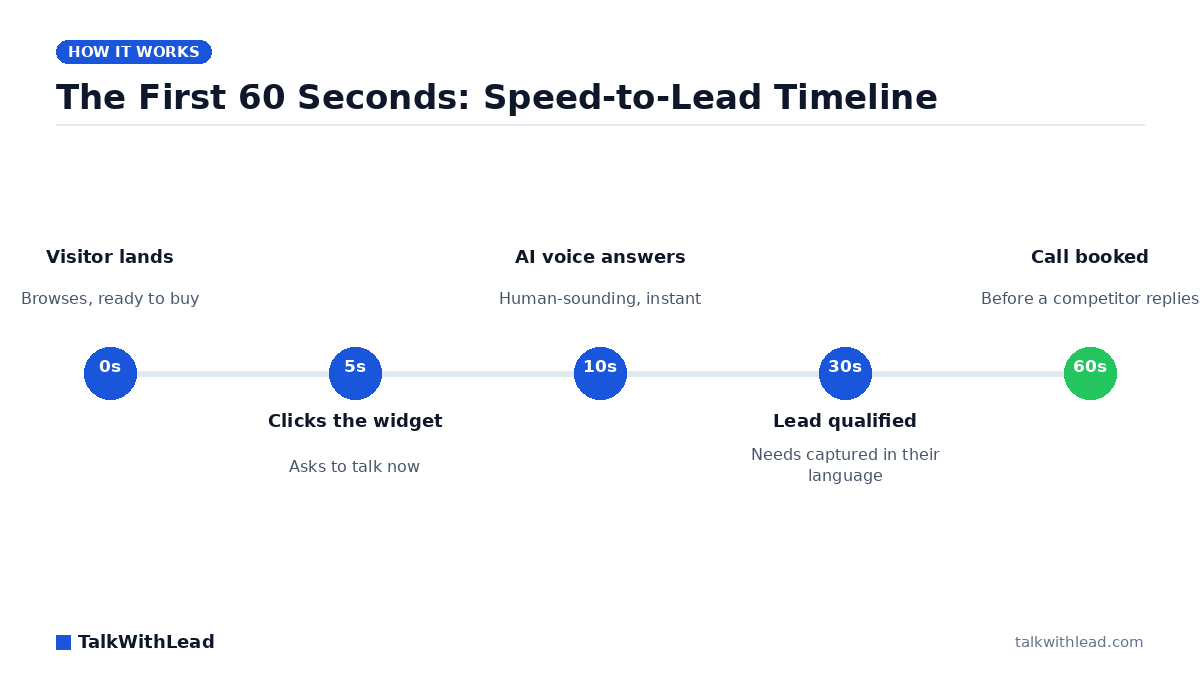
Under 60 seconds wins. Wait five minutes and, in a competitive search, the lead has often already pinged the next vendor on the list. After an hour, the lead is mostly gone. Forms are slow. Chatbots make people type. The win goes to whichever vendor’s phone — or AI voice agent — rings first. Talk to TalkWithLead’s AI voice agent yourself and feel what a sub-60-second response actually sounds like.
Short answer: Speed-to-lead is how fast you respond to a new inbound lead, and it is one of the strongest predictors of whether you win the deal. A good lead response time is under five minutes — ideally under 60 seconds — because the longer you wait, the more likely the prospect has already started talking to a competitor. The fastest reliable way to hit that window is to answer or call back automatically, 24/7, instead of depending on a rep being free.
Why speed-to-lead matters more than nearly any other sales metric
Sales operators who have run inbound funnels for any length of time will recognize this pattern: the leads that closed are almost always the leads that got a fast first touch. Faster than the competition. Faster than the visitor’s attention span. Fast enough that the moment of intent — that small, fleeting “I’m ready” feeling — is still alive.
That moment lasts seconds, not hours. A homeowner with a leaking water heater on a Sunday is not going to wait until Monday morning. A buyer comparing three mortgage brokers at 10 PM does not pause to remember which one had the prettier website. A traveler in Mexico City who clicks a U.S. contractor’s site does not want to think about long-distance call costs. They want someone — or something that sounds like someone — to pick up.
This is not theoretical hand-waving — it is what operators who run inbound funnels see again and again, and the published research lines up. According to Harvard Business Review research, companies that reach a web lead within an hour are nearly 7× more likely to qualify it than those that wait even an hour longer. And the MIT Lead Response Management study found you’re about 21× more likely to qualify a lead contacted within 5 minutes than one contacted at 30 minutes. The exact numbers vary by industry and study, but the shape of the pattern is consistent: response times under a minute outperform response times measured in hours by enough to change the unit economics of a business. That is the whole case for taking speed-to-lead seriously.
What “speed-to-lead” actually means
The clock starts at the form submit, not the next morning
Speed-to-lead is the elapsed time between when a prospect tells you they want to talk — they clicked “request a quote,” they filled the demo form, they clicked the callback widget — and when you actually reach them with a meaningful response.
Most teams measure this incorrectly. They measure “the next time a human looked at the lead in the CRM.” The real metric is the time until the prospect actually hears from you in a way they care about — a phone call, an AI voice conversation, a meaningful text. An auto-acknowledgement email does not count.
What counts as a “response,” ranked by what visitors actually feel
Channels matter. From the prospect’s perspective, ordered by perceived urgency:
- AI voice agent conversation — answers in seconds in the visitor’s language, sounds human, qualifies the lead, and books the next step before the prospect can open a competitor tab. This is what TalkWithLead leads with.
- Phone call from a human — highest perceived urgency, but only if a human is actually available. Outside business hours or when reps are on other calls, this drops to “voicemail.”
- SMS — fast and casual, great for confirmations and reminders, not great for the first real conversation.
- Live chat staffed by a human — useful if a person is actually staffing it; useless if a bot just collects an email.
- Typed chatbot loop — visitors who came to talk do not want to read four prompts and pick from buttons. This is where most chatbot funnels leak.
- Email — slow, and most prospects assume the response window is “tomorrow.”
Why the 60-second threshold matters more than the 5-minute or 1-hour rule
The often-quoted “5-minute rule” is a useful floor. The “1-hour rule” is a useful warning sign. The cliff is steeper than either suggests. Within the first 60 seconds the prospect is still on your site, still in the buying mindset, and has not yet opened a competitor’s tab. Past that, you are competing with whatever distraction happened next in their life.
A practical missed-lead math example
Numbers tell this story better than adjectives. Below is a representative small home-services business — not a real customer, just an illustrative example you can run against your own data.
- 200 inbound web/phone leads per month.
- Current median response time: 2 hours (typical for shops without an after-hours plan).
- Current close rate: 8%.
- Average ticket: $1,200.
That is about 16 closed jobs per month and roughly $19,200 in revenue. Now imagine adding an AI voice-first widget that picks up in seconds, handles the conversation in the prospect’s language, and books the next step before the prospect goes elsewhere. You don’t even need a huge swing — just a 30% lift in close rate (from 8% to about 10.4%). That is about 21 closed jobs and roughly $25,000 — an extra $5,760 per month or $69,000 per year.
We can’t promise that lift for any specific business; every shop’s numbers are different, and we will not pretend otherwise. But the math is honest: even small wins on response time compound quickly, and the cost of an AI voice agent that catches every missed conversation is almost always less than the revenue from a single recovered job.
If those numbers look conservative for your business, they probably are. Start a free TalkWithLead trial and run the same math against your own pipeline — or see pricing first if you want the cost side before the conversion side.
Where teams lose minutes (and why hiring more staff isn’t the right first move)
If response time is the problem, “hire more people” looks like the answer. It is almost always the wrong first move. Adding headcount adds payroll, training, and a hiring lag — and it does not help with the after-hours problem at all. Here is where the minutes actually leak:
The 5 PM to 9 AM dead zone
A large share of website traffic happens after the workday ends. A demo request at 7 PM, a quote inquiry at 10 PM, a contractor search at 1 AM — all default to the next-business-day queue. By the time someone answers, the prospect is in a meeting, a school run, a different mindset. An AI voice agent that answers in seconds covers this gap automatically.
Weekend leakage
Saturday and Sunday inbound is some of the highest-intent traffic of the week, especially in real estate, home services, and clinics. If Monday morning is your first response, weekend leads are gone before you start.
Reps already on calls
The team you have today is rarely sitting at zero call volume. When the new lead arrives, your reps are already on the phone with the previous one. Twenty minutes later — too late.
Field crews with their hands full
If your business has techs in the field, they cannot pick up the phone while they are under a sink, on a roof, or in a patient’s mouth. A missed call is the default — not the exception.
Language and distance mismatches
Two leaks most teams never even count. A prospect who speaks Spanish, Hindi, French, or Mandarin first will often hang up the moment the answer comes in a language they cannot work in. A prospect calling from a different country worries about the toll. TalkWithLead’s AI voice agent handles 50+ languages out of the box, and the platform covers unlimited long-distance calling — so the prospect’s first impression is “they speak my language and the call costs me nothing.” That is two friction points removed before the conversation even starts.
Manual triage of “junk vs real”
Even when leads land in the inbox, they get triaged before anyone calls. That triage step adds 10 to 30 minutes — minutes you don’t have. An AI voice agent qualifies inline as part of the conversation, so a real lead arrives already pre-screened.
The four levers that actually move speed-to-lead
- An AI voice agent at the moment of intent. A voice agent that picks up immediately, speaks the visitor’s language, sounds human, and qualifies the lead while they are still on the page. This is what TalkWithLead’s widget is built around.
- Instant callback as a fallback. For visitors who prefer a callback, the widget triggers a real phone call in seconds — no form, no waiting for a sequence email.
- Unlimited long-distance, so international leads stop dropping off. Prospects from anywhere in the world can reach you without thinking about call costs. TalkWithLead absorbs the long-distance, so a buyer in Vancouver, Manila, or Madrid is one click away from a real conversation.
- Routing rules that match the qualified lead to the first available human. Round-robin, geo-based, or skill-based routing so the qualified lead never sits in a queue waiting for the “right” rep.
TalkWithLead’s AI voice-first widget gives you the first three levers in one install. The fourth — routing rules — is configured in your team’s existing phone/CRM stack.
Speed-to-lead by industry
Real estate — the Saturday open-house example
Picture a buyer who lands on a listing at 3 PM Saturday. They want a tour. The listing agent is in the middle of another open house. Without an instant callback option, the buyer fills the form, waits 10 minutes, then opens Zillow and checks the other three nearby listings. By 3:30 they are talking to a different agent. With an AI voice agent on the widget, the buyer answers two qualifying questions in their preferred language and gets a callback the moment the original agent is free.
Home services — the Sunday emergency-call example
A homeowner’s water heater is leaking at 9 PM. They search “plumber near me,” click the first three results, and try to call. Whichever shop’s phone is answered first — by a human or by an AI voice agent that sounds human — gets the job. The other two shops never hear about it. If the homeowner speaks Spanish or Mandarin and your competitors only answer in English, that is one more reason TalkWithLead’s multilingual voice wins the call.
Mortgage — the Tuesday-night rate-shop example
A rate-shopper compares three mortgage brokers’ websites at 10 PM. They fill the contact form on all three. The first broker to actually call them — typically by 7 AM the next day if a human team handles it — wins the conversation. An AI voice agent that calls back in 30 seconds compresses that overnight gap to nothing.
Insurance — the quote-shop example
Quote-shoppers compare two or three carriers in a single sitting. The carrier that gets on the phone first usually closes, even if the quote is slightly higher, because the prospect has already explained their situation once and does not want to do it again.
SaaS — the pricing-page demo request example
A buyer hits your pricing page on a Friday afternoon, clicks “request a demo,” then disappears for the weekend. If sales does not follow up until Monday, the prospect has already started a pilot with whichever vendor’s SDR reached out within the hour. An AI voice agent on the pricing page captures the demo intent in real time and books a calendar slot before the buyer closes the tab.
Lawyers, dentists, and clinics
Intake-driven practices win or lose on response speed too, with extra care needed for compliance and confidentiality. We will not give specific legal or clinical advice here — your own counsel or compliance officer should set the rules for what an AI conversation can collect or record in your jurisdiction. The framing principle is the same as every other vertical: an inbound inquiry that gets a fast first touch is dramatically more likely to convert than one that waits.
Before and after with TalkWithLead
Same fictional lead. Two timelines.
Before
- 9:12 PM Sunday — homeowner submits the “request a quote” form on a plumber’s website.
- 9:13 PM — auto-acknowledgement email lands in their inbox.
- 9:30 PM — homeowner has tried the next two plumbers in the search results; the second one answered the phone.
- Monday 8:45 AM — the original plumber’s office sees the lead and calls. Voicemail.
- Monday 10:00 AM — the original plumber leaves a second voicemail; the homeowner has already booked the other shop.
- Outcome: lead lost.
After
- 9:12 PM Sunday — homeowner clicks the TalkWithLead widget on the plumber’s site.
- 9:12 PM — TalkWithLead’s AI voice agent picks up immediately, in the homeowner’s language, in a voice that sounds human, and asks two qualifying questions (what is leaking; what is the address).
- 9:13 PM — AI voice agent confirms a Monday 8 AM slot and texts the homeowner the appointment details.
- Monday 7:55 AM — the on-call tech reviews the qualified intake, confirms the slot, arrives at 8.
- Outcome: lead won, with zero late-night work from the office team and zero long-distance cost to the homeowner who happened to be calling from a different country.
The difference between those two timelines is not intelligence, effort, or talent. It is a single tool that picks up the phone when the moment of intent is still live, in the language the prospect actually speaks. Book a 15-minute TalkWithLead demo if you want to see exactly how the AI voice agent handles that 9:12 PM inquiry on your site.
How to measure speed-to-lead this week
- Log the form-submit timestamp and the first-meaningful-response timestamp for every inbound lead.
- Tag the channel (call, AI voice, SMS, chat, email) and the eventual outcome (booked, ghosted, lost-to-competitor).
- Push these as GA4 events so you can see distribution by hour of day, day of week, and visitor language.
- Build one dashboard with three numbers: median response time, % of leads reached within 60 seconds, and close rate by response-time bucket.
Most teams discover after one week of logging that their reported response time is roughly half of their actual response time, because nobody was counting weekends, evenings, or non-English inquiries. That gap is exactly where TalkWithLead’s AI voice agent pays for itself. Talk to the live demo and see how it handles your worst-case lead in real time.
Response time vs. outcome: what the research shows
Every figure below comes from a published, named study — follow the linked source in the last column for the original research. None of these are TalkWithLead’s own numbers; they are the industry research on what happens when you respond faster.
| Response window | What the research shows | Source |
|---|---|---|
| Within ~1 minute | About 391% more likely to convert than calling later | Velocify (3.5M leads) |
| Within 5 vs. 30 minutes | About 21× more likely to qualify the lead (and roughly 100× more likely to reach them at all) | MIT Lead Response Management study |
| Within 1 hour vs. longer | Nearly 7× more likely to have a meaningful conversation; more than 60× vs. waiting 24h+ | Harvard Business Review |
| Industry reality | Average B2B company takes 47 hours; only 7% respond within 5 minutes; 27% never respond | Drift study of 433 B2B companies |
| First responder | An estimated 35–50% of sales go to whoever responds first | InsideSales / Dr. James Oldroyd |
The verdict: what a good response time is, and who needs to automate it
Bottom line: Aim for under 5 minutes (ideally under 60 seconds), and automate it so speed never depends on who’s free.
- Best for: Any business with inbound web or phone leads where a human could be slow to respond — service businesses, brokers, agencies, sales teams. Aim for a first response under 5 minutes, and automate the response so nights, weekends, and busy reps never create a dead zone.
- Less essential for: If you have zero inbound lead flow, or a fully staffed instant-response desk already hitting sub-minute times, automation adds less. For everyone else, an automated instant call/callback is the most reliable way to win the speed race.
Start a free TalkWithLead trial and put an instant AI voice response on your site, or talk to the live demo first to hear what a sub-60-second answer sounds like.
FAQ
What is a good lead response time?
Under 60 seconds is the modern bar for inbound web leads in service businesses. Under five minutes is acceptable. After an hour, most leads have moved on or contacted a competitor.
Is speed-to-lead really that important?
For most service businesses that depend on inbound inquiries: yes. The conversion difference between a 30-second response and a one-hour response is usually larger than the difference between two competitive offers.
How do I improve speed-to-lead without hiring more people?
Add an AI voice agent at the moment of intent. TalkWithLead’s voice-first widget handles after-hours coverage, overflow when reps are on other calls, and the first qualifying conversation — in 50+ languages, with an extremely human-sounding voice, and unlimited long-distance calling so international prospects don’t drop off.
Does an auto-acknowledgement email count as a response?
From the prospect’s perspective, no. They want to talk to someone, not receive a receipt. An auto-acknowledgement is fine as a confirmation, but it does not reset the speed-to-lead clock.
Will an AI voice agent annoy my prospects?
Older robocall systems were annoying. Modern AI voice agents handle interruptions and speak naturally. TalkWithLead’s voice was tuned to sound extremely human, and it switches languages dynamically — so a prospect speaking Spanish or French gets answered in Spanish or French, not in stilted English with a robot accent. In inbound contexts where the prospect just asked to talk, the experience is usually well received because it is instant and it sounds like a person.
How fast can a callback widget actually call?
With TalkWithLead, typically within seconds of the visitor clicking. Exact timing depends on the platform and the visitor’s connectivity, but the live AI voice option answers immediately.
What about international leads and long-distance costs?
TalkWithLead covers unlimited long-distance, so a prospect from anywhere in the world can talk to your AI voice agent without thinking about toll costs. This matters more than people realize — international leads frequently abandon at the “do I want to pay long-distance for this?” mental moment. Removing that moment removes the abandonment.
What if my industry is regulated?
Lawyers, medical practices, mortgage brokers, and insurance agencies all have specific rules around what an AI conversation can collect, store, or record. Talk to your own compliance counsel before turning recording on, and disclose recording per the law where you operate.
How do I see TalkWithLead in action?
Talk to the live AI voice agent yourself — in any language — at the TalkWithLead Live Demo. If you want a walkthrough for your specific industry, book a 15-minute demo. Want the cost side first? See pricing.
What is the average lead response time for most companies?
Far slower than buyers expect. According to Drift’s lead-response study of 433 B2B companies, the average company takes 47 hours to respond to a new lead — and only 7% respond within five minutes, while over a quarter never respond at all. That gap is exactly why responding instantly is such an advantage: the bar is low, so being fast stands out.
How can I respond to leads in under 5 minutes without hiring more staff?
Automate the first response. An AI voice agent or instant callback widget answers or calls the lead back within seconds, 24/7, so coverage doesn’t depend on a rep being free during nights, weekends, or peak call volume. A human then takes over the qualified conversation. That is the whole idea behind TalkWithLead’s voice-first widget — it picks up the moment of intent so your team isn’t racing the clock.
Does responding first actually win more deals?
Yes — being first is a measurable edge. Research popularized by InsideSales / Dr. James Oldroyd found that roughly 35–50% of sales go to the company that responds first. That is why shaving minutes off your response time pays off directly: in a competitive search, the prospect often commits to whoever reaches them first.
Next step: If one extra recovered lead per week would change the math for your business, the system that recovers it costs less than the lead it brings back. Talk to TalkWithLead’s live AI voice demo and feel the difference between a slow form and a sub-60-second conversation. Then start your free signup and run the missed-lead math against your own pipeline. Pricing here if you want it first.
Let’s Turn More Website Visitors Into Sales Conversations
TalkWithLead is the AI voice-first lead-conversion platform behind hundreds of high-intent business websites. See it on your own number in a 15-minute live demo, or spin one up free and have it running before lunch.