AI Voice Agents That Turn Website Visitors Into Real Conversations
TalkWithLead is the AI voice-first widget that picks up the phone the moment a visitor lands on your site. Multilingual, extremely human-sounding, with unlimited long-distance calling so prospects anywhere can call you back. More calls. More leads. More closed deals.
A homeowner’s water heater just failed. They pull up three contractor websites, call the first, and get voicemail. They call the second and a human-sounding voice picks up on the first ring, asks two questions, and books the visit for tomorrow morning. Guess which contractor wins the job? The ai receptionist for contractors cost question matters, but it’s the wrong first question. The real one is: what are you losing every time a ready-to-hire caller hits your voicemail?
TL;DR: An AI receptionist for a contracting business usually costs a flat monthly subscription — a fraction of a full-time front-desk salary — and replaces missed calls with instant, human-sounding voice conversations that book jobs 24/7. Whether it pays off comes down to your average job value and how many calls you currently miss: for most contractors, capturing even a couple of extra jobs a month covers the tool many times over.
How much does an AI receptionist for contractors cost?
Pricing for AI voice reception is almost always a predictable monthly subscription rather than a per-minute answering-service bill that spikes in your busy season. That flat structure is the point: you know your number before the phone rings. Compare that to the alternatives contractors usually weigh.
A full-time receptionist: a real salary plus benefits, plus they clock out at 5 p.m., take lunch, and can’t answer two calls at once during a storm-damage rush.
A traditional answering service: often billed per minute or per call, so your invoice climbs exactly when call volume spikes — and the operator reading from a script still can’t book the job in your calendar.
Voicemail: technically free, and quietly the most expensive option on this list, because it sends buyers straight to your competitor.
An AI voice agent sits between those: one flat monthly cost, unlimited pickups, and unlimited long-distance calling so a lead three states away gets the same instant answer as one across town. Want to hear one handle a live call? Try the Live Demo and judge how human it sounds before you spend a dollar. You can see current plans on the pricing page.
What are you really paying for when a call goes unanswered?
Here’s the honest framing every contractor should run before comparing subscription tiers. The subscription is small and fixed. The missed-call cost is large and invisible — it never shows up on an invoice, so it’s easy to ignore.
Picture a remodeler whose average job is worth $9,000. Say even 4 qualified callers a month hit voicemail and never call back because a competitor answered first. That’s not a $99 problem — that’s $36,000 in walked-away revenue in a single month, or over $400,000 a year. Against numbers like that, the question stops being “can I afford an AI receptionist?” and becomes “can I afford to keep missing these calls?”
The pattern holds across trades. Roofers after a hailstorm, plumbers at 11 p.m., HVAC techs in a July heat wave — the calls you can’t physically answer are often the highest-intent buyers you’ll get all week. An AI voice agent answers all of them at once, in the caller’s language, and hands you a booked appointment instead of a red voicemail badge. To see how this plays out in real dollars for your business, run your own numbers through the free missed-call revenue calculator.
Why AI voice beats chatbots and web forms for contractors
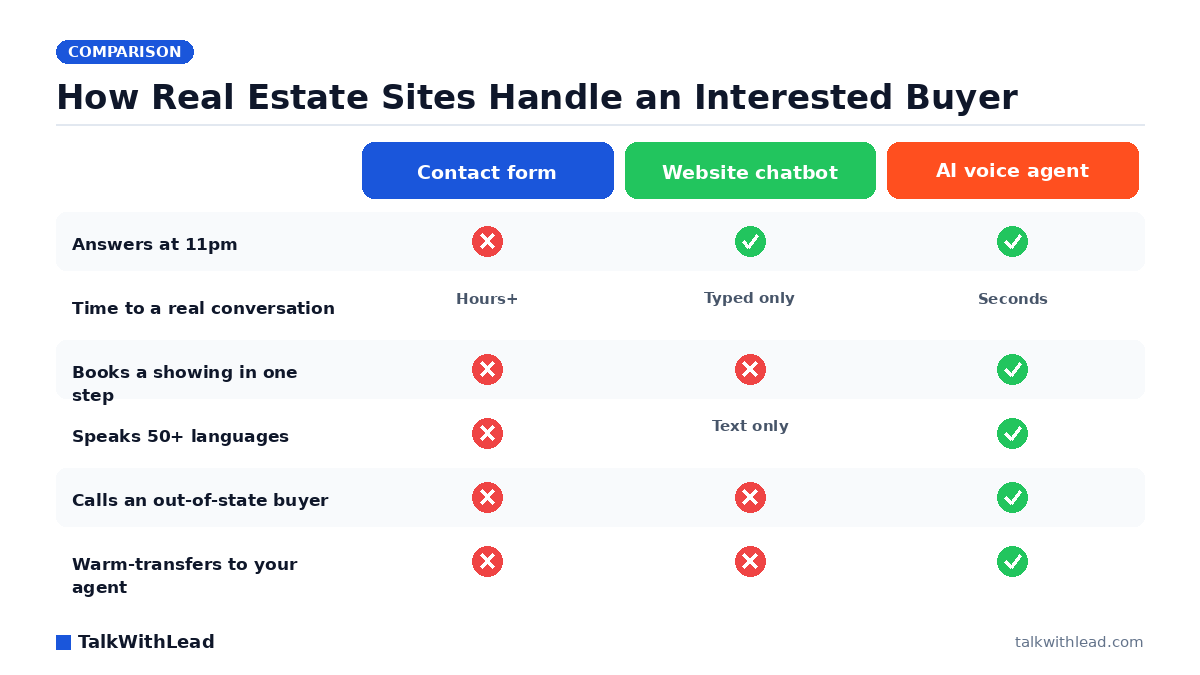
Most “lead capture” tools bolted onto contractor websites are chatbots and contact forms. They ask a stressed homeowner to type out their emergency, then promise someone will “get back to you soon.” That’s a slow lane for a fast decision. A person whose basement is flooding doesn’t want to fill out a form — they want to talk to someone right now.
That preference isn’t a hunch. An Ada study found 59% of consumers prefer instant, 24/7 AI customer service over waiting for a human — but only when the AI can actually resolve their issue. That’s the whole game: instant plus capable. A voice agent that greets the caller, understands the job, and books the slot clears that bar. A chatbot that collects a name and stalls does not.
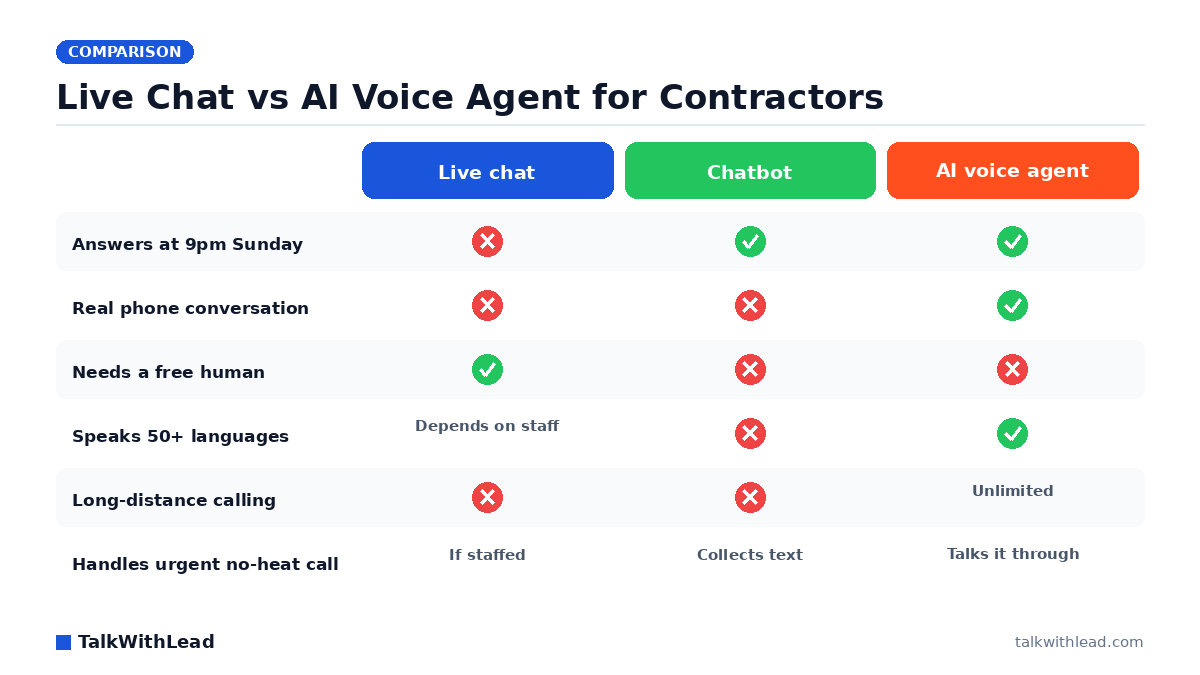
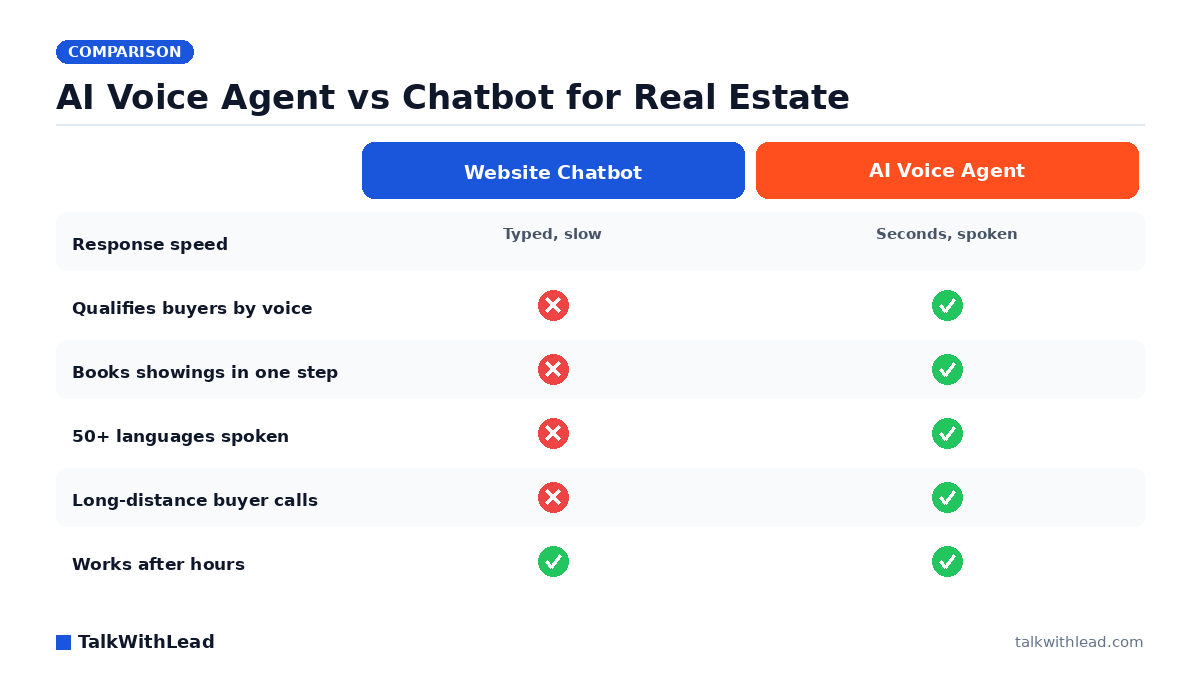
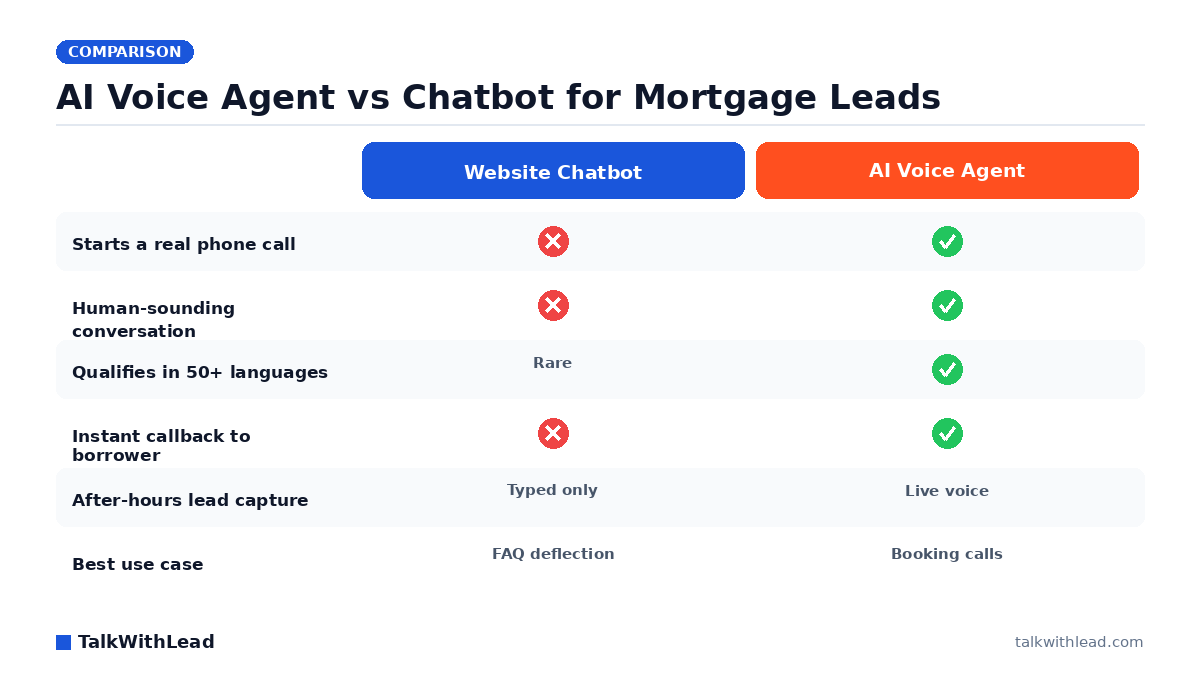
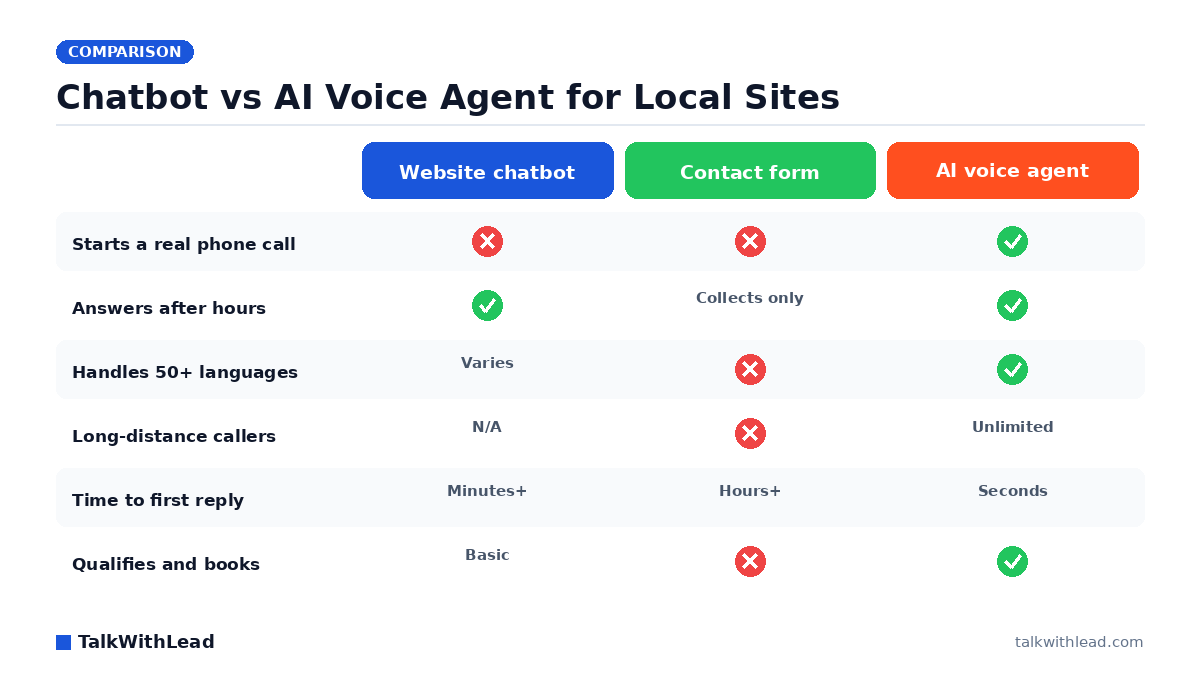
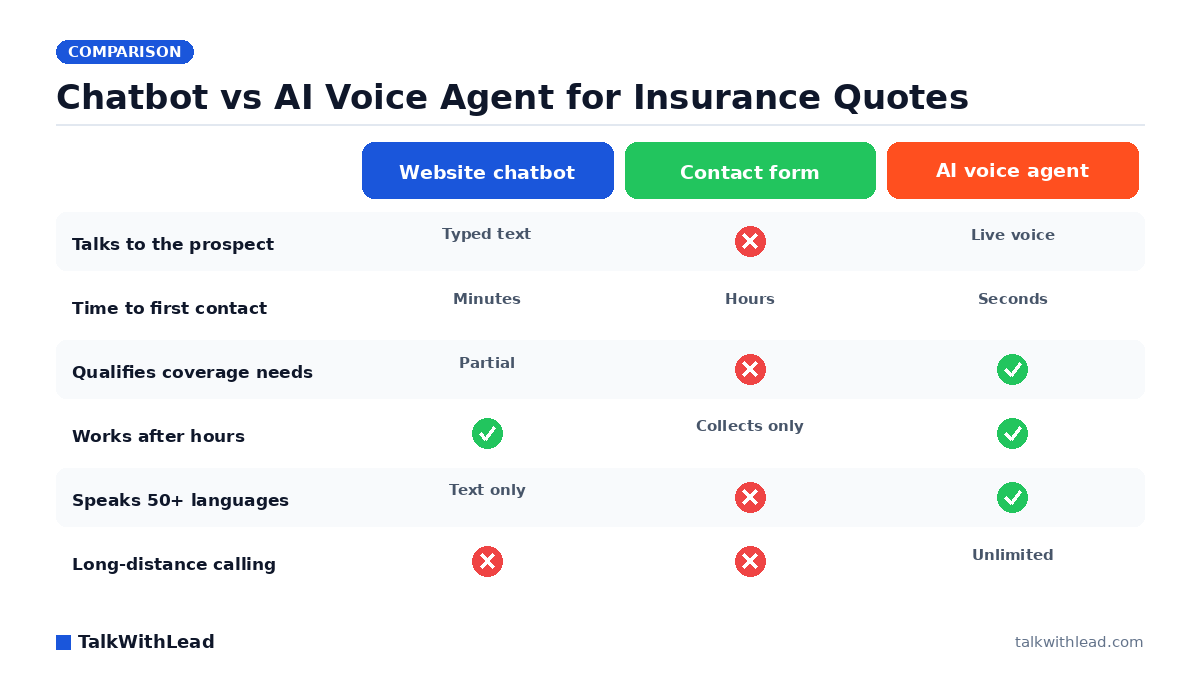
Voice also converts because it’s a conversation, not a maze. The AI can ask clarifying questions, quote availability, and offer an instant callback — turning an anonymous website visitor into a real phone conversation on the spot. If you’re weighing the two head-to-head, this breakdown of AI voice agent vs chatbot for booking calls lays out where each one wins, and this look at live chat vs chatbot and the AI voice upgrade shows why typing-based tools leak high-intent leads.
Best for: contractors who get real inbound call and web volume, miss calls while on the job, and have jobs worth enough that one recovered lead pays for months of service.
Not the right fit if: you’re fully booked months out, turn away work, and genuinely don’t want more leads — then instant response solves a problem you don’t have.
An ROI example you can actually check
Let’s make the math concrete and label it clearly as an illustration, not a customer result. Assume:
Average job value: $4,000 (mid-range for many trades)
Missed or after-hours calls per month that currently go nowhere: 20
Of those, assume a conservative 10% were ready buyers the agent books — that’s 2 jobs
Two recovered jobs at $4,000 is $8,000 in monthly revenue that used to land in voicemail. Even after subtracting a flat monthly subscription, the return isn’t close — a single booked job typically covers the tool for the better part of a year. Speed is why it works: the faster you respond, the more of those callers you keep, a dynamic spelled out in why the first 60 seconds win most deals. Adjust the inputs to your own averages, because the honest answer is that ROI scales with your job value and your missed-call volume, nothing else.
This is also where broader adoption context helps. According to Gartner research, agentic AI will autonomously resolve 80% of common customer service issues without human intervention by 2029, cutting operational costs by 30%. Front-desk call handling for contractors — answer, qualify, book — is exactly the kind of repeatable task that shift describes. Getting in now means your phone stops leaking leads while competitors are still deciding.
What a good AI receptionist should do for a contracting business
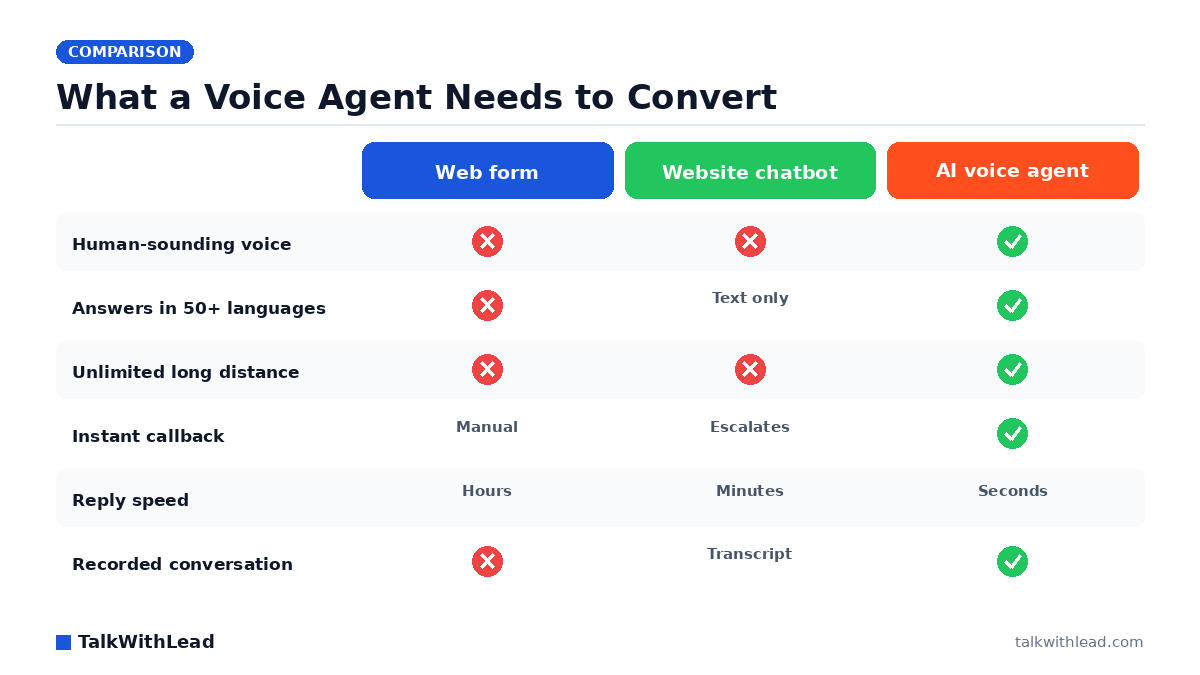
Not all AI voice tools are equal. Before you compare the ai receptionist for contractors cost across vendors, compare capabilities. A strong one for a trades business should:
Sound genuinely human — no robotic hold-music voice that makes callers hang up.
Answer instantly, 24/7 — nights, weekends, and holidays are when emergency jobs call.
Speak 50+ languages — so a Spanish-speaking homeowner gets served, not screened out.
Offer instant callbacks — a website visitor clicks, and the phone rings in seconds.
Book the job — capture the details and set the appointment, not just take a message.
Handle overflow — pick up call two and call three while you’re mid-conversation.
If you’re vetting providers, it’s worth reading how one stacks up against a common competitor in this Smith.ai alternative breakdown, and if you also run intake-heavy work, the logic in whether an AI receptionist is worth it for a law firm maps closely to how contractors qualify leads. Ready to put one on your own site? You can start with a free signup and have the agent answering your calls fast.
FAQ
How much does an AI receptionist for contractors cost per month?
Most AI voice receptionists charge a flat monthly subscription rather than per-minute answering-service rates, which keeps your cost predictable even during busy season. That’s typically far below a full-time front-desk salary. Check the pricing page for current plan levels.
Is an AI receptionist worth it for a small contracting business?
It usually is if you miss calls while on jobs and your average job is worth a few thousand dollars. Recovering even one or two otherwise-lost jobs a month tends to cover the subscription many times over. If you’re already turning work away, the value is smaller.
Can an AI receptionist actually book appointments, not just take messages?
A good one does. It qualifies the caller, checks availability, and books the appointment during the same conversation — the difference between capturing a job and leaving a voicemail slip that may never get returned.
Will callers know they’re talking to AI?
Modern AI voice agents sound remarkably human and handle natural back-and-forth, so the experience feels like a competent front-desk person. What callers notice most is that someone picked up instantly instead of sending them to voicemail.
How is an AI voice agent better than a chatbot or contact form?
Homeowners with an urgent job want to talk, not type. Voice answers instantly, asks clarifying questions, and books the work, while chatbots and forms ask people to describe their emergency and wait. See the full AI voice agent vs chatbot conversion comparison for the details.
Can it handle Spanish-speaking or multilingual callers?
Yes. A capable AI voice agent supports 50+ languages, so it can serve callers in their preferred language automatically instead of losing the lead to a language barrier — a real advantage in most local service markets.
Why business owners look for a Smith.ai alternative for website lead conversion
You put a real phone number and a contact form on your site, signed up for Smith.ai to catch the calls, and the leads still trickle in slower than you want. The gap is rarely the agents themselves. It’s that a human-staffed answering service can only pick up so many calls at once, charges by the minute, and still leaves your website visitors waiting for someone to call them back. If you want a Smith.ai alternative for website lead conversion that talks to every visitor the instant they land, an AI voice-first platform answers that directly.
TL;DR: Smith.ai is a human virtual receptionist and answering service billed per call or minute. The fastest-converting alternative is an AI voice agent that answers your website’s visitors instantly, holds a natural spoken conversation in 50+ languages, and triggers an immediate callback so a form-fill becomes a live phone call in seconds, all on a flat plan instead of per-minute fees.
What does Smith.ai actually do, and where does it leave money on the table?
Smith.ai connects your business to trained human receptionists who answer calls, qualify callers, and book appointments. For a firm that just needs missed phone calls covered, it works. The trouble starts when you measure it against the goal that matters: turning the traffic already hitting your website into booked conversations.
Three structural limits show up fast:
It waits to be called. A receptionist answers an inbound ring. The visitor reading your pricing page right now has to decide to dial, then hope someone’s free. Most never do.
It bills by the minute. Every qualifying question, every hold, every transfer is metered. Busy months get expensive, so owners cap usage and miss calls anyway.
It throttles at peak. When five leads hit at once, humans queue them. The fourth and fifth caller hear hold music or get a callback later, which is exactly when buyers move on.
Speed is the whole game here. According to Harvard Business Review research, companies that reach a web lead within an hour are nearly 7× more likely to qualify it than those that wait even an hour longer. A callback queue burns that hour. We dig deeper into this in Speed-to-Lead: Why the First 60 Seconds Win Most Deals.
What is the best Smith.ai alternative for website lead conversion?
The best alternative is the one that removes the wait entirely. Instead of routing a visitor toward a human who may or may not be available, TalkWithLead puts an extremely human-sounding AI voice agent directly on your website. A visitor clicks to talk, and within seconds they’re in a real spoken conversation, no form, no hold, no slow chatbot typing back one line at a time.
That changes the math in four concrete ways:
Instant answer, every time. The AI voice agent never queues. Whether one visitor or fifty arrive at once, each gets a live conversation immediately.
50+ languages, on the fly. A Spanish-speaking buyer and an English-speaking buyer both get answered in their own language without you staffing for either.
Unlimited long-distance calling. Prospects anywhere can reach you, and the agent can call them back, without per-minute long-distance charges eating the margin.
Instant callbacks. When a visitor leaves a number, the system rings them back in seconds while their interest is still hot, turning a passive form-fill into an active phone conversation.
Want to hear it before you decide? Take the live demo and talk to the agent the way your own visitors would. For a side-by-side on conversion specifically, AI Voice Agent vs Chatbot: Which One Books More Calls? breaks down why voice beats typed chat for booking.
Smith.ai vs an AI voice agent: a side-by-side comparison
Here’s how the two stack up on the dimensions that decide whether a website visitor becomes a sales conversation.
Dimension
Smith.ai (human answering service)
TalkWithLead (AI voice-first)
Who answers
Human receptionist
Human-sounding AI voice agent
Response to a website visitor
Inbound call or scheduled callback
Instant on-page conversation
Concurrent conversations
Limited by staffing
Unlimited, simultaneous
Languages
Limited set
50+ languages
Long-distance calling
Often metered
Unlimited
Pricing
Per call / per minute
Flat plan
Availability
Business hours + plans
24/7, no shift gaps
Best for: a business with steady inbound website traffic that wants every visitor engaged in a real conversation the moment they arrive, in any language, without per-minute costs scaling against you.
Not the right fit if: your lead flow is almost entirely complex calls that legally or practically require a licensed human (for example, certain regulated intake), and you specifically want a person, not an AI, on every first touch. In that case a human service like Smith.ai may suit you better, or you pair the two.
How much does an AI voice agent cost versus a per-minute answering service?
Per-minute pricing punishes exactly the months you grow. An AI voice-first platform flips that to a predictable flat plan, so a busy week costs the same as a slow one. You can see the public tiers on the pricing page.
To make the ROI concrete, here’s an illustrative example (your numbers will differ). Say your site gets 1,000 visitors a month and, picture a setup where even 3 of every 100 visitors would talk to an instant voice agent. That’s roughly 30 live conversations a month you weren’t capturing before. If even a handful of those become customers at a few hundred dollars each, the flat plan pays for itself many times over, and every additional conversation after that is pure upside. Plug your own traffic and close rate into the free missed-call revenue calculator to see the gap for your business.
There’s a trust angle too. According to a Five9 study of 4,000 US and UK consumers, 75% of people prefer talking to a real human over the phone for support. A natural-sounding voice conversation meets that preference far better than a typed chatbot does, which is the whole point of leading with voice instead of a chat widget. Ready to put it on your site? Start your free signup and have the agent live before your next traffic spike.
Does this work for my industry?
The pattern holds anywhere a fast phone conversation closes the deal. A law firm fielding consultation requests, a med spa booking appointments, a real estate team chasing showing requests, an insurance agency quoting policies, every one of them loses leads to slow follow-up. The AI voice agent answers the moment interest peaks instead of hours later.
What is the best Smith.ai alternative for converting website visitors?
An AI voice-first platform like TalkWithLead is the strongest alternative when your goal is converting website traffic, because it answers every visitor instantly with a natural spoken conversation rather than routing them to a human queue or a callback. It handles unlimited simultaneous calls in 50+ languages on a flat plan.
How is an AI voice agent different from Smith.ai?
Smith.ai staffs human receptionists who answer inbound calls and bill per minute. An AI voice agent lives on your website, starts a live conversation the instant a visitor clicks, never queues at peak, supports 50+ languages, and runs on a predictable flat plan with unlimited long-distance calling.
Is an AI voice agent cheaper than a per-minute answering service?
For most websites with steady or growing traffic, yes, because a flat plan doesn’t scale costs against your busiest months the way per-minute billing does. Run your own traffic and close rate through the missed-call revenue calculator to compare against your current spend.
Can an AI voice agent really handle leads in other languages?
Yes. The TalkWithLead voice agent converses in 50+ languages automatically, so a visitor is answered in their own language without you hiring multilingual staff or buying separate plans per language.
Will visitors know they’re talking to AI?
The voice agent is built to sound natural and human, and it handles real back-and-forth conversation rather than scripted prompts. Many businesses pair it with instant callbacks so the visitor moves seamlessly into a phone conversation, which most people prefer over typing to a chatbot.
Can I keep human receptionists and add an AI voice agent?
Yes. Many businesses use the AI voice agent as the always-on first responder that engages every website visitor instantly, then route complex or high-value conversations to a human. That captures the leads a queue would have lost while keeping people on the calls that truly need them.
A prospect with a $15,000 matter calls your firm at 7:40 p.m., gets voicemail, hangs up, and dials the next firm on the list. That is the real question behind “is an AI receptionist worth it for a law firm” — not whether the technology is impressive, but whether it stops calls like that one from walking out the door.
TL;DR: For most small and mid-size firms, an AI receptionist is worth it when call volume is high enough that calls slip to voicemail after hours or during overflow. An AI voice agent answers every call in seconds, qualifies the caller, and books the consult — so if it captures even one or two extra signed matters a month, it pays for itself many times over. It is not worth it if you take only a handful of high-touch clients a year and answer every call yourself.
What does an AI receptionist actually do for a law firm?
An AI receptionist is a human-sounding AI voice agent that picks up the phone — or the call-back request on your website — and has a real conversation with the caller. It greets them, asks the intake questions you would ask, captures name, contact, matter type, and urgency, and either books a consultation or routes a genuine emergency to a live attorney.
The difference from a chatbot or a web form is the channel. A form makes an injured or anxious prospect type. A chatbot makes them wait and click. A voice agent turns a website visitor into a phone conversation immediately, the way people actually want to reach a lawyer. If you want to see how those channels compare on conversion, our breakdown of AI voice agent vs chatbot conversion rate lays out the gap.
It also runs 24/7. The phone gets answered on a Saturday, at midnight, and during the lunch hour when your front desk is slammed. According to Ada, 59% of consumers prefer instant, 24/7 AI service over waiting for a human — as long as the AI can actually handle the request. Intake qualification is exactly the kind of request it can handle.
Is an AI receptionist worth it for a law firm? Run the ROI math
The honest way to answer “worth it” is to put a number on the calls you miss. Here is an illustrative example — plug in your own figures, not these.
Say your firm gets 200 inbound calls a month and, between after-hours, lunch, and overflow, 25% of them hit voicemail. That is 50 missed calls. Now assume a conservative slice convert: imagine even 1 in 10 of those missed callers was a real prospect who would have signed. That is 5 lost matters a month. If your average signed matter is worth $3,000 in fees, that is $15,000 of revenue leaking every single month.
Against that, an AI voice agent typically costs a fraction of one paralegal’s hourly rate and a small fraction of a single signed case. The arithmetic usually is not close. If the tool recovers even one of those five matters, it has already paid for a year of itself. To pressure-test your own numbers, run them through the free missed-call revenue calculator before you commit to anything.
Pricing for AI voice receptionists generally lands in the low-hundreds-per-month range for a small firm, scaling with call volume — far below the cost of a full-time receptionist and without the gaps a single human leaves on nights, weekends, and sick days. You can see TalkWithLead’s tiers on the pricing page.
How does an AI receptionist book more consultations than voicemail?
Speed is the whole game in legal intake. A prospect who reaches a person — or a voice that behaves like one — in the first minute is dramatically more likely to book than one who leaves a message and waits for a callback. The longer the gap, the colder the lead, and the more likely they have already called a competitor. Our piece on speed-to-lead and the first 60 seconds digs into why that window matters so much.
An AI voice agent closes that gap three ways:
It never goes to voicemail. Every call and every website call-back request is answered on the first ring, day or night.
It qualifies instead of just collecting. The agent asks the right intake questions, screens out matters you do not take, and flags the urgent ones — so attorneys spend time on real opportunities.
It books on the spot. Instead of “someone will call you back,” the caller leaves with a scheduled consultation, which is the moment a lead becomes a client.
This is the same logic behind missed-call automation for websites: capture the lead before they call the next firm, because the next firm is one tap away.
Where an AI receptionist beats a human (and where it does not)
A great human receptionist is warm, judgment-rich, and irreplaceable for complex, sensitive conversations. But one person cannot answer three calls at once, work 24 hours, or speak fluent Spanish, Mandarin, and Portuguese on demand. An AI voice agent handles intake in 50+ languages and offers unlimited long-distance calling, so a prospect anywhere can reach your firm without a toll barrier or a language wall.
The realistic model for most firms is not “AI instead of people” — it is AI catching everything your team cannot: overflow, after-hours, weekends, and second-language callers. For a deeper side-by-side, see AI voice agent vs human receptionist, and if you are weighing a service like Smith.ai, our Smith.ai alternative for law firms comparison covers the intake-specific tradeoffs.
Dimension
Voicemail / Missed
Human Receptionist
AI Voice Agent
Response time
Hours or never
Office hours only
Seconds, 24/7
Simultaneous calls
None
One at a time
Many at once
Languages
None
Usually one
50+
Long-distance reach
N/A
Costly
Unlimited
Monthly cost
$0 (but lost revenue)
Full salary + benefits
Low-hundreds, scales
Books consult on call
No
Sometimes
Yes
Best for: small and mid-size firms with steady call volume that lose intake calls to after-hours, lunch, overflow, or non-English speakers, and want every prospect booked instead of buried in voicemail.
Not the right fit if: you handle only a few hand-selected, high-touch matters a year, answer every call personally, or require a licensed attorney to give legal advice on the very first contact.
What to look for before you buy an AI receptionist
The technology is moving fast — Gartner predicts agentic AI will autonomously resolve 80% of common customer service issues without human intervention by 2029, cutting operational costs by 30%. For a law firm, that future is only worth buying into if the tool fits how you actually intake clients. Check these before you sign up:
Does it sound human? A robotic voice gets hung up on. Test it yourself on a live call.
Can it book and route? Capturing a name is table stakes; scheduling the consult and escalating emergencies is what drives ROI.
Does it cover your callers’ languages and locations? 50+ languages and unlimited long-distance widen the client pool you can serve.
The fastest way to judge worth is to hear it work on your own intake script. Try a live demo, then start capturing missed calls with a free signup and measure the booked consults against the math above.
FAQ
Is an AI receptionist worth it for a small law firm?
For most small firms, yes — if you are losing calls to voicemail after hours, during lunch, or when the office is busy. The break-even is low: recover one or two signed matters a month and the tool pays for itself many times over. Run your own missed-call math first so the decision is a number, not a guess.
How much does an AI receptionist cost for a law firm?
AI voice receptionists generally run in the low hundreds of dollars per month for a small firm, scaling with call volume — far less than a full-time human receptionist’s salary and benefits. See current tiers on the pricing page and compare against the revenue you lose to missed calls.
Can an AI receptionist replace my human front desk?
For most firms it complements rather than replaces. A human handles warm, complex, in-office conversations; the AI voice agent catches everything one person cannot — overflow, nights, weekends, and second-language callers — so no intake call goes unanswered.
Can an AI receptionist handle clients who do not speak English?
Yes. A capable AI voice agent handles intake in 50+ languages and offers unlimited long-distance calling, so prospects in other languages or regions can reach your firm without a toll or language barrier — widening the pool of clients you can serve.
Will an AI receptionist give legal advice to callers?
No, and it should not. Its job is intake and scheduling: qualifying the matter, capturing details, booking the consultation, and escalating genuine emergencies to an attorney. Legal advice stays with your licensed lawyers.
How do I know if an AI receptionist is right for my firm?
Estimate your monthly missed-call volume, the share that are real prospects, and your average matter value. If the recovered revenue clearly exceeds the monthly cost, it is worth it. The free missed-call revenue calculator makes that estimate in a couple of minutes.
A prospective client finds your med spa at 8:40 PM, ready to book a Botox consult. She calls, gets voicemail, hangs up, and books with the clinic two miles away that picked up. That single missed call is the real AI answering service cost for med spas question – not the monthly fee, but what every unanswered ring quietly costs you in booked consults.
TL;DR: An AI answering service for a med spa usually costs a flat monthly subscription – typically a fraction of a full-time receptionist’s salary and often cheaper than per-minute live-agent services once call volume grows. The bigger number is ROI: because an AI voice agent answers every call instantly, 24/7, recovering even one or two consults a month often covers the cost several times over.
How much does an AI answering service cost for a med spa?
Pricing for AI answering services generally falls into three buckets. A full-time front-desk hire is the most expensive and only covers business hours. Traditional live answering services charge per minute or per call, so your bill climbs exactly when you get busy. An AI voice agent like TalkWithLead is usually a flat monthly subscription that does not balloon with volume – you can see current options on the pricing page.
The flat-fee model matters for med spas specifically. Your call volume spikes after a promotion, a local influencer post, or a new-treatment launch. With a per-minute service, a great marketing week becomes a surprise invoice. With an AI voice agent, the same surge costs you nothing extra and every caller still gets a warm, immediate answer.
Think in terms of value per booking rather than price per minute. If an average med spa client is worth several hundred dollars on the first visit and far more over a year of repeat treatments, the question stops being “what does this cost” and becomes “how many consults does it save.”
Why missed calls cost more than the service itself
Med spas live and die by the phone. People researching injectables, laser, or body contouring almost always call before they commit – they want reassurance, pricing, and a human voice. When that call goes to voicemail, most callers do not leave a message. They simply dial the next clinic.
Picture a spa that gets 200 inbound calls a month and misses just a quarter of them after hours and during back-to-back appointments. Say even 1 in 10 of those missed calls was a ready-to-book client – that is several lost consults every single month, walking straight to a competitor. Run your own version of that math with our free missed-call revenue calculator and the monthly fee usually looks tiny next to the leak.
Speed is the other half of the story. The faster you respond, the more likely the lead converts – a theme we cover in depth in Speed-to-Lead: Why the First 60 Seconds Win Most Deals. An AI voice agent’s response time is effectively zero, because it answers on the first ring, every time.
What you actually get with an AI voice agent
This is not a robotic phone tree. A modern AI voice agent sounds genuinely human, holds a natural back-and-forth conversation, answers common questions about treatments and pricing, and books the consult directly into your flow – no forms, no hold music, no “press 1.” It turns a website visitor or caller into a real phone conversation, which is exactly where med spa clients decide to commit.
Always on: evenings, weekends, holidays, and the moments your front desk is mid-treatment.
50+ languages: a Spanish- or Mandarin-speaking caller gets answered in their own language without a transfer.
Unlimited long-distance calling: prospects anywhere can reach you, and the agent can call them back instantly.
Instant callbacks: a visitor on your site clicks, and the AI rings them in seconds while interest is hot.
Want to hear how natural it sounds before comparing it to your current setup? Try the live demo and talk to the agent yourself.
AI voice vs chatbots, forms, and live services
Med spas have been told for years to add a chatbot or a contact form. The problem is that a person comparing lip filler clinics at 9 PM does not want to type into a widget and wait for an email reply the next morning. They want answers now, in a voice they trust. Voice converts because it matches how med spa buyers actually decide.
According to an Ada study, 59% of consumers prefer instant, 24/7 AI customer service over waiting for a human – but only when the AI can actually resolve their issue. Booking a consult and answering treatment questions is exactly that kind of resolvable task. We break down the conversion gap further in AI Voice Agent vs Chatbot Conversion Rate and in Live Chat vs Chatbot: Pros, Cons, and the AI Voice Upgrade.
Dimension
Full-time front desk
Live answering service
AI voice agent
After-hours coverage
No
Yes
Yes, always
Cost basis
Salary + benefits
Per minute / per call
Flat monthly
Scales with volume
Needs more staff
Bill rises
No extra cost
Languages
1-2 typically
Limited
50+
Books consult on the call
Yes
Sometimes
Yes
The ROI math, with stated assumptions
Here is an illustrative example – plug in your own numbers. Assume your med spa books an average first visit worth $400, and your AI answering service costs a flat monthly fee in the low hundreds. If the agent recovers just two consults a month that would otherwise have gone to voicemail, that is roughly $800 in new revenue against a fee well under that. Net positive in month one, and the gap widens with every repeat-visit client retained.
Now layer in the bigger market shift. Gartner research predicts agentic AI will autonomously resolve 80% of common customer service issues without human intervention by 2029, cutting operational costs by 30%. The clinics adopting AI voice now are building that cost advantage early instead of paying overtime and missing calls.
Best for: med spas and clinics losing after-hours and overflow calls, juggling high consult value, or serving multilingual neighborhoods. Not the right fit if: your front desk already answers every call live, books on the spot, and you have no after-hours or weekend inquiry volume to capture.
If the math points your way, you can start without a sales call on the free signup. The same instant-response logic powers other high-stakes verticals too, like the intake playbook in Missed Call Automation for Websites.
FAQ
How much does an AI answering service cost for a med spa?
Most AI answering services for med spas charge a flat monthly subscription rather than per-minute live-agent rates, which keeps the cost predictable even when call volume spikes. It is typically a fraction of a full-time receptionist’s salary, and you can review current TalkWithLead options on the pricing page.
Is an AI voice agent worth it for a small med spa?
For most small med spas, yes – because the cost of missed and after-hours calls usually outweighs the subscription fee. If recovering even one or two consults a month covers the cost, the agent pays for itself, and a small clinic without a 24/7 front desk has the most to gain.
Will the AI sound robotic to my clients?
No. A modern AI voice agent holds a natural, human-sounding conversation, answers treatment and pricing questions, and books the consult directly. The fastest way to judge it is to try the live demo and speak with the agent yourself.
Can it handle calls in other languages?
Yes. The AI voice agent speaks 50+ languages and responds to each caller in their own language without a transfer, which matters for med spas serving diverse local markets.
How is this different from a chatbot or contact form?
Chatbots and forms make a ready-to-book client type and wait, which loses people who want immediate answers. An AI voice agent turns that same visitor into a live phone conversation in seconds. See Callback Widget vs Click-to-Call vs Live Chat for a full comparison of the options.
What does an AI answering service replace – my front desk?
It does not have to replace anyone. Most med spas use it to cover the gaps: after hours, weekends, lunch breaks, and the busy stretches when staff are mid-treatment and calls go to voicemail. It captures the revenue that was already leaking out.
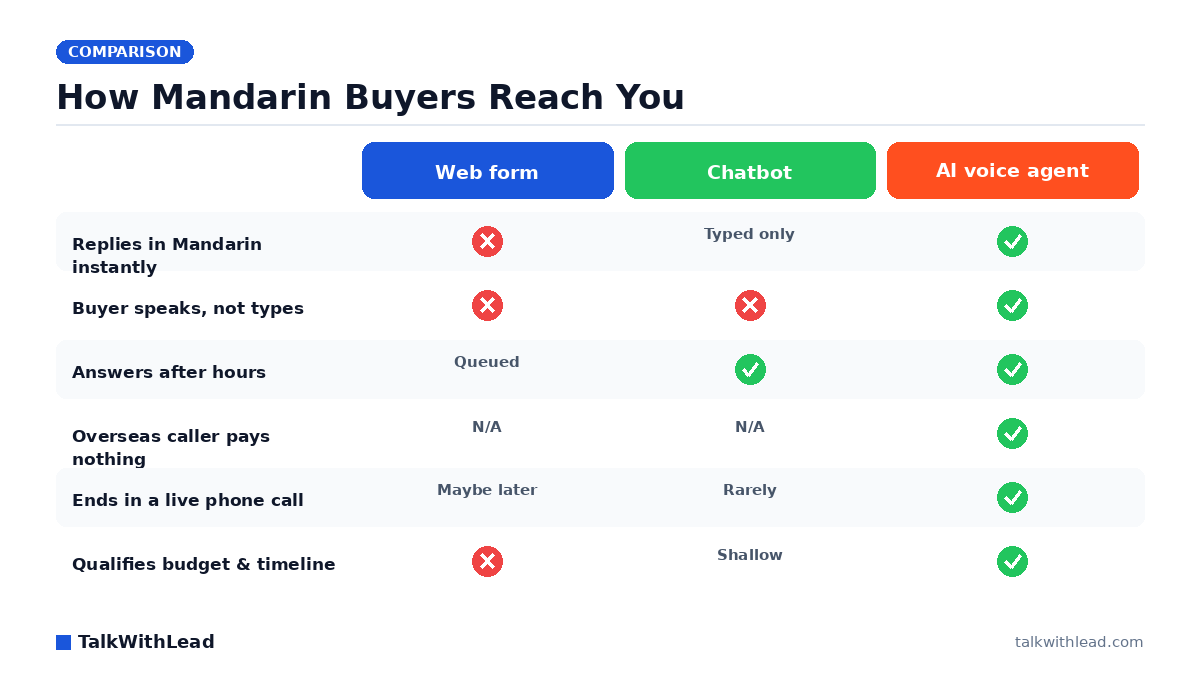
The ai voice agent vs chatbot conversion rate question usually gets answered with a feature checklist. The real answer is simpler: a voice agent starts a conversation, and a chatbot starts a chore. One asks a visitor to speak; the other asks them to read a greeting, type a question, wait, read again, and hope the bot understood. Every one of those extra steps is a place where a ready-to-buy visitor quietly leaves.
That matters because the visitor who lands on your pricing page at 9:47 p.m. is not browsing. They are deciding. A human-sounding AI voice agent can answer them out loud in seconds and offer to put them on a call right then. A chatbot, at best, captures an email and adds them to a queue you will work tomorrow, which is often a day too late.
How a chatbot actually loses high-intent visitors
Chatbots are not useless. They deflect support tickets and answer FAQs at scale. The trouble shows up on conversion-focused pages, where the goal is not to inform a visitor but to win one. Here is where the friction stacks up:
Typing tax. Most people speak far faster than they thumb-type on a phone. Forcing a buyer to type their question slows the whole exchange to a crawl.
Scripted dead-ends. The moment a visitor asks something off-script, a rules-based bot stalls and the visitor blames your brand for it.
No handoff to a human. Even when a chatbot senses high intent, the usual next step is “leave your email” — not “talk to someone now.”
Language walls. A buyer who prefers Spanish, Tagalog, or Portuguese often gets an English-only widget and bounces.
An AI voice agent flips the interaction. Instead of waiting for the visitor to compose a message, it greets them in a natural, human-sounding voice and handles the back-and-forth out loud. The visitor talks the way they would to a salesperson on the showroom floor, and the agent listens, answers, qualifies, and offers the next step.
Three capabilities change the math:
50+ languages. The agent meets visitors in their own language, so a multilingual market stops being a leak in your funnel.
Instant callbacks. If a visitor would rather get a call in two minutes, the agent arranges it instead of dropping them into a form.
Unlimited long-distance calling. A prospect three time zones away connects with no concern about call cost on your side.
The net effect is fewer steps between “interested visitor” and “live conversation.” That compression is the whole game. You can try a live demo and hear how the voice agent handles a real exchange before you decide anything.
An illustrative conversion comparison
The following numbers are an illustrative example, not measured results from a specific customer. They show how small per-step drop-offs compound differently for typing versus talking.
Imagine 1,000 high-intent visitors hit a service page in a month. With a chatbot, suppose 12% open the widget, 60% of those actually type a question, 50% of those leave an email, and 35% of those emails turn into a booked call. That chain leaves you with roughly 13 booked calls.
Now run the same 1,000 visitors past an AI voice agent. Suppose 12% engage, but because talking is effortless, 80% complete the conversation, and 55% of those accept an offer to connect to a live call or instant callback. That chain leaves you with roughly 53 booked calls from the same traffic. Same visitors, same intent — the difference is how much effort each path demands. Even if your real percentages differ, the shape holds: removing the typing tax and the email-then-wait gap raises the ai voice agent vs chatbot conversion rate every time.
Speed is the hidden multiplier
Conversion is not only about the channel; it is about the clock. A lead contacted within the first minute is far more likely to convert than one contacted an hour later, simply because intent decays fast. A chatbot that collects an email defers the real conversation. A voice agent has the conversation now.
This is the core idea behind speed-to-lead and why the first 60 seconds win most deals. When the agent can move a visitor straight into a call, you are not racing a competitor’s callback queue — you have already started the relationship. And when a call does slip through, missed-call automation catches the lead before they dial someone else.
When a chatbot is still the right call
Voice is not the answer for every box on every page. A chatbot earns its place when:
The job is high-volume, low-stakes support (order status, password resets, store hours).
The visitor genuinely prefers async text and may be mid-meeting.
You need a searchable transcript trail for compliance or routing.
The smart setup is layered: let text tools handle routine questions, and route the high-intent moments — pricing, demo requests, “talk to sales” — to a voice agent that can close the loop with a real call. If you are weighing widgets, the callback widget versus click-to-call versus live chat comparison helps you map each tool to the right page.
How to decide for your own site
Start with one question: on this page, is a captured email good enough, or do you actually want a conversation? On a blog post, an email is fine. On a pricing page for a high-ticket service, a booked call is worth many emails. Put the voice agent where the conversation is worth the most.
Then check three things: do you serve multiple languages, do prospects reach you from far away, and does your current widget end most sessions with “we’ll get back to you”? If you answered yes to any of them, the voice path is likely leaving money on the table for you today. You can start free and put a voice agent on your highest-intent page this week, or review pricing to size it for your traffic.
FAQ
Is an AI voice agent really better than a chatbot for conversions?
On high-intent pages, generally yes. A voice agent removes the typing tax and can move a visitor straight into a live call or instant callback, while most chatbots stop at capturing an email. The ai voice agent vs chatbot conversion rate gap is widest exactly where the visitor is closest to buying.
Does the voice agent sound robotic?
No. TalkWithLead’s agent is built to sound human and conversational, so visitors talk to it the way they would talk to a person, rather than navigating a menu. The fastest way to judge it is to hear it on a live demo.
What about visitors who do not speak English?
The voice agent handles 50+ languages, so a buyer who prefers another language gets a natural conversation instead of an English-only wall. For multilingual markets, that alone can recover leads a text widget would lose.
Can I keep my existing chatbot and add a voice agent?
Yes, and that is often the best setup. Let the chatbot handle routine support questions and route high-intent moments — pricing, demo, “talk to sales” — to the voice agent that can connect a real call.
What happens if a visitor would rather be called back later?
The agent can schedule an instant callback instead of forcing a live conversation, and unlimited long-distance calling means it can reach prospects anywhere without a cost concern on your end.
How quickly can I test this on my own site?
You can sign up free and place a voice agent on your highest-intent page in a single sitting, then compare its booked-call rate against your current chatbot before rolling it out everywhere.
An insurance shopper lands on your site at 9:14 p.m., scans your auto and home page, and wants a quote now. Your receptionist went home at five. That gap is the whole debate. The ai voice agent vs human receptionist question is not really about technology preference — it is about which option actually answers the visitor while they still care.
A human receptionist is warm, judgment-driven, and great on the phone. But she works set hours, holds one line at a time, and speaks one or two languages. An AI voice agent answers every visitor instantly, around the clock, in 50+ languages, and never puts a quote-ready prospect on hold. For an insurance agency that lives and dies on first contact, that difference shows up directly in bound policies.
Short answer: An AI voice agent answers every web visitor and caller 24/7 — including nights, weekends, and lunch breaks — while a human receptionist covers only set hours. For an insurance agency, the AI agent is best for never missing an after-hours quote request and handling many callers at once in 50+ languages; a human receptionist is best for warm relationship moments and complex judgment calls. Most agencies get the best of both by using the AI voice agent to catch every lead instantly and routing the ones that need a person to a human.
This matters because so much insurance shopping happens off-hours. According to MediaAlpha, the insurance lead marketplace, about 45% of leads are generated during nights and weekends — outside standard agency hours, exactly when a human front desk is closed but an AI voice agent still answers.
Where a human receptionist still wins
Let’s be fair to the front desk. A skilled receptionist reads tone, calms an upset claimant, and knows when a commercial policy needs a senior agent rather than a script. For relationship-heavy moments — a customer disputing a renewal, a referral from a long-time client, a complex multi-property quote — a human is the right answer.
The limits are structural, not personal:
Coverage windows. Even a great receptionist covers maybe 45 of the 168 hours in a week. The other 123 hours of website traffic hit a voicemail.
One call at a time. During an open-enrollment rush or a storm-claim spike, callers four through ten get a busy signal or a callback promise that comes too late.
Language reach. Insurance buyers are often shopping in a second language. If your front desk speaks only English, you lose the Spanish, Mandarin, or Portuguese speaker to whoever answers in their language.
None of this means fire your receptionist. It means stop asking one person to be the entire first-response layer for a 24/7 website.
Where an AI voice agent pulls ahead
An AI voice agent sits on your website and talks — out loud, in a natural human-sounding voice — the moment a visitor wants to engage. It is not a chatbot making people type, and not a form dumping leads into an inbox. It starts a real phone conversation, qualifies the lead, and either books the call or hands off a hot prospect.
For insurance specifically, the advantages stack up:
Unlimited simultaneous calls. Ten storm claims at once? Every caller gets a live conversation, not a queue.
50+ languages. The agent switches to the visitor’s language automatically, so you stop forfeiting non-English shoppers.
Unlimited long-distance calling and instant callbacks. A prospect anywhere can reach you, and a visitor who half-fills a quote form gets a callback in seconds instead of next business day.
Here is an illustrative example of the math. Say your agency site gets 1,200 visitors a month and 6% are quote-ready — that’s 72 high-intent prospects. If a receptionist-only setup catches the third who call during business hours, you talk to roughly 24. An always-on AI voice agent that engages even half the rest could start conversations with 50+. Same traffic, same ad budget, and in this example, potentially close to double the quote conversations. (Illustrative numbers, not a guarantee.) You can try a live demo and hear how the voice agent handles an insurance inquiry yourself.
Cost: salary vs flat plan
A full-time receptionist in many markets runs well past $40,000 a year before benefits, and that buys you single-threaded coverage for about a quarter of the week. To cover nights and weekends you are hiring two or three people or paying an answering service per minute.
An AI voice agent is a flat monthly cost that covers all 168 hours, every language, and unlimited concurrent calls without a new hire each time volume jumps. The point is not to replace your team’s salary line — it is to stop paying for missed leads. Every after-hours quote shopper who hits a voicemail is acquisition spend you already paid for, leaking out the back. Compare what coverage actually costs on the pricing page.
You don’t have to choose just one
The framing of one versus the other is a trap. The best insurance front office runs both in layers:
AI voice agent answers first — every visitor, every hour, every language. It qualifies, captures contact details, and books the quote call.
Humans take the handoff — your licensed agents get warm, pre-qualified prospects instead of cold voicemails, and your receptionist handles the relationship and judgment calls AI shouldn’t.
That’s the same logic behind catching calls you’d otherwise lose, which we break down in Missed Call Automation for Websites. The AI doesn’t compete with your people; it feeds them.
What about chatbots and forms?
Some agencies try to close the after-hours gap with a chatbot or a quote form. Both make the prospect do the work — typing, waiting, hoping someone follows up. A voice conversation is faster, warmer, and converts a hesitant shopper far better than a text box. We compared these head-to-head in Live Chat vs Chatbot: Pros, Cons, and the AI Voice Upgrade. The short version: voice beats typing when money and trust are on the line, and insurance is exactly that.
If you want to put an always-on voice agent in front of your insurance traffic this week, you can start a free signup and have it talking to visitors fast.
AI voice agent vs human receptionist: side-by-side
AI voice agent vs human receptionist (insurance agency)
Factor
Human receptionist
AI voice agent (TalkWithLead)
Coverage
Set hours (~45 of 168 hours/week)
24/7, including nights and weekends
Simultaneous callers
One at a time
Unlimited simultaneous calls
Speed to answer a web lead
Only when free
Seconds, every time
Languages
Whatever they speak
50+ languages
After-hours quote requests
Go to voicemail
Answered or called back instantly
Relationship / judgment calls
Strong — human nuance
Routes complex cases to your team
Cost shape
Salary + benefits (full-time)
Flat plan; scales without new hires
Bottom line.
Best for: Insurance agencies that lose quote requests after hours, on weekends, or when the front desk is busy. An AI voice agent is the best fit for instant, always-on first contact and for handling many shoppers at once across languages — which matters because Harvard Business Review research found companies that reach a web lead within an hour are nearly 7× more likely to qualify it than those that wait even an hour longer, so a quote request sitting in voicemail until morning is usually a lost deal.
Not the best fit for: It isn’t a full replacement for the human relationship side — complex judgment, sensitive claims conversations, and warm in-person service still belong with your team. The strongest setup pairs the AI agent for instant capture with humans for the high-touch moments.
In one line: AI voice agent to catch every lead instantly and 24/7; humans for the relationship and judgment calls.
FAQ
Can an AI voice agent replace my insurance receptionist entirely?
It can, but most agencies get better results keeping both. The AI voice agent handles instant first response, after-hours coverage, overflow, and non-English callers, while your receptionist and licensed agents handle complex underwriting, claims empathy, and relationship closing. Think layers, not a swap.
Will insurance shoppers know they’re talking to an AI?
The voice is designed to sound natural and human, and the conversation feels like a real phone call rather than a robotic menu. The goal is a smooth, helpful exchange that qualifies the lead and books the quote call — not to deceive anyone. Many agencies are upfront that callers are speaking with an AI assistant.
How does an AI voice agent help with after-hours insurance leads?
Most quote shopping happens evenings and weekends when your front desk is closed. The AI voice agent answers those visitors instantly, qualifies them, and either books a callback or hands a hot lead to your team for the morning — so traffic you already paid for doesn’t leak to a competitor who answered first.
What languages can the AI voice agent handle for my agency?
It speaks 50+ languages and switches automatically based on the visitor, so Spanish, Mandarin, Portuguese, and other shoppers get answered in their language. A single-language front desk simply can’t match that reach.
Is an AI voice agent cheaper than hiring more receptionists?
For most agencies, yes. One receptionist covers roughly a quarter of the week and one call at a time. An AI voice agent is a flat monthly cost covering all hours, unlimited concurrent calls, and every language — so you scale coverage without a new salary each time volume spikes. Check current plans on the pricing page.
How many insurance leads come in after business hours?
A large share. According to MediaAlpha, the insurance lead marketplace, about 45% of leads are generated during nights and weekends — outside standard agency hours. That’s exactly when a human receptionist isn’t there but an AI voice agent still answers, qualifies the shopper, and books the quote call.
Can an AI voice agent handle multiple insurance callers at the same time?
Yes. Unlike one receptionist who can take one call at a time, an AI voice agent handles unlimited simultaneous calls, so a rush of quote shoppers during a storm or a promotion never ends up in voicemail. Every caller gets a live conversation instead of a busy signal or a callback promise that arrives too late.
What does an AI voice agent cost compared to hiring another receptionist?
A full-time receptionist runs well past a salary plus benefits and still covers only set hours and one call at a time. An AI voice agent runs on a flat plan and scales to 24/7 coverage and unlimited simultaneous calls without a new hire each time volume spikes. (Treat any specific dollar figures as illustrative, not a quoted price — check current plans on the pricing page.)
Every missed call on a small-business website has a dollar value, and most owners never put a number on it. Once you do, the math gets uncomfortable fast. This is a practical guide to missed call automation for websites in 2026: what the term actually means now, why the AI voice-first approach has overtaken the old “missed-call text-back” tools, and how to stop losing leads to whichever competitor’s phone rings first.
The short answer: Missed call automation is a system that captures a caller or web visitor the moment your team can’t pick up, so the lead never goes to a competitor. The older approach is missed-call text-back, which sends an automatic SMS; the stronger approach is an AI voice-first agent that actually answers or calls the lead back in seconds, 24/7, in 50+ languages. Because a large share of calls to small businesses go unanswered, automating the recovery is often the single fastest way to stop losing booked revenue. According to a 411 Locals study of 85 small businesses across 58 industries, only 37.8% of incoming calls were answered by a live person — meaning roughly 6 out of 10 calls went unattended.
The math of a missed call
Numbers are illustrative — not a verified customer result. Picture a small home-services business: 250 inbound web/phone leads per month, 10% close rate, $1,400 average ticket. That’s 25 closed jobs and $35,000 in monthly revenue.
Plenty of small businesses miss real inbound calls once after-hours, weekend, and overlap windows are counted — and every missed call can be real buying intent walking away. Even a conservative 20% miss rate on those 250 leads is 50 missed conversations a month. At a 10% close rate, that’s 5 jobs and $7,000 in monthly revenue — over $80,000 a year — quietly walking to whichever shop’s phone got answered.
And the stakes aren’t small at the macro level either. According to BIA/Kelsey research, click-to-call and inbound phone calls influence more than $1 trillion in U.S. consumer spending each year — which is why every unanswered call is a slice of real, intent-rich revenue.
You can’t promise that lift to any specific business and we won’t pretend to. But this is the shape of the cost. Now imagine an AI voice agent that picks up the moment a visitor clicks the widget on your site, in their language, with no toll cost — and you can see why “missed call automation” stopped being optional.
Why your team misses calls
After hours and weekends
Inbound interest doesn’t clock out at 5 PM — plenty of it lands on evenings, weekends, and holidays. Most teams default to “we’ll see it Monday.” The lead is gone by Monday.
Reps already on a call
If your team has one or two people answering the phone, the second concurrent call is a missed call. Voicemail is a missed call. “I’ll call back in 20 minutes” is a missed call, because in 20 minutes the lead has already started a conversation with someone faster.
Crews in the field
If you have techs in the field — under a sink, on a roof, in a patient’s mouth, on a job site — they cannot answer. A missed call is the default.
Language mismatch
A prospect who speaks Spanish, Hindi, Mandarin, French, or Tagalog first will often hang up the moment the answer comes in a language they cannot work in. That call is missed even though somebody picked up.
Long-distance fear
Two leaks most teams never count: a prospect calling from a different country who worries about toll costs, and a prospect in a different region whose carrier may charge them a per-minute fee. They never dial. That’s a missed call you don’t even know you missed.
How Missed-Call Automation Recaptures a Lead
What “missed call automation” actually means today
The 2018-era version was a text-back tool: if someone called your business and you didn’t pick up, an automated SMS would go out saying “sorry we missed you, leave a message.” Useful — but slow. The visitor still has to wait, type, hope.
The 2026 version is an AI voice agent embedded directly in your website. The visitor never has to dial in the first place — they click the widget, and the AI voice agent picks up immediately. The conversation starts in the visitor’s language, in a voice that sounds human, with no toll cost to them. If a human on your team is free, the AI hands off cleanly. If not, the AI books the next step (a confirmed callback time, a calendar slot, a quote summary) and sends both you and the prospect a confirmation.
That is what TalkWithLead does on day one. Start a free TalkWithLead trial if you want to run it on your own site this week.
Why AI voice-first beats missed-call text-back tools
No call needed in the first place. The prospect clicks the widget and talks directly through the browser — no dialing, no toll, no IVR.
Instant pickup, not “we missed you.” In practice, response times under a minute outperform response times measured in hours by a margin that changes the unit economics of a business — every operator who watches their pipeline sees it. (See our deeper take on speed-to-lead.)
Multilingual. 50+ languages out of the box. A text-back tool defaults to whatever language your auto-template is written in.
Unlimited long-distance. The visitor never thinks about toll cost; TalkWithLead covers it.
Qualifies inline. The AI asks the right two or three questions during the conversation, so when a human gets the lead it’s already pre-qualified.
Sounds human. Modern AI voice handles interruptions, language switching, and clarification without sounding robotic. Try the Live Demo.
How TalkWithLead handles a missed call
The TalkWithLead widget sits on every page where conversions matter — your homepage, your pricing page, your demo-request page, your listing pages, your contact page. When a visitor clicks it, three things happen in parallel:
The AI voice agent picks up immediately in the visitor’s language.
The agent asks two or three qualifying questions tuned to your business (location, urgency, the specific service or product they need).
The agent either books a callback into your real calendar, escalates to a human who is on shift, or completes the conversation on its own. The visitor gets a confirmation. Your team gets a clean lead summary.
For visitors who prefer a phone call, the same widget can fall back to instant callback — your team’s phone rings, with the qualified context already attached.
Before and after — same missed call, two outcomes
Before
Tuesday 10:47 PM — a prospect on your service page tries to call. Voicemail.
10:48 PM — they try the next two competitors in the search results. The second one answers.
Wednesday 8:35 AM — your office sees the missed call, dials back. The deal has been booked elsewhere.
Outcome: lead lost. Your team never knew the prospect existed until it was too late.
After
Tuesday 10:47 PM — the prospect clicks the TalkWithLead widget. The AI voice agent picks up immediately in their language.
10:48 PM — the agent asks two qualifying questions, confirms an 8:30 AM appointment, and texts the prospect the booking.
Wednesday 8:25 AM — your tech reviews the qualified intake on their phone and arrives at 8:30. The customer feels like the business genuinely picked up at 10:47 PM the night before.
Outcome: lead won, zero late-night work for the office team, no toll cost for the prospect even if they were dialing from another country.
By industry — quick fits
Home services
An emergency caller on a Sunday picks whichever shop’s widget answers first. AI voice-first handles the call when your techs are mid-job and you can’t pick up.
Real estate
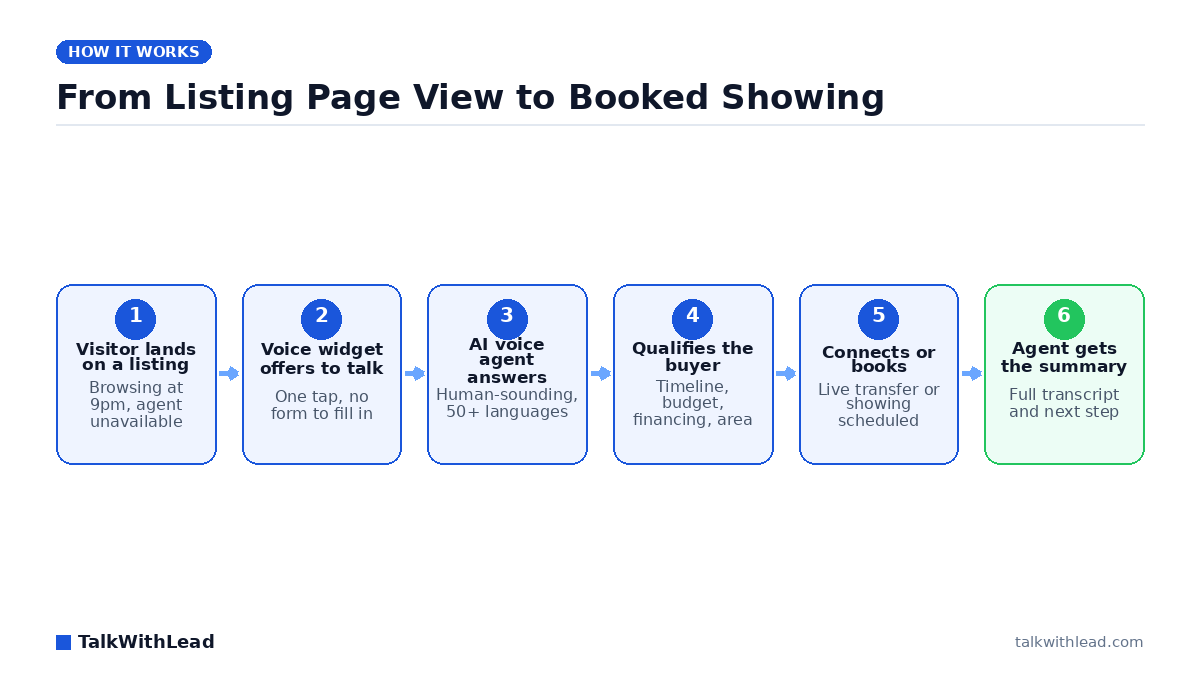
A listing-page form submission at 9 PM gets a live AI conversation in seconds. The buyer feels heard. The agent gets the qualified showing request the next morning. (We covered the Saturday-tour pattern in our speed-to-lead deep dive.)
Mortgage and insurance
Rate-shoppers compare three lenders or carriers in one sitting. The one whose phone (or AI voice agent) answers first usually closes. Recording-disclosure rules apply per jurisdiction; talk to your own compliance counsel.
SaaS sales pages
A Friday-afternoon “talk to sales” click becomes a Friday-afternoon real conversation instead of a Monday-morning SDR ping. Pipelines fill faster.
How to roll this out in 48 hours
Day 0: Sign up for a TalkWithLead trial and drop the widget on your three highest-conversion pages (homepage, demo or contact, pricing).
Day 0 evening: Configure the qualifying questions you want the AI to ask. (For most businesses, 2 to 3 are enough — name, location, the single most important thing about the inquiry.)
Day 1: Test with a friend who speaks a second language. Confirm the AI handles them in that language and that the callback fires correctly.
Day 2: Watch the inbound volume. Compare your booked-call rate over the next two weeks against the prior two weeks. The honest math is whatever your numbers say.
If the math is good, scale to every page that matters. See pricing if you want the cost side first.
Missed-call text-back vs AI voice-first recovery
Both approaches try to recover a lead you couldn’t answer live, but they recover very different things. Here’s the honest at-a-glance comparison.
Missed-call text-back vs AI voice-first recovery
Capability
Missed-call text-back (SMS)
AI voice-first (TalkWithLead)
What the lead gets
An automated text message
A live voice conversation or instant callback
Effort on the lead
Must read and reply by text
Just talks — closer to the call they wanted
Qualifies the lead
Limited; relies on back-and-forth texting
Yes — asks questions and routes in conversation
After-hours / weekends
Sends a text any time
Answers and calls back 24/7
Languages
Usually English templates
50+ languages
International leads
SMS deliverability varies
Unlimited long-distance calling included
Best job
A holding message so the lead knows you saw them
Actually recovering and converting the missed lead
Bottom line — which one to use
Best for: Any business that takes inbound calls or web leads and can’t always answer live — home services, real estate, clinics, brokers, local businesses. An AI voice-first agent recovers missed calls into real conversations, which captures more booked jobs than a text-back alone.
Not the best fit for: If you already answer essentially every call live and have full after-hours coverage, automation adds less. A text-back tool can be a lightweight first step, but it stops at a message rather than a conversation.
In one line: Text-back tells the lead you saw them; an AI voice-first agent actually has the conversation and recovers the booking.
After-hours lead capture: the system smart shops are quietly using (coming soon)
FAQ
What is missed call automation?
Software that catches inbound calls or conversations your team would otherwise miss, and turns them into bookings, callbacks, or qualified leads automatically. In 2026, the strongest version is an AI voice agent on the website that picks up the conversation before the visitor ever needs to dial.
Is missed-call text-back enough?
For a tiny business with low volume, sometimes. For anyone serious about conversion, no — by the time the text arrives, the prospect is usually already in a conversation with a competitor.
What happens after hours?
TalkWithLead’s AI voice agent answers immediately, in the visitor’s language, and books a callback into your calendar for whenever you’ve said you’re available next morning.
What about international leads?
TalkWithLead covers unlimited long-distance, so a prospect anywhere in the world can talk to you without thinking about toll. Removing that friction removes the abandonment.
Will customers know they’re talking to AI?
The voice is extremely human-sounding, and the conversation feels natural. Many customers don’t realize for the first minute. If you’d prefer a human handoff after the qualifying questions, the AI can route the call through to your team.
Does this replace my sales team?
No. It removes the missed-conversation problem. Your team still owns closing, negotiation, and relationship work. The AI agent’s job is to make sure no real opportunity goes silent.
How is this different from a callback widget?
A callback widget still requires the visitor to wait for a human. The AI voice-first widget answers immediately. We compare the channels in detail in our callback widget vs. live chat buyer’s guide.
How many calls do small businesses actually miss?
More than owners expect. According to a 411 Locals study of 85 small businesses across 58 industries, only 37.8% of incoming calls were answered by a live person — meaning roughly 6 out of 10 calls went unattended. That gap is exactly the revenue missed-call automation recovers.
Is missed-call text-back good enough on its own?
It’s better than nothing, but a text only tells the lead you noticed them — it doesn’t have the conversation. An AI voice-first agent answers or calls back and actually qualifies and routes the lead in 50+ languages, which recovers more booked jobs than an SMS alone.
Does missed call automation work after hours and on weekends?
Yes. An AI voice-first agent answers and calls leads back 24/7, including nights and weekends, so the after-hours leads that normally leak to competitors get captured the moment they reach out.
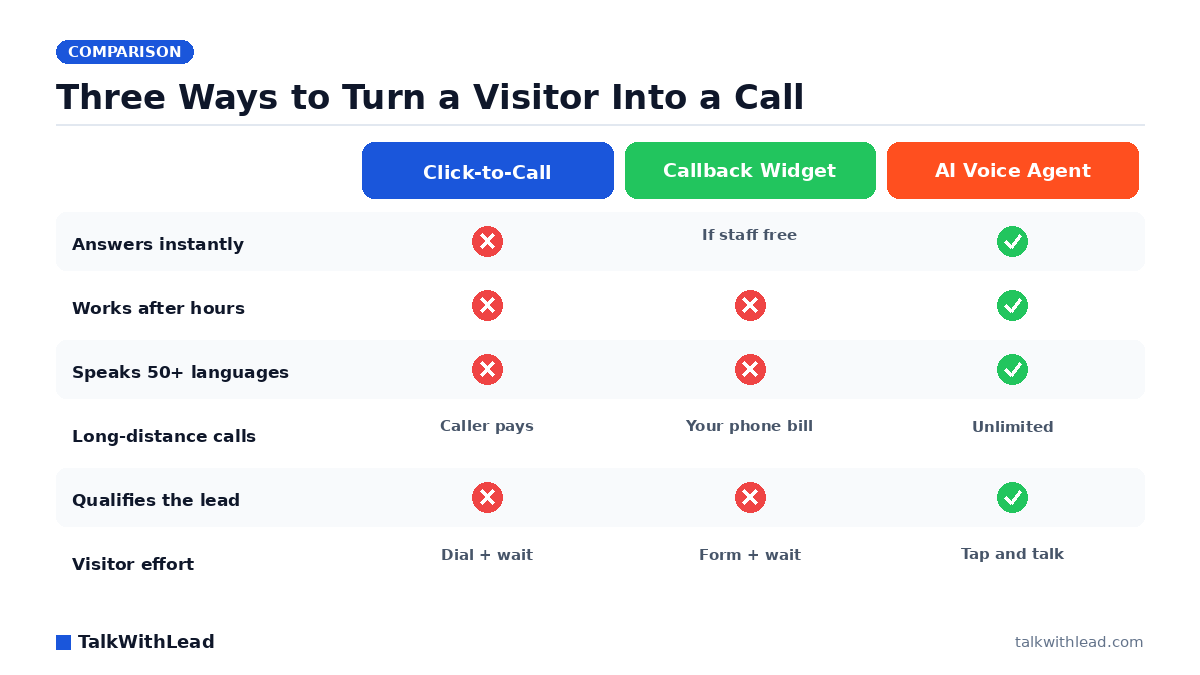
If your website gets inbound interest, you have one job: turn that interest into a conversation before the visitor closes the tab. The tools that do that work fall into four camps: click-to-call, callback widget, live chat, and the newer AI voice-first widget. Same goal, very different conversion rates.
Quick answer: Click-to-call, callback widgets, and live chat all try to convert website visitors, but they win in different situations. Click-to-call is best on mobile when the visitor is ready to dial now; a callback widget is best for capturing warm leads who can’t talk right that second; live chat is best for FAQ deflection and self-serve support. The highest-converting option for the buying moment is an AI voice-first widget, which combines instant calling, 24/7 callbacks, and 50+ languages so no high-intent visitor slips away. The reason speed matters this much: according to Harvard Business Review research, companies that reach a web lead within an hour are nearly 7× more likely to qualify it than those that wait even an hour longer.
This is a buyer’s guide. No fluff, no unsupported numbers, no fake testimonials. Just where each tool wins, where each tool leaks leads, and how to pick. Talk to TalkWithLead’s AI voice agent yourself if you want to feel the difference before you read on.
TL;DR — which one converts more, in 60 seconds
Click-to-call wins when the visitor is already on mobile and already ready to call. Loses everyone else.
Callback widget wins when the visitor will accept a phone call but not initiate one. Loses visitors who want answers now.
Live chat wins for self-serve product questions, FAQ deflection, and visitors who prefer typing. Loses high-intent buyers who want to talk.
AI voice-first widget (TalkWithLead) removes the “type into a box” or “wait for a callback” friction that stalls the other formats. The AI voice agent picks up immediately, in the visitor’s language, in a voice that actually sounds human. Hear it live.
The four tools, plain English
1. Click-to-call
A button on your site that, when clicked from a mobile device, opens the phone dialer with your number. Cheap, simple. On desktop it does almost nothing — most desktops aren’t set up to make calls. And the visitor still has to do the call: dial, wait through your IVR, leave a voicemail if you’re busy.
2. Callback widget
A widget that asks the visitor for a phone number and triggers a callback in seconds. Better than click-to-call on desktop. Better than live chat for high-intent buyers. Still has one assumption: that a human on your team is free to take the call right now.
3. Live chat
A chat window that lets the visitor type questions and get typed answers. Excellent for self-service product questions, FAQ deflection, and account lookups. Terrible at high-intent service inquiries because the visitor has to read prompts, type, wait, read, type. Most chat funnels see the same drop-off pattern: the prospect starts typing, then realizes they’d rather just talk to someone, then closes the tab.
4. AI voice-first widget (TalkWithLead)
A widget that lets the visitor click once and immediately have a real spoken conversation with an AI voice agent — no form, no typing, no waiting. It sounds human. It handles 50+ languages out of the box. It qualifies the lead, books the next step, and also covers unlimited long-distance, so a prospect anywhere in the world can call you without thinking about the cost. If a human takes over, the AI hands off cleanly. If no human is available, the AI books the callback in a calendar slot the visitor confirms on the spot.
That last difference is why the AI voice-first widget is the format that keeps high-intent visitors moving: it removes the “next step” friction that loses them in the other formats.
Callback Widget vs Click-to-Call vs Live Chat
Side-by-side comparison
Dimension
Click-to-call
Callback widget
Live chat
AI voice-first (TalkWithLead)
Visitor effort
Click + dial + listen to ring
Click + type phone number
Click + read + type each turn
Click + talk
Works on desktop
Poor
Yes
Yes
Yes
First response time
Depends on you picking up
Seconds to minutes
Seconds (bot) or minutes (human)
Instant — AI picks up immediately
Works after hours
No (your phone is closed)
Only if you have on-call coverage
Only if staffed; otherwise a bot
Yes — AI voice agent + scheduled callback
Multilingual
Depends on your team
Translation plugins; clunky
50+ languages, native
Long-distance cost to visitor
Visitor pays
You pay (small)
None (typed)
None — unlimited long-distance covered
Best for
Mobile + simple call routing
Visitors who’ll accept a callback
FAQ deflection + self-serve
High-intent conversion at the moment of interest
Hands off to a human
It IS the human
Yes, when a human is free
Yes — AI qualifies first, then routes
Once you see the table side by side, the question stops being “which legacy tool?” and starts being “do I want the upgrade or not?” If you’d like to compare the AI voice-first option against your current setup on your own pricing page, start a free TalkWithLead trial and run it in production.
Where each one wins
Click-to-call wins on a mobile checkout
If your buyer is already on a phone and already decided they want to call, a tap-to-dial button on a “contact” page is the right answer. It’s a finisher, not a converter.
Callback widget wins for warm leads who are at work
A prospect researching at their desk who doesn’t want to make a call right now will happily request a callback for “in the next 15 minutes.” It’s faster than a form and friendlier than an inbound IVR. Speed still wins the race, though: Velocify research analyzing 3.5 million leads found that calling a lead within one minute makes them 391% more likely to convert — which is exactly why an instant, automated callback beats a human getting to it 15 minutes later.
Live chat wins for SaaS support and FAQ deflection
If your top use case is “does the product integrate with X?” or “where do I find my invoice?”, a chat box is great. A buyer in research mode with a typing-friendly question will take the chat. They’ll close the tab if they’re trying to book a tour or get an emergency tech out.
AI voice-first widget wins the high-intent conversion moment
This is the moment that decides quarterly numbers. A visitor on a real-estate listing page at 9 PM Saturday. A homeowner with a leaking water heater on a Sunday. A buyer on your pricing page who clicked “talk to sales” expecting an answer in the next 60 seconds. In every one of those cases, the AI voice-first widget converts more leads because it removes the part where the visitor has to wait or work for the conversation.
Where each one loses leads
Click-to-call loses everyone on desktop, everyone with anxiety about phone IVRs, and every after-hours visitor.
Callback widget loses the visitor who wants an answer in the next minute, not in the next 15.
Live chat loses the visitor who came to talk, not to type. It also loses non-English speakers stuck with weak translation widgets and international visitors who would have been on the phone with a competitor before your live chat agent typed “Hi there, how can I help?”.
AI voice-first widget loses very little — it can still hand off to a human for nuanced sales conversations, and the AI agent answers the simple cases on its own.
The AI-voice-first upgrade
If you’ve been running click-to-call, a callback widget, or live chat on your site and you’ve watched the conversion rate plateau, the upgrade you’re looking for isn’t a new chat skin. It’s a different category. TalkWithLead’s widget answers the visitor’s first question in seconds, in their language, in a voice that doesn’t sound like a robot. A human-sounding voice keeps the conversation feeling natural — far less friction than typing into a bot.
For the cases that need a human, the AI hands off cleanly with all the context already captured. For the cases that don’t, the AI books the next step and you don’t pay anybody to take a 30-second qualifying call.
By industry — quick fits
Real estate: AI voice-first widget on every listing page. The Saturday-tour moment is the entire game. (See our deep dive on speed-to-lead.)
Home services: AI voice-first on the homepage and the booking page. Sunday emergency calls go to whichever shop’s widget picks up first.
Mortgage: AI voice-first on rate pages. Rate-shoppers compare three lenders in one sitting and close with whoever calls back fastest.
SaaS sales pages: live chat for self-serve product questions; AI voice-first on the demo-request and pricing pages.
Local businesses: AI voice-first widget — multilingual is a huge win in any city with a real immigrant population, and unlimited long-distance opens you up to traveling customers.
Lawyers, dentists, clinics: AI voice-first works here too, with extra care for compliance and recording disclosure. Talk to your own counsel before turning recording on; don’t let any AI conversation drift into giving legal, medical, or financial advice.
Numbers are illustrative — not a verified customer result. Picture a service business with 300 inbound web/phone leads per month and an 8% close rate at $1,500 average ticket. That’s about 24 closed jobs and $36,000 in revenue.
Now imagine the AI voice-first widget catches even 25% more of the inbound moments — visitors who would have bounced from a chat box, abandoned a callback queue, or never tried calling from another country because of the toll. A 25% lift on those 24 closed jobs is 6 extra jobs at $1,500, or$9,000 a month — over $100,000 a year. We can’t promise that lift for any specific business and we won’t pretend to. But the framing is honest: an AI voice agent that catches conversations the legacy widgets miss almost always pays for itself before quarter-end.
What is the highest-value conversion on your site — phone call, demo booked, or chat-resolved support ticket?
Where does most of your inbound interest land — mobile, desktop, or both?
What share of your prospects are international or speak a primary language other than English?
What happens to your inbound inquiries between 5 PM and 9 AM, on weekends, and during peak call volume?
Which feels more like a real conversation to your buyer — typing, leaving a number for a callback, dialing your IVR, or being answered by a voice in seconds?
If your honest answers say “phone call / both / yes / it leaks / a voice in seconds,” the AI voice-first widget is the move.
The bottom line: which tool to pick
Best for: Use click-to-call for mobile “ready to dial” moments, a callback widget to capture warm leads who are busy, and live chat for support and FAQ deflection. For the highest-intent conversion moment — and to cover nights, weekends, languages, and international leads in one tool — an AI voice-first widget is the best fit.
Not the best fit for: An AI voice-first widget is more than you need for a pure low-traffic FAQ page; plain live chat or click-to-call may suffice there. Most sites can run more than one of these together.
One line: Click-to-call = mobile dial-now; callback widget = warm-lead capture; live chat = support; AI voice-first = win the high-intent conversion. Start a free TalkWithLead signup to test the voice-first option in your own pipeline.
FAQ
Is a callback widget better than live chat?
For high-intent service buyers, yes — they prefer a phone call to typing. For self-serve product questions, live chat is fine. An AI voice-first widget covers both cases.
Can I run more than one of these on my site?
Yes. Many TalkWithLead customers keep a typed chat for product-page questions and use the AI voice-first widget on conversion pages (demo request, pricing, contact, key landing pages). The two are complementary.
What if my prospect speaks a different language?
The AI voice agent handles 50+ languages out of the box. It detects the prospect’s preferred language and answers in it — without you needing to staff a multilingual team.
What about international leads and toll costs?
TalkWithLead covers unlimited long-distance, so a prospect calling from anywhere in the world doesn’t worry about toll. Removing that “do I want to pay long-distance” moment removes the abandonment that legacy click-to-call setups suffer.
Does the AI voice sound robotic?
Modern AI voice is extremely human-sounding. TalkWithLead’s voice was tuned to feel like a person, handle interruptions, and switch languages cleanly. Try the Live Demo and judge for yourself.
How fast can a callback actually happen?
With TalkWithLead, typically within seconds of the visitor clicking the widget. If the AI voice option is enabled, the conversation starts immediately — no callback wait at all.
What’s the simplest place to start?
Install the AI voice-first widget on your two highest-conversion pages — usually your homepage and your demo/pricing page. Watch what happens to your booked-call rate over the next two weeks. Free signup is here.
Which converts better, a callback widget or click-to-call?
It depends on the visitor. Click-to-call wins when someone is on mobile and ready to dial immediately; a callback widget wins for desktop or busy visitors who want you to call them. An AI voice-first widget covers both moments plus after-hours, which is why it tends to capture more total leads.
Do I have to choose just one of these tools?
No. Many sites run more than one — for example click-to-call on mobile plus an AI voice-first widget for the high-intent buying moment. The goal is to never leave a ready-to-talk visitor without an instant path to a conversation.
What happens to leads that come in after business hours?
With staffed live chat or a manual callback, after-hours leads usually wait until morning — by which point many have contacted a competitor. An AI voice-first widget answers and calls back automatically 24/7, so nights and weekends stop being a dead zone.
Where can I see TalkWithLead in action?
The Live Demo page lets you talk to the AI voice agent right now. For a guided walkthrough, the same page books a 15-minute call. Pricing is here if you want the cost first.
Speed-to-lead is the single biggest predictor of whether a website lead turns into a phone call, a booked job, or a closed deal. Not your offer. Not your pricing. Not your brand. How fast you respond.
Under 60 seconds wins. Wait five minutes and, in a competitive search, the lead has often already pinged the next vendor on the list. After an hour, the lead is mostly gone. Forms are slow. Chatbots make people type. The win goes to whichever vendor’s phone — or AI voice agent — rings first. Talk to TalkWithLead’s AI voice agent yourself and feel what a sub-60-second response actually sounds like.
Short answer: Speed-to-lead is how fast you respond to a new inbound lead, and it is one of the strongest predictors of whether you win the deal. A good lead response time is under five minutes — ideally under 60 seconds — because the longer you wait, the more likely the prospect has already started talking to a competitor. The fastest reliable way to hit that window is to answer or call back automatically, 24/7, instead of depending on a rep being free.
Why speed-to-lead matters more than nearly any other sales metric
Sales operators who have run inbound funnels for any length of time will recognize this pattern: the leads that closed are almost always the leads that got a fast first touch. Faster than the competition. Faster than the visitor’s attention span. Fast enough that the moment of intent — that small, fleeting “I’m ready” feeling — is still alive.
That moment lasts seconds, not hours. A homeowner with a leaking water heater on a Sunday is not going to wait until Monday morning. A buyer comparing three mortgage brokers at 10 PM does not pause to remember which one had the prettier website. A traveler in Mexico City who clicks a U.S. contractor’s site does not want to think about long-distance call costs. They want someone — or something that sounds like someone — to pick up.
This is not theoretical hand-waving — it is what operators who run inbound funnels see again and again, and the published research lines up. According to Harvard Business Review research, companies that reach a web lead within an hour are nearly 7× more likely to qualify it than those that wait even an hour longer. And the MIT Lead Response Management study found you’re about 21× more likely to qualify a lead contacted within 5 minutes than one contacted at 30 minutes. The exact numbers vary by industry and study, but the shape of the pattern is consistent: response times under a minute outperform response times measured in hours by enough to change the unit economics of a business. That is the whole case for taking speed-to-lead seriously.
What “speed-to-lead” actually means
The clock starts at the form submit, not the next morning
Speed-to-lead is the elapsed time between when a prospect tells you they want to talk — they clicked “request a quote,” they filled the demo form, they clicked the callback widget — and when you actually reach them with a meaningful response.
Most teams measure this incorrectly. They measure “the next time a human looked at the lead in the CRM.” The real metric is the time until the prospect actually hears from you in a way they care about — a phone call, an AI voice conversation, a meaningful text. An auto-acknowledgement email does not count.
What counts as a “response,” ranked by what visitors actually feel
Channels matter. From the prospect’s perspective, ordered by perceived urgency:
AI voice agent conversation — answers in seconds in the visitor’s language, sounds human, qualifies the lead, and books the next step before the prospect can open a competitor tab. This is what TalkWithLead leads with.
Phone call from a human — highest perceived urgency, but only if a human is actually available. Outside business hours or when reps are on other calls, this drops to “voicemail.”
SMS — fast and casual, great for confirmations and reminders, not great for the first real conversation.
Live chat staffed by a human — useful if a person is actually staffing it; useless if a bot just collects an email.
Typed chatbot loop — visitors who came to talk do not want to read four prompts and pick from buttons. This is where most chatbot funnels leak.
Email — slow, and most prospects assume the response window is “tomorrow.”
Why the 60-second threshold matters more than the 5-minute or 1-hour rule
The often-quoted “5-minute rule” is a useful floor. The “1-hour rule” is a useful warning sign. The cliff is steeper than either suggests. Within the first 60 seconds the prospect is still on your site, still in the buying mindset, and has not yet opened a competitor’s tab. Past that, you are competing with whatever distraction happened next in their life.
The First 60 Seconds: Speed-to-Lead Timeline
A practical missed-lead math example
Numbers tell this story better than adjectives. Below is a representative small home-services business — not a real customer, just an illustrative example you can run against your own data.
200 inbound web/phone leads per month.
Current median response time: 2 hours (typical for shops without an after-hours plan).
Current close rate: 8%.
Average ticket: $1,200.
That is about 16 closed jobs per month and roughly $19,200 in revenue. Now imagine adding an AI voice-first widget that picks up in seconds, handles the conversation in the prospect’s language, and books the next step before the prospect goes elsewhere. You don’t even need a huge swing — just a 30% lift in close rate (from 8% to about 10.4%). That is about 21 closed jobs and roughly $25,000 — an extra $5,760 per month or $69,000 per year.
We can’t promise that lift for any specific business; every shop’s numbers are different, and we will not pretend otherwise. But the math is honest: even small wins on response time compound quickly, and the cost of an AI voice agent that catches every missed conversation is almost always less than the revenue from a single recovered job.
Where teams lose minutes (and why hiring more staff isn’t the right first move)
If response time is the problem, “hire more people” looks like the answer. It is almost always the wrong first move. Adding headcount adds payroll, training, and a hiring lag — and it does not help with the after-hours problem at all. Here is where the minutes actually leak:
The 5 PM to 9 AM dead zone
A large share of website traffic happens after the workday ends. A demo request at 7 PM, a quote inquiry at 10 PM, a contractor search at 1 AM — all default to the next-business-day queue. By the time someone answers, the prospect is in a meeting, a school run, a different mindset. An AI voice agent that answers in seconds covers this gap automatically.
Weekend leakage
Saturday and Sunday inbound is some of the highest-intent traffic of the week, especially in real estate, home services, and clinics. If Monday morning is your first response, weekend leads are gone before you start.
Reps already on calls
The team you have today is rarely sitting at zero call volume. When the new lead arrives, your reps are already on the phone with the previous one. Twenty minutes later — too late.
Field crews with their hands full
If your business has techs in the field, they cannot pick up the phone while they are under a sink, on a roof, or in a patient’s mouth. A missed call is the default — not the exception.
Language and distance mismatches
Two leaks most teams never even count. A prospect who speaks Spanish, Hindi, French, or Mandarin first will often hang up the moment the answer comes in a language they cannot work in. A prospect calling from a different country worries about the toll. TalkWithLead’s AI voice agent handles 50+ languages out of the box, and the platform covers unlimited long-distance calling — so the prospect’s first impression is “they speak my language and the call costs me nothing.” That is two friction points removed before the conversation even starts.
Manual triage of “junk vs real”
Even when leads land in the inbox, they get triaged before anyone calls. That triage step adds 10 to 30 minutes — minutes you don’t have. An AI voice agent qualifies inline as part of the conversation, so a real lead arrives already pre-screened.
The four levers that actually move speed-to-lead
An AI voice agent at the moment of intent. A voice agent that picks up immediately, speaks the visitor’s language, sounds human, and qualifies the lead while they are still on the page. This is what TalkWithLead’s widget is built around.
Instant callback as a fallback. For visitors who prefer a callback, the widget triggers a real phone call in seconds — no form, no waiting for a sequence email.
Unlimited long-distance, so international leads stop dropping off. Prospects from anywhere in the world can reach you without thinking about call costs. TalkWithLead absorbs the long-distance, so a buyer in Vancouver, Manila, or Madrid is one click away from a real conversation.
Routing rules that match the qualified lead to the first available human. Round-robin, geo-based, or skill-based routing so the qualified lead never sits in a queue waiting for the “right” rep.
TalkWithLead’s AI voice-first widget gives you the first three levers in one install. The fourth — routing rules — is configured in your team’s existing phone/CRM stack.
Speed-to-lead by industry
Real estate — the Saturday open-house example
Picture a buyer who lands on a listing at 3 PM Saturday. They want a tour. The listing agent is in the middle of another open house. Without an instant callback option, the buyer fills the form, waits 10 minutes, then opens Zillow and checks the other three nearby listings. By 3:30 they are talking to a different agent. With an AI voice agent on the widget, the buyer answers two qualifying questions in their preferred language and gets a callback the moment the original agent is free.
Home services — the Sunday emergency-call example
A homeowner’s water heater is leaking at 9 PM. They search “plumber near me,” click the first three results, and try to call. Whichever shop’s phone is answered first — by a human or by an AI voice agent that sounds human — gets the job. The other two shops never hear about it. If the homeowner speaks Spanish or Mandarin and your competitors only answer in English, that is one more reason TalkWithLead’s multilingual voice wins the call.
Mortgage — the Tuesday-night rate-shop example
A rate-shopper compares three mortgage brokers’ websites at 10 PM. They fill the contact form on all three. The first broker to actually call them — typically by 7 AM the next day if a human team handles it — wins the conversation. An AI voice agent that calls back in 30 seconds compresses that overnight gap to nothing.
Insurance — the quote-shop example
Quote-shoppers compare two or three carriers in a single sitting. The carrier that gets on the phone first usually closes, even if the quote is slightly higher, because the prospect has already explained their situation once and does not want to do it again.
SaaS — the pricing-page demo request example
A buyer hits your pricing page on a Friday afternoon, clicks “request a demo,” then disappears for the weekend. If sales does not follow up until Monday, the prospect has already started a pilot with whichever vendor’s SDR reached out within the hour. An AI voice agent on the pricing page captures the demo intent in real time and books a calendar slot before the buyer closes the tab.
Lawyers, dentists, and clinics
Intake-driven practices win or lose on response speed too, with extra care needed for compliance and confidentiality. We will not give specific legal or clinical advice here — your own counsel or compliance officer should set the rules for what an AI conversation can collect or record in your jurisdiction. The framing principle is the same as every other vertical: an inbound inquiry that gets a fast first touch is dramatically more likely to convert than one that waits.
Before and after with TalkWithLead
Same fictional lead. Two timelines.
Before
9:12 PM Sunday — homeowner submits the “request a quote” form on a plumber’s website.
9:13 PM — auto-acknowledgement email lands in their inbox.
9:30 PM — homeowner has tried the next two plumbers in the search results; the second one answered the phone.
Monday 8:45 AM — the original plumber’s office sees the lead and calls. Voicemail.
Monday 10:00 AM — the original plumber leaves a second voicemail; the homeowner has already booked the other shop.
Outcome: lead lost.
After
9:12 PM Sunday — homeowner clicks the TalkWithLead widget on the plumber’s site.
9:12 PM — TalkWithLead’s AI voice agent picks up immediately, in the homeowner’s language, in a voice that sounds human, and asks two qualifying questions (what is leaking; what is the address).
9:13 PM — AI voice agent confirms a Monday 8 AM slot and texts the homeowner the appointment details.
Monday 7:55 AM — the on-call tech reviews the qualified intake, confirms the slot, arrives at 8.
Outcome: lead won, with zero late-night work from the office team and zero long-distance cost to the homeowner who happened to be calling from a different country.
The difference between those two timelines is not intelligence, effort, or talent. It is a single tool that picks up the phone when the moment of intent is still live, in the language the prospect actually speaks. Book a 15-minute TalkWithLead demo if you want to see exactly how the AI voice agent handles that 9:12 PM inquiry on your site.
How to measure speed-to-lead this week
Log the form-submit timestamp and the first-meaningful-response timestamp for every inbound lead.
Tag the channel (call, AI voice, SMS, chat, email) and the eventual outcome (booked, ghosted, lost-to-competitor).
Push these as GA4 events so you can see distribution by hour of day, day of week, and visitor language.
Build one dashboard with three numbers: median response time, % of leads reached within 60 seconds, and close rate by response-time bucket.
Most teams discover after one week of logging that their reported response time is roughly half of their actual response time, because nobody was counting weekends, evenings, or non-English inquiries. That gap is exactly where TalkWithLead’s AI voice agent pays for itself. Talk to the live demo and see how it handles your worst-case lead in real time.
Response time vs. outcome: what the research shows
Every figure below comes from a published, named study — follow the linked source in the last column for the original research. None of these are TalkWithLead’s own numbers; they are the industry research on what happens when you respond faster.
How response speed changes your odds (sourced research)
Response window
What the research shows
Source
Within ~1 minute
About 391% more likely to convert than calling later
The verdict: what a good response time is, and who needs to automate it
Bottom line: Aim for under 5 minutes (ideally under 60 seconds), and automate it so speed never depends on who’s free.
Best for: Any business with inbound web or phone leads where a human could be slow to respond — service businesses, brokers, agencies, sales teams. Aim for a first response under 5 minutes, and automate the response so nights, weekends, and busy reps never create a dead zone.
Less essential for: If you have zero inbound lead flow, or a fully staffed instant-response desk already hitting sub-minute times, automation adds less. For everyone else, an automated instant call/callback is the most reliable way to win the speed race.
Under 60 seconds is the modern bar for inbound web leads in service businesses. Under five minutes is acceptable. After an hour, most leads have moved on or contacted a competitor.
Is speed-to-lead really that important?
For most service businesses that depend on inbound inquiries: yes. The conversion difference between a 30-second response and a one-hour response is usually larger than the difference between two competitive offers.
How do I improve speed-to-lead without hiring more people?
Add an AI voice agent at the moment of intent. TalkWithLead’s voice-first widget handles after-hours coverage, overflow when reps are on other calls, and the first qualifying conversation — in 50+ languages, with an extremely human-sounding voice, and unlimited long-distance calling so international prospects don’t drop off.
Does an auto-acknowledgement email count as a response?
From the prospect’s perspective, no. They want to talk to someone, not receive a receipt. An auto-acknowledgement is fine as a confirmation, but it does not reset the speed-to-lead clock.
Will an AI voice agent annoy my prospects?
Older robocall systems were annoying. Modern AI voice agents handle interruptions and speak naturally. TalkWithLead’s voice was tuned to sound extremely human, and it switches languages dynamically — so a prospect speaking Spanish or French gets answered in Spanish or French, not in stilted English with a robot accent. In inbound contexts where the prospect just asked to talk, the experience is usually well received because it is instant and it sounds like a person.
How fast can a callback widget actually call?
With TalkWithLead, typically within seconds of the visitor clicking. Exact timing depends on the platform and the visitor’s connectivity, but the live AI voice option answers immediately.
What about international leads and long-distance costs?
TalkWithLead covers unlimited long-distance, so a prospect from anywhere in the world can talk to your AI voice agent without thinking about toll costs. This matters more than people realize — international leads frequently abandon at the “do I want to pay long-distance for this?” mental moment. Removing that moment removes the abandonment.
What if my industry is regulated?
Lawyers, medical practices, mortgage brokers, and insurance agencies all have specific rules around what an AI conversation can collect, store, or record. Talk to your own compliance counsel before turning recording on, and disclose recording per the law where you operate.
What is the average lead response time for most companies?
Far slower than buyers expect. According to Drift’s lead-response study of 433 B2B companies, the average company takes 47 hours to respond to a new lead — and only 7% respond within five minutes, while over a quarter never respond at all. That gap is exactly why responding instantly is such an advantage: the bar is low, so being fast stands out.
How can I respond to leads in under 5 minutes without hiring more staff?
Automate the first response. An AI voice agent or instant callback widget answers or calls the lead back within seconds, 24/7, so coverage doesn’t depend on a rep being free during nights, weekends, or peak call volume. A human then takes over the qualified conversation. That is the whole idea behind TalkWithLead’s voice-first widget — it picks up the moment of intent so your team isn’t racing the clock.
Does responding first actually win more deals?
Yes — being first is a measurable edge. Research popularized by InsideSales / Dr. James Oldroyd found that roughly 35–50% of sales go to the company that responds first. That is why shaving minutes off your response time pays off directly: in a competitive search, the prospect often commits to whoever reaches them first.
Next step: If one extra recovered lead per week would change the math for your business, the system that recovers it costs less than the lead it brings back. Talk to TalkWithLead’s live AI voice demo and feel the difference between a slow form and a sub-60-second conversation. Then start your free signup and run the missed-lead math against your own pipeline. Pricing here if you want it first.
Chatbots make visitors type. AI voice agents create real conversations. If you run a business where buyers want to talk to someone now — a plumber, a real-estate agent, a mortgage broker, a lawyer, a clinic, a SaaS sales team — that one difference shows up in your pipeline.
Short answer: An AI voice agent turns a website visitor into a live phone conversation in seconds, while a chatbot makes that visitor type and wait. Chatbots are best for deflecting repetitive FAQs and self-serve support; an AI voice agent is best for converting high-intent visitors into qualified sales calls, because talking is faster and closer to how buying decisions actually happen. For most businesses chasing leads, the highest-converting setup is an AI voice agent for the buying moment, with a chatbot kept for low-stakes support questions. According to a Five9 study of 4,000 US and UK consumers, 75% of people prefer talking to a real human in person or over the phone for customer support — which is exactly the moment a human-sounding AI voice agent is built to win.
This is a practical comparison: where chatbots still earn their keep, where AI voice agents quietly outperform them, and how to decide for your own site. No fluff and no invented stats — just the trade-offs that actually move the needle on booked calls. See TalkWithLead’s widget in action on talkwithlead.com if you want to feel the difference between typing and talking before you read on.
AI voice agent vs chatbot in 60 seconds
The short version, before the detail:
Chatbot: a typed conversation in a window on your site. Best for self-service questions, order/account lookups, and FAQ deflection.
AI voice agent: a spoken conversation, either by callback or directly through the widget. Best for high-intent inquiries, after-hours qualification, and any industry where the next step is “get on a call.”
The deciding factor: how ready is the visitor to take the next step? Browsing visitors will type. Decision-ready buyers want to talk.
What is an AI voice agent? What is a chatbot?
AI voice agent — how it works
An AI voice agent is a system that holds a spoken conversation with a visitor. On a website, it usually lives behind a small widget. The visitor either clicks “talk now” and speaks through the browser, or asks for an instant callback and the AI agent dials them back within seconds.
Under the hood, the agent transcribes what the visitor says, runs that through a language model to decide how to respond, then converts the response back to speech. Modern voice agents handle interruptions, recognize intent, and can hand off to a human when the conversation crosses a threshold — for example, “I want to schedule a tour this weekend” on a real-estate site, or “I have a burst pipe” on a plumber’s site.
Chatbot — how it works
A chatbot is a typed conversation in a chat window. Older chatbots followed a decision-tree (button-based) script. Modern AI chatbots use a language model to interpret typed messages and respond in natural language. Both still rely on the visitor reading and typing.
Chatbots are excellent at structured tasks: looking up an order number, surfacing a help-center article, or qualifying a visitor with a short form-style flow. They are also genuinely useful when the visitor prefers asynchronous chat — for example, when they are at work and cannot take a call.
The conversational gap that matters
A typed chatbot turns every interaction into a series of small commitments. The visitor reads a prompt, decides what to type, types it, waits for a reply, reads the reply, decides what to type next. Every step is a moment the visitor can close the tab. Speaking removes most of those steps. A short phone-style exchange usually replaces three or four chat turns and feels closer to how a normal sales or service call would go.
That gap matters most when the visitor is already in buying mode. They do not want to be educated. They want a person — or a system that sounds like one — to confirm a price, a slot, or a callback.
AI Voice Agent vs Chatbot: What Actually Converts
Where chatbots actually shine
It is unfair to call chatbots dead. They are a great default for several specific jobs:
Self-service product questions. If your site sells software with documented features, a chatbot can resolve “does it integrate with X?” without anyone picking up the phone.
Order tracking and account lookups. A chatbot that authenticates the visitor and surfaces order status is faster than calling support.
Documentation and FAQ deflection. Pointing visitors to the right help article is a chatbot’s natural strength.
Quiet hours when the visitor prefers chat. Some visitors really do prefer typing — they’re at work, the kids are asleep, they don’t want their voice picked up.
Triage to a live agent. Chatbots are good at collecting the basics (“name, email, the gist of the problem”) before a human jumps in.
If your top KPI is “deflect support tickets” or “let visitors self-serve,” a chatbot is usually the right call. If your top KPI is “book more phone calls and demos,” keep reading.
Where AI voice agents win
AI voice agents earn their place when the next step in the funnel is a call. Several scenarios show this pattern clearly:
High-intent service inquiries. A homeowner with a leaking water heater on a Sunday is not going to type out their problem in a chat window. They want a voice on the other end. An AI voice agent that picks up immediately, qualifies the job, and books a tech is the difference between winning and losing the work.
High-ticket purchases. A buyer evaluating a multi-thousand-dollar service expects a conversation, not a form. Voice agents handle the discovery questions that build trust.
Industries where phone is still the dominant channel. Real estate, mortgage, insurance, law, healthcare, and home services lean phone-heavy. Buyers in those verticals interpret “call me” as serious and “chat with us” as casual.
After-hours qualification. Most chatbots can take a name and email after hours. Voice agents can actually answer questions, qualify the lead, and book a callback during business hours, all without a human.
Recovering missed calls. When a missed call lands on your number, an AI voice agent can call back within seconds, ask the visitor what they need, and book a real follow-up. A chatbot cannot recover a missed phone call at all.
Excellent for visually impaired or mobile-on-the-go users
Compliance considerations
Standard web/cookie/privacy practices
Plus call-recording disclosure where applicable; check local laws
Both channels can coexist on the same site. The mistake most teams make is forcing one channel to do both jobs. A chatbot pretending to handle high-intent service calls feels slow. A voice agent answering “what time do you close?” feels like overkill.
The deciding factor: speed-to-lead
For most service businesses, the single biggest predictor of whether a lead converts is how fast you respond. Sales operators who have run inbound for years have all watched the same thing happen: response times under a minute dramatically outperform response times measured in hours. We won’t quote specific numbers without a citation, but if you have ever lost a lead to a competitor who called first, you already know the shape of the data.
Speed-to-lead is where AI voice agents pull ahead. A chatbot can collect a name and an email in 30 seconds. A voice agent can have already qualified the job, scheduled a follow-up, and texted a calendar invite by the time a competitor’s human picks up the phone.
Want to compare both on your own site? Start a free TalkWithLead trial — both callback and AI voice are included by default. You can A/B them on different pages and watch what your real visitors choose.
Which to choose by industry
Real estate
Buyers explore listings late at night and on weekends. A chatbot can grab a name; an AI voice agent can actually ask whether they want a Saturday or Sunday showing and reach out to the listing agent in parallel. For listing pages and “request a tour” flows, voice wins on intent.
Home services contractors (plumbing, HVAC, electrical, roofing)
Jobs go to whoever picks up first. Techs are on roofs, in crawl spaces, or under sinks. An AI voice agent fills the “we can’t pick up right now” gap without losing the job. Chatbots underperform here — homeowners in distress do not type.
Lawyers and law firms
Intake speed wins high-value cases. The caveat: confidentiality matters. Use a voice agent that records and stores only what your intake policy allows, and disclose recording per the law where you practice. Frame any AI conversation as preliminary qualification, not legal advice. Readers should consult their own counsel on what they can disclose to an AI intake step.
Dentists and clinics
Front desks are busy and new-patient calls leak after hours. A voice agent can take basic information and book a callback for the next business day. Anything beyond scheduling should defer to a clinician; this is not the place for diagnostic chat. Always check the privacy rules that apply to your patient communications in your jurisdiction.
Mortgage brokers
Rate-shoppers close with whoever calls first. Voice agents shave minutes off the response window. Avoid quoting specific rates or terms in the AI conversation; that is what your licensed advisors are for.
Insurance brokers and agencies
Quote-seekers want a human voice fast. AI voice handles first-touch qualification, then hands off to a licensed agent who can quote properly.
SaaS sales teams
Demo requests on pricing pages decay fast. A chatbot is fine for self-serve docs; an AI voice agent on the demo-request page can convert intent into a live or scheduled call within minutes. Use both: chatbot for product-led-growth questions, voice for “talk to sales.”
Local businesses (auto, beauty, fitness, etc.)
Owners cannot answer every call. After-hours calls are pure lost revenue. A voice agent that books appointments and answers “are you open?” turns that lost revenue back into bookings.
How TalkWithLead fits
TalkWithLead is a small widget for your website that lets visitors do one of two things: request an instant callback, or talk to an AI voice agent right now. That second option is the differentiator — the visitor does not have to wait, and you do not have to hire a 24/7 phone team.
We chose to offer both because the right channel depends on the visitor. A casual browser does not need a callback in 30 seconds — they will accept a typed exchange or no exchange at all. A serious buyer comparing three plumbers at 10 PM wants a voice. Forcing every visitor into the same channel costs conversions; meeting them where they are lifts them.
If you already have a chatbot, you do not need to rip it out. Many TalkWithLead customers run both: chat for product questions, voice for sales and service inquiries.
A practical evaluation checklist
Before you choose, ask:
What is the most valuable conversion on my site? (Demo? Phone call? Booking?)
How quickly does my industry expect a response?
Do my visitors typically type or call to engage a competitor?
What happens to inquiries that arrive after hours today?
What is the cost of a missed lead vs. the cost of a tool that catches one?
If I added a voice option above the fold tomorrow, would anything in my compliance or recording-disclosure policy need to change?
Walking these questions for ten minutes usually tells you whether you need a chatbot, a voice agent, or both.
Five mistakes buyers make when picking between the two
Most teams don’t pick the wrong tool because they misunderstand the technology. They pick wrong because they evaluate it against the wrong question. After watching how businesses shop for this category, the same avoidable errors come up again and again.
Mistake one: judging a chatbot demo by how smart its answers sound, instead of by how many real visitors finish the flow without bailing. Mistake two: assuming a voice agent will feel robotic, then never actually listening to one talk. Mistake three: optimizing for deflection (fewer human conversations) when your real goal is more booked calls. Mistake four: ignoring after-hours and weekend traffic, which is often when your highest-intent visitors arrive and your team is offline. Mistake five: treating language and long-distance reach as a nice-to-have, when a prospect who can’t be understood or can’t get a call back is simply a lost lead.
Composite example: a remodeling company compared a typed chatbot and an AI voice agent by reading transcripts side by side. The chatbot looked impressive on FAQs. But when they filtered for visitors who clearly wanted to hire, the voice agent had turned far more of those into actual phone conversations — because high-intent people want to talk, not type. The lesson: pick the tool that converts your ready-to-buy traffic, and let it handle the moment a visitor is most likely to become a real sales conversation.
AI voice agent vs chatbot, at a glance
Dimension
Chatbot
AI voice agent (TalkWithLead)
Primary interaction
Visitor types text
Visitor speaks; instant live call or callback
Best job
FAQ deflection / self-serve support
Converting high-intent visitors into sales calls
Speed to a real conversation
Visitor must type, read, and wait between replies
Seconds to a live voice conversation or callback
After-hours coverage
24/7 text replies
24/7 voice answering and callbacks
Languages
Varies by setup
50+ languages
Long-distance / international leads
Text only; no calling cost handled
Unlimited long-distance calling included
Concurrent visitors
Many at once
Unlimited simultaneous calls
Signal sent to a buyer
Automated, low-touch
Human-sounding, high-touch conversation
Where it can fall short
Stalls on nuanced or high-intent questions
Overkill for pure self-serve FAQ lookups
Bottom line. Chatbot for support deflection; AI voice agent for turning visitors into sales calls.
Best for: Businesses that want to convert website visitors into phone conversations and qualified leads — service businesses, brokers, agencies, and any team where a fast call wins the deal. Choose the AI voice agent here.
Not the best fit for: Pure self-serve support or simple FAQ deflection on a low-intent help page — a chatbot is cheaper and sufficient. Many sites run both: voice for the buying moment, chat for routine support.
It’s worth knowing where chatbots lose people: a Five9 survey of 4,000 consumers found that 56% are frequently frustrated by AI customer-service chatbots and 48% don’t trust the information those bots provide — which is exactly why a real conversation tends to win the high-intent moment.
FAQ
Is an AI voice agent better than a chatbot?
For high-intent inquiries and businesses where the next step is a phone call, yes. For self-service product questions and FAQ deflection, a chatbot is usually a better fit. Many sites benefit from both.
Will an AI voice agent replace my sales team?
No. It handles first-touch qualification, after-hours coverage, and missed-call recovery. Your human team still owns closing, negotiation, and relationships. The voice agent’s job is to make sure no real opportunity goes silent.
Do visitors find AI voice agents annoying?
Older robocall-style systems were annoying. Modern AI voice agents handle interruptions, speak naturally, and escalate to a human when the conversation calls for it. They are not perfect, but the bar to a useful experience is much lower than it was three years ago.
How fast can an AI voice agent call a lead back?
With a callback widget like TalkWithLead’s, typically within seconds of the visitor clicking. The exact timing depends on the platform and the visitor’s connectivity.
What about compliance and call recording?
Call recording is regulated and varies by jurisdiction (one-party vs. two-party consent, sector-specific rules, and so on). If you record AI-handled calls, disclose the recording in your widget copy and follow the law where you operate. Consult counsel where the rules are not obvious.
Can I keep my existing chatbot and add a voice agent?
Yes. The two channels complement each other. Use the chatbot for self-service and FAQs, and the voice agent for “talk to a person” or “book a callback” flows.
How do I measure whether voice is working better than chat?
Track both: chatbot conversation starts vs. voice conversation starts, and then the downstream conversion rate of each — usually booked calls, qualified leads, or completed signups. The channel with the higher downstream conversion rate wins for your audience.
How does TalkWithLead handle both?
One widget on your site offers two actions: request an instant callback, or speak with an AI voice agent right now. You can see both options on talkwithlead.com, and you can book a TalkWithLead demo to walk through how to tune the flows for your industry.
Can an AI voice agent and a chatbot run on the same website?
Yes. The common setup is an AI voice agent on high-intent pages — pricing, demo, contact — to capture buying-moment visitors as calls, plus a chatbot on support and help pages for routine self-serve questions. They serve different jobs and don’t conflict, so you keep FAQ deflection while gaining live-call conversion.
Which converts more website visitors into leads, a chatbot or an AI voice agent?
For high-intent visitors, voice typically converts better, because it starts a real conversation in seconds instead of a typing exchange the visitor often abandons. Chatbots convert well for capturing low-friction support questions. The honest answer is to match the tool to the intent of the page it sits on.
Do I have to replace my chatbot to add an AI voice agent?
No. You can keep your existing chatbot and add a voice-first widget alongside it. TalkWithLead adds the voice layer without ripping out your current stack, so you keep FAQ deflection and gain live-call conversion for the buying moment.
Does an AI voice agent slow down my website?
No. TalkWithLead loads as a lightweight widget and the voice conversation runs in the cloud, so your page speed and Core Web Vitals stay intact while visitors still get an instant voice response.
What happens if the AI voice agent can’t answer a question?
It captures the visitor’s details and intent and routes the conversation to your team for a fast human follow-up, so a lead is never dropped just because a question is out of scope.
Is an AI voice agent worth it for a small business?
Often yes. A small team can’t answer every visitor in seconds, but an AI voice agent can, turning after-hours and overflow traffic into booked calls without adding headcount.
Related reading on the TalkWithLead blog
This article is part of a series on converting website visitors into phone calls. More from the TalkWithLead Resources hub:
How real estate agents are booking more showings with instant callback (coming soon)
Chatbot alternatives for small businesses that need to book calls (coming soon)
Next step: If you want to test voice and callback side by side on your own site, start a free TalkWithLead trial. Both are included — no separate plans, no upgrade required. Want a walkthrough first? Book a TalkWithLead demo and we’ll show you how teams in your industry are combining the two. See pricing if you want the cost side first.
Your next lead is on your site right now — ready to talk.
TalkWithLead’s AI voice agent picks up in seconds, qualifies the lead in their language, and books the call before the prospect can open a competitor’s tab. Forms are slow. Chatbots make people type. Voice closes.
This is the TalkWithLead Widget. Click to see how it will work on your website!
Live AI voice agent
Turn website visitors into phone calls
This is the same TalkWithLead widget you can add to your site — an AI voice agent that talks to your website visitors and calls leads back 24/7, in 50+ languages. Try it two ways: