
In this article
- The math of a missed call
- Why your team misses calls
- What “missed call automation” actually means today
- Why AI voice-first beats missed-call text-back tools
- How TalkWithLead handles a missed call
- Before and after — same missed call, two outcomes
- By industry — quick fits
- How to roll this out in 48 hours
- Missed-call text-back vs AI voice-first recovery
- Bottom line — which one to use
- FAQ
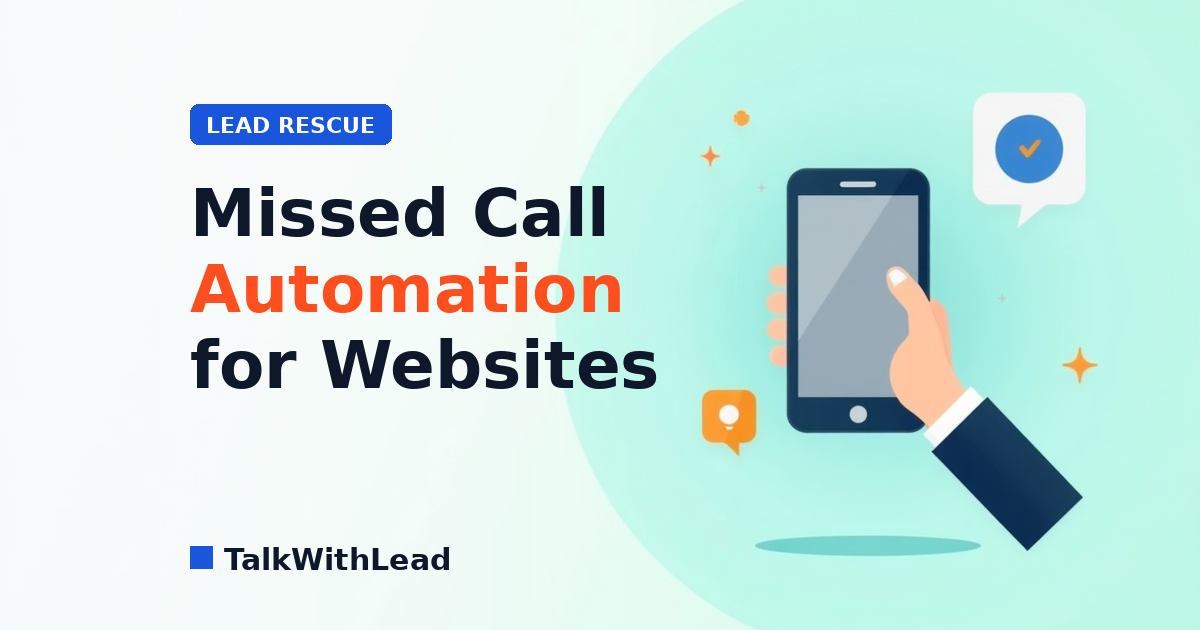
Every missed call on a small-business website has a dollar value, and most owners never put a number on it. Once you do, the math gets uncomfortable fast. This is a practical guide to missed call automation for websites in 2026: what the term actually means now, why the AI voice-first approach has overtaken the old “missed-call text-back” tools, and how to stop losing leads to whichever competitor’s phone rings first.
Talk to TalkWithLead’s AI voice agent if you want to hear what an instantly answered call actually sounds like before you read on.
The short answer: Missed call automation is a system that captures a caller or web visitor the moment your team can’t pick up, so the lead never goes to a competitor. The older approach is missed-call text-back, which sends an automatic SMS; the stronger approach is an AI voice-first agent that actually answers or calls the lead back in seconds, 24/7, in 50+ languages. Because a large share of calls to small businesses go unanswered, automating the recovery is often the single fastest way to stop losing booked revenue. According to a 411 Locals study of 85 small businesses across 58 industries, only 37.8% of incoming calls were answered by a live person — meaning roughly 6 out of 10 calls went unattended.
The math of a missed call
Numbers are illustrative — not a verified customer result. Picture a small home-services business: 250 inbound web/phone leads per month, 10% close rate, $1,400 average ticket. That’s 25 closed jobs and $35,000 in monthly revenue.
Plenty of small businesses miss real inbound calls once after-hours, weekend, and overlap windows are counted — and every missed call can be real buying intent walking away. Even a conservative 20% miss rate on those 250 leads is 50 missed conversations a month. At a 10% close rate, that’s 5 jobs and $7,000 in monthly revenue — over $80,000 a year — quietly walking to whichever shop’s phone got answered.
And the stakes aren’t small at the macro level either. According to BIA/Kelsey research, click-to-call and inbound phone calls influence more than $1 trillion in U.S. consumer spending each year — which is why every unanswered call is a slice of real, intent-rich revenue.
You can’t promise that lift to any specific business and we won’t pretend to. But this is the shape of the cost. Now imagine an AI voice agent that picks up the moment a visitor clicks the widget on your site, in their language, with no toll cost — and you can see why “missed call automation” stopped being optional.
Why your team misses calls
After hours and weekends
Inbound interest doesn’t clock out at 5 PM — plenty of it lands on evenings, weekends, and holidays. Most teams default to “we’ll see it Monday.” The lead is gone by Monday.
Reps already on a call
If your team has one or two people answering the phone, the second concurrent call is a missed call. Voicemail is a missed call. “I’ll call back in 20 minutes” is a missed call, because in 20 minutes the lead has already started a conversation with someone faster.
Crews in the field
If you have techs in the field — under a sink, on a roof, in a patient’s mouth, on a job site — they cannot answer. A missed call is the default.
Language mismatch
A prospect who speaks Spanish, Hindi, Mandarin, French, or Tagalog first will often hang up the moment the answer comes in a language they cannot work in. That call is missed even though somebody picked up.
Long-distance fear
Two leaks most teams never count: a prospect calling from a different country who worries about toll costs, and a prospect in a different region whose carrier may charge them a per-minute fee. They never dial. That’s a missed call you don’t even know you missed.
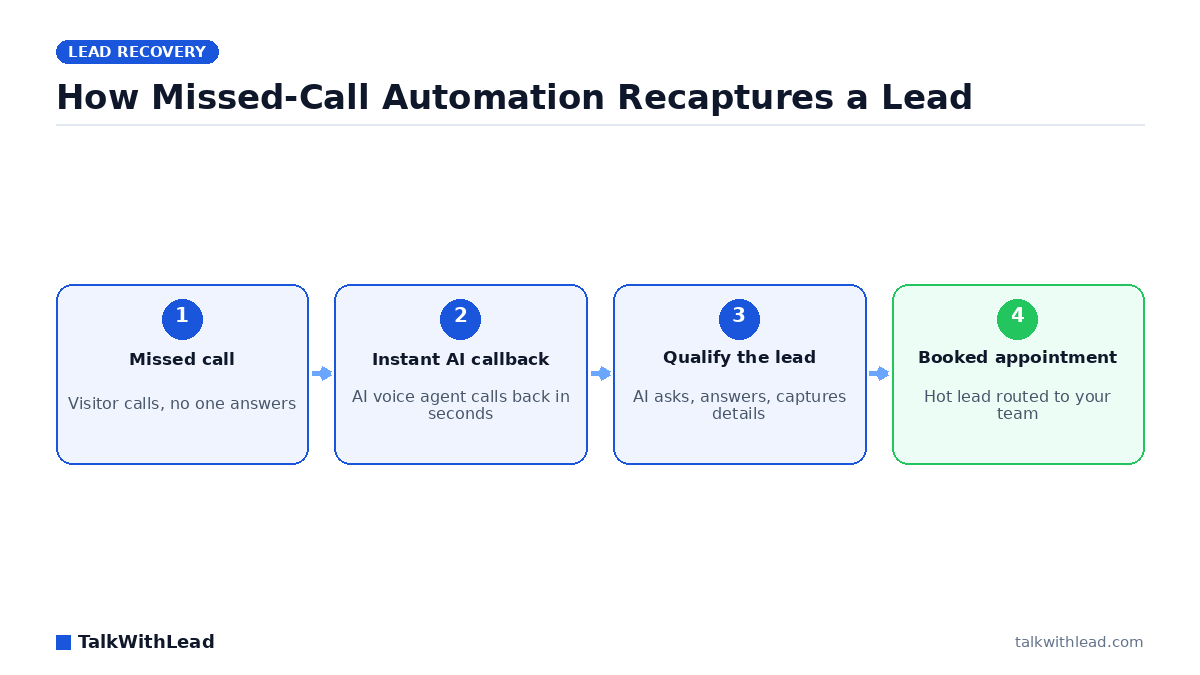
What “missed call automation” actually means today
The 2018-era version was a text-back tool: if someone called your business and you didn’t pick up, an automated SMS would go out saying “sorry we missed you, leave a message.” Useful — but slow. The visitor still has to wait, type, hope.
The 2026 version is an AI voice agent embedded directly in your website. The visitor never has to dial in the first place — they click the widget, and the AI voice agent picks up immediately. The conversation starts in the visitor’s language, in a voice that sounds human, with no toll cost to them. If a human on your team is free, the AI hands off cleanly. If not, the AI books the next step (a confirmed callback time, a calendar slot, a quote summary) and sends both you and the prospect a confirmation.
That is what TalkWithLead does on day one. Start a free TalkWithLead trial if you want to run it on your own site this week.
Why AI voice-first beats missed-call text-back tools
- No call needed in the first place. The prospect clicks the widget and talks directly through the browser — no dialing, no toll, no IVR.
- Instant pickup, not “we missed you.” In practice, response times under a minute outperform response times measured in hours by a margin that changes the unit economics of a business — every operator who watches their pipeline sees it. (See our deeper take on speed-to-lead.)
- Multilingual. 50+ languages out of the box. A text-back tool defaults to whatever language your auto-template is written in.
- Unlimited long-distance. The visitor never thinks about toll cost; TalkWithLead covers it.
- Qualifies inline. The AI asks the right two or three questions during the conversation, so when a human gets the lead it’s already pre-qualified.
- Sounds human. Modern AI voice handles interruptions, language switching, and clarification without sounding robotic. Try the Live Demo.
How TalkWithLead handles a missed call
The TalkWithLead widget sits on every page where conversions matter — your homepage, your pricing page, your demo-request page, your listing pages, your contact page. When a visitor clicks it, three things happen in parallel:
- The AI voice agent picks up immediately in the visitor’s language.
- The agent asks two or three qualifying questions tuned to your business (location, urgency, the specific service or product they need).
- The agent either books a callback into your real calendar, escalates to a human who is on shift, or completes the conversation on its own. The visitor gets a confirmation. Your team gets a clean lead summary.
For visitors who prefer a phone call, the same widget can fall back to instant callback — your team’s phone rings, with the qualified context already attached.
Before and after — same missed call, two outcomes
Before
- Tuesday 10:47 PM — a prospect on your service page tries to call. Voicemail.
- 10:48 PM — they try the next two competitors in the search results. The second one answers.
- Wednesday 8:35 AM — your office sees the missed call, dials back. The deal has been booked elsewhere.
- Outcome: lead lost. Your team never knew the prospect existed until it was too late.
After
- Tuesday 10:47 PM — the prospect clicks the TalkWithLead widget. The AI voice agent picks up immediately in their language.
- 10:48 PM — the agent asks two qualifying questions, confirms an 8:30 AM appointment, and texts the prospect the booking.
- Wednesday 8:25 AM — your tech reviews the qualified intake on their phone and arrives at 8:30. The customer feels like the business genuinely picked up at 10:47 PM the night before.
- Outcome: lead won, zero late-night work for the office team, no toll cost for the prospect even if they were dialing from another country.
By industry — quick fits
Home services
An emergency caller on a Sunday picks whichever shop’s widget answers first. AI voice-first handles the call when your techs are mid-job and you can’t pick up.
Real estate
A listing-page form submission at 9 PM gets a live AI conversation in seconds. The buyer feels heard. The agent gets the qualified showing request the next morning. (We covered the Saturday-tour pattern in our speed-to-lead deep dive.)
Mortgage and insurance
Rate-shoppers compare three lenders or carriers in one sitting. The one whose phone (or AI voice agent) answers first usually closes. Recording-disclosure rules apply per jurisdiction; talk to your own compliance counsel.
SaaS sales pages
A Friday-afternoon “talk to sales” click becomes a Friday-afternoon real conversation instead of a Monday-morning SDR ping. Pipelines fill faster.
How to roll this out in 48 hours
- Day 0: Sign up for a TalkWithLead trial and drop the widget on your three highest-conversion pages (homepage, demo or contact, pricing).
- Day 0 evening: Configure the qualifying questions you want the AI to ask. (For most businesses, 2 to 3 are enough — name, location, the single most important thing about the inquiry.)
- Day 1: Test with a friend who speaks a second language. Confirm the AI handles them in that language and that the callback fires correctly.
- Day 2: Watch the inbound volume. Compare your booked-call rate over the next two weeks against the prior two weeks. The honest math is whatever your numbers say.
If the math is good, scale to every page that matters. See pricing if you want the cost side first.
Missed-call text-back vs AI voice-first recovery
Both approaches try to recover a lead you couldn’t answer live, but they recover very different things. Here’s the honest at-a-glance comparison.
| Capability | Missed-call text-back (SMS) | AI voice-first (TalkWithLead) |
|---|---|---|
| What the lead gets | An automated text message | A live voice conversation or instant callback |
| Effort on the lead | Must read and reply by text | Just talks — closer to the call they wanted |
| Qualifies the lead | Limited; relies on back-and-forth texting | Yes — asks questions and routes in conversation |
| After-hours / weekends | Sends a text any time | Answers and calls back 24/7 |
| Languages | Usually English templates | 50+ languages |
| International leads | SMS deliverability varies | Unlimited long-distance calling included |
| Best job | A holding message so the lead knows you saw them | Actually recovering and converting the missed lead |
Bottom line — which one to use
Best for: Any business that takes inbound calls or web leads and can’t always answer live — home services, real estate, clinics, brokers, local businesses. An AI voice-first agent recovers missed calls into real conversations, which captures more booked jobs than a text-back alone.
Not the best fit for: If you already answer essentially every call live and have full after-hours coverage, automation adds less. A text-back tool can be a lightweight first step, but it stops at a message rather than a conversation.
In one line: Text-back tells the lead you saw them; an AI voice-first agent actually has the conversation and recovers the booking.
FAQ
What is missed call automation?
Software that catches inbound calls or conversations your team would otherwise miss, and turns them into bookings, callbacks, or qualified leads automatically. In 2026, the strongest version is an AI voice agent on the website that picks up the conversation before the visitor ever needs to dial.
Is missed-call text-back enough?
For a tiny business with low volume, sometimes. For anyone serious about conversion, no — by the time the text arrives, the prospect is usually already in a conversation with a competitor.
What happens after hours?
TalkWithLead’s AI voice agent answers immediately, in the visitor’s language, and books a callback into your calendar for whenever you’ve said you’re available next morning.
What about international leads?
TalkWithLead covers unlimited long-distance, so a prospect anywhere in the world can talk to you without thinking about toll. Removing that friction removes the abandonment.
Will customers know they’re talking to AI?
The voice is extremely human-sounding, and the conversation feels natural. Many customers don’t realize for the first minute. If you’d prefer a human handoff after the qualifying questions, the AI can route the call through to your team.
Does this replace my sales team?
No. It removes the missed-conversation problem. Your team still owns closing, negotiation, and relationship work. The AI agent’s job is to make sure no real opportunity goes silent.
How is this different from a callback widget?
A callback widget still requires the visitor to wait for a human. The AI voice-first widget answers immediately. We compare the channels in detail in our callback widget vs. live chat buyer’s guide.
How many calls do small businesses actually miss?
More than owners expect. According to a 411 Locals study of 85 small businesses across 58 industries, only 37.8% of incoming calls were answered by a live person — meaning roughly 6 out of 10 calls went unattended. That gap is exactly the revenue missed-call automation recovers.
Is missed-call text-back good enough on its own?
It’s better than nothing, but a text only tells the lead you noticed them — it doesn’t have the conversation. An AI voice-first agent answers or calls back and actually qualifies and routes the lead in 50+ languages, which recovers more booked jobs than an SMS alone.
Does missed call automation work after hours and on weekends?
Yes. An AI voice-first agent answers and calls leads back 24/7, including nights and weekends, so the after-hours leads that normally leak to competitors get captured the moment they reach out.
Where do I start?
The Live Demo lets you talk to the agent yourself. Free signup is here. Pricing is here.
Next step: Every quarter you spend without missed-call automation is a quarter of revenue walking to whoever picked up first. Talk to the Live AI Voice Demo. Start a free signup. See pricing.
Let’s Turn More Website Visitors Into Sales Conversations
TalkWithLead is the AI voice-first lead-conversion platform behind hundreds of high-intent business websites. See it on your own number in a 15-minute live demo, or spin one up free and have it running before lunch.