
In this article
- Why real estate websites leak so many leads
- What is an AI voice agent on a real estate website?
- AI voice agent vs form vs chatbot for real estate
- How much business does a slow response actually cost?
- The five moments an AI voice agent earns its keep in real estate
- How do you actually put one on a real estate site?
- Honest verdict: is this right for your brokerage?
- FAQ
A buyer finds your listing at 9:40pm, loves the kitchen, and wants to know if the seller will take an offer under asking. Your contact form promises a reply “within one business day.” By then they have already toured two other homes.
TL;DR: AI voice agents for real estate websites answer that buyer instantly with a human-sounding voice, qualify the inquiry, and either book the showing or ring your phone while the visitor is still on the listing page. They work around the clock, hold the conversation in 50+ languages, and place unlimited long-distance calls, so an out-of-state or overseas buyer converts the same way a local one does.
Why real estate websites leak so many leads
Real estate is a speed sport played on other people’s schedules. Buyers browse after dinner, on weekends, and from three time zones away. Agents are showing property, sitting in inspections, or driving — the exact hours when the website is busiest.
The math is brutal. According to the MIT Lead Response Management study, you’re about 21× more likely to qualify a lead contacted within 5 minutes than one contacted at 30 minutes. A form that sits in an inbox overnight is not a lead-capture tool; it is a delay mechanism.
And the phone line does not save you either. According to a 411 Locals study of 85 small businesses across 58 industries, only 37.8% of incoming calls were answered by a live person. Apply that to a listing page and the picture is clear: the visitor who actually reaches for the phone often gets voicemail, then calls the next agent.
What is an AI voice agent on a real estate website?
It is a widget on your site that starts a spoken conversation. The visitor taps once and an AI voice agent — one that sounds like a person, not a phone tree — greets them, asks what they are looking at, answers questions about the property, price range, and timeline, and moves them toward a booked showing or a live handoff to you.
Three capabilities separate it from every text-based widget:
- Real voice, immediately. No typing, no “an agent will be with you shortly.” The conversation starts in seconds.
- 50+ languages. The relocating family, the overseas investor, the local buyer who is simply more comfortable in Spanish, Hindi, or French — all get served in their own language without you hiring for it.
- Unlimited long-distance calling and instant callbacks. The agent can call the visitor back on their phone, wherever they are, and can bridge them to your line while intent is still hot.
If you want to see how the voice actually sounds before you decide anything, the fastest route is the live demo — thirty seconds tells you more than any feature list.
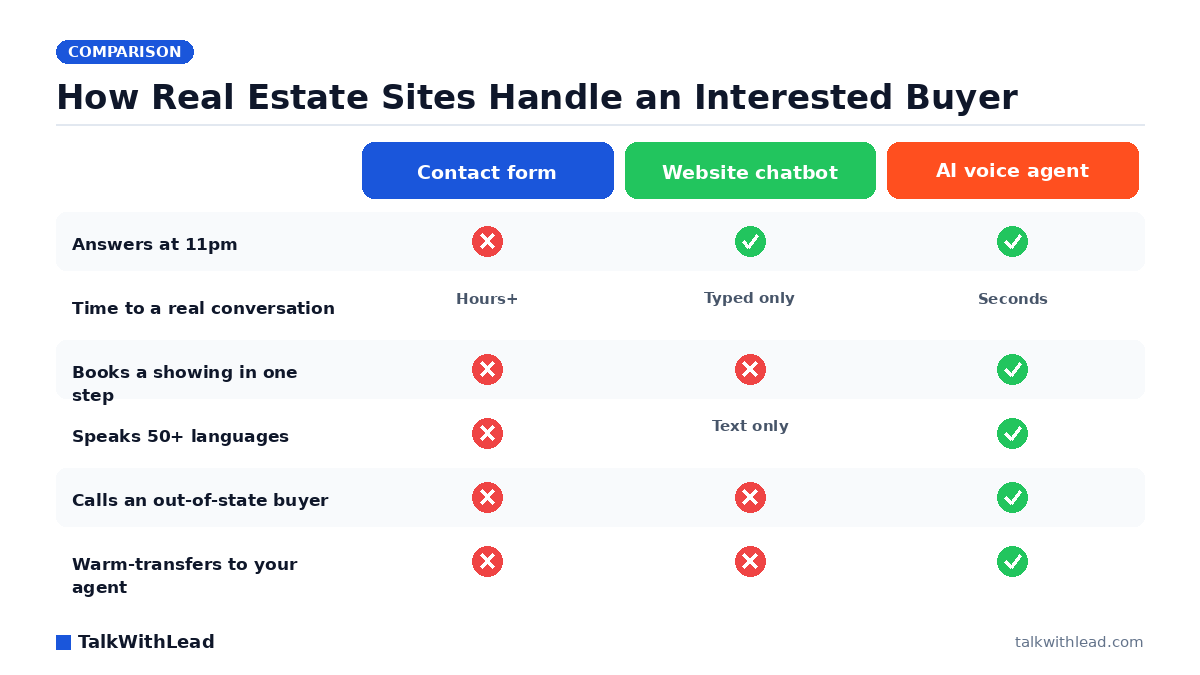
AI voice agent vs form vs chatbot for real estate
Every real estate site already has some way to capture interest. The question is what each one costs you in conversations.
| Dimension | Contact form | Website chatbot | AI voice agent |
|---|---|---|---|
| Response time | Hours to next business day | Instant, but typed | Instant, spoken |
| After-hours coverage | Collects only | Yes | Yes |
| Books a showing in one interaction | No | Sometimes, via a form | Yes, in conversation |
| Handles non-English buyers | No | Text translation | 50+ spoken languages |
| Reaches out-of-area buyers by phone | No | No | Unlimited long-distance calling |
| Transfers to the listing agent | No | Rarely | Instant callback or live bridge |
| Emotional read of the buyer | None | Low | Tone, urgency, objections |
Chatbots are not useless — they are just the wrong shape for a six-figure decision. A buyer weighing a mortgage payment wants a person’s voice, and they want to ask the awkward question out loud. Our deeper breakdown of that trade-off lives in AI Voice Agent vs Chatbot: Which Is Better for Real Estate?, and if you’re comparing widget types specifically, see Click-to-Call vs Callback Widget vs AI Voice Agent.
How much business does a slow response actually cost?
Let’s do labeled, illustrative math — these are assumed rates, not measured results from any client.
Illustrative example. Say a mid-sized brokerage site gets 900 visitors a month and 40 of them show real intent (they click a listing CTA, request info, or start a call). Assume half of that intent arrives outside staffed hours — 20 people. Assume only 1 in 4 of those leave a form and, of those, say 1 in 5 eventually converts to a signed client. That is one client a month from after-hours traffic.
Now assume an AI voice agent picks up all 20 of those after-hours conversations and, say, 1 in 8 becomes a signed client. That is 2.5 clients a month instead of 1. On a modest average commission, the difference is not a rounding error — it is the reason to install the widget this week rather than next quarter.
Want to run your own numbers instead of mine? Use the free missed-call revenue calculator with your own traffic and commission figures. And when you’re ready to see plans, the pricing page lists them plainly.
The five moments an AI voice agent earns its keep in real estate
- The 10pm listing browse. Peak buyer curiosity, zero staff. The agent answers, qualifies budget and timeline, and books tomorrow’s showing.
- The open-house weekend overflow. You’re standing in a kitchen with four people. The website keeps talking to everyone else.
- The relocating buyer. They’re in another state or country. Unlimited long-distance calling means the callback actually happens instead of dying on a toll charge.
- The non-English-speaking family. A conversation in their language converts; a translated chat window usually does not. See how that plays out in AI Voice in Hindi for Real Estate.
- The comparison shopper. They are on three agents’ sites in one session. The one whose site talks back first usually gets the appointment.
How do you actually put one on a real estate site?
Faster than most agents expect. You add a small script to your site — WordPress, Wix, Squarespace, an IDX-powered template, or a custom build — and the voice widget appears. You then tell it three things: what you sell, what questions it should ask a buyer or seller, and where to route a hot lead.
Practical setup notes worth getting right:
- Route by intent, not by page. A seller asking about a valuation and a buyer asking about a showing should not land in the same bucket.
- Give it your qualifying questions. Pre-approval status, timeline, target neighborhoods, price band. The agent asks them naturally, in conversation.
- Set a handoff rule. Decide when the AI stops and your phone rings — usually a buyer with a timeline under 60 days.
- Keep it on every page, not just Contact. Intent spikes on the listing, not on the form.
You can have this running today with a free signup, and if you’d rather hear it first, the live demo takes under a minute.
Honest verdict: is this right for your brokerage?
Best for: solo agents, small teams, and brokerages whose website gets meaningful traffic but who cannot staff a phone from 7am to 11pm — especially anyone serving relocating, investor, or multilingual buyers.
Not the right fit if: your jurisdiction or brokerage policy requires a licensed human on every first contact with a consumer, you get so few web visitors that a personal callback is already instant, or your leads come almost entirely from referrals rather than your site.
The honest framing is this: an AI voice agent does not replace a good agent. It replaces the silence between the visitor’s interest and your availability — and in real estate, that silence is where most deals quietly die. If you’re weighing it against the widget you already have, Live Chat Alternative for Real Estate Agents compares them side by side.
FAQ
What is an AI voice agent for a real estate website?
It’s a widget that lets a website visitor start a spoken conversation with a human-sounding AI. It answers questions about listings, qualifies the buyer or seller, books showings, and can call or transfer the lead to your agent instantly — 24 hours a day.
Do AI voice agents work better than chatbots for real estate leads?
For high-value, emotional decisions like a home purchase, voice generally moves people further in one interaction. A buyer will ask an awkward question out loud that they’d never type, and a showing can be booked inside the conversation instead of through a follow-up form.
Can an AI voice agent speak to buyers in other languages?
Yes. TalkWithLead’s voice agent handles conversations in 50+ languages, which matters for relocating families, international investors, and any market where buyers prefer their first language over English.
Will it call buyers who are out of state or overseas?
Yes — unlimited long-distance calling is included, so an instant callback reaches a buyer in another state or country the same way it reaches a local one. That’s often the difference between capturing a relocation lead and losing it.
How fast should a real estate lead be contacted?
As close to immediately as you can manage. Harvard Business Review research found companies that reach a web lead within an hour are nearly 7× more likely to qualify it than those that wait even an hour longer, per their study of online sales leads. More detail in Speed to Lead Real Estate.
How long does it take to set up on my site?
Adding the script is a few minutes on most platforms, including WordPress and hosted IDX sites. Configuring your qualifying questions and routing rules typically takes another sitting — you can start with a free signup and adjust the script as you learn what buyers ask.
Let’s Turn More Website Visitors Into Sales Conversations
TalkWithLead is the AI voice-first lead-conversion platform behind hundreds of high-intent business websites. See it on your own number in a 15-minute live demo, or spin one up free and have it running before lunch.