
In this article
- Why real estate leads die between the listing page and the phone call
- What does AI voice-first lead conversion for real estate actually do?
- Voice vs. form vs. chatbot: which converts a property inquiry?
- What is a missed after-hours inquiry actually worth?
- How do you roll it out on a real estate site without breaking anything?
- The mistakes that make voice underperform
- FAQ
Why real estate leads die between the listing page and the phone call
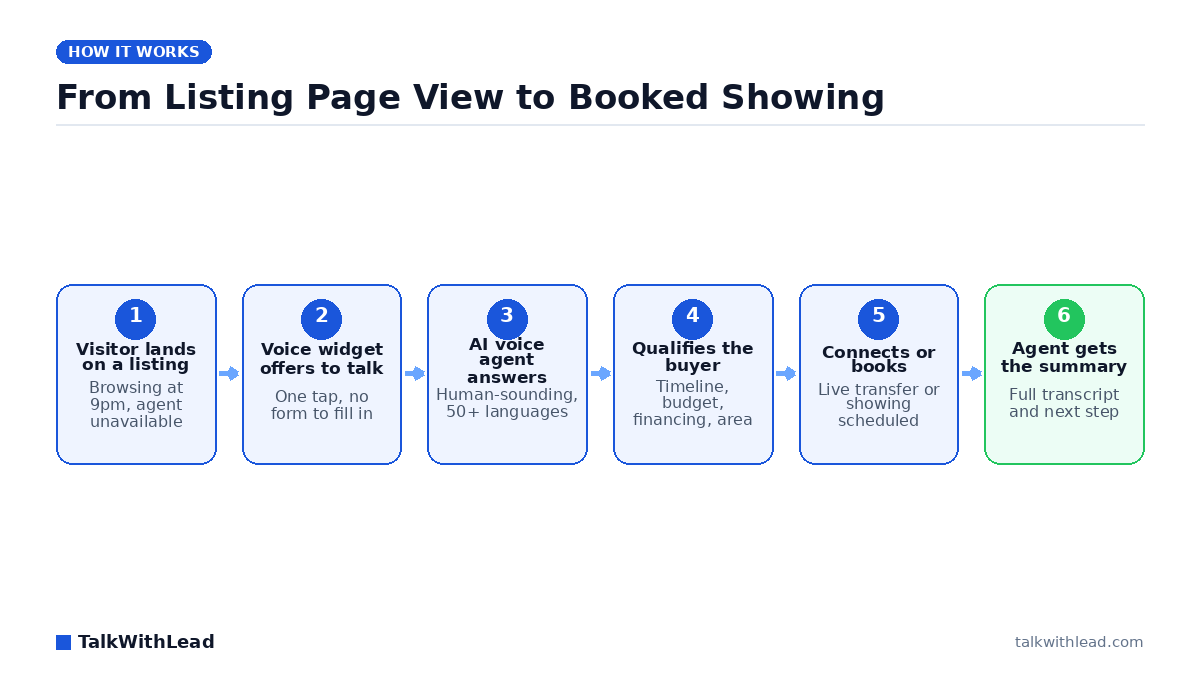
A buyer finds your listing at 9:14pm, wants to know if the basement is finished and whether the seller will take an offer under asking, and there is nobody to ask. They fill in a form, or they don’t, and then they open the next tab. That gap between interest and conversation is where most agents quietly lose their pipeline.
TL;DR: AI voice-first lead conversion for real estate replaces the contact form with an AI voice agent that answers the website visitor by phone within seconds, at any hour, in 50+ languages. It asks the qualifying questions a good agent would ask — timeline, budget, financing, neighbourhood — then transfers the live call to you or books the showing directly. The lead becomes a conversation instead of an email you answer tomorrow.
Speed is not a soft advantage in this business. According to Harvard Business Review research, companies that reach a web lead within an hour are nearly 7× more likely to qualify it than those that wait even an hour longer. Real estate compresses that further: the buyer who wants to see a house this weekend is calling three agents tonight, and the first real voice usually gets the showing.
What does AI voice-first lead conversion for real estate actually do?
It puts a voice option on every listing page, every neighbourhood guide, and every home-valuation page. The visitor taps once. An extremely human-sounding AI voice agent picks up immediately and holds a real conversation — not a scripted menu, not a text box that replies with links.
In a single call the agent can:
- Answer property-level questions the visitor is stuck on (square footage, taxes, HOA, showing availability).
- Qualify the buyer: are they pre-approved, are they selling first, what’s their timeline, what’s their range.
- Route the call — hot buyer transferred live to you, everyone else booked into a slot or handed a callback time.
- Handle the whole thing in the visitor’s own language, across 50+ of them.
- Reach the caller anywhere, because long-distance calling is unlimited — relocation buyers and overseas investors are not a cost problem.
You wake up to transcripts and booked showings instead of a form-fill queue. If you want to hear how it sounds before believing any of that, take the Live Demo — it’s the fastest way to judge whether the voice passes as human.
Voice vs. form vs. chatbot: which converts a property inquiry?
Every agent site already has a form. Many have added a chatbot. Both collect text and both hand the buyer a wait. Here is the honest comparison on the dimensions that decide whether a showing gets booked.
| Capability | Contact form | Website chatbot | AI voice agent |
|---|---|---|---|
| Response to the visitor | Hours or next day | Instant text | Instant live call |
| Buyer effort | Type 5 fields | Type back and forth | One tap, then talk |
| Qualifies budget & timeline | Rarely | Sometimes, if they stay | Yes, conversationally |
| Handles a non-English buyer | No | Translated text | 50+ spoken languages |
| Books the showing on the spot | No | Link handoff | Yes, or live transfer |
| Works at 9pm and on weekends | Collects only | Collects only | Full conversation |
The pattern is consistent: text channels capture a name, voice channels capture a decision. That gap is bigger in real estate than almost anywhere else, because the purchase is emotional and the questions are specific to one property. We broke the mechanics down further in AI Voice Agent vs Chatbot: Which Is Better for Real Estate? and compared the widget formats in Click-to-Call vs Callback Widget vs AI Voice Agent.
Best for: agents, teams, and brokerages whose listing pages get real traffic but whose leads arrive as unanswered form-fills, especially outside business hours.
Not the right fit if: your site gets almost no organic or portal traffic yet — fix demand first, because a voice agent converts visitors you already have; it doesn’t create them.
What is a missed after-hours inquiry actually worth?
Run the math on your own numbers rather than trusting a vendor’s. Here is an illustrative example — the rates are assumptions, not measured results:
- Say your listing pages get 900 visitors a month and 40 of them try to make contact.
- Assume half of those attempts land outside your working hours, so 20 sit unanswered overnight.
- Picture a quarter of those overnight inquiries being serious buyers — on that assumption, 5 real opportunities a month.
- Assume you convert 1 of those 5 into a transaction and your side of the commission is $9,000.
That single recovered deal dwarfs the cost of answering the phone automatically. Plug your own figures into the free missed-call revenue calculator and the speed-to-lead ROI calculator — no email required. Plan pricing is published openly on the pricing page, so you can compare the monthly cost against one commission and decide in about a minute.
The unanswered-call problem is well documented outside real estate too. A 411 Locals study of 85 small businesses across 58 industries found only 37.8% of incoming calls were answered by a live person — meaning roughly 6 out of 10 calls went unattended. Real estate has no structural immunity to that.
How do you roll it out on a real estate site without breaking anything?
Start narrow and let the transcripts teach you. A practical sequence:
- Put voice on your highest-intent pages first — individual listings, home valuation, and “schedule a showing.” Those visitors already have a question.
- Write the qualifying script like your best buyer’s-agent call. Motivation, timeline, financing, area, must-haves. Five questions, not fifteen.
- Define the transfer rule. Pre-approved and touring this week goes straight to your cell. Everything else gets booked or scheduled for a callback.
- Turn on multilingual immediately if you serve any relocation, investor, or immigrant buyer segment. See AI Voice in Spanish for Real Estate for what that changes in practice.
- Read the transcripts weekly. The questions buyers keep asking are your next listing description edits and your next blog posts.
Nothing here requires ripping out your CRM or your IDX. The widget sits on the site, the calls flow to your phone, and the summaries land in your inbox. You can have it live on your listing pages today with a free signup, then decide after a week of real transcripts whether the calls are worth keeping.
The mistakes that make voice underperform
Voice is not magic, and a few setup errors reliably waste it. Agents who get poor results almost always made one of these choices:
- Hiding the voice option below the fold. If the buyer has to scroll past the photo gallery to find it, they won’t.
- Over-qualifying. A twelve-question interrogation on a first call kills the very interest you captured. Get enough to route, then hand off.
- No live-transfer path. If a genuinely hot buyer can never reach a human on that call, you’ve built a nicer form.
- Ignoring the after-hours window. Evening and weekend traffic is exactly when portals send browsers to your site and exactly when competitors are also unavailable.
- Treating multilingual as optional. A buyer who can ask questions in their first language stays on the call longer and stays with the agent who let them.
For a wider view of how voice compares against the older widget options agents still run, AI Voice Agent vs Callback Widget vs Live Chat covers what each one actually converts.
FAQ
What is AI voice-first lead conversion for real estate?
It’s a website setup where the primary conversion action is a live phone conversation instead of a form submission. A visitor on a listing page taps once, an AI voice agent answers immediately, qualifies them, and either transfers the call to the agent or books a showing.
Will buyers realize they are talking to an AI?
The voice is designed to sound human and conversational rather than robotic or menu-driven, and the agent identifies itself honestly when asked. Most callers care far more that someone picked up at 9pm and answered their question than about who was on the line.
Can it handle buyers who don’t speak English?
Yes — it converses in 50+ languages, so a relocation or overseas buyer can ask about a property in their own language. Combined with unlimited long-distance calling, out-of-area buyers stop being a cost or a language problem.
Does this replace my real estate agent or ISA?
No. It replaces the dead time between a website inquiry and a human conversation. The AI answers instantly and filters, then hands you buyers who are already qualified — so your calling hours go to people who are ready to tour.
How fast should I respond to a new property inquiry?
As close to immediately as you can manage. The MIT Lead Response Management study found you’re about 21× more likely to qualify a lead contacted within 5 minutes than one contacted at 30 minutes. An always-on voice agent makes that response time the default rather than a personal discipline problem.
What does it cost to add voice to a real estate website?
Plans are published on the pricing page, and the practical test is simple: compare a month of service against one side of one commission. You can start on a free signup and hear it on your own listings before committing.
Let’s Turn More Website Visitors Into Sales Conversations
TalkWithLead is the AI voice-first lead-conversion platform behind hundreds of high-intent business websites. See it on your own number in a 15-minute live demo, or spin one up free and have it running before lunch.