
In this article
- The Showing Goes to Whoever Talks to the Buyer First
- Why Does Speed Decide Real Estate Deals?
- AI Voice Agent vs Chatbot for Real Estate: Head-to-Head
- What Can an AI Voice Agent Do That a Chatbot Can’t?
- Where Does a Chatbot Still Make Sense?
- The Math: What Is One Missed Buyer Worth?
- How to Put an AI Voice Agent on Your Real Estate Site
- FAQ
The Showing Goes to Whoever Talks to the Buyer First
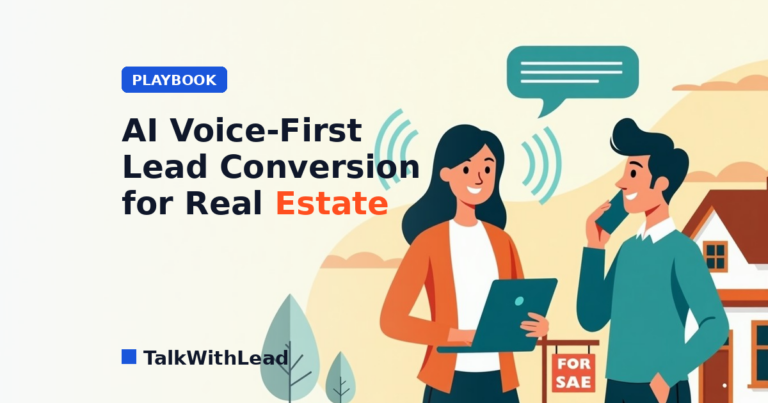
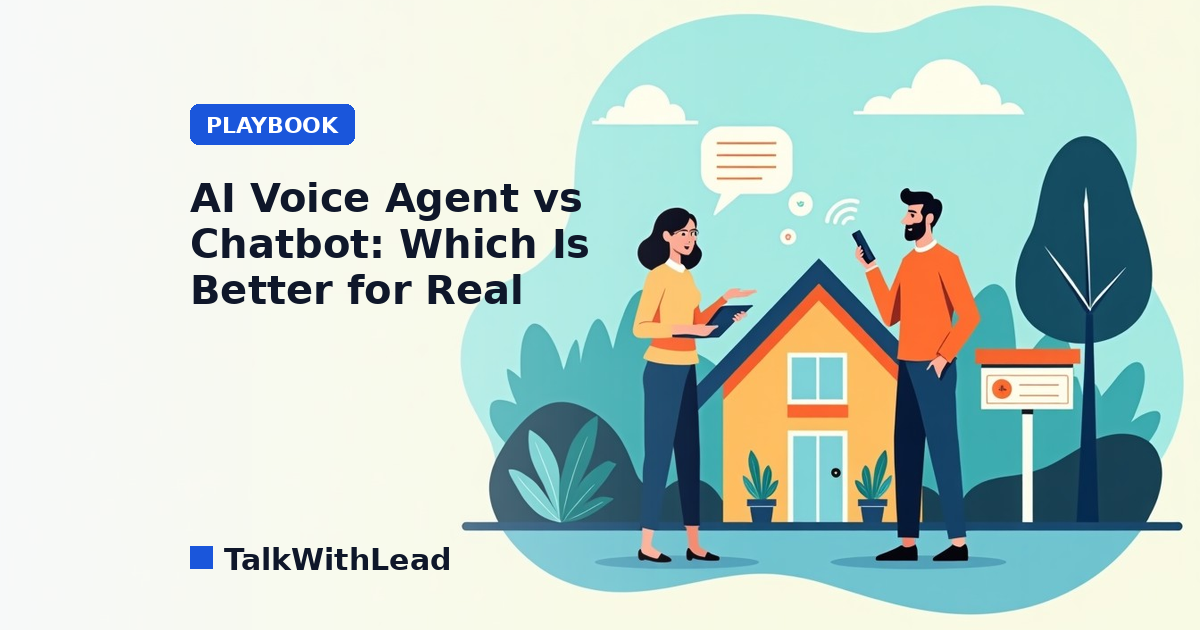
A buyer lands on your listing page at 9:40 p.m., ready to ask about a showing. What happens next decides whether that commission is yours or your competitor’s. That is the real question behind the ai voice agent vs chatbot for real estate debate: which one turns that late-night visitor into an actual conversation before they open the next agent’s website?
TL;DR: For real estate, an AI voice agent beats a chatbot for lead conversion. Voice engages the visitor in a real spoken conversation within seconds, qualifies budget, timeline, and financing, and books the showing in one step. A chatbot makes a motivated buyer type through a scripted menu — and motivated buyers don’t wait. Chatbots still work for low-stakes FAQ deflection, but the appointment goes to voice.
Why Does Speed Decide Real Estate Deals?
Real estate is the ultimate speed-to-lead business. Buyers shortlist several agents in one sitting, and sellers interviewing listing agents often sign with the first one who responds like a professional. The MIT Lead Response Management study found you’re about 21× more likely to qualify a lead contacted within 5 minutes than one contacted at 30 minutes. Five minutes is generous — a website visitor who gets no human-feeling response often leaves in under one.
A chatbot technically “responds” instantly, but it responds with a widget the buyer has to operate: click a bubble, pick from canned options, type answers on a phone keyboard. That’s homework, not a conversation. An AI voice agent flips it — the visitor talks, the agent talks back in a natural human-sounding voice, and inside two minutes you know whether this is a pre-approved buyer who wants a Saturday showing or someone six months from a decision. We break down the response-time math in Speed to Lead Real Estate: Book More Showings.
AI Voice Agent vs Chatbot for Real Estate: Head-to-Head
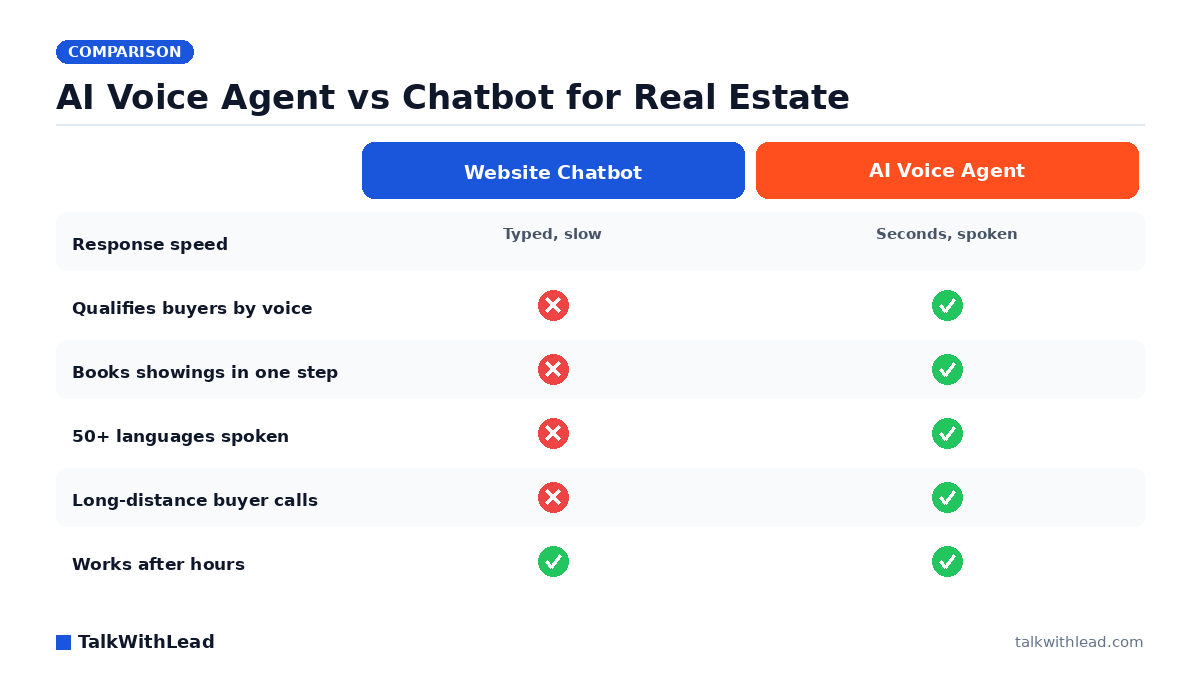
Here’s how the two options compare on the dimensions that actually move commissions:
| Dimension | Website Chatbot | AI Voice Agent |
|---|---|---|
| Interaction | Typing through scripted menus | Natural spoken conversation |
| Time to real engagement | Minutes of typing, often abandoned | Seconds — visitor just talks |
| Qualification depth | Shallow; buyers quit long forms-in-disguise | Budget, timeline, area, pre-approval in one call |
| Emotional read | None — text can’t hear urgency | Hears hesitation, urgency, seriousness |
| Languages | Text translation, robotic feel | Speaks 50+ languages naturally |
| Out-of-town buyers | Same typed widget | Unlimited long-distance calling, instant callbacks |
| After-hours coverage | Yes, but low completion | Yes, with showing requests captured by voice |
| Best use | Deflecting simple FAQs | Converting visitors into phone conversations |
Notice the pattern: everywhere the stakes are low, the chatbot is fine. Everywhere money changes hands — qualification, trust, booking — voice wins. That pattern isn’t unique to property; it shows up across industries in our conversion-rate comparison of voice agents and chatbots.
What Can an AI Voice Agent Do That a Chatbot Can’t?
Qualify like a top producer. A good buyer-qualification conversation covers price range, neighborhoods, timeline, financing status, and whether they’re working with another agent. Ask that through a chatbot and you’ve rebuilt a web form with extra steps. A voice agent asks it the way you would — conversationally, in order, adapting to the answers — and the buyer answers because talking is effortless.
Speak the buyer’s language — literally. Real estate is a multilingual business. Relocating families, international investors, and first-generation buyers routinely prefer to discuss a six-figure purchase in their first language. A voice agent that handles 50+ languages greets a Spanish-, Hindi-, or French-speaking visitor in their own language on the spot. We’ve covered vertical examples in AI Voice in Hindi for Real Estate.
Reach buyers who aren’t local. The buyer for your lakefront listing might be two time zones away. Unlimited long-distance calling plus instant callbacks means a visitor in another state — or another country — taps once and is on a real call with your AI agent, no international dialing friction, no “we’ll email you back.”
Capture the after-hours flood. Portals push traffic at night and on weekends, exactly when you’re at showings or asleep. A voice agent answers every one of those visits like a sharp assistant who never clocks out, then hands you a qualified summary and a booked slot.
Want to hear how human it sounds before you believe any of this? Try the live demo — talk to the agent yourself for two minutes.
Where Does a Chatbot Still Make Sense?
An honest comparison admits the chatbot’s lane. If your main need is deflecting repetitive typed questions — “what are your office hours,” “do you handle rentals” — a chatbot does that cheaply. Some brokerages also use chat as a quiet-channel option for visitors browsing from an open-plan office who can’t speak out loud.
But be honest about what a chatbot on a real estate site usually is: a slower form. The visitor does the work, the answers are shallow, and the handoff to a human still takes hours. If you’re weighing text-based options, our breakdown of live chat vs chatbot covers where each stalls — and why voice is the upgrade path for both.
Best for: agents, teams, and brokerages whose revenue depends on booked showings and listing appointments, especially with after-hours traffic, out-of-town buyers, or multilingual markets.
Not the right fit if: your website exists only to answer typed FAQs and you genuinely don’t want more phone conversations — a simple chatbot or FAQ page covers that for less.
The Math: What Is One Missed Buyer Worth?
Run an illustrative example — your numbers will differ, so plug in your own. Say your site gets 600 visitors a month and, like most real estate sites, the vast majority leave without ever making contact. Imagine a voice agent starts real conversations with just 30 of them — 5% — and a third of those turn into qualified buyer or seller appointments. That’s roughly 10 extra appointments a month. Now assume your average commission is $9,000, and say even one in ten of those appointments eventually closes — under those stated assumptions, that’s one additional closing a month: about $9,000 in GCI your website was quietly leaking.
Those are stated assumptions, not promises — which is exactly why we built a free calculator so you can use your own traffic and commission numbers: estimate what missed conversations cost you here. And the urgency behind the math is well documented: according to Harvard Business Review research, companies that reach a web lead within an hour are nearly 7× more likely to qualify it than those that wait even an hour longer.
How to Put an AI Voice Agent on Your Real Estate Site
Getting started is deliberately boring:
- Add the widget. One snippet on your site — no rebuild, works alongside your IDX pages.
- Teach it your business. Service areas, buyer and seller qualification questions, showing availability, languages you serve.
- Turn it on. Visitors talk to a human-sounding voice agent in seconds, or request an instant callback; you get qualified conversations and booked appointments instead of anonymous traffic.
Check plans and pricing — then weigh it against the value of a single extra closing. When you’re ready, start your free signup and have a voice agent answering your website today.
FAQ
Is an AI voice agent better than a chatbot for real estate?
For converting website visitors into showings and listing appointments, yes. A voice agent starts a spoken conversation in seconds and qualifies budget, timeline, and financing naturally, while a chatbot asks a motivated buyer to type through a menu. Chatbots remain fine for simple typed FAQs, but the appointment-generating work belongs to voice.
Will an AI voice agent sound robotic to my buyers?
Modern AI voice agents are strikingly human-sounding — natural pacing, tone, and back-and-forth rather than the flat text-to-speech of a decade ago. The fastest way to judge is to talk to one in the live demo and decide with your own ears.
Can an AI voice agent qualify real estate leads?
Yes. It asks the same questions a sharp assistant would — price range, preferred areas, timeline, pre-approval status, whether they’re already working with an agent — and hands you a summary with the appointment. Because the buyer is speaking instead of typing, they answer more questions and abandon far less often than they do with forms or chat flows.
What happens with leads that come in after hours?
The voice agent answers them the moment they engage — nights, weekends, holidays. It holds the conversation, qualifies the lead, books the showing request or offers an instant callback, and you wake up to a qualified appointment instead of a stale form fill from eleven hours ago.
Does an AI voice agent work for international or out-of-town buyers?
Yes, and this is a real edge in property. It speaks 50+ languages naturally, and unlimited long-distance calling with instant callbacks means a buyer in another state or country connects with one tap — no dialing costs, no time-zone email tag.
Do I still need a contact form if I add a voice agent?
You can keep one as a fallback, but treat it as the slow lane. The voice agent becomes the primary path because it converts intent while it’s hot; the form catches the small group who genuinely prefer to write. Most agents find the voice conversations are where the appointments actually come from.
Let’s Turn More Website Visitors Into Sales Conversations
TalkWithLead is the AI voice-first lead-conversion platform behind hundreds of high-intent business websites. See it on your own number in a 15-minute live demo, or spin one up free and have it running before lunch.