TalkWithLead
AI Voice-First Lead Conversion

AI Voice Agents That Turn Website Visitors Into Real Conversations

TalkWithLead is the AI voice-first widget that picks up the phone the moment a visitor lands on your site. Multilingual, extremely human-sounding, with unlimited long-distance calling so prospects anywhere can call you back. More calls. More leads. More closed deals.

Extremely human-sounding voice 50+ languages out of the box Unlimited long-distance calling Instant callback widget

Author: TalkWithLead Editorial Team

  • AI Voice-First Lead Conversion for Law Firms

    AI Voice-First Lead Conversion for Law Firms

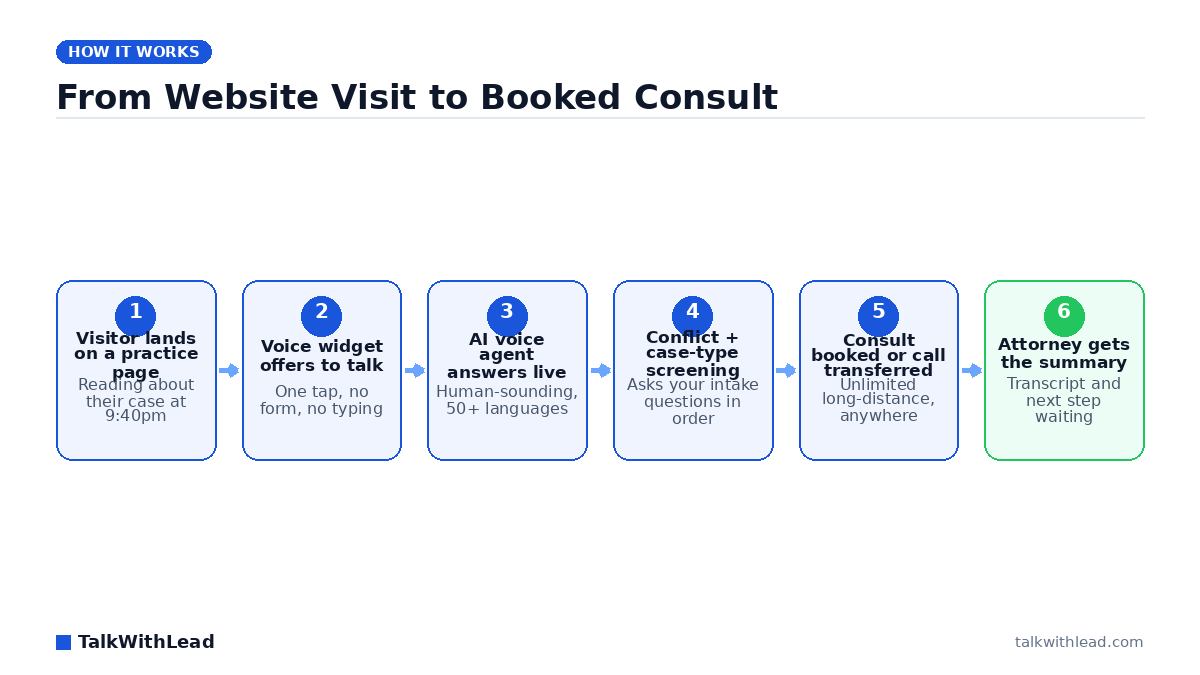
    From Website Visit to Booked Consult — TalkWithLead original infographic (flow diagram).
    From Website Visit to Booked Consult

    A person who just got rear-ended does not fill out a contact form and wait. They open three law firm websites, and they retain whichever one actually picks up. If your site answers with a text box and a promise to respond within one business day, you already lost that case.

    AI voice-first lead conversion for law firms means the website itself starts a real phone conversation instead of collecting a form. A human-sounding AI voice agent answers the visitor within seconds, screens the matter using your intake script, speaks 50+ languages, and either books the consult or connects the caller straight to an attorney over unlimited long-distance calling. The result is a live intake call rather than a lead sitting in an inbox overnight.

    Why legal intake breaks at exactly the wrong moment

    Most firms have decent traffic and terrible capture. The receptionist is at lunch, in a deposition prep, or gone at 5:01. Meanwhile the highest-value legal searches — accident, arrest, eviction, custody emergency — happen at night and on weekends, because that is when bad things happen to people.

    The gap is not marketing spend. It is answering. According to a 411 Locals study of 85 small businesses across 58 industries, only 37.8% of incoming calls were answered by a live person — meaning roughly 6 out of 10 calls went unattended. Apply that pattern to a personal injury practice and the leak is not a rounding error; it is the case list.

    Voicemail makes it worse. A prospective client who reaches a recording rarely leaves a message. They go back to the search results and click the next firm.

    How does AI voice-first lead conversion work for a law firm website?

    A voice widget sits on your practice-area pages. When a visitor taps it, an AI voice agent answers immediately and talks — no typing, no queue, no “an agent will be with you shortly.” It introduces the firm, asks what happened, and walks the caller through the same qualifying questions your intake coordinator would ask: date of incident, jurisdiction, injuries, insurance, opposing party, prior counsel.

    From there it does one of three things: book a consult on the calendar, transfer the call live to whoever is on rotation, or trigger an instant callback if the caller wants a moment. Every conversation lands as a transcript and summary so an attorney reads the matter in thirty seconds instead of re-interviewing the client. You can hear the difference in tone on the live demo — the voice is the whole product, so it is worth listening to before deciding.

    The mechanics of what makes voice convert are broken down further in AI Voice Agents for Law Firms Websites and in Law Firm Intake Automation for Lawyers.

    Voice agent vs chatbot vs contact form vs answering service

    Firms usually have one of four things on the site. They are not equivalent.

    CapabilityContact formWebsite chatbotHuman answering serviceAI voice agent
    Response timeHours to a dayInstant, in textRing queueSeconds, in voice
    Answers at 2amNoYesSometimesYes
    Actually a phone conversationNoNoYesYes
    Follows your intake script every timeNoPartlyVaries by repYes
    Languages coveredOneText onlyLimited50+ spoken
    Long-distance / out-of-state callerN/AN/AMeteredUnlimited
    Scales at 11pm FridayN/AYesCostlyYes

    Best for: firms that already get meaningful website traffic and know they are missing calls after hours, during hearings, or in a second language.

    Not the right fit if: your intake volume is tiny and a single paralegal answers every call within one ring — then the gain is marginal, and you should fix marketing before intake.

    What does the missed-case math actually look like?

    Here is an illustrative example, not a client result. Say a firm gets 600 website visitors a month and 90 of them tap to talk. Assume half arrive outside staffed hours, so 45 conversations currently die in voicemail or a form. Now assume a conservative signing rate of 12% on those conversations — that would be roughly 5 or 6 cases a month never opened. Put your own average case value against that number and the intake gap stops being an operations detail.

    Run your own version with the free missed-call revenue calculator, which uses your inputs rather than ours. On cost framing: an AI voice agent is priced as a flat monthly subscription rather than per-minute or per-lead, which is the opposite of how most answering services bill — see current tiers on the pricing page. Firms comparing the two models will also want AI Receptionist vs Human Answering Service Cost.

    Speed is the whole game in legal intake

    Response time is the single lever with the most evidence behind it. The MIT Lead Response Management study found you’re about 21× more likely to qualify a lead contacted within 5 minutes than one contacted at 30 minutes. Legal is a harsher version of that curve, because a claimant with a fresh injury is calling several firms in one sitting.

    A voice-first widget collapses that window to zero. There is no form submission, no CRM routing delay, no callback queue. The visitor is talking while they are still on the page reading about your practice area — which is the moment their intent is highest and their comparison shopping has not started yet.

    Multilingual intake is a case-volume decision, not a nicety

    A Spanish-speaking construction worker with a workplace injury is a serious matter, and most firms lose that call at hello. Same with Mandarin, Punjabi, Tagalog, Haitian Creole. Hiring bilingual intake staff for every language your market speaks is not realistic. An AI voice agent that handles 50+ languages simply answers in whatever the caller speaks, screens the matter, and hands your attorney a summary in English.

    Unlimited long-distance matters for the same structural reason. Mass tort, class action, and multi-state practices get calls from everywhere, and metered per-minute answering costs quietly discourage the long screening conversations that surface the best cases.

    Rolling it out without disrupting the firm

    Start narrow and measure. A practical sequence:

    • After-hours only first. Let staff keep daytime calls; point evenings, weekends, and holidays at the voice agent. This is where the leaked value already sits.
    • Load your real intake script. Conflict-check questions, case-type disqualifiers, statute-of-limitations screening, jurisdiction. The agent should ask what your best intake coordinator asks.
    • Set clear escalation. Certain triggers — a caller in custody, an imminent filing deadline — should transfer to a human immediately rather than book a Tuesday consult.
    • Read the transcripts weekly. They are the cheapest client-research you will ever get, and they tell you which practice pages attract the wrong matters.
    • Then expand to daytime overflow. Second and third simultaneous callers stop hitting hold music.

    Nothing here requires replacing your case management system or retraining staff on new software. The widget goes on the site, the calls route where you say, and the intake team stops losing the ones that arrive at 10pm. You can put it on a practice-area page and watch the first week of transcripts by starting a free signup, or listen to the agent first on the live demo.

    FAQ

    What is AI voice-first lead conversion for law firms?

    It is an intake approach where the firm’s website starts a live phone conversation with a visitor instead of collecting a contact form. An AI voice agent answers in seconds, screens the matter with the firm’s own intake questions, and books a consult or transfers the caller to an attorney.

    Can an AI voice agent handle legal client intake properly?

    For first-touch screening, yes — it asks case type, date of incident, jurisdiction, injuries, and conflict-check questions consistently every time. It is a qualification and scheduling layer, not a substitute for legal advice; attorneys still evaluate the matter and give counsel.

    Will callers know they are talking to an AI?

    The voice is designed to sound natural rather than robotic, and the agent identifies itself as the firm’s virtual intake assistant. Most callers care far more that someone answered at all than about which side of the line is automated.

    How is this different from a website chatbot?

    A chatbot collects typed text and usually ends with “someone will reach out.” A voice agent produces the actual phone conversation the caller wanted. For a fuller side-by-side, see AI Voice Agent vs Chatbot: Which One Books More Calls?

    Does it work for Spanish-speaking or out-of-state callers?

    Yes. The agent handles 50+ spoken languages and includes unlimited long-distance calling, so a Spanish-speaking claimant or an out-of-state inquiry gets a full screening conversation instead of a language barrier or a metered-minute cutoff.

    How much does an AI voice agent cost for a small firm?

    It is billed as a flat monthly subscription rather than per minute or per lead, which makes the cost predictable regardless of call volume. Current tiers are listed on the pricing page, and you can estimate the offsetting value with the missed-call revenue calculator.
  • AI Voice in Mandarin: Win Real Estate Leads You Lose

    AI Voice in Mandarin: Win Real Estate Leads You Lose

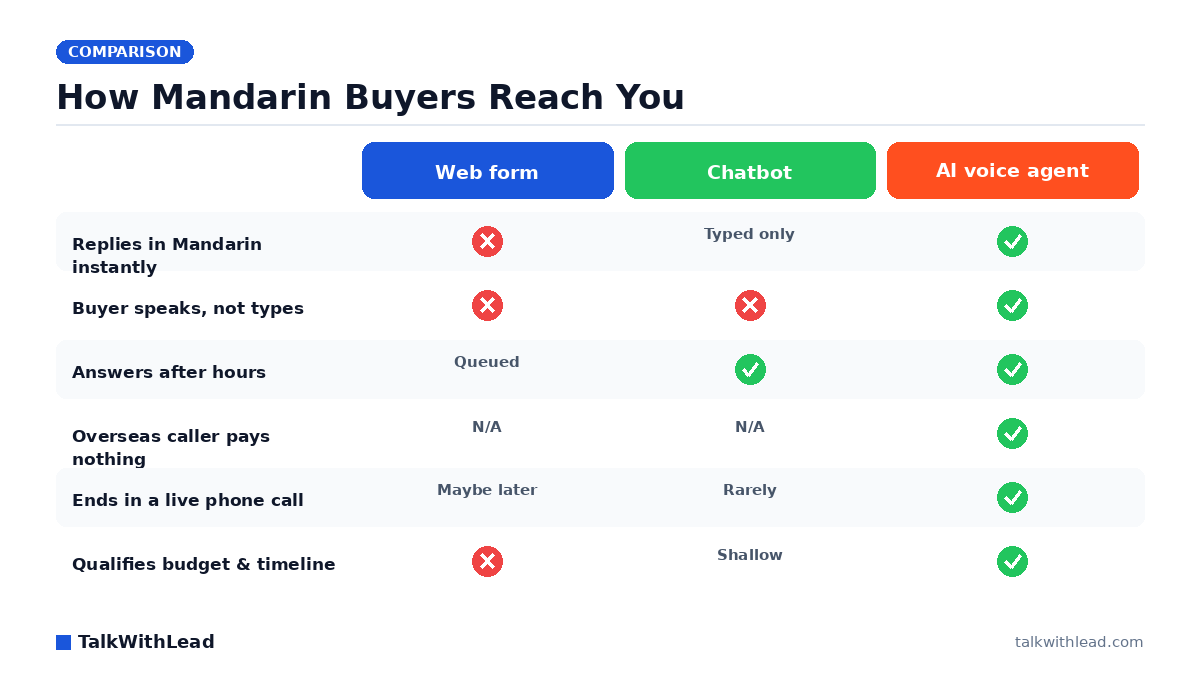
    How Mandarin Buyers Reach You — TalkWithLead original infographic (comparison diagram).
    How Mandarin Buyers Reach You

    A Mandarin-speaking buyer lands on your listing page at 9:40pm, reads the price in English, and has three questions she’d rather ask out loud in Mandarin: is the school catchment confirmed, is the seller flexible on closing, and can she see it Saturday. Your site offers her a form. She closes the tab and messages an agent from a WeChat group instead. That’s the exact leak ai voice in mandarin for real estate closes.

    TL;DR: An AI voice agent on your real estate website answers Mandarin-speaking visitors in Mandarin, out loud, the moment they ask — no form, no typing, no waiting for business hours. It qualifies budget, timeline, and neighbourhood, then connects a warm caller to your agent or books the showing. With 50+ languages and unlimited long-distance calling, an overseas or out-of-province buyer reaches you free.

    Why Mandarin-speaking buyers vanish from your funnel

    Mandarin buyers are not hard to reach. They are hard to hold. Many browse listings comfortably in English — MLS photos and square footage translate fine — but the decision conversation happens in Mandarin, often with a spouse, a parent, or an investor back home on the call. The instant your site forces that conversation into an English text box, you’ve asked the buyer to negotiate the biggest purchase of their life in their second language.

    The other half of the problem is distance. A parent in Shanghai buying a condo for a student in Toronto is not going to dial an international number to ask about parking. Picture a listing page that gets 200 Mandarin-speaking visitors a month and captures a dozen forms. Say even two of those silent visitors were pre-approved and ready — that’s two deals a month leaving through a gap you can’t see in your analytics, because non-conversions don’t fill anything in.

    What does an AI voice agent in Mandarin actually do?

    It picks up. A visitor taps the widget, speaks in Mandarin, and gets a human-sounding voice back in Mandarin within seconds — not a menu tree, not a canned translation, an actual conversation. The agent covers the questions your team answers forty times a week: price, taxes, condo fees, closing timeline, whether the unit is tenanted, when a showing is available.

    From there it does the part that matters to your business. It qualifies — budget range, financing status, purchase timeline, buyer vs. investor — and then either warm-transfers the call to whoever is on duty or books the showing and drops the details to your agent. Because it runs on unlimited long-distance calling, the buyer in Shanghai and the investor in Vancouver both reach you at no cost to them. You can hear it work on the live demo before you decide anything.

    The same logic applies across every language your market speaks. We’ve written the parallel playbooks for Spanish-speaking buyers and Hindi-speaking buyers — same mechanism, different market.

    Mandarin AI voice vs. chatbot vs. translated form

    Most brokerages have already tried a fix. A translated contact form. A chatbot with a Mandarin toggle. Both fail for the same reason: they keep the buyer typing, and typing is slow, formal, and easy to abandon at 9:40pm.

    DimensionTranslated web formChatbot with Mandarin toggleAI voice agent (TalkWithLead)
    Response speedHours to next morningInstant, but textInstant, spoken
    Buyer’s effortType 6 fieldsType back and forthJust talk
    Handles follow-up questionsNoScripted, shallowOpen conversation
    After-hours coverageQueuedYesYes
    Overseas caller costN/AN/AFree (unlimited long distance)
    Languages supportedWhatever you translatedUsually a handful50+
    Ends in a live phone callMaybe, days laterRarelyWarm transfer or booked showing

    Best for: brokerages and agents whose listing pages already draw Mandarin-speaking traffic — urban condo markets, school-catchment neighbourhoods, student-housing corridors, and pre-construction investor inventory.

    Not the right fit if: your Mandarin traffic is negligible, or your team genuinely cannot take a transferred call and has no one to route to. Voice creates conversations; you still need someone to close them. If you’re weighing the general case first, our AI voice agent vs. chatbot for real estate breakdown covers it.

    How fast do you actually have to respond?

    Faster than you think, and the research is consistent about it. The MIT Lead Response Management study found you’re about 21× more likely to qualify a lead contacted within 5 minutes than one contacted at 30 minutes. According to Harvard Business Review research, companies that reach a web lead within an hour are nearly 7× more likely to qualify it than those that wait even an hour longer.

    Now layer language on top. A Mandarin-speaking buyer who submits a form at 9:40pm isn’t just waiting until morning — she’s waiting until morning and hoping whoever calls back speaks Mandarin. Two failure points, both removed when the voice agent answers in Mandarin on the spot. Our deeper piece on speed to lead in real estate walks through the timing math.

    An illustrative ROI example (assumptions stated)

    This is math, not a case study — plug your own numbers in. Assume a listing site draws 300 Mandarin-speaking visitors a month and currently converts 4% into a form (12 leads). Assume the voice agent lifts spoken engagement to 9% (27 conversations) because the buyer can just talk. Now assume a 20% conversation-to-showing rate and a 17% showing-to-transaction rate: roughly 5 showings and just under one extra deal a month. At an assumed average commission of $12,000, that’s a materially different year — from one widget on one page.

    Run your own version against your missed-call volume with the free missed-call revenue calculator. Cost framing: an AI voice agent is a flat monthly software line, typically far below the cost of a bilingual receptionist covering evenings and weekends — see current pricing for exact tiers.
    How to roll it out without disrupting your team

    Start narrow and prove it. Pick the one listing or neighbourhood page that already draws the most Mandarin traffic and put the voice agent there first.

    • Week 1: Install the widget on a single high-traffic page. Set the greeting to detect and offer Mandarin.
    • Week 2: Write the qualification script your agents actually use — budget, financing, timeline, buyer vs. investor, preferred showing windows.
    • Week 3: Set routing rules. Who takes a warm transfer during the day? Who gets the after-hours booking summary?
    • Week 4: Review recordings and transcripts. Fix the two or three questions the agent handled weakly.
    • Month 2: Roll it across all listing pages and turn on the additional languages your market speaks.

    The measurement that matters isn’t widget clicks. It’s booked showings from Mandarin-speaking callers, and how many of those existed before you installed anything. You can have the whole thing live on a page today — start free, or take the live demo first and hear how the Mandarin voice actually sounds before you commit a dollar.

    FAQ

    Does the AI voice agent really speak natural Mandarin, or is it translated English?

    It speaks conversationally in Mandarin — the visitor talks, the agent responds out loud in Mandarin with a human-sounding voice, and the exchange flows like a phone call rather than a translation layer. The same agent handles 50+ languages, so a Cantonese or Korean speaker on the same page gets the same experience.

    Can a buyer in China call my listing without paying international rates?

    Yes. Unlimited long-distance calling is part of the platform, so an overseas parent, investor, or relocating buyer connects to you at no cost to them. That removes the single most common reason overseas prospects never dial a North American listing.

    What happens when nobody on my team speaks Mandarin?

    The AI voice agent handles the Mandarin conversation end to end — questions, qualification, showing preferences — and hands your agent an English summary plus a booked appointment. Your team never has to fake a language they don’t speak, and the buyer never has to switch out of hers.

    Is this better than adding a Mandarin option to my chatbot?

    For real estate, generally yes. A chatbot still makes the buyer type, in a second language, about a seven-figure decision, and it rarely ends in a phone call. Voice ends in a conversation with a person, which is where showings actually get booked.

    How much does an AI voice agent cost for a real estate website?

    It’s a flat monthly subscription rather than a per-call or per-minute answering-service bill, and the tiers are published on the pricing page. Compare it against what evening and weekend coverage from a bilingual receptionist would cost you, then weigh it against a single extra closed deal.

    Will it work on my existing website without a rebuild?

    Yes — it’s a widget you add to your existing site, whether that’s a WordPress blog, an IDX listing platform, or a custom brokerage site. Nothing about your listings, forms, or CRM has to change to test it on one page.

  • AI Voice Agents for Law Firms Websites: Win More Cases

    AI Voice Agents for Law Firms Websites: Win More Cases

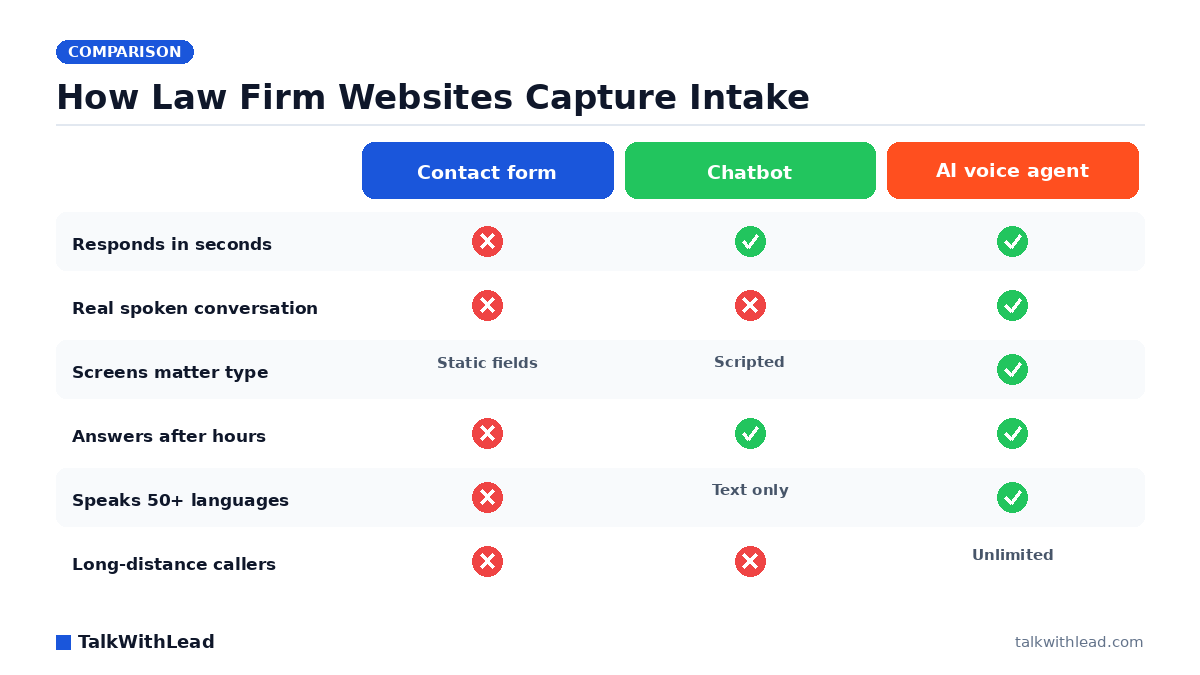
    How Law Firm Websites Capture Intake — TalkWithLead original infographic (comparison diagram).
    How Law Firm Websites Capture Intake

    A person who just got rear-ended, fired, or served with papers does not want to fill out a form. They want to talk to someone right now — and if your website makes them type and wait, they will call the firm three results down the page. That is the exact gap AI voice agents for law firms websites close.

    TL;DR: An AI voice agent on a law firm website answers a visitor by voice within seconds, asks the intake questions a paralegal would ask, screens the matter type and jurisdiction, and either books the consultation or connects the caller to an attorney. It runs after hours, speaks 50+ languages, and places unlimited long-distance calls — so no qualified case is lost to a voicemail box.

    Why law firm websites leak cases

    Most legal sites are built to look credible, not to start conversations. The visitor gets a phone number that rings a front desk between 9 and 5, a contact form that promises a reply “within one business day,” and maybe a chat widget staffed by an offshore typist. Every one of those is a delay, and legal intent does not wait.

    Legal buyers shop in parallel. Picture a personal injury search where a visitor opens four firm websites in four tabs and calls whichever one answers first — that is the ordinary behavior of someone in distress, not an edge case. Research popularized by InsideSales / Dr. James Oldroyd found that roughly 35-50% of sales go to the company that responds first. In legal intake, “responds first” means picks up the phone.

    The other leak is the phone itself. According to a 411 Locals study of 85 small businesses across 58 industries, only 37.8% of incoming calls were answered by a live person — meaning roughly 6 out of 10 calls went unattended. A small firm with two attorneys in depositions all afternoon is exactly the business that study describes.

    What is an AI voice agent on a law firm website?

    It is a widget that sits on every page and, when a visitor taps it, starts a real spoken conversation with an extremely human-sounding AI voice. The visitor talks. The agent listens, answers, and asks the next question. No download, no phone tag, no typing on a cracked phone screen in a hospital parking lot.

    For a law firm, the agent is scripted around intake rather than sales chatter. A practical flow looks like this:

    • Greet and identify the matter — car accident, divorce, employment dispute, immigration, estate.
    • Screen the basics — where the incident happened, roughly when, whether another firm is already involved.
    • Flag urgency — statute deadlines, an arrest, a court date this week.
    • Book or transfer — put a consultation on the calendar, or ring the on-call attorney immediately for a high-value matter.
    • Hand off clean notes — the attorney opens the consult already knowing the story.

    You can hear that flow rather than imagine it — the Live Demo lets you talk to the agent the same way a prospective client would.

    AI voice agent vs chatbot vs answering service for legal intake

    Firms usually compare three options. They are not equivalent.

    DimensionContact formChatbot / live chatHuman answering serviceAI voice agent
    Response timeHours to a daySeconds, by textRings out, then queueSeconds, by voice
    InteractionFieldsTypingPhone callPhone conversation
    After-hours coverCollects onlyUsually scriptedOften premium-pricedAlways on
    Legal-specific screeningStatic questionsShallowDepends on operatorTrained on your intake script
    LanguagesOneText translationLimited bilingual staff50+ spoken
    Out-of-state callersN/AN/AMetered minutesUnlimited long distance
    Cost behaviorLow, low yieldPer seatPer minute / per callFlat subscription

    Best for: solo and small-to-midsize firms that get real website traffic, cannot staff a receptionist past 5pm, and lose consults to whoever answers first.

    Not the right fit if: your practice is referral-only with almost no web traffic, or your matters require privileged, attorney-only first contact from the very first sentence — in that case use voice purely to route and schedule, not to screen.

    If you want the head-to-head on cost specifically, we broke it down in AI Receptionist vs Human Answering Service Cost and Is an AI Receptionist Worth It for a Law Firm?.

    How much is a missed intake call actually worth?

    Legal is unforgiving math because one signed case can outweigh a year of software cost. Here is a labeled illustration, not a claim about any real firm.

    Illustrative ROI example. Assume a firm’s website produces 120 inbound intake attempts a month. Assume half arrive outside staffed hours or while the line is busy — that is 60 unanswered attempts. Say even a small slice of those, imagine roughly one in twelve, was a viable matter, and the firm signs half of the viable ones: that is roughly 2 to 3 signed cases a month never reaching an attorney. At an assumed average case value of $3,000, that is $6,000 to $9,000 of monthly fee revenue leaving through an unanswered phone. Every number in that paragraph is an assumption you should replace with your own.

    Run your own version with the free missed-call revenue calculator — it takes your call volume and case value and shows the gap. The plain framing: an AI voice agent is a flat monthly subscription rather than a per-minute bill, so the cost does not spike in the month your marketing works. Current tiers are on the pricing page.

    Speed to lead is the whole game in legal intake

    Intake speed is not a nice-to-have metric. According to Harvard Business Review research, companies that reach a web lead within an hour are nearly 7× more likely to qualify it than those that wait even an hour longer. A firm that returns Friday-evening form submissions on Monday morning is not competing on that curve at all.

    An AI voice agent collapses the gap to zero because there is no gap — the visitor is already on the site, already motivated, and the conversation starts on the spot instead of being scheduled. The deeper mechanics of that timing advantage are in Speed to Lead: How Fast Should You Call a New Lead?

    Instant callback matters too. Some visitors will not tap a widget but will leave a number. The agent calls them back within seconds rather than adding them to a list someone works through tomorrow.

    Languages and long distance: the cases most firms quietly refuse

    Immigration, personal injury, employment, and family law all draw callers whose first language is not English. Today those calls often end with “can you call back when Maria is in?” — and the caller does not call back. A voice agent that speaks 50+ languages takes that same call in Spanish, Mandarin, Punjabi, Portuguese, or Tagalog, screens it properly, and hands the attorney a summary in English.

    Unlimited long-distance calling covers the other version of the same loss: an out-of-state family member calling about a relative’s accident, or a prospective client who moved. The firm can talk to them without watching a per-minute meter. Our team wrote about the same pattern in other verticals in AI Voice Agent vs Chatbot for Local Businesses.

    How to roll it out without disrupting the firm

    Deployment is a website change, not a practice-management migration. A sane sequence:

    1. Write the intake script you already use. Whatever your paralegal asks in the first three minutes becomes the agent’s script.
    2. Define what the agent must never do. No fee quotes, no legal advice, no opinion on the merits — screen and schedule only.
    3. Set routing rules. High-urgency matter types ring an attorney immediately; everything else books a consult slot.
    4. Install the widget site-wide, with extra prominence on practice-area and “contact” pages where intent peaks.
    5. Review transcripts weekly for the first month and tighten questions that produced vague answers.

    Most firms are live the same week. You can start on the free signup, or talk to the agent first through the Live Demo and decide from there. If you want the intake-automation view rather than the widget view, see Law Firm Intake Automation for Lawyers.

    FAQ

    What is an AI voice agent for a law firm website?

    It is a widget on the firm’s site that starts a spoken conversation with a visitor in seconds. The AI voice screens the matter, captures contact details and case basics, and either books a consultation or transfers the caller to an attorney — 24 hours a day.

    Can an AI voice agent replace my legal receptionist?

    It replaces the unanswered calls, not the person. Most firms keep their receptionist for daytime relationship work and let the agent cover evenings, weekends, lunch hours, and overflow when every line is busy — the windows where intake usually disappears.

    Is it ethical for an AI to handle legal intake?

    Screening and scheduling are administrative tasks that non-attorney staff already perform. The safeguard is scope: configure the agent to identify itself, collect facts, and book time with a lawyer, and explicitly bar it from giving legal advice, evaluating the merits, or quoting fees. Confirm the wording against your jurisdiction’s advertising and unauthorized-practice rules.

    How much does an AI voice agent cost for a small firm?

    TalkWithLead is a flat monthly subscription with unlimited long-distance calling rather than a per-minute answering-service bill, so the cost stays predictable as call volume grows. Current tiers are listed on the pricing page.

    Will it work for Spanish-speaking clients?

    Yes. The agent handles conversations in 50+ languages, so a Spanish-speaking caller gets a full intake conversation instead of a callback promise, and the attorney receives the summary in English.

    How is this different from the chatbot already on my site?

    A chatbot asks a stressed person to type. A voice agent lets them talk, which surfaces detail a text box never captures — tone, urgency, the part of the story they would not have typed. Voice conversations also convert into booked consults because the prospect is already, functionally, on the phone with your firm.

  • AI Voice Agent vs Chatbot for SaaS Sales Teams

    AI Voice Agent vs Chatbot for SaaS Sales Teams

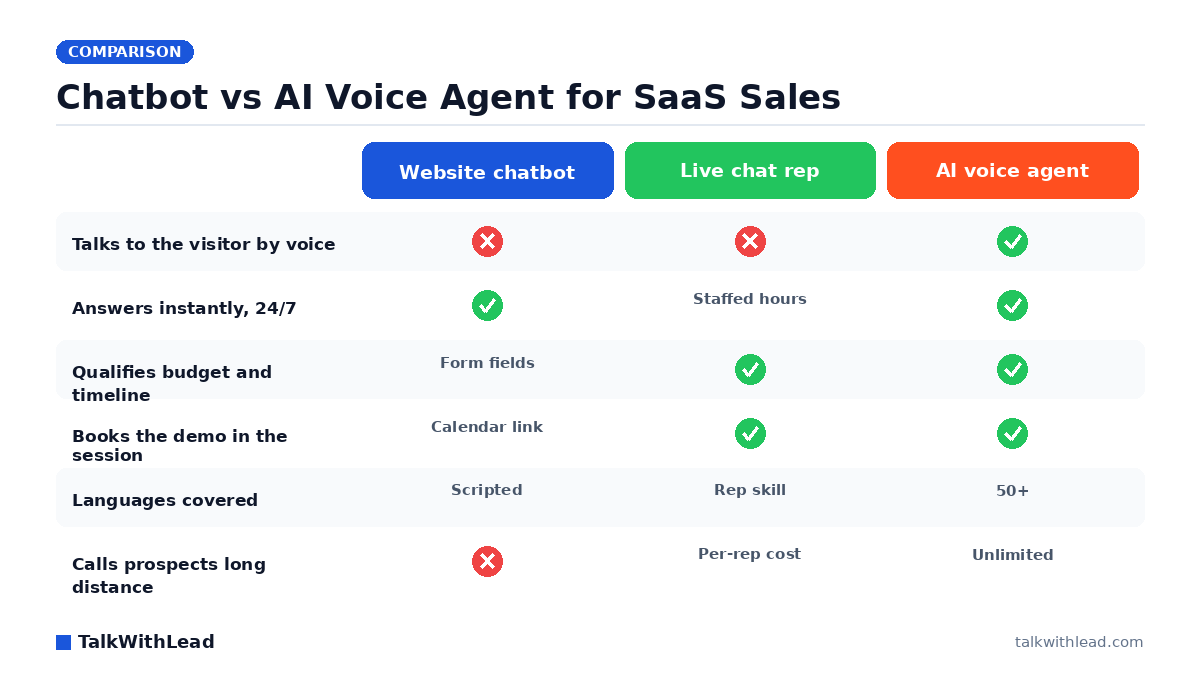
    Chatbot vs AI Voice Agent for SaaS Sales — TalkWithLead original infographic (comparison diagram).
    Chatbot vs AI Voice Agent for SaaS Sales

    Your SaaS pricing page gets the visit, the chatbot bubble pops up, and the buyer types “how much for 20 seats?” Twenty minutes later a rep replies to a form fill and the buyer is already demoing a competitor. That gap is the whole argument in ai voice agent vs chatbot for saas sales teams.

    Short answer: a chatbot is a text-capture tool, while an AI voice agent is a conversation tool. For SaaS sales teams, the voice agent wins on high-intent traffic because it answers the pricing, security, and integration questions out loud in seconds and books the demo inside the same session. Keep the chatbot for documentation and low-intent FAQ deflection.

    What is the real difference between an AI voice agent and a chatbot?

    A chatbot waits for typing. It matches intent to a scripted branch, hands over an email field, and hopes the buyer stays. Every extra message is another exit point, and buyers on a pricing page are comparing three tabs at once.

    An AI voice agent puts an extremely human-sounding voice in front of that same visitor. The visitor clicks once, the phone rings, and a real conversation starts — questions answered, objections heard, next step booked. TalkWithLead runs that agent in 50+ languages with unlimited long-distance calling, so a buyer in Berlin or Bogota gets the same instant answer as one in Boston. If nobody on your team is free, the agent handles it and triggers an instant callback the moment a rep is.

    The distinction matters more in SaaS than almost anywhere else, because the qualifying questions are layered: seat count, current stack, integration needs, procurement timeline. Text drags that across days. Voice compresses it into four minutes.

    Which converts more SaaS demo requests?

    Speed is the variable that decides it. According to Harvard Business Review research, companies that reach a web lead within an hour are nearly 7× more likely to qualify it than those that wait even an hour longer. A chatbot does not reach anyone — it stores a message for a human to reach later. A voice agent reaches them while the pricing page is still open.

    Consider an illustrative example. Say your site gets 1,000 pricing-page visits a month and your chatbot captures 40 emails. Assume your reps eventually connect with half of those and close 10% of the connections — that is two new accounts. Now assume a voice agent converts even 6% of those same 1,000 visits into live conversations: 60 real calls, and at the same 10% close rate that is six accounts from identical traffic. The math is illustrative, but the mechanism is not: conversations close, transcripts do not.

    Want the reasoning in more depth? Our breakdown of AI voice agent vs chatbot conversion rate walks through the same comparison across page types, and SaaS demo request conversion for pricing pages covers placement specifically. You can also just watch it happen on the Live Demo — talk to the agent the way a prospect would.

    Side-by-side: chatbot, live chat, and AI voice agent

    DimensionWebsite chatbotLive chat repAI voice agent
    ChannelTyped textTyped textSpoken conversation
    Response timeInstant, but scriptedMinutes, if staffedInstant, conversational
    After-hours coverageYes, capture onlyNoYes, full conversation
    Qualification depthForm fieldsGood, rep-dependentBudget, seats, timeline, stack
    Demo bookingCalendar link handoffIn-sessionIn-session, on the call
    Language coveragePre-scripted stringsWhoever is on shift50+ languages
    International prospectsText onlyToll costs, time zonesUnlimited long-distance calling
    Best useDocs and FAQ deflectionExisting-customer supportHigh-intent buyer conversion

    Read the table as a routing map, not a scoreboard. Support traffic belongs in text. Buyer traffic belongs on the phone.

    How does an AI voice agent qualify a SaaS lead?

    SaaS qualification is a short list of hard questions, and buyers answer them more honestly out loud than in a form. A voice agent asks how many seats, which tools the team already runs, who signs off, and when the current contract renews. It logs the answers and routes the hot ones to a rep immediately.

    • Intent capture at the moment of interest — the agent engages while the buyer is still reading your pricing tiers, not the next morning.
    • Objection handling in real time — pricing pushback, SSO questions, migration worries get answered before the tab closes.
    • Instant callback — if the buyer prefers a later slot, the agent schedules it and calls them, so the follow-up never depends on a rep remembering.
    • Language match — the agent switches to the buyer’s language, which removes the quiet drop-off that kills international pipeline.

    Compare that to the chatbot path: message, email field, thank-you screen, nurture sequence, silence. Our post on live chat vs chatbot covers why even staffed text falls short at the buying moment. If you want to price the swap, see pricing before you build another nurture flow.

    What does slow response actually cost a SaaS team?

    Put a number on it with stated assumptions rather than a guess. Say your product runs $400 per month per account with an average 18-month lifetime — roughly $7,200 in lifetime value. Assume your site produces 30 high-intent pricing-page sessions a week and your current text-only setup converts 5% into sales conversations. That is 1.5 conversations a week. Lift that to 12% with a voice agent and you get about 3.6 a week, or roughly 8 extra conversations a month. Close a quarter of them and you have added two accounts, about $14,400 in lifetime value, from traffic you already paid for.

    Run your own version with the free speed-to-lead ROI calculator — put in your real traffic, deal size, and close rate. The assumptions above are illustrative, not a promise; the calculator makes them yours.

    Best for: SaaS teams with real pricing-page traffic, a deal size above roughly $100 per month, international prospects, and fewer reps than inbound demand.
    Not the right fit if: you sell a $9 self-serve tool where nobody expects a call, your traffic is overwhelmingly existing customers looking for docs, or your product is pre-launch with no pricing page yet. In those cases a chatbot and a good help center do more.

    Should you run both a chatbot and a voice agent?

    Usually yes, with clear routing. Keep the chatbot on documentation, changelog, and support pages where deflection is the goal. Put the voice agent on pricing, demo, comparison, and high-intent landing pages where a conversation is the goal. The two stop competing the moment you stop asking one tool to do both jobs.

    One caution from watching sites do this badly: do not stack a chatbot bubble and a voice widget in the same corner of the same page. Pick one primary action per page type. Our comparison of click-to-call vs callback widget vs AI voice agent covers which control fits which intent.

    Start where the money is. Put the voice agent on your pricing page first, measure demo bookings for two weeks, then expand. You can start free and have it live on the page today, or try the Live Demo first and hear exactly what your buyers would hear.

    FAQ

    Is an AI voice agent better than a chatbot for SaaS sales teams?

    For high-intent buyer traffic, yes. A voice agent answers pricing and integration questions out loud and books the demo in the same session, while a chatbot mostly captures an email for later follow-up. For documentation and support traffic, a chatbot is still the cheaper, better fit.

    Will an AI voice agent replace my SDRs?

    It replaces the waiting, not the reps. The agent picks up every visitor instantly, qualifies on seats, budget, and timeline, and hands warm, pre-qualified conversations to your team — so SDRs spend their day on buyers who already said yes to a conversation instead of chasing cold form fills.

    Can an AI voice agent handle international SaaS prospects?

    Yes. TalkWithLead’s agent speaks 50+ languages and includes unlimited long-distance calling, so a prospect anywhere can have the conversation in their own language without your team covering extra time zones or paying per-minute international rates.

    Where should I put the voice widget on a SaaS site?

    Pricing page first, then the demo-request page and your competitor comparison pages. Those are the pages where a buyer already has a specific question and a specific objection. Leave documentation and support pages to your chatbot.

    How fast do I actually need to respond to a SaaS lead?

    Minutes, not hours. The MIT Lead Response Management study found you’re about 21× more likely to qualify a lead contacted within 5 minutes than one contacted at 30 minutes. A voice agent answers in seconds, which is the only reliable way to hit that window around the clock.

    What does an AI voice agent cost compared with a chatbot?

    Chatbots are typically the cheaper line item; a voice agent is priced as a conversion tool rather than a deflection tool. The honest way to judge it is per booked demo, not per month — current plans and tiers are on the pricing page.

  • AI Voice Agent vs Live Chat for Contractors

    AI Voice Agent vs Live Chat for Contractors

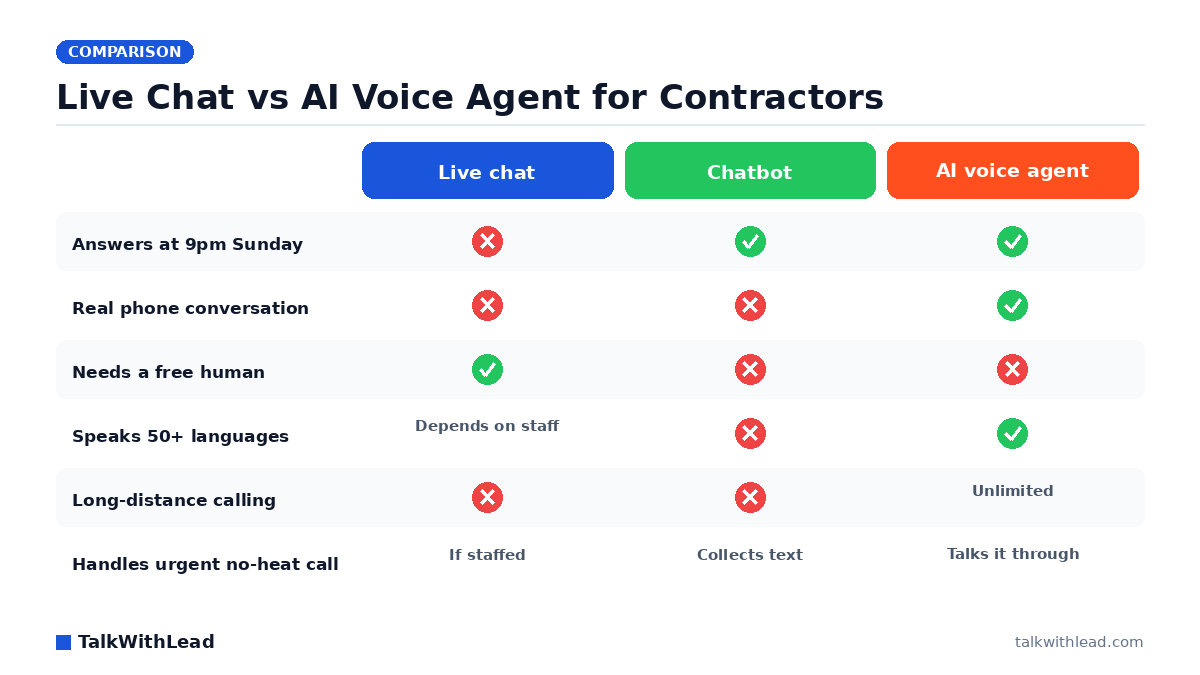
    Live Chat vs AI Voice Agent for Contractors — TalkWithLead original infographic (comparison diagram).
    Live Chat vs AI Voice Agent for Contractors

    Your site gets the visit at 8:47pm. The furnace is dead, the homeowner has three tabs open, and whoever answers first gets the job. That is the real question behind ai voice agent vs live chat for contractors — not which widget looks nicer, but which one is actually awake when the money shows up.

    TL;DR: For contractors, an AI voice agent beats live chat because it answers every visitor instantly, 24/7, and converts the visit into a real phone conversation instead of a typing session. Live chat only performs when a human is free to reply, which almost never describes a crew in the field. Keep live chat for quiet browsing questions; put voice in front of urgent, high-ticket work.

    Why live chat quietly underperforms for trades

    Live chat was built for teams that sit at desks. Contractors do not. The office manager is invoicing, the owner is on a ladder, and the phone is in a truck cup holder. When nobody picks up the chat within a minute, that window becomes a form — and a form is just a slower way of saying “we’ll call you back eventually.”

    The timing math is brutal, and it is well documented. According to Harvard Business Review research, companies that reach a web lead within an hour are nearly 7× more likely to qualify it than those that wait even an hour longer. A chat that goes unanswered until morning is not a slow lead. It is somebody else’s job.

    Then there is what typing does to a service inquiry. A homeowner describing a sewer smell, a soft spot in a subfloor, or a breaker that trips only when the dryer runs is not going to type it well. They will type six words, wait, and leave. Voice gets the whole story in twenty seconds.

    What an AI voice agent actually does on a contractor site

    TalkWithLead puts an extremely human-sounding AI voice agent on your website. A visitor clicks, and instead of a chat box, a conversation starts — out loud. The agent greets them, asks what is going on, captures the address and the trade, checks whether it is an emergency, and either books the slot or triggers an instant callback so a human closes it while the intent is still hot.

    Three things matter more for contractors than for almost any other vertical:

    • After-hours coverage. No-heat, no-water, and no-power calls arrive at night and on weekends. The voice agent never clocks out.
    • 50+ languages. Service areas are not monolingual. A crew that can only intake in English is turning away paying neighborhoods, which is exactly the problem we break down in our bilingual Spanish AI answering service for contractors guide.
    • Unlimited long-distance calling. Out-of-state landlords, relocating buyers, and property managers calling about a unit three time zones away all reach you without a toll worry.

    Want to hear the difference before you decide anything? Take the live demo and talk to the agent the way a homeowner would.

    Which is better for contractors: AI voice agent or live chat?

    Better depends on what the visitor came to do. Someone comparing tankless water heaters at lunch is happy to type. Someone standing in two inches of water is not. Contractors skew heavily toward the second group, and the second group is where the ticket size lives.

    DimensionLive chat (human)ChatbotAI voice agent
    Response speedFast when staffed, dead when notInstant but scriptedInstant, every hour
    CoverageBusiness hours24/724/7
    Detail capturedGood, if the visitor typesWhatever the form fields allowFull spoken description
    Emergency triagePossibleWeakStrong — asks and escalates
    LanguagesLimited to staffText translation50+ spoken languages
    Ends in a phone callRarelyAlmost neverBy design
    Staffing costPer seat, per shiftLowFlat subscription

    Best for: emergency and high-ticket trades — HVAC, plumbing, roofing, restoration, electrical — where the visitor wants to talk now and the first contractor to answer usually wins the job.

    Not the right fit if: your work is low-ticket, scheduled weeks out, and your buyers genuinely prefer async text — or if you already have a fully staffed intake desk answering chats in under a minute, every hour you advertise.

    The revenue you are already leaving on the table

    Run the arithmetic on your own numbers instead of trusting a vendor claim. Illustrative example, assumptions stated: say your site gets 600 visitors a month, and imagine only 4 of every 100 ever contact you — that is 24 inquiries. Now say half of those arrive outside office hours and go unanswered because live chat was offline. If your average job is worth $1,400 and you would have closed a third of the 12 you missed, that is roughly $5,600 a month walking to a competitor. Those are assumed rates, not measured results — plug in your real ticket and close rate with the missed-call revenue calculator and see what your own gap looks like.

    The pattern behind that math is not speculative. A 411 Locals study of 85 small businesses across 58 industries found that only 37.8% of incoming calls were answered by a live person — meaning roughly 6 out of 10 calls went unattended. Contractors are the archetype for that failure: the work itself makes answering impossible.

    Pricing on the voice side is a flat monthly subscription rather than a per-shift staffing line, which is what makes the comparison lopsided for small crews. See the pricing page for the current tiers, and our AI receptionist cost and ROI breakdown for contractors for the full accounting.

    How to run both without cannibalizing either

    You do not have to choose one and delete the other. The setup that works looks like this:

    1. Voice first on money pages. Emergency service, main service pages, and your city landing pages get the voice agent front and center.
    2. Chat on quiet pages. Blog posts, financing explainers, and “about us” can keep live chat or a simple text widget for low-urgency questions.
    3. Instant callback as the safety net. If a visitor will not talk right then, capture the number and fire a callback in minutes, not hours.
    4. Track which one books jobs. Tag the source on every booked call. Within a month you will know exactly which widget pays for itself.

    If you are still weighing widget types generally, the click-to-call vs callback widget vs AI voice agent comparison covers the mechanics of each. And if speed is the part you keep losing on, read how fast you should call a new lead before you change anything else.

    When you are ready to stop losing after-hours jobs, start free and put a voice on your site tonight — or try the live demo first and hear what your visitors would hear.

    FAQ

    Is an AI voice agent better than live chat for a contractor website?

    For most contractors, yes. Live chat depends on a human being free to type, which rarely happens when the crew is on site. An AI voice agent answers instantly at any hour and turns the visitor into a phone conversation, which is how service work actually gets booked.

    Can an AI voice agent handle emergency service calls?

    It can triage them. The agent asks what is wrong, how urgent it is, and where the property is, then either books the appointment or escalates to an on-call technician with the details already captured. That beats a chat transcript nobody reads until morning.

    Will homeowners actually talk to an AI voice agent?

    Many do, because it is faster than typing and faster than waiting on hold. The voice is extremely human-sounding, and for anyone in an urgent situation, speaking is the path of least resistance. Visitors who prefer not to talk can still request an instant callback.

    Do I need to drop live chat if I add an AI voice agent?

    No. Run voice on emergency and service pages where urgency is high, and keep chat on informational pages where visitors are browsing. Tag your booked jobs by source and let the data decide where each one belongs.

    What about customers who do not speak English?

    The voice agent handles conversations in 50+ languages, so your intake is not limited to whoever is staffing the phone that day. For crews serving mixed-language service areas, this is often the single biggest lift in captured leads.

    How much does an AI voice agent cost compared to staffing live chat?

    Live chat costs per seat and per shift, and covering nights and weekends means paying for coverage you may barely use. A voice agent is a flat monthly subscription with unlimited long-distance calling included. Current tiers are on the pricing page.

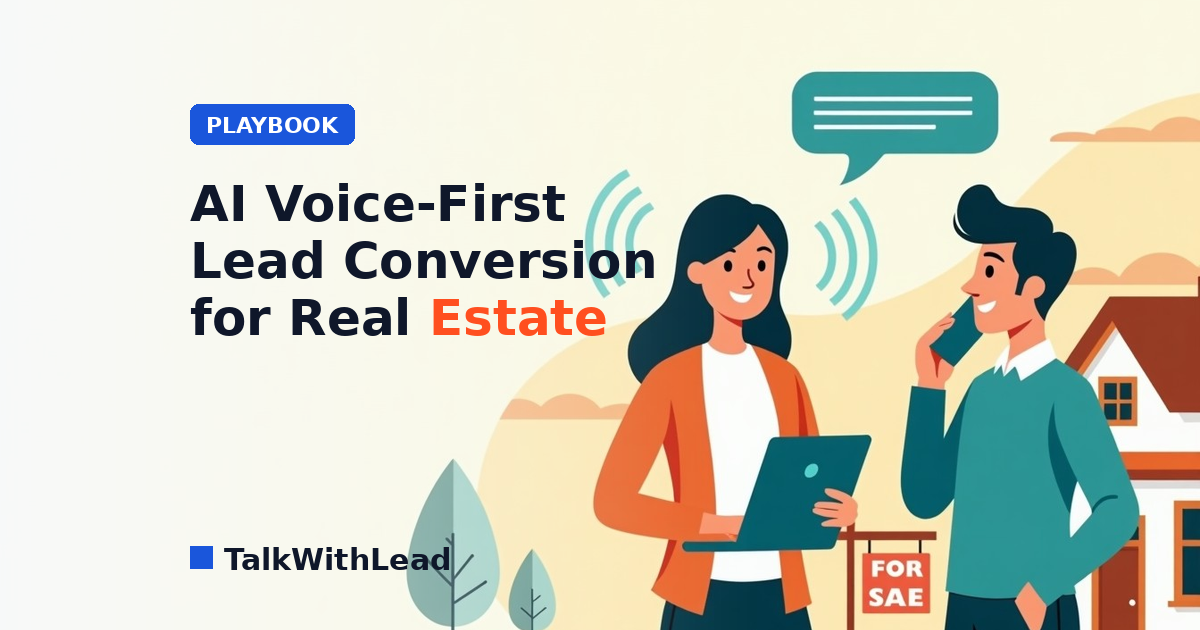
  • AI Voice-First Lead Conversion for Real Estate

    AI Voice-First Lead Conversion for Real Estate

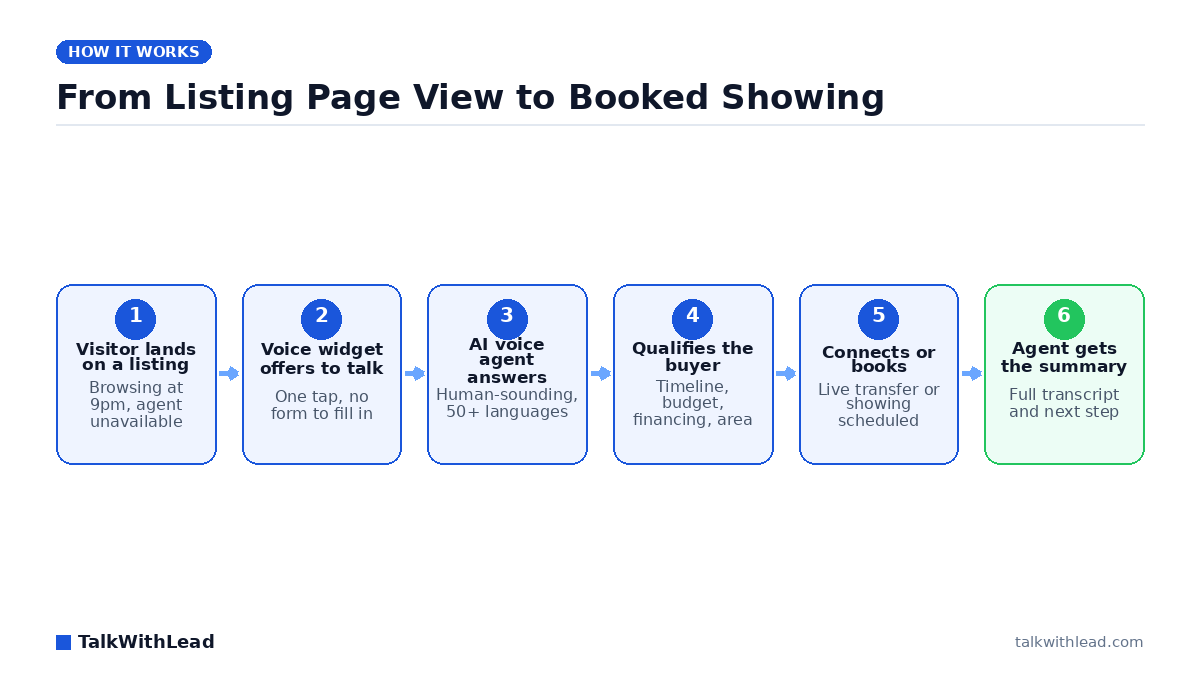
    From Listing Page View to Booked Showing — TalkWithLead original infographic (flow diagram).
    From Listing Page View to Booked Showing

    Why real estate leads die between the listing page and the phone call

    A buyer finds your listing at 9:14pm, wants to know if the basement is finished and whether the seller will take an offer under asking, and there is nobody to ask. They fill in a form, or they don’t, and then they open the next tab. That gap between interest and conversation is where most agents quietly lose their pipeline.

    TL;DR: AI voice-first lead conversion for real estate replaces the contact form with an AI voice agent that answers the website visitor by phone within seconds, at any hour, in 50+ languages. It asks the qualifying questions a good agent would ask — timeline, budget, financing, neighbourhood — then transfers the live call to you or books the showing directly. The lead becomes a conversation instead of an email you answer tomorrow.

    Speed is not a soft advantage in this business. According to Harvard Business Review research, companies that reach a web lead within an hour are nearly 7× more likely to qualify it than those that wait even an hour longer. Real estate compresses that further: the buyer who wants to see a house this weekend is calling three agents tonight, and the first real voice usually gets the showing.

    What does AI voice-first lead conversion for real estate actually do?

    It puts a voice option on every listing page, every neighbourhood guide, and every home-valuation page. The visitor taps once. An extremely human-sounding AI voice agent picks up immediately and holds a real conversation — not a scripted menu, not a text box that replies with links.

    In a single call the agent can:

    • Answer property-level questions the visitor is stuck on (square footage, taxes, HOA, showing availability).
    • Qualify the buyer: are they pre-approved, are they selling first, what’s their timeline, what’s their range.
    • Route the call — hot buyer transferred live to you, everyone else booked into a slot or handed a callback time.
    • Handle the whole thing in the visitor’s own language, across 50+ of them.
    • Reach the caller anywhere, because long-distance calling is unlimited — relocation buyers and overseas investors are not a cost problem.

    You wake up to transcripts and booked showings instead of a form-fill queue. If you want to hear how it sounds before believing any of that, take the Live Demo — it’s the fastest way to judge whether the voice passes as human.

    Voice vs. form vs. chatbot: which converts a property inquiry?

    Every agent site already has a form. Many have added a chatbot. Both collect text and both hand the buyer a wait. Here is the honest comparison on the dimensions that decide whether a showing gets booked.

    CapabilityContact formWebsite chatbotAI voice agent
    Response to the visitorHours or next dayInstant textInstant live call
    Buyer effortType 5 fieldsType back and forthOne tap, then talk
    Qualifies budget & timelineRarelySometimes, if they stayYes, conversationally
    Handles a non-English buyerNoTranslated text50+ spoken languages
    Books the showing on the spotNoLink handoffYes, or live transfer
    Works at 9pm and on weekendsCollects onlyCollects onlyFull conversation

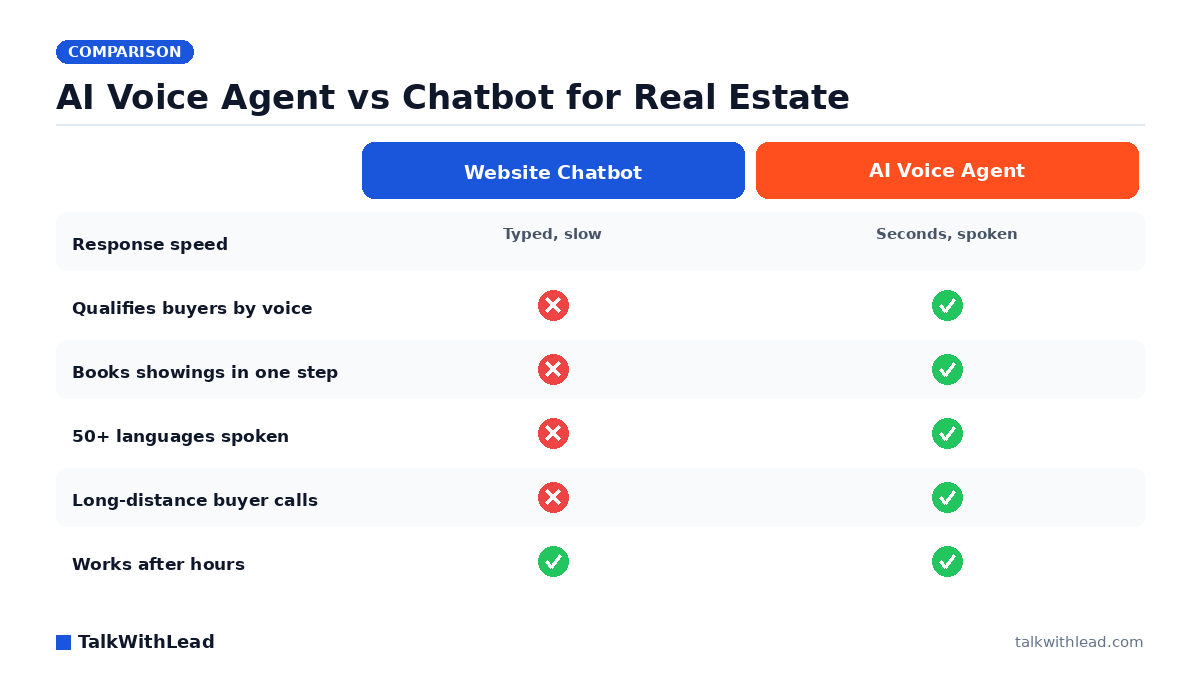
    The pattern is consistent: text channels capture a name, voice channels capture a decision. That gap is bigger in real estate than almost anywhere else, because the purchase is emotional and the questions are specific to one property. We broke the mechanics down further in AI Voice Agent vs Chatbot: Which Is Better for Real Estate? and compared the widget formats in Click-to-Call vs Callback Widget vs AI Voice Agent.

    Best for: agents, teams, and brokerages whose listing pages get real traffic but whose leads arrive as unanswered form-fills, especially outside business hours.
    Not the right fit if: your site gets almost no organic or portal traffic yet — fix demand first, because a voice agent converts visitors you already have; it doesn’t create them.

    What is a missed after-hours inquiry actually worth?

    Run the math on your own numbers rather than trusting a vendor’s. Here is an illustrative example — the rates are assumptions, not measured results:

    • Say your listing pages get 900 visitors a month and 40 of them try to make contact.
    • Assume half of those attempts land outside your working hours, so 20 sit unanswered overnight.
    • Picture a quarter of those overnight inquiries being serious buyers — on that assumption, 5 real opportunities a month.
    • Assume you convert 1 of those 5 into a transaction and your side of the commission is $9,000.

    That single recovered deal dwarfs the cost of answering the phone automatically. Plug your own figures into the free missed-call revenue calculator and the speed-to-lead ROI calculator — no email required. Plan pricing is published openly on the pricing page, so you can compare the monthly cost against one commission and decide in about a minute.

    The unanswered-call problem is well documented outside real estate too. A 411 Locals study of 85 small businesses across 58 industries found only 37.8% of incoming calls were answered by a live person — meaning roughly 6 out of 10 calls went unattended. Real estate has no structural immunity to that.

    How do you roll it out on a real estate site without breaking anything?

    Start narrow and let the transcripts teach you. A practical sequence:

    1. Put voice on your highest-intent pages first — individual listings, home valuation, and “schedule a showing.” Those visitors already have a question.
    2. Write the qualifying script like your best buyer’s-agent call. Motivation, timeline, financing, area, must-haves. Five questions, not fifteen.
    3. Define the transfer rule. Pre-approved and touring this week goes straight to your cell. Everything else gets booked or scheduled for a callback.
    4. Turn on multilingual immediately if you serve any relocation, investor, or immigrant buyer segment. See AI Voice in Spanish for Real Estate for what that changes in practice.
    5. Read the transcripts weekly. The questions buyers keep asking are your next listing description edits and your next blog posts.

    Nothing here requires ripping out your CRM or your IDX. The widget sits on the site, the calls flow to your phone, and the summaries land in your inbox. You can have it live on your listing pages today with a free signup, then decide after a week of real transcripts whether the calls are worth keeping.

    The mistakes that make voice underperform

    Voice is not magic, and a few setup errors reliably waste it. Agents who get poor results almost always made one of these choices:

    • Hiding the voice option below the fold. If the buyer has to scroll past the photo gallery to find it, they won’t.
    • Over-qualifying. A twelve-question interrogation on a first call kills the very interest you captured. Get enough to route, then hand off.
    • No live-transfer path. If a genuinely hot buyer can never reach a human on that call, you’ve built a nicer form.
    • Ignoring the after-hours window. Evening and weekend traffic is exactly when portals send browsers to your site and exactly when competitors are also unavailable.
    • Treating multilingual as optional. A buyer who can ask questions in their first language stays on the call longer and stays with the agent who let them.

    For a wider view of how voice compares against the older widget options agents still run, AI Voice Agent vs Callback Widget vs Live Chat covers what each one actually converts.

    FAQ

    What is AI voice-first lead conversion for real estate?

    It’s a website setup where the primary conversion action is a live phone conversation instead of a form submission. A visitor on a listing page taps once, an AI voice agent answers immediately, qualifies them, and either transfers the call to the agent or books a showing.

    Will buyers realize they are talking to an AI?

    The voice is designed to sound human and conversational rather than robotic or menu-driven, and the agent identifies itself honestly when asked. Most callers care far more that someone picked up at 9pm and answered their question than about who was on the line.

    Can it handle buyers who don’t speak English?

    Yes — it converses in 50+ languages, so a relocation or overseas buyer can ask about a property in their own language. Combined with unlimited long-distance calling, out-of-area buyers stop being a cost or a language problem.

    Does this replace my real estate agent or ISA?

    No. It replaces the dead time between a website inquiry and a human conversation. The AI answers instantly and filters, then hands you buyers who are already qualified — so your calling hours go to people who are ready to tour.

    How fast should I respond to a new property inquiry?

    As close to immediately as you can manage. The MIT Lead Response Management study found you’re about 21× more likely to qualify a lead contacted within 5 minutes than one contacted at 30 minutes. An always-on voice agent makes that response time the default rather than a personal discipline problem.

    What does it cost to add voice to a real estate website?

    Plans are published on the pricing page, and the practical test is simple: compare a month of service against one side of one commission. You can start on a free signup and hear it on your own listings before committing.

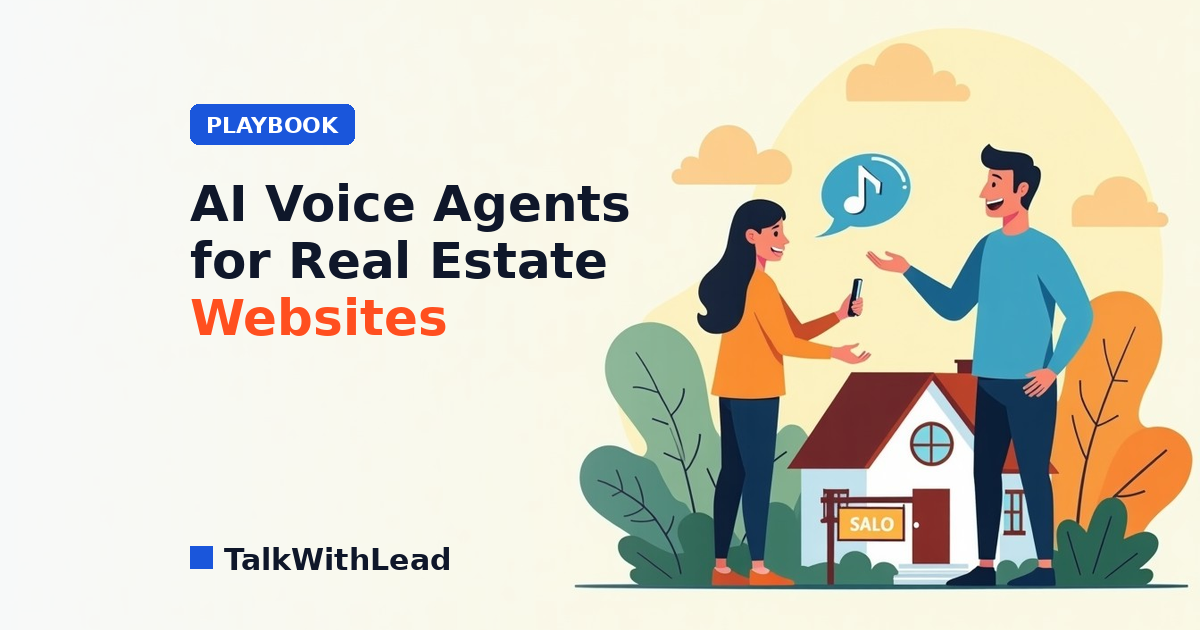
  • AI Voice Agents for Real Estate Websites

    AI Voice Agents for Real Estate Websites

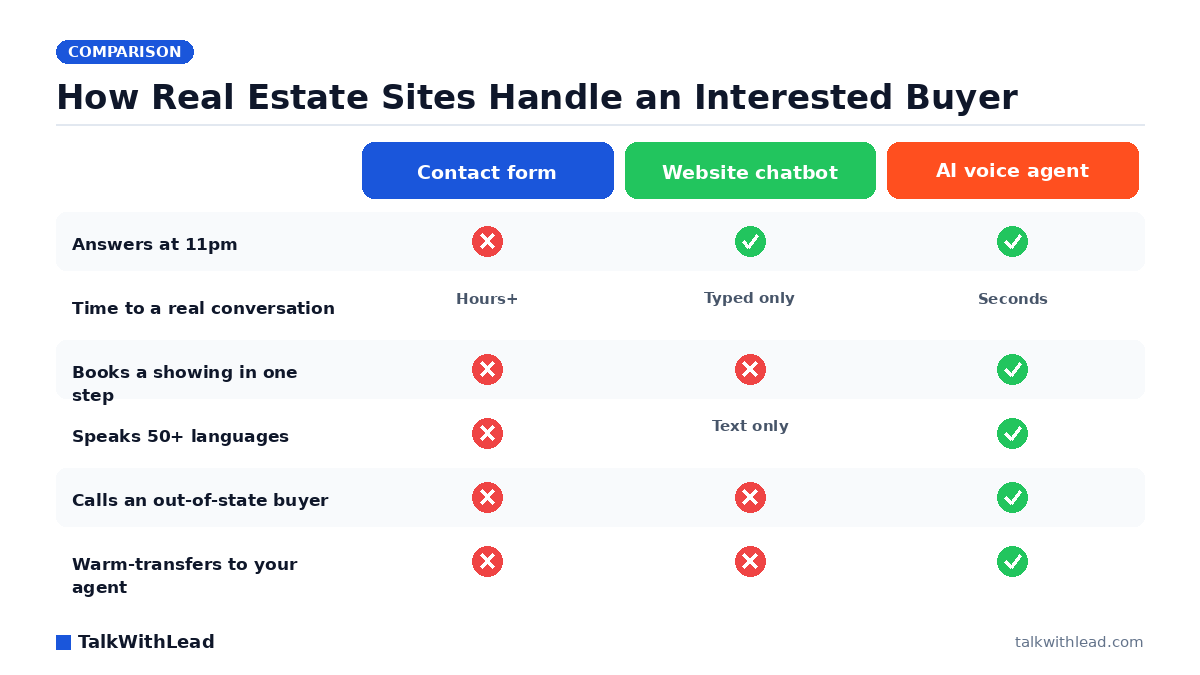
    How Real Estate Sites Handle an Interested Buyer — TalkWithLead original infographic (comparison diagram).
    How Real Estate Sites Handle an Interested Buyer

    A buyer finds your listing at 9:40pm, loves the kitchen, and wants to know if the seller will take an offer under asking. Your contact form promises a reply “within one business day.” By then they have already toured two other homes.

    TL;DR: AI voice agents for real estate websites answer that buyer instantly with a human-sounding voice, qualify the inquiry, and either book the showing or ring your phone while the visitor is still on the listing page. They work around the clock, hold the conversation in 50+ languages, and place unlimited long-distance calls, so an out-of-state or overseas buyer converts the same way a local one does.

    Why real estate websites leak so many leads

    Real estate is a speed sport played on other people’s schedules. Buyers browse after dinner, on weekends, and from three time zones away. Agents are showing property, sitting in inspections, or driving — the exact hours when the website is busiest.

    The math is brutal. According to the MIT Lead Response Management study, you’re about 21× more likely to qualify a lead contacted within 5 minutes than one contacted at 30 minutes. A form that sits in an inbox overnight is not a lead-capture tool; it is a delay mechanism.

    And the phone line does not save you either. According to a 411 Locals study of 85 small businesses across 58 industries, only 37.8% of incoming calls were answered by a live person. Apply that to a listing page and the picture is clear: the visitor who actually reaches for the phone often gets voicemail, then calls the next agent.

    What is an AI voice agent on a real estate website?

    It is a widget on your site that starts a spoken conversation. The visitor taps once and an AI voice agent — one that sounds like a person, not a phone tree — greets them, asks what they are looking at, answers questions about the property, price range, and timeline, and moves them toward a booked showing or a live handoff to you.

    Three capabilities separate it from every text-based widget:

    • Real voice, immediately. No typing, no “an agent will be with you shortly.” The conversation starts in seconds.
    • 50+ languages. The relocating family, the overseas investor, the local buyer who is simply more comfortable in Spanish, Hindi, or French — all get served in their own language without you hiring for it.
    • Unlimited long-distance calling and instant callbacks. The agent can call the visitor back on their phone, wherever they are, and can bridge them to your line while intent is still hot.

    If you want to see how the voice actually sounds before you decide anything, the fastest route is the live demo — thirty seconds tells you more than any feature list.

    AI voice agent vs form vs chatbot for real estate

    Every real estate site already has some way to capture interest. The question is what each one costs you in conversations.

    DimensionContact formWebsite chatbotAI voice agent
    Response timeHours to next business dayInstant, but typedInstant, spoken
    After-hours coverageCollects onlyYesYes
    Books a showing in one interactionNoSometimes, via a formYes, in conversation
    Handles non-English buyersNoText translation50+ spoken languages
    Reaches out-of-area buyers by phoneNoNoUnlimited long-distance calling
    Transfers to the listing agentNoRarelyInstant callback or live bridge
    Emotional read of the buyerNoneLowTone, urgency, objections

    Chatbots are not useless — they are just the wrong shape for a six-figure decision. A buyer weighing a mortgage payment wants a person’s voice, and they want to ask the awkward question out loud. Our deeper breakdown of that trade-off lives in AI Voice Agent vs Chatbot: Which Is Better for Real Estate?, and if you’re comparing widget types specifically, see Click-to-Call vs Callback Widget vs AI Voice Agent.

    How much business does a slow response actually cost?

    Let’s do labeled, illustrative math — these are assumed rates, not measured results from any client.

    Illustrative example. Say a mid-sized brokerage site gets 900 visitors a month and 40 of them show real intent (they click a listing CTA, request info, or start a call). Assume half of that intent arrives outside staffed hours — 20 people. Assume only 1 in 4 of those leave a form and, of those, say 1 in 5 eventually converts to a signed client. That is one client a month from after-hours traffic.

    Now assume an AI voice agent picks up all 20 of those after-hours conversations and, say, 1 in 8 becomes a signed client. That is 2.5 clients a month instead of 1. On a modest average commission, the difference is not a rounding error — it is the reason to install the widget this week rather than next quarter.

    Want to run your own numbers instead of mine? Use the free missed-call revenue calculator with your own traffic and commission figures. And when you’re ready to see plans, the pricing page lists them plainly.

    The five moments an AI voice agent earns its keep in real estate

    1. The 10pm listing browse. Peak buyer curiosity, zero staff. The agent answers, qualifies budget and timeline, and books tomorrow’s showing.
    2. The open-house weekend overflow. You’re standing in a kitchen with four people. The website keeps talking to everyone else.
    3. The relocating buyer. They’re in another state or country. Unlimited long-distance calling means the callback actually happens instead of dying on a toll charge.
    4. The non-English-speaking family. A conversation in their language converts; a translated chat window usually does not. See how that plays out in AI Voice in Hindi for Real Estate.
    5. The comparison shopper. They are on three agents’ sites in one session. The one whose site talks back first usually gets the appointment.

    How do you actually put one on a real estate site?

    Faster than most agents expect. You add a small script to your site — WordPress, Wix, Squarespace, an IDX-powered template, or a custom build — and the voice widget appears. You then tell it three things: what you sell, what questions it should ask a buyer or seller, and where to route a hot lead.

    Practical setup notes worth getting right:

    • Route by intent, not by page. A seller asking about a valuation and a buyer asking about a showing should not land in the same bucket.
    • Give it your qualifying questions. Pre-approval status, timeline, target neighborhoods, price band. The agent asks them naturally, in conversation.
    • Set a handoff rule. Decide when the AI stops and your phone rings — usually a buyer with a timeline under 60 days.
    • Keep it on every page, not just Contact. Intent spikes on the listing, not on the form.

    You can have this running today with a free signup, and if you’d rather hear it first, the live demo takes under a minute.

    Honest verdict: is this right for your brokerage?

    Best for: solo agents, small teams, and brokerages whose website gets meaningful traffic but who cannot staff a phone from 7am to 11pm — especially anyone serving relocating, investor, or multilingual buyers.

    Not the right fit if: your jurisdiction or brokerage policy requires a licensed human on every first contact with a consumer, you get so few web visitors that a personal callback is already instant, or your leads come almost entirely from referrals rather than your site.

    The honest framing is this: an AI voice agent does not replace a good agent. It replaces the silence between the visitor’s interest and your availability — and in real estate, that silence is where most deals quietly die. If you’re weighing it against the widget you already have, Live Chat Alternative for Real Estate Agents compares them side by side.

    FAQ

    What is an AI voice agent for a real estate website?

    It’s a widget that lets a website visitor start a spoken conversation with a human-sounding AI. It answers questions about listings, qualifies the buyer or seller, books showings, and can call or transfer the lead to your agent instantly — 24 hours a day.

    Do AI voice agents work better than chatbots for real estate leads?

    For high-value, emotional decisions like a home purchase, voice generally moves people further in one interaction. A buyer will ask an awkward question out loud that they’d never type, and a showing can be booked inside the conversation instead of through a follow-up form.

    Can an AI voice agent speak to buyers in other languages?

    Yes. TalkWithLead’s voice agent handles conversations in 50+ languages, which matters for relocating families, international investors, and any market where buyers prefer their first language over English.

    Will it call buyers who are out of state or overseas?

    Yes — unlimited long-distance calling is included, so an instant callback reaches a buyer in another state or country the same way it reaches a local one. That’s often the difference between capturing a relocation lead and losing it.

    How fast should a real estate lead be contacted?

    As close to immediately as you can manage. Harvard Business Review research found companies that reach a web lead within an hour are nearly 7× more likely to qualify it than those that wait even an hour longer, per their study of online sales leads. More detail in Speed to Lead Real Estate.

    How long does it take to set up on my site?

    Adding the script is a few minutes on most platforms, including WordPress and hosted IDX sites. Configuring your qualifying questions and routing rules typically takes another sitting — you can start with a free signup and adjust the script as you learn what buyers ask.

  • AI Voice in Spanish for Real Estate: Stop Losing Leads

    AI Voice in Spanish for Real Estate: Stop Losing Leads

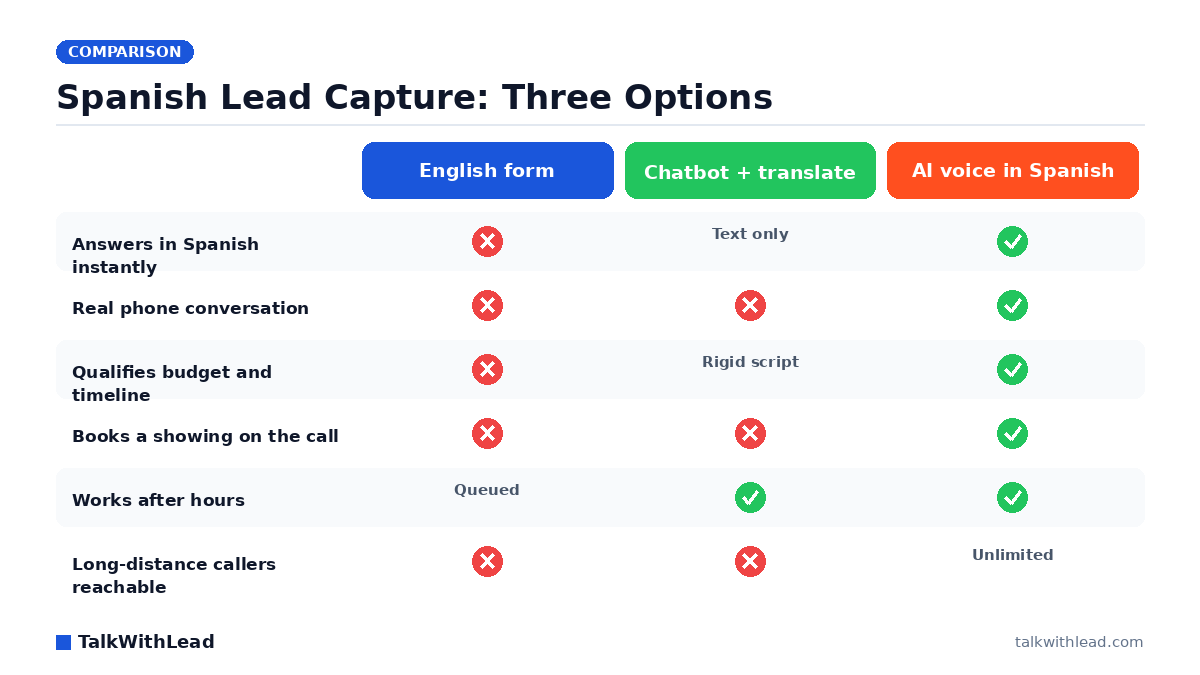
    Spanish Lead Capture: Three Options — TalkWithLead original infographic (comparison diagram).
    Spanish Lead Capture: Three Options

    A Spanish-speaking family finds your listing at 8:40 p.m., loves the kitchen photos, and hits your contact form. The form is in English. They close the tab and call the agent whose sign is in their neighborhood. That lead was never lost to price or product — it was lost to language and to silence.

    Short answer: AI voice in Spanish for real estate puts a human-sounding voice agent on your website that answers Spanish-speaking visitors in seconds, asks about budget, timeline, and neighborhood in their own language, and books the showing or hands off a live call to you. It runs 24/7, handles 50+ languages on the same widget, and converts visitors into phone conversations instead of unanswered form submissions.

    Why Spanish-speaking real estate leads disappear before you ever see them

    Real estate is a spoken business. Buyers want to ask whether the HOA covers the roof, whether the seller will take a 45-day close, whether the school zone is the one their cousin mentioned. Those questions are awkward to type in a second language and easy to say out loud in a first one. When your site only offers an English form or an English chat box, you are asking your Spanish-speaking visitors to do the hardest possible version of contacting you.

    The fallback is the phone — and that’s where the second leak opens. According to a 411 Locals study of 85 small businesses across 58 industries, only 37.8% of incoming calls were answered by a live person — meaning roughly 6 out of 10 calls went unattended. Agents are showing property, not sitting by a desk phone. So the Spanish-speaking caller gets voicemail in a language they may not want to leave a message in, and moves on.

    Picture a listing page pulling 400 visits a month with a third of that traffic Spanish-speaking. Say even 5% of those visitors would have talked to a live voice — that’s roughly 6 real conversations a month you never had, in a business where one closing pays for the year’s marketing.

    How does an AI voice agent in Spanish actually work on a real estate site?

    The widget sits on your listing pages and your homepage. A visitor taps it, and within a couple of rings an AI voice agent picks up — not a bot reading a menu, but a natural-sounding voice that speaks conversational Spanish, understands regional phrasing, and answers back without the robotic pauses buyers associate with automated systems.

    From there it does the work a good ISA does on a first call:

    • Qualifies in Spanish — price range, financing status, timeline, whether they’re selling something first.
    • Answers listing questions — square footage, availability, showing windows, what’s included.
    • Books the showing or triggers an instant callback to your cell while the visitor is still interested.
    • Switches languages mid-conversation — the same widget covers 50+ languages, so a bilingual household never hits a wall.
    • Takes long-distance calls — unlimited long-distance calling means an out-of-state relocation buyer or a family member calling from abroad reaches you without a toll charge killing the call.

    You can hear the difference in about two minutes on the TalkWithLead live demo — talk to the agent yourself, in Spanish, and judge whether a buyer would keep talking.

    AI voice in Spanish vs. the alternatives real estate teams usually try

    Most agents have already tried something. Here’s how the common options compare on the dimensions that decide whether a Spanish-speaking lead turns into a showing.

    CapabilityEnglish contact formChatbot with translationBilingual answering serviceAI voice agent in Spanish
    Responds in Spanish immediatelyNoText onlyDepends on staffingYes, in seconds
    Real spoken conversationNoNoYesYes
    Available nights and weekendsForm queuesYesOften surchargedYes, always
    Qualifies budget and timelineStatic fieldsRigid decision treeYes, if trainedYes, conversationally
    Books the showing on the spotNoRarelySometimesYes
    Long-distance / overseas callersN/AN/AUsually billed per minuteUnlimited long distance
    Cost scales with volumeFree but leakyLowPer-minute, climbs fastFlat plan

    Best for: agents, teams, and brokerages whose listing traffic includes a meaningful share of Spanish-speaking buyers or renters, and who cannot answer every call live during showings.

    Not the right fit if: your entire pipeline comes from referrals you already answer personally within minutes, or your market has essentially no Spanish-speaking demand — in that case a voice agent solves a problem you don’t have.

    If you’re weighing voice against the tools you already pay for, the deeper breakdowns are here: AI voice agent vs chatbot for real estate and the live chat alternative for real estate agents.

    How fast do you have to answer a Spanish-speaking lead?

    Faster than you think, and faster than a callback form allows. The MIT Lead Response Management study found you’re about 21× more likely to qualify a lead contacted within 5 minutes than one contacted at 30 minutes. That window is the whole game in real estate, where a serious buyer is inquiring on four listings in one evening.

    An AI voice agent collapses that window to zero. The visitor doesn’t wait for you to check your phone between showings — the conversation starts on the page, in Spanish, at 8:40 p.m. on a Tuesday. If the lead is hot, the agent connects them to you or schedules the showing directly. If it’s early-stage, you get a qualified summary instead of a name and an email address.

    Run your own numbers on what the delay costs with the free speed-to-lead ROI calculator, or read the fundamentals in speed to lead for real estate.

    What it costs, and the math that decides it

    Bilingual answering services generally bill per minute or per call, so cost rises exactly when your marketing is working. An AI voice agent runs on a flat monthly plan — see current tiers on the TalkWithLead pricing page.

    Illustrative ROI math (assumptions stated, not a customer result): assume your average commission per closed transaction is $8,000, and assume a Spanish voice agent recovers 6 conversations a month that previously bounced. Assume a conservative 5% of those convert to a closing within your normal cycle. That’s roughly one extra closing every three to four months — around $2,400 per month in expected commission against a flat software cost. Your own commission, traffic, and conversion rate change the answer, which is why the math should be run on your numbers, not ours.

    Rolling it out without breaking what already works

    Start narrow. Put the voice agent on your three highest-traffic listing pages and your homepage, set the greeting to open in Spanish when the browser signals a Spanish locale, and leave your existing form in place for people who prefer typing. Give the agent a short script for the questions you answer forty times a week: availability, price flexibility, pet policy, showing windows, financing prerequisites.

    Then check two things after the first two weeks — how many conversations happened outside business hours, and how many of them you would otherwise have missed entirely. That’s the honest measure. Teams running the same play in other languages describe it here: AI voice in Hindi for real estate.

    When you’re ready to put it on a live page, start free with TalkWithLead and have the Spanish voice agent answering on your listings today, or try the live demo first and hear what your buyers would hear.

    FAQ

    Does the AI voice agent actually sound natural in Spanish, or like a robot menu?

    It speaks conversationally — natural pacing, natural phrasing, and it responds to what the caller actually said rather than reading a menu tree. The fastest way to judge it is to call it yourself in Spanish on the live demo and decide whether you’d keep talking.

    What happens if a caller switches between Spanish and English mid-conversation?

    The same agent handles both, along with 50+ other languages. Bilingual households switch constantly, and the conversation continues instead of restarting or dropping the caller into a different queue.

    Can it book a showing, or does it only take messages?

    It qualifies the lead and can book the appointment or trigger an instant callback to your phone while the visitor is still on the listing page. You get a qualified summary rather than a bare name and email.

    Do out-of-state or overseas buyers pay long-distance charges to reach me?

    No. Unlimited long-distance calling is included, so a relocation buyer in another state or a family member calling from abroad can reach your listing without a toll charge ending the conversation.

    Is this better than hiring a bilingual assistant?

    It’s different. A bilingual assistant is better at nuanced negotiation and relationship work; the AI voice agent is better at never missing the 9 p.m. inquiry and never charging more when your traffic spikes. Many teams run both — the agent catches everything, the human handles what matters most.

    How long does it take to get a Spanish voice agent live on my site?

    Installing the widget is a snippet on your pages, so most agents are answering the same day they sign up. Start with your top listing pages, then expand once you see where the after-hours conversations come from.

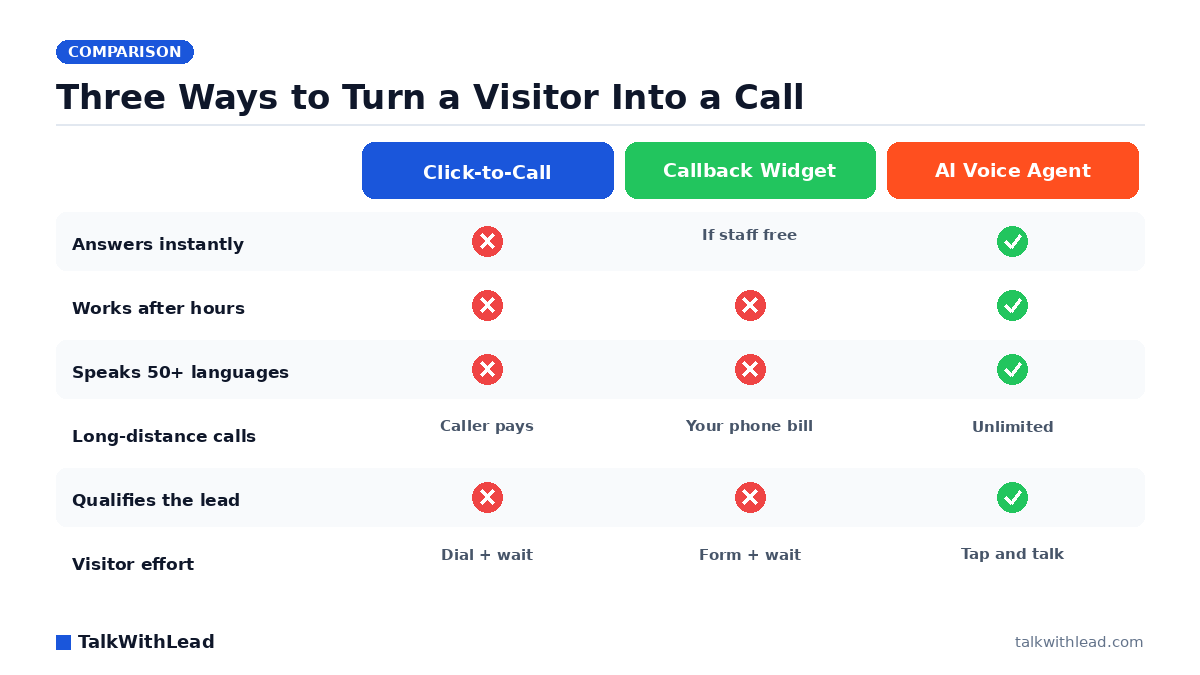
  • Click-to-Call vs Callback Widget vs AI Voice Agent

    Click-to-Call vs Callback Widget vs AI Voice Agent

    Three Ways to Turn a Visitor Into a Call — TalkWithLead original infographic (comparison diagram).
    Three Ways to Turn a Visitor Into a Call

    Every visitor who leaves your site without talking to a human is a lead your competitor gets to call first. The click-to-call vs callback widget vs AI voice agent decision is really one question: how long does a ready buyer have to wait before a voice answers? Three seconds, three hours, or never.

    TL;DR: Click-to-call only helps visitors already willing to dial and wait on hold. A callback widget captures more intent but still queues the lead behind a human’s availability. An AI voice agent answers the moment a visitor taps — 24/7, in 50+ languages, with unlimited long-distance calling — so the conversation happens while interest is at its peak. For most websites, the AI voice agent converts the most because it removes the wait entirely.

    What each option actually does

    These three tools look similar on a page — a button, a bubble, a phone icon — but they behave completely differently once a visitor engages.

    • Click-to-call is a tel: link. The visitor taps, their phone dials your number, and everything after that depends on whether someone picks up. On desktop it often does nothing useful at all.
    • Callback widget collects a phone number and promises a call back — sometimes in 28 seconds, sometimes whenever your team gets to it. It converts the visitor into a task in someone’s queue.
    • AI voice agent starts a real, spoken conversation right there in the browser. A human-sounding voice greets the visitor, answers questions, qualifies them, and books the next step or connects them to a person.

    Only one of those three guarantees a voice on the other end. That distinction decides the conversion rate.

    Which one converts more website visitors?

    Conversion follows response speed, and the evidence on that is unusually blunt. The MIT Lead Response Management study found you’re about 21× more likely to qualify a lead contacted within 5 minutes than one contacted at 30 minutes. Every minute a lead spends waiting is conversion you already lost.

    Now map that to the three tools. Click-to-call is instant only if your line is answered instantly — and answering is the weak link. According to a 411 Locals study of 85 small businesses across 58 industries, only 37.8% of incoming calls were answered by a live person. A callback widget shifts the wait to your team’s response time, which on a busy Tuesday afternoon is rarely five minutes. An AI voice agent has no queue and no lunch break.

    Want to hear what that sounds like before you decide? Take the Live Demo and talk to the agent yourself.

    Side-by-side comparison

    DimensionClick-to-CallCallback WidgetAI Voice Agent
    Time to first voiceHowever long the phone ringsMinutes to hoursSeconds
    Works after hoursNoRequest logged onlyYes, fully
    Desktop visitorsPoor (no dialer)GoodGood
    LanguagesWhoever answersWhoever calls back50+ languages
    Long-distance leadsCaller pays, many won’tYour phone billUnlimited long-distance
    Lead qualificationManualManualAutomatic, during the call
    Staffing neededFull coverageFull coverageNone for first contact
    Best useMobile, ready buyersTeams with fast callersAny site, any hour

    Read the rows top to bottom and a pattern shows up: the first two options are fine when a person is sitting there ready to answer. The third one is the only one designed for the hours and languages when nobody is.

    The math on the leads you never hear from

    Here’s an illustrative example, not a customer result. Say your site gets 4,000 visitors a month and, imagine, even 3 in 100 of them would happily talk to someone about buying. That’s 120 conversations available. If click-to-call captures the handful already dialing and your callback queue reaches half the rest within an hour, you might touch 60 — leaving 60 conversations on the table each month.

    Apply your own average deal value to those 60 and the number gets uncomfortable fast. You can run your own version of this math with the free missed-call revenue calculator — put in your real traffic and close rate rather than trusting anyone’s blog arithmetic.

    The point isn’t the exact figure. It’s that both click-to-call and callback widgets quietly depend on a human being available, and human availability is the single most expensive thing on this list. Pricing for an always-on AI voice agent sits well below the cost of staffing evenings, weekends, and second languages.

    When a click-to-call button is still the right call

    Click-to-call earns its place on mobile-heavy sites where visitors arrive already decided — an emergency plumber, a locksmith, a walk-in clinic. If someone’s basement is flooding, they don’t want a conversation. They want your number dialing.

    The trap is treating it as your whole strategy. On desktop it’s inert, after hours it’s a voicemail box, and for a visitor who speaks Spanish or French it’s a gamble on who happens to answer. Compare the mechanics in detail in our breakdown of callback widget vs click-to-call vs live chat.

    When a callback widget beats both

    A callback widget shines for teams with disciplined sales floors and genuine coverage — a mortgage team with licensed loan officers on rotation, an inside-sales group with a five-minute SLA they actually hit. In those setups the widget is a clean intent capture and the human closes it.

    It falls apart the moment the callback becomes a to-do item. A lead who filled the form at 7:40 p.m. and gets called at 10:15 a.m. the next day has already spoken to two competitors. If your team can’t promise minutes, an AI voice agent should answer first and hand off warm leads to your people. That handoff pattern is exactly what we cover in AI voice agent vs callback widget vs live chat.

    Why the AI voice agent wins most sites

    Voice does something no form or chatbot can: it lets a stranger explain their situation in their own words and get an answer in the same breath. A human-sounding AI voice agent picks up in seconds, asks the qualifying questions your best rep would ask, handles the accent and the language, and books the appointment or transfers the call.

    Three capabilities carry most of the lift:

    1. Instant answer. No hold music, no “we’ll get back to you.” The conversation happens at peak intent.
    2. 50+ languages. A visitor who’d have hung up on an English-only line stays on the phone and converts.
    3. Unlimited long-distance calling. Out-of-state and international prospects reach you without anyone weighing the cost of the call.

    Chatbots were supposed to solve this and mostly taught buyers to close the widget — we broke that down in AI voice agent vs chatbot. Typing is slower than talking, and slower loses.

    Honest verdict

    Best for: Any business whose website gets leads outside staffed hours, in more than one language, or faster than the team can call back — service businesses, clinics, law firms, real estate, contractors, and SaaS teams with global traffic.

    Not the right fit if: You’re a single-person shop with very low traffic who genuinely answers every call within a ring or two, or your sale legally requires a licensed human on first contact. In that case a plain click-to-call button is honest and sufficient.

    If you fall in the first group, the fastest way to find out is to run it on your own site. Start free, drop the widget on your highest-traffic page, and count how many conversations happen this week that would otherwise have been silence.

    FAQ

    What is the difference between click-to-call and a callback widget?

    Click-to-call opens the visitor’s phone dialer so they call you and wait for someone to answer. A callback widget collects their number and puts a task in your team’s queue to call them back. The first depends on you answering; the second depends on you calling promptly.

    Does an AI voice agent replace my callback widget?

    It usually replaces the waiting part of it. The agent answers the visitor immediately, qualifies them, and either books the next step or routes a warm lead to a human. You can still offer a scheduled callback for people who prefer one — it just stops being the only option.

    Will visitors know they’re talking to an AI?

    The voice is designed to sound natural rather than robotic, and the agent identifies itself honestly. In practice most visitors care far more that someone answered in seconds than about who is on the line.

    Which converts better on mobile, click-to-call or an AI voice agent?

    Click-to-call converts the small group already committed to dialing. An AI voice agent also captures the much larger group who have a question first and won’t sit through a phone tree to ask it. On mobile, running both is reasonable — the tap-to-talk option catches everyone the dialer loses.

    How fast should I respond to a website lead?

    Minutes, not hours. Harvard Business Review research found companies that reach a web lead within an hour are nearly 7× more likely to qualify it than those that wait even an hour longer. That’s the entire argument for answering the moment the visitor is on your page.

    Do I need to change my phone system to use an AI voice agent?

    No. It runs as a widget on your website and handles the call in the browser, then transfers to your existing number when a human is needed. You can try it on the Live Demo before touching anything in your phone setup.

  • AI Voice Agent vs Chatbot: Which Is Better for Real Estate?

    AI Voice Agent vs Chatbot: Which Is Better for Real Estate?

    AI Voice Agent vs Chatbot for Real Estate — TalkWithLead original infographic (comparison diagram).
    AI Voice Agent vs Chatbot for Real Estate

    The Showing Goes to Whoever Talks to the Buyer First

    A buyer lands on your listing page at 9:40 p.m., ready to ask about a showing. What happens next decides whether that commission is yours or your competitor’s. That is the real question behind the ai voice agent vs chatbot for real estate debate: which one turns that late-night visitor into an actual conversation before they open the next agent’s website?

    TL;DR: For real estate, an AI voice agent beats a chatbot for lead conversion. Voice engages the visitor in a real spoken conversation within seconds, qualifies budget, timeline, and financing, and books the showing in one step. A chatbot makes a motivated buyer type through a scripted menu — and motivated buyers don’t wait. Chatbots still work for low-stakes FAQ deflection, but the appointment goes to voice.

    Why Does Speed Decide Real Estate Deals?

    Real estate is the ultimate speed-to-lead business. Buyers shortlist several agents in one sitting, and sellers interviewing listing agents often sign with the first one who responds like a professional. The MIT Lead Response Management study found you’re about 21× more likely to qualify a lead contacted within 5 minutes than one contacted at 30 minutes. Five minutes is generous — a website visitor who gets no human-feeling response often leaves in under one.

    A chatbot technically “responds” instantly, but it responds with a widget the buyer has to operate: click a bubble, pick from canned options, type answers on a phone keyboard. That’s homework, not a conversation. An AI voice agent flips it — the visitor talks, the agent talks back in a natural human-sounding voice, and inside two minutes you know whether this is a pre-approved buyer who wants a Saturday showing or someone six months from a decision. We break down the response-time math in Speed to Lead Real Estate: Book More Showings.

    AI Voice Agent vs Chatbot for Real Estate: Head-to-Head

    Here’s how the two options compare on the dimensions that actually move commissions:

    DimensionWebsite ChatbotAI Voice Agent
    InteractionTyping through scripted menusNatural spoken conversation
    Time to real engagementMinutes of typing, often abandonedSeconds — visitor just talks
    Qualification depthShallow; buyers quit long forms-in-disguiseBudget, timeline, area, pre-approval in one call
    Emotional readNone — text can’t hear urgencyHears hesitation, urgency, seriousness
    LanguagesText translation, robotic feelSpeaks 50+ languages naturally
    Out-of-town buyersSame typed widgetUnlimited long-distance calling, instant callbacks
    After-hours coverageYes, but low completionYes, with showing requests captured by voice
    Best useDeflecting simple FAQsConverting visitors into phone conversations

    Notice the pattern: everywhere the stakes are low, the chatbot is fine. Everywhere money changes hands — qualification, trust, booking — voice wins. That pattern isn’t unique to property; it shows up across industries in our conversion-rate comparison of voice agents and chatbots.

    What Can an AI Voice Agent Do That a Chatbot Can’t?

    Qualify like a top producer. A good buyer-qualification conversation covers price range, neighborhoods, timeline, financing status, and whether they’re working with another agent. Ask that through a chatbot and you’ve rebuilt a web form with extra steps. A voice agent asks it the way you would — conversationally, in order, adapting to the answers — and the buyer answers because talking is effortless.

    Speak the buyer’s language — literally. Real estate is a multilingual business. Relocating families, international investors, and first-generation buyers routinely prefer to discuss a six-figure purchase in their first language. A voice agent that handles 50+ languages greets a Spanish-, Hindi-, or French-speaking visitor in their own language on the spot. We’ve covered vertical examples in AI Voice in Hindi for Real Estate.

    Reach buyers who aren’t local. The buyer for your lakefront listing might be two time zones away. Unlimited long-distance calling plus instant callbacks means a visitor in another state — or another country — taps once and is on a real call with your AI agent, no international dialing friction, no “we’ll email you back.”

    Capture the after-hours flood. Portals push traffic at night and on weekends, exactly when you’re at showings or asleep. A voice agent answers every one of those visits like a sharp assistant who never clocks out, then hands you a qualified summary and a booked slot.

    Want to hear how human it sounds before you believe any of this? Try the live demo — talk to the agent yourself for two minutes.

    Where Does a Chatbot Still Make Sense?

    An honest comparison admits the chatbot’s lane. If your main need is deflecting repetitive typed questions — “what are your office hours,” “do you handle rentals” — a chatbot does that cheaply. Some brokerages also use chat as a quiet-channel option for visitors browsing from an open-plan office who can’t speak out loud.

    But be honest about what a chatbot on a real estate site usually is: a slower form. The visitor does the work, the answers are shallow, and the handoff to a human still takes hours. If you’re weighing text-based options, our breakdown of live chat vs chatbot covers where each stalls — and why voice is the upgrade path for both.

    Best for: agents, teams, and brokerages whose revenue depends on booked showings and listing appointments, especially with after-hours traffic, out-of-town buyers, or multilingual markets.

    Not the right fit if: your website exists only to answer typed FAQs and you genuinely don’t want more phone conversations — a simple chatbot or FAQ page covers that for less.

    The Math: What Is One Missed Buyer Worth?

    Run an illustrative example — your numbers will differ, so plug in your own. Say your site gets 600 visitors a month and, like most real estate sites, the vast majority leave without ever making contact. Imagine a voice agent starts real conversations with just 30 of them — 5% — and a third of those turn into qualified buyer or seller appointments. That’s roughly 10 extra appointments a month. Now assume your average commission is $9,000, and say even one in ten of those appointments eventually closes — under those stated assumptions, that’s one additional closing a month: about $9,000 in GCI your website was quietly leaking.

    Those are stated assumptions, not promises — which is exactly why we built a free calculator so you can use your own traffic and commission numbers: estimate what missed conversations cost you here. And the urgency behind the math is well documented: according to Harvard Business Review research, companies that reach a web lead within an hour are nearly 7× more likely to qualify it than those that wait even an hour longer.

    How to Put an AI Voice Agent on Your Real Estate Site

    Getting started is deliberately boring:

    1. Add the widget. One snippet on your site — no rebuild, works alongside your IDX pages.
    2. Teach it your business. Service areas, buyer and seller qualification questions, showing availability, languages you serve.
    3. Turn it on. Visitors talk to a human-sounding voice agent in seconds, or request an instant callback; you get qualified conversations and booked appointments instead of anonymous traffic.

    Check plans and pricing — then weigh it against the value of a single extra closing. When you’re ready, start your free signup and have a voice agent answering your website today.

    FAQ

    Is an AI voice agent better than a chatbot for real estate?

    For converting website visitors into showings and listing appointments, yes. A voice agent starts a spoken conversation in seconds and qualifies budget, timeline, and financing naturally, while a chatbot asks a motivated buyer to type through a menu. Chatbots remain fine for simple typed FAQs, but the appointment-generating work belongs to voice.

    Will an AI voice agent sound robotic to my buyers?

    Modern AI voice agents are strikingly human-sounding — natural pacing, tone, and back-and-forth rather than the flat text-to-speech of a decade ago. The fastest way to judge is to talk to one in the live demo and decide with your own ears.

    Can an AI voice agent qualify real estate leads?

    Yes. It asks the same questions a sharp assistant would — price range, preferred areas, timeline, pre-approval status, whether they’re already working with an agent — and hands you a summary with the appointment. Because the buyer is speaking instead of typing, they answer more questions and abandon far less often than they do with forms or chat flows.

    What happens with leads that come in after hours?

    The voice agent answers them the moment they engage — nights, weekends, holidays. It holds the conversation, qualifies the lead, books the showing request or offers an instant callback, and you wake up to a qualified appointment instead of a stale form fill from eleven hours ago.

    Does an AI voice agent work for international or out-of-town buyers?

    Yes, and this is a real edge in property. It speaks 50+ languages naturally, and unlimited long-distance calling with instant callbacks means a buyer in another state or country connects with one tap — no dialing costs, no time-zone email tag.

    Do I still need a contact form if I add a voice agent?

    You can keep one as a fallback, but treat it as the slow lane. The voice agent becomes the primary path because it converts intent while it’s hot; the form catches the small group who genuinely prefer to write. Most agents find the voice conversations are where the appointments actually come from.

Your next lead is on your site right now — ready to talk.

TalkWithLead’s AI voice agent picks up in seconds, qualifies the lead in their language, and books the call before the prospect can open a competitor’s tab. Forms are slow. Chatbots make people type. Voice closes.

Just curious about plans? See pricing →
This is the TalkWithLead Widget. Click to see how it will work on your website!