TalkWithLead
AI Voice-First Lead Conversion

AI Voice Agents That Turn Website Visitors Into Real Conversations

TalkWithLead is the AI voice-first widget that picks up the phone the moment a visitor lands on your site. Multilingual, extremely human-sounding, with unlimited long-distance calling so prospects anywhere can call you back. More calls. More leads. More closed deals.

Extremely human-sounding voice 50+ languages out of the box Unlimited long-distance calling Instant callback widget

Tag: callbacks

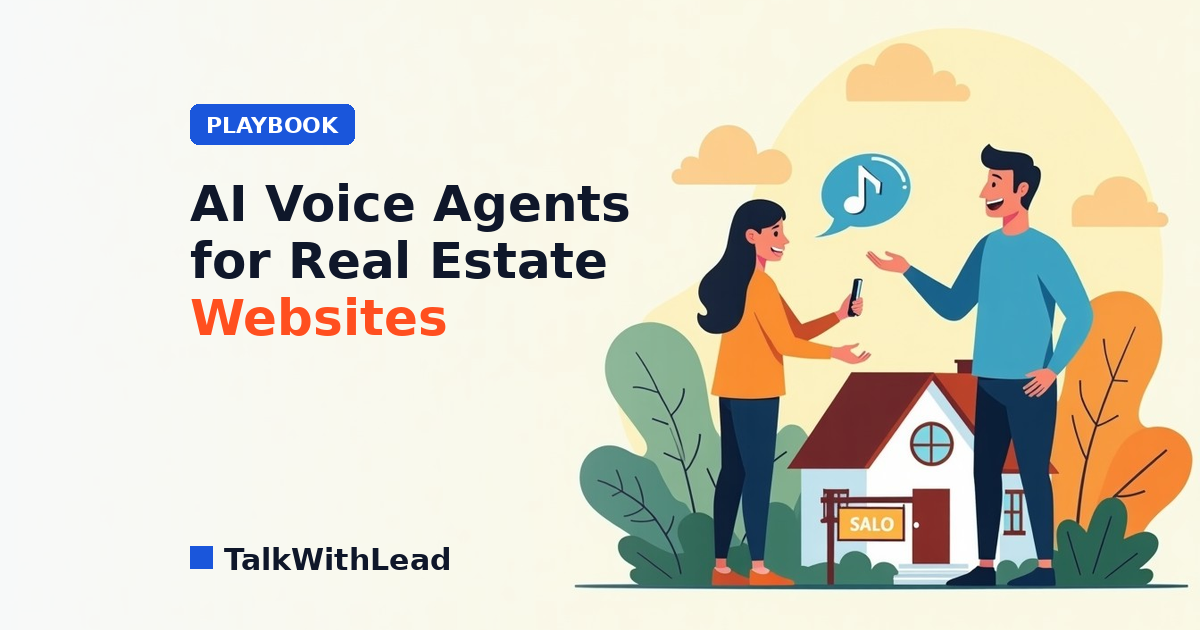
  • AI Voice Agents for Real Estate Websites

    AI Voice Agents for Real Estate Websites

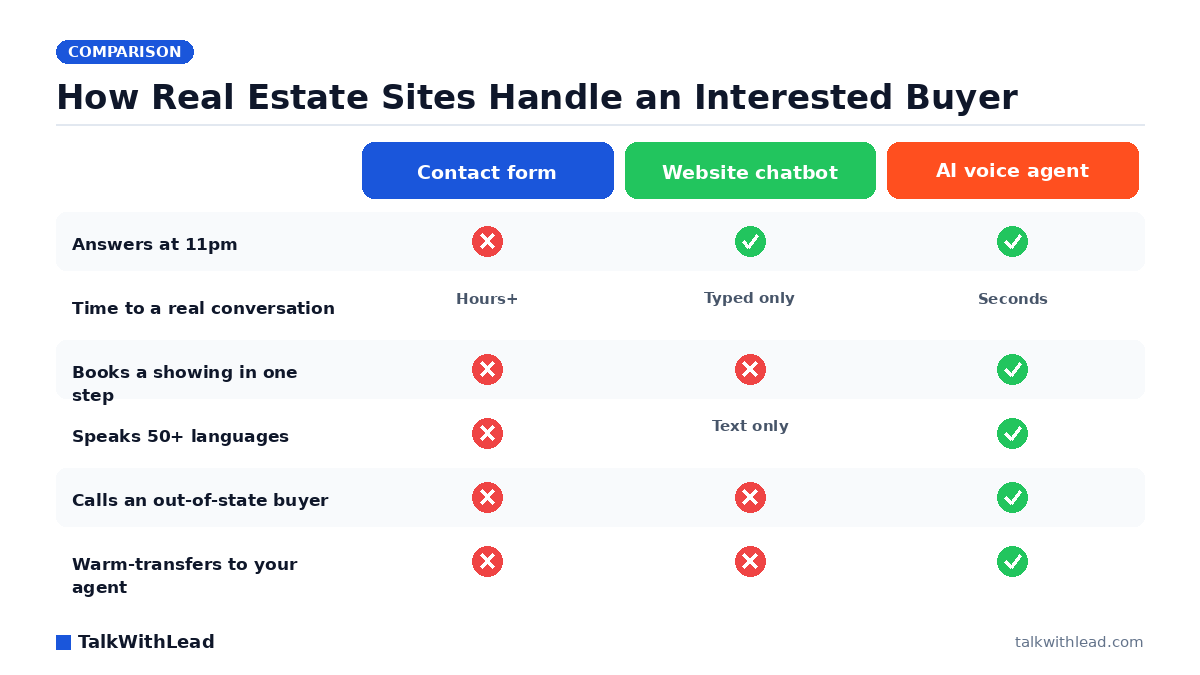
    How Real Estate Sites Handle an Interested Buyer — TalkWithLead original infographic (comparison diagram).
    How Real Estate Sites Handle an Interested Buyer

    A buyer finds your listing at 9:40pm, loves the kitchen, and wants to know if the seller will take an offer under asking. Your contact form promises a reply “within one business day.” By then they have already toured two other homes.

    TL;DR: AI voice agents for real estate websites answer that buyer instantly with a human-sounding voice, qualify the inquiry, and either book the showing or ring your phone while the visitor is still on the listing page. They work around the clock, hold the conversation in 50+ languages, and place unlimited long-distance calls, so an out-of-state or overseas buyer converts the same way a local one does.

    Why real estate websites leak so many leads

    Real estate is a speed sport played on other people’s schedules. Buyers browse after dinner, on weekends, and from three time zones away. Agents are showing property, sitting in inspections, or driving — the exact hours when the website is busiest.

    The math is brutal. According to the MIT Lead Response Management study, you’re about 21× more likely to qualify a lead contacted within 5 minutes than one contacted at 30 minutes. A form that sits in an inbox overnight is not a lead-capture tool; it is a delay mechanism.

    And the phone line does not save you either. According to a 411 Locals study of 85 small businesses across 58 industries, only 37.8% of incoming calls were answered by a live person. Apply that to a listing page and the picture is clear: the visitor who actually reaches for the phone often gets voicemail, then calls the next agent.

    What is an AI voice agent on a real estate website?

    It is a widget on your site that starts a spoken conversation. The visitor taps once and an AI voice agent — one that sounds like a person, not a phone tree — greets them, asks what they are looking at, answers questions about the property, price range, and timeline, and moves them toward a booked showing or a live handoff to you.

    Three capabilities separate it from every text-based widget:

    • Real voice, immediately. No typing, no “an agent will be with you shortly.” The conversation starts in seconds.
    • 50+ languages. The relocating family, the overseas investor, the local buyer who is simply more comfortable in Spanish, Hindi, or French — all get served in their own language without you hiring for it.
    • Unlimited long-distance calling and instant callbacks. The agent can call the visitor back on their phone, wherever they are, and can bridge them to your line while intent is still hot.

    If you want to see how the voice actually sounds before you decide anything, the fastest route is the live demo — thirty seconds tells you more than any feature list.

    AI voice agent vs form vs chatbot for real estate

    Every real estate site already has some way to capture interest. The question is what each one costs you in conversations.

    DimensionContact formWebsite chatbotAI voice agent
    Response timeHours to next business dayInstant, but typedInstant, spoken
    After-hours coverageCollects onlyYesYes
    Books a showing in one interactionNoSometimes, via a formYes, in conversation
    Handles non-English buyersNoText translation50+ spoken languages
    Reaches out-of-area buyers by phoneNoNoUnlimited long-distance calling
    Transfers to the listing agentNoRarelyInstant callback or live bridge
    Emotional read of the buyerNoneLowTone, urgency, objections

    Chatbots are not useless — they are just the wrong shape for a six-figure decision. A buyer weighing a mortgage payment wants a person’s voice, and they want to ask the awkward question out loud. Our deeper breakdown of that trade-off lives in AI Voice Agent vs Chatbot: Which Is Better for Real Estate?, and if you’re comparing widget types specifically, see Click-to-Call vs Callback Widget vs AI Voice Agent.

    How much business does a slow response actually cost?

    Let’s do labeled, illustrative math — these are assumed rates, not measured results from any client.

    Illustrative example. Say a mid-sized brokerage site gets 900 visitors a month and 40 of them show real intent (they click a listing CTA, request info, or start a call). Assume half of that intent arrives outside staffed hours — 20 people. Assume only 1 in 4 of those leave a form and, of those, say 1 in 5 eventually converts to a signed client. That is one client a month from after-hours traffic.

    Now assume an AI voice agent picks up all 20 of those after-hours conversations and, say, 1 in 8 becomes a signed client. That is 2.5 clients a month instead of 1. On a modest average commission, the difference is not a rounding error — it is the reason to install the widget this week rather than next quarter.

    Want to run your own numbers instead of mine? Use the free missed-call revenue calculator with your own traffic and commission figures. And when you’re ready to see plans, the pricing page lists them plainly.

    The five moments an AI voice agent earns its keep in real estate

    1. The 10pm listing browse. Peak buyer curiosity, zero staff. The agent answers, qualifies budget and timeline, and books tomorrow’s showing.
    2. The open-house weekend overflow. You’re standing in a kitchen with four people. The website keeps talking to everyone else.
    3. The relocating buyer. They’re in another state or country. Unlimited long-distance calling means the callback actually happens instead of dying on a toll charge.
    4. The non-English-speaking family. A conversation in their language converts; a translated chat window usually does not. See how that plays out in AI Voice in Hindi for Real Estate.
    5. The comparison shopper. They are on three agents’ sites in one session. The one whose site talks back first usually gets the appointment.

    How do you actually put one on a real estate site?

    Faster than most agents expect. You add a small script to your site — WordPress, Wix, Squarespace, an IDX-powered template, or a custom build — and the voice widget appears. You then tell it three things: what you sell, what questions it should ask a buyer or seller, and where to route a hot lead.

    Practical setup notes worth getting right:

    • Route by intent, not by page. A seller asking about a valuation and a buyer asking about a showing should not land in the same bucket.
    • Give it your qualifying questions. Pre-approval status, timeline, target neighborhoods, price band. The agent asks them naturally, in conversation.
    • Set a handoff rule. Decide when the AI stops and your phone rings — usually a buyer with a timeline under 60 days.
    • Keep it on every page, not just Contact. Intent spikes on the listing, not on the form.

    You can have this running today with a free signup, and if you’d rather hear it first, the live demo takes under a minute.

    Honest verdict: is this right for your brokerage?

    Best for: solo agents, small teams, and brokerages whose website gets meaningful traffic but who cannot staff a phone from 7am to 11pm — especially anyone serving relocating, investor, or multilingual buyers.

    Not the right fit if: your jurisdiction or brokerage policy requires a licensed human on every first contact with a consumer, you get so few web visitors that a personal callback is already instant, or your leads come almost entirely from referrals rather than your site.

    The honest framing is this: an AI voice agent does not replace a good agent. It replaces the silence between the visitor’s interest and your availability — and in real estate, that silence is where most deals quietly die. If you’re weighing it against the widget you already have, Live Chat Alternative for Real Estate Agents compares them side by side.

    FAQ

    What is an AI voice agent for a real estate website?

    It’s a widget that lets a website visitor start a spoken conversation with a human-sounding AI. It answers questions about listings, qualifies the buyer or seller, books showings, and can call or transfer the lead to your agent instantly — 24 hours a day.

    Do AI voice agents work better than chatbots for real estate leads?

    For high-value, emotional decisions like a home purchase, voice generally moves people further in one interaction. A buyer will ask an awkward question out loud that they’d never type, and a showing can be booked inside the conversation instead of through a follow-up form.

    Can an AI voice agent speak to buyers in other languages?

    Yes. TalkWithLead’s voice agent handles conversations in 50+ languages, which matters for relocating families, international investors, and any market where buyers prefer their first language over English.

    Will it call buyers who are out of state or overseas?

    Yes — unlimited long-distance calling is included, so an instant callback reaches a buyer in another state or country the same way it reaches a local one. That’s often the difference between capturing a relocation lead and losing it.

    How fast should a real estate lead be contacted?

    As close to immediately as you can manage. Harvard Business Review research found companies that reach a web lead within an hour are nearly 7× more likely to qualify it than those that wait even an hour longer, per their study of online sales leads. More detail in Speed to Lead Real Estate.

    How long does it take to set up on my site?

    Adding the script is a few minutes on most platforms, including WordPress and hosted IDX sites. Configuring your qualifying questions and routing rules typically takes another sitting — you can start with a free signup and adjust the script as you learn what buyers ask.
  • The Three Things an AI Voice Agent Needs to Convert

    The Three Things an AI Voice Agent Needs to Convert

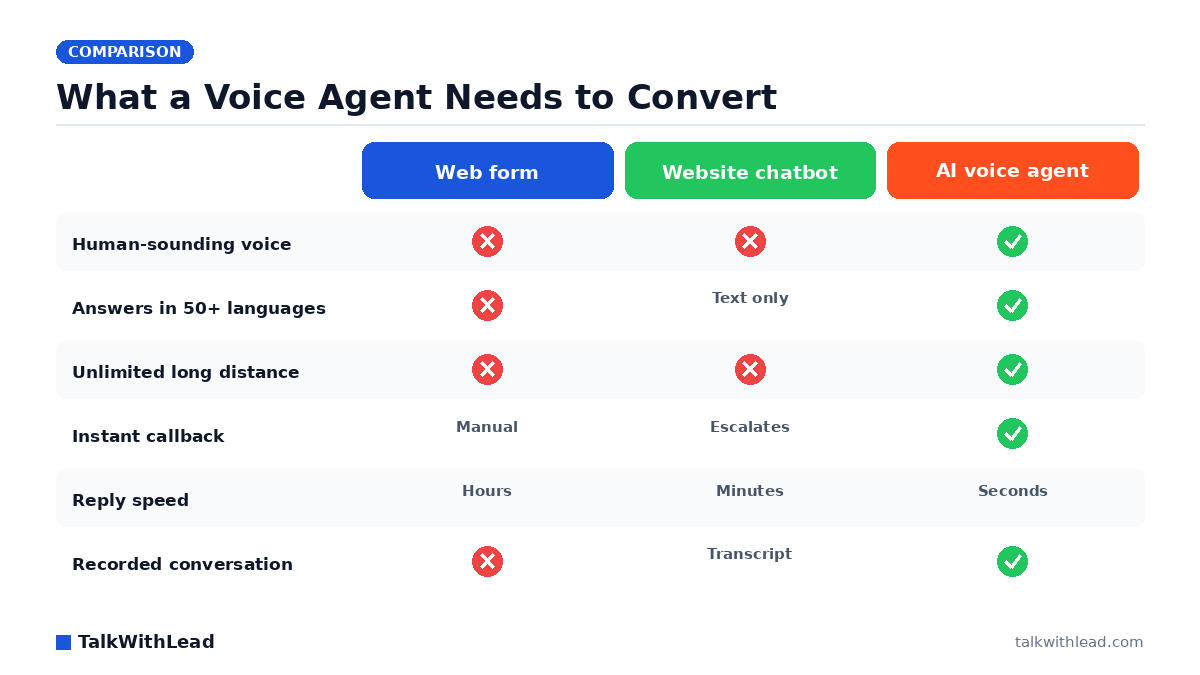
    What a Voice Agent Needs to Convert — TalkWithLead original infographic (comparison diagram).
    What a Voice Agent Needs to Convert

    Most AI voice tools fail for a boring reason: they sound wrong, they only speak one language, or they refuse to dial the caller’s area code. The three things an AI voice agent needs to convert a website visitor are a voice a human will stay on the line for, language coverage that matches the traffic you actually get, and calling that never stops at a border.

    TL;DR: An AI voice agent converts website visitors when it does three things well — speaks with a human-sounding voice that survives the first ten seconds, handles the visitor’s own language across 50+ options, and calls back anywhere without long-distance limits. Miss any one and the conversation ends before your sales team ever hears about it. TalkWithLead ships all three plus instant callbacks.

    What are the three things an AI voice agent needs to convert visitors?

    Strip away the demos and the dashboards. A website visitor converts when a real conversation happens — voice, in their language, on their phone. Everything else is packaging. The three requirements, in order of how fast they kill a lead when missing:

    • A human-sounding voice. The first ten seconds decide whether the visitor talks or hangs up.
    • Real multilingual coverage. A buyer who cannot explain their problem in their own words will not explain it at all.
    • Unlimited long-distance calling. A voice agent that cannot dial the number in front of it is a very expensive voicemail.

    Forms and chatbots fail on all three at once. A form takes text and a promise. A chatbot takes text and stalls. Voice takes the visitor straight to the outcome your business runs on: a phone conversation with someone who was on your pricing page thirty seconds ago.

    Thing one: a voice people do not hang up on

    Robotic prosody is the fastest exit ramp in lead conversion. Flat cadence, no breath, wrong emphasis — buyers recognize it instantly and treat it the way they treat an obvious robocall. Which is to say, they end the call. That is why voice quality belongs in the conversion column of your spreadsheet, not the branding column.

    An extremely human-sounding voice buys you the only thing that matters early: enough seconds for the visitor to say what they came for. Once they are talking, the agent can qualify, answer pricing questions, and book. Once they hang up, nothing downstream helps. Our own comparison of AI voice agents versus chatbots walks through where each one loses the visitor.

    Judge this with your ears, not a feature list. Call the agent yourself, interrupt it mid-sentence, ask something off-script, and listen to how it recovers. You can do exactly that on the TalkWithLead live demo — it takes about a minute and tells you more than any vendor page.

    Thing two: 50+ languages, because your traffic is not monolingual

    Look at your analytics by country and browser language. Unless you sell something hyper-local, a slice of your traffic is reading your English page in their second or third language — well enough to browse, not comfortably enough to negotiate. Those visitors bounce quietly and you log it as “low intent.”

    A voice agent that handles 50+ languages flips that. The visitor clicks, the agent greets them in their language, and the conversation happens at full fluency instead of at translation speed. That is not a nice-to-have in a market where a bilingual competitor is one search result away. We covered the same dynamic in French real estate leads in this breakdown of French-language voice capture.

    Picture a site pulling 4,000 monthly visitors where roughly one in eight prefers a language you do not answer in. Say even a tenth of that group would have booked a call if someone spoke their language — that is a handful of qualified conversations a month, gone, with no trace in your CRM to argue about. Framed math, not a measured statistic, but run it on your own numbers and the shape holds.

    Thing three: unlimited long-distance calling, or you are rejecting buyers by area code

    This is the requirement nobody puts on the shortlist and everybody regrets. Callback systems with metered or region-locked calling quietly decline the numbers that cost the most to dial. The visitor requested a call. Your system decided the call was too expensive. Nobody tells you.

    Unlimited long-distance calling removes that entire failure class. A prospect three time zones or one ocean away gets the same instant callback as someone across town. For anyone selling remotely — SaaS, brokerage, consulting, franchise services — that is not an edge case, it is a meaningful share of pipeline. The same logic drives SaaS demo request conversion on pricing pages, where the buyer’s location is essentially random.

    RequirementWeb formWebsite chatbotAI voice agent
    Human-sounding voiceNoneNoneYes, conversational
    Language coverageOne, as writtenText translation50+ spoken
    Long-distance reachNot applicableNot applicableUnlimited
    Time to first responseHours to daysMinutes, then queuedSeconds
    Output for sales teamForm fieldsChat transcriptLive phone conversation
    After-hours coverageCollects onlyDeflectsAnswers and books

    Why speed is the thread running through all three

    Each requirement exists to protect the same asset: the narrow window where a visitor is still interested. According to Harvard Business Review research, companies that reach a web lead within an hour are nearly 7× more likely to qualify it than those that wait even an hour longer. An agent that sounds human, speaks the visitor’s language, and can dial any number collapses that response window to seconds.

    The failure mode is easy to picture. A visitor fills out a form at 8:40 p.m. Your rep sees it at 9:15 the next morning. By then the visitor has talked to two competitors. Nothing about your product lost that deal — your response time did. That is the same argument we make in why the first 60 seconds win most deals.

    If you want to size the cost for your own business before changing anything, run your numbers through the free missed-call revenue calculator. It uses your inputs and states its assumptions instead of handing you a scary number with no math behind it.

    An illustrative ROI example

    Illustrative scenario, not a customer result. Assumptions are stated so you can swap in your own.

    Assume 3,000 monthly website visitors, an assumed 2% who would take a call if offered instantly (60 conversations), an assumed 25% of those becoming qualified opportunities (15), and an assumed close rate of 20% at an average deal value of $1,500. That works out to 3 closed deals a month, or roughly $4,500 in new revenue from conversations that previously ended as bounces. Change any assumption and the output changes — that is the point of showing the math instead of asserting a result.

    Against that, price the tooling honestly. Voice agent platforms in this category generally land in the tens-to-low-hundreds of dollars per month range depending on volume and features; you can see TalkWithLead’s tiers on the pricing page. The comparison worth making is not agent-versus-nothing, it is agent-versus-the-leads-you-are-currently-losing.

    Best for, and not the right fit if

    Best for: businesses with steady website traffic, a sales process that runs on phone conversations, and buyers spread across regions or languages — brokerages, agencies, clinics, contractors, and SaaS teams with self-serve traffic that needs a human nudge.

    Not the right fit if: your site gets very little traffic, your product genuinely closes without a conversation, or your buyers actively prefer async text and your existing chat already books at a rate you are happy with. A voice agent multiplies existing demand — it does not manufacture it.

    How to evaluate a voice agent in one afternoon

    Skip the feature matrix and test the three requirements directly:

    1. Call it and interrupt it. Talk over the greeting. A human-sounding agent yields; a script barrels on.
    2. Switch languages mid-call. Ask a question in Spanish, French, or Portuguese and hear whether it follows.
    3. Give it a distant number. Request a callback to an out-of-region or international line and confirm the call actually lands.
    4. Test after hours. Run the same three checks at 10 p.m. That is when your competitors’ forms are asleep.
    5. Check the handoff. A booked call is worthless if it does not reach the right person with context.

    If a tool passes all five, it will convert traffic you are already paying for. If it fails the third one, keep looking — long-distance limits are the defect you discover last and pay for longest. For a broader shortlist view, our general buyer’s guide to AI voice agents for small business covers the wider field.

    Ready to put all three on your own site? Start free with TalkWithLead, or try the live demo first and hear the voice your visitors would hear.

    FAQ

    What are the three things an AI voice agent needs to convert website visitors?

    A human-sounding voice that keeps the visitor on the line, spoken coverage across 50+ languages so buyers can talk in their own words, and unlimited long-distance calling so no callback is blocked by geography. Instant callback speed ties the three together.

    Does an AI voice agent really sound human enough to work?

    Modern voice models handle natural cadence, interruptions, and follow-up questions well enough that most visitors simply have a conversation. The honest test is to call one yourself and try to break it — interrupt it, change topics, ask something off-script.

    Why does unlimited long-distance calling matter for lead conversion?

    Metered or region-limited calling silently declines expensive numbers, so out-of-region buyers who requested a call never get one. You lose the lead and never see it in a report. Unlimited calling removes that failure mode entirely.

    Is an AI voice agent better than a chatbot for converting website traffic?

    For anything that closes over the phone, yes — voice reaches the outcome directly instead of collecting text and queuing a human. Chatbots still fit self-serve products with async buyers. Our voice versus chatbot conversion comparison breaks down where each wins.

    How fast should a voice agent call a website visitor back?

    Seconds, not minutes. The visitor is still on the page with the problem fresh in mind. Research on lead response consistently favors the fastest responder, and an AI agent answering instantly is the only way to hit that window at every hour of the day.

    How much does an AI voice agent cost?

    Pricing in this category typically scales with call volume and feature tier, landing in the tens-to-low-hundreds of dollars per month for most small and mid-sized businesses. TalkWithLead’s current tiers are listed on the pricing page.

Your next lead is on your site right now — ready to talk.

TalkWithLead’s AI voice agent picks up in seconds, qualifies the lead in their language, and books the call before the prospect can open a competitor’s tab. Forms are slow. Chatbots make people type. Voice closes.

Just curious about plans? See pricing →
This is the TalkWithLead Widget. Click to see how it will work on your website!