TalkWithLead
AI Voice-First Lead Conversion

AI Voice Agents That Turn Website Visitors Into Real Conversations

TalkWithLead is the AI voice-first widget that picks up the phone the moment a visitor lands on your site. Multilingual, extremely human-sounding, with unlimited long-distance calling so prospects anywhere can call you back. More calls. More leads. More closed deals.

Extremely human-sounding voice 50+ languages out of the box Unlimited long-distance calling Instant callback widget

Tag: real estate

  • AI Voice in Mandarin: Win Real Estate Leads You Lose

    AI Voice in Mandarin: Win Real Estate Leads You Lose

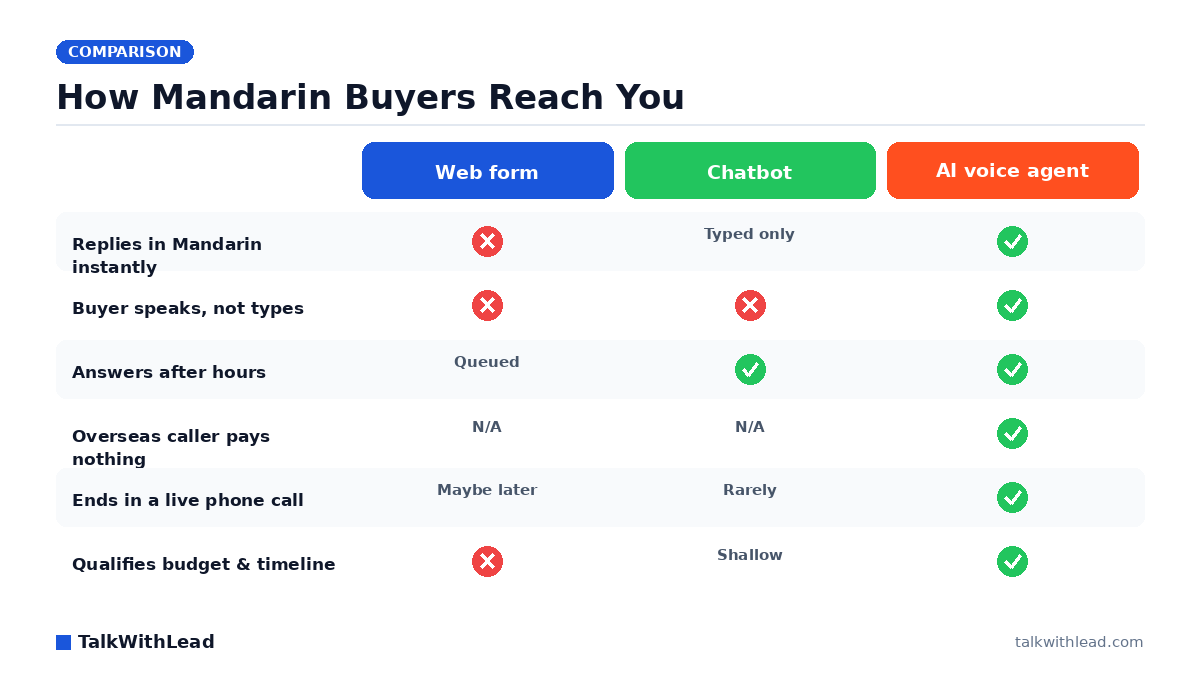
    How Mandarin Buyers Reach You — TalkWithLead original infographic (comparison diagram).
    How Mandarin Buyers Reach You

    A Mandarin-speaking buyer lands on your listing page at 9:40pm, reads the price in English, and has three questions she’d rather ask out loud in Mandarin: is the school catchment confirmed, is the seller flexible on closing, and can she see it Saturday. Your site offers her a form. She closes the tab and messages an agent from a WeChat group instead. That’s the exact leak ai voice in mandarin for real estate closes.

    TL;DR: An AI voice agent on your real estate website answers Mandarin-speaking visitors in Mandarin, out loud, the moment they ask — no form, no typing, no waiting for business hours. It qualifies budget, timeline, and neighbourhood, then connects a warm caller to your agent or books the showing. With 50+ languages and unlimited long-distance calling, an overseas or out-of-province buyer reaches you free.

    Why Mandarin-speaking buyers vanish from your funnel

    Mandarin buyers are not hard to reach. They are hard to hold. Many browse listings comfortably in English — MLS photos and square footage translate fine — but the decision conversation happens in Mandarin, often with a spouse, a parent, or an investor back home on the call. The instant your site forces that conversation into an English text box, you’ve asked the buyer to negotiate the biggest purchase of their life in their second language.

    The other half of the problem is distance. A parent in Shanghai buying a condo for a student in Toronto is not going to dial an international number to ask about parking. Picture a listing page that gets 200 Mandarin-speaking visitors a month and captures a dozen forms. Say even two of those silent visitors were pre-approved and ready — that’s two deals a month leaving through a gap you can’t see in your analytics, because non-conversions don’t fill anything in.

    What does an AI voice agent in Mandarin actually do?

    It picks up. A visitor taps the widget, speaks in Mandarin, and gets a human-sounding voice back in Mandarin within seconds — not a menu tree, not a canned translation, an actual conversation. The agent covers the questions your team answers forty times a week: price, taxes, condo fees, closing timeline, whether the unit is tenanted, when a showing is available.

    From there it does the part that matters to your business. It qualifies — budget range, financing status, purchase timeline, buyer vs. investor — and then either warm-transfers the call to whoever is on duty or books the showing and drops the details to your agent. Because it runs on unlimited long-distance calling, the buyer in Shanghai and the investor in Vancouver both reach you at no cost to them. You can hear it work on the live demo before you decide anything.

    The same logic applies across every language your market speaks. We’ve written the parallel playbooks for Spanish-speaking buyers and Hindi-speaking buyers — same mechanism, different market.

    Mandarin AI voice vs. chatbot vs. translated form

    Most brokerages have already tried a fix. A translated contact form. A chatbot with a Mandarin toggle. Both fail for the same reason: they keep the buyer typing, and typing is slow, formal, and easy to abandon at 9:40pm.

    DimensionTranslated web formChatbot with Mandarin toggleAI voice agent (TalkWithLead)
    Response speedHours to next morningInstant, but textInstant, spoken
    Buyer’s effortType 6 fieldsType back and forthJust talk
    Handles follow-up questionsNoScripted, shallowOpen conversation
    After-hours coverageQueuedYesYes
    Overseas caller costN/AN/AFree (unlimited long distance)
    Languages supportedWhatever you translatedUsually a handful50+
    Ends in a live phone callMaybe, days laterRarelyWarm transfer or booked showing

    Best for: brokerages and agents whose listing pages already draw Mandarin-speaking traffic — urban condo markets, school-catchment neighbourhoods, student-housing corridors, and pre-construction investor inventory.

    Not the right fit if: your Mandarin traffic is negligible, or your team genuinely cannot take a transferred call and has no one to route to. Voice creates conversations; you still need someone to close them. If you’re weighing the general case first, our AI voice agent vs. chatbot for real estate breakdown covers it.

    How fast do you actually have to respond?

    Faster than you think, and the research is consistent about it. The MIT Lead Response Management study found you’re about 21× more likely to qualify a lead contacted within 5 minutes than one contacted at 30 minutes. According to Harvard Business Review research, companies that reach a web lead within an hour are nearly 7× more likely to qualify it than those that wait even an hour longer.

    Now layer language on top. A Mandarin-speaking buyer who submits a form at 9:40pm isn’t just waiting until morning — she’s waiting until morning and hoping whoever calls back speaks Mandarin. Two failure points, both removed when the voice agent answers in Mandarin on the spot. Our deeper piece on speed to lead in real estate walks through the timing math.

    An illustrative ROI example (assumptions stated)

    This is math, not a case study — plug your own numbers in. Assume a listing site draws 300 Mandarin-speaking visitors a month and currently converts 4% into a form (12 leads). Assume the voice agent lifts spoken engagement to 9% (27 conversations) because the buyer can just talk. Now assume a 20% conversation-to-showing rate and a 17% showing-to-transaction rate: roughly 5 showings and just under one extra deal a month. At an assumed average commission of $12,000, that’s a materially different year — from one widget on one page.

    Run your own version against your missed-call volume with the free missed-call revenue calculator. Cost framing: an AI voice agent is a flat monthly software line, typically far below the cost of a bilingual receptionist covering evenings and weekends — see current pricing for exact tiers.

    How to roll it out without disrupting your team

    Start narrow and prove it. Pick the one listing or neighbourhood page that already draws the most Mandarin traffic and put the voice agent there first.

    • Week 1: Install the widget on a single high-traffic page. Set the greeting to detect and offer Mandarin.
    • Week 2: Write the qualification script your agents actually use — budget, financing, timeline, buyer vs. investor, preferred showing windows.
    • Week 3: Set routing rules. Who takes a warm transfer during the day? Who gets the after-hours booking summary?
    • Week 4: Review recordings and transcripts. Fix the two or three questions the agent handled weakly.
    • Month 2: Roll it across all listing pages and turn on the additional languages your market speaks.

    The measurement that matters isn’t widget clicks. It’s booked showings from Mandarin-speaking callers, and how many of those existed before you installed anything. You can have the whole thing live on a page today — start free, or take the live demo first and hear how the Mandarin voice actually sounds before you commit a dollar.

    FAQ

    Does the AI voice agent really speak natural Mandarin, or is it translated English?

    It speaks conversationally in Mandarin — the visitor talks, the agent responds out loud in Mandarin with a human-sounding voice, and the exchange flows like a phone call rather than a translation layer. The same agent handles 50+ languages, so a Cantonese or Korean speaker on the same page gets the same experience.

    Can a buyer in China call my listing without paying international rates?

    Yes. Unlimited long-distance calling is part of the platform, so an overseas parent, investor, or relocating buyer connects to you at no cost to them. That removes the single most common reason overseas prospects never dial a North American listing.

    What happens when nobody on my team speaks Mandarin?

    The AI voice agent handles the Mandarin conversation end to end — questions, qualification, showing preferences — and hands your agent an English summary plus a booked appointment. Your team never has to fake a language they don’t speak, and the buyer never has to switch out of hers.

    Is this better than adding a Mandarin option to my chatbot?

    For real estate, generally yes. A chatbot still makes the buyer type, in a second language, about a seven-figure decision, and it rarely ends in a phone call. Voice ends in a conversation with a person, which is where showings actually get booked.

    How much does an AI voice agent cost for a real estate website?

    It’s a flat monthly subscription rather than a per-call or per-minute answering-service bill, and the tiers are published on the pricing page. Compare it against what evening and weekend coverage from a bilingual receptionist would cost you, then weigh it against a single extra closed deal.

    Will it work on my existing website without a rebuild?

    Yes — it’s a widget you add to your existing site, whether that’s a WordPress blog, an IDX listing platform, or a custom brokerage site. Nothing about your listings, forms, or CRM has to change to test it on one page.
  • AI Voice Agents for Real Estate Websites

    AI Voice Agents for Real Estate Websites

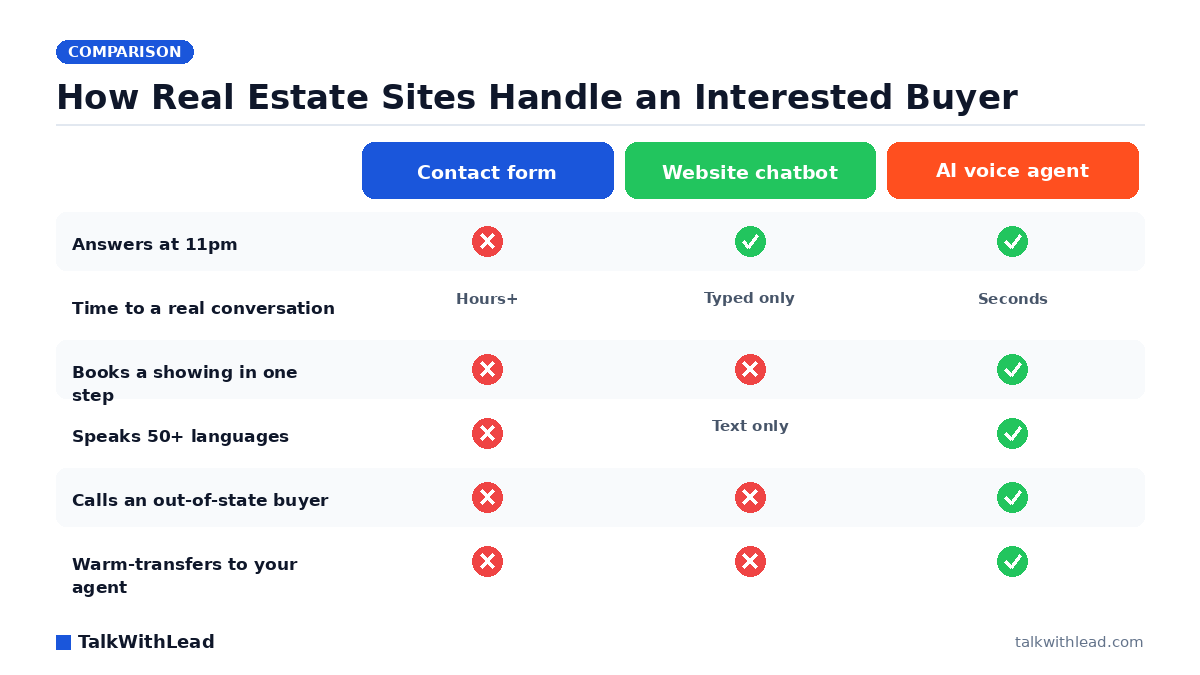
    How Real Estate Sites Handle an Interested Buyer — TalkWithLead original infographic (comparison diagram).
    How Real Estate Sites Handle an Interested Buyer

    A buyer finds your listing at 9:40pm, loves the kitchen, and wants to know if the seller will take an offer under asking. Your contact form promises a reply “within one business day.” By then they have already toured two other homes.

    TL;DR: AI voice agents for real estate websites answer that buyer instantly with a human-sounding voice, qualify the inquiry, and either book the showing or ring your phone while the visitor is still on the listing page. They work around the clock, hold the conversation in 50+ languages, and place unlimited long-distance calls, so an out-of-state or overseas buyer converts the same way a local one does.

    Why real estate websites leak so many leads

    Real estate is a speed sport played on other people’s schedules. Buyers browse after dinner, on weekends, and from three time zones away. Agents are showing property, sitting in inspections, or driving — the exact hours when the website is busiest.

    The math is brutal. According to the MIT Lead Response Management study, you’re about 21× more likely to qualify a lead contacted within 5 minutes than one contacted at 30 minutes. A form that sits in an inbox overnight is not a lead-capture tool; it is a delay mechanism.

    And the phone line does not save you either. According to a 411 Locals study of 85 small businesses across 58 industries, only 37.8% of incoming calls were answered by a live person. Apply that to a listing page and the picture is clear: the visitor who actually reaches for the phone often gets voicemail, then calls the next agent.

    What is an AI voice agent on a real estate website?

    It is a widget on your site that starts a spoken conversation. The visitor taps once and an AI voice agent — one that sounds like a person, not a phone tree — greets them, asks what they are looking at, answers questions about the property, price range, and timeline, and moves them toward a booked showing or a live handoff to you.

    Three capabilities separate it from every text-based widget:

    • Real voice, immediately. No typing, no “an agent will be with you shortly.” The conversation starts in seconds.
    • 50+ languages. The relocating family, the overseas investor, the local buyer who is simply more comfortable in Spanish, Hindi, or French — all get served in their own language without you hiring for it.
    • Unlimited long-distance calling and instant callbacks. The agent can call the visitor back on their phone, wherever they are, and can bridge them to your line while intent is still hot.

    If you want to see how the voice actually sounds before you decide anything, the fastest route is the live demo — thirty seconds tells you more than any feature list.

    AI voice agent vs form vs chatbot for real estate

    Every real estate site already has some way to capture interest. The question is what each one costs you in conversations.

    DimensionContact formWebsite chatbotAI voice agent
    Response timeHours to next business dayInstant, but typedInstant, spoken
    After-hours coverageCollects onlyYesYes
    Books a showing in one interactionNoSometimes, via a formYes, in conversation
    Handles non-English buyersNoText translation50+ spoken languages
    Reaches out-of-area buyers by phoneNoNoUnlimited long-distance calling
    Transfers to the listing agentNoRarelyInstant callback or live bridge
    Emotional read of the buyerNoneLowTone, urgency, objections

    Chatbots are not useless — they are just the wrong shape for a six-figure decision. A buyer weighing a mortgage payment wants a person’s voice, and they want to ask the awkward question out loud. Our deeper breakdown of that trade-off lives in AI Voice Agent vs Chatbot: Which Is Better for Real Estate?, and if you’re comparing widget types specifically, see Click-to-Call vs Callback Widget vs AI Voice Agent.

    How much business does a slow response actually cost?

    Let’s do labeled, illustrative math — these are assumed rates, not measured results from any client.

    Illustrative example. Say a mid-sized brokerage site gets 900 visitors a month and 40 of them show real intent (they click a listing CTA, request info, or start a call). Assume half of that intent arrives outside staffed hours — 20 people. Assume only 1 in 4 of those leave a form and, of those, say 1 in 5 eventually converts to a signed client. That is one client a month from after-hours traffic.

    Now assume an AI voice agent picks up all 20 of those after-hours conversations and, say, 1 in 8 becomes a signed client. That is 2.5 clients a month instead of 1. On a modest average commission, the difference is not a rounding error — it is the reason to install the widget this week rather than next quarter.

    Want to run your own numbers instead of mine? Use the free missed-call revenue calculator with your own traffic and commission figures. And when you’re ready to see plans, the pricing page lists them plainly.

    The five moments an AI voice agent earns its keep in real estate

    1. The 10pm listing browse. Peak buyer curiosity, zero staff. The agent answers, qualifies budget and timeline, and books tomorrow’s showing.
    2. The open-house weekend overflow. You’re standing in a kitchen with four people. The website keeps talking to everyone else.
    3. The relocating buyer. They’re in another state or country. Unlimited long-distance calling means the callback actually happens instead of dying on a toll charge.
    4. The non-English-speaking family. A conversation in their language converts; a translated chat window usually does not. See how that plays out in AI Voice in Hindi for Real Estate.
    5. The comparison shopper. They are on three agents’ sites in one session. The one whose site talks back first usually gets the appointment.

    How do you actually put one on a real estate site?

    Faster than most agents expect. You add a small script to your site — WordPress, Wix, Squarespace, an IDX-powered template, or a custom build — and the voice widget appears. You then tell it three things: what you sell, what questions it should ask a buyer or seller, and where to route a hot lead.

    Practical setup notes worth getting right:

    • Route by intent, not by page. A seller asking about a valuation and a buyer asking about a showing should not land in the same bucket.
    • Give it your qualifying questions. Pre-approval status, timeline, target neighborhoods, price band. The agent asks them naturally, in conversation.
    • Set a handoff rule. Decide when the AI stops and your phone rings — usually a buyer with a timeline under 60 days.
    • Keep it on every page, not just Contact. Intent spikes on the listing, not on the form.

    You can have this running today with a free signup, and if you’d rather hear it first, the live demo takes under a minute.

    Honest verdict: is this right for your brokerage?

    Best for: solo agents, small teams, and brokerages whose website gets meaningful traffic but who cannot staff a phone from 7am to 11pm — especially anyone serving relocating, investor, or multilingual buyers.

    Not the right fit if: your jurisdiction or brokerage policy requires a licensed human on every first contact with a consumer, you get so few web visitors that a personal callback is already instant, or your leads come almost entirely from referrals rather than your site.

    The honest framing is this: an AI voice agent does not replace a good agent. It replaces the silence between the visitor’s interest and your availability — and in real estate, that silence is where most deals quietly die. If you’re weighing it against the widget you already have, Live Chat Alternative for Real Estate Agents compares them side by side.

    FAQ

    What is an AI voice agent for a real estate website?

    It’s a widget that lets a website visitor start a spoken conversation with a human-sounding AI. It answers questions about listings, qualifies the buyer or seller, books showings, and can call or transfer the lead to your agent instantly — 24 hours a day.

    Do AI voice agents work better than chatbots for real estate leads?

    For high-value, emotional decisions like a home purchase, voice generally moves people further in one interaction. A buyer will ask an awkward question out loud that they’d never type, and a showing can be booked inside the conversation instead of through a follow-up form.

    Can an AI voice agent speak to buyers in other languages?

    Yes. TalkWithLead’s voice agent handles conversations in 50+ languages, which matters for relocating families, international investors, and any market where buyers prefer their first language over English.

    Will it call buyers who are out of state or overseas?

    Yes — unlimited long-distance calling is included, so an instant callback reaches a buyer in another state or country the same way it reaches a local one. That’s often the difference between capturing a relocation lead and losing it.

    How fast should a real estate lead be contacted?

    As close to immediately as you can manage. Harvard Business Review research found companies that reach a web lead within an hour are nearly 7× more likely to qualify it than those that wait even an hour longer, per their study of online sales leads. More detail in Speed to Lead Real Estate.

    How long does it take to set up on my site?

    Adding the script is a few minutes on most platforms, including WordPress and hosted IDX sites. Configuring your qualifying questions and routing rules typically takes another sitting — you can start with a free signup and adjust the script as you learn what buyers ask.

  • Live Chat Alternative for Real Estate Agents

    Live Chat Alternative for Real Estate Agents

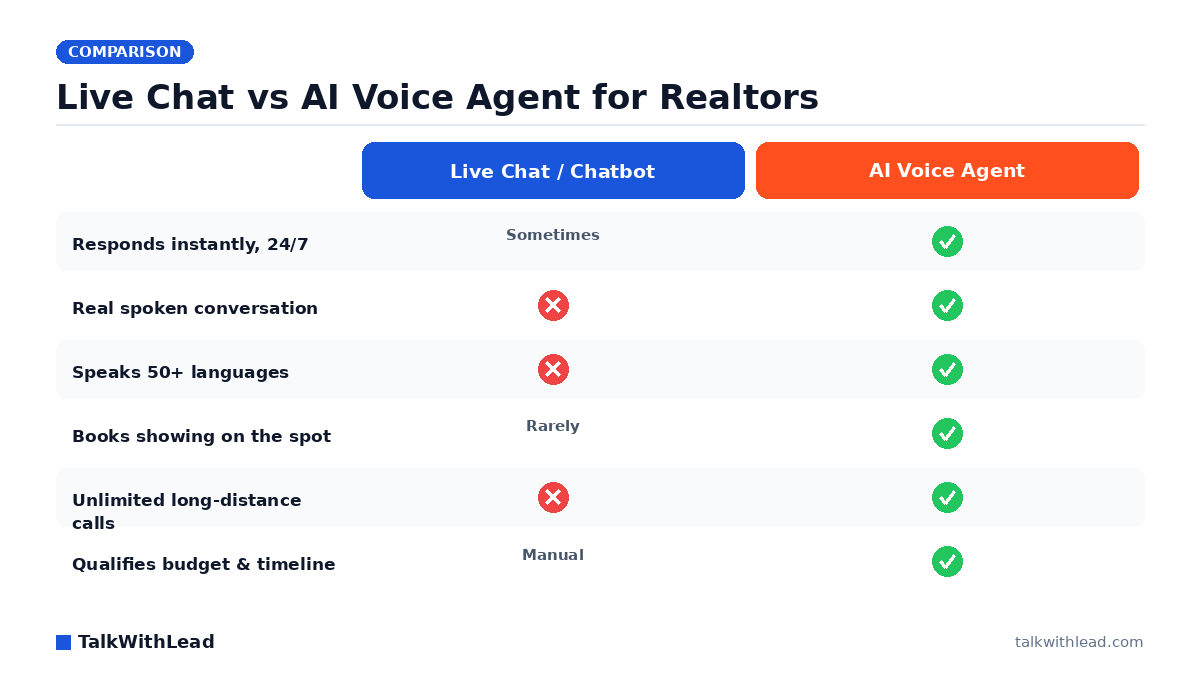
    Live Chat vs AI Voice Agent for Realtors — TalkWithLead original infographic (comparison diagram).
    Live Chat vs AI Voice Agent for Realtors

    A buyer lands on your listing at 9:47 p.m., loves the kitchen, and clicks your live chat. A box pops up: “We’re away right now, leave your email.” They don’t. They open the next agent’s site instead. That single silent moment is why so many real estate agents are hunting for an ai voice agent alternative to live chat for real estate agent websites — something that actually talks back the second interest is highest.

    TL;DR: The strongest live-chat alternative for real estate is a human-sounding AI voice agent that answers the instant a visitor asks to talk, holds a real spoken conversation in 50+ languages, qualifies budget and timeline, and books the showing on the call. Instead of collecting a typed email you may never follow up on, it turns the website visit into a live phone conversation while the buyer is still excited.

    Why live chat quietly loses real estate leads

    Live chat felt modern a decade ago, but for property buyers it introduces friction at the worst possible moment. A serious buyer researching a home doesn’t want to thumb-type questions about square footage, school districts, and closing timelines into a tiny widget. They want to ask and get an answer.

    Three things go wrong with chat on an agent site:

    • It’s usually unstaffed. Agents are at showings, in the car, or asleep. “Live” chat becomes a form that promises a human and delivers a delay.
    • It caps the emotion. Buying a home is a phone-call decision, not a text-thread decision. Typing strips out the tone and reassurance that move someone toward booking.
    • It stalls exactly when speed wins. According to Harvard Business Review research, companies that reach a web lead within an hour are nearly 7× more likely to qualify it than those that wait even an hour longer. A chat transcript sitting unread until morning burns that window.

    We break the chat-versus-bot tradeoff down further in Live Chat vs Chatbot: Pros, Cons, and the AI Voice Upgrade, but the short version is simple: both make the buyer wait or type. Voice does neither.

    What is an AI voice agent alternative to live chat for real estate agent websites?

    An AI voice agent is a widget you drop on your site that lets a visitor start talking — out loud — the moment they want to. Instead of a chat bubble, they get an extremely human-sounding voice that greets them, answers questions about the listing, and offers to set a showing. It runs on your site around the clock and never sends anyone to voicemail.

    Picture the same 9:47 p.m. visitor. They click “Talk now,” and within a second a warm voice says, “Hi, I can help with the Maple Street listing — are you looking to tour it this week?” It asks their timeline, whether they’re pre-approved, and which neighborhoods they’re considering, then books a showing straight into your calendar. That’s a booked appointment from a visit that live chat would have turned into an ignored transcript.

    Because it’s voice-first, it also does things chat structurally can’t:

    • 50+ languages. A relocating engineer or an overseas investor gets answered in their own language, instantly.
    • Unlimited long-distance calling. An out-of-state buyer relocating for work talks to “your office” with no toll barrier.
    • Instant callbacks. If a visitor would rather be called, the agent rings them in seconds while they’re still on the page.

    Want to hear it? Try a Live Demo and talk to the agent the way your buyers would.

    Live chat vs AI voice agent: how they compare

    Here’s the honest, side-by-side view for a real estate website, on the dimensions that decide whether a browsing visitor becomes a booked showing.

    CapabilityLive chat / chatbotAI voice agent
    Answers instantly, 24/7Only if staffedYes, always
    Real spoken conversationNo — typing onlyYes
    Speaks 50+ languagesRarelyYes
    Qualifies budget & timelineManual or scriptedYes, conversationally
    Books a showing on the spotSeldomYes
    Unlimited long-distance callingNoYes

    Best for: real estate agents and teams whose listing pages get after-hours or out-of-area traffic and who lose leads to slow follow-up.

    Not the right fit if: you only ever work referral clients you already know by name and your site isn’t meant to capture new buyer or seller inquiries.

    The same speed logic drives our piece on Speed to Lead Real Estate: Book More Showings — the agent who talks first usually books first.

    How much does an AI voice agent cost, and is it worth it?

    Cost anxiety is fair, so let’s make it concrete with clearly-labeled example math (your numbers will differ). Say your site gets 400 listing-page visitors a month and, like most agent sites relying on forms and chat, only a small slice ever contacts you.

    Illustration: imagine even 12 of those visitors would have talked if someone picked up, and your average commission on a closed buyer is a conservative figure you can plug in. If the voice agent books showings with just 3 of those 12 and one becomes a client, a single deal dwarfs a monthly software subscription. That’s the ROI shape for lead-conversion tools — one saved deal covers a year of the tool.

    To pressure-test your own numbers, run them through our free missed-call revenue calculator — it turns “how many leads am I leaving on the table” into a dollar figure. For plan-level pricing on the voice agent itself, see TalkWithLead pricing; a straightforward monthly subscription typically runs a small fraction of one real estate commission.

    If you’re weighing voice against a hiring an answering service or receptionist, the same tradeoffs we cover in AI Receptionist for Contractors: 2026 Cost & ROI apply to agents: an AI voice agent answers every visitor at once, never takes a lunch break, and doesn’t cost per-minute for long calls.

    Booking showings faster than the competition

    Real estate is a speed sport. When a buyer requests information, they usually reach out to several agents. Whoever converts that interest into a scheduled conversation first tends to win the relationship. A voice agent compresses that race to seconds.

    Here’s what changes on your site the day you replace chat with voice:

    • No dead ends after hours. Evening and weekend traffic — when most buyers browse — gets a real conversation instead of a “leave a message” box.
    • Qualified, not just captured. By the time you see the lead, budget, timeline, financing status, and target neighborhoods are already noted.
    • Fewer lost relocations. Long-distance and multilingual buyers, historically the hardest to convert through text, actually get served.

    You can layer it on the systems you already trust; the goal isn’t to replace your CRM, it’s to stop the leak between “visited your listing” and “talked to you.” See how the widget mechanics compare across formats in Callback Widget vs Click-to-Call vs Live Chat.

    The setup is quick and there’s no reason to keep bleeding after-hours leads. Start free with TalkWithLead and let a voice agent answer your next midnight listing visitor.

    FAQ

    What is the best live chat alternative for a real estate agent website?

    A human-sounding AI voice agent is the strongest alternative because it removes the two biggest weaknesses of chat: the wait and the typing. It answers instantly by voice, qualifies the buyer, and books a showing on the spot — even at night and even in 50+ languages.

    Can an AI voice agent actually book showings on its own?

    Yes. It holds a natural spoken conversation, asks the qualifying questions you’d ask, and schedules the appointment during the call, then hands you a qualified lead with the details already captured.

    Will it work for out-of-state or international buyers?

    That’s one of its biggest advantages. With 50+ languages and unlimited long-distance calling, relocating and overseas buyers get answered in their own language with no toll barrier — exactly the segment that typed chat tends to lose.

    Is an AI voice agent worth the cost for a solo agent?

    For most agents, one additional closed deal covers the tool for a long stretch, so it usually pays for itself quickly. Run your own traffic and commission numbers through a missed-lead calculator to see your specific payback before deciding.

    Does it replace live chat entirely or run alongside it?

    You can run either way. Many agents lead with the voice agent because it converts higher, while still offering a text option for visitors who prefer to type. The point is that no interested visitor hits a silent dead end.

    How fast can I get it live on my site?

    Setup is designed to take minutes, not a developer project — you add the widget, connect your calendar, and it starts answering visitors. You can try it first with a live demo to hear the voice quality before you commit.

Your next lead is on your site right now — ready to talk.

TalkWithLead’s AI voice agent picks up in seconds, qualifies the lead in their language, and books the call before the prospect can open a competitor’s tab. Forms are slow. Chatbots make people type. Voice closes.

Just curious about plans? See pricing →
This is the TalkWithLead Widget. Click to see how it will work on your website!