AI Voice Agents That Turn Website Visitors Into Real Conversations
TalkWithLead is the AI voice-first widget that picks up the phone the moment a visitor lands on your site. Multilingual, extremely human-sounding, with unlimited long-distance calling so prospects anywhere can call you back. More calls. More leads. More closed deals.
Every visitor who leaves your site without talking to a human is a lead your competitor gets to call first. The click-to-call vs callback widget vs AI voice agent decision is really one question: how long does a ready buyer have to wait before a voice answers? Three seconds, three hours, or never.
TL;DR: Click-to-call only helps visitors already willing to dial and wait on hold. A callback widget captures more intent but still queues the lead behind a human’s availability. An AI voice agent answers the moment a visitor taps — 24/7, in 50+ languages, with unlimited long-distance calling — so the conversation happens while interest is at its peak. For most websites, the AI voice agent converts the most because it removes the wait entirely.
What each option actually does
These three tools look similar on a page — a button, a bubble, a phone icon — but they behave completely differently once a visitor engages.
Click-to-call is a tel: link. The visitor taps, their phone dials your number, and everything after that depends on whether someone picks up. On desktop it often does nothing useful at all.
Callback widget collects a phone number and promises a call back — sometimes in 28 seconds, sometimes whenever your team gets to it. It converts the visitor into a task in someone’s queue.
AI voice agent starts a real, spoken conversation right there in the browser. A human-sounding voice greets the visitor, answers questions, qualifies them, and books the next step or connects them to a person.
Only one of those three guarantees a voice on the other end. That distinction decides the conversion rate.
Which one converts more website visitors?
Conversion follows response speed, and the evidence on that is unusually blunt. The MIT Lead Response Management study found you’re about 21× more likely to qualify a lead contacted within 5 minutes than one contacted at 30 minutes. Every minute a lead spends waiting is conversion you already lost.
Now map that to the three tools. Click-to-call is instant only if your line is answered instantly — and answering is the weak link. According to a 411 Locals study of 85 small businesses across 58 industries, only 37.8% of incoming calls were answered by a live person. A callback widget shifts the wait to your team’s response time, which on a busy Tuesday afternoon is rarely five minutes. An AI voice agent has no queue and no lunch break.
Want to hear what that sounds like before you decide? Take the Live Demo and talk to the agent yourself.
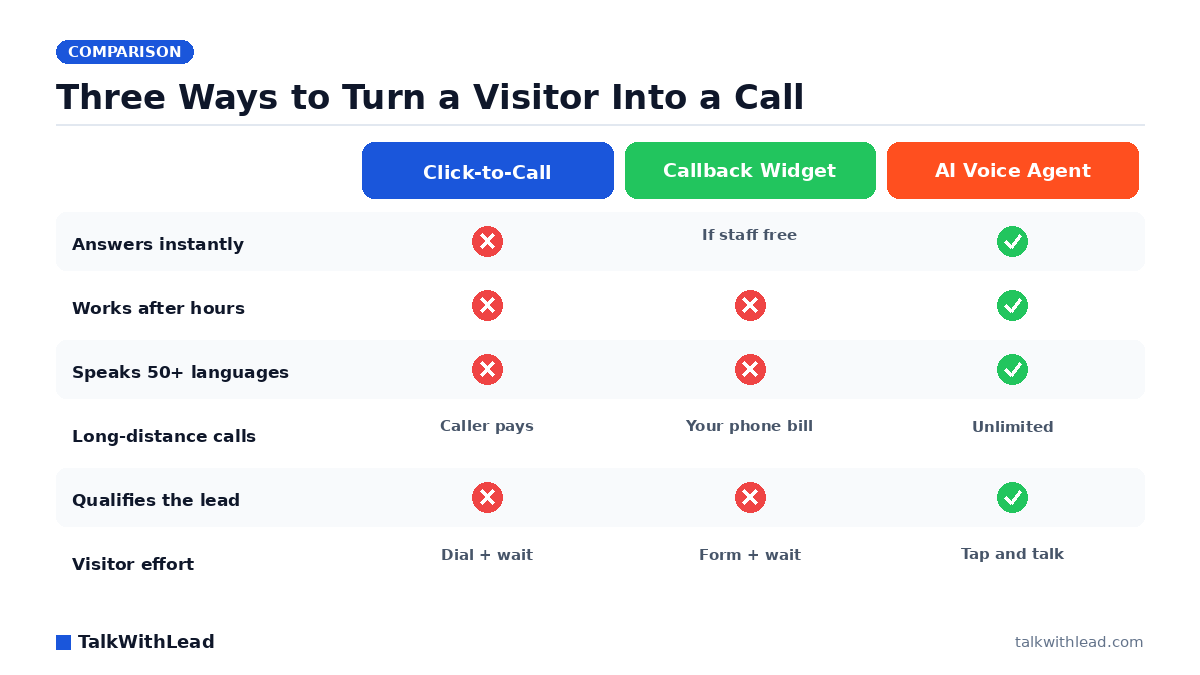
Side-by-side comparison
Dimension
Click-to-Call
Callback Widget
AI Voice Agent
Time to first voice
However long the phone rings
Minutes to hours
Seconds
Works after hours
No
Request logged only
Yes, fully
Desktop visitors
Poor (no dialer)
Good
Good
Languages
Whoever answers
Whoever calls back
50+ languages
Long-distance leads
Caller pays, many won’t
Your phone bill
Unlimited long-distance
Lead qualification
Manual
Manual
Automatic, during the call
Staffing needed
Full coverage
Full coverage
None for first contact
Best use
Mobile, ready buyers
Teams with fast callers
Any site, any hour
Read the rows top to bottom and a pattern shows up: the first two options are fine when a person is sitting there ready to answer. The third one is the only one designed for the hours and languages when nobody is.
The math on the leads you never hear from
Here’s an illustrative example, not a customer result. Say your site gets 4,000 visitors a month and, imagine, even 3 in 100 of them would happily talk to someone about buying. That’s 120 conversations available. If click-to-call captures the handful already dialing and your callback queue reaches half the rest within an hour, you might touch 60 — leaving 60 conversations on the table each month.
Apply your own average deal value to those 60 and the number gets uncomfortable fast. You can run your own version of this math with the free missed-call revenue calculator — put in your real traffic and close rate rather than trusting anyone’s blog arithmetic.
The point isn’t the exact figure. It’s that both click-to-call and callback widgets quietly depend on a human being available, and human availability is the single most expensive thing on this list. Pricing for an always-on AI voice agent sits well below the cost of staffing evenings, weekends, and second languages.
When a click-to-call button is still the right call
Click-to-call earns its place on mobile-heavy sites where visitors arrive already decided — an emergency plumber, a locksmith, a walk-in clinic. If someone’s basement is flooding, they don’t want a conversation. They want your number dialing.
The trap is treating it as your whole strategy. On desktop it’s inert, after hours it’s a voicemail box, and for a visitor who speaks Spanish or French it’s a gamble on who happens to answer. Compare the mechanics in detail in our breakdown of callback widget vs click-to-call vs live chat.
When a callback widget beats both
A callback widget shines for teams with disciplined sales floors and genuine coverage — a mortgage team with licensed loan officers on rotation, an inside-sales group with a five-minute SLA they actually hit. In those setups the widget is a clean intent capture and the human closes it.
It falls apart the moment the callback becomes a to-do item. A lead who filled the form at 7:40 p.m. and gets called at 10:15 a.m. the next day has already spoken to two competitors. If your team can’t promise minutes, an AI voice agent should answer first and hand off warm leads to your people. That handoff pattern is exactly what we cover in AI voice agent vs callback widget vs live chat.
Why the AI voice agent wins most sites
Voice does something no form or chatbot can: it lets a stranger explain their situation in their own words and get an answer in the same breath. A human-sounding AI voice agent picks up in seconds, asks the qualifying questions your best rep would ask, handles the accent and the language, and books the appointment or transfers the call.
Three capabilities carry most of the lift:
Instant answer. No hold music, no “we’ll get back to you.” The conversation happens at peak intent.
50+ languages. A visitor who’d have hung up on an English-only line stays on the phone and converts.
Unlimited long-distance calling. Out-of-state and international prospects reach you without anyone weighing the cost of the call.
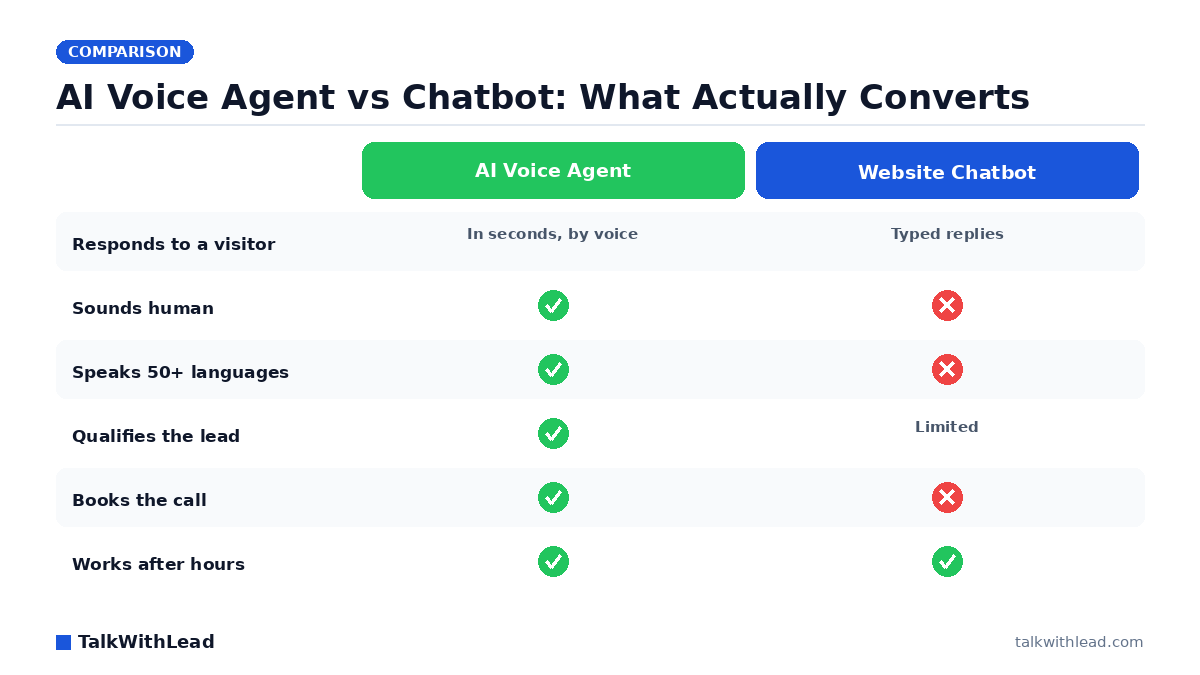
Chatbots were supposed to solve this and mostly taught buyers to close the widget — we broke that down in AI voice agent vs chatbot. Typing is slower than talking, and slower loses.
Honest verdict
Best for: Any business whose website gets leads outside staffed hours, in more than one language, or faster than the team can call back — service businesses, clinics, law firms, real estate, contractors, and SaaS teams with global traffic.
Not the right fit if: You’re a single-person shop with very low traffic who genuinely answers every call within a ring or two, or your sale legally requires a licensed human on first contact. In that case a plain click-to-call button is honest and sufficient.
If you fall in the first group, the fastest way to find out is to run it on your own site. Start free, drop the widget on your highest-traffic page, and count how many conversations happen this week that would otherwise have been silence.
FAQ
What is the difference between click-to-call and a callback widget?
Click-to-call opens the visitor’s phone dialer so they call you and wait for someone to answer. A callback widget collects their number and puts a task in your team’s queue to call them back. The first depends on you answering; the second depends on you calling promptly.
Does an AI voice agent replace my callback widget?
It usually replaces the waiting part of it. The agent answers the visitor immediately, qualifies them, and either books the next step or routes a warm lead to a human. You can still offer a scheduled callback for people who prefer one — it just stops being the only option.
Will visitors know they’re talking to an AI?
The voice is designed to sound natural rather than robotic, and the agent identifies itself honestly. In practice most visitors care far more that someone answered in seconds than about who is on the line.
Which converts better on mobile, click-to-call or an AI voice agent?
Click-to-call converts the small group already committed to dialing. An AI voice agent also captures the much larger group who have a question first and won’t sit through a phone tree to ask it. On mobile, running both is reasonable — the tap-to-talk option catches everyone the dialer loses.
How fast should I respond to a website lead?
Minutes, not hours. Harvard Business Review research found companies that reach a web lead within an hour are nearly 7× more likely to qualify it than those that wait even an hour longer. That’s the entire argument for answering the moment the visitor is on your page.
Do I need to change my phone system to use an AI voice agent?
No. It runs as a widget on your website and handles the call in the browser, then transfers to your existing number when a human is needed. You can try it on the Live Demo before touching anything in your phone setup.
Every one of these widgets makes the same promise: turn an anonymous website visitor into a lead before they hit the back button. But the ai voice agent vs callback widget vs live chat decision is really a decision about who answers, and how fast. Pick wrong, and your best prospects click away to a competitor who picked right.
TL;DR: Live chat converts only when a trained human is actually online. A callback widget captures phone numbers but inserts a delay between intent and conversation. An AI voice agent removes both weaknesses — it answers every visitor instantly with a human-sounding voice, in 50+ languages, at any hour — so for most businesses it converts more visitors into real sales conversations than either alternative.
How Each Option Actually Works
Live chat puts a text box in the corner of your site. When a visitor types, someone on your team is supposed to reply within seconds. In practice, chat sits unmanned during lunch, after 5 p.m., on weekends, and whenever the person covering it is on the phone. The visitor types a question, watches the cursor blink, and leaves. Even when it works, you get a typed exchange — not the phone call where deals actually close. We broke down that gap in Live Chat vs Chatbot: Pros, Cons, and the AI Voice Upgrade.
A callback widget flips the interaction: the visitor enters their number, and your team calls them back. It respects a truth live chat ignores — serious buyers want to talk. But it still depends on a human dialing back quickly. If the callback lands in 30 seconds, it converts well. If it lands in an hour, the lead has often gone cold or gone shopping.
An AI voice agent collapses the whole sequence. The visitor clicks, and an extremely human-sounding AI voice answers immediately — no number form, no queue, no waiting for a rep. It handles the conversation naturally, answers questions, qualifies the lead, books the demo or appointment, and offers an instant callback to the visitor’s phone if they prefer. Because it speaks 50+ languages and supports unlimited long-distance calling, a prospect in Madrid or Mumbai gets the same instant conversation as one down the street. You can hear it live in a two-minute demo — the fastest way to understand why voice beats a text box.
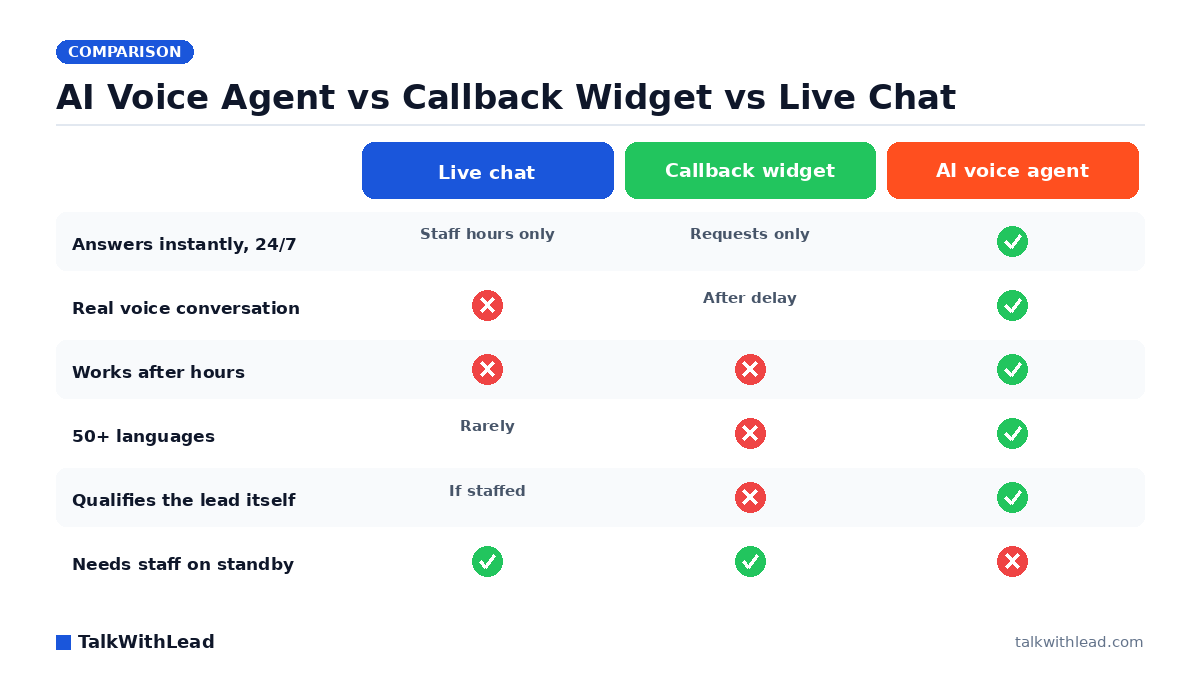
Which Converts More Website Visitors: AI Voice Agent, Callback Widget, or Live Chat?
Conversion in this category comes down to three variables: response speed, conversation quality, and coverage. Here is how the three options compare on the dimensions that decide whether a visitor becomes a booked call:
Dimension
Live chat
Callback widget
AI voice agent
Response speed
Seconds — if staffed
Minutes to hours
Instant, always
After-hours coverage
None (or a bot)
Captures number only
Full conversations 24/7
Conversation medium
Text
Voice, delayed
Voice, immediate
Languages
Whatever your team speaks
Whatever your team speaks
50+ languages
Lead qualification
Manual, if staffed
Manual, after callback
Automatic, in the call
Staffing required
Constant
On-call
None
Long-distance prospects
Text only
Toll costs apply
Unlimited long-distance included
Why does speed dominate this table? Because the research on lead response is brutal. The MIT Lead Response Management study found you’re about 21× more likely to qualify a lead contacted within 5 minutes than one contacted at 30 minutes. Live chat can hit that window only during staffed hours. A callback widget hits it only when someone drops everything to dial. An AI voice agent hits it every single time, because “response time” is the time it takes the visitor to click. We go deeper on the speed math in Speed-to-Lead: Why the First 60 Seconds Win Most Deals.
And the answer-rate problem is worse than most owners think. According to a 411 Locals study of 85 small businesses across 58 industries, only 37.8% of incoming calls were answered by a live person — meaning roughly 6 out of 10 calls went unattended. A callback widget that routes into that same overloaded team inherits that same failure rate.
The ROI Math: What a Delay Actually Costs
Here is an illustrative example — your numbers will differ, so plug in your own. Say your site gets 2,000 visitors a month, and imagine just 2% would talk to someone if a real conversation were one click away. That’s 40 potential conversations. Now assume a widget that depends on human availability catches only the ones arriving during staffed weekday hours — say half — and that delayed callbacks lose a further share to cooled-off interest. You could easily be having 15 conversations instead of 40. If even a modest fraction of those conversations become customers worth $1,000 each, the gap between the two setups is tens of thousands of dollars a year — from the same traffic you already paid to acquire.
Don’t take the hypothetical on faith: run your own visitor count, close rate, and deal size through the free missed-call revenue calculator. It uses your inputs and labeled assumptions, and it takes about a minute.
When Each Option Is the Right Choice
Choose live chat if you have trained staff genuinely available during all your traffic hours and your buyers prefer typing — some support-heavy audiences do. Just be honest about coverage: an unmanned chat box converts worse than no widget at all, because it advertises a promise you’re breaking in real time.
Choose a plain callback widget if your team reliably returns calls within a few minutes and your traffic is concentrated in business hours. It’s a real upgrade over a contact form. If you’re evaluating this route, our teardown of Callback Widget vs Click-to-Call vs Live Chat covers the implementation details.
Choose an AI voice agent if you want every visitor — after-hours, weekend, overseas, or Spanish-speaking — to get an instant, human-sounding phone conversation without adding headcount. It’s the only option in this comparison where conversion doesn’t degrade when your team is busy, asleep, or on vacation. TalkWithLead’s agent also offers instant callbacks, so visitors who want the call on their own phone still skip the waiting.
Best for: businesses whose leads arrive around the clock or from multiple countries, and any owner tired of paying for traffic that never becomes a conversation. Not the right fit if: your buyers must speak to a licensed or credentialed human on the first touch for regulatory reasons, and you already have that human answering within seconds during every hour your site gets traffic.
How to Test This on Your Own Site This Week
You don’t need a committee to settle the ai voice agent vs callback widget question — you need a week of your own data. First, try the live demo and judge the voice quality yourself; skepticism about “robotic AI” usually ends about ten seconds in. Second, check pricing against what one recovered deal is worth in your business — for most, a single saved lead covers months of the widget. Third, create a free account, drop the widget on your site, and count booked conversations after seven days. If you want the deeper comparison against text-based bots before you start, read AI Voice Agent vs Chatbot Conversion Rate.
FAQ
Is an AI voice agent better than a callback widget?
For most businesses, yes — because it removes the delay a callback widget depends on. A callback widget captures a phone number and waits for a human; an AI voice agent starts the conversation the moment the visitor clicks, then can still place an instant callback to the visitor’s phone. You keep everything a callback widget offers and eliminate its weakest link.
Does live chat or a voice conversation convert more website visitors?
Voice tends to win for sales-intent visitors because phone conversations carry tone, urgency, and trust that typed chat can’t. Live chat also fails silently whenever no one is staffing it. A voice-first widget converts the same click into an actual sales conversation instead of a text thread that ends with “someone will follow up.”
Do AI voice agents sound robotic to callers?
Modern AI voice agents are strikingly human — natural pacing, interruptions handled gracefully, and conversational answers rather than scripted menus. The honest test is to listen for yourself: TalkWithLead’s live demo lets you have the exact conversation your visitors would.
Can an AI voice agent handle visitors who don’t speak English?
Yes. TalkWithLead’s agent conducts full conversations in 50+ languages, so a Spanish-, Hindi-, or French-speaking visitor gets the same instant experience as an English speaker — without you hiring multilingual staff. Combined with unlimited long-distance calling, international prospects can reach you as easily as local ones.
What happens to leads that arrive after business hours?
With live chat, they usually bounce. With a callback widget, they leave a number and wait until morning — often after contacting a competitor. An AI voice agent answers at 2 a.m. exactly as it does at 2 p.m.: it holds the conversation, qualifies the lead, and books the appointment so your team starts the day with warm leads instead of cold voicemails.
How much does an AI voice agent cost compared to staffing live chat?
Staffing live chat across real coverage hours means salaries; an AI voice agent is a flat software subscription that never sleeps. As a one-line framing: it typically costs a small fraction of one part-time employee. Check the current plans on the TalkWithLead pricing page and weigh it against the value of a single recovered deal.
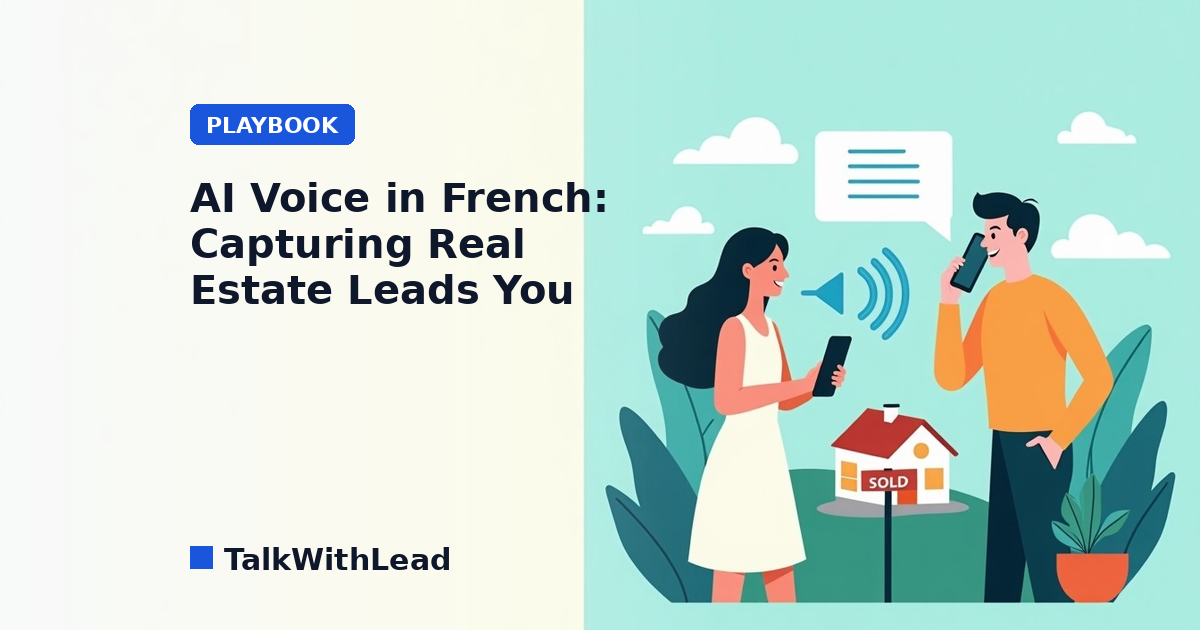
A French-speaking buyer finds your listing at 9pm, reads three lines of English, and closes the tab. You never see that visitor in your CRM, because nothing was ever submitted. AI voice in French closes that hole: the visitor clicks once, a human-sounding voice agent greets them in their own language, and the conversation starts while they are still looking at the property.
TL;DR: An AI voice agent on a real estate website answers French-speaking visitors by phone in seconds, in French, at any hour. It qualifies the buyer’s budget, timeline, and neighbourhood, then books the showing or routes the call to the agent. That replaces the English contact form that French buyers silently abandon, and it works across 50+ languages on the same widget.
Why French-speaking buyers disappear from your funnel
Real estate is a language-of-comfort purchase. A buyer will scroll English listing photos happily, then stop cold at the moment they have to explain their financing situation, their closing timeline, or a question about the condo fees. Typing that in a second language is work. Closing the tab is not.
Your analytics will not show this as a problem. It shows traffic, time on page, and a low form-fill rate — the same signature as any underperforming listing page. The lost French inquiry leaves no fingerprint. Picture a Montreal or Ottawa listing where a meaningful slice of monthly visitors prefer French, and say even a small share of them were ready to book a viewing that week. Those are showings that quietly went to the brokerage whose site spoke their language.
The fix is not translating the page. Translated pages help discovery; they still end at the same silent form. The fix is making the conversation available in French, immediately.
How does AI voice in French actually work on a listing page?
A visitor lands on a property page and sees a callback widget. They tap it, enter a number or accept a browser call, and within seconds an AI voice agent is speaking — in French, with natural pacing and interruption handling, not a menu tree. The agent asks the questions a good buyer’s agent asks: which property, are you pre-approved, what’s your timeline, do you want to see it this weekend.
Three things make that work in practice:
Language detection and 50+ language coverage. The same widget that answers in French answers a Spanish-speaking investor and an English relocation buyer, without you staffing three desks.
Unlimited long-distance calling. Overseas and out-of-province French buyers — a real segment for Quebec, Florida, and European second-home markets — reach you without a toll charge or a WhatsApp negotiation.
Instant callbacks. If the buyer prefers, the widget rings them back in seconds rather than queueing an email.
You can hear the agent handle a live conversation yourself on the TalkWithLead live demo before you decide anything about your site.
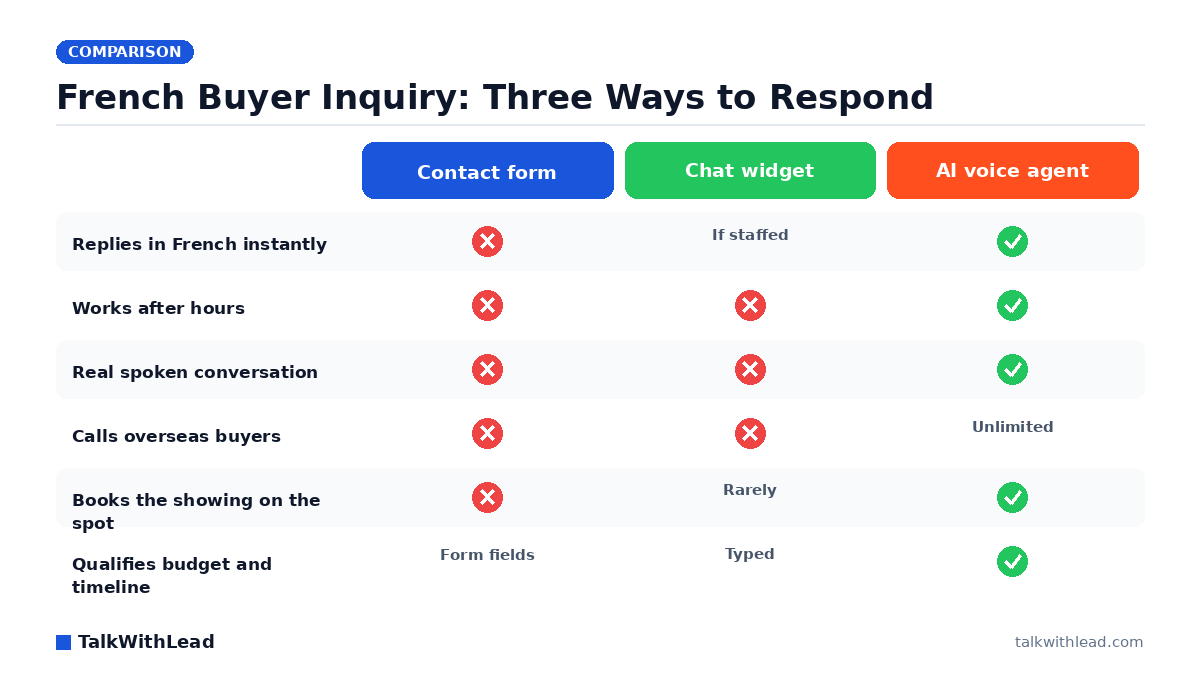
Voice versus chat versus form for a bilingual market
Every real estate site already has a lead-capture layer. The question is which one survives contact with a buyer who is not typing in their first language.
Capability
Contact form
Chat widget
AI voice agent
Responds in French immediately
No — reply comes later, often in English
Only if a French-speaking rep is online
Yes, in seconds
Available after hours and weekends
Collects only
Bot fallback, no booking
Yes, 24/7
Effort for the buyer
High — typing in a second language
Medium — still typing
Low — they just talk
Handles overseas callers
Email only
Email only
Unlimited long-distance calling
Qualifies budget and timeline
Fixed fields
Depends on the rep
Conversational, adapts
Books a showing in the same session
No
Rarely
Yes
Best for: agents and brokerages in bilingual or immigrant-heavy markets — Montreal, Ottawa, New Brunswick, South Florida, Paris-adjacent resort towns — who are already getting listing traffic but few inbound calls.
Not the right fit if: your market is monolingual English and your inbound volume is small enough that you personally answer every call within a minute. Then the language layer buys you nothing you don’t already have.
Language removes the friction. Speed is what wins the deal. According to Harvard Business Review research, companies that reach a web lead within an hour are nearly 7× more likely to qualify it than those that wait even an hour longer. In residential real estate that hour is generous — a serious buyer inquires on three listings the same evening.
Here is illustrative ROI math, with the assumptions stated plainly. Say a listing page draws 400 visitors a month and roughly a quarter of them prefer French. Assume the current English-only form converts 1% of that French segment, and assume an instant French voice conversation converts 4% instead. That moves the group from about one inquiry a month to about four. At an assumed 25% showing-to-offer rate and an assumed $9,000 average commission, the difference is roughly one extra closed transaction per quarter. Those rates are assumptions for illustration, not measured results — plug your own numbers into the speed-to-lead ROI calculator and see what the gap is worth in your market.
The same arithmetic applies to missed phone calls. A 411 Locals study of 85 small businesses across 58 industries found only 37.8% of incoming calls were answered by a live person — meaning roughly 6 out of 10 calls went unattended. An agent showing a property cannot also answer the phone. The voice agent can.
What the agent should say to a French-speaking buyer
Configuration matters more than the technology. A voice agent that opens with a generic greeting wastes the advantage. Give it the listing context and a short qualification path:
Greet in the visitor’s language and name the property. “Bonjour — vous regardez le condo sur Rue Saint-Denis?” beats “How can I help you today?”
Ask timeline before budget. Buyers answer “when” honestly and “how much” defensively.
Offer two concrete showing windows. Open-ended scheduling loses the moment.
Capture the callback number and confirm it back. Numbers get misheard in any language; confirmation is cheap insurance.
Hand off warm. The agent should text the human a two-line summary before the buyer hangs up.
Brokerages running this alongside their existing intake often pair it with a speed-to-lead callback widget on every listing page, so the buyer never has to hunt for the phone number.
Rolling it out without disrupting your current process
This is a widget, not a CRM migration. The practical sequence: install on your highest-traffic listing pages first, set French and English as the primary languages, route qualified calls to the listing agent’s mobile, and let after-hours calls run fully autonomous with a morning summary. Give it two weeks before you judge it — you need enough evening and weekend traffic for the pattern to show.
Watch three numbers: conversations started, showings booked, and after-hours share. If the after-hours share is meaningful, that is capacity you previously had no way to serve. Plans and per-market costs are listed on the TalkWithLead pricing page, and you can put it on a single listing page today with a free signup to see whether your French traffic actually picks up the phone. If you want the broader vertical view first, our guide to the best AI voice agent for real estate agents covers the non-language criteria.
FAQ
Does the AI voice agent actually sound natural in French?
Yes — the agent uses a human-sounding synthetic voice with natural pacing, and it handles interruptions rather than reading a script to the end. It is not an IVR menu, and callers speak to it the way they would speak to a receptionist.
What happens if a visitor starts in French and switches to English?
The agent follows the caller. Language handling is conversational across 50+ languages, so a bilingual buyer who drifts between French and English mid-sentence is handled without a restart or a transfer.
Can a French-speaking buyer overseas call without paying long distance?
Yes. Unlimited long-distance calling is included, so a buyer in France, Belgium, or Morocco looking at a North American property can have the conversation at no cost to them.
Will this replace my human agent on the call?
No — it handles first contact and qualification, then hands off. The typical setup routes a qualified, motivated buyer straight to the listing agent’s phone, and only runs fully autonomous when nobody is available.
How is this different from adding a French chatbot to my site?
A chatbot still asks the buyer to type in a second language and rarely books anything. Voice removes the typing entirely and finishes the job — qualification and a scheduled showing — inside one conversation. The voice-versus-chatbot comparison goes deeper on the mechanics.
How long does it take to get AI voice in French running on my listings?
Installation is a script on your site, so most agents are live the same day. Configuring the property context, qualification questions, and routing rules is the part worth spending an hour on.
Adding a callback widget to WordPress is a ten-minute job, and it is probably the highest-leverage ten minutes you will spend on your site this quarter. Most WordPress sites already earn traffic they never convert — visitors read a page, hesitate, and leave without ever picking up the phone. A callback widget closes that gap by turning a click into a live phone conversation.
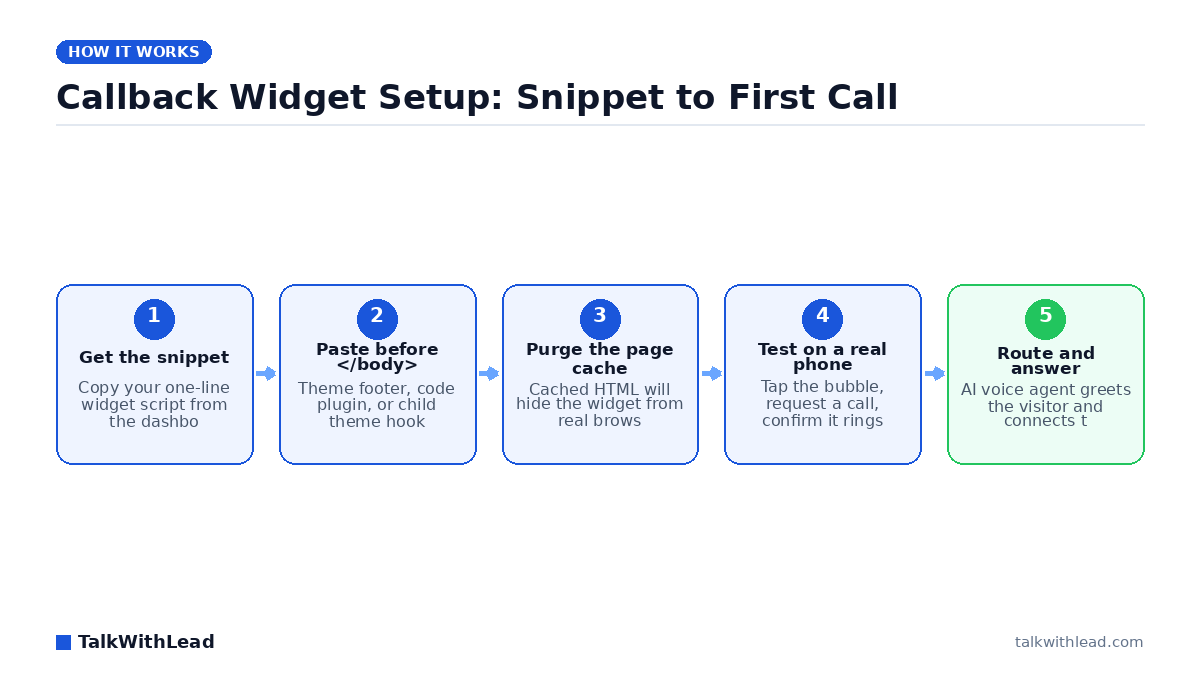
TL;DR: To add a callback widget to WordPress, copy the widget’s JavaScript snippet from your provider, paste it immediately before the closing </body> tag using your theme’s footer hook or a code-insertion plugin, purge your page cache, then test the widget on a real mobile browser. With TalkWithLead, the widget also answers — an AI voice agent talks to the visitor and places the call within seconds.
What a callback widget actually does on a WordPress site
A callback widget is a small floating element — usually a bubble in a bottom corner — that offers the visitor a phone conversation instead of a form. The visitor taps it, gives a number or asks to talk, and the system connects the call. No inbox. No “we’ll get back to you within one business day.”
That distinction matters more than the install itself. A widget that just queues a phone number in a CRM is a contact form wearing a different costume. The version that earns its place on your site is the one that starts the conversation while the visitor is still on the page, still comparing you against two other tabs. If you are still weighing formats, our breakdown of callback widget vs click-to-call vs live chat lays out where each one wins.
How do I add a callback widget to WordPress in 10 minutes?
Here is the whole sequence. Nothing here requires a developer, and every step is reversible.
Create the account and grab the snippet. Sign up, add your site domain, and copy the one-line script the dashboard gives you. Start with the free signup if you do not have a snippet yet. (~3 minutes)
Decide where the code goes. Three safe options, in order of preference: a code-insertion plugin (WPCode, Insert Headers and Footers), your theme’s built-in “Footer scripts” field, or a child theme’s wp_footer hook. Never edit a parent theme’s footer.php directly — the next theme update erases it. (~1 minute)
Paste it before the closing body tag. The footer position keeps the script out of your render path, so it will not slow your Largest Contentful Paint. (~1 minute)
Purge every cache layer. This is the step people skip and then file a support ticket about. Clear your WordPress page cache plugin, your host’s server cache, and your CDN. Cached HTML was generated before the snippet existed, so real browsers keep getting the old version even though the code is saved. (~2 minutes)
Test on a real phone. Open the site on your own mobile browser — not just a desktop window resized narrow. Tap the widget, request a callback, and confirm your phone actually rings. (~3 minutes)
If the widget does not appear after a purge, open your browser console and look for a Content Security Policy error or a script blocked by an optimization plugin. “Defer all JavaScript” and “Delay JS until interaction” settings in caching plugins are the two most common culprits. Add the widget domain to the exclusion list and it renders.
Plugin or code snippet: which install method should you use?
Both work. Pick based on how much control you need over where the widget appears.
Dimension
Code snippet in footer
Code-insertion plugin
Setup time
~2 minutes
~5 minutes
Survives theme updates
Only via child theme
Yes
Page-level show/hide rules
Manual code
Built-in conditions
Extra plugin to maintain
None
One more
Best for
Sitewide widget
Landing pages only
Default to the snippet. Reach for the plugin when you want the widget on service pages but not on checkout, or when a non-technical teammate needs to toggle it without touching theme files.
Why an answering widget beats a message-taking widget
Installing the widget is the easy part. What decides whether it produces revenue is what happens in the sixty seconds after someone uses it.
According to Harvard Business Review research, companies that reach a web lead within an hour are nearly 7× more likely to qualify it than those that wait even an hour longer. A callback widget that emails you a phone number does not deliver that hour — it delivers whenever you next check your inbox. On a Saturday afternoon, that could be Monday.
TalkWithLead closes the loop on the widget’s own side. An extremely human-sounding AI voice agent picks up the request, greets the visitor by voice, asks what they need, and places the call immediately. It handles the conversation in 50+ languages, so a Spanish-speaking visitor is not stuck reading English form labels. Unlimited long-distance calling means a prospect three time zones away costs you nothing extra to reach. You can hear it running on a live site through the Live Demo.
Best for: WordPress site owners who get real traffic, sell something worth a phone conversation, and cannot staff a live answering desk every hour their site is open.
Not the right fit if: your product sells entirely self-serve at a low price point and a phone call would only add friction to the checkout.
How much is a slow callback costing you?
Run the arithmetic on your own numbers rather than trusting a generic benchmark. Here is an illustrative example, with every assumption stated:
Assume 2,000 monthly visitors to your service pages.
Assume 2% tap a callback widget — 40 requests a month.
Say even 1 in 4 of those requests goes unanswered until the next business day: 10 lost conversations.
Assume a 20% close rate and a $1,500 average job value: roughly $3,000 a month walking to a competitor.
Those inputs are placeholders — swap in yours. The free missed-call revenue calculator does the math with your traffic, close rate, and ticket size. Compare the output against published pricing and the decision usually makes itself. For a deeper look at why the first minute carries so much weight, read how fast you should call a new lead.
Five settings to configure before you call it done
A default install works. A configured install converts. Spend ten more minutes here:
Trigger timing. Show the widget after a short scroll or dwell rather than the instant the page paints. An overlay that lands before the visitor reads your headline gets dismissed on reflex.
Mobile placement. Check that the bubble does not cover your primary call-to-action button on a 375px-wide screen. Most callback requests arrive from phones.
Business hours and after-hours behavior. Decide explicitly what happens at 11pm. An AI voice agent answering beats a form that promises a reply.
Language handling. If your traffic is mixed, confirm the agent switches languages on its own instead of forcing a menu choice.
Analytics events. Fire a GA4 event on widget open and on completed callback so you can measure the widget instead of guessing about it.
Chatbots and contact forms remain the slow alternative here: they collect text, hand you a transcript, and leave the actual selling for later. Voice skips that queue. If you want the side-by-side, see AI voice agent vs chatbot conversion rate.
Verify the install like a professional
Before you move on, confirm four things from a clean browser session with cache disabled: the widget renders on your homepage and on a deep service page; tapping it produces an actual ring on your phone; PageSpeed Insights shows no meaningful regression in your Largest Contentful Paint; and your analytics records the open event.
If all four pass, you are done. The widget will keep working while you sleep, and every visitor who wants to talk gets a conversation instead of a confirmation message. Start the free signup, paste one line of code, and watch what happens when your website starts answering back.
FAQ
How do I add a callback widget to WordPress without a plugin?
Copy your provider’s JavaScript snippet and paste it into your theme’s footer scripts field, or add it to a child theme using the wp_footer action hook. Then purge your page cache and CDN so browsers receive the updated HTML. No plugin is required for a sitewide widget.
Will a callback widget slow down my WordPress site?
Not meaningfully, if it loads asynchronously in the footer. The script runs after your page content renders, so it should not affect Largest Contentful Paint. Verify with PageSpeed Insights before and after installing, and exclude the widget domain from any “delay JavaScript” setting that would break it.
Why is my callback widget not showing up after I installed it?
Nine times out of ten it is caching. Purge your WordPress cache plugin, your host’s server cache, and your CDN. If it still does not appear, check the browser console for a blocked script — optimization plugins that defer or delay JavaScript are the usual cause, and adding the widget domain to their exclusion list fixes it.
Can a callback widget talk to visitors in other languages?
With TalkWithLead, yes. The AI voice agent handles conversations in 50+ languages and adapts to the caller rather than making them pick from a menu. That matters on sites drawing multilingual traffic, where an English-only form quietly filters out qualified buyers.
Is a callback widget better than live chat for a WordPress site?
For anything sold through a conversation, usually yes. Chat requires typing, produces a transcript instead of a relationship, and stalls when nobody is staffing it. A callback widget backed by an AI voice agent gets the visitor on the phone in seconds, at any hour, which is where deals actually close.
What does a callback widget cost?
Most callback tools price as a flat monthly subscription rather than per-minute, and TalkWithLead includes unlimited long-distance calling so international prospects do not create surprise charges. Current tiers are listed on the pricing page; run your own numbers through the missed-call calculator to see what the widget needs to recover to pay for itself.
A buyer lands on your listing at 9:14 p.m., loves the kitchen, and wants to see the place this weekend. If you call back tomorrow morning, that buyer has already booked two showings with agents who answered first. Speed to lead in real estate is won in minutes, not mornings — and most agents are still losing it to a contact form and a 12-hour reply gap.
TL;DR: The fastest way for real estate agents to book more showings is to replace slow web forms with an instant callback widget backed by a human-sounding AI voice agent. It calls the buyer back in seconds, answers questions in their language around the clock, and books the showing while interest is still hot — turning anonymous website traffic into real phone conversations before a competitor responds.
Why does speed to lead matter so much in real estate?
Real estate buyers shop in tabs. A single property search ends with five or six listings open at once, and the agent who turns that browsing into a live conversation first usually wins the relationship. The gap you are competing against is brutal: according to the MIT Lead Response Management study, you are roughly 21× more likely to qualify a lead contacted within 5 minutes than one contacted at 30 minutes. In a market where the listing itself is public, response speed is one of the few advantages you fully control.
Now picture the inverse. Say even 1 in 10 of the after-hours inquiries you currently reply to “first thing tomorrow” was a ready buyer — that is a handful of booked showings a month walking straight to the agent who picked up first. The cost of slow is not theoretical; it is the listing down the street getting the offer.
What is an instant callback widget, and how does it book showings?
An instant callback widget is a small button on your website and landing pages that offers the visitor a phone call right now, with no form to fill out. The visitor taps it, and instead of waiting in a queue, they get a call back in seconds. When that call connects to a human-sounding callback widget powered by an AI voice agent, the conversation starts immediately — the buyer talks, the agent listens, and a showing time gets proposed before the buyer ever closes the tab.
This is the core difference between voice-first and the slow alternatives. A web form collects a name and disappears into an inbox. A chatbot makes the buyer type, wait, and re-type. A voice callback does the one thing real estate runs on: it gets two people talking. See the side-by-side in our breakdown of AI voice agents vs chatbots for which actually converts website visitors.
Best for: agents and teams who get steady website or listing-page traffic but lose after-hours and weekend inquiries to slow follow-up. Not the right fit if: you have almost no inbound web traffic yet — fix lead generation first, because a callback widget converts demand, it does not create it.
How an AI voice agent covers the leads you can’t
No agent can answer every call. You are at a closing, in a showing, asleep, or already on another line. That is exactly when the next buyer is browsing. A human-sounding AI voice agent answers those inquiries the moment they come in — 24/7, in 50+ languages — so a relocating buyer from another country or a night-shift worker scrolling at midnight gets a real conversation instead of a voicemail.
Two real-estate-specific wins matter here:
50+ languages — a multilingual market like Miami, Toronto, or Houston means buyers who would hang up on an English-only line instead get qualified in their own language.
Unlimited long-distance calling — out-of-state and international buyers relocating into your market reach you with zero toll friction, and you reach them right back.
The AI voice agent qualifies the buyer, answers the obvious questions (price, square footage, is it still available, can I see it Saturday), and books or routes the showing. When you are free, it hands you a warm lead instead of a cold callback list. It is the difference between capturing the lead before they call a competitor and finding out Monday that they already toured three other homes.
Want to hear how human it actually sounds? Try the live demo and have the AI voice agent call you the way it would call your next buyer.
Voice-first vs forms and chatbots for real estate leads
Most agent websites still funnel inquiries through a “Request Info” form or a typing chatbot. Both leak buyers at the exact moment intent peaks. Here is how the three stack up on what a showing actually depends on:
Capability
Web form
Chatbot
Instant callback + AI voice
Response time
Hours
Minutes of typing
Seconds, by phone
Works 24/7
Collects only
Yes
Yes, and it talks
50+ languages spoken
No
Limited
Yes
Books a showing on the spot
No
Rarely
Yes
Long-distance buyers reached
No
No
Unlimited calling
Becomes a real conversation
No
No
Yes
The pattern is consistent: forms and chatbots are holding pens, while a voice callback is a conversation. For the deeper trade-offs between typing-based tools, our piece on live chat vs chatbot, and the AI voice upgrade walks through why voice closes the gap. And if you want the data behind responding inside the first minute, read why the first 60 seconds win most deals.
What does this cost, and is it worth it for an agent?
The honest framing: an instant callback tool runs a predictable monthly subscription, far below the cost of a single lost commission. To see whether it pencils out for your pipeline, here is illustrative ROI math (your numbers will differ):
Example: Say your site gets 200 listing-page inquiries a month and your current form-and-follow-up flow converts 4% of them into showings — 8 showings. If answering instantly by voice lifts that to a still-modest 7%, that is 14 showings, or 6 extra showings a month. In real estate, even one of those turning into a closed deal can cover a year of the tool. Plug your own traffic and average commission into the free speed-to-lead ROI calculator to see your version of the number.
The math leans this way because of who responds first. Research popularized by InsideSales and Dr. James Oldroyd found roughly 35-50% of sales go to the company that responds first — in real estate, “responds first” means “got the showing.” You can compare the plan tiers on the pricing page and start converting your existing traffic with a free signup.
How to add speed to lead to your real estate site this week
You do not need a website rebuild. A practical rollout looks like this:
Put the callback widget on high-intent pages first — individual listings, the “book a showing” page, and any paid-ad landing page where buyers arrive ready.
Set the AI voice agent to answer instantly after hours and overflow so nights and weekends, when buyers actually browse, stop going to voicemail.
Turn on the languages your market speaks so multilingual buyers get qualified instead of dropping off.
Let it book or route showings, then review the transcripts weekly to sharpen the questions it asks.
The goal is simple and measurable: every inquiry becomes a phone conversation in seconds, not a form sitting in an inbox. If you want to compare voice against booking by chatbot specifically, our look at which one books more calls makes the case. When you are ready, run the live demo on your own phone before you put it in front of a buyer.
FAQ
What does speed to lead mean in real estate?
Speed to lead is how fast you respond to a new buyer or seller inquiry from your website, ads, or listings. In real estate it usually decides who gets the showing, because the first agent to start a real conversation tends to win the relationship before competitors even reply.
How fast should a real estate agent respond to a web lead?
Within minutes, ideally seconds. Qualification rates drop sharply after the first five minutes, so an instant callback that connects the buyer to a live or AI voice conversation right away dramatically outperforms a same-day or next-morning reply.
Can an AI voice agent really book showings for real estate?
Yes. A human-sounding AI voice agent answers the inquiry instantly, qualifies the buyer, answers common questions about the property, and proposes or books a showing time. It works 24/7 in 50+ languages and hands you warm, already-engaged leads instead of a callback list.
Is an instant callback widget better than a chatbot for real estate?
For booking showings, voice usually wins. A chatbot makes the buyer type and wait, while a callback widget gets two people talking in seconds — which is how real estate deals actually move. Voice also handles tone, urgency, and follow-up questions that text struggles with.
How much does an instant callback tool cost for agents?
It is a monthly subscription, typically far less than a single lost commission. Whether it pays off depends on your traffic and conversion lift — you can estimate your own return with the free speed-to-lead ROI calculator before committing to a plan.
Does it work for out-of-state or international buyers?
Yes. Unlimited long-distance calling removes the toll barrier for relocating buyers, and support for 50+ languages means buyers who would hang up on an English-only line get qualified in their own language instead.
Every missed call on a small-business website has a dollar value, and most owners never put a number on it. Once you do, the math gets uncomfortable fast. This is a practical guide to missed call automation for websites in 2026: what the term actually means now, why the AI voice-first approach has overtaken the old “missed-call text-back” tools, and how to stop losing leads to whichever competitor’s phone rings first.
The short answer: Missed call automation is a system that captures a caller or web visitor the moment your team can’t pick up, so the lead never goes to a competitor. The older approach is missed-call text-back, which sends an automatic SMS; the stronger approach is an AI voice-first agent that actually answers or calls the lead back in seconds, 24/7, in 50+ languages. Because a large share of calls to small businesses go unanswered, automating the recovery is often the single fastest way to stop losing booked revenue. According to a 411 Locals study of 85 small businesses across 58 industries, only 37.8% of incoming calls were answered by a live person — meaning roughly 6 out of 10 calls went unattended.
The math of a missed call
Numbers are illustrative — not a verified customer result. Picture a small home-services business: 250 inbound web/phone leads per month, 10% close rate, $1,400 average ticket. That’s 25 closed jobs and $35,000 in monthly revenue.
Plenty of small businesses miss real inbound calls once after-hours, weekend, and overlap windows are counted — and every missed call can be real buying intent walking away. Even a conservative 20% miss rate on those 250 leads is 50 missed conversations a month. At a 10% close rate, that’s 5 jobs and $7,000 in monthly revenue — over $80,000 a year — quietly walking to whichever shop’s phone got answered.
And the stakes aren’t small at the macro level either. According to BIA/Kelsey research, click-to-call and inbound phone calls influence more than $1 trillion in U.S. consumer spending each year — which is why every unanswered call is a slice of real, intent-rich revenue.
You can’t promise that lift to any specific business and we won’t pretend to. But this is the shape of the cost. Now imagine an AI voice agent that picks up the moment a visitor clicks the widget on your site, in their language, with no toll cost — and you can see why “missed call automation” stopped being optional.
Why your team misses calls
After hours and weekends
Inbound interest doesn’t clock out at 5 PM — plenty of it lands on evenings, weekends, and holidays. Most teams default to “we’ll see it Monday.” The lead is gone by Monday.
Reps already on a call
If your team has one or two people answering the phone, the second concurrent call is a missed call. Voicemail is a missed call. “I’ll call back in 20 minutes” is a missed call, because in 20 minutes the lead has already started a conversation with someone faster.
Crews in the field
If you have techs in the field — under a sink, on a roof, in a patient’s mouth, on a job site — they cannot answer. A missed call is the default.
Language mismatch
A prospect who speaks Spanish, Hindi, Mandarin, French, or Tagalog first will often hang up the moment the answer comes in a language they cannot work in. That call is missed even though somebody picked up.
Long-distance fear
Two leaks most teams never count: a prospect calling from a different country who worries about toll costs, and a prospect in a different region whose carrier may charge them a per-minute fee. They never dial. That’s a missed call you don’t even know you missed.
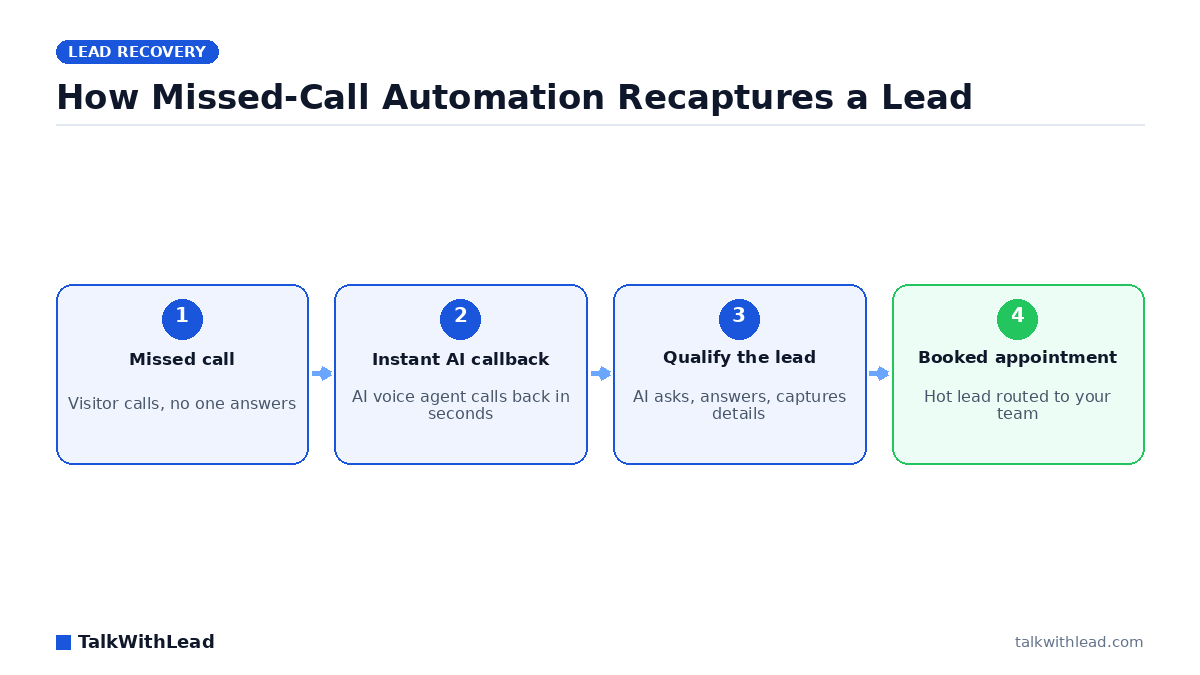
How Missed-Call Automation Recaptures a Lead
What “missed call automation” actually means today
The 2018-era version was a text-back tool: if someone called your business and you didn’t pick up, an automated SMS would go out saying “sorry we missed you, leave a message.” Useful — but slow. The visitor still has to wait, type, hope.
The 2026 version is an AI voice agent embedded directly in your website. The visitor never has to dial in the first place — they click the widget, and the AI voice agent picks up immediately. The conversation starts in the visitor’s language, in a voice that sounds human, with no toll cost to them. If a human on your team is free, the AI hands off cleanly. If not, the AI books the next step (a confirmed callback time, a calendar slot, a quote summary) and sends both you and the prospect a confirmation.
That is what TalkWithLead does on day one. Start a free TalkWithLead trial if you want to run it on your own site this week.
Why AI voice-first beats missed-call text-back tools
No call needed in the first place. The prospect clicks the widget and talks directly through the browser — no dialing, no toll, no IVR.
Instant pickup, not “we missed you.” In practice, response times under a minute outperform response times measured in hours by a margin that changes the unit economics of a business — every operator who watches their pipeline sees it. (See our deeper take on speed-to-lead.)
Multilingual. 50+ languages out of the box. A text-back tool defaults to whatever language your auto-template is written in.
Unlimited long-distance. The visitor never thinks about toll cost; TalkWithLead covers it.
Qualifies inline. The AI asks the right two or three questions during the conversation, so when a human gets the lead it’s already pre-qualified.
Sounds human. Modern AI voice handles interruptions, language switching, and clarification without sounding robotic. Try the Live Demo.
How TalkWithLead handles a missed call
The TalkWithLead widget sits on every page where conversions matter — your homepage, your pricing page, your demo-request page, your listing pages, your contact page. When a visitor clicks it, three things happen in parallel:
The AI voice agent picks up immediately in the visitor’s language.
The agent asks two or three qualifying questions tuned to your business (location, urgency, the specific service or product they need).
The agent either books a callback into your real calendar, escalates to a human who is on shift, or completes the conversation on its own. The visitor gets a confirmation. Your team gets a clean lead summary.
For visitors who prefer a phone call, the same widget can fall back to instant callback — your team’s phone rings, with the qualified context already attached.
Before and after — same missed call, two outcomes
Before
Tuesday 10:47 PM — a prospect on your service page tries to call. Voicemail.
10:48 PM — they try the next two competitors in the search results. The second one answers.
Wednesday 8:35 AM — your office sees the missed call, dials back. The deal has been booked elsewhere.
Outcome: lead lost. Your team never knew the prospect existed until it was too late.
After
Tuesday 10:47 PM — the prospect clicks the TalkWithLead widget. The AI voice agent picks up immediately in their language.
10:48 PM — the agent asks two qualifying questions, confirms an 8:30 AM appointment, and texts the prospect the booking.
Wednesday 8:25 AM — your tech reviews the qualified intake on their phone and arrives at 8:30. The customer feels like the business genuinely picked up at 10:47 PM the night before.
Outcome: lead won, zero late-night work for the office team, no toll cost for the prospect even if they were dialing from another country.
By industry — quick fits
Home services
An emergency caller on a Sunday picks whichever shop’s widget answers first. AI voice-first handles the call when your techs are mid-job and you can’t pick up.
Real estate
A listing-page form submission at 9 PM gets a live AI conversation in seconds. The buyer feels heard. The agent gets the qualified showing request the next morning. (We covered the Saturday-tour pattern in our speed-to-lead deep dive.)
Mortgage and insurance
Rate-shoppers compare three lenders or carriers in one sitting. The one whose phone (or AI voice agent) answers first usually closes. Recording-disclosure rules apply per jurisdiction; talk to your own compliance counsel.
SaaS sales pages
A Friday-afternoon “talk to sales” click becomes a Friday-afternoon real conversation instead of a Monday-morning SDR ping. Pipelines fill faster.
How to roll this out in 48 hours
Day 0: Sign up for a TalkWithLead trial and drop the widget on your three highest-conversion pages (homepage, demo or contact, pricing).
Day 0 evening: Configure the qualifying questions you want the AI to ask. (For most businesses, 2 to 3 are enough — name, location, the single most important thing about the inquiry.)
Day 1: Test with a friend who speaks a second language. Confirm the AI handles them in that language and that the callback fires correctly.
Day 2: Watch the inbound volume. Compare your booked-call rate over the next two weeks against the prior two weeks. The honest math is whatever your numbers say.
If the math is good, scale to every page that matters. See pricing if you want the cost side first.
Missed-call text-back vs AI voice-first recovery
Both approaches try to recover a lead you couldn’t answer live, but they recover very different things. Here’s the honest at-a-glance comparison.
Missed-call text-back vs AI voice-first recovery
Capability
Missed-call text-back (SMS)
AI voice-first (TalkWithLead)
What the lead gets
An automated text message
A live voice conversation or instant callback
Effort on the lead
Must read and reply by text
Just talks — closer to the call they wanted
Qualifies the lead
Limited; relies on back-and-forth texting
Yes — asks questions and routes in conversation
After-hours / weekends
Sends a text any time
Answers and calls back 24/7
Languages
Usually English templates
50+ languages
International leads
SMS deliverability varies
Unlimited long-distance calling included
Best job
A holding message so the lead knows you saw them
Actually recovering and converting the missed lead
Bottom line — which one to use
Best for: Any business that takes inbound calls or web leads and can’t always answer live — home services, real estate, clinics, brokers, local businesses. An AI voice-first agent recovers missed calls into real conversations, which captures more booked jobs than a text-back alone.
Not the best fit for: If you already answer essentially every call live and have full after-hours coverage, automation adds less. A text-back tool can be a lightweight first step, but it stops at a message rather than a conversation.
In one line: Text-back tells the lead you saw them; an AI voice-first agent actually has the conversation and recovers the booking.
After-hours lead capture: the system smart shops are quietly using (coming soon)
FAQ
What is missed call automation?
Software that catches inbound calls or conversations your team would otherwise miss, and turns them into bookings, callbacks, or qualified leads automatically. In 2026, the strongest version is an AI voice agent on the website that picks up the conversation before the visitor ever needs to dial.
Is missed-call text-back enough?
For a tiny business with low volume, sometimes. For anyone serious about conversion, no — by the time the text arrives, the prospect is usually already in a conversation with a competitor.
What happens after hours?
TalkWithLead’s AI voice agent answers immediately, in the visitor’s language, and books a callback into your calendar for whenever you’ve said you’re available next morning.
What about international leads?
TalkWithLead covers unlimited long-distance, so a prospect anywhere in the world can talk to you without thinking about toll. Removing that friction removes the abandonment.
Will customers know they’re talking to AI?
The voice is extremely human-sounding, and the conversation feels natural. Many customers don’t realize for the first minute. If you’d prefer a human handoff after the qualifying questions, the AI can route the call through to your team.
Does this replace my sales team?
No. It removes the missed-conversation problem. Your team still owns closing, negotiation, and relationship work. The AI agent’s job is to make sure no real opportunity goes silent.
How is this different from a callback widget?
A callback widget still requires the visitor to wait for a human. The AI voice-first widget answers immediately. We compare the channels in detail in our callback widget vs. live chat buyer’s guide.
How many calls do small businesses actually miss?
More than owners expect. According to a 411 Locals study of 85 small businesses across 58 industries, only 37.8% of incoming calls were answered by a live person — meaning roughly 6 out of 10 calls went unattended. That gap is exactly the revenue missed-call automation recovers.
Is missed-call text-back good enough on its own?
It’s better than nothing, but a text only tells the lead you noticed them — it doesn’t have the conversation. An AI voice-first agent answers or calls back and actually qualifies and routes the lead in 50+ languages, which recovers more booked jobs than an SMS alone.
Does missed call automation work after hours and on weekends?
Yes. An AI voice-first agent answers and calls leads back 24/7, including nights and weekends, so the after-hours leads that normally leak to competitors get captured the moment they reach out.
If your website gets inbound interest, you have one job: turn that interest into a conversation before the visitor closes the tab. The tools that do that work fall into four camps: click-to-call, callback widget, live chat, and the newer AI voice-first widget. Same goal, very different conversion rates.
Quick answer: Click-to-call, callback widgets, and live chat all try to convert website visitors, but they win in different situations. Click-to-call is best on mobile when the visitor is ready to dial now; a callback widget is best for capturing warm leads who can’t talk right that second; live chat is best for FAQ deflection and self-serve support. The highest-converting option for the buying moment is an AI voice-first widget, which combines instant calling, 24/7 callbacks, and 50+ languages so no high-intent visitor slips away. The reason speed matters this much: according to Harvard Business Review research, companies that reach a web lead within an hour are nearly 7× more likely to qualify it than those that wait even an hour longer.
This is a buyer’s guide. No fluff, no unsupported numbers, no fake testimonials. Just where each tool wins, where each tool leaks leads, and how to pick. Talk to TalkWithLead’s AI voice agent yourself if you want to feel the difference before you read on.
TL;DR — which one converts more, in 60 seconds
Click-to-call wins when the visitor is already on mobile and already ready to call. Loses everyone else.
Callback widget wins when the visitor will accept a phone call but not initiate one. Loses visitors who want answers now.
Live chat wins for self-serve product questions, FAQ deflection, and visitors who prefer typing. Loses high-intent buyers who want to talk.
AI voice-first widget (TalkWithLead) removes the “type into a box” or “wait for a callback” friction that stalls the other formats. The AI voice agent picks up immediately, in the visitor’s language, in a voice that actually sounds human. Hear it live.
The four tools, plain English
1. Click-to-call
A button on your site that, when clicked from a mobile device, opens the phone dialer with your number. Cheap, simple. On desktop it does almost nothing — most desktops aren’t set up to make calls. And the visitor still has to do the call: dial, wait through your IVR, leave a voicemail if you’re busy.
2. Callback widget
A widget that asks the visitor for a phone number and triggers a callback in seconds. Better than click-to-call on desktop. Better than live chat for high-intent buyers. Still has one assumption: that a human on your team is free to take the call right now.
3. Live chat
A chat window that lets the visitor type questions and get typed answers. Excellent for self-service product questions, FAQ deflection, and account lookups. Terrible at high-intent service inquiries because the visitor has to read prompts, type, wait, read, type. Most chat funnels see the same drop-off pattern: the prospect starts typing, then realizes they’d rather just talk to someone, then closes the tab.
4. AI voice-first widget (TalkWithLead)
A widget that lets the visitor click once and immediately have a real spoken conversation with an AI voice agent — no form, no typing, no waiting. It sounds human. It handles 50+ languages out of the box. It qualifies the lead, books the next step, and also covers unlimited long-distance, so a prospect anywhere in the world can call you without thinking about the cost. If a human takes over, the AI hands off cleanly. If no human is available, the AI books the callback in a calendar slot the visitor confirms on the spot.
That last difference is why the AI voice-first widget is the format that keeps high-intent visitors moving: it removes the “next step” friction that loses them in the other formats.
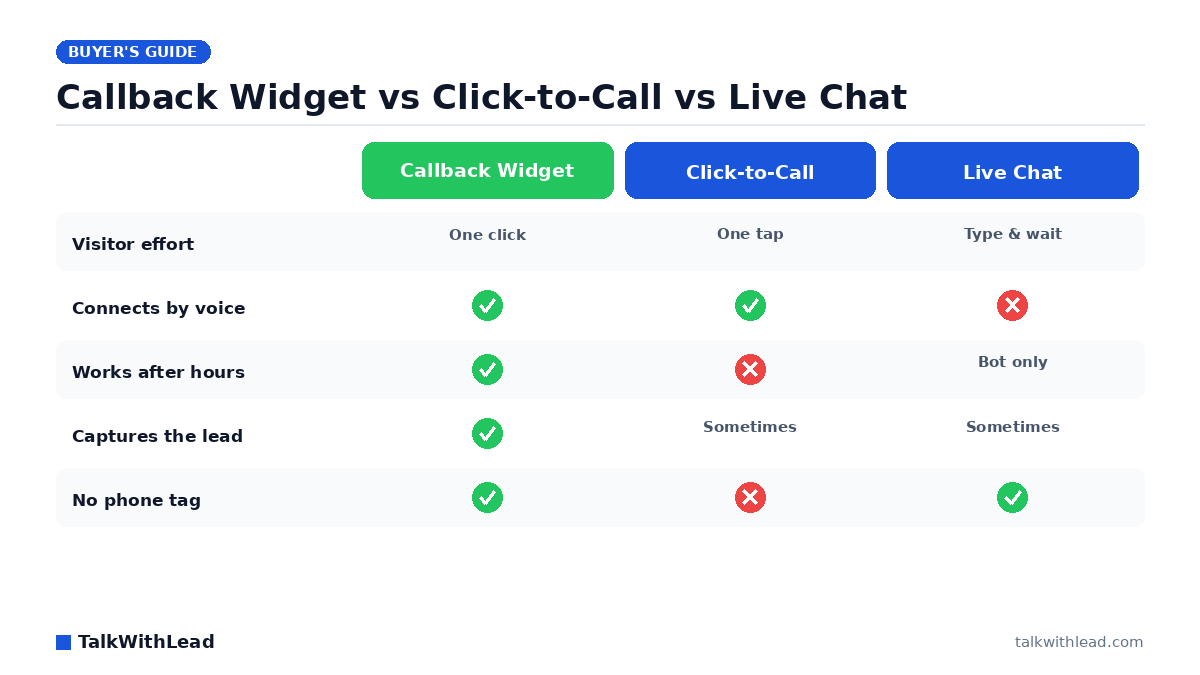
Callback Widget vs Click-to-Call vs Live Chat
Side-by-side comparison
Dimension
Click-to-call
Callback widget
Live chat
AI voice-first (TalkWithLead)
Visitor effort
Click + dial + listen to ring
Click + type phone number
Click + read + type each turn
Click + talk
Works on desktop
Poor
Yes
Yes
Yes
First response time
Depends on you picking up
Seconds to minutes
Seconds (bot) or minutes (human)
Instant — AI picks up immediately
Works after hours
No (your phone is closed)
Only if you have on-call coverage
Only if staffed; otherwise a bot
Yes — AI voice agent + scheduled callback
Multilingual
Depends on your team
Depends on your team
Translation plugins; clunky
50+ languages, native
Long-distance cost to visitor
Visitor pays
You pay (small)
None (typed)
None — unlimited long-distance covered
Best for
Mobile + simple call routing
Visitors who’ll accept a callback
FAQ deflection + self-serve
High-intent conversion at the moment of interest
Hands off to a human
It IS the human
Yes, when a human is free
Yes, when a human is free
Yes — AI qualifies first, then routes
Once you see the table side by side, the question stops being “which legacy tool?” and starts being “do I want the upgrade or not?” If you’d like to compare the AI voice-first option against your current setup on your own pricing page, start a free TalkWithLead trial and run it in production.
Where each one wins
Click-to-call wins on a mobile checkout
If your buyer is already on a phone and already decided they want to call, a tap-to-dial button on a “contact” page is the right answer. It’s a finisher, not a converter.
Callback widget wins for warm leads who are at work
A prospect researching at their desk who doesn’t want to make a call right now will happily request a callback for “in the next 15 minutes.” It’s faster than a form and friendlier than an inbound IVR. Speed still wins the race, though: Velocify research analyzing 3.5 million leads found that calling a lead within one minute makes them 391% more likely to convert — which is exactly why an instant, automated callback beats a human getting to it 15 minutes later.
Live chat wins for SaaS support and FAQ deflection
If your top use case is “does the product integrate with X?” or “where do I find my invoice?”, a chat box is great. A buyer in research mode with a typing-friendly question will take the chat. They’ll close the tab if they’re trying to book a tour or get an emergency tech out.
AI voice-first widget wins the high-intent conversion moment
This is the moment that decides quarterly numbers. A visitor on a real-estate listing page at 9 PM Saturday. A homeowner with a leaking water heater on a Sunday. A buyer on your pricing page who clicked “talk to sales” expecting an answer in the next 60 seconds. In every one of those cases, the AI voice-first widget converts more leads because it removes the part where the visitor has to wait or work for the conversation.
Where each one loses leads
Click-to-call loses everyone on desktop, everyone with anxiety about phone IVRs, and every after-hours visitor.
Callback widget loses the visitor who wants an answer in the next minute, not in the next 15.
Live chat loses the visitor who came to talk, not to type. It also loses non-English speakers stuck with weak translation widgets and international visitors who would have been on the phone with a competitor before your live chat agent typed “Hi there, how can I help?”.
AI voice-first widget loses very little — it can still hand off to a human for nuanced sales conversations, and the AI agent answers the simple cases on its own.
The AI-voice-first upgrade
If you’ve been running click-to-call, a callback widget, or live chat on your site and you’ve watched the conversion rate plateau, the upgrade you’re looking for isn’t a new chat skin. It’s a different category. TalkWithLead’s widget answers the visitor’s first question in seconds, in their language, in a voice that doesn’t sound like a robot. A human-sounding voice keeps the conversation feeling natural — far less friction than typing into a bot.
For the cases that need a human, the AI hands off cleanly with all the context already captured. For the cases that don’t, the AI books the next step and you don’t pay anybody to take a 30-second qualifying call.
By industry — quick fits
Real estate: AI voice-first widget on every listing page. The Saturday-tour moment is the entire game. (See our deep dive on speed-to-lead.)
Home services: AI voice-first on the homepage and the booking page. Sunday emergency calls go to whichever shop’s widget picks up first.
Mortgage: AI voice-first on rate pages. Rate-shoppers compare three lenders in one sitting and close with whoever calls back fastest.
SaaS sales pages: live chat for self-serve product questions; AI voice-first on the demo-request and pricing pages.
Local businesses: AI voice-first widget — multilingual is a huge win in any city with a real immigrant population, and unlimited long-distance opens you up to traveling customers.
Lawyers, dentists, clinics: AI voice-first works here too, with extra care for compliance and recording disclosure. Talk to your own counsel before turning recording on; don’t let any AI conversation drift into giving legal, medical, or financial advice.
Numbers are illustrative — not a verified customer result. Picture a service business with 300 inbound web/phone leads per month and an 8% close rate at $1,500 average ticket. That’s about 24 closed jobs and $36,000 in revenue.
Now imagine the AI voice-first widget catches even 25% more of the inbound moments — visitors who would have bounced from a chat box, abandoned a callback queue, or never tried calling from another country because of the toll. A 25% lift on those 24 closed jobs is 6 extra jobs at $1,500, or$9,000 a month — over $100,000 a year. We can’t promise that lift for any specific business and we won’t pretend to. But the framing is honest: an AI voice agent that catches conversations the legacy widgets miss almost always pays for itself before quarter-end.
What is the highest-value conversion on your site — phone call, demo booked, or chat-resolved support ticket?
Where does most of your inbound interest land — mobile, desktop, or both?
What share of your prospects are international or speak a primary language other than English?
What happens to your inbound inquiries between 5 PM and 9 AM, on weekends, and during peak call volume?
Which feels more like a real conversation to your buyer — typing, leaving a number for a callback, dialing your IVR, or being answered by a voice in seconds?
If your honest answers say “phone call / both / yes / it leaks / a voice in seconds,” the AI voice-first widget is the move.
The bottom line: which tool to pick
Best for: Use click-to-call for mobile “ready to dial” moments, a callback widget to capture warm leads who are busy, and live chat for support and FAQ deflection. For the highest-intent conversion moment — and to cover nights, weekends, languages, and international leads in one tool — an AI voice-first widget is the best fit.
Not the best fit for: An AI voice-first widget is more than you need for a pure low-traffic FAQ page; plain live chat or click-to-call may suffice there. Most sites can run more than one of these together.
One line: Click-to-call = mobile dial-now; callback widget = warm-lead capture; live chat = support; AI voice-first = win the high-intent conversion. Start a free TalkWithLead signup to test the voice-first option in your own pipeline.
FAQ
Is a callback widget better than live chat?
For high-intent service buyers, yes — they prefer a phone call to typing. For self-serve product questions, live chat is fine. An AI voice-first widget covers both cases.
Can I run more than one of these on my site?
Yes. Many TalkWithLead customers keep a typed chat for product-page questions and use the AI voice-first widget on conversion pages (demo request, pricing, contact, key landing pages). The two are complementary.
What if my prospect speaks a different language?
The AI voice agent handles 50+ languages out of the box. It detects the prospect’s preferred language and answers in it — without you needing to staff a multilingual team.
What about international leads and toll costs?
TalkWithLead covers unlimited long-distance, so a prospect calling from anywhere in the world doesn’t worry about toll. Removing that “do I want to pay long-distance” moment removes the abandonment that legacy click-to-call setups suffer.
Does the AI voice sound robotic?
Modern AI voice is extremely human-sounding. TalkWithLead’s voice was tuned to feel like a person, handle interruptions, and switch languages cleanly. Try the Live Demo and judge for yourself.
How fast can a callback actually happen?
With TalkWithLead, typically within seconds of the visitor clicking the widget. If the AI voice option is enabled, the conversation starts immediately — no callback wait at all.
What’s the simplest place to start?
Install the AI voice-first widget on your two highest-conversion pages — usually your homepage and your demo/pricing page. Watch what happens to your booked-call rate over the next two weeks. Free signup is here.
Which converts better, a callback widget or click-to-call?
It depends on the visitor. Click-to-call wins when someone is on mobile and ready to dial immediately; a callback widget wins for desktop or busy visitors who want you to call them. An AI voice-first widget covers both moments plus after-hours, which is why it tends to capture more total leads.
Do I have to choose just one of these tools?
No. Many sites run more than one — for example click-to-call on mobile plus an AI voice-first widget for the high-intent buying moment. The goal is to never leave a ready-to-talk visitor without an instant path to a conversation.
What happens to leads that come in after business hours?
With staffed live chat or a manual callback, after-hours leads usually wait until morning — by which point many have contacted a competitor. An AI voice-first widget answers and calls back automatically 24/7, so nights and weekends stop being a dead zone.
Where can I see TalkWithLead in action?
The Live Demo page lets you talk to the AI voice agent right now. For a guided walkthrough, the same page books a 15-minute call. Pricing is here if you want the cost first.
Speed-to-lead is the single biggest predictor of whether a website lead turns into a phone call, a booked job, or a closed deal. Not your offer. Not your pricing. Not your brand. How fast you respond.
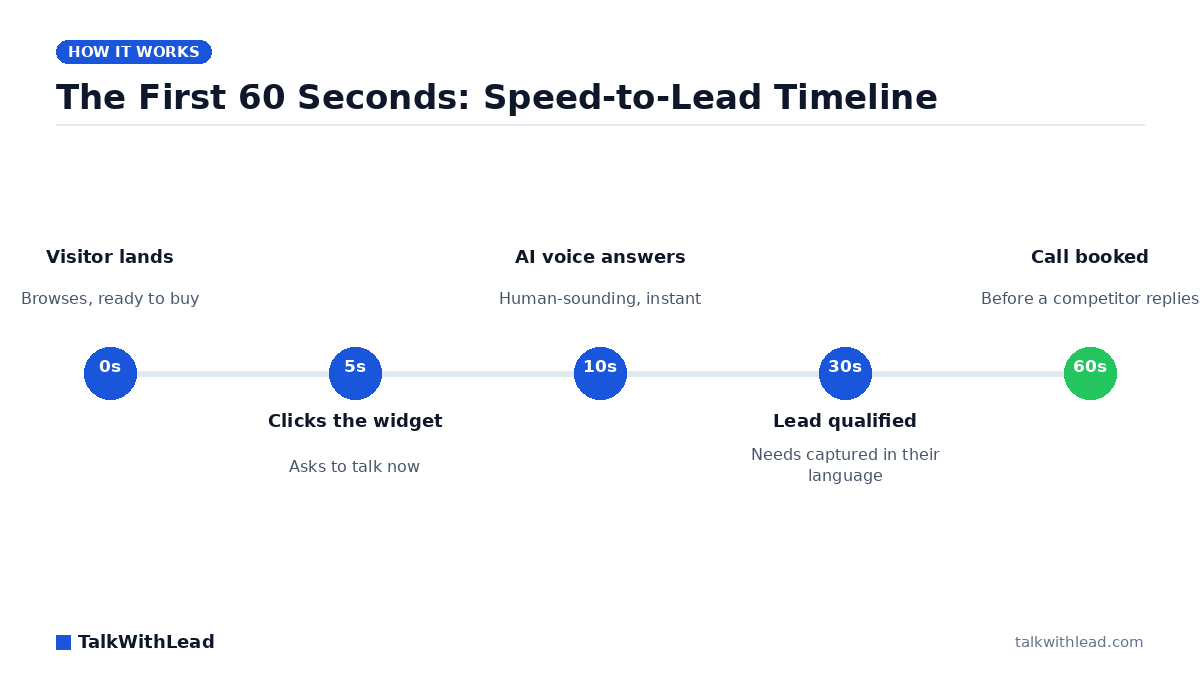
Under 60 seconds wins. Wait five minutes and, in a competitive search, the lead has often already pinged the next vendor on the list. After an hour, the lead is mostly gone. Forms are slow. Chatbots make people type. The win goes to whichever vendor’s phone — or AI voice agent — rings first. Talk to TalkWithLead’s AI voice agent yourself and feel what a sub-60-second response actually sounds like.
Short answer: Speed-to-lead is how fast you respond to a new inbound lead, and it is one of the strongest predictors of whether you win the deal. A good lead response time is under five minutes — ideally under 60 seconds — because the longer you wait, the more likely the prospect has already started talking to a competitor. The fastest reliable way to hit that window is to answer or call back automatically, 24/7, instead of depending on a rep being free.
Why speed-to-lead matters more than nearly any other sales metric
Sales operators who have run inbound funnels for any length of time will recognize this pattern: the leads that closed are almost always the leads that got a fast first touch. Faster than the competition. Faster than the visitor’s attention span. Fast enough that the moment of intent — that small, fleeting “I’m ready” feeling — is still alive.
That moment lasts seconds, not hours. A homeowner with a leaking water heater on a Sunday is not going to wait until Monday morning. A buyer comparing three mortgage brokers at 10 PM does not pause to remember which one had the prettier website. A traveler in Mexico City who clicks a U.S. contractor’s site does not want to think about long-distance call costs. They want someone — or something that sounds like someone — to pick up.
This is not theoretical hand-waving — it is what operators who run inbound funnels see again and again, and the published research lines up. According to Harvard Business Review research, companies that reach a web lead within an hour are nearly 7× more likely to qualify it than those that wait even an hour longer. And the MIT Lead Response Management study found you’re about 21× more likely to qualify a lead contacted within 5 minutes than one contacted at 30 minutes. The exact numbers vary by industry and study, but the shape of the pattern is consistent: response times under a minute outperform response times measured in hours by enough to change the unit economics of a business. That is the whole case for taking speed-to-lead seriously.
What “speed-to-lead” actually means
The clock starts at the form submit, not the next morning
Speed-to-lead is the elapsed time between when a prospect tells you they want to talk — they clicked “request a quote,” they filled the demo form, they clicked the callback widget — and when you actually reach them with a meaningful response.
Most teams measure this incorrectly. They measure “the next time a human looked at the lead in the CRM.” The real metric is the time until the prospect actually hears from you in a way they care about — a phone call, an AI voice conversation, a meaningful text. An auto-acknowledgement email does not count.
What counts as a “response,” ranked by what visitors actually feel
Channels matter. From the prospect’s perspective, ordered by perceived urgency:
AI voice agent conversation — answers in seconds in the visitor’s language, sounds human, qualifies the lead, and books the next step before the prospect can open a competitor tab. This is what TalkWithLead leads with.
Phone call from a human — highest perceived urgency, but only if a human is actually available. Outside business hours or when reps are on other calls, this drops to “voicemail.”
SMS — fast and casual, great for confirmations and reminders, not great for the first real conversation.
Live chat staffed by a human — useful if a person is actually staffing it; useless if a bot just collects an email.
Typed chatbot loop — visitors who came to talk do not want to read four prompts and pick from buttons. This is where most chatbot funnels leak.
Email — slow, and most prospects assume the response window is “tomorrow.”
Why the 60-second threshold matters more than the 5-minute or 1-hour rule
The often-quoted “5-minute rule” is a useful floor. The “1-hour rule” is a useful warning sign. The cliff is steeper than either suggests. Within the first 60 seconds the prospect is still on your site, still in the buying mindset, and has not yet opened a competitor’s tab. Past that, you are competing with whatever distraction happened next in their life.
The First 60 Seconds: Speed-to-Lead Timeline
A practical missed-lead math example
Numbers tell this story better than adjectives. Below is a representative small home-services business — not a real customer, just an illustrative example you can run against your own data.
200 inbound web/phone leads per month.
Current median response time: 2 hours (typical for shops without an after-hours plan).
Current close rate: 8%.
Average ticket: $1,200.
That is about 16 closed jobs per month and roughly $19,200 in revenue. Now imagine adding an AI voice-first widget that picks up in seconds, handles the conversation in the prospect’s language, and books the next step before the prospect goes elsewhere. You don’t even need a huge swing — just a 30% lift in close rate (from 8% to about 10.4%). That is about 21 closed jobs and roughly $25,000 — an extra $5,760 per month or $69,000 per year.
We can’t promise that lift for any specific business; every shop’s numbers are different, and we will not pretend otherwise. But the math is honest: even small wins on response time compound quickly, and the cost of an AI voice agent that catches every missed conversation is almost always less than the revenue from a single recovered job.
Where teams lose minutes (and why hiring more staff isn’t the right first move)
If response time is the problem, “hire more people” looks like the answer. It is almost always the wrong first move. Adding headcount adds payroll, training, and a hiring lag — and it does not help with the after-hours problem at all. Here is where the minutes actually leak:
The 5 PM to 9 AM dead zone
A large share of website traffic happens after the workday ends. A demo request at 7 PM, a quote inquiry at 10 PM, a contractor search at 1 AM — all default to the next-business-day queue. By the time someone answers, the prospect is in a meeting, a school run, a different mindset. An AI voice agent that answers in seconds covers this gap automatically.
Weekend leakage
Saturday and Sunday inbound is some of the highest-intent traffic of the week, especially in real estate, home services, and clinics. If Monday morning is your first response, weekend leads are gone before you start.
Reps already on calls
The team you have today is rarely sitting at zero call volume. When the new lead arrives, your reps are already on the phone with the previous one. Twenty minutes later — too late.
Field crews with their hands full
If your business has techs in the field, they cannot pick up the phone while they are under a sink, on a roof, or in a patient’s mouth. A missed call is the default — not the exception.
Language and distance mismatches
Two leaks most teams never even count. A prospect who speaks Spanish, Hindi, French, or Mandarin first will often hang up the moment the answer comes in a language they cannot work in. A prospect calling from a different country worries about the toll. TalkWithLead’s AI voice agent handles 50+ languages out of the box, and the platform covers unlimited long-distance calling — so the prospect’s first impression is “they speak my language and the call costs me nothing.” That is two friction points removed before the conversation even starts.
Manual triage of “junk vs real”
Even when leads land in the inbox, they get triaged before anyone calls. That triage step adds 10 to 30 minutes — minutes you don’t have. An AI voice agent qualifies inline as part of the conversation, so a real lead arrives already pre-screened.
The four levers that actually move speed-to-lead
An AI voice agent at the moment of intent. A voice agent that picks up immediately, speaks the visitor’s language, sounds human, and qualifies the lead while they are still on the page. This is what TalkWithLead’s widget is built around.
Instant callback as a fallback. For visitors who prefer a callback, the widget triggers a real phone call in seconds — no form, no waiting for a sequence email.
Unlimited long-distance, so international leads stop dropping off. Prospects from anywhere in the world can reach you without thinking about call costs. TalkWithLead absorbs the long-distance, so a buyer in Vancouver, Manila, or Madrid is one click away from a real conversation.
Routing rules that match the qualified lead to the first available human. Round-robin, geo-based, or skill-based routing so the qualified lead never sits in a queue waiting for the “right” rep.
TalkWithLead’s AI voice-first widget gives you the first three levers in one install. The fourth — routing rules — is configured in your team’s existing phone/CRM stack.
Speed-to-lead by industry
Real estate — the Saturday open-house example
Picture a buyer who lands on a listing at 3 PM Saturday. They want a tour. The listing agent is in the middle of another open house. Without an instant callback option, the buyer fills the form, waits 10 minutes, then opens Zillow and checks the other three nearby listings. By 3:30 they are talking to a different agent. With an AI voice agent on the widget, the buyer answers two qualifying questions in their preferred language and gets a callback the moment the original agent is free.
Home services — the Sunday emergency-call example
A homeowner’s water heater is leaking at 9 PM. They search “plumber near me,” click the first three results, and try to call. Whichever shop’s phone is answered first — by a human or by an AI voice agent that sounds human — gets the job. The other two shops never hear about it. If the homeowner speaks Spanish or Mandarin and your competitors only answer in English, that is one more reason TalkWithLead’s multilingual voice wins the call.
Mortgage — the Tuesday-night rate-shop example
A rate-shopper compares three mortgage brokers’ websites at 10 PM. They fill the contact form on all three. The first broker to actually call them — typically by 7 AM the next day if a human team handles it — wins the conversation. An AI voice agent that calls back in 30 seconds compresses that overnight gap to nothing.
Insurance — the quote-shop example
Quote-shoppers compare two or three carriers in a single sitting. The carrier that gets on the phone first usually closes, even if the quote is slightly higher, because the prospect has already explained their situation once and does not want to do it again.
SaaS — the pricing-page demo request example
A buyer hits your pricing page on a Friday afternoon, clicks “request a demo,” then disappears for the weekend. If sales does not follow up until Monday, the prospect has already started a pilot with whichever vendor’s SDR reached out within the hour. An AI voice agent on the pricing page captures the demo intent in real time and books a calendar slot before the buyer closes the tab.
Lawyers, dentists, and clinics
Intake-driven practices win or lose on response speed too, with extra care needed for compliance and confidentiality. We will not give specific legal or clinical advice here — your own counsel or compliance officer should set the rules for what an AI conversation can collect or record in your jurisdiction. The framing principle is the same as every other vertical: an inbound inquiry that gets a fast first touch is dramatically more likely to convert than one that waits.
Before and after with TalkWithLead
Same fictional lead. Two timelines.
Before
9:12 PM Sunday — homeowner submits the “request a quote” form on a plumber’s website.
9:13 PM — auto-acknowledgement email lands in their inbox.
9:30 PM — homeowner has tried the next two plumbers in the search results; the second one answered the phone.
Monday 8:45 AM — the original plumber’s office sees the lead and calls. Voicemail.
Monday 10:00 AM — the original plumber leaves a second voicemail; the homeowner has already booked the other shop.
Outcome: lead lost.
After
9:12 PM Sunday — homeowner clicks the TalkWithLead widget on the plumber’s site.
9:12 PM — TalkWithLead’s AI voice agent picks up immediately, in the homeowner’s language, in a voice that sounds human, and asks two qualifying questions (what is leaking; what is the address).
9:13 PM — AI voice agent confirms a Monday 8 AM slot and texts the homeowner the appointment details.
Monday 7:55 AM — the on-call tech reviews the qualified intake, confirms the slot, arrives at 8.
Outcome: lead won, with zero late-night work from the office team and zero long-distance cost to the homeowner who happened to be calling from a different country.
The difference between those two timelines is not intelligence, effort, or talent. It is a single tool that picks up the phone when the moment of intent is still live, in the language the prospect actually speaks. Book a 15-minute TalkWithLead demo if you want to see exactly how the AI voice agent handles that 9:12 PM inquiry on your site.
How to measure speed-to-lead this week
Log the form-submit timestamp and the first-meaningful-response timestamp for every inbound lead.
Tag the channel (call, AI voice, SMS, chat, email) and the eventual outcome (booked, ghosted, lost-to-competitor).
Push these as GA4 events so you can see distribution by hour of day, day of week, and visitor language.
Build one dashboard with three numbers: median response time, % of leads reached within 60 seconds, and close rate by response-time bucket.
Most teams discover after one week of logging that their reported response time is roughly half of their actual response time, because nobody was counting weekends, evenings, or non-English inquiries. That gap is exactly where TalkWithLead’s AI voice agent pays for itself. Talk to the live demo and see how it handles your worst-case lead in real time.
Response time vs. outcome: what the research shows
Every figure below comes from a published, named study — follow the linked source in the last column for the original research. None of these are TalkWithLead’s own numbers; they are the industry research on what happens when you respond faster.
How response speed changes your odds (sourced research)
Response window
What the research shows
Source
Within ~1 minute
About 391% more likely to convert than calling later
The verdict: what a good response time is, and who needs to automate it
Bottom line: Aim for under 5 minutes (ideally under 60 seconds), and automate it so speed never depends on who’s free.
Best for: Any business with inbound web or phone leads where a human could be slow to respond — service businesses, brokers, agencies, sales teams. Aim for a first response under 5 minutes, and automate the response so nights, weekends, and busy reps never create a dead zone.
Less essential for: If you have zero inbound lead flow, or a fully staffed instant-response desk already hitting sub-minute times, automation adds less. For everyone else, an automated instant call/callback is the most reliable way to win the speed race.
Under 60 seconds is the modern bar for inbound web leads in service businesses. Under five minutes is acceptable. After an hour, most leads have moved on or contacted a competitor.
Is speed-to-lead really that important?
For most service businesses that depend on inbound inquiries: yes. The conversion difference between a 30-second response and a one-hour response is usually larger than the difference between two competitive offers.
How do I improve speed-to-lead without hiring more people?
Add an AI voice agent at the moment of intent. TalkWithLead’s voice-first widget handles after-hours coverage, overflow when reps are on other calls, and the first qualifying conversation — in 50+ languages, with an extremely human-sounding voice, and unlimited long-distance calling so international prospects don’t drop off.
Does an auto-acknowledgement email count as a response?
From the prospect’s perspective, no. They want to talk to someone, not receive a receipt. An auto-acknowledgement is fine as a confirmation, but it does not reset the speed-to-lead clock.
Will an AI voice agent annoy my prospects?
Older robocall systems were annoying. Modern AI voice agents handle interruptions and speak naturally. TalkWithLead’s voice was tuned to sound extremely human, and it switches languages dynamically — so a prospect speaking Spanish or French gets answered in Spanish or French, not in stilted English with a robot accent. In inbound contexts where the prospect just asked to talk, the experience is usually well received because it is instant and it sounds like a person.
How fast can a callback widget actually call?
With TalkWithLead, typically within seconds of the visitor clicking. Exact timing depends on the platform and the visitor’s connectivity, but the live AI voice option answers immediately.
What about international leads and long-distance costs?
TalkWithLead covers unlimited long-distance, so a prospect from anywhere in the world can talk to your AI voice agent without thinking about toll costs. This matters more than people realize — international leads frequently abandon at the “do I want to pay long-distance for this?” mental moment. Removing that moment removes the abandonment.
What if my industry is regulated?
Lawyers, medical practices, mortgage brokers, and insurance agencies all have specific rules around what an AI conversation can collect, store, or record. Talk to your own compliance counsel before turning recording on, and disclose recording per the law where you operate.
What is the average lead response time for most companies?
Far slower than buyers expect. According to Drift’s lead-response study of 433 B2B companies, the average company takes 47 hours to respond to a new lead — and only 7% respond within five minutes, while over a quarter never respond at all. That gap is exactly why responding instantly is such an advantage: the bar is low, so being fast stands out.
How can I respond to leads in under 5 minutes without hiring more staff?
Automate the first response. An AI voice agent or instant callback widget answers or calls the lead back within seconds, 24/7, so coverage doesn’t depend on a rep being free during nights, weekends, or peak call volume. A human then takes over the qualified conversation. That is the whole idea behind TalkWithLead’s voice-first widget — it picks up the moment of intent so your team isn’t racing the clock.
Does responding first actually win more deals?
Yes — being first is a measurable edge. Research popularized by InsideSales / Dr. James Oldroyd found that roughly 35–50% of sales go to the company that responds first. That is why shaving minutes off your response time pays off directly: in a competitive search, the prospect often commits to whoever reaches them first.
Next step: If one extra recovered lead per week would change the math for your business, the system that recovers it costs less than the lead it brings back. Talk to TalkWithLead’s live AI voice demo and feel the difference between a slow form and a sub-60-second conversation. Then start your free signup and run the missed-lead math against your own pipeline. Pricing here if you want it first.
Chatbots make visitors type. AI voice agents create real conversations. If you run a business where buyers want to talk to someone now — a plumber, a real-estate agent, a mortgage broker, a lawyer, a clinic, a SaaS sales team — that one difference shows up in your pipeline.
Short answer: An AI voice agent turns a website visitor into a live phone conversation in seconds, while a chatbot makes that visitor type and wait. Chatbots are best for deflecting repetitive FAQs and self-serve support; an AI voice agent is best for converting high-intent visitors into qualified sales calls, because talking is faster and closer to how buying decisions actually happen. For most businesses chasing leads, the highest-converting setup is an AI voice agent for the buying moment, with a chatbot kept for low-stakes support questions. According to a Five9 study of 4,000 US and UK consumers, 75% of people prefer talking to a real human in person or over the phone for customer support — which is exactly the moment a human-sounding AI voice agent is built to win.
This is a practical comparison: where chatbots still earn their keep, where AI voice agents quietly outperform them, and how to decide for your own site. No fluff and no invented stats — just the trade-offs that actually move the needle on booked calls. See TalkWithLead’s widget in action on talkwithlead.com if you want to feel the difference between typing and talking before you read on.
AI voice agent vs chatbot in 60 seconds
The short version, before the detail:
Chatbot: a typed conversation in a window on your site. Best for self-service questions, order/account lookups, and FAQ deflection.
AI voice agent: a spoken conversation, either by callback or directly through the widget. Best for high-intent inquiries, after-hours qualification, and any industry where the next step is “get on a call.”
The deciding factor: how ready is the visitor to take the next step? Browsing visitors will type. Decision-ready buyers want to talk.
What is an AI voice agent? What is a chatbot?
AI voice agent — how it works
An AI voice agent is a system that holds a spoken conversation with a visitor. On a website, it usually lives behind a small widget. The visitor either clicks “talk now” and speaks through the browser, or asks for an instant callback and the AI agent dials them back within seconds.
Under the hood, the agent transcribes what the visitor says, runs that through a language model to decide how to respond, then converts the response back to speech. Modern voice agents handle interruptions, recognize intent, and can hand off to a human when the conversation crosses a threshold — for example, “I want to schedule a tour this weekend” on a real-estate site, or “I have a burst pipe” on a plumber’s site.
Chatbot — how it works
A chatbot is a typed conversation in a chat window. Older chatbots followed a decision-tree (button-based) script. Modern AI chatbots use a language model to interpret typed messages and respond in natural language. Both still rely on the visitor reading and typing.
Chatbots are excellent at structured tasks: looking up an order number, surfacing a help-center article, or qualifying a visitor with a short form-style flow. They are also genuinely useful when the visitor prefers asynchronous chat — for example, when they are at work and cannot take a call.
The conversational gap that matters
A typed chatbot turns every interaction into a series of small commitments. The visitor reads a prompt, decides what to type, types it, waits for a reply, reads the reply, decides what to type next. Every step is a moment the visitor can close the tab. Speaking removes most of those steps. A short phone-style exchange usually replaces three or four chat turns and feels closer to how a normal sales or service call would go.
That gap matters most when the visitor is already in buying mode. They do not want to be educated. They want a person — or a system that sounds like one — to confirm a price, a slot, or a callback.
AI Voice Agent vs Chatbot: What Actually Converts
Where chatbots actually shine
It is unfair to call chatbots dead. They are a great default for several specific jobs:
Self-service product questions. If your site sells software with documented features, a chatbot can resolve “does it integrate with X?” without anyone picking up the phone.
Order tracking and account lookups. A chatbot that authenticates the visitor and surfaces order status is faster than calling support.
Documentation and FAQ deflection. Pointing visitors to the right help article is a chatbot’s natural strength.
Quiet hours when the visitor prefers chat. Some visitors really do prefer typing — they’re at work, the kids are asleep, they don’t want their voice picked up.
Triage to a live agent. Chatbots are good at collecting the basics (“name, email, the gist of the problem”) before a human jumps in.
If your top KPI is “deflect support tickets” or “let visitors self-serve,” a chatbot is usually the right call. If your top KPI is “book more phone calls and demos,” keep reading.
Where AI voice agents win
AI voice agents earn their place when the next step in the funnel is a call. Several scenarios show this pattern clearly:
High-intent service inquiries. A homeowner with a leaking water heater on a Sunday is not going to type out their problem in a chat window. They want a voice on the other end. An AI voice agent that picks up immediately, qualifies the job, and books a tech is the difference between winning and losing the work.
High-ticket purchases. A buyer evaluating a multi-thousand-dollar service expects a conversation, not a form. Voice agents handle the discovery questions that build trust.
Industries where phone is still the dominant channel. Real estate, mortgage, insurance, law, healthcare, and home services lean phone-heavy. Buyers in those verticals interpret “call me” as serious and “chat with us” as casual.
After-hours qualification. Most chatbots can take a name and email after hours. Voice agents can actually answer questions, qualify the lead, and book a callback during business hours, all without a human.
Recovering missed calls. When a missed call lands on your number, an AI voice agent can call back within seconds, ask the visitor what they need, and book a real follow-up. A chatbot cannot recover a missed phone call at all.
Excellent for visually impaired or mobile-on-the-go users
Compliance considerations
Standard web/cookie/privacy practices
Plus call-recording disclosure where applicable; check local laws
Both channels can coexist on the same site. The mistake most teams make is forcing one channel to do both jobs. A chatbot pretending to handle high-intent service calls feels slow. A voice agent answering “what time do you close?” feels like overkill.
The deciding factor: speed-to-lead
For most service businesses, the single biggest predictor of whether a lead converts is how fast you respond. Sales operators who have run inbound for years have all watched the same thing happen: response times under a minute dramatically outperform response times measured in hours. We won’t quote specific numbers without a citation, but if you have ever lost a lead to a competitor who called first, you already know the shape of the data.
Speed-to-lead is where AI voice agents pull ahead. A chatbot can collect a name and an email in 30 seconds. A voice agent can have already qualified the job, scheduled a follow-up, and texted a calendar invite by the time a competitor’s human picks up the phone.
Want to compare both on your own site? Start a free TalkWithLead trial — both callback and AI voice are included by default. You can A/B them on different pages and watch what your real visitors choose.
Which to choose by industry
Real estate
Buyers explore listings late at night and on weekends. A chatbot can grab a name; an AI voice agent can actually ask whether they want a Saturday or Sunday showing and reach out to the listing agent in parallel. For listing pages and “request a tour” flows, voice wins on intent.
Home services contractors (plumbing, HVAC, electrical, roofing)
Jobs go to whoever picks up first. Techs are on roofs, in crawl spaces, or under sinks. An AI voice agent fills the “we can’t pick up right now” gap without losing the job. Chatbots underperform here — homeowners in distress do not type.
Lawyers and law firms
Intake speed wins high-value cases. The caveat: confidentiality matters. Use a voice agent that records and stores only what your intake policy allows, and disclose recording per the law where you practice. Frame any AI conversation as preliminary qualification, not legal advice. Readers should consult their own counsel on what they can disclose to an AI intake step.
Dentists and clinics
Front desks are busy and new-patient calls leak after hours. A voice agent can take basic information and book a callback for the next business day. Anything beyond scheduling should defer to a clinician; this is not the place for diagnostic chat. Always check the privacy rules that apply to your patient communications in your jurisdiction.
Mortgage brokers
Rate-shoppers close with whoever calls first. Voice agents shave minutes off the response window. Avoid quoting specific rates or terms in the AI conversation; that is what your licensed advisors are for.
Insurance brokers and agencies
Quote-seekers want a human voice fast. AI voice handles first-touch qualification, then hands off to a licensed agent who can quote properly.
SaaS sales teams
Demo requests on pricing pages decay fast. A chatbot is fine for self-serve docs; an AI voice agent on the demo-request page can convert intent into a live or scheduled call within minutes. Use both: chatbot for product-led-growth questions, voice for “talk to sales.”
Local businesses (auto, beauty, fitness, etc.)
Owners cannot answer every call. After-hours calls are pure lost revenue. A voice agent that books appointments and answers “are you open?” turns that lost revenue back into bookings.
How TalkWithLead fits
TalkWithLead is a small widget for your website that lets visitors do one of two things: request an instant callback, or talk to an AI voice agent right now. That second option is the differentiator — the visitor does not have to wait, and you do not have to hire a 24/7 phone team.
We chose to offer both because the right channel depends on the visitor. A casual browser does not need a callback in 30 seconds — they will accept a typed exchange or no exchange at all. A serious buyer comparing three plumbers at 10 PM wants a voice. Forcing every visitor into the same channel costs conversions; meeting them where they are lifts them.
If you already have a chatbot, you do not need to rip it out. Many TalkWithLead customers run both: chat for product questions, voice for sales and service inquiries.
A practical evaluation checklist
Before you choose, ask:
What is the most valuable conversion on my site? (Demo? Phone call? Booking?)
How quickly does my industry expect a response?
Do my visitors typically type or call to engage a competitor?
What happens to inquiries that arrive after hours today?
What is the cost of a missed lead vs. the cost of a tool that catches one?
If I added a voice option above the fold tomorrow, would anything in my compliance or recording-disclosure policy need to change?
Walking these questions for ten minutes usually tells you whether you need a chatbot, a voice agent, or both.
Five mistakes buyers make when picking between the two
Most teams don’t pick the wrong tool because they misunderstand the technology. They pick wrong because they evaluate it against the wrong question. After watching how businesses shop for this category, the same avoidable errors come up again and again.
Mistake one: judging a chatbot demo by how smart its answers sound, instead of by how many real visitors finish the flow without bailing. Mistake two: assuming a voice agent will feel robotic, then never actually listening to one talk. Mistake three: optimizing for deflection (fewer human conversations) when your real goal is more booked calls. Mistake four: ignoring after-hours and weekend traffic, which is often when your highest-intent visitors arrive and your team is offline. Mistake five: treating language and long-distance reach as a nice-to-have, when a prospect who can’t be understood or can’t get a call back is simply a lost lead.
Composite example: a remodeling company compared a typed chatbot and an AI voice agent by reading transcripts side by side. The chatbot looked impressive on FAQs. But when they filtered for visitors who clearly wanted to hire, the voice agent had turned far more of those into actual phone conversations — because high-intent people want to talk, not type. The lesson: pick the tool that converts your ready-to-buy traffic, and let it handle the moment a visitor is most likely to become a real sales conversation.
AI voice agent vs chatbot, at a glance
AI voice agent vs chatbot, at a glance
Dimension
Chatbot
AI voice agent (TalkWithLead)
Primary interaction
Visitor types text
Visitor speaks; instant live call or callback
Best job
FAQ deflection / self-serve support
Converting high-intent visitors into sales calls
Speed to a real conversation
Visitor must type, read, and wait between replies
Seconds to a live voice conversation or callback
After-hours coverage
24/7 text replies
24/7 voice answering and callbacks
Languages
Varies by setup
50+ languages
Long-distance / international leads
Text only; no calling cost handled
Unlimited long-distance calling included
Concurrent visitors
Many at once
Unlimited simultaneous calls
Signal sent to a buyer
Automated, low-touch
Human-sounding, high-touch conversation
Where it can fall short
Stalls on nuanced or high-intent questions
Overkill for pure self-serve FAQ lookups
Bottom line. Chatbot for support deflection; AI voice agent for turning visitors into sales calls.
Best for: Businesses that want to convert website visitors into phone conversations and qualified leads — service businesses, brokers, agencies, and any team where a fast call wins the deal. Choose the AI voice agent here.
Not the best fit for: Pure self-serve support or simple FAQ deflection on a low-intent help page — a chatbot is cheaper and sufficient. Many sites run both: voice for the buying moment, chat for routine support.
It’s worth knowing where chatbots lose people: a Five9 survey of 4,000 consumers found that 56% are frequently frustrated by AI customer-service chatbots and 48% don’t trust the information those bots provide — which is exactly why a real conversation tends to win the high-intent moment.
FAQ
Is an AI voice agent better than a chatbot?
For high-intent inquiries and businesses where the next step is a phone call, yes. For self-service product questions and FAQ deflection, a chatbot is usually a better fit. Many sites benefit from both.
Will an AI voice agent replace my sales team?
No. It handles first-touch qualification, after-hours coverage, and missed-call recovery. Your human team still owns closing, negotiation, and relationships. The voice agent’s job is to make sure no real opportunity goes silent.
Do visitors find AI voice agents annoying?
Older robocall-style systems were annoying. Modern AI voice agents handle interruptions, speak naturally, and escalate to a human when the conversation calls for it. They are not perfect, but the bar to a useful experience is much lower than it was three years ago.
How fast can an AI voice agent call a lead back?
With a callback widget like TalkWithLead’s, typically within seconds of the visitor clicking. The exact timing depends on the platform and the visitor’s connectivity.
What about compliance and call recording?
Call recording is regulated and varies by jurisdiction (one-party vs. two-party consent, sector-specific rules, and so on). If you record AI-handled calls, disclose the recording in your widget copy and follow the law where you operate. Consult counsel where the rules are not obvious.
Can I keep my existing chatbot and add a voice agent?
Yes. The two channels complement each other. Use the chatbot for self-service and FAQs, and the voice agent for “talk to a person” or “book a callback” flows.
How do I measure whether voice is working better than chat?
Track both: chatbot conversation starts vs. voice conversation starts, and then the downstream conversion rate of each — usually booked calls, qualified leads, or completed signups. The channel with the higher downstream conversion rate wins for your audience.
How does TalkWithLead handle both?
One widget on your site offers two actions: request an instant callback, or speak with an AI voice agent right now. You can see both options on talkwithlead.com, and you can book a TalkWithLead demo to walk through how to tune the flows for your industry.
Can an AI voice agent and a chatbot run on the same website?
Yes. The common setup is an AI voice agent on high-intent pages — pricing, demo, contact — to capture buying-moment visitors as calls, plus a chatbot on support and help pages for routine self-serve questions. They serve different jobs and don’t conflict, so you keep FAQ deflection while gaining live-call conversion.
Which converts more website visitors into leads, a chatbot or an AI voice agent?
For high-intent visitors, voice typically converts better, because it starts a real conversation in seconds instead of a typing exchange the visitor often abandons. Chatbots convert well for capturing low-friction support questions. The honest answer is to match the tool to the intent of the page it sits on.
Do I have to replace my chatbot to add an AI voice agent?
No. You can keep your existing chatbot and add a voice-first widget alongside it. TalkWithLead adds the voice layer without ripping out your current stack, so you keep FAQ deflection and gain live-call conversion for the buying moment.
Does an AI voice agent slow down my website?
No. TalkWithLead loads as a lightweight widget and the voice conversation runs in the cloud, so your page speed and Core Web Vitals stay intact while visitors still get an instant voice response.
What happens if the AI voice agent can’t answer a question?
It captures the visitor’s details and intent and routes the conversation to your team for a fast human follow-up, so a lead is never dropped just because a question is out of scope.
Is an AI voice agent worth it for a small business?
Often yes. A small team can’t answer every visitor in seconds, but an AI voice agent can, turning after-hours and overflow traffic into booked calls without adding headcount.
Related reading on the TalkWithLead blog
This article is part of a series on converting website visitors into phone calls. More from the TalkWithLead Resources hub:
How real estate agents are booking more showings with instant callback (coming soon)
Chatbot alternatives for small businesses that need to book calls (coming soon)
Next step: If you want to test voice and callback side by side on your own site, start a free TalkWithLead trial. Both are included — no separate plans, no upgrade required. Want a walkthrough first? Book a TalkWithLead demo and we’ll show you how teams in your industry are combining the two. See pricing if you want the cost side first.
Your next lead is on your site right now — ready to talk.
TalkWithLead’s AI voice agent picks up in seconds, qualifies the lead in their language, and books the call before the prospect can open a competitor’s tab. Forms are slow. Chatbots make people type. Voice closes.
This is the TalkWithLead Widget. Click to see how it will work on your website!
Live AI voice agent
Turn website visitors into phone calls
This is the same TalkWithLead widget you can add to your site — an AI voice agent that talks to your website visitors and calls leads back 24/7, in 50+ languages. Try it two ways: