
In this article
A patient cracks a molar at 8 p.m., searches for a dentist, and lands on your website. If the only options are a contact form or a voicemail box, that patient calls the next practice on the list. The best AI receptionist for dental offices closes that gap by answering the phone in a human-sounding voice the moment a caller reaches out, booking the appointment before a competitor ever picks up.
Short answer: The best AI receptionist for a dental office is a human-sounding AI voice agent that answers every call and website visitor instantly, 24/7, in the patient’s language, and books or routes the appointment without a form. Voice-first tools like TalkWithLead lead this category because dental patients in pain want to talk, not type into a chatbot.
Why dental offices need an AI receptionist in the first place
Dental front desks are busy in a very specific way. The receptionist is checking in one patient, taking payment from another, and answering the phone all at once. New-patient calls land in that chaos, and the ones that go to voicemail rarely call back. Every missed call is a booked cleaning, a crown consult, or an emergency visit walking straight to a competitor.
An AI receptionist removes the tradeoff. It answers on the first ring during the lunch rush, after hours, and on weekends. It never puts a nervous patient on hold to “grab the schedule.” Picture a practice that fields 40 new-patient calls a week and misses even 8 of them because the desk was slammed. If just 3 of those callers were ready to book a $200 visit, that’s roughly $2,400 a month in production leaving the building unanswered. Run your own numbers with the free missed-call revenue calculator before you assume it’s a rounding error.
What makes the best AI receptionist for dental offices?
Not every tool labeled “AI receptionist” does the same job. Chatbots and web forms make the patient type and wait; a voice agent lets them talk. When someone has a throbbing tooth, the difference decides whether they book with you. An Ada study found 59% of consumers prefer instant, 24/7 AI customer service over waiting for a human – but only when the AI can actually resolve their issue. For a dental office, “resolve” means booking the appointment, not reading a script.
Score any provider on your shortlist against these must-haves:
- Human-sounding voice. A robotic IVR menu scares patients off. The agent should sound like a warm front-desk person.
- Instant response, 24/7. After-hours and weekend emergencies are where practices win or lose new patients.
- 50+ languages. A Spanish-speaking parent booking for a child should get the same smooth experience as an English speaker.
- Instant callbacks. When a website visitor asks to talk, the agent should ring them in seconds, not “within one business day.”
- Unlimited long-distance calling. Snowbird patients, referrals from out of state, and traveling families should always reach you.
- Books, doesn’t just log. The point is a scheduled visit, not a message slip.
The deeper argument for going voice-first is covered in AI Voice Agent vs Chatbot: Which One Books More Calls?, which walks through why voice converts website traffic that chatbots let leak away.
The 2026 shortlist: types of AI receptionist to compare
Rather than rank brand names that change quarterly, compare the four approaches a dental office actually chooses between. Match the type to how your patients contact you.
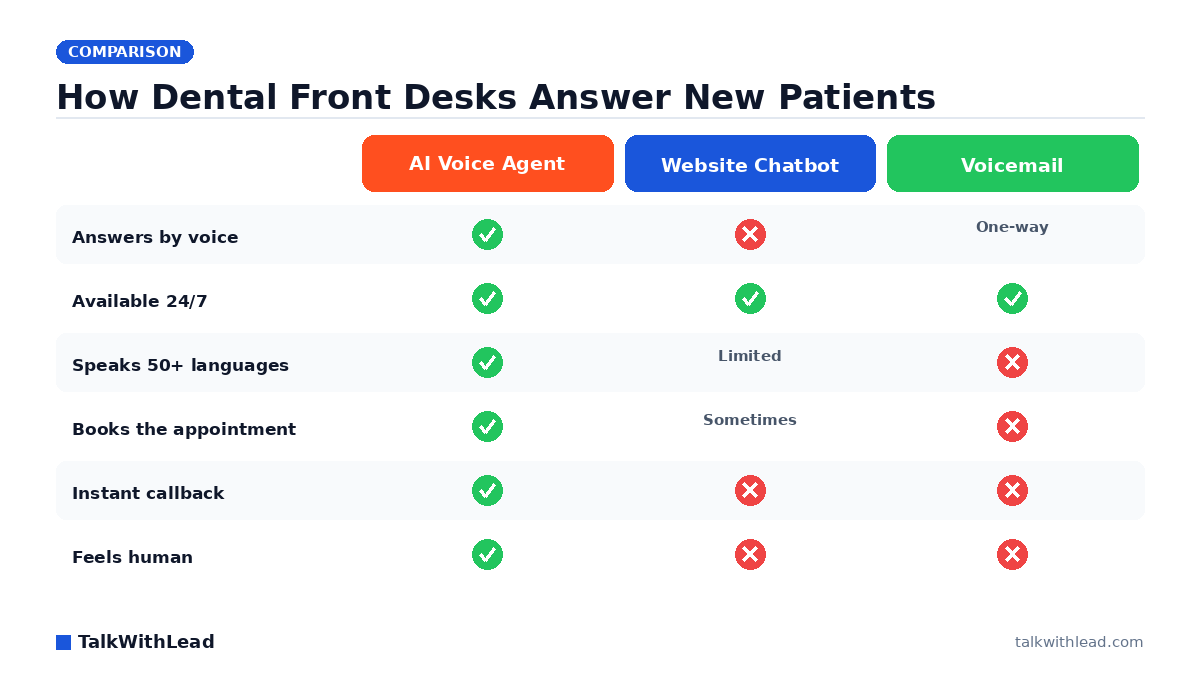
| Approach | How patients reach it | Best for | Weak spot |
|---|---|---|---|
| AI voice agent (TalkWithLead) | Website + phone, live voice | Converting web visitors and after-hours callers into booked visits | Complex clinical questions still route to staff |
| Website chatbot | Text box on the site | FAQ deflection during office hours | Patients in pain won’t type; drop-off is high |
| Human answering service | Forwarded phone calls | Practices that want live people only | Per-minute costs climb; limited languages; hold times |
| Voicemail / call-back form | Recording or web form | Nothing, honestly | Most callers never leave a message or fill it out |
A voice agent stands out because it works on both the phone line and the website. A visitor reading your “emergency dentist” page can start a real conversation on the spot, and a caller who dials the main number hears the same warm agent. You can watch that flow yourself in a free live demo and hear how human the voice sounds before deciding.
How much does an AI receptionist for a dental office cost?
Pricing ranges widely. Human answering services often bill per minute, so a busy month gets expensive fast. AI voice agents usually run on a flat monthly plan, which makes budgeting predictable for a single-location practice. Plainly put: expect a fixed monthly software fee rather than a metered bill that punishes you for being busy.
Here’s a labeled ROI example, with assumptions stated. Say your practice misses 8 new-patient calls a week, and assume just 1 in 4 of those callers would have booked an average first visit worth $250. That’s 2 booked visits a week recovered, roughly $2,000 a month, against a flat software fee that’s a fraction of that. Even if your recovery rate is lower, the math tilts fast when the tool answers calls you were losing entirely. Check current tiers on the pricing page, then pressure-test the assumptions with the missed-call revenue calculator.
Best for: A single or multi-location dental practice that misses new-patient calls after hours, during the lunch rush, or in a language the front desk doesn’t speak.
Not the right fit if: You have full front-desk coverage that already answers every call live on the first ring and never sends a new patient to voicemail.
Voice-first beats forms and chatbots for patient booking
The whole point of an AI receptionist is turning interest into a scheduled visit. A form makes the patient do work and wait. A chatbot makes them type symptoms into a box. A voice agent picks up, listens, and books. That difference matters most in dentistry, where urgency and anxiety drive the call.
The conversational AI space is scaling because businesses see the same thing. Gartner research predicts agentic AI will autonomously resolve 80% of common customer service issues without human intervention by 2029, cutting operational costs by 30%. For a dental office, “common issues” means booking a cleaning, quoting hours, and routing an emergency, which is most of what the front desk phone rings for.
TalkWithLead puts that human-sounding AI voice agent on your website and phone line, speaking 50+ languages, offering instant callbacks, and backing it with unlimited long-distance calling so a referral three states away gets through. It turns visitors into live phone conversations instead of abandoned forms. Ready to stop losing after-hours patients? Start free with TalkWithLead and put an AI receptionist on your site this week.
If you want more context on how voice stacks up against the alternatives, see Live Chat vs Chatbot: Pros, Cons, and the AI Voice Upgrade and the vertical breakdown in AI Answering Service Cost for Med Spas, which mirrors the cost logic clinics face.
FAQ
What is the best AI receptionist for dental offices?
The best fit is a human-sounding AI voice agent that answers calls and website visitors instantly, 24/7, in the patient’s language, and books the appointment without a form. TalkWithLead is built for this, converting web visitors and after-hours callers into live phone conversations rather than voicemails.
Can an AI receptionist book dental appointments on its own?
Yes. A capable voice agent handles the common requests, booking cleanings, quoting hours, and routing emergencies, while passing genuinely clinical questions to your staff. That covers most of what a dental front desk phone handles day to day.
Is an AI receptionist better than a chatbot for a dental office?
For dentistry, yes. Patients in pain want to talk, not type. A chatbot makes them describe symptoms in a text box and often loses them; a voice agent picks up and speaks. See AI Voice Agent vs Chatbot for the full comparison.
How much does an AI receptionist cost for a dental practice?
Most AI voice agents run on a flat monthly plan rather than per-minute billing, which keeps costs predictable during busy months. Check the pricing page for current tiers and estimate your return with the missed-call revenue calculator.
Does an AI receptionist work after hours and on weekends?
Yes, and that’s where practices gain the most. Emergency and new-patient calls often come in at night and on weekends when the front desk is closed. An AI voice agent answers those calls live so the patient books with you instead of the next practice.
Can an AI receptionist speak languages other than English?
A strong voice agent supports 50+ languages, so a Spanish-speaking parent or a multilingual household gets the same smooth booking experience. That widens the pool of new patients your practice can serve without hiring bilingual staff.
How is a website AI voice agent different from a phone-only dental AI receptionist?
A phone-only dental AI receptionist answers calls that already happened. A website voice agent like TalkWithLead engages patients while they are still browsing your site, speaks with a human-sounding voice in 50+ languages, and offers an instant callback — so it captures the patients who would otherwise never dial at all.
Is an AI receptionist better than a traditional dental answering service?
For most practices, yes on coverage and cost predictability: an answering service bills for human time and quality varies by operator, while an AI receptionist answers every call and web visitor instantly, 24/7, typically at a flat, predictable monthly cost. Practices that want a live human on every call can pair the two.
What should a dental office compare when shortlisting AI receptionist vendors?
Compare five things: whether it engages website visitors or only inbound calls, how human the voice sounds, language coverage, after-hours behavior, and whether it books or routes the appointment rather than just taking a message. Test each vendor’s live demo with a real scenario like a toothache call before committing.
Let’s Turn More Website Visitors Into Sales Conversations
TalkWithLead is the AI voice-first lead-conversion platform behind hundreds of high-intent business websites. See it on your own number in a 15-minute live demo, or spin one up free and have it running before lunch.