TalkWithLead
AI Voice-First Lead Conversion

AI Voice Agents That Turn Website Visitors Into Real Conversations

TalkWithLead is the AI voice-first widget that picks up the phone the moment a visitor lands on your site. Multilingual, extremely human-sounding, with unlimited long-distance calling so prospects anywhere can call you back. More calls. More leads. More closed deals.

Extremely human-sounding voice 50+ languages out of the box Unlimited long-distance calling Instant callback widget

Tag: ai receptionist

  • AI Receptionist vs Human Answering Service Cost

    AI Receptionist vs Human Answering Service Cost

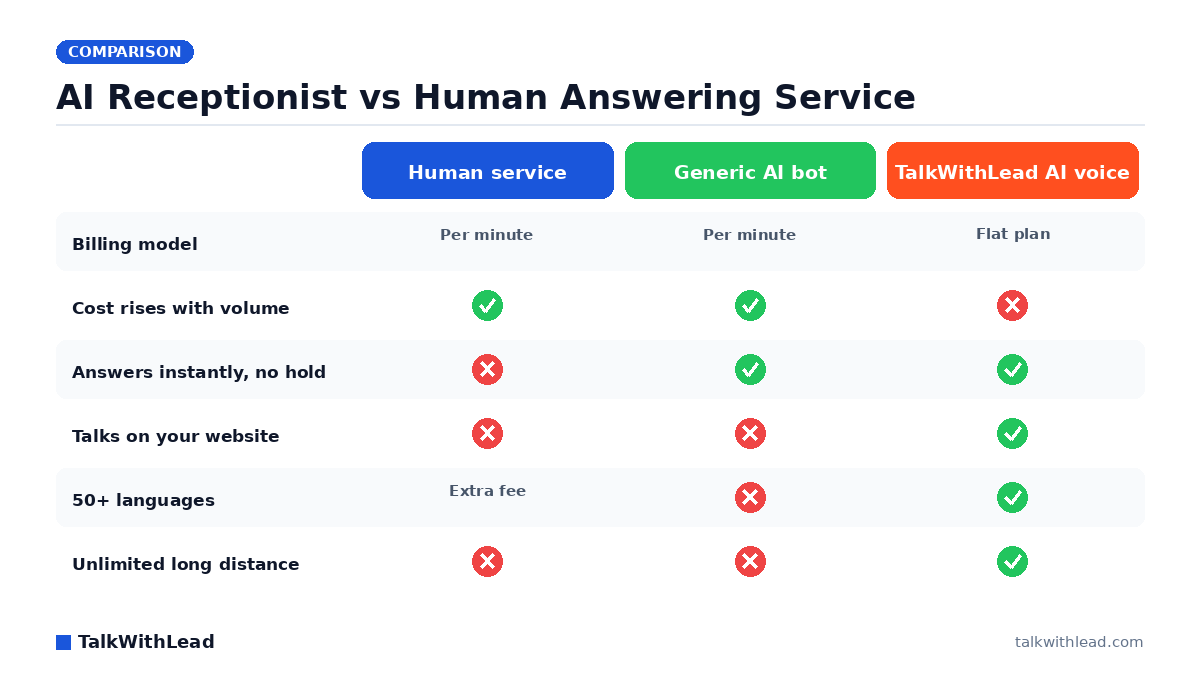
    AI Receptionist vs Human Answering Service — TalkWithLead original infographic (comparison diagram).
    AI Receptionist vs Human Answering Service

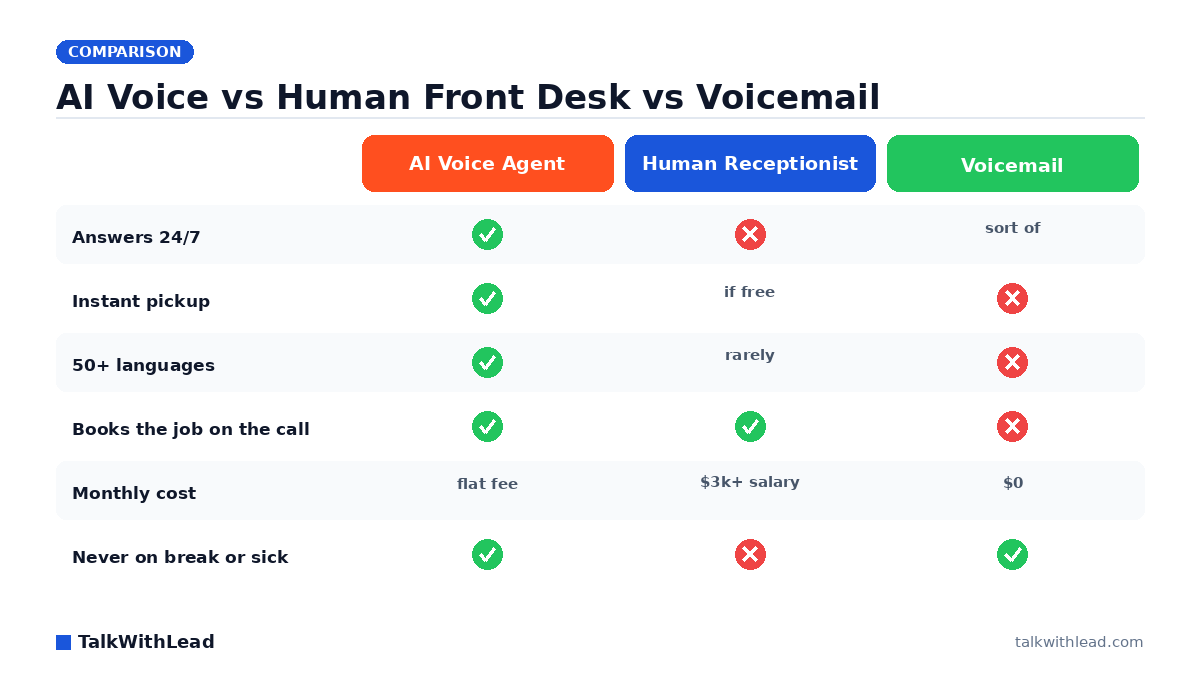
    Two quotes land on your desk. A human answering service wants a monthly minimum plus a per-minute rate. An AI receptionist wants a flat subscription. Both promise you will stop losing leads, and neither quote tells you what you will actually pay in a busy month.

    TL;DR: a fair ai receptionist vs human answering service cost comparison usually lands the same way. Human services typically bill per minute or per call on top of a monthly minimum, so your bill grows every time your marketing works. AI receptionists bill like software — a flat monthly plan that covers far more conversations — which makes high-volume months dramatically cheaper and quiet months predictable.

    How much does a human answering service cost?

    Almost every live answering service prices the same way: a monthly minimum that buys a bucket of minutes, then an overage rate once you burn through it. Rate cards in this category commonly run from roughly a hundred dollars a month at the small end to several hundred or more for real receptionist coverage, with per-minute overage on top. Check current published rates yourself before you sign anything, because they move.

    The rate card is not the problem. The billing unit is. You pay for minutes, not for booked jobs, and plenty of billed minutes produce nothing: the robocall that got answered, the existing customer asking about an invoice, the vendor, the wrong number, the caller who spent ninety seconds spelling their last name. Every one of those is revenue for the vendor and cost for you.

    Two more line items show up after the first invoice. Bilingual or after-hours coverage is often a surcharge rather than a default. And long-distance or toll handling can be billed separately, which quietly punishes you for having customers outside your area code.

    How much does an AI receptionist cost?

    An AI receptionist is software, so it prices like software: a flat monthly plan tied to seats, features, or a generous conversation allowance instead of a taxi meter. Entry plans in this category generally sit in the tens-of-dollars-per-month range and climb with features rather than with call volume. TalkWithLead publishes its plans on the pricing page so you can compare against your current answering-service invoice line by line.

    The structural difference is what happens on your best month. A per-minute vendor is rewarded when your ad spend spikes. A flat-rate AI receptionist is not. You can run a promotion, get featured somewhere, or double your traffic without opening a spreadsheet to model your support bill.

    TalkWithLead also removes two of the classic surcharges. Its AI voice agent handles conversations in 50+ languages without a bilingual upcharge, and unlimited long-distance calling means a prospect three time zones away is not a billing event. If you want to hear how human it sounds before you believe any of this, the live demo takes about a minute.

    Side-by-side: the cost comparison that matters

    DimensionHuman answering serviceAI receptionist (TalkWithLead)
    Billing unitPer minute or per call, over a monthly minimumFlat monthly plan
    Cost in a high-volume monthRises with every extra callEffectively unchanged
    Spam and wrong numbersBillable minutesHandled inside the plan
    After-hours and weekendsOften a surchargeAlways on, same price
    LanguagesBilingual usually costs extra50+ languages included
    Long distanceFrequently billed separatelyUnlimited
    Where it answersYour phone lineYour website, then the phone
    Hold timePossible during call spikesAnswers immediately, in parallel
    Judgment on unusual callsStrong — a real person adaptsGood on scripted intake, escalates the rest

    Read the last three rows twice. They are where the money actually is, and neither rate card mentions them.

    The cost nobody quotes you: the call that never got answered

    Answer rate beats rate card. A missed call does not cost you eighty cents of billed time — it costs you the entire job, and often to the competitor the caller phoned twelve seconds later. According to a 411 Locals study of 85 small businesses across 58 industries, only 37.8% of incoming calls were answered by a live person — meaning roughly 6 out of 10 calls went unattended.

    Speed compounds the same way on web leads. The MIT Lead Response Management study found you’re about 21× more likely to qualify a lead contacted within 5 minutes than one contacted at 30 minutes. A human answering service takes a message; that message still has to reach someone who calls back. An AI voice agent on your website starts the conversation while the visitor is still reading the page — which is the whole argument in how fast you should call a new lead.

    ROI math: an illustrative example

    The following is an illustrative scenario, not a customer result. Assume a services business that gets 200 inbound calls and website enquiries a month, closes at an assumed 20%, and books an average job worth $600.

    • Today: say 60 of those 200 go unanswered after hours or during call spikes. At an assumed 20% close rate, that is 12 jobs, or roughly $7,200 a month walking away.
    • Human answering service: assume it recovers half of those 60 as messages, and assume half of the messages get a timely callback. That is 15 recovered conversations, about 3 jobs, roughly $1,800 — against a bill that grows with every minute answered.
    • AI voice agent: imagine it engages nearly all 60 immediately on the site and by instant callback, no hold, no message queue. Even at the same assumed 20% close rate on the engaged share, the recovered revenue is a multiple of the human-service path, on a flat plan.

    Swap in your own numbers with the free missed-call revenue calculator — it takes about two minutes and it is usually the number that ends the debate. Contractors comparing the same two options can also read the vertical version in AI receptionist for contractors: cost and ROI.

    Honest verdict

    Best for: owners of service businesses and lead-gen sites who get most enquiries from their website and after hours, want a predictable flat bill as volume grows, and need callers handled instantly in multiple languages without hold time or long-distance charges.

    Not the right fit if: your calls are long, unscripted, emotionally sensitive, or legally delicate from the first sentence — think crisis intake or complex clinical triage. In that case, keep a human on the line and let AI cover only overflow and after-hours.

    Plenty of businesses run both. The AI voice agent answers on the website, qualifies, and books; anything unusual escalates to a person. That hybrid is exactly how the comparison plays out in AI voice agent vs human receptionist.

    How to run the comparison on your own numbers this week

    1. Pull your last three answering-service invoices and total the minutes actually billed, including overage.
    2. Divide the total cost by the number of booked jobs it produced. That is your real cost per booked job — not your per-minute rate.
    3. Count after-hours and weekend enquiries separately. That bucket is where AI wins hardest.
    4. Run the same volume through a flat AI plan on the pricing page.
    5. Test the caller experience yourself. Hold time and robotic scripting cost you conversions no rate card captures.

    If step five is where you are, start there: hear the voice agent on the live demo, then put it on your own site with a free signup and watch what happens to the enquiries you were previously converting into voicemail.

    FAQ

    Is an AI receptionist cheaper than a human answering service?

    Usually yes, and the gap widens with volume. Human services bill per minute or per call over a monthly minimum, so cost scales with activity. An AI receptionist bills as a flat monthly plan, so a busy month costs roughly what a slow month costs.

    What do answering services actually charge per minute?

    Rates vary by vendor and by whether you buy a receptionist tier or a message-taking tier, and they change often, so check the vendor’s current published rate card. The structural point holds regardless: you are billed for every answered minute, including spam calls and hold time.

    What hidden fees should I check before signing?

    Ask about overage rates past your included minutes, minimum billing increments per call, bilingual or after-hours surcharges, long-distance and toll handling, setup or script-change fees, and contract length. Those line items often move the effective price more than the headline rate does.

    Can an AI receptionist handle calls in Spanish or other languages?

    TalkWithLead’s AI voice agent converses in 50+ languages as part of the plan, with no bilingual surcharge. With a human service, multilingual coverage is typically a paid add-on and depends on which agents are on shift.

    Will callers know they are talking to AI?

    The voice is extremely human-sounding, and most callers simply get their question answered and book. Being upfront works fine too — what visitors reject is waiting on hold or typing into a slow chatbot, which is the comparison drawn in AI voice agent vs chatbot.

    Can I use both an AI receptionist and a human team?

    Yes, and it is a common setup. Let the AI voice agent answer instantly on the website, qualify, and book appointments, then route anything complex or sensitive to a person. You cut billed minutes on routine calls and keep human judgment where it earns its cost.
  • Best AI Receptionist for Law Firms: Client Intake (2026)

    Best AI Receptionist for Law Firms: Client Intake (2026)

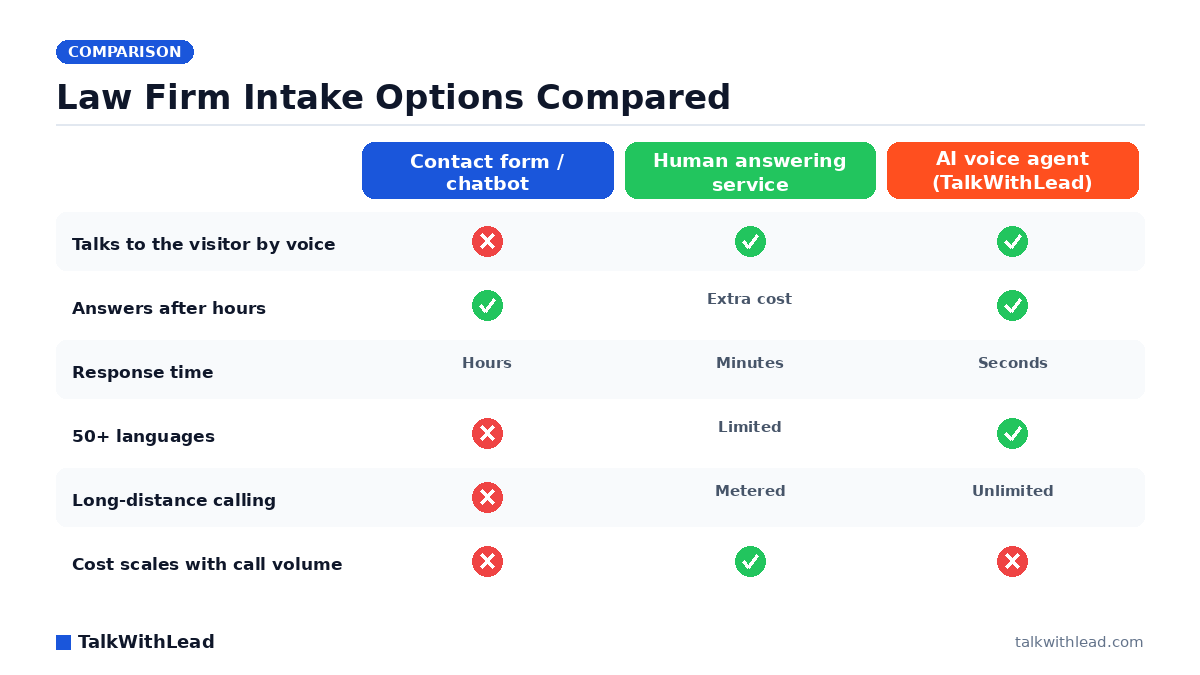
    Law Firm Intake Options Compared — TalkWithLead original infographic (comparison diagram).
    Law Firm Intake Options Compared

    A prospective client with a car accident, a DUI, or a termination letter does not fill out a form and wait. They call three firms in ten minutes and hire whoever picks up. That single behavior is why choosing an ai receptionist for law firms best for client intake is now a caseload decision, not an office-admin decision.

    Short answer: the best AI receptionist for law firm client intake is one that answers by voice within seconds of a website visit or missed call, works nights and weekends, qualifies the matter type and conflicts basics, and books the consult on the calendar. AI voice agents like TalkWithLead do this; chatbots, contact forms, and per-minute answering services either delay the conversation or price it by the minute.

    What does an AI receptionist actually do for a law firm?

    An AI receptionist answers the phone or the website the moment a prospective client shows intent. It greets them, asks what happened, captures name, number, jurisdiction, and matter type, screens out the obvious non-fits, and either books a consult or hands a warm caller to an attorney. The good ones sound like a person, not a phone tree — they interrupt gracefully, handle a rambling story, and repeat a phone number back correctly.

    For intake specifically, three jobs matter more than everything else on the feature list: answer fast, keep the person talking, and get the appointment on the calendar. A tool that logs a transcript but loses the caller has failed intake, no matter how clean the dashboard looks. That is the lens used to compare every option below, and it is the same lens applied in our broader look at law firm intake automation and after-hours cases.

    Best AI receptionist for law firms: the options compared

    Four categories compete for legal intake budget: AI voice agents, human virtual receptionist services, website chatbots, and plain contact forms. They are not variations of the same product — they behave completely differently at 9pm on a Saturday.

    OptionChannelTypical response timeAfter-hoursLanguagesPricing modelBest intake use
    AI voice agent (TalkWithLead)Voice, from the website + instant callbackSecondsAlways on50+Flat subscription, unlimited long distanceWebsite visitors and missed calls that must become phone conversations now
    Human virtual receptionist (Smith.ai-style)Voice, forwarded callsMinutesOften a paid add-onUsually English + SpanishPer minute or per callFirms wanting a human voice and willing to meter cost
    Website chatbotTextInstant text, slow human handoffBot onlyVariesSeat or conversation basedSimple FAQ deflection, not urgent matters
    Contact formText, one directionWhenever staff reads itNoneOneFreeLow-urgency inquiries and document requests
    In-house receptionistVoiceSeconds while staffedNoOne or twoSalaryBusiness-hours reception plus firm operations

    Best for: small and mid-size firms — personal injury, family, criminal defense, immigration, employment — whose website already gets traffic and whose intake gap is nights, weekends, overflow, and non-English callers.

    Not the right fit if: your practice is appellate, transactional, or referral-driven with a handful of inbound inquiries a month that a paralegal already answers on the first ring. Automating five calls a month does not pay for itself, and you would be buying coverage you do not need.

    Why speed decides which firm signs the case

    Legal intake is a race, and the finish line is early. The MIT Lead Response Management study found you are about 21× more likely to qualify a lead contacted within 5 minutes than one contacted at 30 minutes. That gap is brutal for firms whose intake process is “the form emails the office manager, who calls back Monday.”

    The phone side is no kinder. According to a 411 Locals study of 85 small businesses across 58 industries, only 37.8% of incoming calls were answered by a live person — meaning roughly 6 out of 10 calls went unattended. Apply that pattern to a firm running paid search for “car accident lawyer near me” and you are paying for clicks whose calls nobody picks up.

    An AI voice agent attacks both numbers at once. The visitor never leaves your site to dial: they tap the widget, and a human-sounding voice is talking to them before the tab closes. If they do call and nobody is free, an instant callback fires within seconds. Our deeper breakdown of how fast you should call a new lead covers the response curve in detail.

    How much does an AI receptionist cost for a law firm?

    Legal intake coverage generally lands in one of three cost shapes: salary (an in-house receptionist, the highest fixed cost), metered (human answering services billing per minute or per call, which punishes a good marketing month), and flat subscription (AI voice agents, where a busy week costs the same as a quiet one). TalkWithLead sits in the third bucket, and long-distance calling is unlimited, so an out-of-state caller does not add a line item. Current tiers are on the pricing page.

    Illustrative ROI math — assumptions stated, not a customer result. Imagine a firm that gets 120 inbound website and phone inquiries a month and, between after-hours gaps and overflow, never connects with 30 of them. Assume a conservative 8% of connected consults sign, and assume an average matter value of $4,000. Recovering even half of those 30 missed conversations — 15 conversations, at 8%, is roughly 1.2 signed matters — is about $4,800 a month in new fee revenue in this example. Against a flat monthly subscription, one signed matter typically covers a year of coverage. Plug your own numbers into the free missed-call revenue calculator instead of trusting anyone’s averages, including ours.

    If you want the full cost-vs-value argument for legal specifically, we wrote it up separately in is an AI receptionist worth it for a law firm.

    Why chatbots and forms lose legal intake

    Chat looks like the safe modern choice. It is also the slowest possible channel for someone who was rear-ended two hours ago. Text intake asks an anxious person to type their story on a phone screen, one thumb at a time, while a bot asks for their email address. Picture a site where most visitors never make it past the third question — that is the realistic failure mode, and it is invisible in your analytics because a bounce looks identical to a lost case.

    Voice does the opposite. People explain a legal problem far faster than they type it, and the emotional register of a real conversation is what actually converts a scared caller into a booked consult. A voice agent also picks up the details a form field never asks for: date of the incident, whether police were involved, whether they have already spoken with an insurer. If you are weighing the two side by side, the numbers-first version of that argument lives in AI voice agent vs chatbot conversion rate.

    The other quiet loser is the multilingual caller. Immigration, personal injury, and employment practices field a steady stream of Spanish-speaking prospects, and a bot with a translate widget is not the same as an agent that answers in Spanish immediately. TalkWithLead handles 50+ languages out of the box, which means a 10pm call from a Spanish-speaking family does not become a message someone returns two days later.

    How to evaluate an AI receptionist for your firm in one week

    Do not buy on a feature grid. Test the thing your clients will actually experience.

    • Call it yourself, twice. Once calmly, once talking over it mid-sentence. If it cannot handle an interruption, it cannot handle an intake call.
    • Test at 11pm on a Sunday. After-hours is where the case volume hides, and it is the exact window your competitors leave uncovered.
    • Test a second language. Have someone call in Spanish and see whether the conversation continues or collapses into a callback promise.
    • Check the handoff. Does a qualified caller reach an attorney or a calendar, or just a transcript in an inbox?
    • Confirm the cost shape. Ask what a month with triple the calls costs. Metered services answer that question very differently than flat ones.
    • Verify what it will and will not say. An intake agent gathers facts and books consults; it must not give legal advice or quote outcomes.

    The fastest way to run that test on TalkWithLead is the live demo — you talk to the agent yourself and judge whether it sounds like someone you would let answer for your firm.

    Where an AI receptionist fits alongside your existing staff

    The best-performing setup we see described by firms is not replacement, it is coverage. The in-house receptionist owns business hours, walk-ins, and the relationships. The AI voice agent owns everything else: 6pm to 9am, weekends, holidays, overflow when two lines ring at once, and every website visitor who would otherwise have read the practice-areas page and left silently.

    That division has a second benefit. Your staff stops spending mornings on voicemail triage and starts the day with booked consults already on the calendar. Firms comparing this against a traditional per-minute service usually start with our Smith.ai alternative for law firms breakdown, and solo practitioners should read virtual receptionist for solo attorneys, which covers the one-lawyer case directly.

    If the math above matches your firm, the next step is small: put the widget on your site, point it at your intake criteria, and watch a week of after-hours traffic turn into phone conversations. You can start free and have voice intake answering tonight, or try the live demo first and hear it before you commit.

    FAQ

    What is the best AI receptionist for law firms for client intake?

    For website-driven intake, the best fit is an AI voice agent that answers by voice in seconds directly from your site, works 24/7, speaks the caller’s language, and books consults — TalkWithLead is built for exactly that pattern. If your intake is almost entirely forwarded phone calls and you specifically want a human on the line, a per-minute virtual receptionist service is the alternative, at a cost that rises with your call volume.

    Can an AI receptionist handle legal client intake without giving legal advice?

    Yes, when it is scoped correctly. An intake agent should collect facts — name, contact number, jurisdiction, matter type, date of incident, whether other counsel is involved — and book the consult. It should never assess a case’s merits, estimate damages, or answer a legal question. Set those boundaries in the agent’s instructions before you go live and test them deliberately.

    Will clients know they are talking to an AI?

    Modern voice agents sound remarkably human, and callers routinely complete a full intake conversation without friction. The honest practice is to be upfront: have the agent identify itself as the firm’s automated intake assistant and offer to connect a person. In legal specifically, transparency protects you and rarely costs the conversation.

    How fast should a law firm respond to a new website lead?

    Within minutes, ideally seconds. The MIT lead-response research cited above puts a 5-minute contact at roughly 21× the qualification odds of a 30-minute contact, and legal prospects shop several firms in a single sitting. An instant callback triggered from the website is the only mechanism that reliably hits that window overnight and on weekends.

    Does an AI receptionist work for Spanish-speaking clients?

    It should. TalkWithLead’s voice agent handles 50+ languages, so a Spanish-speaking caller gets a real conversation immediately rather than a callback promise. For firms in immigration, personal injury, and employment, that single capability often accounts for a meaningful share of the intake an English-only setup was quietly losing.

    How much does AI intake cost compared with hiring a receptionist?

    An in-house receptionist is a full salary plus benefits and covers roughly a third of the week. A per-minute answering service costs more in your busiest months, which are exactly the months you want more coverage. A flat AI subscription costs the same whether you take 50 calls or 500, and TalkWithLead includes unlimited long-distance calling. Current tiers are on the pricing page.

  • Best AI Voice Agent Answering Service for Dental Clinics

    Best AI Voice Agent Answering Service for Dental Clinics

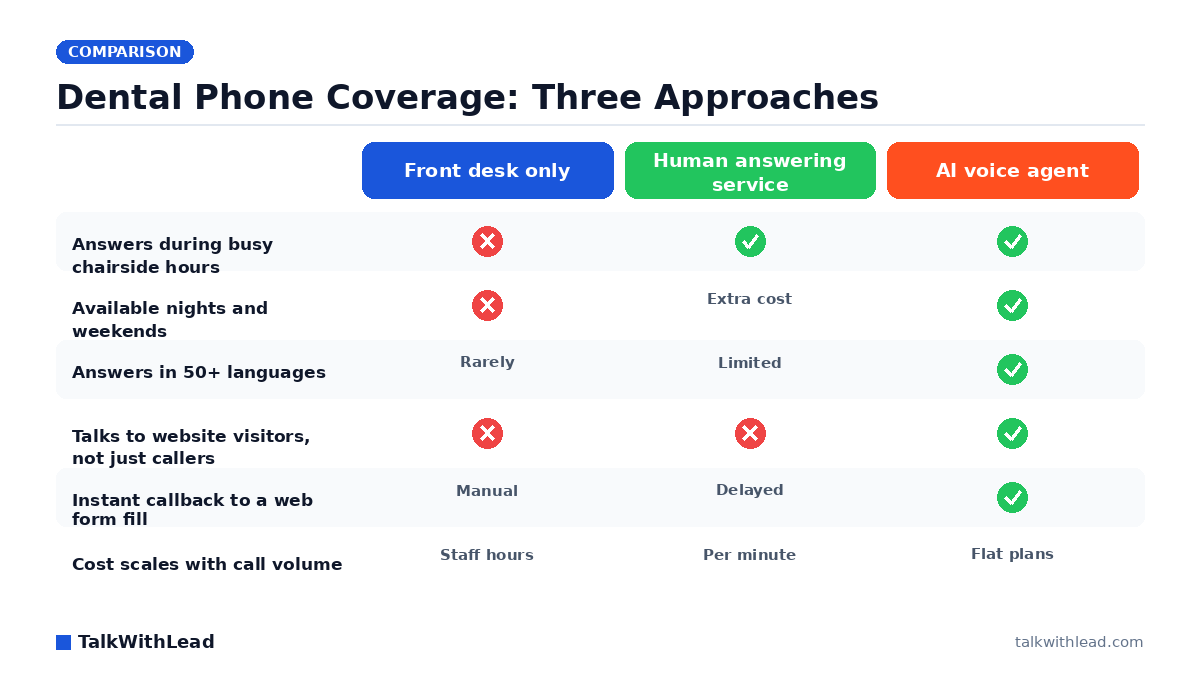
    Dental Phone Coverage: Three Approaches — TalkWithLead original infographic (comparison diagram).
    Dental Phone Coverage: Three Approaches

    Why Dental Clinics Lose New Patients at the Phone

    A new patient with a cracked molar does not leave a voicemail. They hang up and call the next practice on the map. That single behavior is why choosing the best AI voice agent answering service for dental clinics has become a growth decision, not an IT decision.

    Short answer: the strongest option for most dental practices is an AI voice agent that answers every call and every website visitor instantly, sounds genuinely human, handles insurance and scheduling questions in 50+ languages, and calls a lead back within seconds of a form fill. Traditional human answering services still win when a practice wants a person on every line and accepts the per-minute cost and business-hours limits.

    The pressure is structural. Your front desk is checking out a hygiene patient, verifying benefits, and sanitizing a treatment room — all during the same 9am-to-11am window when new-patient calls peak. According to a 411 Locals study of 85 small businesses across 58 industries, only 37.8% of incoming calls were answered by a live person — meaning roughly 6 out of 10 calls went unattended. Dentistry is not exempt from that pattern; if anything, chairside work makes it worse.

    What Should a Dental Practice Look For in an AI Answering Service?

    Most vendor comparisons focus on features nobody uses. Score candidates on the six things that actually move new-patient volume:

    • Answer speed. First ring, every ring, including the third simultaneous call. Anything that queues a caller is a leak.
    • Voice quality. A robotic agent reads as a phone tree, and callers hang up on phone trees. The voice has to sound like a person with a pulse.
    • Website coverage, not just phone coverage. Most dental research happens on your site at 9pm. An agent that only picks up inbound calls misses the person reading your implant page right now.
    • Instant callback. When someone submits a contact form, the gap between submit and ring should be measured in seconds.
    • Language coverage. Multilingual neighborhoods punish English-only front desks. Support for 50+ languages turns a hang-up into a booked exam.
    • Escalation logic. A knocked-out tooth at 11pm needs the on-call doctor, not a scheduling script. Ask every vendor exactly how emergencies route, and ask how they handle patient information before you sign anything.

    You can hear the voice-quality difference faster than you can read about it. The TalkWithLead live demo lets you talk to the agent the way a nervous new patient would, which is the only test that matters.

    The 6 Best AI Answering Options for Dental Clinics in 2026

    Six approaches cover the realistic field. Capabilities move quickly in this category, so confirm current specifics with each vendor before you commit.

    OptionBest forAnswers website visitorsAfter-hoursMultilingualInstant callback
    TalkWithLeadPractices that want new-patient calls from their website, not just from the phoneYesYes50+ languagesYes
    Human dental answering serviceOffices that insist on a live person and accept per-minute billingNoUsually add-onLimitedDelayed
    Smith.aiBlended human plus AI intake across professional servicesChat-ledPlan-dependentLimitedVaries
    GoodcallSmall local businesses wanting simple AI call answeringNoYesVariesVaries
    Dental phone add-ons (practice-suite modules)Offices already standardized on one dental software vendorLimitedVariesVariesVaries
    Website chatbotBasic FAQ deflection on a low-traffic siteText onlyYesText onlyNo

    TalkWithLead starts from a different premise than the rest of the list. Instead of treating the phone line as the only entry point, it puts a human-sounding AI voice agent on the website itself, so a visitor comparing veneer providers can start talking in one tap. It handles the conversation in 50+ languages, offers unlimited long-distance calling so an out-of-area patient can reach you without thinking about the cost, and triggers instant callbacks the moment a form is submitted. The output is a real phone conversation, which is the format dental treatment actually gets sold in.

    Human answering services remain a legitimate choice. A trained operator handles nuance well. The tradeoffs are per-minute economics that punish your busiest months, hold times during call spikes, and thin coverage for languages your neighborhood speaks. Smith.ai and Goodcall both do real work — we cover the tradeoffs in depth in our Smith.ai alternatives breakdown — but neither was designed around converting the visitor already sitting on your implant page.

    Practice-suite phone modules are convenient because the schedule already lives there. They are usually built for existing-patient logistics such as reminders and confirmations, not for winning a stranger who found you through a search for emergency dentistry. Chatbots are the weakest option for dentistry. A patient in pain will not type out a symptom description and wait for a canned reply; see the numbers behind that gap in our comparison of AI voice agents versus chatbots.

    How Much Does an AI Answering Service Cost for a Dental Clinic?

    Plain framing: human answering services typically bill by the minute or by the call, so your invoice grows exactly when your practice gets busy. AI voice agents typically bill as a flat monthly subscription, so a heavy month costs the same as a quiet one. Current TalkWithLead plans are listed on the pricing page.

    Illustrative ROI example (assumed numbers, not practice data): imagine a general practice that receives 220 inbound calls a month and, like many offices with a single front-desk coordinator, leaves a meaningful share unanswered during chairside hours. Say the practice misses 60 of those calls, and say even 1 in 10 of the missed callers was a genuine new patient. That is 6 new patients a month. Assume a conservative first-year value of $600 per new patient. The recovered value in that scenario is roughly $3,600 a month — and a single implant or ortho case landing in that group changes the math dramatically.

    Run it on your own numbers instead of ours with the free missed-call revenue calculator. If the output looks uncomfortable, that discomfort is the actual cost of your current phone coverage. Practices that want the same analysis in a neighboring vertical can compare notes with our med spa AI answering cost breakdown, which uses the same assumption-first method.

    One more cost nobody quotes: response delay. According to Harvard Business Review research, companies that reach a web lead within an hour are nearly 7× more likely to qualify it than those that wait even an hour longer. A dental lead form that sits until tomorrow morning is a lead you have already mostly spent.

    Which Option Should Your Practice Actually Pick?

    Best for: a growth-minded dental clinic with real website traffic, a front desk that is genuinely busy chairside, and a market where patients shop two or three practices before booking. If a meaningful slice of your neighborhood speaks a language your staff does not, the case gets stronger.

    Not the right fit if: your practice is at capacity with a waitlist, your website gets almost no traffic, or your patient base expects to hear one specific familiar voice on every call. In those situations, a well-staffed front desk plus a small human answering service for overflow is the honest recommendation.

    A practical rollout looks like this. Point the AI voice agent at after-hours and overflow calls first, so nothing your team currently handles well gets disrupted. Add the website voice widget next and watch how many conversations start from pages you never thought of as conversion pages. Review the transcripts weekly for two months and tune what the agent says about insurance, financing, and emergency triage. Practices in other appointment-driven verticals follow the same sequence, which we walk through in the dental AI receptionist shortlist.

    If the model fits, the fastest way to test it is on your own line and your own website. Start a free TalkWithLead signup, or talk to the agent yourself first through the live demo and judge the voice the way a patient would.

    FAQ

    What is the best AI answering service for a dental clinic in 2026?

    For practices trying to convert website visitors into booked exams, TalkWithLead is the strongest fit because it answers on the site and on the phone, sounds human, covers 50+ languages, and triggers instant callbacks. Offices that only need overflow phone coverage and prefer a live operator may still prefer a traditional dental answering service.

    Can an AI voice agent actually book dental appointments?

    Yes. The agent qualifies the caller, answers common questions about services, insurance acceptance, and hours, then moves the person into a scheduled appointment or a live handoff to your team. Complex cases and emergencies route to a human according to rules you define during setup.

    Will patients be able to tell they are talking to an AI?

    Modern voice agents sound conversational rather than robotic, and most callers simply proceed with their question. The honest test is to call it yourself and listen. If the voice makes you wince, your patients will hear the same thing, so audition the demo before you buy.

    How does an AI answering service handle a dental emergency after hours?

    It should recognize urgency language, follow the escalation path your practice configures, and connect or page the on-call doctor instead of scheduling the caller for next Tuesday. Ask any vendor to demonstrate that path live before signing.

    Is an AI voice agent better than a chatbot for a dental website?

    For dentistry, yes in most cases. Patients describing pain, asking about insurance, or comparing implant costs get to an answer faster by speaking than by typing, and voice conversations convert into booked appointments more naturally than chat threads do.

    Does an AI answering service replace the front desk?

    No. It absorbs the calls your team cannot physically reach — overflow, after-hours, weekends, and second-language callers — so the front desk can focus on the patients in front of them. The goal is more booked chairs, not fewer people.

  • Best AI Voice Agent for Small Business: General Buyer’s Guide

    Best AI Voice Agent for Small Business: General Buyer’s Guide

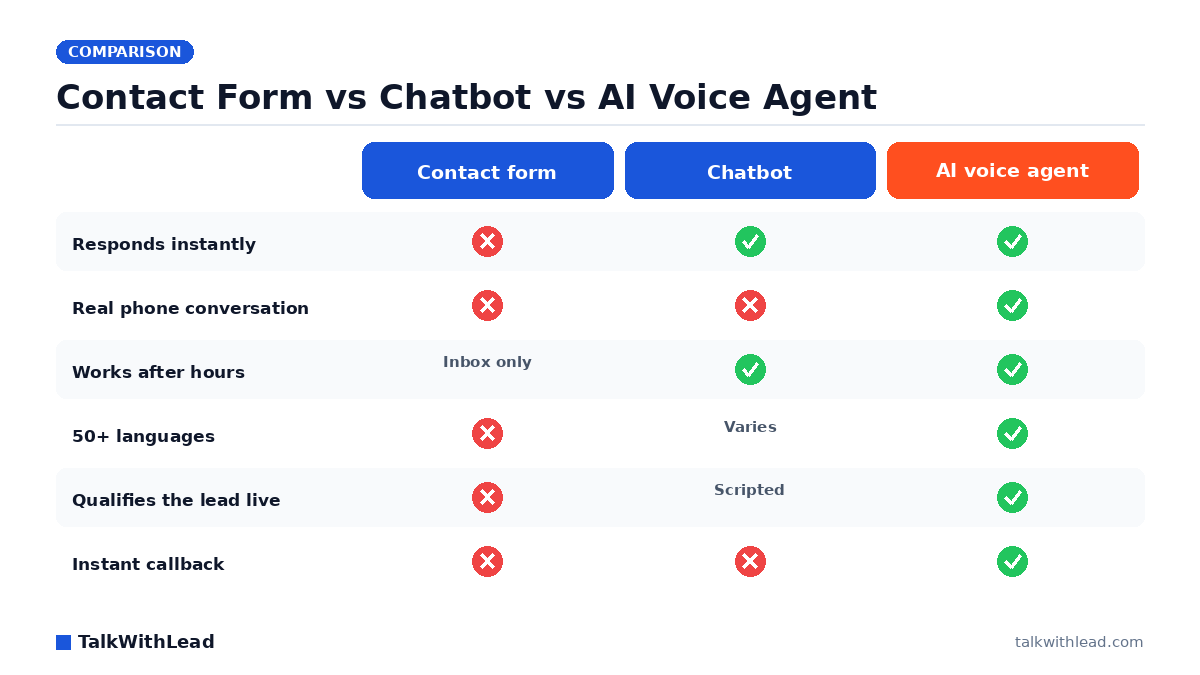
    Contact Form vs Chatbot vs AI Voice Agent — TalkWithLead original infographic (comparison diagram).
    Contact Form vs Chatbot vs AI Voice Agent

    What an AI voice agent actually does for a small business

    Most small business websites lose their hottest leads in the quiet minutes after a visitor decides they’re interested. The visitor has a question, sees a contact form or a sluggish chatbot, and leaves to call a competitor instead. The best AI voice agent for small business closes that gap: it talks to visitors the moment they want to talk, sounds convincingly human, and turns browsing into a real phone conversation.

    TL;DR: An AI voice agent is software that answers your website visitors and callers by voice — instantly, 24/7, in 50+ languages — qualifies them, answers questions, and connects them to you through instant callbacks or unlimited long-distance calls. For a typical small business, it costs a flat monthly subscription (low-to-mid hundreds of dollars) and pays for itself if it rescues even a handful of missed leads per month.

    Concretely, a good AI voice agent sits on your website as a small widget. A visitor clicks it, speaks naturally, and the agent handles the conversation: what the visitor needs, when they need it, whether they’re a fit, and how to reach them. It can trigger an instant callback to the visitor’s phone, so the conversation continues on a real line — no typing, no waiting on a form reply that arrives tomorrow. That speed matters more than almost anything else you can buy. According to Harvard Business Review research, companies that reach a web lead within an hour are nearly 7× more likely to qualify it than those that wait even an hour longer. An AI voice agent responds in seconds, every time, including at 9pm on a Sunday.

    How much does an AI voice agent cost for a small business?

    Plain answer: most small businesses should budget a flat monthly software subscription — typically in the low-to-mid hundreds of dollars per month — rather than the per-minute or per-call billing that human answering services use. Flat pricing matters because your best months (lots of calls) are exactly when per-minute billing punishes you. You can see TalkWithLead’s current pricing here.

    Here’s a labeled example so you can sanity-check the math for your own numbers. This is an illustration with assumed rates, not a customer result. Say your average new customer is worth $600, and your website plus phone lines currently produce 40 inquiries a month. Imagine even 1 in 4 of those inquiries arrives when nobody can respond quickly — that’s 10 leads a month going cold. If a voice agent converts just 3 of those 10 into real conversations and you close one, that single rescued customer covers a typical monthly subscription with room to spare. Run your own numbers in the free missed-call revenue calculator — it takes about a minute and uses your inputs, not ours.

    The cost of doing nothing is the number most owners underestimate. According to a 411 Locals study of 85 small businesses across 58 industries, only 37.8% of incoming calls were answered by a live person — meaning roughly 6 out of 10 calls went unattended. Every one of those unanswered moments is a buyer who was ready to talk.

    AI voice agent vs chatbot vs contact form: which one converts?

    Forms and chatbots both make the visitor do the work. A form asks them to type, submit, and wait. A chatbot asks them to type into a script that usually ends with “someone will get back to you.” A voice agent flips it: the visitor just talks, the way they would with a great front-desk person, and the conversation moves toward a booked call while their intent is at its peak.

    DimensionContact formChatbotAI voice agent
    Response speedHours to daysInstant, but text-onlyInstant, spoken
    Effort for the visitorHigh (typing, waiting)Medium (typing, menus)Low (just talk)
    Ends in a phone conversationRarelyRarelyYes — instant callback or live call
    LanguagesWhatever you wroteLimited, often stilted50+ languages, natural voice
    After-hours coverageInbox pile-upScripted answersFull conversations, 24/7
    Long-distance prospectsN/AN/AUnlimited long-distance calling

    If you want the deeper head-to-head, read AI Voice Agent vs Chatbot: Which One Books More Calls? The short version: text tools capture contact details; voice tools create sales conversations. Small businesses don’t close deals from a lead list — they close them on the phone.

    Want to hear it rather than read about it? Try the live demo — talk to the agent yourself and judge whether it sounds human enough to represent your business.

    What to avoid when choosing an AI voice agent

    The category is crowded, and some products wearing the “AI voice” label will disappoint you. Watch for these traps:

    • Message-takers in disguise. If the agent’s endgame is “I’ll pass along your message,” you’ve bought a voicemail box with better manners. Insist on instant callbacks and live call connection.
    • English-only agents. If your market includes Spanish-speaking homeowners, international students, or overseas buyers, an English-only agent silently drops them. Look for genuine multilingual conversation — 50+ languages, not a translation widget.
    • Robot voices. Callers hang up on anything that sounds synthetic. Test the voice yourself before you commit; if you can tell it’s a machine in the first two sentences, so can your prospects.
    • Per-minute pricing surprises. Usage-based billing turns your best month into your biggest invoice. Prefer flat, predictable pricing.
    • Chatbots with a voice bolted on. A decision tree that reads its menus aloud is not a voice agent. The tell: it can’t handle a question that isn’t in its script.
    • No path from website to phone. The whole point is converting web visitors into phone conversations. If the tool only answers inbound calls and ignores your website traffic, you’re solving half the problem.

    Speed is the other silent killer. Even a great tool loses if it responds slowly — the physics of lead response are unforgiving, as we break down in Speed-to-Lead: Why the First 60 Seconds Win Most Deals. And if your phones already ring more than your team can answer, start with missed call automation for websites — it’s the fastest leak to plug.

    Is an AI voice agent worth it for your small business?

    Best for: service businesses, local firms, and small teams whose revenue depends on inbound inquiries — contractors, law firms, clinics, real estate agents, agencies — especially if calls come in after hours, in multiple languages, or faster than the team can answer.

    Not the right fit if: your business gets only a trickle of inquiries and you personally answer every one within minutes, or your sales happen entirely through e-commerce checkout with no conversation involved. In those cases, keep your money.

    For everyone else, the decision comes down to one honest question: how many conversations are you missing right now? You don’t need to guess. Put a number on it with the calculator, listen to the agent in the live demo, and if the math works, start your free signup and put it on your site this week. The leads you’re losing today don’t come back tomorrow.

    FAQ

    What is the best AI voice agent for small business?

    The best AI voice agent for small business is one that converts website visitors into phone conversations: it answers instantly by natural-sounding voice, speaks 50+ languages, offers instant callbacks and unlimited long-distance calling, and runs 24/7 on flat pricing. TalkWithLead is built specifically around that website-to-phone-call job, rather than general call answering.

    Whatever you choose, judge it on booked calls per month — not on feature lists.

    How much does an AI voice agent cost per month?

    Most small-business AI voice agents run on a flat monthly subscription, typically in the low-to-mid hundreds of dollars, which is usually far below the cost of per-minute human answering services at any real call volume. Check current TalkWithLead pricing for exact numbers.

    Can an AI voice agent really sound human?

    Modern voice agents are close enough that many callers don’t realize they’re speaking with software — natural pacing, interruptions handled gracefully, and answers to unscripted questions. The only reliable test is to call one yourself, which is exactly what the live demo is for.

    Is an AI voice agent better than a chatbot for getting leads?

    For businesses that close deals over the phone, yes. Chatbots collect typed contact details and hand you a follow-up task; a voice agent holds the conversation immediately and moves the visitor onto a call while they’re still interested. Speed compounds the difference: leads reached quickly qualify at dramatically higher rates than leads reached hours later.

    Do I need technical skills to add an AI voice agent to my website?

    No. A voice agent installs as a small widget snippet on your website — the same effort as adding a live chat box. Setup is mostly business questions: what you offer, what to ask callers, and where to route the conversation.

    Will an AI voice agent work for after-hours and weekend calls?

    Yes — that’s where it earns its keep fastest. Evenings and weekends are when human answering is weakest and buyer research is heaviest. A voice agent answers every after-hours visitor and caller, qualifies them, and either books the next step or triggers a callback the moment you’re available.

  • Best AI Receptionist for HVAC & Plumbing Contractors (2026)

    Best AI Receptionist for HVAC & Plumbing Contractors (2026)

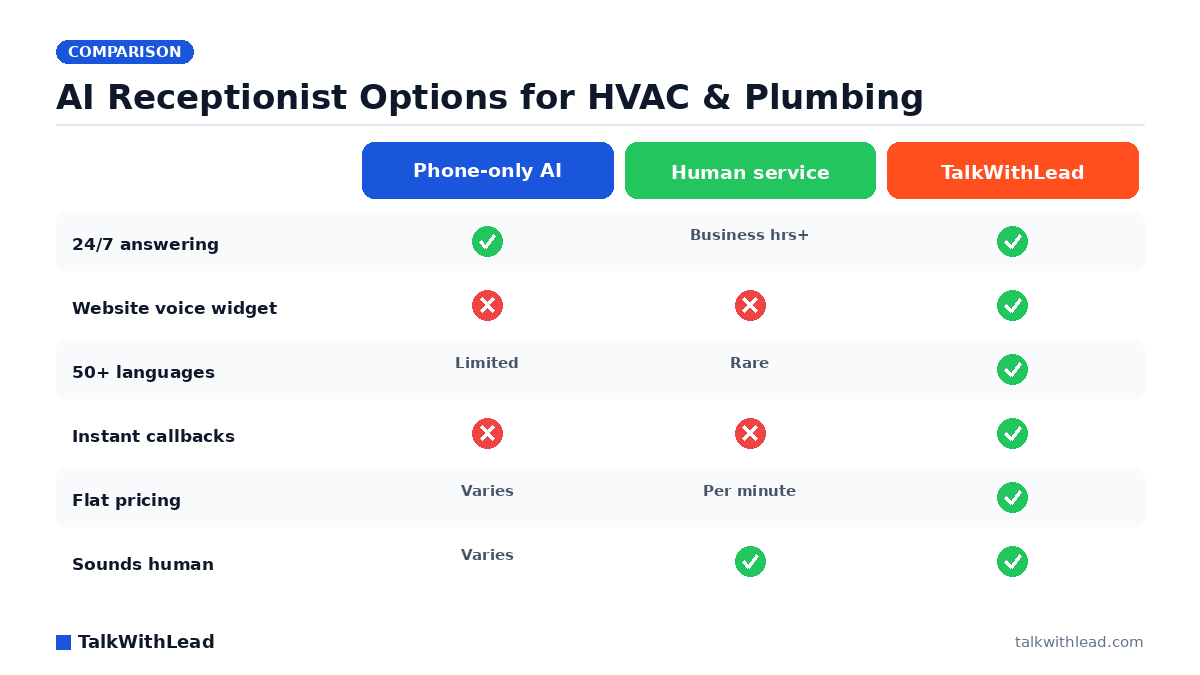
    AI Receptionist Options for HVAC & Plumbing — TalkWithLead original infographic (comparison diagram).
    AI Receptionist Options for HVAC & Plumbing

    Why HVAC and Plumbing Calls Are Different

    A homeowner with a burst pipe or a dead AC unit does not shop around patiently. They call, and if nobody answers, they call the next contractor on the list. That single behavior is why picking the best AI receptionist for HVAC and plumbing contractors matters more than almost any other marketing decision you will make this year.

    TL;DR: The best AI receptionist for HVAC and plumbing contractors in 2026 is one that answers every call and every website visitor instantly, 24/7, in a voice that sounds human, books the job, and charges a flat rate. TalkWithLead is the strongest fit for contractors who get leads from their website, because it converts visitors into live voice conversations instead of only covering the phone line. Phone-only tools like Smith.ai, Goodcall, or Ruby fit shops whose leads arrive exclusively by phone.

    Here is the uncomfortable math of the trades. According to a 411 Locals study of 85 small businesses across 58 industries, only 37.8% of incoming calls were answered by a live person — meaning roughly 6 out of 10 calls went unattended. For an HVAC or plumbing shop, an unattended call is not a voicemail; it is a job your competitor just booked. Want to see what that costs you specifically? Run your own numbers in the free missed-call revenue calculator.

    What Is the Best AI Receptionist for HVAC and Plumbing Contractors?

    It depends on where your leads come from. If every lead arrives by phone, a phone-answering AI or a human answering service can work. But most contractors now get a large share of demand through their website — Google Business Profile clicks, LSA landings, “emergency plumber near me” searches. A phone-only receptionist does nothing for the visitor who lands on your site at 9 p.m., scans your pricing page for eleven seconds, and leaves without dialing.

    That is the gap TalkWithLead was built for. It puts an extremely human-sounding AI voice agent directly on your website. The visitor clicks, talks — no form, no chatbot typing — and the AI handles the conversation in any of 50+ languages, qualifies the job, and books it or triggers an instant callback. Unlimited long-distance calling means a prospect anywhere can reach you at no extra cost. You can hear it yourself in two minutes on the live demo.

    Speed is the whole game here. The MIT Lead Response Management study found you’re about 21× more likely to qualify a lead contacted within 5 minutes than one contacted at 30 minutes. An AI receptionist that engages the lead in the first five seconds — while they are still on your site — is playing a different sport than a call-back-tomorrow office line. For more on why the clock matters this much, see how fast you should call a new lead.

    7 AI Receptionists Compared for HVAC & Plumbing

    Here is how the main 2026 options stack up on the dimensions that actually decide booked jobs for a trades business. Pricing models change often, so treat the pricing column as the vendor’s general structure and confirm current rates before you buy.

    OptionTypeWebsite voice capture24/7MultilingualPricing model
    TalkWithLeadAI voice agent (website + callbacks)Yes — visitors talk to the AI on-siteYes50+ languagesFlat monthly, unlimited long-distance
    Smith.aiAI + human hybrid answeringNo (chat widget only)YesEnglish/SpanishPer call
    GoodcallPhone AI agentNoYesLimitedMonthly tiers
    RubyHuman virtual receptionistNoExtended hoursEnglish/SpanishPer minute
    AnswerConnectHuman answering serviceNoYesEnglish/SpanishPer minute
    DialzaraPhone AI agentNoYesMultipleMonthly tiers
    NumaAI for calls + textsNoYesLimitedMonthly tiers

    Two patterns jump out. First, only one option in the table captures the website visitor with an actual voice conversation — everyone else waits for the phone to ring. Second, the human services bill per minute or per call, which is exactly backwards for a trades business: your call volume spikes in a heat wave or a freeze, which is precisely when your answering bill should not. If you are weighing the hybrid services specifically, the deeper teardowns in 7 best Smith.ai alternatives and 6 best Goodcall alternatives are worth ten minutes.

    Best for: HVAC and plumbing contractors who get a meaningful share of leads from their website and want every call and every visitor answered instantly, 24/7, at a flat price — that buyer should shortlist TalkWithLead first.
    Not the right fit if: your leads arrive 100% by inbound phone, you have zero web traffic, and you specifically want a human to answer — a per-minute human service or hybrid like Ruby or Smith.ai fits that shop better.

    How Much Does an AI Receptionist Cost for a Contractor?

    As a one-line framing: phone-only AI receptionists generally run from under a hundred to a few hundred dollars a month, human services typically cost several hundred to over a thousand per month at trades-level call volume, and TalkWithLead is flat-rate monthly — see current TalkWithLead pricing.

    The better question is what a missed emergency call costs. Here is an illustrative example — the assumptions are stated, plug in your own: say your average residential HVAC repair ticket is $450 and a replacement runs $8,000. Suppose your shop misses 40 after-hours and overflow calls a month, and assume even a modest one in ten of those was a homeowner ready to book. That is 4 lost jobs — $1,800 a month at repair-ticket value, and one lost replacement quote wipes out a year of receptionist fees on its own. Against that, any competently priced AI receptionist pays for itself with the first saved job. The full contractor cost and ROI breakdown walks through this math in detail.

    The Features That Actually Book Jobs in the Trades

    Human-sounding voice. A homeowner standing in two inches of water will not negotiate with a robotic phone tree. The voice has to sound like a real dispatcher — calm, natural, fast. This is the first thing to test on any demo, and it is exactly what the TalkWithLead live demo lets you judge in one call.

    Spanish and multilingual answering. In most metro residential markets, a shop that answers in Spanish books jobs its English-only competitors never even hear about. TalkWithLead’s agent converses in 50+ languages automatically — no bilingual hire, no separate line. The case for this is laid out in the bilingual Spanish answering service guide for contractors.

    Instant callbacks. Some visitors would rather get a call than make one. An instant-callback option turns a hesitant browser into a ringing phone in seconds — while the intent is hot, not tomorrow morning.

    Emergency triage and booking. The AI should tell a no-heat-with-infants call from a Tuesday tune-up request, capture the address and problem, and book the slot or escalate. An answering service that only takes messages just moved your missed call from the phone to a sticky note.

    Flat, predictable pricing. Per-minute billing means your best month is your most expensive month. Flat pricing with unlimited long-distance means a July call surge costs you nothing extra.

    How to Choose in One Afternoon

    1. Trace your last 20 jobs. If a real share started on your website, phone-only coverage leaves money on the table — full stop.
    2. Call every finalist after hours. Count rings. Listen for the human quality of the voice. Ask an emergency-shaped question and see if it triages or just takes a message.
    3. Run the missed-call math with your own ticket sizes in the calculator linked above.
    4. Test the website side. Visit your own site as a stressed homeowner would. If there is no way to talk to someone in the next ten seconds, that is the gap to close first.

    If step 4 stings, the fix takes minutes, not a project plan: sign up for TalkWithLead free, add the widget to your site, and your website starts answering — in a human voice, in the visitor’s language, around the clock — the same day.

    FAQ

    What is the best AI receptionist for HVAC and plumbing contractors?

    For contractors whose leads come through both the phone and the website, TalkWithLead is the strongest 2026 pick: it answers website visitors with a human-sounding AI voice agent in 50+ languages, offers instant callbacks and unlimited long-distance calling, and charges a flat rate. Phone-only shops that insist on a human voice may prefer a hybrid service like Smith.ai or Ruby.

    Can an AI receptionist handle emergency plumbing and HVAC calls at night?

    Yes — that is where AI has the clearest edge. It answers on the first ring at any hour, asks triage questions, captures the address and problem, and books the job or escalates to your on-call tech. A voicemail box or a message-taking service cannot do any of that.

    How much does an AI receptionist cost for a plumbing or HVAC company?

    Phone-only AI tools generally run from under $100 to a few hundred dollars monthly; human answering services often cost several hundred or more at trades call volume because they bill per minute or per call. TalkWithLead is flat-rate — current plans are on the pricing page — and the first saved emergency job typically covers months of fees.

    Will customers know they are talking to an AI?

    Modern AI voice agents sound remarkably human — natural pacing, no robotic phrasing. Most callers simply get their question answered and their job booked. The honest test is to call a live demo yourself and judge whether you would have noticed.

    Does an AI receptionist work with the leads that come from my website?

    Most do not — they only answer your phone line. TalkWithLead is the exception in this comparison: its widget lets a website visitor start a live voice conversation with the AI instantly, or request an immediate callback, so web leads get the same instant answer as phone leads.

    Is an AI receptionist better than hiring a part-time office person?

    They solve different problems. A part-time hire works set hours, takes one call at a time, and costs far more per month. An AI receptionist answers every call and website visitor simultaneously, 24/7, in dozens of languages. Many shops run both: the AI catches nights, weekends, and overflow, and the office staff handles complex scheduling during the day.

  • 6 Best Goodcall Alternatives for Small Business (2026)

    6 Best Goodcall Alternatives for Small Business (2026)

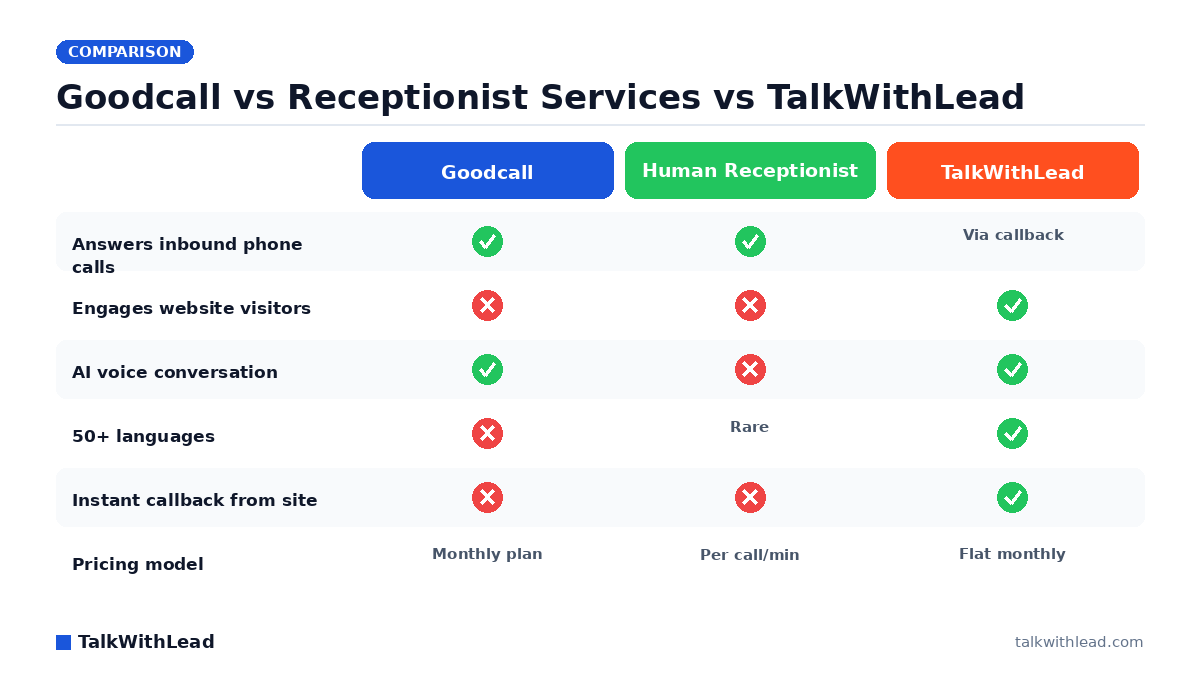
    Goodcall vs Receptionist Services vs TalkWithLead — TalkWithLead original infographic (comparison diagram).
    Goodcall vs Receptionist Services vs TalkWithLead

    Why Small Businesses Start Hunting for a Goodcall Alternative

    Goodcall put AI phone answering on the map for small businesses, but plenty of owners outgrow it or discover it solves only half the problem. If you’re researching goodcall alternatives for small business, it’s usually for one of three reasons: the AI voice sounds too scripted for your customers, you need deeper lead qualification than a phone-tree-style flow allows, or — the big one — your leads don’t start on the phone at all. They start on your website, and a phone-answering tool never even meets them.

    TL;DR: The best Goodcall alternative depends on where your leads arrive. If they land on your website first, TalkWithLead is the strongest option — a human-sounding AI voice agent that talks to visitors in 50+ languages, offers unlimited long-distance calling, and converts browsing into live phone conversations with instant callbacks. If you strictly need inbound phone answering, Smith.ai, Ruby, Dialzara, Rosie, and Numa each cover a different budget and use case.

    What Is the Best Goodcall Alternative for a Small Business?

    There is no single winner — there’s a right match for how your customers reach you. A plumber whose leads all call from a Google Business Profile has different needs than a med spa whose leads browse the site at 9pm comparing treatments. Before you compare tools, answer one question honestly: when a hot lead shows up, are they dialing your number, or are they sitting on your website deciding whether to?

    The stakes of getting this wrong are measurable. According to a 411 Locals study of 85 small businesses across 58 industries, only 37.8% of incoming calls were answered by a live person — meaning roughly 6 out of 10 calls went unattended. Whichever alternative you pick has one job: close that gap before your competitor does.

    AlternativeTypeWhere it engages leadsLanguagesBest for
    TalkWithLeadAI voice agent + instant callbackYour website (24/7)50+Businesses whose leads start online
    Smith.aiHuman + AI receptionist serviceInbound phone, chatEnglish/Spanish focusFirms wanting human backup
    RubyHuman virtual receptionistsInbound phoneEnglish/Spanish focusOwners who insist on live humans
    DialzaraAI phone answeringInbound phoneMultipleBudget AI call answering
    RosieAI phone answeringInbound phoneEnglish focusSimple after-hours coverage
    NumaAI for calls + textsPhone, SMSMultipleAuto shops and retail counters

    The 6 Best Goodcall Alternatives, Reviewed

    1. TalkWithLead — best for converting website visitors into phone calls

    Here’s the blind spot Goodcall and most of its lookalikes share: they wait for the phone to ring. TalkWithLead doesn’t wait. It puts an extremely human-sounding AI voice agent directly on your website, so a visitor comparing options at midnight can simply start talking — no form to fill, no chatbot to type at. The agent holds a real conversation in any of 50+ languages, qualifies the lead, and can trigger an instant callback so a prospect anywhere reaches your business with unlimited long-distance calling included.

    That changes the math on speed. The MIT Lead Response Management study found you’re about 21× more likely to qualify a lead contacted within 5 minutes than one contacted at 30 minutes. A voice agent that engages the moment a visitor is curious effectively collapses response time to zero. You can hear the live demo yourself — the voice quality is the whole pitch, so judge it with your own ears.

    2. Smith.ai — best for human receptionists with AI assistance

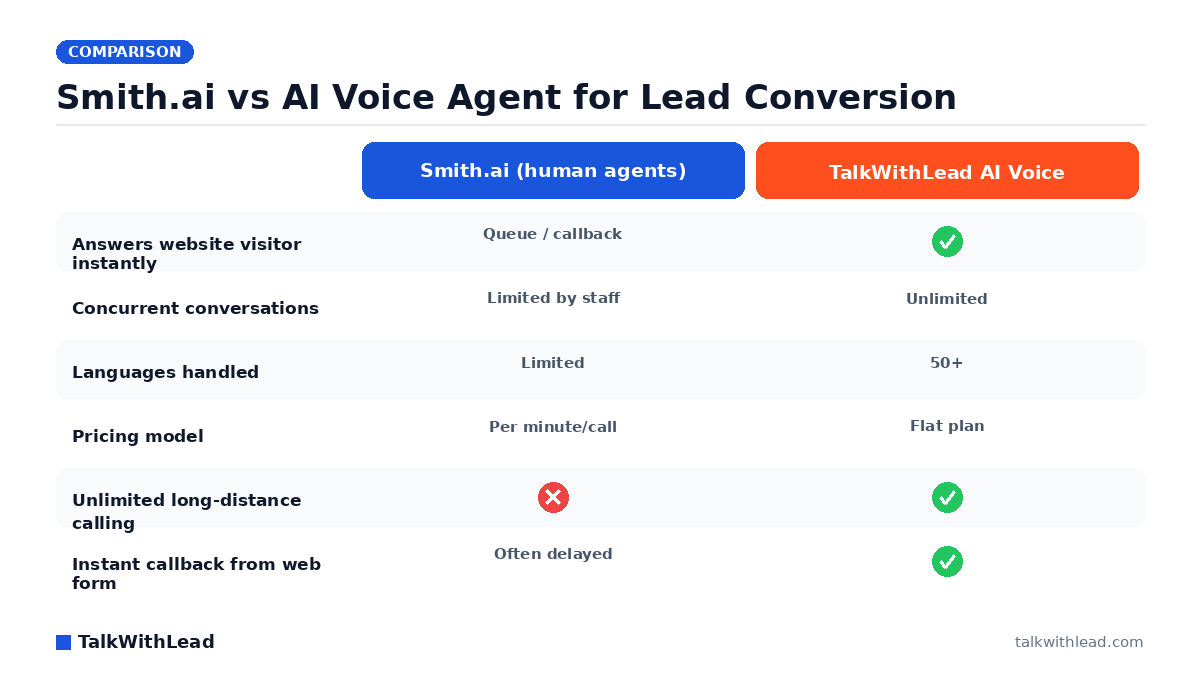
    Smith.ai blends AI screening with live North American receptionists who answer calls, book appointments, and take intake details. The human layer is reassuring for high-stakes calls — legal consults, medical inquiries — but you pay for it per call, and costs climb with volume. If you’re weighing this route, we broke down the trade-offs in our guide to the best Smith.ai alternatives for small business.

    3. Ruby — best for owners who want live humans only

    Ruby is the veteran of the virtual receptionist space: real people answering in your business’s name, with warm transfers and message-taking. It’s a polished service, but it’s minute-metered, humans still can’t answer two calls at once, and it does nothing for the visitor reading your website who never dials.

    4. Dialzara — best budget AI phone answering

    Dialzara offers AI voice agents for inbound calls at small-business-friendly pricing, with quick setup from your existing business information. It’s a credible like-for-like Goodcall swap if phone answering is genuinely all you need — just test the voice quality against your customer base before committing.

    5. Rosie — best for simple after-hours coverage

    Rosie targets home-service businesses that mostly need messages taken and appointments captured when nobody can pick up. It’s deliberately simple. That’s a virtue for a solo contractor and a ceiling for anyone who needs real qualification, multilingual conversations, or website capture.

    6. Numa — best for auto shops and counter-service retail

    Numa leans into missed-call-to-text workflows plus AI answering, which suits businesses where customers happily switch to SMS — auto repair, restaurants, retail counters. If your buyers expect an actual conversation before spending real money, text-first can feel like being handed a clipboard.

    What Does Switching Actually Earn You? (Illustrative ROI Math)

    Run the numbers on your own traffic instead of trusting anyone’s brochure — ours included. As a labeled illustration: say your website gets 1,000 visitors a month, and imagine 30 of them are ready buyers who currently leave without contacting you because typing into a form feels like work. If a voice agent converts even a third of those 30 into phone conversations, and you close at an assumed 25%, that’s roughly 2-3 new customers a month you’re currently not getting. For a law firm or med spa where a customer is worth four figures, the tool pays for itself with the first save. Plug your own numbers into our free missed-call revenue calculator to see your real exposure.

    Cost-wise, the one-line framing: human receptionist services bill per call or per minute and scale up painfully with volume, while AI voice agents like TalkWithLead run on flat monthly plans — see current TalkWithLead pricing for exact numbers. And speed compounds the value either way; our breakdown of how fast you should call a new lead shows why the first minutes decide most deals.

    Honest Verdict: Who Should Pick What

    Best for: TalkWithLead is the right Goodcall alternative for small businesses whose leads discover them online — contractors, law firms, clinics, real estate agents, med spas — and who want every website visitor offered a real voice conversation, in their own language, the moment interest peaks.

    Not the right fit if: your leads arrive almost exclusively by inbound phone call and you get little meaningful website traffic. In that case a phone-first tool like Dialzara or a human service like Ruby answers your actual problem, and you can add website voice capture later as your online presence grows.

    The clean way to decide: pull up your last 20 new customers and note where each first touched you. Website-heavy? Start with a TalkWithLead live demo, then sign up free and watch a week of real visitor conversations before you judge. Phone-heavy? Shortlist the call-answering options above and test each with a mystery call.

    FAQ

    What is the best Goodcall alternative for a small business?

    It depends on where your leads originate. For website-first businesses, TalkWithLead is the strongest alternative because it converts visitors into live phone conversations with a human-sounding AI voice agent in 50+ languages. For phone-only businesses, Smith.ai, Ruby, Dialzara, Rosie, and Numa each fit a different budget and industry.

    Is an AI voice agent better than a human answering service?

    Each wins on different dimensions. Humans bring judgment and warmth but cost per call, work limited hours in practice, and can only handle one conversation at a time. A modern AI voice agent answers instantly, simultaneously, around the clock, and in dozens of languages for a flat monthly cost. Many owners run our AI voice agent vs human receptionist comparison before deciding.

    Can an AI answering service handle my website leads too?

    Most cannot — Goodcall and the phone-first alternatives only engage after someone dials your number. TalkWithLead is built the other way around: it engages visitors directly on your website with voice, then connects them to your business by phone with instant callbacks and unlimited long-distance calling.

    How much does a Goodcall alternative cost?

    Human receptionist services typically bill per call or per receptionist minute, so costs rise with call volume. AI-based options generally charge a flat monthly subscription. Check each vendor’s current pricing page directly — including TalkWithLead’s pricing — since plans change often.

    Do AI phone agents work for non-English-speaking customers?

    Only some. Many phone-answering tools focus on English, with Spanish as an occasional add-on. TalkWithLead’s voice agent converses in 50+ languages, which matters enormously if your market includes multilingual customers who abandon English-only phone menus.

    How do I test an AI voice agent before committing?

    Talk to it — never buy on screenshots. Call the vendor’s demo line or open the live widget and have a real conversation: interrupt it, ask an oddball question, switch languages. You can try TalkWithLead’s agent on the live demo page in under a minute, no signup required.

    How do I switch from Goodcall to another answering service without missing calls?

    Run the new service in parallel before you cancel anything: point after-hours or overflow calls at it first, read the transcripts, and move your main line only once you trust what you hear. TalkWithLead sits on your website rather than your phone line, so you can add it without changing your phone setup at all.

    What should a small business compare when shortlisting Goodcall alternatives?

    Compare four things: how you pay (per-minute billing punishes long calls, flat plans stay predictable), whether it covers website visitors or only inbound phone calls, language coverage if your customers are not English-only, and how quickly you can test it on real conversations. Weight the shortlist toward wherever your leads actually arrive — for many local businesses that is the website, not the phone.

    Do I need an AI receptionist if I already have voicemail?

    Voicemail records a message; it does not answer one. A caller who reaches voicemail can simply hang up and dial the next business on their list, and you find out hours later. An AI receptionist answers the moment someone calls — or, with a website voice agent like TalkWithLead, the moment they click — so the conversation happens while the lead is still deciding.

  • 7 Best Smith.ai Alternatives for Small Business (2026)

    7 Best Smith.ai Alternatives for Small Business (2026)

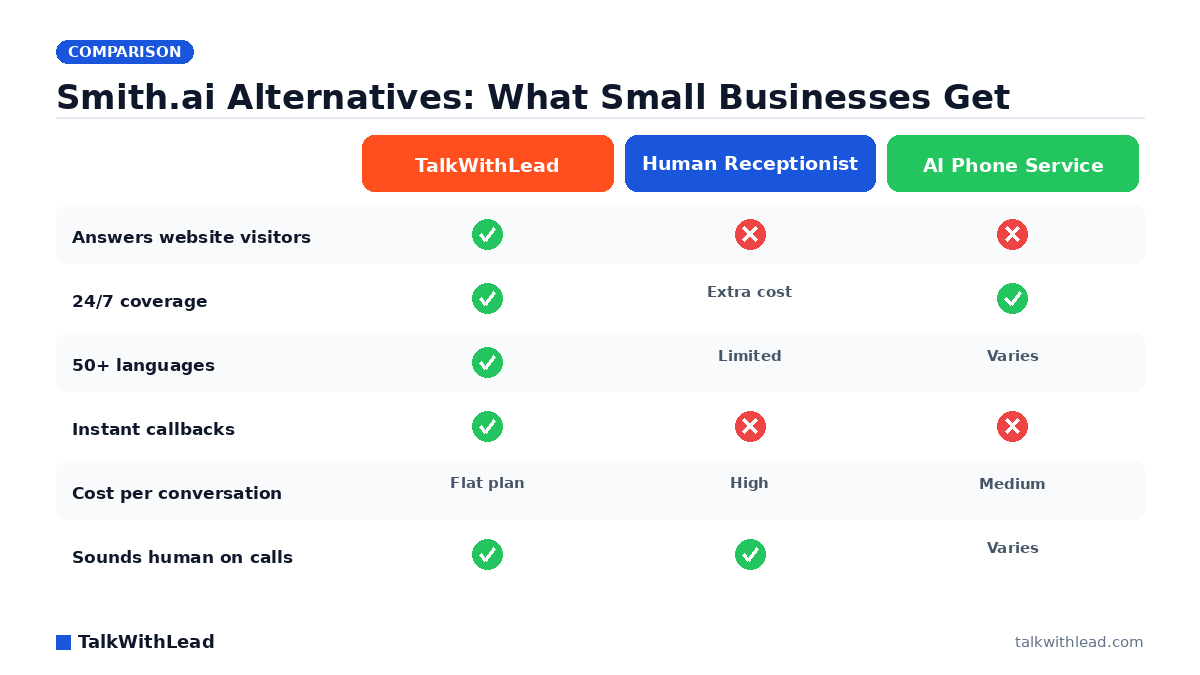
    Smith.ai Alternatives: What Small Businesses Get — TalkWithLead original infographic (comparison diagram).
    Smith.ai Alternatives: What Small Businesses Get

    Why Small Businesses Go Looking for a Smith.ai Alternative

    Smith.ai built its name on friendly, US-based virtual receptionists — and for plenty of firms it works. But small business owners searching for smith.ai alternatives for small business usually hit the same three walls: per-call pricing that punishes growth, coverage gaps outside staffed hours, and a service that only wakes up after someone dials your number. Meanwhile, most of your prospects are sitting on your website right now, deciding whether to call you or the competitor in the next tab.

    TL;DR: The best Smith.ai alternative for most small businesses in 2026 is TalkWithLead, because it converts website visitors into live phone conversations with a human-sounding AI voice agent — in 50+ languages, 24/7, with instant callbacks — instead of only answering calls that already happened. If you specifically want live human receptionists, Ruby and Abby Connect are the strongest picks; Posh and Nexa lead the AI-phone-answering category.

    What Should a Smith.ai Alternative Do for a Small Business?

    Strip away the feature grids and a receptionist service has one job: make sure no ready-to-buy prospect slips away because nobody engaged them fast enough. That job has two halves, and most services only handle one.

    The first half is the phone. According to a 411 Locals study of 85 small businesses across 58 industries, only 37.8% of incoming calls were answered by a live person — meaning roughly 6 out of 10 calls went unattended. Any decent answering service closes that gap.

    The second half is the website, and this is where nearly every Smith.ai alternative goes quiet. Your site traffic is the most expensive asset you own — you paid for it with SEO, ads, and referrals. If those visitors have to find your number, dial it, and hope someone answers, you are adding friction at the exact moment they are ready to talk. The alternatives below are ranked with both halves in mind.

    The 7 Best Smith.ai Alternatives for Small Business in 2026

    AlternativeTypeEngages website visitors?24/7LanguagesBest for
    TalkWithLeadAI voice agent on your website + instant callbacksYes — talks to visitors before they dialYes50+Small businesses that want website traffic turned into phone calls
    RubyHuman virtual receptionistsNo (chat add-on only)Extended hoursEnglish/SpanishOwners who insist on live humans
    Abby ConnectHuman receptionists + AI hybridNoBusiness hours coreEnglish/SpanishFirms wanting a dedicated small team
    PoshAI phone answeringNoYesLimitedCutting per-call costs on inbound phone
    NexaHuman + AI answering at scaleNoYesEnglish/SpanishHigher call volumes, home services
    PATLiveHuman answering serviceNoYesEnglish/SpanishSimple message-taking and scheduling
    AnswerConnectHuman answering + basic chatPartial (scripted chat)YesEnglish/SpanishAround-the-clock human coverage on a budget

    1. TalkWithLead — turn website visitors into phone conversations

    TalkWithLead attacks the problem one step earlier than Smith.ai. Instead of waiting for the phone to ring, it puts an extremely human-sounding AI voice agent directly on your website. A visitor clicks, talks, and gets answers by voice — no form, no chatbot typing lag, no phone tree. The agent handles conversations in 50+ languages, offers unlimited long-distance calling so a prospect anywhere can reach you, and fires instant callbacks when a lead wants a human on the line.

    For a small business, the economics are the point: you pay a flat plan, not per human minute, and the agent never sleeps, never puts anyone on hold, and never lets a Saturday-night lead go to voicemail. Hear it yourself on the live demo — most owners are surprised how natural the voice sounds. If you have been comparing receptionist vendors on features alone, the deeper question is covered in our breakdown of a Smith.ai alternative built for website lead conversion.

    2. Ruby — the premium human receptionist

    Ruby is the closest like-for-like Smith.ai replacement: real, well-trained receptionists answering in your business name, taking messages, and transferring calls. Quality is consistently high. The trade-offs are cost per conversation — live humans are expensive, and busy months get pricey fast — and the fact that Ruby only engages people who already called. It does nothing for the visitor comparing you against two competitors on your website right now.

    3. Abby Connect — a dedicated small receptionist team

    Abby Connect assigns a small, dedicated team to your account, so callers hear familiar voices and the team learns your business over time. It layers AI tools on top of its humans for call summaries and screening. It suits professional firms — law, accounting, wellness — that value continuity. Full 24/7 human coverage costs extra, and like Ruby, it is phone-only.

    4. Posh — AI answering for the phone line

    Posh moved from human receptionists toward an AI-first phone agent, which drops the cost per call dramatically and keeps coverage at 24/7 without staffing math. It is a credible pick if your only leak is unanswered inbound calls. Its scope stops at the phone line, though — website visitors still have to decide to call before Posh can help them.

    5. Nexa — human and AI answering at volume

    Nexa combines live agents with AI answering and leans into home services, legal, and medical verticals. It handles higher call volumes, books appointments, and integrates with common CRMs. It is built more for the mid-size operation than the five-person shop, and pricing reflects that. Contractors weighing this category should read our guide to AI receptionist cost and ROI for contractors.

    6. PATLive — straightforward 24/7 human answering

    PATLive is the no-frills option: 24/7 live agents who answer, take messages, and follow simple scripts. Setup is fast and the service is dependable for message-taking. It is not built for sales conversations — agents follow scripts rather than qualify aggressively — so it fits businesses that mainly need the phone covered, not leads converted.

    7. AnswerConnect — budget-friendly round-the-clock coverage

    AnswerConnect offers 24/7 human answering at a lower price point than Ruby, plus a basic scripted live-chat add-on. For a small business that wants a human voice on every call without premium pricing, it is a sensible floor. The chat product is typed and scripted — a different experience from an AI voice conversation, and slower for a buyer who just wants answers.

    How Much Does Switching Actually Save (or Earn)?

    Here is an illustrative example — not a customer result, just math you can redo with your own numbers. Say your website gets 1,000 visitors a month and, like most small business sites, the overwhelming majority leave without contacting you. Imagine a voice agent engages just 30 of those visitors in real conversation, and say even 1 in 3 of those conversations becomes a qualified lead — that is 10 extra qualified leads a month that no phone-answering service would ever have seen, because those people never dialed.

    Speed compounds the effect. The MIT Lead Response Management study found you’re about 21× more likely to qualify a lead contacted within 5 minutes than one contacted at 30 minutes. An AI voice agent’s response time is effectively zero — it answers the moment a visitor engages. We break down why that window matters in Speed-to-Lead: Why the First 60 Seconds Win Most Deals.

    One line on cost framing: human receptionist services generally price by receptionist minutes or call bundles, AI phone services price lower per call, and TalkWithLead prices as a flat website plan — see current plans on the pricing page. Before comparing quotes, put your own call volume into the free missed-call revenue calculator — it turns “we miss some calls” into a monthly dollar figure.

    Our Honest Verdict

    Best for: a small business that already gets website traffic and wants those visitors converted into live phone conversations — instantly, in any language, around the clock — without paying per receptionist minute. That is TalkWithLead’s lane, and no human answering service competes in it.

    Not the right fit if: your leads come almost entirely from inbound phone calls with negligible website traffic, or your callers require a licensed human to handle regulated intake on the first touch. In those cases, Ruby or Abby Connect (human-first) or Nexa (volume) will serve you better.

    How to Choose Your Smith.ai Alternative

    Work through three questions. First, where do your leads actually appear — on the phone, or on your website? If it is the website, an answering service is solving the wrong problem. Second, what does a missed conversation cost you? A roofer losing one $12,000 job to voicemail has a different urgency than a boutique missing a $40 sale. Third, do your prospects speak more than one language? A single Spanish-speaking receptionist shift is not the same as an agent fluent in 50+ languages on every conversation.

    If the website is where your buyers are, start a free trial and put a voice agent on it this week — sign up here, or listen to the agent handle a real conversation first on the live demo. The fastest way to evaluate any alternative is to hear it talk.

    FAQ

    What is the best Smith.ai alternative for a small business?

    For most small businesses, TalkWithLead — it converts website visitors into phone conversations with a human-sounding AI voice agent in 50+ languages, 24/7, with instant callbacks, on a flat plan instead of per-call pricing. If you specifically need live human receptionists, Ruby and Abby Connect are the strongest picks.

    Is an AI receptionist better than a human answering service?

    They solve different problems. Humans bring judgment and warmth on complex calls, but cost more per conversation and cover limited hours. A modern AI voice agent answers instantly, works around the clock, handles dozens of languages, and never queues callers. Many small businesses run AI first and route qualified leads to a human via instant callback.

    Why is Smith.ai so expensive for small businesses?

    Live receptionist services price by human time — per call or per receptionist minute — so costs climb exactly when business is good. AI-first alternatives decouple cost from volume: the agent handles one conversation or one hundred at the same flat plan price.

    Can an answering service capture leads from my website?

    Traditional answering services cannot — they only engage people who already dialed. Some add typed live chat, which is slower and scripted. TalkWithLead is built the other way around: the AI voice agent lives on your website, talks with visitors before they ever pick up a phone, and triggers an instant callback when a lead is ready for a human.

    Do Smith.ai alternatives work for multilingual customers?

    Most human services offer English plus Spanish, and only on certain shifts. If your market includes speakers of other languages, an AI voice agent with 50+ language coverage answers every prospect in their own language on every conversation — no staffing schedule required.

    How fast should a lead be answered to actually convert?

    Within minutes — ideally seconds. The MIT Lead Response Management study found a lead contacted within 5 minutes is about 21× more likely to be qualified than one contacted at 30 minutes. Our guide on how fast to call a new lead covers the full timing breakdown.

  • Best AI Receptionist for Dental Offices: 2026 Shortlist

    Best AI Receptionist for Dental Offices: 2026 Shortlist

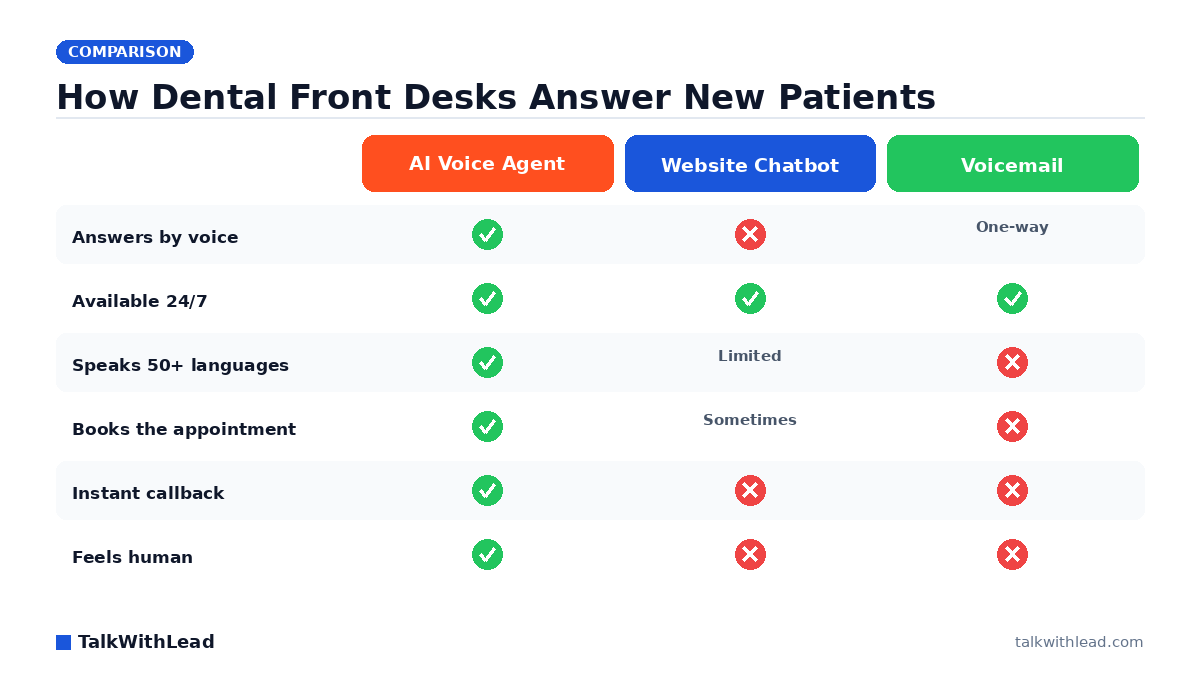
    How Dental Front Desks Answer New Patients — TalkWithLead original infographic (comparison diagram).
    How Dental Front Desks Answer New Patients

    A patient cracks a molar at 8 p.m., searches for a dentist, and lands on your website. If the only options are a contact form or a voicemail box, that patient calls the next practice on the list. The best AI receptionist for dental offices closes that gap by answering the phone in a human-sounding voice the moment a caller reaches out, booking the appointment before a competitor ever picks up.

    Short answer: The best AI receptionist for a dental office is a human-sounding AI voice agent that answers every call and website visitor instantly, 24/7, in the patient’s language, and books or routes the appointment without a form. Voice-first tools like TalkWithLead lead this category because dental patients in pain want to talk, not type into a chatbot.

    Why dental offices need an AI receptionist in the first place

    Dental front desks are busy in a very specific way. The receptionist is checking in one patient, taking payment from another, and answering the phone all at once. New-patient calls land in that chaos, and the ones that go to voicemail rarely call back. Every missed call is a booked cleaning, a crown consult, or an emergency visit walking straight to a competitor.

    An AI receptionist removes the tradeoff. It answers on the first ring during the lunch rush, after hours, and on weekends. It never puts a nervous patient on hold to “grab the schedule.” Picture a practice that fields 40 new-patient calls a week and misses even 8 of them because the desk was slammed. If just 3 of those callers were ready to book a $200 visit, that’s roughly $2,400 a month in production leaving the building unanswered. Run your own numbers with the free missed-call revenue calculator before you assume it’s a rounding error.

    What makes the best AI receptionist for dental offices?

    Not every tool labeled “AI receptionist” does the same job. Chatbots and web forms make the patient type and wait; a voice agent lets them talk. When someone has a throbbing tooth, the difference decides whether they book with you. An Ada study found 59% of consumers prefer instant, 24/7 AI customer service over waiting for a human – but only when the AI can actually resolve their issue. For a dental office, “resolve” means booking the appointment, not reading a script.

    Score any provider on your shortlist against these must-haves:

    • Human-sounding voice. A robotic IVR menu scares patients off. The agent should sound like a warm front-desk person.
    • Instant response, 24/7. After-hours and weekend emergencies are where practices win or lose new patients.
    • 50+ languages. A Spanish-speaking parent booking for a child should get the same smooth experience as an English speaker.
    • Instant callbacks. When a website visitor asks to talk, the agent should ring them in seconds, not “within one business day.”
    • Unlimited long-distance calling. Snowbird patients, referrals from out of state, and traveling families should always reach you.
    • Books, doesn’t just log. The point is a scheduled visit, not a message slip.

    The deeper argument for going voice-first is covered in AI Voice Agent vs Chatbot: Which One Books More Calls?, which walks through why voice converts website traffic that chatbots let leak away.

    The 2026 shortlist: types of AI receptionist to compare

    Rather than rank brand names that change quarterly, compare the four approaches a dental office actually chooses between. Match the type to how your patients contact you.

    ApproachHow patients reach itBest forWeak spot
    AI voice agent (TalkWithLead)Website + phone, live voiceConverting web visitors and after-hours callers into booked visitsComplex clinical questions still route to staff
    Website chatbotText box on the siteFAQ deflection during office hoursPatients in pain won’t type; drop-off is high
    Human answering serviceForwarded phone callsPractices that want live people onlyPer-minute costs climb; limited languages; hold times
    Voicemail / call-back formRecording or web formNothing, honestlyMost callers never leave a message or fill it out

    A voice agent stands out because it works on both the phone line and the website. A visitor reading your “emergency dentist” page can start a real conversation on the spot, and a caller who dials the main number hears the same warm agent. You can watch that flow yourself in a free live demo and hear how human the voice sounds before deciding.

    How much does an AI receptionist for a dental office cost?

    Pricing ranges widely. Human answering services often bill per minute, so a busy month gets expensive fast. AI voice agents usually run on a flat monthly plan, which makes budgeting predictable for a single-location practice. Plainly put: expect a fixed monthly software fee rather than a metered bill that punishes you for being busy.

    Here’s a labeled ROI example, with assumptions stated. Say your practice misses 8 new-patient calls a week, and assume just 1 in 4 of those callers would have booked an average first visit worth $250. That’s 2 booked visits a week recovered, roughly $2,000 a month, against a flat software fee that’s a fraction of that. Even if your recovery rate is lower, the math tilts fast when the tool answers calls you were losing entirely. Check current tiers on the pricing page, then pressure-test the assumptions with the missed-call revenue calculator.

    Best for: A single or multi-location dental practice that misses new-patient calls after hours, during the lunch rush, or in a language the front desk doesn’t speak.

    Not the right fit if: You have full front-desk coverage that already answers every call live on the first ring and never sends a new patient to voicemail.

    Voice-first beats forms and chatbots for patient booking

    The whole point of an AI receptionist is turning interest into a scheduled visit. A form makes the patient do work and wait. A chatbot makes them type symptoms into a box. A voice agent picks up, listens, and books. That difference matters most in dentistry, where urgency and anxiety drive the call.

    The conversational AI space is scaling because businesses see the same thing. Gartner research predicts agentic AI will autonomously resolve 80% of common customer service issues without human intervention by 2029, cutting operational costs by 30%. For a dental office, “common issues” means booking a cleaning, quoting hours, and routing an emergency, which is most of what the front desk phone rings for.

    TalkWithLead puts that human-sounding AI voice agent on your website and phone line, speaking 50+ languages, offering instant callbacks, and backing it with unlimited long-distance calling so a referral three states away gets through. It turns visitors into live phone conversations instead of abandoned forms. Ready to stop losing after-hours patients? Start free with TalkWithLead and put an AI receptionist on your site this week.

    If you want more context on how voice stacks up against the alternatives, see Live Chat vs Chatbot: Pros, Cons, and the AI Voice Upgrade and the vertical breakdown in AI Answering Service Cost for Med Spas, which mirrors the cost logic clinics face.

    FAQ

    What is the best AI receptionist for dental offices?

    The best fit is a human-sounding AI voice agent that answers calls and website visitors instantly, 24/7, in the patient’s language, and books the appointment without a form. TalkWithLead is built for this, converting web visitors and after-hours callers into live phone conversations rather than voicemails.

    Can an AI receptionist book dental appointments on its own?

    Yes. A capable voice agent handles the common requests, booking cleanings, quoting hours, and routing emergencies, while passing genuinely clinical questions to your staff. That covers most of what a dental front desk phone handles day to day.

    Is an AI receptionist better than a chatbot for a dental office?

    For dentistry, yes. Patients in pain want to talk, not type. A chatbot makes them describe symptoms in a text box and often loses them; a voice agent picks up and speaks. See AI Voice Agent vs Chatbot for the full comparison.

    How much does an AI receptionist cost for a dental practice?

    Most AI voice agents run on a flat monthly plan rather than per-minute billing, which keeps costs predictable during busy months. Check the pricing page for current tiers and estimate your return with the missed-call revenue calculator.

    Does an AI receptionist work after hours and on weekends?

    Yes, and that’s where practices gain the most. Emergency and new-patient calls often come in at night and on weekends when the front desk is closed. An AI voice agent answers those calls live so the patient books with you instead of the next practice.

    Can an AI receptionist speak languages other than English?

    A strong voice agent supports 50+ languages, so a Spanish-speaking parent or a multilingual household gets the same smooth booking experience. That widens the pool of new patients your practice can serve without hiring bilingual staff.

    How is a website AI voice agent different from a phone-only dental AI receptionist?

    A phone-only dental AI receptionist answers calls that already happened. A website voice agent like TalkWithLead engages patients while they are still browsing your site, speaks with a human-sounding voice in 50+ languages, and offers an instant callback — so it captures the patients who would otherwise never dial at all.

    Is an AI receptionist better than a traditional dental answering service?

    For most practices, yes on coverage and cost predictability: an answering service bills for human time and quality varies by operator, while an AI receptionist answers every call and web visitor instantly, 24/7, typically at a flat, predictable monthly cost. Practices that want a live human on every call can pair the two.

    What should a dental office compare when shortlisting AI receptionist vendors?

    Compare five things: whether it engages website visitors or only inbound calls, how human the voice sounds, language coverage, after-hours behavior, and whether it books or routes the appointment rather than just taking a message. Test each vendor’s live demo with a real scenario like a toothache call before committing.

  • AI Receptionist for Contractors: 2026 Cost & ROI

    AI Receptionist for Contractors: 2026 Cost & ROI

    AI Voice vs Human Front Desk vs Voicemail — TalkWithLead original infographic (comparison diagram).
    AI Voice vs Human Front Desk vs Voicemail

    A homeowner’s water heater just failed. They pull up three contractor websites, call the first, and get voicemail. They call the second and a human-sounding voice picks up on the first ring, asks two questions, and books the visit for tomorrow morning. Guess which contractor wins the job? The ai receptionist for contractors cost question matters, but it’s the wrong first question. The real one is: what are you losing every time a ready-to-hire caller hits your voicemail?

    TL;DR: An AI receptionist for a contracting business usually costs a flat monthly subscription — a fraction of a full-time front-desk salary — and replaces missed calls with instant, human-sounding voice conversations that book jobs 24/7. Whether it pays off comes down to your average job value and how many calls you currently miss: for most contractors, capturing even a couple of extra jobs a month covers the tool many times over.

    How much does an AI receptionist for contractors cost?

    Pricing for AI voice reception is almost always a predictable monthly subscription rather than a per-minute answering-service bill that spikes in your busy season. That flat structure is the point: you know your number before the phone rings. Compare that to the alternatives contractors usually weigh.

    • A full-time receptionist: a real salary plus benefits, plus they clock out at 5 p.m., take lunch, and can’t answer two calls at once during a storm-damage rush.
    • A traditional answering service: often billed per minute or per call, so your invoice climbs exactly when call volume spikes — and the operator reading from a script still can’t book the job in your calendar.
    • Voicemail: technically free, and quietly the most expensive option on this list, because it sends buyers straight to your competitor.

    An AI voice agent sits between those: one flat monthly cost, unlimited pickups, and unlimited long-distance calling so a lead three states away gets the same instant answer as one across town. Want to hear one handle a live call? Try the Live Demo and judge how human it sounds before you spend a dollar. You can see current plans on the pricing page.

    What are you really paying for when a call goes unanswered?

    Here’s the honest framing every contractor should run before comparing subscription tiers. The subscription is small and fixed. The missed-call cost is large and invisible — it never shows up on an invoice, so it’s easy to ignore.

    Picture a remodeler whose average job is worth $9,000. Say even 4 qualified callers a month hit voicemail and never call back because a competitor answered first. That’s not a $99 problem — that’s $36,000 in walked-away revenue in a single month, or over $400,000 a year. Against numbers like that, the question stops being “can I afford an AI receptionist?” and becomes “can I afford to keep missing these calls?”

    The pattern holds across trades. Roofers after a hailstorm, plumbers at 11 p.m., HVAC techs in a July heat wave — the calls you can’t physically answer are often the highest-intent buyers you’ll get all week. An AI voice agent answers all of them at once, in the caller’s language, and hands you a booked appointment instead of a red voicemail badge. To see how this plays out in real dollars for your business, run your own numbers through the free missed-call revenue calculator.

    Why AI voice beats chatbots and web forms for contractors

    Most “lead capture” tools bolted onto contractor websites are chatbots and contact forms. They ask a stressed homeowner to type out their emergency, then promise someone will “get back to you soon.” That’s a slow lane for a fast decision. A person whose basement is flooding doesn’t want to fill out a form — they want to talk to someone right now.

    That preference isn’t a hunch. An Ada study found 59% of consumers prefer instant, 24/7 AI customer service over waiting for a human — but only when the AI can actually resolve their issue. That’s the whole game: instant plus capable. A voice agent that greets the caller, understands the job, and books the slot clears that bar. A chatbot that collects a name and stalls does not.

    Voice also converts because it’s a conversation, not a maze. The AI can ask clarifying questions, quote availability, and offer an instant callback — turning an anonymous website visitor into a real phone conversation on the spot. If you’re weighing the two head-to-head, this breakdown of AI voice agent vs chatbot for booking calls lays out where each one wins, and this look at live chat vs chatbot and the AI voice upgrade shows why typing-based tools leak high-intent leads.

    Best for: contractors who get real inbound call and web volume, miss calls while on the job, and have jobs worth enough that one recovered lead pays for months of service.

    Not the right fit if: you’re fully booked months out, turn away work, and genuinely don’t want more leads — then instant response solves a problem you don’t have.

    An ROI example you can actually check

    Let’s make the math concrete and label it clearly as an illustration, not a customer result. Assume:

    • Average job value: $4,000 (mid-range for many trades)
    • Missed or after-hours calls per month that currently go nowhere: 20
    • Of those, assume a conservative 10% were ready buyers the agent books — that’s 2 jobs

    Two recovered jobs at $4,000 is $8,000 in monthly revenue that used to land in voicemail. Even after subtracting a flat monthly subscription, the return isn’t close — a single booked job typically covers the tool for the better part of a year. Speed is why it works: the faster you respond, the more of those callers you keep, a dynamic spelled out in why the first 60 seconds win most deals. Adjust the inputs to your own averages, because the honest answer is that ROI scales with your job value and your missed-call volume, nothing else.

    This is also where broader adoption context helps. According to Gartner research, agentic AI will autonomously resolve 80% of common customer service issues without human intervention by 2029, cutting operational costs by 30%. Front-desk call handling for contractors — answer, qualify, book — is exactly the kind of repeatable task that shift describes. Getting in now means your phone stops leaking leads while competitors are still deciding.

    What a good AI receptionist should do for a contracting business

    Not all AI voice tools are equal. Before you compare the ai receptionist for contractors cost across vendors, compare capabilities. A strong one for a trades business should:

    • Sound genuinely human — no robotic hold-music voice that makes callers hang up.
    • Answer instantly, 24/7 — nights, weekends, and holidays are when emergency jobs call.
    • Speak 50+ languages — so a Spanish-speaking homeowner gets served, not screened out.
    • Offer instant callbacks — a website visitor clicks, and the phone rings in seconds.
    • Book the job — capture the details and set the appointment, not just take a message.
    • Handle overflow — pick up call two and call three while you’re mid-conversation.

    If you’re vetting providers, it’s worth reading how one stacks up against a common competitor in this Smith.ai alternative breakdown, and if you also run intake-heavy work, the logic in whether an AI receptionist is worth it for a law firm maps closely to how contractors qualify leads. Ready to put one on your own site? You can start with a free signup and have the agent answering your calls fast.

    FAQ

    How much does an AI receptionist for contractors cost per month?

    Most AI voice receptionists charge a flat monthly subscription rather than per-minute answering-service rates, which keeps your cost predictable even during busy season. That’s typically far below a full-time front-desk salary. Check the pricing page for current plan levels.

    Is an AI receptionist worth it for a small contracting business?

    It usually is if you miss calls while on jobs and your average job is worth a few thousand dollars. Recovering even one or two otherwise-lost jobs a month tends to cover the subscription many times over. If you’re already turning work away, the value is smaller.

    Can an AI receptionist actually book appointments, not just take messages?

    A good one does. It qualifies the caller, checks availability, and books the appointment during the same conversation — the difference between capturing a job and leaving a voicemail slip that may never get returned.

    Will callers know they’re talking to AI?

    Modern AI voice agents sound remarkably human and handle natural back-and-forth, so the experience feels like a competent front-desk person. What callers notice most is that someone picked up instantly instead of sending them to voicemail.

    How is an AI voice agent better than a chatbot or contact form?

    Homeowners with an urgent job want to talk, not type. Voice answers instantly, asks clarifying questions, and books the work, while chatbots and forms ask people to describe their emergency and wait. See the full AI voice agent vs chatbot conversion comparison for the details.

    Can it handle Spanish-speaking or multilingual callers?

    Yes. A capable AI voice agent supports 50+ languages, so it can serve callers in their preferred language automatically instead of losing the lead to a language barrier — a real advantage in most local service markets.

  • Smith.ai Alternative for Website Lead Conversion

    Smith.ai Alternative for Website Lead Conversion

    Smith.ai vs AI Voice Agent for Lead Conversion — TalkWithLead original infographic (comparison diagram).
    Smith.ai vs AI Voice Agent for Lead Conversion

    Why business owners look for a Smith.ai alternative for website lead conversion

    You put a real phone number and a contact form on your site, signed up for Smith.ai to catch the calls, and the leads still trickle in slower than you want. The gap is rarely the agents themselves. It’s that a human-staffed answering service can only pick up so many calls at once, charges by the minute, and still leaves your website visitors waiting for someone to call them back. If you want a Smith.ai alternative for website lead conversion that talks to every visitor the instant they land, an AI voice-first platform answers that directly.

    TL;DR: Smith.ai is a human virtual receptionist and answering service billed per call or minute. The fastest-converting alternative is an AI voice agent that answers your website’s visitors instantly, holds a natural spoken conversation in 50+ languages, and triggers an immediate callback so a form-fill becomes a live phone call in seconds, all on a flat plan instead of per-minute fees.

    What does Smith.ai actually do, and where does it leave money on the table?

    Smith.ai connects your business to trained human receptionists who answer calls, qualify callers, and book appointments. For a firm that just needs missed phone calls covered, it works. The trouble starts when you measure it against the goal that matters: turning the traffic already hitting your website into booked conversations.

    Three structural limits show up fast:

    • It waits to be called. A receptionist answers an inbound ring. The visitor reading your pricing page right now has to decide to dial, then hope someone’s free. Most never do.
    • It bills by the minute. Every qualifying question, every hold, every transfer is metered. Busy months get expensive, so owners cap usage and miss calls anyway.
    • It throttles at peak. When five leads hit at once, humans queue them. The fourth and fifth caller hear hold music or get a callback later, which is exactly when buyers move on.

    Speed is the whole game here. According to Harvard Business Review research, companies that reach a web lead within an hour are nearly 7× more likely to qualify it than those that wait even an hour longer. A callback queue burns that hour. We dig deeper into this in Speed-to-Lead: Why the First 60 Seconds Win Most Deals.

    What is the best Smith.ai alternative for website lead conversion?

    The best alternative is the one that removes the wait entirely. Instead of routing a visitor toward a human who may or may not be available, TalkWithLead puts an extremely human-sounding AI voice agent directly on your website. A visitor clicks to talk, and within seconds they’re in a real spoken conversation, no form, no hold, no slow chatbot typing back one line at a time.

    That changes the math in four concrete ways:

    • Instant answer, every time. The AI voice agent never queues. Whether one visitor or fifty arrive at once, each gets a live conversation immediately.
    • 50+ languages, on the fly. A Spanish-speaking buyer and an English-speaking buyer both get answered in their own language without you staffing for either.
    • Unlimited long-distance calling. Prospects anywhere can reach you, and the agent can call them back, without per-minute long-distance charges eating the margin.
    • Instant callbacks. When a visitor leaves a number, the system rings them back in seconds while their interest is still hot, turning a passive form-fill into an active phone conversation.

    Want to hear it before you decide? Take the live demo and talk to the agent the way your own visitors would. For a side-by-side on conversion specifically, AI Voice Agent vs Chatbot: Which One Books More Calls? breaks down why voice beats typed chat for booking.

    Smith.ai vs an AI voice agent: a side-by-side comparison

    Here’s how the two stack up on the dimensions that decide whether a website visitor becomes a sales conversation.

    DimensionSmith.ai (human answering service)TalkWithLead (AI voice-first)
    Who answersHuman receptionistHuman-sounding AI voice agent
    Response to a website visitorInbound call or scheduled callbackInstant on-page conversation
    Concurrent conversationsLimited by staffingUnlimited, simultaneous
    LanguagesLimited set50+ languages
    Long-distance callingOften meteredUnlimited
    PricingPer call / per minuteFlat plan
    AvailabilityBusiness hours + plans24/7, no shift gaps

    Best for: a business with steady inbound website traffic that wants every visitor engaged in a real conversation the moment they arrive, in any language, without per-minute costs scaling against you.

    Not the right fit if: your lead flow is almost entirely complex calls that legally or practically require a licensed human (for example, certain regulated intake), and you specifically want a person, not an AI, on every first touch. In that case a human service like Smith.ai may suit you better, or you pair the two.

    How much does an AI voice agent cost versus a per-minute answering service?

    Per-minute pricing punishes exactly the months you grow. An AI voice-first platform flips that to a predictable flat plan, so a busy week costs the same as a slow one. You can see the public tiers on the pricing page.

    To make the ROI concrete, here’s an illustrative example (your numbers will differ). Say your site gets 1,000 visitors a month and, picture a setup where even 3 of every 100 visitors would talk to an instant voice agent. That’s roughly 30 live conversations a month you weren’t capturing before. If even a handful of those become customers at a few hundred dollars each, the flat plan pays for itself many times over, and every additional conversation after that is pure upside. Plug your own traffic and close rate into the free missed-call revenue calculator to see the gap for your business.

    There’s a trust angle too. According to a Five9 study of 4,000 US and UK consumers, 75% of people prefer talking to a real human over the phone for support. A natural-sounding voice conversation meets that preference far better than a typed chatbot does, which is the whole point of leading with voice instead of a chat widget. Ready to put it on your site? Start your free signup and have the agent live before your next traffic spike.

    Does this work for my industry?

    The pattern holds anywhere a fast phone conversation closes the deal. A law firm fielding consultation requests, a med spa booking appointments, a real estate team chasing showing requests, an insurance agency quoting policies, every one of them loses leads to slow follow-up. The AI voice agent answers the moment interest peaks instead of hours later.

    If you run a practice or agency, these breakdowns get specific: Smith.ai Alternative for Law Firms covers website intake, Is an AI Receptionist Worth It for a Law Firm? weighs the cost, and Speed to Lead Real Estate shows how instant callbacks book more showings. For the broader build-vs-buy view on people, AI Voice Agent vs Human Receptionist lays out the tradeoffs.

    FAQ

    What is the best Smith.ai alternative for converting website visitors?

    An AI voice-first platform like TalkWithLead is the strongest alternative when your goal is converting website traffic, because it answers every visitor instantly with a natural spoken conversation rather than routing them to a human queue or a callback. It handles unlimited simultaneous calls in 50+ languages on a flat plan.

    How is an AI voice agent different from Smith.ai?

    Smith.ai staffs human receptionists who answer inbound calls and bill per minute. An AI voice agent lives on your website, starts a live conversation the instant a visitor clicks, never queues at peak, supports 50+ languages, and runs on a predictable flat plan with unlimited long-distance calling.

    Is an AI voice agent cheaper than a per-minute answering service?

    For most websites with steady or growing traffic, yes, because a flat plan doesn’t scale costs against your busiest months the way per-minute billing does. Run your own traffic and close rate through the missed-call revenue calculator to compare against your current spend.

    Can an AI voice agent really handle leads in other languages?

    Yes. The TalkWithLead voice agent converses in 50+ languages automatically, so a visitor is answered in their own language without you hiring multilingual staff or buying separate plans per language.

    Will visitors know they’re talking to AI?

    The voice agent is built to sound natural and human, and it handles real back-and-forth conversation rather than scripted prompts. Many businesses pair it with instant callbacks so the visitor moves seamlessly into a phone conversation, which most people prefer over typing to a chatbot.

    Can I keep human receptionists and add an AI voice agent?

    Yes. Many businesses use the AI voice agent as the always-on first responder that engages every website visitor instantly, then route complex or high-value conversations to a human. That captures the leads a queue would have lost while keeping people on the calls that truly need them.

Your next lead is on your site right now — ready to talk.

TalkWithLead’s AI voice agent picks up in seconds, qualifies the lead in their language, and books the call before the prospect can open a competitor’s tab. Forms are slow. Chatbots make people type. Voice closes.

Just curious about plans? See pricing →
This is the TalkWithLead Widget. Click to see how it will work on your website!