TalkWithLead
AI Voice-First Lead Conversion

AI Voice Agents That Turn Website Visitors Into Real Conversations

TalkWithLead is the AI voice-first widget that picks up the phone the moment a visitor lands on your site. Multilingual, extremely human-sounding, with unlimited long-distance calling so prospects anywhere can call you back. More calls. More leads. More closed deals.

Extremely human-sounding voice 50+ languages out of the box Unlimited long-distance calling Instant callback widget

Tag: missed calls

  • Best AI Receptionist for Dental Offices: 2026 Shortlist

    Best AI Receptionist for Dental Offices: 2026 Shortlist

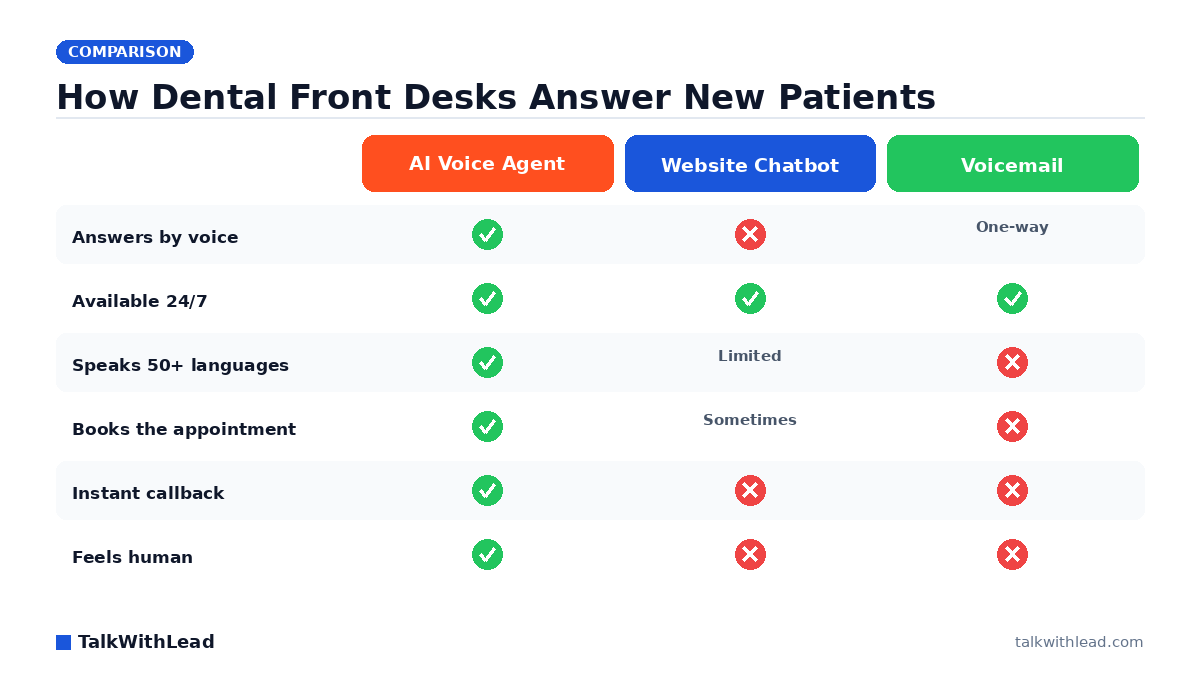
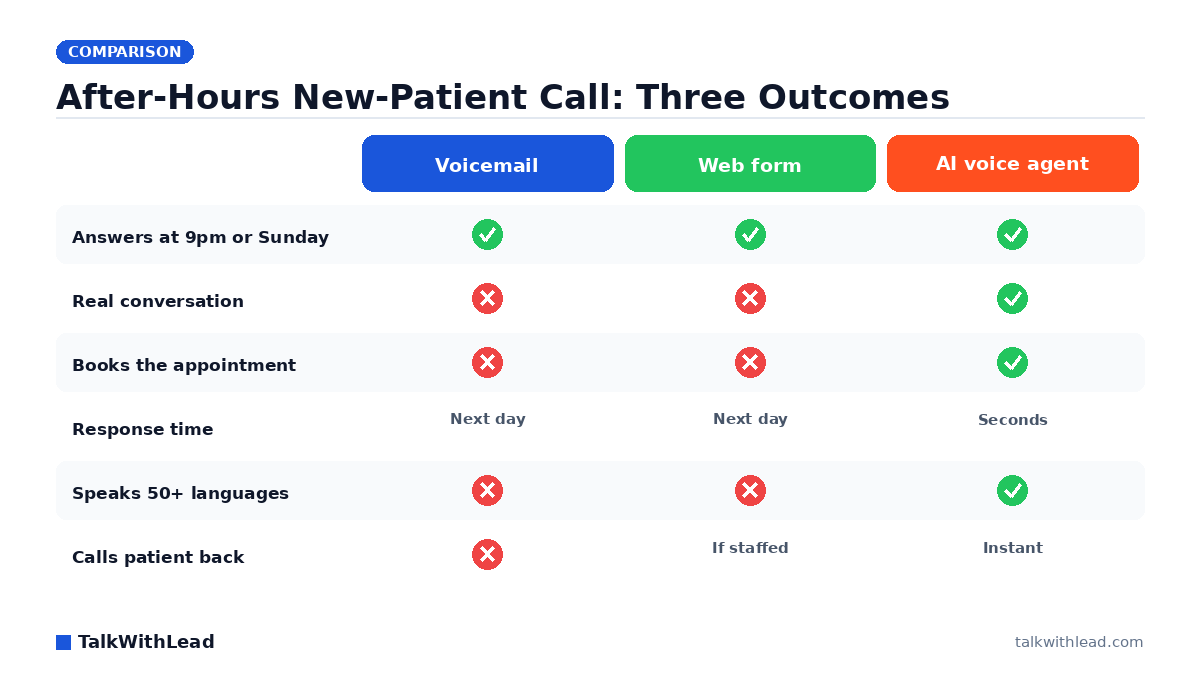
    How Dental Front Desks Answer New Patients — TalkWithLead original infographic (comparison diagram).
    How Dental Front Desks Answer New Patients

    A patient cracks a molar at 8 p.m., searches for a dentist, and lands on your website. If the only options are a contact form or a voicemail box, that patient calls the next practice on the list. The best AI receptionist for dental offices closes that gap by answering the phone in a human-sounding voice the moment a caller reaches out, booking the appointment before a competitor ever picks up.

    Short answer: The best AI receptionist for a dental office is a human-sounding AI voice agent that answers every call and website visitor instantly, 24/7, in the patient’s language, and books or routes the appointment without a form. Voice-first tools like TalkWithLead lead this category because dental patients in pain want to talk, not type into a chatbot.

    Why dental offices need an AI receptionist in the first place

    Dental front desks are busy in a very specific way. The receptionist is checking in one patient, taking payment from another, and answering the phone all at once. New-patient calls land in that chaos, and the ones that go to voicemail rarely call back. Every missed call is a booked cleaning, a crown consult, or an emergency visit walking straight to a competitor.

    An AI receptionist removes the tradeoff. It answers on the first ring during the lunch rush, after hours, and on weekends. It never puts a nervous patient on hold to “grab the schedule.” Picture a practice that fields 40 new-patient calls a week and misses even 8 of them because the desk was slammed. If just 3 of those callers were ready to book a $200 visit, that’s roughly $2,400 a month in production leaving the building unanswered. Run your own numbers with the free missed-call revenue calculator before you assume it’s a rounding error.

    What makes the best AI receptionist for dental offices?

    Not every tool labeled “AI receptionist” does the same job. Chatbots and web forms make the patient type and wait; a voice agent lets them talk. When someone has a throbbing tooth, the difference decides whether they book with you. An Ada study found 59% of consumers prefer instant, 24/7 AI customer service over waiting for a human – but only when the AI can actually resolve their issue. For a dental office, “resolve” means booking the appointment, not reading a script.

    Score any provider on your shortlist against these must-haves:

    • Human-sounding voice. A robotic IVR menu scares patients off. The agent should sound like a warm front-desk person.
    • Instant response, 24/7. After-hours and weekend emergencies are where practices win or lose new patients.
    • 50+ languages. A Spanish-speaking parent booking for a child should get the same smooth experience as an English speaker.
    • Instant callbacks. When a website visitor asks to talk, the agent should ring them in seconds, not “within one business day.”
    • Unlimited long-distance calling. Snowbird patients, referrals from out of state, and traveling families should always reach you.
    • Books, doesn’t just log. The point is a scheduled visit, not a message slip.

    The deeper argument for going voice-first is covered in AI Voice Agent vs Chatbot: Which One Books More Calls?, which walks through why voice converts website traffic that chatbots let leak away.

    The 2026 shortlist: types of AI receptionist to compare

    Rather than rank brand names that change quarterly, compare the four approaches a dental office actually chooses between. Match the type to how your patients contact you.

    ApproachHow patients reach itBest forWeak spot
    AI voice agent (TalkWithLead)Website + phone, live voiceConverting web visitors and after-hours callers into booked visitsComplex clinical questions still route to staff
    Website chatbotText box on the siteFAQ deflection during office hoursPatients in pain won’t type; drop-off is high
    Human answering serviceForwarded phone callsPractices that want live people onlyPer-minute costs climb; limited languages; hold times
    Voicemail / call-back formRecording or web formNothing, honestlyMost callers never leave a message or fill it out

    A voice agent stands out because it works on both the phone line and the website. A visitor reading your “emergency dentist” page can start a real conversation on the spot, and a caller who dials the main number hears the same warm agent. You can watch that flow yourself in a free live demo and hear how human the voice sounds before deciding.

    How much does an AI receptionist for a dental office cost?

    Pricing ranges widely. Human answering services often bill per minute, so a busy month gets expensive fast. AI voice agents usually run on a flat monthly plan, which makes budgeting predictable for a single-location practice. Plainly put: expect a fixed monthly software fee rather than a metered bill that punishes you for being busy.

    Here’s a labeled ROI example, with assumptions stated. Say your practice misses 8 new-patient calls a week, and assume just 1 in 4 of those callers would have booked an average first visit worth $250. That’s 2 booked visits a week recovered, roughly $2,000 a month, against a flat software fee that’s a fraction of that. Even if your recovery rate is lower, the math tilts fast when the tool answers calls you were losing entirely. Check current tiers on the pricing page, then pressure-test the assumptions with the missed-call revenue calculator.

    Best for: A single or multi-location dental practice that misses new-patient calls after hours, during the lunch rush, or in a language the front desk doesn’t speak.

    Not the right fit if: You have full front-desk coverage that already answers every call live on the first ring and never sends a new patient to voicemail.

    Voice-first beats forms and chatbots for patient booking

    The whole point of an AI receptionist is turning interest into a scheduled visit. A form makes the patient do work and wait. A chatbot makes them type symptoms into a box. A voice agent picks up, listens, and books. That difference matters most in dentistry, where urgency and anxiety drive the call.

    The conversational AI space is scaling because businesses see the same thing. Gartner research predicts agentic AI will autonomously resolve 80% of common customer service issues without human intervention by 2029, cutting operational costs by 30%. For a dental office, “common issues” means booking a cleaning, quoting hours, and routing an emergency, which is most of what the front desk phone rings for.

    TalkWithLead puts that human-sounding AI voice agent on your website and phone line, speaking 50+ languages, offering instant callbacks, and backing it with unlimited long-distance calling so a referral three states away gets through. It turns visitors into live phone conversations instead of abandoned forms. Ready to stop losing after-hours patients? Start free with TalkWithLead and put an AI receptionist on your site this week.

    If you want more context on how voice stacks up against the alternatives, see Live Chat vs Chatbot: Pros, Cons, and the AI Voice Upgrade and the vertical breakdown in AI Answering Service Cost for Med Spas, which mirrors the cost logic clinics face.

    FAQ

    What is the best AI receptionist for dental offices?

    The best fit is a human-sounding AI voice agent that answers calls and website visitors instantly, 24/7, in the patient’s language, and books the appointment without a form. TalkWithLead is built for this, converting web visitors and after-hours callers into live phone conversations rather than voicemails.

    Can an AI receptionist book dental appointments on its own?

    Yes. A capable voice agent handles the common requests, booking cleanings, quoting hours, and routing emergencies, while passing genuinely clinical questions to your staff. That covers most of what a dental front desk phone handles day to day.

    Is an AI receptionist better than a chatbot for a dental office?

    For dentistry, yes. Patients in pain want to talk, not type. A chatbot makes them describe symptoms in a text box and often loses them; a voice agent picks up and speaks. See AI Voice Agent vs Chatbot for the full comparison.

    How much does an AI receptionist cost for a dental practice?

    Most AI voice agents run on a flat monthly plan rather than per-minute billing, which keeps costs predictable during busy months. Check the pricing page for current tiers and estimate your return with the missed-call revenue calculator.

    Does an AI receptionist work after hours and on weekends?

    Yes, and that’s where practices gain the most. Emergency and new-patient calls often come in at night and on weekends when the front desk is closed. An AI voice agent answers those calls live so the patient books with you instead of the next practice.

    Can an AI receptionist speak languages other than English?

    A strong voice agent supports 50+ languages, so a Spanish-speaking parent or a multilingual household gets the same smooth booking experience. That widens the pool of new patients your practice can serve without hiring bilingual staff.

  • AI Receptionist for Contractors: 2026 Cost & ROI

    AI Receptionist for Contractors: 2026 Cost & ROI

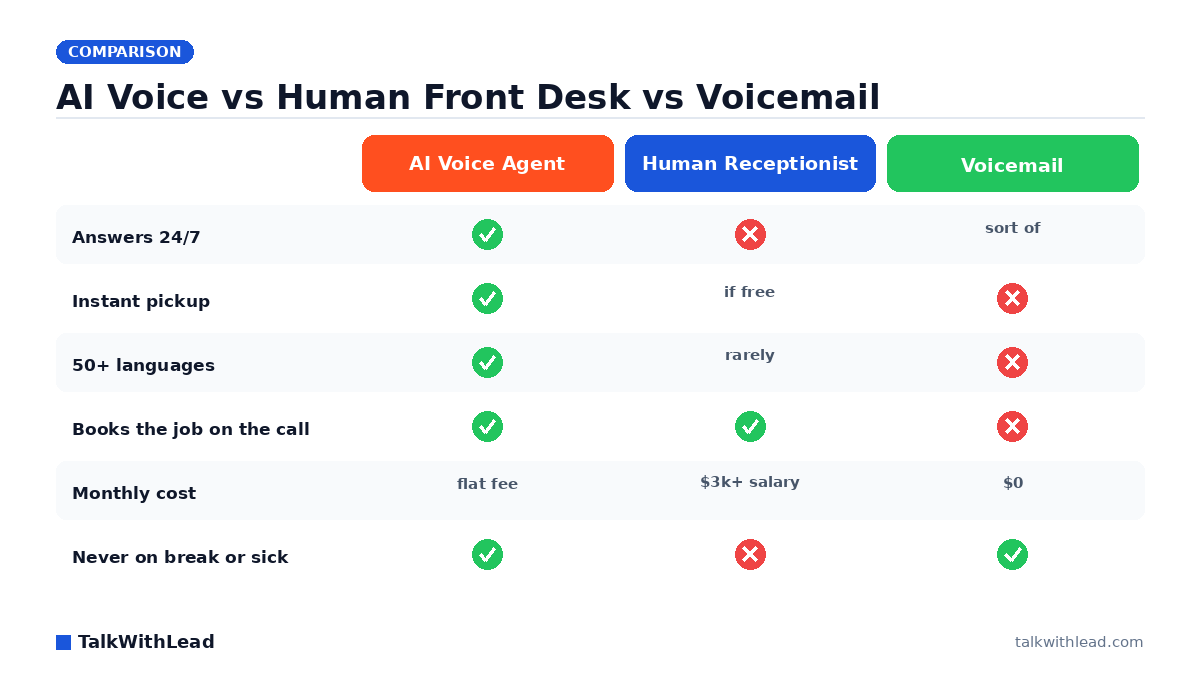
    AI Voice vs Human Front Desk vs Voicemail — TalkWithLead original infographic (comparison diagram).
    AI Voice vs Human Front Desk vs Voicemail

    A homeowner’s water heater just failed. They pull up three contractor websites, call the first, and get voicemail. They call the second and a human-sounding voice picks up on the first ring, asks two questions, and books the visit for tomorrow morning. Guess which contractor wins the job? The ai receptionist for contractors cost question matters, but it’s the wrong first question. The real one is: what are you losing every time a ready-to-hire caller hits your voicemail?

    TL;DR: An AI receptionist for a contracting business usually costs a flat monthly subscription — a fraction of a full-time front-desk salary — and replaces missed calls with instant, human-sounding voice conversations that book jobs 24/7. Whether it pays off comes down to your average job value and how many calls you currently miss: for most contractors, capturing even a couple of extra jobs a month covers the tool many times over.

    How much does an AI receptionist for contractors cost?

    Pricing for AI voice reception is almost always a predictable monthly subscription rather than a per-minute answering-service bill that spikes in your busy season. That flat structure is the point: you know your number before the phone rings. Compare that to the alternatives contractors usually weigh.

    • A full-time receptionist: a real salary plus benefits, plus they clock out at 5 p.m., take lunch, and can’t answer two calls at once during a storm-damage rush.
    • A traditional answering service: often billed per minute or per call, so your invoice climbs exactly when call volume spikes — and the operator reading from a script still can’t book the job in your calendar.
    • Voicemail: technically free, and quietly the most expensive option on this list, because it sends buyers straight to your competitor.

    An AI voice agent sits between those: one flat monthly cost, unlimited pickups, and unlimited long-distance calling so a lead three states away gets the same instant answer as one across town. Want to hear one handle a live call? Try the Live Demo and judge how human it sounds before you spend a dollar. You can see current plans on the pricing page.

    What are you really paying for when a call goes unanswered?

    Here’s the honest framing every contractor should run before comparing subscription tiers. The subscription is small and fixed. The missed-call cost is large and invisible — it never shows up on an invoice, so it’s easy to ignore.

    Picture a remodeler whose average job is worth $9,000. Say even 4 qualified callers a month hit voicemail and never call back because a competitor answered first. That’s not a $99 problem — that’s $36,000 in walked-away revenue in a single month, or over $400,000 a year. Against numbers like that, the question stops being “can I afford an AI receptionist?” and becomes “can I afford to keep missing these calls?”

    The pattern holds across trades. Roofers after a hailstorm, plumbers at 11 p.m., HVAC techs in a July heat wave — the calls you can’t physically answer are often the highest-intent buyers you’ll get all week. An AI voice agent answers all of them at once, in the caller’s language, and hands you a booked appointment instead of a red voicemail badge. To see how this plays out in real dollars for your business, run your own numbers through the free missed-call revenue calculator.

    Why AI voice beats chatbots and web forms for contractors

    Most “lead capture” tools bolted onto contractor websites are chatbots and contact forms. They ask a stressed homeowner to type out their emergency, then promise someone will “get back to you soon.” That’s a slow lane for a fast decision. A person whose basement is flooding doesn’t want to fill out a form — they want to talk to someone right now.

    That preference isn’t a hunch. An Ada study found 59% of consumers prefer instant, 24/7 AI customer service over waiting for a human — but only when the AI can actually resolve their issue. That’s the whole game: instant plus capable. A voice agent that greets the caller, understands the job, and books the slot clears that bar. A chatbot that collects a name and stalls does not.

    Voice also converts because it’s a conversation, not a maze. The AI can ask clarifying questions, quote availability, and offer an instant callback — turning an anonymous website visitor into a real phone conversation on the spot. If you’re weighing the two head-to-head, this breakdown of AI voice agent vs chatbot for booking calls lays out where each one wins, and this look at live chat vs chatbot and the AI voice upgrade shows why typing-based tools leak high-intent leads.

    Best for: contractors who get real inbound call and web volume, miss calls while on the job, and have jobs worth enough that one recovered lead pays for months of service.

    Not the right fit if: you’re fully booked months out, turn away work, and genuinely don’t want more leads — then instant response solves a problem you don’t have.

    An ROI example you can actually check

    Let’s make the math concrete and label it clearly as an illustration, not a customer result. Assume:

    • Average job value: $4,000 (mid-range for many trades)
    • Missed or after-hours calls per month that currently go nowhere: 20
    • Of those, assume a conservative 10% were ready buyers the agent books — that’s 2 jobs

    Two recovered jobs at $4,000 is $8,000 in monthly revenue that used to land in voicemail. Even after subtracting a flat monthly subscription, the return isn’t close — a single booked job typically covers the tool for the better part of a year. Speed is why it works: the faster you respond, the more of those callers you keep, a dynamic spelled out in why the first 60 seconds win most deals. Adjust the inputs to your own averages, because the honest answer is that ROI scales with your job value and your missed-call volume, nothing else.

    This is also where broader adoption context helps. According to Gartner research, agentic AI will autonomously resolve 80% of common customer service issues without human intervention by 2029, cutting operational costs by 30%. Front-desk call handling for contractors — answer, qualify, book — is exactly the kind of repeatable task that shift describes. Getting in now means your phone stops leaking leads while competitors are still deciding.

    What a good AI receptionist should do for a contracting business

    Not all AI voice tools are equal. Before you compare the ai receptionist for contractors cost across vendors, compare capabilities. A strong one for a trades business should:

    • Sound genuinely human — no robotic hold-music voice that makes callers hang up.
    • Answer instantly, 24/7 — nights, weekends, and holidays are when emergency jobs call.
    • Speak 50+ languages — so a Spanish-speaking homeowner gets served, not screened out.
    • Offer instant callbacks — a website visitor clicks, and the phone rings in seconds.
    • Book the job — capture the details and set the appointment, not just take a message.
    • Handle overflow — pick up call two and call three while you’re mid-conversation.

    If you’re vetting providers, it’s worth reading how one stacks up against a common competitor in this Smith.ai alternative breakdown, and if you also run intake-heavy work, the logic in whether an AI receptionist is worth it for a law firm maps closely to how contractors qualify leads. Ready to put one on your own site? You can start with a free signup and have the agent answering your calls fast.

    FAQ

    How much does an AI receptionist for contractors cost per month?

    Most AI voice receptionists charge a flat monthly subscription rather than per-minute answering-service rates, which keeps your cost predictable even during busy season. That’s typically far below a full-time front-desk salary. Check the pricing page for current plan levels.

    Is an AI receptionist worth it for a small contracting business?

    It usually is if you miss calls while on jobs and your average job is worth a few thousand dollars. Recovering even one or two otherwise-lost jobs a month tends to cover the subscription many times over. If you’re already turning work away, the value is smaller.

    Can an AI receptionist actually book appointments, not just take messages?

    A good one does. It qualifies the caller, checks availability, and books the appointment during the same conversation — the difference between capturing a job and leaving a voicemail slip that may never get returned.

    Will callers know they’re talking to AI?

    Modern AI voice agents sound remarkably human and handle natural back-and-forth, so the experience feels like a competent front-desk person. What callers notice most is that someone picked up instantly instead of sending them to voicemail.

    How is an AI voice agent better than a chatbot or contact form?

    Homeowners with an urgent job want to talk, not type. Voice answers instantly, asks clarifying questions, and books the work, while chatbots and forms ask people to describe their emergency and wait. See the full AI voice agent vs chatbot conversion comparison for the details.

    Can it handle Spanish-speaking or multilingual callers?

    Yes. A capable AI voice agent supports 50+ languages, so it can serve callers in their preferred language automatically instead of losing the lead to a language barrier — a real advantage in most local service markets.

  • AI Answering Service Cost for Med Spas: Pricing & ROI

    AI Answering Service Cost for Med Spas: Pricing & ROI

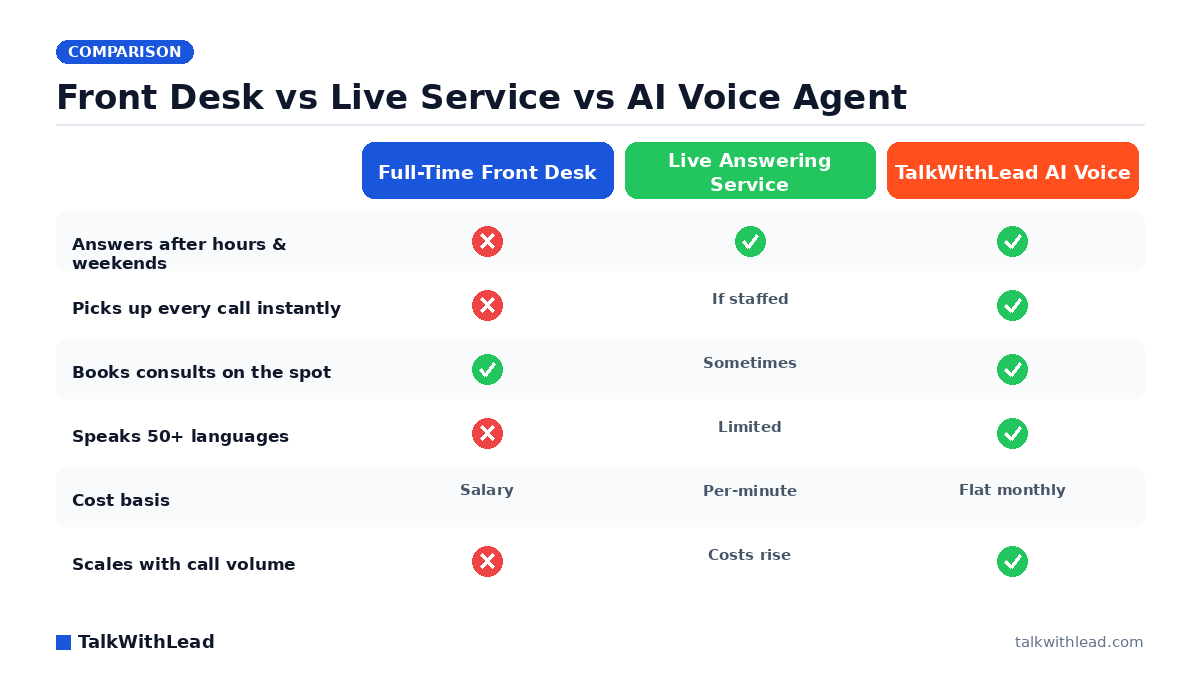
    Front Desk vs Live Service vs AI Voice Agent — TalkWithLead original infographic (comparison diagram).
    Front Desk vs Live Service vs AI Voice Agent

    A prospective client finds your med spa at 8:40 PM, ready to book a Botox consult. She calls, gets voicemail, hangs up, and books with the clinic two miles away that picked up. That single missed call is the real AI answering service cost for med spas question – not the monthly fee, but what every unanswered ring quietly costs you in booked consults.

    TL;DR: An AI answering service for a med spa usually costs a flat monthly subscription – typically a fraction of a full-time receptionist’s salary and often cheaper than per-minute live-agent services once call volume grows. The bigger number is ROI: because an AI voice agent answers every call instantly, 24/7, recovering even one or two consults a month often covers the cost several times over.

    How much does an AI answering service cost for a med spa?

    Pricing for AI answering services generally falls into three buckets. A full-time front-desk hire is the most expensive and only covers business hours. Traditional live answering services charge per minute or per call, so your bill climbs exactly when you get busy. An AI voice agent like TalkWithLead is usually a flat monthly subscription that does not balloon with volume – you can see current options on the pricing page.

    The flat-fee model matters for med spas specifically. Your call volume spikes after a promotion, a local influencer post, or a new-treatment launch. With a per-minute service, a great marketing week becomes a surprise invoice. With an AI voice agent, the same surge costs you nothing extra and every caller still gets a warm, immediate answer.

    Think in terms of value per booking rather than price per minute. If an average med spa client is worth several hundred dollars on the first visit and far more over a year of repeat treatments, the question stops being “what does this cost” and becomes “how many consults does it save.”

    Why missed calls cost more than the service itself

    Med spas live and die by the phone. People researching injectables, laser, or body contouring almost always call before they commit – they want reassurance, pricing, and a human voice. When that call goes to voicemail, most callers do not leave a message. They simply dial the next clinic.

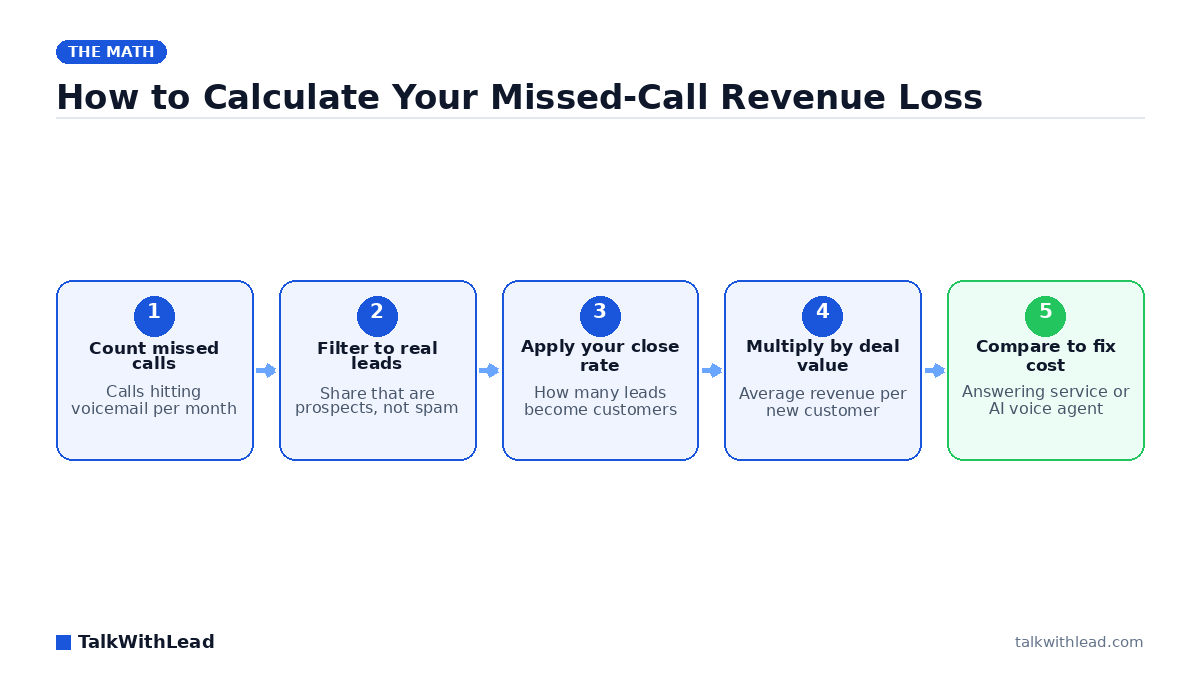
    Picture a spa that gets 200 inbound calls a month and misses just a quarter of them after hours and during back-to-back appointments. Say even 1 in 10 of those missed calls was a ready-to-book client – that is several lost consults every single month, walking straight to a competitor. Run your own version of that math with our free missed-call revenue calculator and the monthly fee usually looks tiny next to the leak.

    Speed is the other half of the story. The faster you respond, the more likely the lead converts – a theme we cover in depth in Speed-to-Lead: Why the First 60 Seconds Win Most Deals. An AI voice agent’s response time is effectively zero, because it answers on the first ring, every time.

    What you actually get with an AI voice agent

    This is not a robotic phone tree. A modern AI voice agent sounds genuinely human, holds a natural back-and-forth conversation, answers common questions about treatments and pricing, and books the consult directly into your flow – no forms, no hold music, no “press 1.” It turns a website visitor or caller into a real phone conversation, which is exactly where med spa clients decide to commit.

    • Always on: evenings, weekends, holidays, and the moments your front desk is mid-treatment.
    • 50+ languages: a Spanish- or Mandarin-speaking caller gets answered in their own language without a transfer.
    • Unlimited long-distance calling: prospects anywhere can reach you, and the agent can call them back instantly.
    • Instant callbacks: a visitor on your site clicks, and the AI rings them in seconds while interest is hot.

    Want to hear how natural it sounds before comparing it to your current setup? Try the live demo and talk to the agent yourself.

    AI voice vs chatbots, forms, and live services

    Med spas have been told for years to add a chatbot or a contact form. The problem is that a person comparing lip filler clinics at 9 PM does not want to type into a widget and wait for an email reply the next morning. They want answers now, in a voice they trust. Voice converts because it matches how med spa buyers actually decide.

    According to an Ada study, 59% of consumers prefer instant, 24/7 AI customer service over waiting for a human – but only when the AI can actually resolve their issue. Booking a consult and answering treatment questions is exactly that kind of resolvable task. We break down the conversion gap further in AI Voice Agent vs Chatbot Conversion Rate and in Live Chat vs Chatbot: Pros, Cons, and the AI Voice Upgrade.

    DimensionFull-time front deskLive answering serviceAI voice agent
    After-hours coverageNoYesYes, always
    Cost basisSalary + benefitsPer minute / per callFlat monthly
    Scales with volumeNeeds more staffBill risesNo extra cost
    Languages1-2 typicallyLimited50+
    Books consult on the callYesSometimesYes

    The ROI math, with stated assumptions

    Here is an illustrative example – plug in your own numbers. Assume your med spa books an average first visit worth $400, and your AI answering service costs a flat monthly fee in the low hundreds. If the agent recovers just two consults a month that would otherwise have gone to voicemail, that is roughly $800 in new revenue against a fee well under that. Net positive in month one, and the gap widens with every repeat-visit client retained.

    Now layer in the bigger market shift. Gartner research predicts agentic AI will autonomously resolve 80% of common customer service issues without human intervention by 2029, cutting operational costs by 30%. The clinics adopting AI voice now are building that cost advantage early instead of paying overtime and missing calls.

    Best for: med spas and clinics losing after-hours and overflow calls, juggling high consult value, or serving multilingual neighborhoods. Not the right fit if: your front desk already answers every call live, books on the spot, and you have no after-hours or weekend inquiry volume to capture.

    If the math points your way, you can start without a sales call on the free signup. The same instant-response logic powers other high-stakes verticals too, like the intake playbook in Missed Call Automation for Websites.

    FAQ

    How much does an AI answering service cost for a med spa?

    Most AI answering services for med spas charge a flat monthly subscription rather than per-minute live-agent rates, which keeps the cost predictable even when call volume spikes. It is typically a fraction of a full-time receptionist’s salary, and you can review current TalkWithLead options on the pricing page.

    Is an AI voice agent worth it for a small med spa?

    For most small med spas, yes – because the cost of missed and after-hours calls usually outweighs the subscription fee. If recovering even one or two consults a month covers the cost, the agent pays for itself, and a small clinic without a 24/7 front desk has the most to gain.

    Will the AI sound robotic to my clients?

    No. A modern AI voice agent holds a natural, human-sounding conversation, answers treatment and pricing questions, and books the consult directly. The fastest way to judge it is to try the live demo and speak with the agent yourself.

    Can it handle calls in other languages?

    Yes. The AI voice agent speaks 50+ languages and responds to each caller in their own language without a transfer, which matters for med spas serving diverse local markets.

    How is this different from a chatbot or contact form?

    Chatbots and forms make a ready-to-book client type and wait, which loses people who want immediate answers. An AI voice agent turns that same visitor into a live phone conversation in seconds. See Callback Widget vs Click-to-Call vs Live Chat for a full comparison of the options.

    What does an AI answering service replace – my front desk?

    It does not have to replace anyone. Most med spas use it to cover the gaps: after hours, weekends, lunch breaks, and the busy stretches when staff are mid-treatment and calls go to voicemail. It captures the revenue that was already leaking out.

Your next lead is on your site right now — ready to talk.

TalkWithLead’s AI voice agent picks up in seconds, qualifies the lead in their language, and books the call before the prospect can open a competitor’s tab. Forms are slow. Chatbots make people type. Voice closes.

Just curious about plans? See pricing →
This is the TalkWithLead Widget. Click to see how it will work on your website!