
In this article
A Mandarin-speaking buyer lands on your listing page at 9:40pm, reads the price in English, and has three questions she’d rather ask out loud in Mandarin: is the school catchment confirmed, is the seller flexible on closing, and can she see it Saturday. Your site offers her a form. She closes the tab and messages an agent from a WeChat group instead. That’s the exact leak ai voice in mandarin for real estate closes.
TL;DR: An AI voice agent on your real estate website answers Mandarin-speaking visitors in Mandarin, out loud, the moment they ask — no form, no typing, no waiting for business hours. It qualifies budget, timeline, and neighbourhood, then connects a warm caller to your agent or books the showing. With 50+ languages and unlimited long-distance calling, an overseas or out-of-province buyer reaches you free.
Why Mandarin-speaking buyers vanish from your funnel
Mandarin buyers are not hard to reach. They are hard to hold. Many browse listings comfortably in English — MLS photos and square footage translate fine — but the decision conversation happens in Mandarin, often with a spouse, a parent, or an investor back home on the call. The instant your site forces that conversation into an English text box, you’ve asked the buyer to negotiate the biggest purchase of their life in their second language.
The other half of the problem is distance. A parent in Shanghai buying a condo for a student in Toronto is not going to dial an international number to ask about parking. Picture a listing page that gets 200 Mandarin-speaking visitors a month and captures a dozen forms. Say even two of those silent visitors were pre-approved and ready — that’s two deals a month leaving through a gap you can’t see in your analytics, because non-conversions don’t fill anything in.
What does an AI voice agent in Mandarin actually do?
It picks up. A visitor taps the widget, speaks in Mandarin, and gets a human-sounding voice back in Mandarin within seconds — not a menu tree, not a canned translation, an actual conversation. The agent covers the questions your team answers forty times a week: price, taxes, condo fees, closing timeline, whether the unit is tenanted, when a showing is available.
From there it does the part that matters to your business. It qualifies — budget range, financing status, purchase timeline, buyer vs. investor — and then either warm-transfers the call to whoever is on duty or books the showing and drops the details to your agent. Because it runs on unlimited long-distance calling, the buyer in Shanghai and the investor in Vancouver both reach you at no cost to them. You can hear it work on the live demo before you decide anything.
The same logic applies across every language your market speaks. We’ve written the parallel playbooks for Spanish-speaking buyers and Hindi-speaking buyers — same mechanism, different market.
Mandarin AI voice vs. chatbot vs. translated form
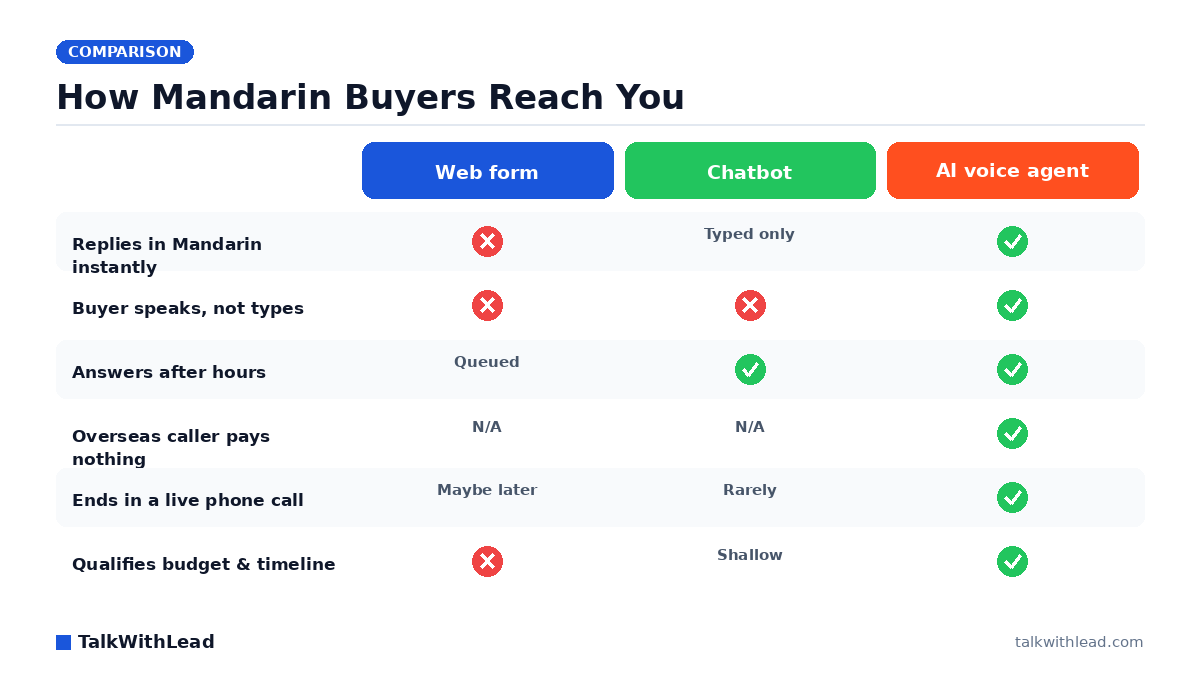
Most brokerages have already tried a fix. A translated contact form. A chatbot with a Mandarin toggle. Both fail for the same reason: they keep the buyer typing, and typing is slow, formal, and easy to abandon at 9:40pm.
| Dimension | Translated web form | Chatbot with Mandarin toggle | AI voice agent (TalkWithLead) |
|---|---|---|---|
| Response speed | Hours to next morning | Instant, but text | Instant, spoken |
| Buyer’s effort | Type 6 fields | Type back and forth | Just talk |
| Handles follow-up questions | No | Scripted, shallow | Open conversation |
| After-hours coverage | Queued | Yes | Yes |
| Overseas caller cost | N/A | N/A | Free (unlimited long distance) |
| Languages supported | Whatever you translated | Usually a handful | 50+ |
| Ends in a live phone call | Maybe, days later | Rarely | Warm transfer or booked showing |
Best for: brokerages and agents whose listing pages already draw Mandarin-speaking traffic — urban condo markets, school-catchment neighbourhoods, student-housing corridors, and pre-construction investor inventory.
Not the right fit if: your Mandarin traffic is negligible, or your team genuinely cannot take a transferred call and has no one to route to. Voice creates conversations; you still need someone to close them. If you’re weighing the general case first, our AI voice agent vs. chatbot for real estate breakdown covers it.
How fast do you actually have to respond?
Faster than you think, and the research is consistent about it. The MIT Lead Response Management study found you’re about 21× more likely to qualify a lead contacted within 5 minutes than one contacted at 30 minutes. According to Harvard Business Review research, companies that reach a web lead within an hour are nearly 7× more likely to qualify it than those that wait even an hour longer.
Now layer language on top. A Mandarin-speaking buyer who submits a form at 9:40pm isn’t just waiting until morning — she’s waiting until morning and hoping whoever calls back speaks Mandarin. Two failure points, both removed when the voice agent answers in Mandarin on the spot. Our deeper piece on speed to lead in real estate walks through the timing math.
An illustrative ROI example (assumptions stated)
This is math, not a case study — plug your own numbers in. Assume a listing site draws 300 Mandarin-speaking visitors a month and currently converts 4% into a form (12 leads). Assume the voice agent lifts spoken engagement to 9% (27 conversations) because the buyer can just talk. Now assume a 20% conversation-to-showing rate and a 17% showing-to-transaction rate: roughly 5 showings and just under one extra deal a month. At an assumed average commission of $12,000, that’s a materially different year — from one widget on one page.
Run your own version against your missed-call volume with the free missed-call revenue calculator. Cost framing: an AI voice agent is a flat monthly software line, typically far below the cost of a bilingual receptionist covering evenings and weekends — see current pricing for exact tiers.
How to roll it out without disrupting your team
Start narrow and prove it. Pick the one listing or neighbourhood page that already draws the most Mandarin traffic and put the voice agent there first.
- Week 1: Install the widget on a single high-traffic page. Set the greeting to detect and offer Mandarin.
- Week 2: Write the qualification script your agents actually use — budget, financing, timeline, buyer vs. investor, preferred showing windows.
- Week 3: Set routing rules. Who takes a warm transfer during the day? Who gets the after-hours booking summary?
- Week 4: Review recordings and transcripts. Fix the two or three questions the agent handled weakly.
- Month 2: Roll it across all listing pages and turn on the additional languages your market speaks.
The measurement that matters isn’t widget clicks. It’s booked showings from Mandarin-speaking callers, and how many of those existed before you installed anything. You can have the whole thing live on a page today — start free, or take the live demo first and hear how the Mandarin voice actually sounds before you commit a dollar.
FAQ
Does the AI voice agent really speak natural Mandarin, or is it translated English?
It speaks conversationally in Mandarin — the visitor talks, the agent responds out loud in Mandarin with a human-sounding voice, and the exchange flows like a phone call rather than a translation layer. The same agent handles 50+ languages, so a Cantonese or Korean speaker on the same page gets the same experience.
Can a buyer in China call my listing without paying international rates?
Yes. Unlimited long-distance calling is part of the platform, so an overseas parent, investor, or relocating buyer connects to you at no cost to them. That removes the single most common reason overseas prospects never dial a North American listing.
What happens when nobody on my team speaks Mandarin?
The AI voice agent handles the Mandarin conversation end to end — questions, qualification, showing preferences — and hands your agent an English summary plus a booked appointment. Your team never has to fake a language they don’t speak, and the buyer never has to switch out of hers.
Is this better than adding a Mandarin option to my chatbot?
For real estate, generally yes. A chatbot still makes the buyer type, in a second language, about a seven-figure decision, and it rarely ends in a phone call. Voice ends in a conversation with a person, which is where showings actually get booked.
How much does an AI voice agent cost for a real estate website?
It’s a flat monthly subscription rather than a per-call or per-minute answering-service bill, and the tiers are published on the pricing page. Compare it against what evening and weekend coverage from a bilingual receptionist would cost you, then weigh it against a single extra closed deal.
Will it work on my existing website without a rebuild?
Yes — it’s a widget you add to your existing site, whether that’s a WordPress blog, an IDX listing platform, or a custom brokerage site. Nothing about your listings, forms, or CRM has to change to test it on one page.
Let’s Turn More Website Visitors Into Sales Conversations
TalkWithLead is the AI voice-first lead-conversion platform behind hundreds of high-intent business websites. See it on your own number in a 15-minute live demo, or spin one up free and have it running before lunch.