
In this article
- What is the difference between an AI voice agent and a chatbot?
- Which one books more calls for a local business?
- How much revenue does the slower option actually cost?
- What about customers who do not speak English — or do not live nearby?
- When is a chatbot still the right call?
- Honest verdict
- How to switch without breaking what already works
- FAQ
A plumber’s website gets a visitor at 8:40pm with a leaking water heater. The chatbot asks for a name and email. The visitor closes the tab and calls the next company on Google. That is the whole argument in one scene.
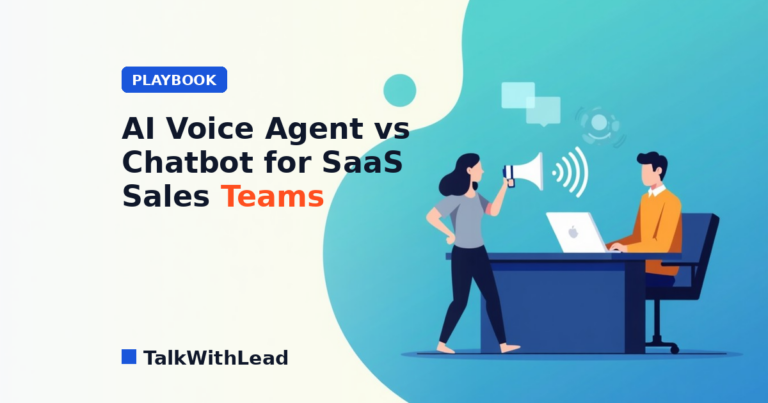
TL;DR: For most local businesses, an AI voice agent beats a chatbot because local buying decisions are urgent and conversational. A chatbot captures text and hands you a lead to call back later; an AI voice agent talks to the visitor immediately, answers questions in a human-sounding voice, and connects them to your business as a live phone conversation. Chatbots still earn their keep for order status and repeat-customer FAQs.
What is the difference between an AI voice agent and a chatbot?
A chatbot is a text interface. The visitor types, waits, reads, types again. Even a good one is a slow-motion version of a conversation, and every extra turn is another chance for the person to give up. A form is worse — it is a chatbot with no replies at all.
An AI voice agent is a voice interface that lives on your site. The visitor clicks, speaks, and hears an extremely human-sounding voice answer back. It asks what they need, handles the qualifying questions a receptionist would ask, and turns the session into a real phone conversation — including an instant callback to their phone if they would rather talk that way. No typing, no queue, no “we’ll get back to you within one business day.”
The distinction matters most for local service businesses, where the buyer usually has a problem right now: a burst pipe, a cracked tooth, an accident, a listing they want to see this weekend.
Which one books more calls for a local business?
Speed decides it. According to Harvard Business Review research, companies that reach a web lead within an hour are nearly 7× more likely to qualify it than those that wait even an hour longer. A chatbot transcript sitting in an inbox until morning is exactly the delay that research describes.
The gap widens because most local businesses cannot answer the phone reliably in the first place. According to a 411 Locals study of 85 small businesses across 58 industries, only 37.8% of incoming calls were answered by a live person — meaning roughly 6 out of 10 calls went unattended. If the phone already leaks that badly, adding a text widget does not plug the hole. Answering the conversation instantly does.
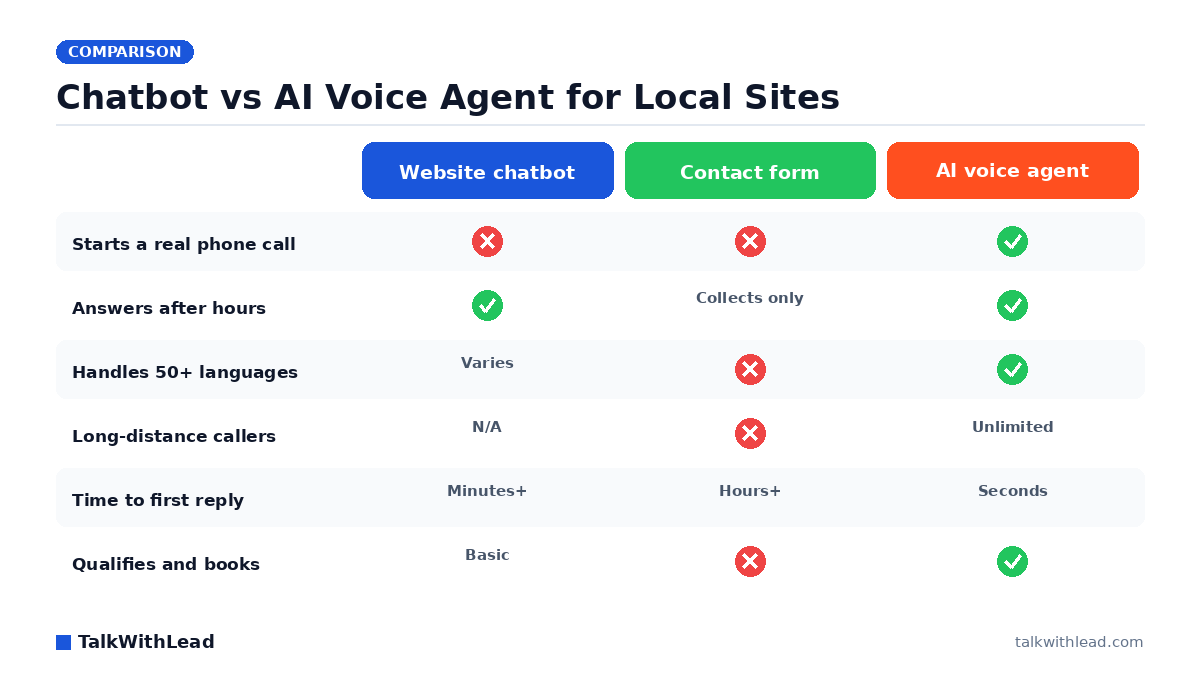
| Dimension | Website chatbot | Contact form | AI voice agent |
|---|---|---|---|
| Interaction mode | Typed text | One-way submission | Spoken conversation |
| Time to first human-quality answer | Minutes to hours | Hours to next business day | Seconds |
| After-hours coverage | Yes, text only | Collects only | Yes, full conversation |
| Languages | Varies by vendor | None | 50+ languages |
| Out-of-area callers | Not applicable | Not applicable | Unlimited long-distance calling |
| Qualifies and books an appointment | Basic scripted flows | No | Yes, conversationally |
| Best use | FAQ and order status | Low-urgency inquiries | New high-value leads |
Want to see the voice side before you commit to anything? Take the Live Demo and talk to the agent the way a customer would. It takes about two minutes, and it settles the argument faster than any comparison chart.
How much revenue does the slower option actually cost?
Here is an illustrative model — your numbers will differ, and the assumptions are stated on purpose. Say a local contractor’s site gets 900 visitors a month and 40 of them start some kind of contact. Assume the chatbot captures 40 typed inquiries but only half get a reply before the person hires someone else, and assume an average job value of $600 with a 25% close rate on reached leads.
- 20 leads reached × 25% close × $600 = $3,000 booked
- The other 20 go cold: $3,000 in assumed lost revenue that month
Now assume voice recovers even half of the cold half — 10 extra conversations, same close rate. That is roughly $1,500 a month recovered under these assumed rates, from traffic already on the site. Plug your own numbers into the free missed-call revenue calculator instead of trusting our example. Cost framing is simple: an AI voice agent generally lands well below the monthly cost of a part-time receptionist, and you can check the current tiers on the pricing page.
What about customers who do not speak English — or do not live nearby?
Two silent leaks hit local businesses harder than owners expect. The first is language. A roofing company in a mixed-language neighbourhood loses every caller who is not confident in English, and a chatbot in one language does nothing to fix that. A voice agent that handles 50+ languages picks up those conversations in the caller’s own words — the same pattern covered in bilingual Spanish answering for contractors.
The second is distance. Out-of-area buyers — a family relocating, an adult child arranging care for a parent, an investor buying a property two provinces away — often will not pay to call, and will not wait on a form. Unlimited long-distance calling removes that friction entirely, which is why voice, languages, and long distance work as a set rather than as separate features.
When is a chatbot still the right call?
Chatbots are not useless. They are just aimed at the wrong moment for most local lead generation. Keep the chatbot when the job is deflection rather than conversion:
- Order and appointment status for existing customers who just want a quick lookup.
- Repetitive policy questions — hours, service area, parking, what to bring to a first visit.
- Silent environments, where the visitor genuinely cannot speak: an open-plan office, a hospital waiting room, a late-night browse next to a sleeping baby.
- High-volume, low-value traffic where a human callback would not pay for itself.
The strongest setup for most local sites is both, aimed correctly: voice as the primary path for new business, text as the fallback for logistics. If you want the deeper head-to-head on conversion behaviour, read AI voice agent vs chatbot conversion rate.
Honest verdict
Best for: local service businesses — contractors, clinics, law firms, real estate agents, med spas, home services — where a single new customer is worth hundreds or thousands of dollars, the buyer is usually in a hurry, and nobody can watch the phone all day.
Not the right fit if: your visitors are mostly existing customers checking order status, your average order value is small enough that a live conversation costs more than it returns, or your audience genuinely prefers async text (some support-heavy software products fit here). In those cases a well-built chatbot is the cheaper, correct tool.
How to switch without breaking what already works
You do not have to rip anything out. Add the voice agent to the pages where high-intent visitors land — service pages, pricing, contact — and leave the chatbot on support and account pages. Watch which one produces booked conversations over two or three weeks and reallocate from there. Local businesses that have already run this play tend to follow the pattern described in this chatbot alternative guide.
Three things worth setting up on day one: an instant-callback option so hesitant visitors can be called back on their own phone, after-hours coverage so evening and weekend traffic is not wasted, and a short qualifying script so the agent captures the details your team actually needs before the call is handed over.
If the goal is more calls, more qualified leads, and more sales conversations from traffic you are already paying for, start with the Live Demo, then create your free account and put the voice agent on your busiest page this week.
FAQ
Is an AI voice agent better than a chatbot for a small local business?
For generating new business, yes in most cases. Local buyers usually have an urgent problem and want to talk to someone now, and a voice agent starts that conversation in seconds instead of collecting text you answer later. A chatbot remains useful for status checks and repeat FAQs.
Does an AI voice agent replace my receptionist?
It covers the hours and overflow your receptionist cannot — evenings, weekends, lunch breaks, and the moments when everyone is already on a call. Most businesses run both, with the agent catching what would otherwise ring out.
Will website visitors actually talk to an AI voice agent?
Many will, because the agent sounds human and answers instantly, which is what they wanted from the phone in the first place. For visitors who cannot speak right then, an instant callback lets them pick the moment instead of abandoning the site.
What languages can an AI voice agent handle?
TalkWithLead’s agent converses in 50+ languages, so a caller who is more comfortable in Spanish, French, Punjabi, or Mandarin gets the same quality of conversation as an English speaker without you hiring for each language.
How much does an AI voice agent cost compared to a chatbot?
Chatbots are often cheaper per month, but they are priced against a different outcome — deflected questions, not booked jobs. The honest comparison is cost per booked conversation, and current plans are listed on the pricing page.
Can I keep my chatbot and add a voice agent?
Yes, and that is usually the smartest first move. Put voice on high-intent pages, leave the chatbot on support and account pages, and compare booked conversations from each over a few weeks before changing anything else.
Let’s Turn More Website Visitors Into Sales Conversations
TalkWithLead is the AI voice-first lead-conversion platform behind hundreds of high-intent business websites. See it on your own number in a 15-minute live demo, or spin one up free and have it running before lunch.