
In this article
- Why your chatbot is quietly costing you calls
- What is the best chatbot alternative for a small business website?
- Chatbot vs form vs AI voice agent: a side-by-side
- How fast do you actually have to respond?
- Where chatbots genuinely lose service buyers
- Honest verdict: is an AI voice agent right for you?
- What it costs, and how to think about payback
- FAQ
Why your chatbot is quietly costing you calls
A homeowner with a flooded basement does not want to type. A person comparing law firms at 9pm does not want a drip of scripted bubbles. They want somebody on the phone, right now — and the moment your bot asks for an email instead, they open the next tab. That is the real case for a chatbot alternative for small business websites.
TL;DR: The best chatbot alternative for a small service business is an AI voice agent that offers the visitor an instant callback and holds a real spoken conversation — answering questions, qualifying the job, and booking the appointment while the visitor is still on the page. Chatbots collect text and hand you a lead to chase later; voice closes the gap between interest and conversation to seconds.
Chatbots are not useless. They are just aimed at the wrong job. They were built for support deflection at companies with thousands of repeat questions. Service businesses have the opposite problem: low volume, high value, and a buyer who decides in minutes.
What is the best chatbot alternative for a small business website?
An AI voice agent. Instead of a text widget, the visitor sees an offer to talk. They enter a number (or click to connect), and a human-sounding AI voice agent calls them within seconds — greets them by business name, asks what they need, answers pricing and availability questions, and books the appointment or hands off to your team.
The mechanics matter more than the label. Three things separate voice from every text-based widget:
- It initiates. Nobody waits for a callback that arrives days later. The call fires while the tab is still open.
- It absorbs mess. “I’ve got a leak under the sink but I rent, does that change anything?” breaks a decision tree. It does not break a conversation.
- It removes friction the buyer never mentions. 50+ languages, so a Spanish-speaking caller is not filtered out by an English-only form. Unlimited long-distance calling, so a lead two provinces away is worth the same as one down the street.
Curious what it sounds like before you read another word? Try the live demo and have the agent call you.
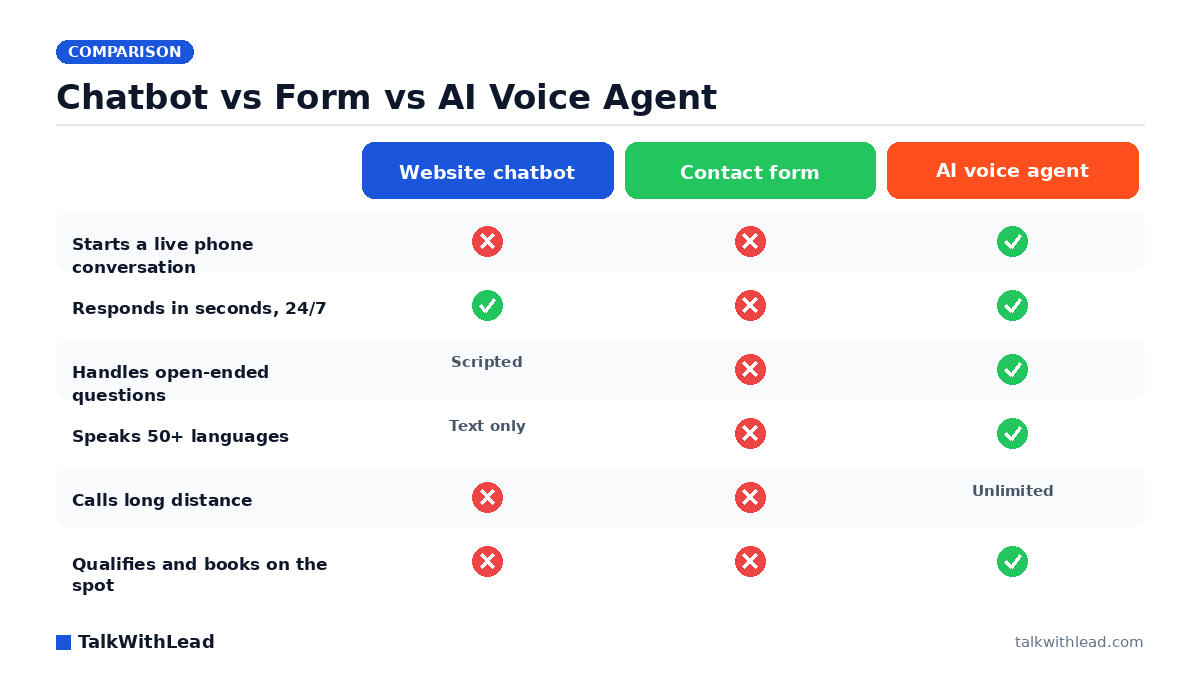
Chatbot vs form vs AI voice agent: a side-by-side
| Dimension | Website chatbot | Contact form | AI voice agent |
|---|---|---|---|
| Time to real conversation | Minutes to hours | Hours to days | Seconds |
| Channel | Text | Live phone call | |
| Handles off-script questions | Poorly | Not at all | Yes |
| After-hours coverage | Yes | Collects only | Yes, answers and books |
| Language coverage | Text translation | None | 50+ spoken languages |
| Long-distance leads | N/A | N/A | Unlimited calling |
| Best job | Existing-customer support | Low-intent inquiries | Converting new buyers |
Read that middle row again. For a service business, “handles off-script questions” is most of the conversation. Buyers ask about their specific driveway, their specific custody case, their specific insurance. A bot that can only route to five intents sends them to a form — which is where the lead goes cold. We broke the underlying conversion mechanics down further in AI Voice Agent vs Chatbot Conversion Rate.
How fast do you actually have to respond?
Faster than feels reasonable. The MIT Lead Response Management study found you’re about 21× more likely to qualify a lead contacted within 5 minutes than one contacted at 30 minutes. And research popularized by InsideSales / Dr. James Oldroyd found that roughly 35-50% of sales go to the company that responds first.
Now compare that to how a chatbot lead actually moves through a small business. Visitor types a question at 7:40pm. Bot captures a name and email. The transcript lands in an inbox. Somebody sees it at 9:15 the next morning and calls at 11. That is roughly fifteen hours — and in a competitive service category the buyer has already spoken to two other companies.
Here is illustrative math, with the assumptions stated plainly. Say your site gets 900 visitors a month and 3% show real buying intent — that’s 27 potential conversations. Imagine your chatbot converts a third of those into typed leads (9), and you reach half of them by phone before they hire someone else (roughly 4-5 conversations). If a voice agent instead put even 15 of those 27 straight onto a live call, you’d triple your conversation count without adding a single visitor. Plug your own numbers into the missed-call revenue calculator rather than trusting mine.
Where chatbots genuinely lose service buyers
Four failure points show up again and again on service-business sites:
- The typing tax. Someone on a phone, one-handed, in a parking lot, will not type six lines describing their problem. They’ll call a competitor who has a number in the header.
- The script wall. Every scripted bot has a boundary. Hit it and the buyer gets “Let me connect you with someone” — which means a form.
- The language filter. A text bot in English silently excludes anybody who’d rather explain the problem out loud in their own language. You never see those lost leads in analytics.
- No qualification. A transcript tells you someone asked about pricing. A call tells you it’s a 3-bedroom re-roof, insurance claim, needed in two weeks.
Voice fixes all four at once because it changes the medium, not just the model. That is also why swapping one chatbot vendor for a smarter chatbot vendor rarely moves booked jobs. We covered the same trade-off from the chat side in Live Chat vs Chatbot: Pros, Cons, and the AI Voice Upgrade.
Honest verdict: is an AI voice agent right for you?
Best for: service businesses where a single new customer is worth hundreds or thousands of dollars and the sale starts with a phone conversation — contractors, clinics, law firms, agencies, real estate, insurance, home services. If your team already tries to call every web lead and keeps losing on speed, this is the fix.
Not the right fit if: your product is self-serve and low-ticket, your buyers deliberately avoid the phone, or most of your inbound volume is existing customers asking “where’s my order?” Keep a chatbot or a help center for those. Voice earns its keep on new revenue, not on support deflection.
Plenty of businesses run both: chat on the docs and support pages, voice on the homepage, service pages, and pricing page where buying decisions happen. That split usually beats picking a side.
What it costs, and how to think about payback
Plans are published openly — see TalkWithLead pricing — and land in the range of a modest monthly software subscription rather than a per-minute answering-service bill that scales with your busy season. For a broader cost frame, the AI receptionist vs human answering service cost comparison lays out both models.
The payback question is simpler than it looks. Take your average job value, decide how many extra booked jobs a month would cover the subscription, and ask whether catching the buyers your chatbot currently hands to a form gets you there. For a roofer at a $9,000 average job, one recovered job a year likely pays for several years of the tool. For a clinic at $180 a visit, the number of recovered bookings has to be higher — so run your own math instead of accepting the headline.
Setup is the part people overestimate. The widget drops onto WordPress or any site, the agent gets your services, hours, and service area, and it starts calling visitors. You can start free and watch it handle real traffic before you change anything else, or hear the voice agent first if you want proof before signup.
FAQ
What is the best chatbot alternative for a small business website?
An AI voice agent that calls website visitors within seconds and holds a spoken conversation. It replaces the typing-and-waiting loop of a chatbot with an actual phone call, which is how most service buyers prefer to make a decision.
The practical test: if your revenue depends on booked appointments rather than answered support tickets, voice is the better fit.
Are chatbots bad for service businesses?
Not bad — mismatched. Chatbots excel at deflecting repeat support questions for companies with high ticket volume. Service businesses have fewer, higher-value inquiries where speed to a live conversation decides who wins the job, and a text widget adds a step instead of removing one.
Can an AI voice agent replace my receptionist?
It can cover what a receptionist cannot: nights, weekends, lunch breaks, and every simultaneous caller during a busy stretch. Most small teams use it as first response — it answers, qualifies, and books, then routes anything complicated to a human.
What happens if the visitor doesn’t speak English?
The agent handles conversations in 50+ languages, so a caller can explain the problem in whatever language they’re comfortable with. Unlimited long-distance calling means a lead outside your local area code costs you nothing extra to reach.
How fast does the callback actually happen?
Seconds after the visitor requests it, while they’re still on your site. That timing is the whole point — the MIT lead-response research above shows how sharply qualification odds drop between the 5-minute mark and the 30-minute mark.
Do I have to remove my chatbot to use a voice agent?
No. A common setup keeps chat on support and documentation pages while voice runs on the homepage, service pages, and pricing page. Chat serves existing customers; voice converts new ones.
Let’s Turn More Website Visitors Into Sales Conversations
TalkWithLead is the AI voice-first lead-conversion platform behind hundreds of high-intent business websites. See it on your own number in a 15-minute live demo, or spin one up free and have it running before lunch.