TalkWithLead
AI Voice-First Lead Conversion

AI Voice Agents That Turn Website Visitors Into Real Conversations

TalkWithLead is the AI voice-first widget that picks up the phone the moment a visitor lands on your site. Multilingual, extremely human-sounding, with unlimited long-distance calling so prospects anywhere can call you back. More calls. More leads. More closed deals.

Extremely human-sounding voice 50+ languages out of the box Unlimited long-distance calling Instant callback widget

Tag: lead conversion

  • Chatbot Alternative for Small Business: For General Sites

    Chatbot Alternative for Small Business: For General Sites

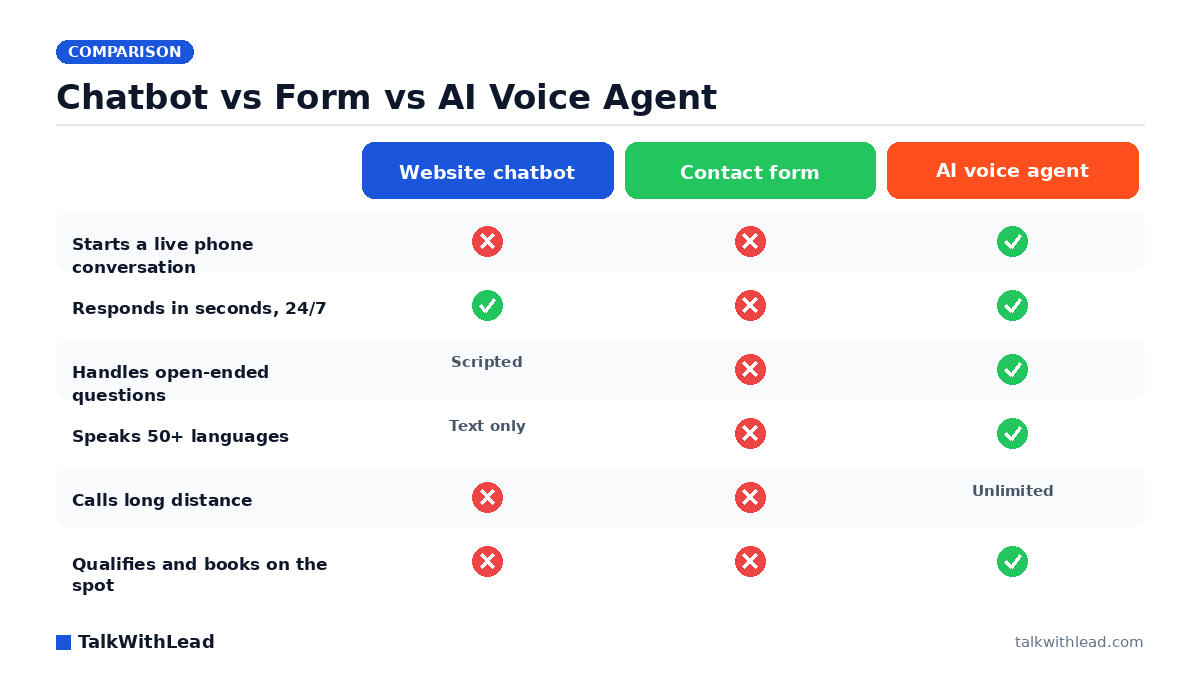
    Chatbot vs Form vs AI Voice Agent — TalkWithLead original infographic (comparison diagram).
    Chatbot vs Form vs AI Voice Agent

    Why your chatbot is quietly costing you calls

    A homeowner with a flooded basement does not want to type. A person comparing law firms at 9pm does not want a drip of scripted bubbles. They want somebody on the phone, right now — and the moment your bot asks for an email instead, they open the next tab. That is the real case for a chatbot alternative for small business websites.

    TL;DR: The best chatbot alternative for a small service business is an AI voice agent that offers the visitor an instant callback and holds a real spoken conversation — answering questions, qualifying the job, and booking the appointment while the visitor is still on the page. Chatbots collect text and hand you a lead to chase later; voice closes the gap between interest and conversation to seconds.

    Chatbots are not useless. They are just aimed at the wrong job. They were built for support deflection at companies with thousands of repeat questions. Service businesses have the opposite problem: low volume, high value, and a buyer who decides in minutes.

    What is the best chatbot alternative for a small business website?

    An AI voice agent. Instead of a text widget, the visitor sees an offer to talk. They enter a number (or click to connect), and a human-sounding AI voice agent calls them within seconds — greets them by business name, asks what they need, answers pricing and availability questions, and books the appointment or hands off to your team.

    The mechanics matter more than the label. Three things separate voice from every text-based widget:

    • It initiates. Nobody waits for a callback that arrives days later. The call fires while the tab is still open.
    • It absorbs mess. “I’ve got a leak under the sink but I rent, does that change anything?” breaks a decision tree. It does not break a conversation.
    • It removes friction the buyer never mentions. 50+ languages, so a Spanish-speaking caller is not filtered out by an English-only form. Unlimited long-distance calling, so a lead two provinces away is worth the same as one down the street.

    Curious what it sounds like before you read another word? Try the live demo and have the agent call you.

    Chatbot vs form vs AI voice agent: a side-by-side

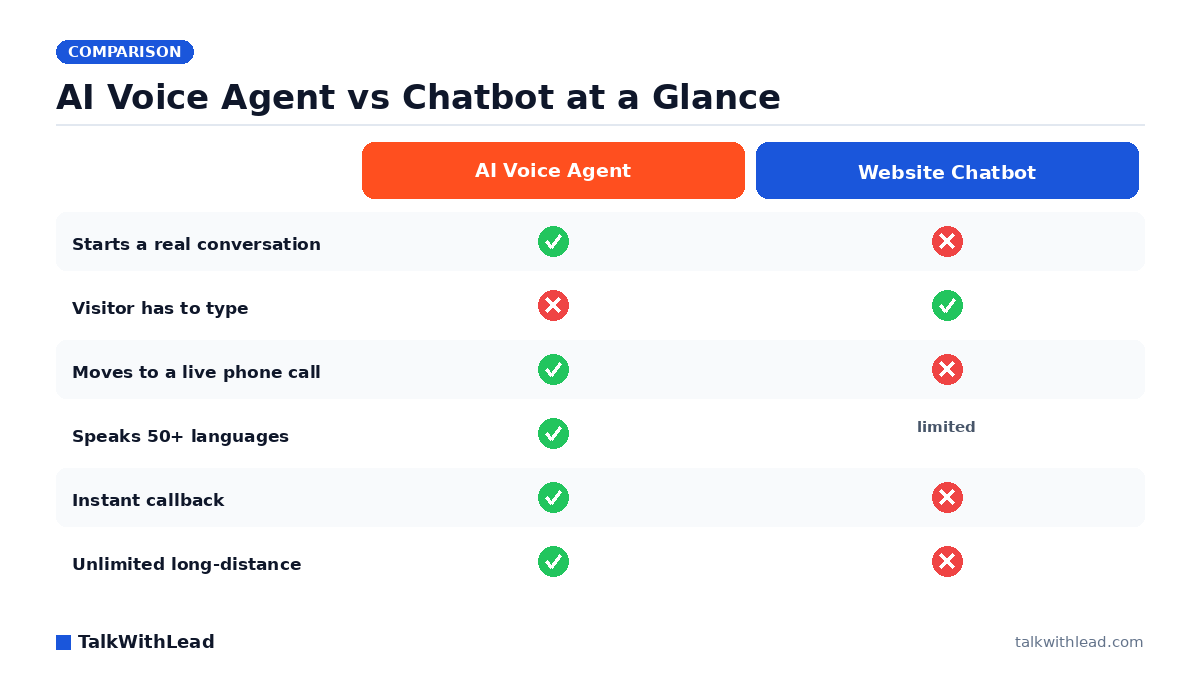
    DimensionWebsite chatbotContact formAI voice agent
    Time to real conversationMinutes to hoursHours to daysSeconds
    ChannelTextEmailLive phone call
    Handles off-script questionsPoorlyNot at allYes
    After-hours coverageYesCollects onlyYes, answers and books
    Language coverageText translationNone50+ spoken languages
    Long-distance leadsN/AN/AUnlimited calling
    Best jobExisting-customer supportLow-intent inquiriesConverting new buyers

    Read that middle row again. For a service business, “handles off-script questions” is most of the conversation. Buyers ask about their specific driveway, their specific custody case, their specific insurance. A bot that can only route to five intents sends them to a form — which is where the lead goes cold. We broke the underlying conversion mechanics down further in AI Voice Agent vs Chatbot Conversion Rate.

    How fast do you actually have to respond?

    Faster than feels reasonable. The MIT Lead Response Management study found you’re about 21× more likely to qualify a lead contacted within 5 minutes than one contacted at 30 minutes. And research popularized by InsideSales / Dr. James Oldroyd found that roughly 35-50% of sales go to the company that responds first.

    Now compare that to how a chatbot lead actually moves through a small business. Visitor types a question at 7:40pm. Bot captures a name and email. The transcript lands in an inbox. Somebody sees it at 9:15 the next morning and calls at 11. That is roughly fifteen hours — and in a competitive service category the buyer has already spoken to two other companies.

    Here is illustrative math, with the assumptions stated plainly. Say your site gets 900 visitors a month and 3% show real buying intent — that’s 27 potential conversations. Imagine your chatbot converts a third of those into typed leads (9), and you reach half of them by phone before they hire someone else (roughly 4-5 conversations). If a voice agent instead put even 15 of those 27 straight onto a live call, you’d triple your conversation count without adding a single visitor. Plug your own numbers into the missed-call revenue calculator rather than trusting mine.

    Where chatbots genuinely lose service buyers

    Four failure points show up again and again on service-business sites:

    1. The typing tax. Someone on a phone, one-handed, in a parking lot, will not type six lines describing their problem. They’ll call a competitor who has a number in the header.
    2. The script wall. Every scripted bot has a boundary. Hit it and the buyer gets “Let me connect you with someone” — which means a form.
    3. The language filter. A text bot in English silently excludes anybody who’d rather explain the problem out loud in their own language. You never see those lost leads in analytics.
    4. No qualification. A transcript tells you someone asked about pricing. A call tells you it’s a 3-bedroom re-roof, insurance claim, needed in two weeks.

    Voice fixes all four at once because it changes the medium, not just the model. That is also why swapping one chatbot vendor for a smarter chatbot vendor rarely moves booked jobs. We covered the same trade-off from the chat side in Live Chat vs Chatbot: Pros, Cons, and the AI Voice Upgrade.

    Honest verdict: is an AI voice agent right for you?

    Best for: service businesses where a single new customer is worth hundreds or thousands of dollars and the sale starts with a phone conversation — contractors, clinics, law firms, agencies, real estate, insurance, home services. If your team already tries to call every web lead and keeps losing on speed, this is the fix.

    Not the right fit if: your product is self-serve and low-ticket, your buyers deliberately avoid the phone, or most of your inbound volume is existing customers asking “where’s my order?” Keep a chatbot or a help center for those. Voice earns its keep on new revenue, not on support deflection.

    Plenty of businesses run both: chat on the docs and support pages, voice on the homepage, service pages, and pricing page where buying decisions happen. That split usually beats picking a side.

    What it costs, and how to think about payback

    Plans are published openly — see TalkWithLead pricing — and land in the range of a modest monthly software subscription rather than a per-minute answering-service bill that scales with your busy season. For a broader cost frame, the AI receptionist vs human answering service cost comparison lays out both models.

    The payback question is simpler than it looks. Take your average job value, decide how many extra booked jobs a month would cover the subscription, and ask whether catching the buyers your chatbot currently hands to a form gets you there. For a roofer at a $9,000 average job, one recovered job a year likely pays for several years of the tool. For a clinic at $180 a visit, the number of recovered bookings has to be higher — so run your own math instead of accepting the headline.

    Setup is the part people overestimate. The widget drops onto WordPress or any site, the agent gets your services, hours, and service area, and it starts calling visitors. You can start free and watch it handle real traffic before you change anything else, or hear the voice agent first if you want proof before signup.

    FAQ

    What is the best chatbot alternative for a small business website?

    An AI voice agent that calls website visitors within seconds and holds a spoken conversation. It replaces the typing-and-waiting loop of a chatbot with an actual phone call, which is how most service buyers prefer to make a decision.

    The practical test: if your revenue depends on booked appointments rather than answered support tickets, voice is the better fit.

    Are chatbots bad for service businesses?

    Not bad — mismatched. Chatbots excel at deflecting repeat support questions for companies with high ticket volume. Service businesses have fewer, higher-value inquiries where speed to a live conversation decides who wins the job, and a text widget adds a step instead of removing one.

    Can an AI voice agent replace my receptionist?

    It can cover what a receptionist cannot: nights, weekends, lunch breaks, and every simultaneous caller during a busy stretch. Most small teams use it as first response — it answers, qualifies, and books, then routes anything complicated to a human.

    What happens if the visitor doesn’t speak English?

    The agent handles conversations in 50+ languages, so a caller can explain the problem in whatever language they’re comfortable with. Unlimited long-distance calling means a lead outside your local area code costs you nothing extra to reach.

    How fast does the callback actually happen?

    Seconds after the visitor requests it, while they’re still on your site. That timing is the whole point — the MIT lead-response research above shows how sharply qualification odds drop between the 5-minute mark and the 30-minute mark.

    Do I have to remove my chatbot to use a voice agent?

    No. A common setup keeps chat on support and documentation pages while voice runs on the homepage, service pages, and pricing page. Chat serves existing customers; voice converts new ones.
  • Best AI Voice Agent for Small Business: General Buyer’s Guide

    Best AI Voice Agent for Small Business: General Buyer’s Guide

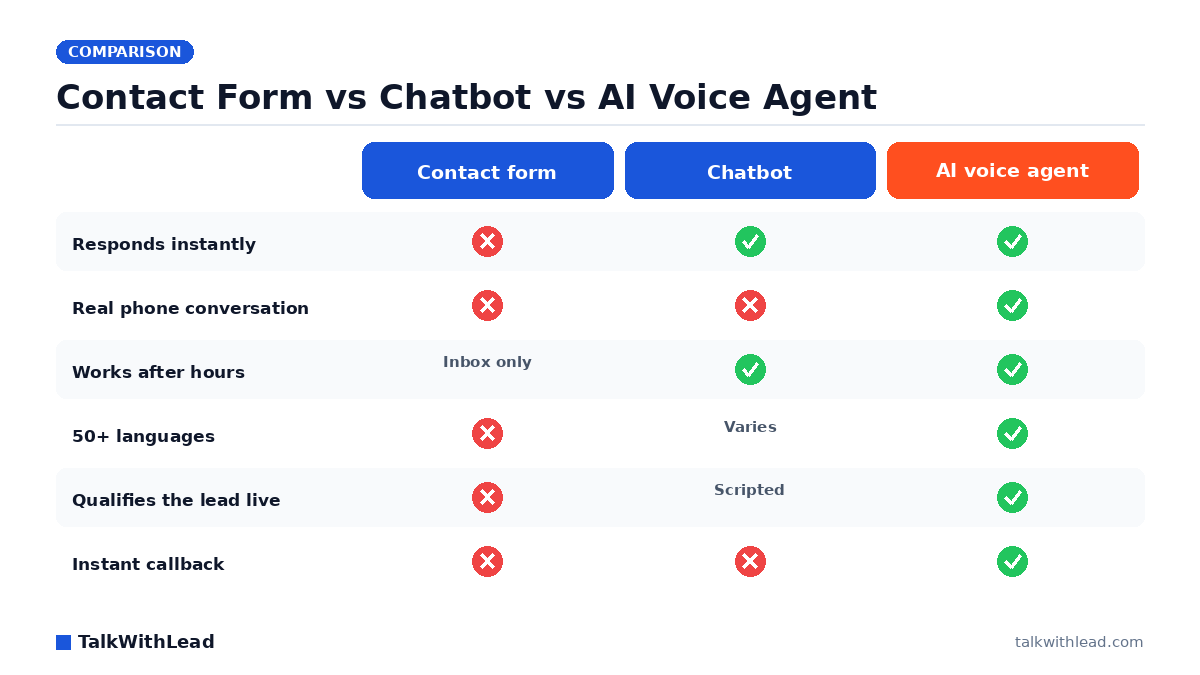
    Contact Form vs Chatbot vs AI Voice Agent — TalkWithLead original infographic (comparison diagram).
    Contact Form vs Chatbot vs AI Voice Agent

    What an AI voice agent actually does for a small business

    Most small business websites lose their hottest leads in the quiet minutes after a visitor decides they’re interested. The visitor has a question, sees a contact form or a sluggish chatbot, and leaves to call a competitor instead. The best AI voice agent for small business closes that gap: it talks to visitors the moment they want to talk, sounds convincingly human, and turns browsing into a real phone conversation.

    TL;DR: An AI voice agent is software that answers your website visitors and callers by voice — instantly, 24/7, in 50+ languages — qualifies them, answers questions, and connects them to you through instant callbacks or unlimited long-distance calls. For a typical small business, it costs a flat monthly subscription (low-to-mid hundreds of dollars) and pays for itself if it rescues even a handful of missed leads per month.

    Concretely, a good AI voice agent sits on your website as a small widget. A visitor clicks it, speaks naturally, and the agent handles the conversation: what the visitor needs, when they need it, whether they’re a fit, and how to reach them. It can trigger an instant callback to the visitor’s phone, so the conversation continues on a real line — no typing, no waiting on a form reply that arrives tomorrow. That speed matters more than almost anything else you can buy. According to Harvard Business Review research, companies that reach a web lead within an hour are nearly 7× more likely to qualify it than those that wait even an hour longer. An AI voice agent responds in seconds, every time, including at 9pm on a Sunday.

    How much does an AI voice agent cost for a small business?

    Plain answer: most small businesses should budget a flat monthly software subscription — typically in the low-to-mid hundreds of dollars per month — rather than the per-minute or per-call billing that human answering services use. Flat pricing matters because your best months (lots of calls) are exactly when per-minute billing punishes you. You can see TalkWithLead’s current pricing here.

    Here’s a labeled example so you can sanity-check the math for your own numbers. This is an illustration with assumed rates, not a customer result. Say your average new customer is worth $600, and your website plus phone lines currently produce 40 inquiries a month. Imagine even 1 in 4 of those inquiries arrives when nobody can respond quickly — that’s 10 leads a month going cold. If a voice agent converts just 3 of those 10 into real conversations and you close one, that single rescued customer covers a typical monthly subscription with room to spare. Run your own numbers in the free missed-call revenue calculator — it takes about a minute and uses your inputs, not ours.

    The cost of doing nothing is the number most owners underestimate. According to a 411 Locals study of 85 small businesses across 58 industries, only 37.8% of incoming calls were answered by a live person — meaning roughly 6 out of 10 calls went unattended. Every one of those unanswered moments is a buyer who was ready to talk.

    AI voice agent vs chatbot vs contact form: which one converts?

    Forms and chatbots both make the visitor do the work. A form asks them to type, submit, and wait. A chatbot asks them to type into a script that usually ends with “someone will get back to you.” A voice agent flips it: the visitor just talks, the way they would with a great front-desk person, and the conversation moves toward a booked call while their intent is at its peak.

    DimensionContact formChatbotAI voice agent
    Response speedHours to daysInstant, but text-onlyInstant, spoken
    Effort for the visitorHigh (typing, waiting)Medium (typing, menus)Low (just talk)
    Ends in a phone conversationRarelyRarelyYes — instant callback or live call
    LanguagesWhatever you wroteLimited, often stilted50+ languages, natural voice
    After-hours coverageInbox pile-upScripted answersFull conversations, 24/7
    Long-distance prospectsN/AN/AUnlimited long-distance calling

    If you want the deeper head-to-head, read AI Voice Agent vs Chatbot: Which One Books More Calls? The short version: text tools capture contact details; voice tools create sales conversations. Small businesses don’t close deals from a lead list — they close them on the phone.

    Want to hear it rather than read about it? Try the live demo — talk to the agent yourself and judge whether it sounds human enough to represent your business.

    What to avoid when choosing an AI voice agent

    The category is crowded, and some products wearing the “AI voice” label will disappoint you. Watch for these traps:

    • Message-takers in disguise. If the agent’s endgame is “I’ll pass along your message,” you’ve bought a voicemail box with better manners. Insist on instant callbacks and live call connection.
    • English-only agents. If your market includes Spanish-speaking homeowners, international students, or overseas buyers, an English-only agent silently drops them. Look for genuine multilingual conversation — 50+ languages, not a translation widget.
    • Robot voices. Callers hang up on anything that sounds synthetic. Test the voice yourself before you commit; if you can tell it’s a machine in the first two sentences, so can your prospects.
    • Per-minute pricing surprises. Usage-based billing turns your best month into your biggest invoice. Prefer flat, predictable pricing.
    • Chatbots with a voice bolted on. A decision tree that reads its menus aloud is not a voice agent. The tell: it can’t handle a question that isn’t in its script.
    • No path from website to phone. The whole point is converting web visitors into phone conversations. If the tool only answers inbound calls and ignores your website traffic, you’re solving half the problem.

    Speed is the other silent killer. Even a great tool loses if it responds slowly — the physics of lead response are unforgiving, as we break down in Speed-to-Lead: Why the First 60 Seconds Win Most Deals. And if your phones already ring more than your team can answer, start with missed call automation for websites — it’s the fastest leak to plug.

    Is an AI voice agent worth it for your small business?

    Best for: service businesses, local firms, and small teams whose revenue depends on inbound inquiries — contractors, law firms, clinics, real estate agents, agencies — especially if calls come in after hours, in multiple languages, or faster than the team can answer.

    Not the right fit if: your business gets only a trickle of inquiries and you personally answer every one within minutes, or your sales happen entirely through e-commerce checkout with no conversation involved. In those cases, keep your money.

    For everyone else, the decision comes down to one honest question: how many conversations are you missing right now? You don’t need to guess. Put a number on it with the calculator, listen to the agent in the live demo, and if the math works, start your free signup and put it on your site this week. The leads you’re losing today don’t come back tomorrow.

    FAQ

    What is the best AI voice agent for small business?

    The best AI voice agent for small business is one that converts website visitors into phone conversations: it answers instantly by natural-sounding voice, speaks 50+ languages, offers instant callbacks and unlimited long-distance calling, and runs 24/7 on flat pricing. TalkWithLead is built specifically around that website-to-phone-call job, rather than general call answering.

    Whatever you choose, judge it on booked calls per month — not on feature lists.

    How much does an AI voice agent cost per month?

    Most small-business AI voice agents run on a flat monthly subscription, typically in the low-to-mid hundreds of dollars, which is usually far below the cost of per-minute human answering services at any real call volume. Check current TalkWithLead pricing for exact numbers.

    Can an AI voice agent really sound human?

    Modern voice agents are close enough that many callers don’t realize they’re speaking with software — natural pacing, interruptions handled gracefully, and answers to unscripted questions. The only reliable test is to call one yourself, which is exactly what the live demo is for.

    Is an AI voice agent better than a chatbot for getting leads?

    For businesses that close deals over the phone, yes. Chatbots collect typed contact details and hand you a follow-up task; a voice agent holds the conversation immediately and moves the visitor onto a call while they’re still interested. Speed compounds the difference: leads reached quickly qualify at dramatically higher rates than leads reached hours later.

    Do I need technical skills to add an AI voice agent to my website?

    No. A voice agent installs as a small widget snippet on your website — the same effort as adding a live chat box. Setup is mostly business questions: what you offer, what to ask callers, and where to route the conversation.

    Will an AI voice agent work for after-hours and weekend calls?

    Yes — that’s where it earns its keep fastest. Evenings and weekends are when human answering is weakest and buyer research is heaviest. A voice agent answers every after-hours visitor and caller, qualifies them, and either books the next step or triggers a callback the moment you’re available.

  • Speed to Lead Mortgage: Why First-to-Call Wins the Loan

    Speed to Lead Mortgage: Why First-to-Call Wins the Loan

    A borrower fills out your rate quote form at 9:40 on a Tuesday night. They also filled out three other lenders’ forms in the same eleven minutes. Whoever calls first gets to define what a good rate looks like, and everybody after that is arguing with a number the borrower already trusts.

    TL;DR: Speed to lead in mortgage means calling a web inquiry within minutes, not hours, because rate shoppers submit to several lenders at once and anchor on the first human who explains the loan. The MIT Lead Response Management study found you’re about 21× more likely to qualify a lead contacted within 5 minutes than one contacted at 30 minutes. An AI voice agent closes that gap around the clock.

    Why speed to lead matters more in mortgage than almost anywhere else

    Most industries compete on features. Mortgage competes on a number the borrower can compare in fifteen seconds across four tabs. That makes the sequencing of conversations the whole game. The first loan officer to actually talk with a borrower gets to explain why the rate on the screen is not the rate they will close at, why points change the math, and why an origination fee comparison is more useful than an APR screenshot.

    By the time your third-place callback lands, the borrower has a mental model. They also have a name they like. You are no longer selling a loan; you are trying to dislodge somebody.

    The research popularized by InsideSales and Dr. James Oldroyd found that roughly 35-50% of sales go to the company that responds first. In a category where the product is close to interchangeable, that share is the entire competitive advantage.

    How fast should a mortgage lender respond to a web lead?

    Under five minutes, every hour your site is open for business. That is not an aspirational target, it is the window where a borrower is still sitting at the laptop with the tab open and the calculator running. At 30 minutes they have made dinner. At two hours they are asleep. At 9am tomorrow, another lender has already had the conversation.

    Run the math on your own funnel instead of taking the number on faith. Say your site produces 200 inquiries a month and your team reaches 60 of them the same day. Say even one in eight of the 140 you missed would have funded at an assumed $4,200 in revenue per closed loan. That is roughly 17 loans and about $73,000 a month walking to a competitor, on an illustrative set of assumptions you can swap for your own. The free speed-to-lead ROI calculator will run it with your numbers.

    Our broader breakdown of the response-time curve lives in Speed to Lead: How Fast Should You Call a New Lead?, and the real-estate version of the same problem is covered in Speed to Lead Real Estate.

    Why your current setup is slow (and it is not your loan officers’ fault)

    Nobody on a mortgage team is sitting around refusing to call people. The delay is structural:

    • Business hours. Borrowers shop rates at night and on weekends, precisely when your LOs are not at a desk.
    • Routing lag. The form hits the CRM, the CRM assigns, the assignment emails, the LO checks email between appointments. Twenty minutes gone before a phone rings.
    • Underwriting-hour blackouts. Your best originator is on a call about a file in clear-to-close. The new lead waits.
    • Chatbots that collect instead of convert. A widget that captures a name and promises a callback has moved the borrower one inch and added a delay.

    Live chat has the same ceiling. A typing session cannot establish trust about a six-figure debt, and it cannot answer “what would my payment actually be at 6.1 with 10% down?” the way a voice can. We walk through that ceiling in detail in AI Voice Agent vs Chatbot Conversion Rate.

    What an AI voice agent does differently for a mortgage site

    TalkWithLead puts a human-sounding AI voice agent on your site. A visitor asks for a callback, or submits the rate form, and the agent is on the phone with them in seconds. It speaks 50+ languages, calls long distance without a meter running, and never has a night off. Your loan officer gets a borrower who is already talking, already qualified on loan type, purchase or refi, ballpark amount, and timeline.

    What the agent does on that first call:

    1. Confirms the borrower is a real person with a real timeline, not a rate-table tourist.
    2. Captures loan purpose, property type, rough credit band, and down payment.
    3. Answers the process questions that make borrowers stall (documents needed, how long pre-approval takes).
    4. Books the loan officer conversation, or transfers live when an LO is available.

    The borrower experiences a lender who picked up. That is the entire perception you are buying. Try the live demo and listen to how it handles an interruption, because that is where scripted systems fall apart and this one does not.

    Callback speed by channel: what each option actually delivers

    A comparison of the response paths a mortgage site can offer, on the dimensions that decide whether a borrower stays with you.

    CapabilityWeb form + CRMLive chat / chatbotAI voice agent
    Typical first contactHours to next dayMinutes, in textUnder a minute, by phone
    Works at 11pm SundayNoBot onlyYes
    Qualifies loan type and amountForm fields onlyPartialConversational
    Handles Spanish and other languagesNoRarely50+ languages
    Long-distance borrowerCallback costN/AUnlimited calling
    Warm transfer to a loan officerNoNoYes

    Best for: mortgage brokers and lender teams whose site produces steady inquiry volume and whose loan officers cannot answer nights, weekends, and mid-appointment.

    Not the right fit if: your leads come almost entirely from realtor referrals and warm introductions, where nobody is comparison-shopping four lenders in one sitting. Speed helps there, but it is not the deciding factor.

    The multilingual borrower nobody is calling back

    Plenty of mortgage markets have large Spanish-speaking buyer populations, and most lender phone trees are English-first with a human handoff that only exists during business hours. A borrower who calls, hears English, and hangs up never shows up in your lead report as a loss. They show up as nothing.

    An AI voice agent that handles 50+ languages picks up that call, holds the conversation in the borrower’s language, and books the appointment. The parallel case for trades is laid out in Bilingual Spanish AI Answering Service for Contractors, and the mechanics translate directly to lending.

    How to install speed to lead as an operating habit

    Speed is a metric or it is a slogan. Make it the former:

    • Measure time-to-first-dial per loan officer, weekly, posted where the team sees it. Averages hide the 4-hour outliers that cost you files.
    • Set an after-hours default. Every inquiry outside business hours goes to the voice agent, no exceptions, no “I’ll get it in the morning.”
    • Score the handoff, not just the dial. A 90-second callback that leaves a voicemail is not a contact. Track conversations started.
    • Audit missed calls monthly. Inbound calls that ring out are the same leak in a different pipe. The missed-call revenue calculator quantifies it.

    Pricing for the voice agent sits in flat monthly plans rather than per-minute answering-service billing, which matters when a single funded loan covers the year. Check the pricing page against what one lost borrower a month costs you, then start free and put the agent on your rate-quote page first. That is the page where the race actually starts.

    FAQ

    What is speed to lead in mortgage lending?

    Speed to lead is the elapsed time between a borrower submitting a web inquiry and a person from your team actually speaking with them. In mortgage it carries extra weight because rate shoppers submit to several lenders in one session, so first contact usually decides who frames the rate conversation.

    How fast should a loan officer call a new mortgage lead?

    Within five minutes while the borrower is still at the computer. MIT lead response research found roughly 21× better qualification odds at 5 minutes versus 30 minutes. Past an hour you are competing against a lender the borrower has already spoken with.

    Can an AI voice agent talk to mortgage borrowers without breaking compliance?

    The agent handles the top of the conversation: confirming intent, loan purpose, timeline, and property type, then booking or transferring to a licensed loan officer. Rate quotes, terms, and anything requiring licensure stay with your LO. Configure the scope to match your compliance policy before you go live.

    Is an AI voice agent better than a call center for mortgage leads?

    For instant first response, yes. A call center has staffing gaps, ramp time, and per-minute costs that make 24/7 coverage expensive. The voice agent answers every inquiry in seconds at a flat cost. Many lenders run both, with the agent taking after-hours and overflow.

    What happens if the borrower asks something the AI cannot answer?

    It says so and moves the borrower toward a human, either transferring live or booking a specific time with the loan officer. That beats the alternative, which is a form confirmation page and silence until morning.

    Will borrowers be annoyed by a callback that fast?

    They requested a quote sixty seconds earlier. Speed reads as competence in lending, the same way a fast underwriting turn does. The annoyance comes from the lender who calls three days later during a work meeting.

  • Speed to Lead: How Fast Should You Call a New Lead?

    Speed to Lead: How Fast Should You Call a New Lead?

    How Fast Should You Call a New Lead?

    A new lead is a countdown, not a to-do item. If you are asking about speed to lead — how fast should you call a new lead before it goes cold — the honest, sourced answer is minutes, not hours, and the businesses that internalize that win a disproportionate share of deals.

    TL;DR: Call a new lead within 5 minutes. The MIT Lead Response Management study found you’re about 21× more likely to qualify a lead contacted within 5 minutes than one contacted at 30 minutes. Better still, answer while the lead is still on your website — an AI voice agent can turn that visit into a live phone conversation in seconds, which makes the 5-minute rule a floor rather than a target.

    The 5-Minute Rule, With Real Sources

    The 5-minute rule isn’t sales-floor folklore. It comes from measured lead response data. The MIT Lead Response Management study found you’re about 21× more likely to qualify a lead contacted within 5 minutes than one contacted at 30 minutes. Twenty-five minutes of delay — the length of one internal meeting — collapses your odds.

    Zoom out and the picture holds. According to Harvard Business Review research, companies that reach a web lead within an hour are nearly 7× more likely to qualify it than those that wait even an hour longer. And research popularized by InsideSales / Dr. James Oldroyd found that roughly 35-50% of sales go to the company that responds first. First responder wins — not the cheapest, not always even the best. First.

    So the answer to “how fast should you call a new lead?” has three tiers:

    • Ideal: while the lead is still on your website — seconds, not minutes.
    • Good: within 5 minutes, per the MIT data.
    • Acceptable ceiling: within the first hour, and even that already costs you deals against a faster competitor.

    Why Leads Go Cold So Fast

    The decay isn’t mysterious. A lead who fills out your form or lands on your pricing page is in a short, intense window of intent. They have the problem open in front of them, budget on their mind, and — this is the part that stings — three of your competitors’ tabs open next to yours.

    Three things happen as minutes pass. First, the lead keeps shopping: whoever picks up the phone first frames the conversation and sets the benchmark everyone else gets compared to. Second, attention moves on. The homeowner with a leaking water heater, the attorney’s prospective client, the marketer comparing tools — they all return to their day, and your callback becomes an interruption instead of an answer. Third, memory fades. A call five minutes after a form fill is a continuation of a thought. A call the next morning is a cold call from a company they vaguely remember.

    This is why the first 60 seconds win most deals: you are not just racing your competitors, you are racing the lead’s own attention span.

    What Slow Response Actually Costs (Illustrative Math)

    Put numbers on it — clearly labeled as an illustrative example, with the assumptions stated so you can swap in your own. Say your website generates 100 leads a month, your average customer is worth $2,000, and you currently reach leads in a few hours on average. Suppose fast response would let you close 15 of those 100, while slow response closes 8 — a conservative gap given the qualification multipliers above. That’s 7 extra customers a month, or $14,000 in monthly revenue riding on nothing but response time. Same leads, same ad spend, same sales pitch. The only variable is the clock.

    Run your own numbers in the free speed-to-lead ROI calculator — it lets you set your own lead volume, close rates, and deal size instead of trusting anyone else’s assumptions. And if part of your problem is calls that never get answered at all, the missed-call revenue calculator covers that side of the leak.

    Why Most Teams Can’t Hit 5 Minutes Manually

    Almost every business owner agrees with the 5-minute rule in principle. Almost none hit it consistently. The reasons are structural, not motivational:

    • Leads arrive when you’re busy. Your best salespeople are on calls, in the field, or in meetings precisely because they’re good. The form fill lands in an inbox and waits.
    • Leads arrive when you’re closed. Evenings, weekends, holidays. A lead who fills out a form Saturday at 9 p.m. and hears from you Monday at 10 a.m. was contacted 37 hours later — the MIT data doesn’t even have a flattering bucket for that.
    • Handoffs add lag. Form → CRM → notification → assignment → dial. Each hop adds minutes, and any broken link adds days.
    • Time zones and language. If prospects reach you from other regions or in other languages, “call them back fast” quietly becomes “call them back tomorrow, in English, and hope.”

    Hiring your way out is expensive and still leaves nights and weekends uncovered. Forms don’t fix it — a form is literally a device for postponing the conversation. And text chatbots convert poorly for exactly this reason: they keep the lead typing instead of talking. (More on that comparison in AI voice agent vs chatbot conversion rate.)

    The Faster Answer: Talk to Leads While They’re Still on Your Site

    Here is the strategic reframe: the 5-minute rule assumes the lead leaves and you chase them. The stronger play is to never let the gap open. If a visitor can start a real phone conversation the moment their interest peaks, your speed to lead is measured in seconds, and the MIT curve works entirely in your favor.

    That’s what TalkWithLead is built to do. An extremely human-sounding AI voice agent lives on your website and talks with visitors the way your best rep would — asking qualifying questions, answering objections, and booking the next step. It speaks 50+ languages, so the prospect in Madrid or São Paulo gets the same instant conversation as the one down the street. Unlimited long-distance calling means geography never becomes an excuse for delay. And for visitors who’d rather hear their phone ring, instant callbacks connect them in moments instead of adding them to a queue.

    The practical effect: at 2 a.m. on a Sunday, your response time is still seconds. No form to abandon, no chatbot to out-type, no “we’ll get back to you within one business day.” The visitor talks, the AI qualifies, and you wake up to booked conversations instead of stale leads. You can hear exactly how human it sounds in a two-minute live demo — talking to it is far more convincing than reading about it.

    How to Build a 5-Minute (or 5-Second) Response System

    Whatever tools you choose, the playbook looks like this:

    1. Measure your real response time first. Pull your last 20 leads and calculate the honest gap between arrival and first human contact — including the ones that came in after hours. Most owners are shocked.
    2. Answer at the source. Put a voice-first conversation option on the pages where intent peaks: pricing, service pages, contact. The best response time is the one where the lead never has to wait for a call at all.
    3. Automate the first touch, not the whole relationship. Let an AI voice agent handle the instant answer and qualification; route qualified, ready-to-buy prospects to your team. Speed wins the conversation — your people still close it.
    4. Cover the calls you currently miss. Response speed and answer rate are the same problem wearing two hats; missed-call automation closes the other half of the leak.
    5. Track it weekly. Response time is a metric like any other. What gets measured gets faster.

    Getting started doesn’t require a project plan. You can sign up free, add the widget to your site, and have an AI voice agent answering leads the same day. Plans are straightforward — see pricing — and cost dramatically less than the illustrative $14,000-a-month leak above, let alone another sales hire.

    Best for: businesses whose leads arrive through a website and convert best over a phone conversation — local services, law firms, clinics, real estate, agencies, and B2B teams tired of chasing stale form fills.

    Not the right fit if: your sales cycle has no phone component at all (pure self-serve e-commerce checkout) or your lead volume is so low that you personally answer every inquiry within minutes already.

    FAQ

    How fast should you call a new lead?

    Within 5 minutes. The MIT Lead Response Management study found you’re about 21× more likely to qualify a lead contacted within 5 minutes than one contacted at 30 minutes. Faster is better still — a conversation that starts while the lead is on your website beats any callback.

    What is the 5-minute rule in sales?

    The 5-minute rule says a new inbound lead should get a first response within five minutes of raising their hand. It’s grounded in lead-response research showing qualification odds fall steeply as minutes pass, with a dramatic drop between the 5-minute and 30-minute marks.

    Does speed to lead really matter that much?

    Yes, and it’s one of the few sales levers with published evidence behind it. Harvard Business Review research found companies responding within an hour were nearly 7× more likely to qualify a web lead than slower responders, and research popularized by InsideSales found roughly 35-50% of sales go to the first responder.

    How can I respond to leads in under 5 minutes after hours?

    Automate the first conversation. An AI voice agent on your website answers instantly at any hour, in 50+ languages, qualifies the visitor, and offers an instant callback or books the next step — so a Saturday-night lead gets a real conversation instead of a Monday-morning voicemail.

    Is an AI voice agent better than a chatbot for lead response?

    For phone-driven businesses, generally yes. A chatbot keeps a high-intent visitor typing into a text box; a voice agent moves them into the medium where deals actually close — a live conversation. Voice also removes the friction of forms and hold queues entirely.

    What’s a good average lead response time for a small business?

    Aim for under 5 minutes during business hours and treat anything over an hour as a leak. If after-hours leads currently wait until the next business day, fixing that gap usually delivers the single biggest improvement, because those leads face the longest delays today.

  • How Much Revenue Are You Losing From Missed Calls? (Calculator)

    How Much Revenue Are You Losing From Missed Calls? (Calculator)

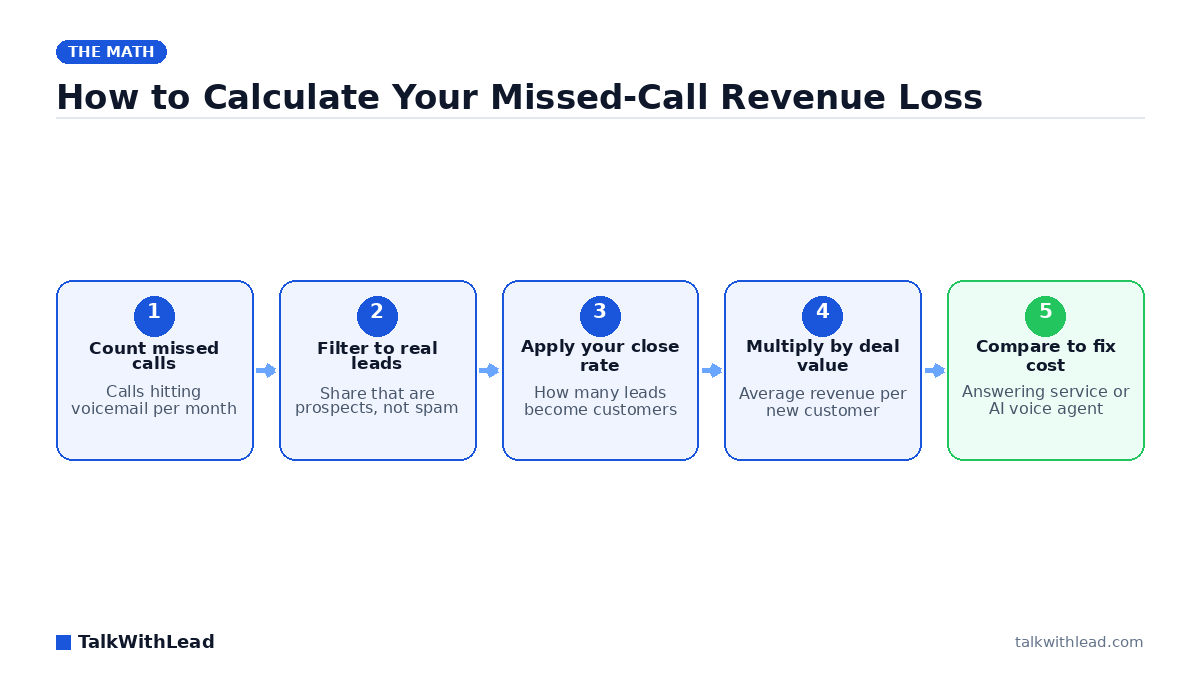
    How to Calculate Your Missed-Call Revenue Loss — TalkWithLead original infographic (flow diagram).
    How to Calculate Your Missed-Call Revenue Loss

    How much revenue am I losing from missed calls?

    Every unanswered ring is a person who wanted to give you money and couldn’t. If you’ve ever typed “how much revenue am I losing from missed calls” into a search bar, you already suspect the number is bigger than you’d like — and you’re probably right.

    TL;DR: Your missed-call revenue loss equals missed calls per month × the share that are genuine leads × your close rate × your average customer value. For most local and service businesses, that formula produces a four- or five-figure monthly number. You can get your exact figure in under a minute with the free missed-call revenue calculator.

    The math is simple. The hard part is being honest about the inputs. This breakdown walks through both — and then shows the fastest way to shut the leak off.

    The missed-call loss formula, explained

    Four numbers determine what missed calls cost you:

    • Missed calls per month. Check your phone system’s logs or call your carrier. Count everything that went to voicemail, rang out, or hit a busy signal — including after-hours and lunchtime calls.
    • Lead percentage. Not every missed call is a buyer. Some are spam or vendors. Be conservative and count only the share that would have been a real prospect.
    • Close rate. Of the prospects you actually talk to, how many become customers?
    • Average customer value. Use lifetime value if you know it; first-transaction value if you don’t.

    Multiply the four together and you have your monthly loss. Annualize it and the number usually stings. The reason this formula understates reality: it ignores referrals those lost customers would have sent, and it ignores the reviews and repeat business that compound over years.

    A worked example (illustrative — plug in your own numbers)

    Picture a plumbing company that misses 40 calls a month. Say half of those are genuine service requests, the company closes 6 in 10 of the prospects it actually speaks with, and an average job is worth $450. The math: 40 × 0.5 × 0.6 × $450 = $5,400 a month, or roughly $64,800 a year — from calls that already came in. No extra ad spend, no new marketing. Just answering the phone.

    Now run the same structure for a law firm where a signed client is worth $3,500, or a med spa where a new patient’s first year is worth $1,200. The per-call stakes climb fast. That’s why we built the free missed-call revenue calculator — enter your own volume, lead share, close rate, and customer value, and it shows your monthly and annual loss with every assumption labeled. Nothing is hidden and nothing is invented; it’s your data, multiplied out.

    Once you see your number, put it next to the cost of fixing it. Answering every call with an AI voice agent typically costs a small fraction of one recovered deal — you can see exact plans on the TalkWithLead pricing page.

    Why do so many business calls go unanswered?

    Missed calls aren’t a character flaw — they’re a math problem. You’re on a job site, with a patient, in court, or it’s 9 p.m. and the office closed five hours ago. Meanwhile the caller doesn’t distinguish between “busy” and “doesn’t care.”

    The scale of the problem is documented. According to a 411 Locals study of 85 small businesses across 58 industries, only 37.8% of incoming calls were answered by a live person — meaning roughly 6 out of 10 calls went unattended. If your business is anywhere near typical, the majority of your inbound phone demand never reaches a human.

    And voicemail doesn’t rescue it. Think about your own behavior: when a business sends you to voicemail, do you leave a message and wait — or do you tap the next Google result? Most buyers do the second. A missed call isn’t a delayed conversation; it’s usually a competitor’s new customer.

    Speed multiplies the loss

    Even calls you return quickly lose value while they wait. The MIT Lead Response Management study found you’re about 21× more likely to qualify a lead contacted within 5 minutes than one contacted at 30 minutes. A voicemail returned “first thing tomorrow” is competing against whoever picked up today.

    This is the same dynamic that governs web leads, which is why the phone problem and the website problem are really one problem: prospects reward whoever responds first, in any channel. We break down the response-time economics in Speed-to-Lead: Why the First 60 Seconds Win Most Deals — the short version is that “we’ll call you back” is where deals go to die.

    How to stop the leak: answer every call and every visitor, instantly

    You have three realistic options, and they aren’t equal.

    OptionCoverageTypical monthly costSpeed to answerLanguages
    Hire more staffBusiness hours onlyThousands (salary + benefits)When someone’s freeWhatever staff speak
    Human answering serviceDepends on plan/minutesHundreds, scales with volumeQueue-dependentUsually 1–2
    AI voice agent (TalkWithLead)24/7, calls + websiteFlat software costInstant, every time50+

    TalkWithLead’s AI voice agent sounds remarkably human, answers instantly around the clock, and holds a real conversation in 50+ languages — qualifying the caller, answering questions, and booking the appointment instead of taking a message. Unlimited long-distance calling means a prospect three time zones away costs you nothing extra to convert. And because it lives on your website too, it catches the visitors who never would have dialed at all: they click, talk, and get an instant callback instead of filling out a form and hoping. Hear it yourself in a two-minute live demo — it’s the fastest way to judge whether “human-sounding” is marketing or reality.

    If your leak is specifically the phone line, missed call automation for websites shows how the pieces fit together. If you’re weighing widget options, see callback widget vs click-to-call vs live chat for how each one converts.

    Best for: local and service businesses (contractors, law firms, clinics, agencies, real estate) that miss calls after hours or during jobs and can trace real revenue to each answered lead.

    Not the right fit if: your phone rings a handful of times a month and your website gets little traffic — fix demand generation first, then fix answer rates.

    Turn your number into a decision

    Run the calculator. If your monthly loss comes back at $2,000, $5,000, or more, you’re not deciding whether to spend money — you’re deciding whether to keep donating that revenue to competitors who answer faster. The fix costs a flat software fee (see pricing), takes minutes to add to your site, and starts answering the very next call. You can sign up free and have an AI voice agent greeting visitors today, or start with the live demo and let it convince you the way it will convince your callers.

    FAQ

    How do I calculate how much revenue I’m losing from missed calls?

    Multiply four numbers: missed calls per month × the share that are genuine leads × your close rate × average customer value. A business missing 40 calls with half being real leads, a 60% close rate, and $450 jobs loses about $5,400 a month in that illustrative scenario. The free calculator does the math with your own inputs.

    What percentage of calls do small businesses actually answer?

    According to a 411 Locals study of 85 small businesses across 58 industries, only 37.8% of incoming calls were answered by a live person. If you haven’t audited your own answer rate, assume it’s lower than you think — especially after hours.

    Do missed callers leave voicemails or call a competitor?

    Most buyers with an immediate need don’t wait. Picture your own behavior: hit voicemail, hang up, tap the next search result. That’s why counting voicemails dramatically undercounts your loss — the callers who mattered most are the least likely to leave one.

    Is an AI voice agent better than a human answering service for missed calls?

    For coverage and cost, usually yes. An AI voice agent answers instantly, 24/7, in 50+ languages, at a flat software price — while human services bill by minutes and can queue callers at peak times. Humans still win for complex, emotionally sensitive conversations, which the AI can route to you. Compare the tradeoffs in AI voice agent vs human receptionist.

    How fast should I respond to a missed call or web lead?

    Within minutes. The MIT Lead Response Management study found leads contacted within 5 minutes are about 21× more likely to qualify than those contacted at 30 minutes. Instant answering — human or AI — is worth far more than a diligent next-morning callback routine.

    What does it cost to stop missing calls with TalkWithLead?

    It’s flat-fee software rather than per-minute billing — current plans are on the pricing page. As illustrative ROI math: if your calculator result shows even one recovered $450 job a month, the software typically pays for itself several times over.

  • AI Receptionist for Contractors: 2026 Cost & ROI

    AI Receptionist for Contractors: 2026 Cost & ROI

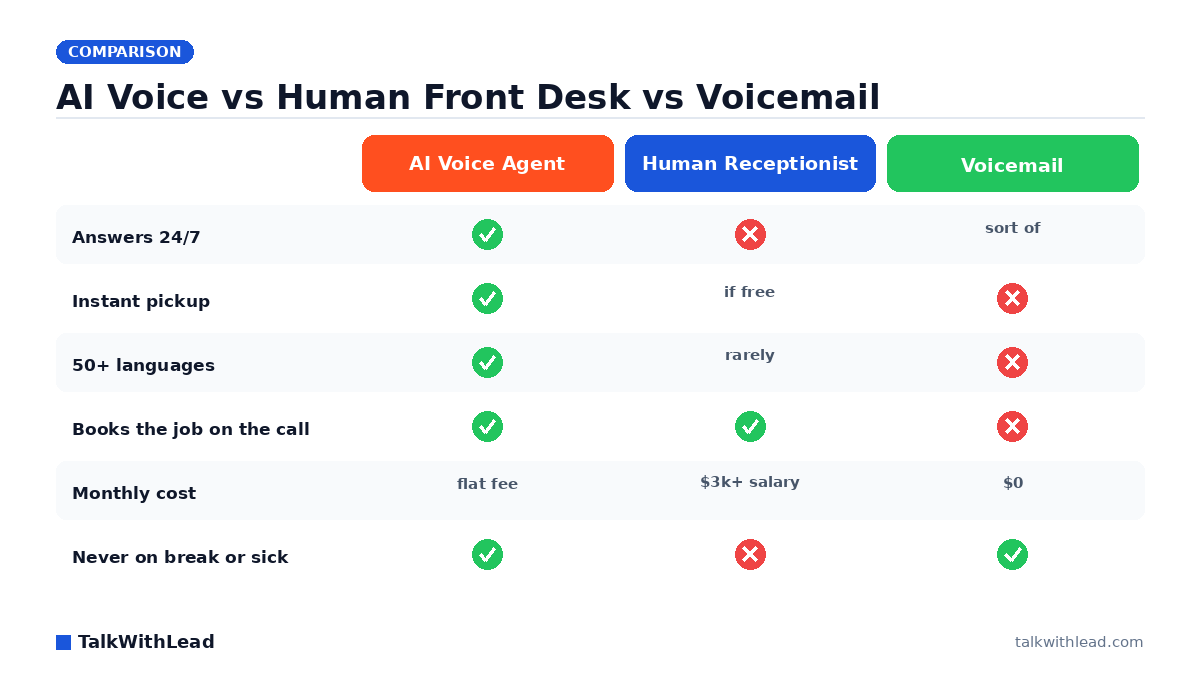
    AI Voice vs Human Front Desk vs Voicemail — TalkWithLead original infographic (comparison diagram).
    AI Voice vs Human Front Desk vs Voicemail

    A homeowner’s water heater just failed. They pull up three contractor websites, call the first, and get voicemail. They call the second and a human-sounding voice picks up on the first ring, asks two questions, and books the visit for tomorrow morning. Guess which contractor wins the job? The ai receptionist for contractors cost question matters, but it’s the wrong first question. The real one is: what are you losing every time a ready-to-hire caller hits your voicemail?

    TL;DR: An AI receptionist for a contracting business usually costs a flat monthly subscription — a fraction of a full-time front-desk salary — and replaces missed calls with instant, human-sounding voice conversations that book jobs 24/7. Whether it pays off comes down to your average job value and how many calls you currently miss: for most contractors, capturing even a couple of extra jobs a month covers the tool many times over.

    How much does an AI receptionist for contractors cost?

    Pricing for AI voice reception is almost always a predictable monthly subscription rather than a per-minute answering-service bill that spikes in your busy season. That flat structure is the point: you know your number before the phone rings. Compare that to the alternatives contractors usually weigh.

    • A full-time receptionist: a real salary plus benefits, plus they clock out at 5 p.m., take lunch, and can’t answer two calls at once during a storm-damage rush.
    • A traditional answering service: often billed per minute or per call, so your invoice climbs exactly when call volume spikes — and the operator reading from a script still can’t book the job in your calendar.
    • Voicemail: technically free, and quietly the most expensive option on this list, because it sends buyers straight to your competitor.

    An AI voice agent sits between those: one flat monthly cost, unlimited pickups, and unlimited long-distance calling so a lead three states away gets the same instant answer as one across town. Want to hear one handle a live call? Try the Live Demo and judge how human it sounds before you spend a dollar. You can see current plans on the pricing page.

    What are you really paying for when a call goes unanswered?

    Here’s the honest framing every contractor should run before comparing subscription tiers. The subscription is small and fixed. The missed-call cost is large and invisible — it never shows up on an invoice, so it’s easy to ignore.

    Picture a remodeler whose average job is worth $9,000. Say even 4 qualified callers a month hit voicemail and never call back because a competitor answered first. That’s not a $99 problem — that’s $36,000 in walked-away revenue in a single month, or over $400,000 a year. Against numbers like that, the question stops being “can I afford an AI receptionist?” and becomes “can I afford to keep missing these calls?”

    The pattern holds across trades. Roofers after a hailstorm, plumbers at 11 p.m., HVAC techs in a July heat wave — the calls you can’t physically answer are often the highest-intent buyers you’ll get all week. An AI voice agent answers all of them at once, in the caller’s language, and hands you a booked appointment instead of a red voicemail badge. To see how this plays out in real dollars for your business, run your own numbers through the free missed-call revenue calculator.

    Why AI voice beats chatbots and web forms for contractors

    Most “lead capture” tools bolted onto contractor websites are chatbots and contact forms. They ask a stressed homeowner to type out their emergency, then promise someone will “get back to you soon.” That’s a slow lane for a fast decision. A person whose basement is flooding doesn’t want to fill out a form — they want to talk to someone right now.

    That preference isn’t a hunch. An Ada study found 59% of consumers prefer instant, 24/7 AI customer service over waiting for a human — but only when the AI can actually resolve their issue. That’s the whole game: instant plus capable. A voice agent that greets the caller, understands the job, and books the slot clears that bar. A chatbot that collects a name and stalls does not.

    Voice also converts because it’s a conversation, not a maze. The AI can ask clarifying questions, quote availability, and offer an instant callback — turning an anonymous website visitor into a real phone conversation on the spot. If you’re weighing the two head-to-head, this breakdown of AI voice agent vs chatbot for booking calls lays out where each one wins, and this look at live chat vs chatbot and the AI voice upgrade shows why typing-based tools leak high-intent leads.

    Best for: contractors who get real inbound call and web volume, miss calls while on the job, and have jobs worth enough that one recovered lead pays for months of service.

    Not the right fit if: you’re fully booked months out, turn away work, and genuinely don’t want more leads — then instant response solves a problem you don’t have.

    An ROI example you can actually check

    Let’s make the math concrete and label it clearly as an illustration, not a customer result. Assume:

    • Average job value: $4,000 (mid-range for many trades)
    • Missed or after-hours calls per month that currently go nowhere: 20
    • Of those, assume a conservative 10% were ready buyers the agent books — that’s 2 jobs

    Two recovered jobs at $4,000 is $8,000 in monthly revenue that used to land in voicemail. Even after subtracting a flat monthly subscription, the return isn’t close — a single booked job typically covers the tool for the better part of a year. Speed is why it works: the faster you respond, the more of those callers you keep, a dynamic spelled out in why the first 60 seconds win most deals. Adjust the inputs to your own averages, because the honest answer is that ROI scales with your job value and your missed-call volume, nothing else.

    This is also where broader adoption context helps. According to Gartner research, agentic AI will autonomously resolve 80% of common customer service issues without human intervention by 2029, cutting operational costs by 30%. Front-desk call handling for contractors — answer, qualify, book — is exactly the kind of repeatable task that shift describes. Getting in now means your phone stops leaking leads while competitors are still deciding.

    What a good AI receptionist should do for a contracting business

    Not all AI voice tools are equal. Before you compare the ai receptionist for contractors cost across vendors, compare capabilities. A strong one for a trades business should:

    • Sound genuinely human — no robotic hold-music voice that makes callers hang up.
    • Answer instantly, 24/7 — nights, weekends, and holidays are when emergency jobs call.
    • Speak 50+ languages — so a Spanish-speaking homeowner gets served, not screened out.
    • Offer instant callbacks — a website visitor clicks, and the phone rings in seconds.
    • Book the job — capture the details and set the appointment, not just take a message.
    • Handle overflow — pick up call two and call three while you’re mid-conversation.

    If you’re vetting providers, it’s worth reading how one stacks up against a common competitor in this Smith.ai alternative breakdown, and if you also run intake-heavy work, the logic in whether an AI receptionist is worth it for a law firm maps closely to how contractors qualify leads. Ready to put one on your own site? You can start with a free signup and have the agent answering your calls fast.

    FAQ

    How much does an AI receptionist for contractors cost per month?

    Most AI voice receptionists charge a flat monthly subscription rather than per-minute answering-service rates, which keeps your cost predictable even during busy season. That’s typically far below a full-time front-desk salary. Check the pricing page for current plan levels.

    Is an AI receptionist worth it for a small contracting business?

    It usually is if you miss calls while on jobs and your average job is worth a few thousand dollars. Recovering even one or two otherwise-lost jobs a month tends to cover the subscription many times over. If you’re already turning work away, the value is smaller.

    Can an AI receptionist actually book appointments, not just take messages?

    A good one does. It qualifies the caller, checks availability, and books the appointment during the same conversation — the difference between capturing a job and leaving a voicemail slip that may never get returned.

    Will callers know they’re talking to AI?

    Modern AI voice agents sound remarkably human and handle natural back-and-forth, so the experience feels like a competent front-desk person. What callers notice most is that someone picked up instantly instead of sending them to voicemail.

    How is an AI voice agent better than a chatbot or contact form?

    Homeowners with an urgent job want to talk, not type. Voice answers instantly, asks clarifying questions, and books the work, while chatbots and forms ask people to describe their emergency and wait. See the full AI voice agent vs chatbot conversion comparison for the details.

    Can it handle Spanish-speaking or multilingual callers?

    Yes. A capable AI voice agent supports 50+ languages, so it can serve callers in their preferred language automatically instead of losing the lead to a language barrier — a real advantage in most local service markets.

  • Smith.ai Alternative for Website Lead Conversion

    Smith.ai Alternative for Website Lead Conversion

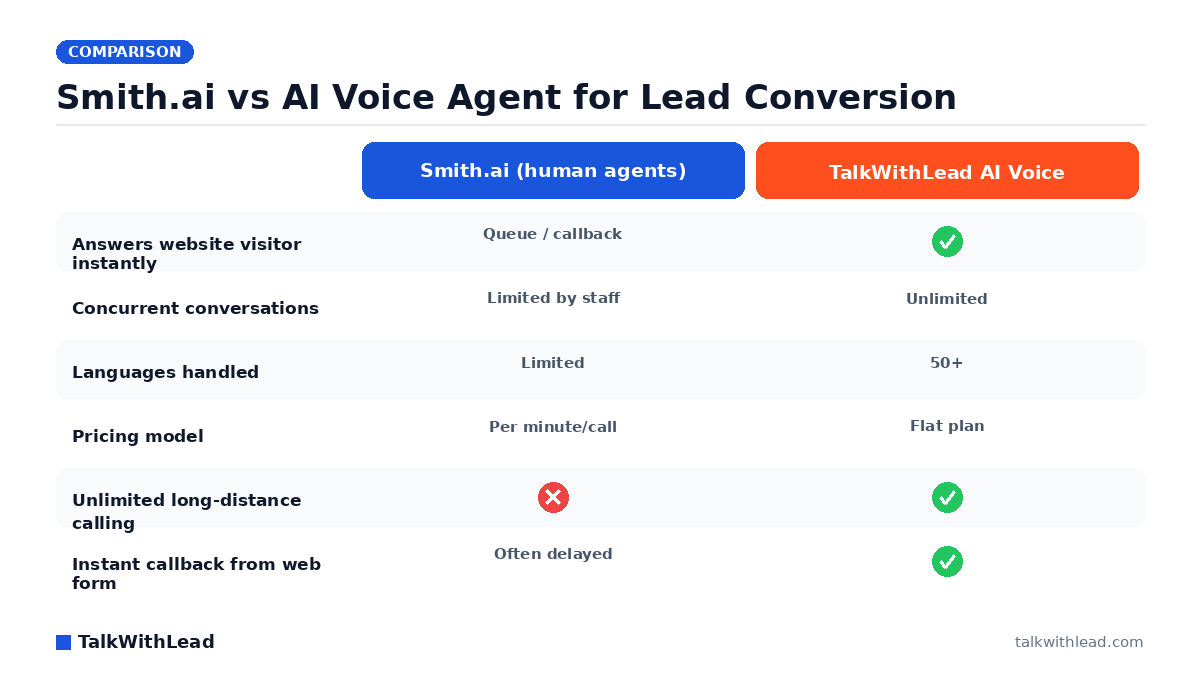
    Smith.ai vs AI Voice Agent for Lead Conversion — TalkWithLead original infographic (comparison diagram).
    Smith.ai vs AI Voice Agent for Lead Conversion

    Why business owners look for a Smith.ai alternative for website lead conversion

    You put a real phone number and a contact form on your site, signed up for Smith.ai to catch the calls, and the leads still trickle in slower than you want. The gap is rarely the agents themselves. It’s that a human-staffed answering service can only pick up so many calls at once, charges by the minute, and still leaves your website visitors waiting for someone to call them back. If you want a Smith.ai alternative for website lead conversion that talks to every visitor the instant they land, an AI voice-first platform answers that directly.

    TL;DR: Smith.ai is a human virtual receptionist and answering service billed per call or minute. The fastest-converting alternative is an AI voice agent that answers your website’s visitors instantly, holds a natural spoken conversation in 50+ languages, and triggers an immediate callback so a form-fill becomes a live phone call in seconds, all on a flat plan instead of per-minute fees.

    What does Smith.ai actually do, and where does it leave money on the table?

    Smith.ai connects your business to trained human receptionists who answer calls, qualify callers, and book appointments. For a firm that just needs missed phone calls covered, it works. The trouble starts when you measure it against the goal that matters: turning the traffic already hitting your website into booked conversations.

    Three structural limits show up fast:

    • It waits to be called. A receptionist answers an inbound ring. The visitor reading your pricing page right now has to decide to dial, then hope someone’s free. Most never do.
    • It bills by the minute. Every qualifying question, every hold, every transfer is metered. Busy months get expensive, so owners cap usage and miss calls anyway.
    • It throttles at peak. When five leads hit at once, humans queue them. The fourth and fifth caller hear hold music or get a callback later, which is exactly when buyers move on.

    Speed is the whole game here. According to Harvard Business Review research, companies that reach a web lead within an hour are nearly 7× more likely to qualify it than those that wait even an hour longer. A callback queue burns that hour. We dig deeper into this in Speed-to-Lead: Why the First 60 Seconds Win Most Deals.

    What is the best Smith.ai alternative for website lead conversion?

    The best alternative is the one that removes the wait entirely. Instead of routing a visitor toward a human who may or may not be available, TalkWithLead puts an extremely human-sounding AI voice agent directly on your website. A visitor clicks to talk, and within seconds they’re in a real spoken conversation, no form, no hold, no slow chatbot typing back one line at a time.

    That changes the math in four concrete ways:

    • Instant answer, every time. The AI voice agent never queues. Whether one visitor or fifty arrive at once, each gets a live conversation immediately.
    • 50+ languages, on the fly. A Spanish-speaking buyer and an English-speaking buyer both get answered in their own language without you staffing for either.
    • Unlimited long-distance calling. Prospects anywhere can reach you, and the agent can call them back, without per-minute long-distance charges eating the margin.
    • Instant callbacks. When a visitor leaves a number, the system rings them back in seconds while their interest is still hot, turning a passive form-fill into an active phone conversation.

    Want to hear it before you decide? Take the live demo and talk to the agent the way your own visitors would. For a side-by-side on conversion specifically, AI Voice Agent vs Chatbot: Which One Books More Calls? breaks down why voice beats typed chat for booking.

    Smith.ai vs an AI voice agent: a side-by-side comparison

    Here’s how the two stack up on the dimensions that decide whether a website visitor becomes a sales conversation.

    DimensionSmith.ai (human answering service)TalkWithLead (AI voice-first)
    Who answersHuman receptionistHuman-sounding AI voice agent
    Response to a website visitorInbound call or scheduled callbackInstant on-page conversation
    Concurrent conversationsLimited by staffingUnlimited, simultaneous
    LanguagesLimited set50+ languages
    Long-distance callingOften meteredUnlimited
    PricingPer call / per minuteFlat plan
    AvailabilityBusiness hours + plans24/7, no shift gaps

    Best for: a business with steady inbound website traffic that wants every visitor engaged in a real conversation the moment they arrive, in any language, without per-minute costs scaling against you.

    Not the right fit if: your lead flow is almost entirely complex calls that legally or practically require a licensed human (for example, certain regulated intake), and you specifically want a person, not an AI, on every first touch. In that case a human service like Smith.ai may suit you better, or you pair the two.

    How much does an AI voice agent cost versus a per-minute answering service?

    Per-minute pricing punishes exactly the months you grow. An AI voice-first platform flips that to a predictable flat plan, so a busy week costs the same as a slow one. You can see the public tiers on the pricing page.

    To make the ROI concrete, here’s an illustrative example (your numbers will differ). Say your site gets 1,000 visitors a month and, picture a setup where even 3 of every 100 visitors would talk to an instant voice agent. That’s roughly 30 live conversations a month you weren’t capturing before. If even a handful of those become customers at a few hundred dollars each, the flat plan pays for itself many times over, and every additional conversation after that is pure upside. Plug your own traffic and close rate into the free missed-call revenue calculator to see the gap for your business.

    There’s a trust angle too. According to a Five9 study of 4,000 US and UK consumers, 75% of people prefer talking to a real human over the phone for support. A natural-sounding voice conversation meets that preference far better than a typed chatbot does, which is the whole point of leading with voice instead of a chat widget. Ready to put it on your site? Start your free signup and have the agent live before your next traffic spike.

    Does this work for my industry?

    The pattern holds anywhere a fast phone conversation closes the deal. A law firm fielding consultation requests, a med spa booking appointments, a real estate team chasing showing requests, an insurance agency quoting policies, every one of them loses leads to slow follow-up. The AI voice agent answers the moment interest peaks instead of hours later.

    If you run a practice or agency, these breakdowns get specific: Smith.ai Alternative for Law Firms covers website intake, Is an AI Receptionist Worth It for a Law Firm? weighs the cost, and Speed to Lead Real Estate shows how instant callbacks book more showings. For the broader build-vs-buy view on people, AI Voice Agent vs Human Receptionist lays out the tradeoffs.

    FAQ

    What is the best Smith.ai alternative for converting website visitors?

    An AI voice-first platform like TalkWithLead is the strongest alternative when your goal is converting website traffic, because it answers every visitor instantly with a natural spoken conversation rather than routing them to a human queue or a callback. It handles unlimited simultaneous calls in 50+ languages on a flat plan.

    How is an AI voice agent different from Smith.ai?

    Smith.ai staffs human receptionists who answer inbound calls and bill per minute. An AI voice agent lives on your website, starts a live conversation the instant a visitor clicks, never queues at peak, supports 50+ languages, and runs on a predictable flat plan with unlimited long-distance calling.

    Is an AI voice agent cheaper than a per-minute answering service?

    For most websites with steady or growing traffic, yes, because a flat plan doesn’t scale costs against your busiest months the way per-minute billing does. Run your own traffic and close rate through the missed-call revenue calculator to compare against your current spend.

    Can an AI voice agent really handle leads in other languages?

    Yes. The TalkWithLead voice agent converses in 50+ languages automatically, so a visitor is answered in their own language without you hiring multilingual staff or buying separate plans per language.

    Will visitors know they’re talking to AI?

    The voice agent is built to sound natural and human, and it handles real back-and-forth conversation rather than scripted prompts. Many businesses pair it with instant callbacks so the visitor moves seamlessly into a phone conversation, which most people prefer over typing to a chatbot.

    Can I keep human receptionists and add an AI voice agent?

    Yes. Many businesses use the AI voice agent as the always-on first responder that engages every website visitor instantly, then route complex or high-value conversations to a human. That captures the leads a queue would have lost while keeping people on the calls that truly need them.

  • Is an AI Receptionist Worth It for a Law Firm?

    Is an AI Receptionist Worth It for a Law Firm?

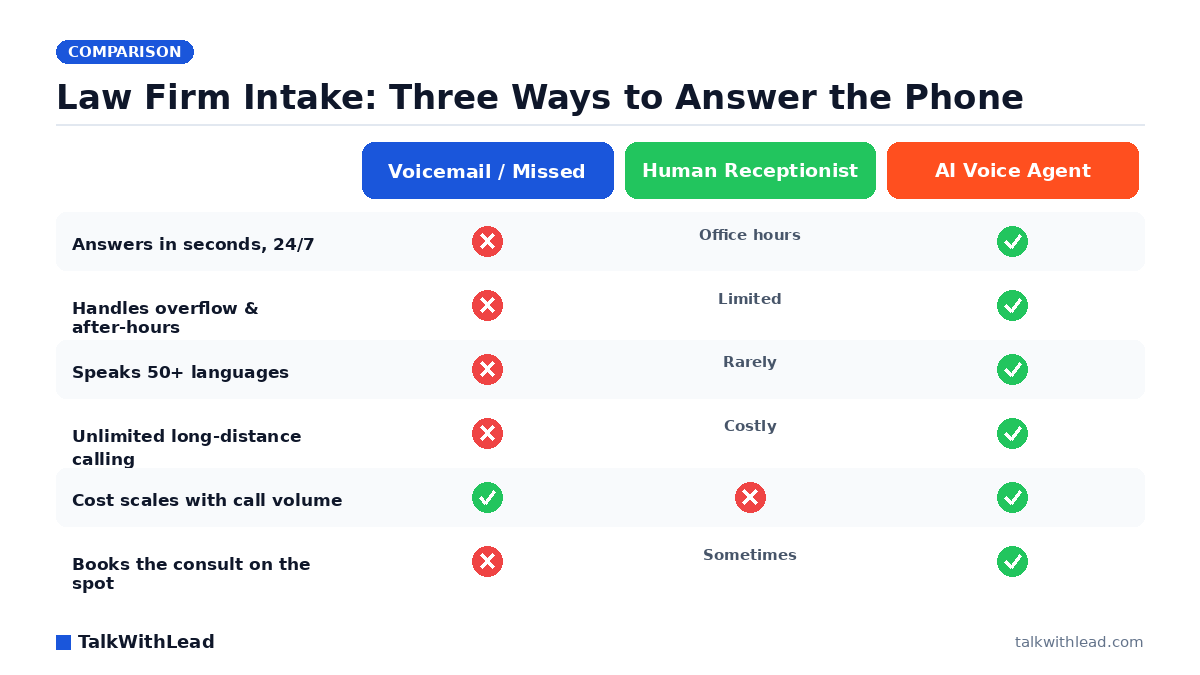
    Law Firm Intake: Three Ways to Answer the Phone — TalkWithLead original infographic (comparison diagram).
    Law Firm Intake: Three Ways to Answer the Phone

    A prospect with a $15,000 matter calls your firm at 7:40 p.m., gets voicemail, hangs up, and dials the next firm on the list. That is the real question behind “is an AI receptionist worth it for a law firm” — not whether the technology is impressive, but whether it stops calls like that one from walking out the door.

    TL;DR: For most small and mid-size firms, an AI receptionist is worth it when call volume is high enough that calls slip to voicemail after hours or during overflow. An AI voice agent answers every call in seconds, qualifies the caller, and books the consult — so if it captures even one or two extra signed matters a month, it pays for itself many times over. It is not worth it if you take only a handful of high-touch clients a year and answer every call yourself.

    What does an AI receptionist actually do for a law firm?

    An AI receptionist is a human-sounding AI voice agent that picks up the phone — or the call-back request on your website — and has a real conversation with the caller. It greets them, asks the intake questions you would ask, captures name, contact, matter type, and urgency, and either books a consultation or routes a genuine emergency to a live attorney.

    The difference from a chatbot or a web form is the channel. A form makes an injured or anxious prospect type. A chatbot makes them wait and click. A voice agent turns a website visitor into a phone conversation immediately, the way people actually want to reach a lawyer. If you want to see how those channels compare on conversion, our breakdown of AI voice agent vs chatbot conversion rate lays out the gap.

    It also runs 24/7. The phone gets answered on a Saturday, at midnight, and during the lunch hour when your front desk is slammed. According to Ada, 59% of consumers prefer instant, 24/7 AI service over waiting for a human — as long as the AI can actually handle the request. Intake qualification is exactly the kind of request it can handle.

    Is an AI receptionist worth it for a law firm? Run the ROI math

    The honest way to answer “worth it” is to put a number on the calls you miss. Here is an illustrative example — plug in your own figures, not these.

    Say your firm gets 200 inbound calls a month and, between after-hours, lunch, and overflow, 25% of them hit voicemail. That is 50 missed calls. Now assume a conservative slice convert: imagine even 1 in 10 of those missed callers was a real prospect who would have signed. That is 5 lost matters a month. If your average signed matter is worth $3,000 in fees, that is $15,000 of revenue leaking every single month.

    Against that, an AI voice agent typically costs a fraction of one paralegal’s hourly rate and a small fraction of a single signed case. The arithmetic usually is not close. If the tool recovers even one of those five matters, it has already paid for a year of itself. To pressure-test your own numbers, run them through the free missed-call revenue calculator before you commit to anything.

    Pricing for AI voice receptionists generally lands in the low-hundreds-per-month range for a small firm, scaling with call volume — far below the cost of a full-time receptionist and without the gaps a single human leaves on nights, weekends, and sick days. You can see TalkWithLead’s tiers on the pricing page.

    How does an AI receptionist book more consultations than voicemail?

    Speed is the whole game in legal intake. A prospect who reaches a person — or a voice that behaves like one — in the first minute is dramatically more likely to book than one who leaves a message and waits for a callback. The longer the gap, the colder the lead, and the more likely they have already called a competitor. Our piece on speed-to-lead and the first 60 seconds digs into why that window matters so much.

    An AI voice agent closes that gap three ways:

    • It never goes to voicemail. Every call and every website call-back request is answered on the first ring, day or night.
    • It qualifies instead of just collecting. The agent asks the right intake questions, screens out matters you do not take, and flags the urgent ones — so attorneys spend time on real opportunities.
    • It books on the spot. Instead of “someone will call you back,” the caller leaves with a scheduled consultation, which is the moment a lead becomes a client.

    This is the same logic behind missed-call automation for websites: capture the lead before they call the next firm, because the next firm is one tap away.

    Where an AI receptionist beats a human (and where it does not)

    A great human receptionist is warm, judgment-rich, and irreplaceable for complex, sensitive conversations. But one person cannot answer three calls at once, work 24 hours, or speak fluent Spanish, Mandarin, and Portuguese on demand. An AI voice agent handles intake in 50+ languages and offers unlimited long-distance calling, so a prospect anywhere can reach your firm without a toll barrier or a language wall.

    The realistic model for most firms is not “AI instead of people” — it is AI catching everything your team cannot: overflow, after-hours, weekends, and second-language callers. For a deeper side-by-side, see AI voice agent vs human receptionist, and if you are weighing a service like Smith.ai, our Smith.ai alternative for law firms comparison covers the intake-specific tradeoffs.

    DimensionVoicemail / MissedHuman ReceptionistAI Voice Agent
    Response timeHours or neverOffice hours onlySeconds, 24/7
    Simultaneous callsNoneOne at a timeMany at once
    LanguagesNoneUsually one50+
    Long-distance reachN/ACostlyUnlimited
    Monthly cost$0 (but lost revenue)Full salary + benefitsLow-hundreds, scales
    Books consult on callNoSometimesYes

    Best for: small and mid-size firms with steady call volume that lose intake calls to after-hours, lunch, overflow, or non-English speakers, and want every prospect booked instead of buried in voicemail.

    Not the right fit if: you handle only a few hand-selected, high-touch matters a year, answer every call personally, or require a licensed attorney to give legal advice on the very first contact.

    What to look for before you buy an AI receptionist

    The technology is moving fast — Gartner predicts agentic AI will autonomously resolve 80% of common customer service issues without human intervention by 2029, cutting operational costs by 30%. For a law firm, that future is only worth buying into if the tool fits how you actually intake clients. Check these before you sign up:

    • Does it sound human? A robotic voice gets hung up on. Test it yourself on a live call.
    • Can it book and route? Capturing a name is table stakes; scheduling the consult and escalating emergencies is what drives ROI.
    • Does it cover your callers’ languages and locations? 50+ languages and unlimited long-distance widen the client pool you can serve.
    • How fast does it answer the website visitor? Instant call-backs turn browsers into booked calls — compare the options in callback widget vs click-to-call vs live chat.

    The fastest way to judge worth is to hear it work on your own intake script. Try a live demo, then start capturing missed calls with a free signup and measure the booked consults against the math above.

    FAQ

    Is an AI receptionist worth it for a small law firm?

    For most small firms, yes — if you are losing calls to voicemail after hours, during lunch, or when the office is busy. The break-even is low: recover one or two signed matters a month and the tool pays for itself many times over. Run your own missed-call math first so the decision is a number, not a guess.

    How much does an AI receptionist cost for a law firm?

    AI voice receptionists generally run in the low hundreds of dollars per month for a small firm, scaling with call volume — far less than a full-time human receptionist’s salary and benefits. See current tiers on the pricing page and compare against the revenue you lose to missed calls.

    Can an AI receptionist replace my human front desk?

    For most firms it complements rather than replaces. A human handles warm, complex, in-office conversations; the AI voice agent catches everything one person cannot — overflow, nights, weekends, and second-language callers — so no intake call goes unanswered.

    Can an AI receptionist handle clients who do not speak English?

    Yes. A capable AI voice agent handles intake in 50+ languages and offers unlimited long-distance calling, so prospects in other languages or regions can reach your firm without a toll or language barrier — widening the pool of clients you can serve.

    Will an AI receptionist give legal advice to callers?

    No, and it should not. Its job is intake and scheduling: qualifying the matter, capturing details, booking the consultation, and escalating genuine emergencies to an attorney. Legal advice stays with your licensed lawyers.

    How do I know if an AI receptionist is right for my firm?

    Estimate your monthly missed-call volume, the share that are real prospects, and your average matter value. If the recovered revenue clearly exceeds the monthly cost, it is worth it. The free missed-call revenue calculator makes that estimate in a couple of minutes.

  • AI Answering Service Cost for Med Spas: Pricing & ROI

    AI Answering Service Cost for Med Spas: Pricing & ROI

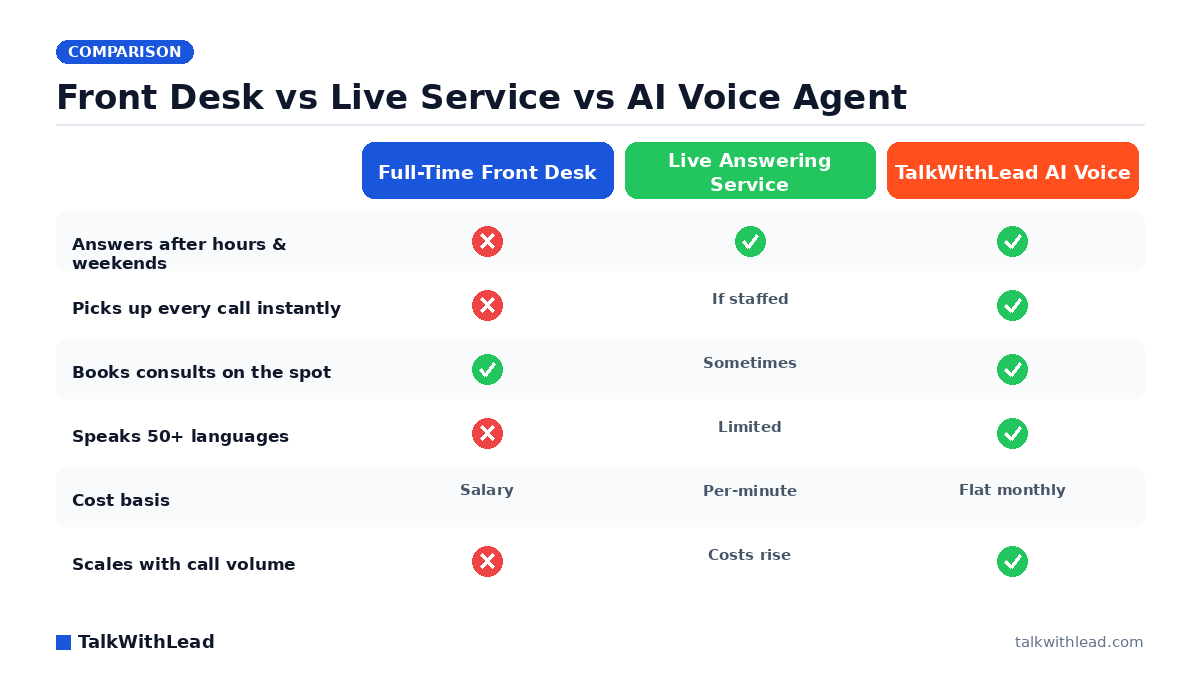
    Front Desk vs Live Service vs AI Voice Agent — TalkWithLead original infographic (comparison diagram).
    Front Desk vs Live Service vs AI Voice Agent

    A prospective client finds your med spa at 8:40 PM, ready to book a Botox consult. She calls, gets voicemail, hangs up, and books with the clinic two miles away that picked up. That single missed call is the real AI answering service cost for med spas question – not the monthly fee, but what every unanswered ring quietly costs you in booked consults.

    TL;DR: An AI answering service for a med spa usually costs a flat monthly subscription – typically a fraction of a full-time receptionist’s salary and often cheaper than per-minute live-agent services once call volume grows. The bigger number is ROI: because an AI voice agent answers every call instantly, 24/7, recovering even one or two consults a month often covers the cost several times over.

    How much does an AI answering service cost for a med spa?

    Pricing for AI answering services generally falls into three buckets. A full-time front-desk hire is the most expensive and only covers business hours. Traditional live answering services charge per minute or per call, so your bill climbs exactly when you get busy. An AI voice agent like TalkWithLead is usually a flat monthly subscription that does not balloon with volume – you can see current options on the pricing page.

    The flat-fee model matters for med spas specifically. Your call volume spikes after a promotion, a local influencer post, or a new-treatment launch. With a per-minute service, a great marketing week becomes a surprise invoice. With an AI voice agent, the same surge costs you nothing extra and every caller still gets a warm, immediate answer.

    Think in terms of value per booking rather than price per minute. If an average med spa client is worth several hundred dollars on the first visit and far more over a year of repeat treatments, the question stops being “what does this cost” and becomes “how many consults does it save.”

    Why missed calls cost more than the service itself

    Med spas live and die by the phone. People researching injectables, laser, or body contouring almost always call before they commit – they want reassurance, pricing, and a human voice. When that call goes to voicemail, most callers do not leave a message. They simply dial the next clinic.

    Picture a spa that gets 200 inbound calls a month and misses just a quarter of them after hours and during back-to-back appointments. Say even 1 in 10 of those missed calls was a ready-to-book client – that is several lost consults every single month, walking straight to a competitor. Run your own version of that math with our free missed-call revenue calculator and the monthly fee usually looks tiny next to the leak.

    Speed is the other half of the story. The faster you respond, the more likely the lead converts – a theme we cover in depth in Speed-to-Lead: Why the First 60 Seconds Win Most Deals. An AI voice agent’s response time is effectively zero, because it answers on the first ring, every time.

    What you actually get with an AI voice agent

    This is not a robotic phone tree. A modern AI voice agent sounds genuinely human, holds a natural back-and-forth conversation, answers common questions about treatments and pricing, and books the consult directly into your flow – no forms, no hold music, no “press 1.” It turns a website visitor or caller into a real phone conversation, which is exactly where med spa clients decide to commit.

    • Always on: evenings, weekends, holidays, and the moments your front desk is mid-treatment.
    • 50+ languages: a Spanish- or Mandarin-speaking caller gets answered in their own language without a transfer.
    • Unlimited long-distance calling: prospects anywhere can reach you, and the agent can call them back instantly.
    • Instant callbacks: a visitor on your site clicks, and the AI rings them in seconds while interest is hot.

    Want to hear how natural it sounds before comparing it to your current setup? Try the live demo and talk to the agent yourself.

    AI voice vs chatbots, forms, and live services

    Med spas have been told for years to add a chatbot or a contact form. The problem is that a person comparing lip filler clinics at 9 PM does not want to type into a widget and wait for an email reply the next morning. They want answers now, in a voice they trust. Voice converts because it matches how med spa buyers actually decide.

    According to an Ada study, 59% of consumers prefer instant, 24/7 AI customer service over waiting for a human – but only when the AI can actually resolve their issue. Booking a consult and answering treatment questions is exactly that kind of resolvable task. We break down the conversion gap further in AI Voice Agent vs Chatbot Conversion Rate and in Live Chat vs Chatbot: Pros, Cons, and the AI Voice Upgrade.

    DimensionFull-time front deskLive answering serviceAI voice agent
    After-hours coverageNoYesYes, always
    Cost basisSalary + benefitsPer minute / per callFlat monthly
    Scales with volumeNeeds more staffBill risesNo extra cost
    Languages1-2 typicallyLimited50+
    Books consult on the callYesSometimesYes

    The ROI math, with stated assumptions

    Here is an illustrative example – plug in your own numbers. Assume your med spa books an average first visit worth $400, and your AI answering service costs a flat monthly fee in the low hundreds. If the agent recovers just two consults a month that would otherwise have gone to voicemail, that is roughly $800 in new revenue against a fee well under that. Net positive in month one, and the gap widens with every repeat-visit client retained.

    Now layer in the bigger market shift. Gartner research predicts agentic AI will autonomously resolve 80% of common customer service issues without human intervention by 2029, cutting operational costs by 30%. The clinics adopting AI voice now are building that cost advantage early instead of paying overtime and missing calls.

    Best for: med spas and clinics losing after-hours and overflow calls, juggling high consult value, or serving multilingual neighborhoods. Not the right fit if: your front desk already answers every call live, books on the spot, and you have no after-hours or weekend inquiry volume to capture.

    If the math points your way, you can start without a sales call on the free signup. The same instant-response logic powers other high-stakes verticals too, like the intake playbook in Missed Call Automation for Websites.

    FAQ

    How much does an AI answering service cost for a med spa?

    Most AI answering services for med spas charge a flat monthly subscription rather than per-minute live-agent rates, which keeps the cost predictable even when call volume spikes. It is typically a fraction of a full-time receptionist’s salary, and you can review current TalkWithLead options on the pricing page.

    Is an AI voice agent worth it for a small med spa?

    For most small med spas, yes – because the cost of missed and after-hours calls usually outweighs the subscription fee. If recovering even one or two consults a month covers the cost, the agent pays for itself, and a small clinic without a 24/7 front desk has the most to gain.

    Will the AI sound robotic to my clients?

    No. A modern AI voice agent holds a natural, human-sounding conversation, answers treatment and pricing questions, and books the consult directly. The fastest way to judge it is to try the live demo and speak with the agent yourself.

    Can it handle calls in other languages?

    Yes. The AI voice agent speaks 50+ languages and responds to each caller in their own language without a transfer, which matters for med spas serving diverse local markets.

    How is this different from a chatbot or contact form?

    Chatbots and forms make a ready-to-book client type and wait, which loses people who want immediate answers. An AI voice agent turns that same visitor into a live phone conversation in seconds. See Callback Widget vs Click-to-Call vs Live Chat for a full comparison of the options.

    What does an AI answering service replace – my front desk?

    It does not have to replace anyone. Most med spas use it to cover the gaps: after hours, weekends, lunch breaks, and the busy stretches when staff are mid-treatment and calls go to voicemail. It captures the revenue that was already leaking out.

  • AI Voice Agent vs Chatbot Conversion Rate

    AI Voice Agent vs Chatbot Conversion Rate

    <a href=AI Voice Agent vs Chatbot at a Glance — TalkWithLead original infographic (comparison diagram).”/>
    AI Voice Agent vs Chatbot at a Glance

    Why the conversion gap is bigger than it looks

    The ai voice agent vs chatbot conversion rate question usually gets answered with a feature checklist. The real answer is simpler: a voice agent starts a conversation, and a chatbot starts a chore. One asks a visitor to speak; the other asks them to read a greeting, type a question, wait, read again, and hope the bot understood. Every one of those extra steps is a place where a ready-to-buy visitor quietly leaves.

    That matters because the visitor who lands on your pricing page at 9:47 p.m. is not browsing. They are deciding. A human-sounding AI voice agent can answer them out loud in seconds and offer to put them on a call right then. A chatbot, at best, captures an email and adds them to a queue you will work tomorrow, which is often a day too late.

    How a chatbot actually loses high-intent visitors

    Chatbots are not useless. They deflect support tickets and answer FAQs at scale. The trouble shows up on conversion-focused pages, where the goal is not to inform a visitor but to win one. Here is where the friction stacks up:

    • Typing tax. Most people speak far faster than they thumb-type on a phone. Forcing a buyer to type their question slows the whole exchange to a crawl.
    • Scripted dead-ends. The moment a visitor asks something off-script, a rules-based bot stalls and the visitor blames your brand for it.
    • No handoff to a human. Even when a chatbot senses high intent, the usual next step is “leave your email” — not “talk to someone now.”
    • Language walls. A buyer who prefers Spanish, Tagalog, or Portuguese often gets an English-only widget and bounces.

    If you want a deeper breakdown of where text-based tools fall short, our piece on live chat versus chatbots and the AI voice upgrade walks through each option side by side.

    What an AI voice agent does differently

    An AI voice agent flips the interaction. Instead of waiting for the visitor to compose a message, it greets them in a natural, human-sounding voice and handles the back-and-forth out loud. The visitor talks the way they would to a salesperson on the showroom floor, and the agent listens, answers, qualifies, and offers the next step.

    Three capabilities change the math:

    • 50+ languages. The agent meets visitors in their own language, so a multilingual market stops being a leak in your funnel.
    • Instant callbacks. If a visitor would rather get a call in two minutes, the agent arranges it instead of dropping them into a form.
    • Unlimited long-distance calling. A prospect three time zones away connects with no concern about call cost on your side.

    The net effect is fewer steps between “interested visitor” and “live conversation.” That compression is the whole game. You can try a live demo and hear how the voice agent handles a real exchange before you decide anything.

    An illustrative conversion comparison

    The following numbers are an illustrative example, not measured results from a specific customer. They show how small per-step drop-offs compound differently for typing versus talking.

    Imagine 1,000 high-intent visitors hit a service page in a month. With a chatbot, suppose 12% open the widget, 60% of those actually type a question, 50% of those leave an email, and 35% of those emails turn into a booked call. That chain leaves you with roughly 13 booked calls.

    Now run the same 1,000 visitors past an AI voice agent. Suppose 12% engage, but because talking is effortless, 80% complete the conversation, and 55% of those accept an offer to connect to a live call or instant callback. That chain leaves you with roughly 53 booked calls from the same traffic. Same visitors, same intent — the difference is how much effort each path demands. Even if your real percentages differ, the shape holds: removing the typing tax and the email-then-wait gap raises the ai voice agent vs chatbot conversion rate every time.

    Speed is the hidden multiplier

    Conversion is not only about the channel; it is about the clock. A lead contacted within the first minute is far more likely to convert than one contacted an hour later, simply because intent decays fast. A chatbot that collects an email defers the real conversation. A voice agent has the conversation now.

    This is the core idea behind speed-to-lead and why the first 60 seconds win most deals. When the agent can move a visitor straight into a call, you are not racing a competitor’s callback queue — you have already started the relationship. And when a call does slip through, missed-call automation catches the lead before they dial someone else.

    When a chatbot is still the right call

    Voice is not the answer for every box on every page. A chatbot earns its place when:

    • The job is high-volume, low-stakes support (order status, password resets, store hours).
    • The visitor genuinely prefers async text and may be mid-meeting.
    • You need a searchable transcript trail for compliance or routing.

    The smart setup is layered: let text tools handle routine questions, and route the high-intent moments — pricing, demo requests, “talk to sales” — to a voice agent that can close the loop with a real call. If you are weighing widgets, the callback widget versus click-to-call versus live chat comparison helps you map each tool to the right page.

    How to decide for your own site

    Start with one question: on this page, is a captured email good enough, or do you actually want a conversation? On a blog post, an email is fine. On a pricing page for a high-ticket service, a booked call is worth many emails. Put the voice agent where the conversation is worth the most.

    Then check three things: do you serve multiple languages, do prospects reach you from far away, and does your current widget end most sessions with “we’ll get back to you”? If you answered yes to any of them, the voice path is likely leaving money on the table for you today. You can start free and put a voice agent on your highest-intent page this week, or review pricing to size it for your traffic.

    FAQ

    Is an AI voice agent really better than a chatbot for conversions?

    On high-intent pages, generally yes. A voice agent removes the typing tax and can move a visitor straight into a live call or instant callback, while most chatbots stop at capturing an email. The ai voice agent vs chatbot conversion rate gap is widest exactly where the visitor is closest to buying.

    Does the voice agent sound robotic?

    No. TalkWithLead’s agent is built to sound human and conversational, so visitors talk to it the way they would talk to a person, rather than navigating a menu. The fastest way to judge it is to hear it on a live demo.

    What about visitors who do not speak English?

    The voice agent handles 50+ languages, so a buyer who prefers another language gets a natural conversation instead of an English-only wall. For multilingual markets, that alone can recover leads a text widget would lose.

    Can I keep my existing chatbot and add a voice agent?

    Yes, and that is often the best setup. Let the chatbot handle routine support questions and route high-intent moments — pricing, demo, “talk to sales” — to the voice agent that can connect a real call.

    What happens if a visitor would rather be called back later?

    The agent can schedule an instant callback instead of forcing a live conversation, and unlimited long-distance calling means it can reach prospects anywhere without a cost concern on your end.

    How quickly can I test this on my own site?

    You can sign up free and place a voice agent on your highest-intent page in a single sitting, then compare its booked-call rate against your current chatbot before rolling it out everywhere.

Your next lead is on your site right now — ready to talk.

TalkWithLead’s AI voice agent picks up in seconds, qualifies the lead in their language, and books the call before the prospect can open a competitor’s tab. Forms are slow. Chatbots make people type. Voice closes.

Just curious about plans? See pricing →
This is the TalkWithLead Widget. Click to see how it will work on your website!