TalkWithLead
AI Voice-First Lead Conversion

AI Voice Agents That Turn Website Visitors Into Real Conversations

TalkWithLead is the AI voice-first widget that picks up the phone the moment a visitor lands on your site. Multilingual, extremely human-sounding, with unlimited long-distance calling so prospects anywhere can call you back. More calls. More leads. More closed deals.

Extremely human-sounding voice 50+ languages out of the box Unlimited long-distance calling Instant callback widget

Tag: ai voice agent

  • AI Voice Agent vs Chatbot for Mortgage Brokers: Which Wins?

    AI Voice Agent vs Chatbot for Mortgage Brokers: Which Wins?

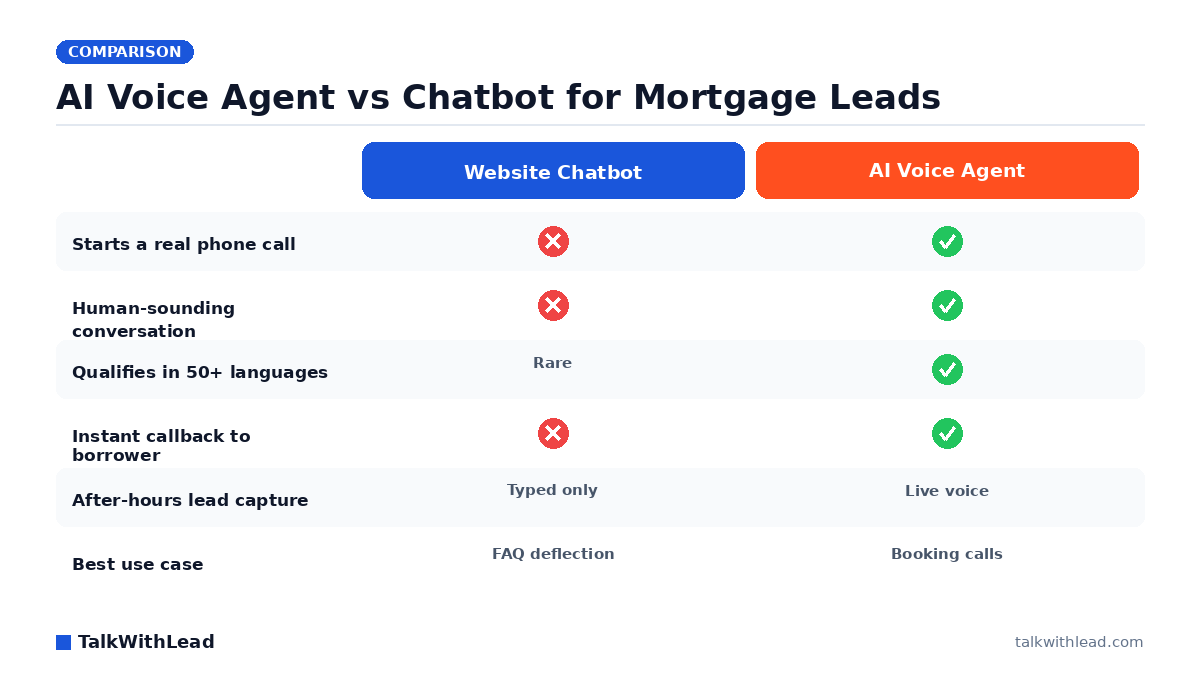
    AI Voice Agent vs Chatbot for Mortgage Leads — TalkWithLead original infographic (comparison diagram).
    AI Voice Agent vs Chatbot for Mortgage Leads

    Why This Choice Decides Who Wins the Loan

    A borrower comparing rates has three broker websites open at once, and the first broker who gets them talking usually gets the application. That is the real stakes behind the ai voice agent vs chatbot for mortgage brokers decision: it is not a software preference, it is a race for the file. Pick the tool that starts a phone conversation fastest and you win more of those races.

    TL;DR: For mortgage brokers, an AI voice agent beats a chatbot because it converts website visitors into live phone conversations instead of typed transcripts. A human-sounding voice agent answers instantly, qualifies borrowers in 50+ languages, and triggers instant callbacks around the clock, while a chatbot leaves the actual call — the moment a mortgage deal really starts — as a follow-up task for later. Chatbots remain useful only for simple FAQ deflection.

    What a Chatbot Actually Does With a Mortgage Lead

    A chatbot is a typing interface. A visitor lands on your rates page at 9:40 pm, opens the widget, and answers a scripted sequence: purchase or refinance, price range, credit band, email, phone. If they finish the script — and many abandon halfway through a form-like exchange — you receive a lead summary. Then the deal waits for a human to call back.

    That gap is the problem. A mortgage is the largest financial decision most people ever make, and typed answers do not build the trust that closes one. Worse, the borrower who just finished your chatbot script is now free to open a competitor’s site — one where a phone rings in the next sixty seconds. The MIT Lead Response Management study found you’re about 21× more likely to qualify a lead contacted within 5 minutes than one contacted at 30 minutes. A chatbot, by design, ends where that 5-minute clock begins.

    What an AI Voice Agent Does Differently

    An AI voice agent skips the transcript and starts the conversation. When a visitor engages the TalkWithLead widget, they talk to an extremely human-sounding AI voice agent — no hold music, no typing, no “an agent will reach out shortly.” The agent asks the same qualifying questions a sharp loan officer would: purchase or refi, timeline, property state, whether they are pre-approved elsewhere. It handles interruptions, follow-up questions, and small talk the way a person does.

    Three capabilities matter specifically for mortgage brokers:

    • 50+ languages. A significant slice of purchase borrowers prefer to discuss a mortgage in Spanish, Hindi, Mandarin, or French. A voice agent that switches languages mid-conversation captures borrowers your English-only chatbot quietly loses.
    • Unlimited long-distance calling. Out-of-state relocation buyers and cross-border investors can reach you — or be called back — without anyone thinking about toll charges.
    • Instant callbacks. A visitor who prefers their own phone gets a call within seconds, while your page is still open in front of them and their intent is at its peak.

    Hearing it is faster than reading about it: try the live demo and judge the voice quality yourself. For the numbers behind why voice outconverts typing, see our breakdown of AI voice agent vs chatbot conversion rates.

    Which Is Better for Mortgage Brokers: AI Voice Agent or Chatbot?

    For lead conversion, the voice agent wins on nearly every dimension a broker cares about. Here is the side-by-side:

    DimensionWebsite ChatbotAI Voice Agent (TalkWithLead)
    First contactTyped script; call happens laterLive phone conversation immediately
    Speed to a real conversationMinutes to days (depends on your follow-up)Seconds, via voice or instant callback
    Borrower trust on a six-figure decisionLow — feels like a formHigh — sounds like a human loan-desk call
    Language coverageUsually English, sometimes a few more50+ languages, switches naturally
    After-hours and weekendsCollects contact info for morning follow-upHolds the full qualifying conversation live
    Out-of-area borrowersNo calling capabilityUnlimited long-distance calling
    Best atDeflecting FAQ questionsBooking qualified phone calls

    Best for: mortgage brokers and loan officers whose website already gets rate-shopper traffic and who close deals over the phone — especially those serving multilingual or relocation borrowers.

    Not the right fit if: your only goal is deflecting routine servicing questions (‘what documents do I upload?’) for existing clients — a simple chatbot or help page handles that more cheaply.

    The Math: What a Faster First Call Is Worth

    Run an illustrative example on your own numbers. Say your site gets 600 visitors a month and 20 of them would talk to someone if talking were effortless. With a chatbot, imagine half abandon the script and half of the rest go cold before your callback — leaving you roughly 5 real conversations. With a voice agent answering instantly, suppose you hold 15 of those 20 conversations. If you convert conversations to funded loans at an assumed 1 in 5, that is 3 loans instead of 1 per month. At a typical broker commission per file, that gap pays for the software many times over — and you can plug in your own figures with our missed-call revenue calculator. These are stated assumptions, not customer results; the point is that the same traffic produces very different outcomes depending on how fast a conversation starts.

    Speed compounds, too. According to Harvard Business Review research, companies that reach a web lead within an hour are nearly 7× more likely to qualify it than those that wait even an hour longer. In a rate-shopping market, first-to-call wins the loan — we cover the mortgage-specific version in Speed to Lead Mortgage: Why First-to-Call Wins the Loan.

    When a Chatbot Still Makes Sense

    An honest comparison names the cases where the cheaper tool is enough. Keep a chatbot if your main need is answering repetitive servicing questions, linking existing clients to document portals, or triaging support tickets. A chatbot can also sit alongside a voice agent: let it handle ‘where do I upload my W-2?’ while the voice agent handles every new purchase and refinance inquiry. What a chatbot should never be is the only path between a high-intent borrower and your phone. Every typed exchange that ends with ‘someone will contact you soon’ is an invitation to call the next broker on the search results page.

    How to Put a Voice Agent on Your Mortgage Site This Week

    Setup is a widget install, not an IT project. Add the TalkWithLead widget to your site, tell the agent what to ask (loan type, timeline, state, preferred language), and route qualified borrowers to your cell or your team line. From that moment, every visitor — 2 pm or 2 am, English or Spanish, local or relocating from three time zones away — can start a real conversation instead of filling out a box.

    Start with the two-minute live demo to hear the agent handle a mortgage-style conversation. Then check pricing — it is a fraction of one funded file — and create your free account to put it on your site before the weekend’s rate shoppers arrive.

    FAQ

    Is an AI voice agent better than a chatbot for mortgage brokers?

    Yes, for lead conversion. A voice agent turns a website visit into a live phone conversation in seconds, which is where mortgage deals are actually won. A chatbot only collects typed answers and defers the call, and the MIT lead-response research shows how sharply qualification odds fall as that delay grows.

    Can an AI voice agent really qualify a mortgage lead?

    It can handle first-contact qualification: purchase vs refinance, timeline, property location, rough price range, and preferred language, then hand the borrower to you as a booked call or instant callback. Licensed advice, rate quotes, and structuring stay with you — the agent’s job is to make sure the conversation happens at all.

    What happens when a borrower visits my site after hours?

    The voice agent answers exactly as it does at noon: it holds the full conversation, qualifies the borrower, and either books a call for the morning or triggers a callback the moment you are available. A chatbot in the same situation leaves a transcript and hopes the borrower is still shopping tomorrow.

    Do AI voice agents work for borrowers who don’t speak English?

    TalkWithLead’s agent converses in more than 50 languages and can switch mid-call. For brokers in multilingual markets, that means Spanish-, Hindi-, or Mandarin-speaking borrowers get qualified in their own language instead of bouncing off an English-only widget.

    Should I remove my chatbot if I add a voice agent?

    Not necessarily. A sensible split is: chatbot for routine servicing questions from existing clients, voice agent for every new purchase or refinance inquiry. If you only keep one, keep the tool that produces phone conversations, because that is the one tied to revenue.

    How much does an AI voice agent cost compared to the leads it saves?

    Plans are published on the TalkWithLead pricing page and cost a fraction of a single funded loan’s commission. Run your own traffic and close-rate assumptions through the ROI framing above: if faster response saves you even one file a quarter, the software pays for itself many times over.
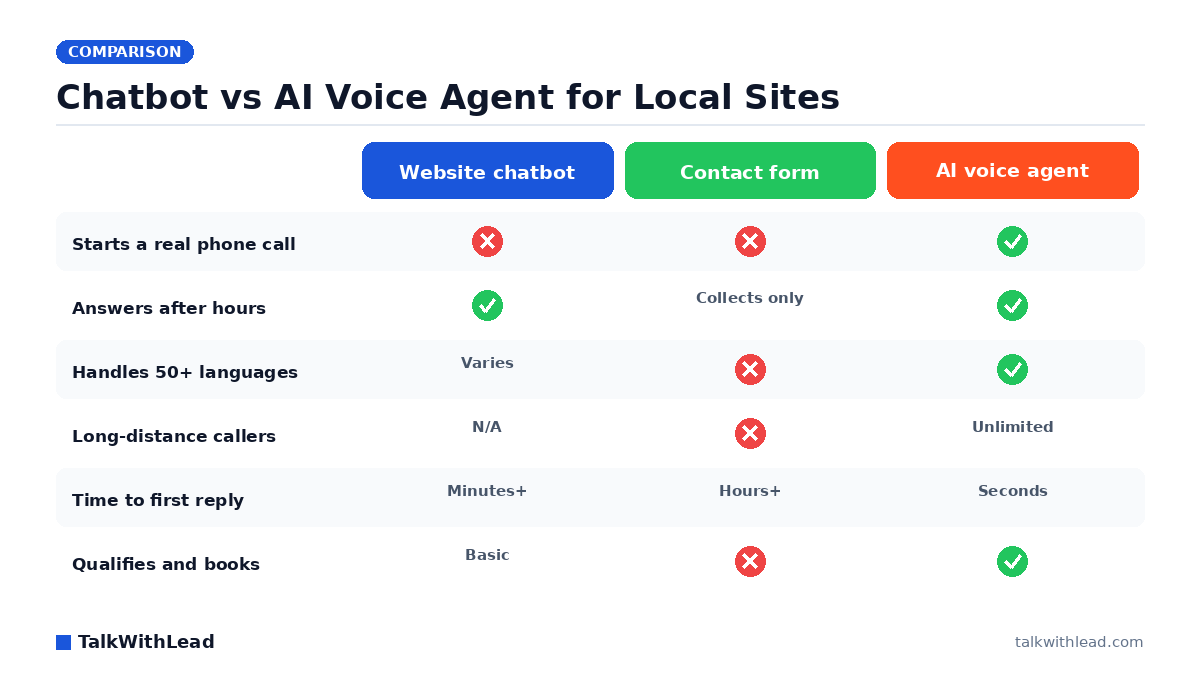
  • AI Voice Agent vs Chatbot for Local Businesses

    AI Voice Agent vs Chatbot for Local Businesses

    Chatbot vs AI Voice Agent for Local Sites — TalkWithLead original infographic (comparison diagram).
    Chatbot vs AI Voice Agent for Local Sites

    A plumber’s website gets a visitor at 8:40pm with a leaking water heater. The chatbot asks for a name and email. The visitor closes the tab and calls the next company on Google. That is the whole argument in one scene.

    TL;DR: For most local businesses, an AI voice agent beats a chatbot because local buying decisions are urgent and conversational. A chatbot captures text and hands you a lead to call back later; an AI voice agent talks to the visitor immediately, answers questions in a human-sounding voice, and connects them to your business as a live phone conversation. Chatbots still earn their keep for order status and repeat-customer FAQs.

    What is the difference between an AI voice agent and a chatbot?

    A chatbot is a text interface. The visitor types, waits, reads, types again. Even a good one is a slow-motion version of a conversation, and every extra turn is another chance for the person to give up. A form is worse — it is a chatbot with no replies at all.

    An AI voice agent is a voice interface that lives on your site. The visitor clicks, speaks, and hears an extremely human-sounding voice answer back. It asks what they need, handles the qualifying questions a receptionist would ask, and turns the session into a real phone conversation — including an instant callback to their phone if they would rather talk that way. No typing, no queue, no “we’ll get back to you within one business day.”

    The distinction matters most for local service businesses, where the buyer usually has a problem right now: a burst pipe, a cracked tooth, an accident, a listing they want to see this weekend.

    Which one books more calls for a local business?

    Speed decides it. According to Harvard Business Review research, companies that reach a web lead within an hour are nearly 7× more likely to qualify it than those that wait even an hour longer. A chatbot transcript sitting in an inbox until morning is exactly the delay that research describes.

    The gap widens because most local businesses cannot answer the phone reliably in the first place. According to a 411 Locals study of 85 small businesses across 58 industries, only 37.8% of incoming calls were answered by a live person — meaning roughly 6 out of 10 calls went unattended. If the phone already leaks that badly, adding a text widget does not plug the hole. Answering the conversation instantly does.

    DimensionWebsite chatbotContact formAI voice agent
    Interaction modeTyped textOne-way submissionSpoken conversation
    Time to first human-quality answerMinutes to hoursHours to next business daySeconds
    After-hours coverageYes, text onlyCollects onlyYes, full conversation
    LanguagesVaries by vendorNone50+ languages
    Out-of-area callersNot applicableNot applicableUnlimited long-distance calling
    Qualifies and books an appointmentBasic scripted flowsNoYes, conversationally
    Best useFAQ and order statusLow-urgency inquiriesNew high-value leads

    Want to see the voice side before you commit to anything? Take the Live Demo and talk to the agent the way a customer would. It takes about two minutes, and it settles the argument faster than any comparison chart.

    How much revenue does the slower option actually cost?

    Here is an illustrative model — your numbers will differ, and the assumptions are stated on purpose. Say a local contractor’s site gets 900 visitors a month and 40 of them start some kind of contact. Assume the chatbot captures 40 typed inquiries but only half get a reply before the person hires someone else, and assume an average job value of $600 with a 25% close rate on reached leads.

    • 20 leads reached × 25% close × $600 = $3,000 booked
    • The other 20 go cold: $3,000 in assumed lost revenue that month

    Now assume voice recovers even half of the cold half — 10 extra conversations, same close rate. That is roughly $1,500 a month recovered under these assumed rates, from traffic already on the site. Plug your own numbers into the free missed-call revenue calculator instead of trusting our example. Cost framing is simple: an AI voice agent generally lands well below the monthly cost of a part-time receptionist, and you can check the current tiers on the pricing page.

    What about customers who do not speak English — or do not live nearby?

    Two silent leaks hit local businesses harder than owners expect. The first is language. A roofing company in a mixed-language neighbourhood loses every caller who is not confident in English, and a chatbot in one language does nothing to fix that. A voice agent that handles 50+ languages picks up those conversations in the caller’s own words — the same pattern covered in bilingual Spanish answering for contractors.

    The second is distance. Out-of-area buyers — a family relocating, an adult child arranging care for a parent, an investor buying a property two provinces away — often will not pay to call, and will not wait on a form. Unlimited long-distance calling removes that friction entirely, which is why voice, languages, and long distance work as a set rather than as separate features.

    When is a chatbot still the right call?

    Chatbots are not useless. They are just aimed at the wrong moment for most local lead generation. Keep the chatbot when the job is deflection rather than conversion:

    • Order and appointment status for existing customers who just want a quick lookup.
    • Repetitive policy questions — hours, service area, parking, what to bring to a first visit.
    • Silent environments, where the visitor genuinely cannot speak: an open-plan office, a hospital waiting room, a late-night browse next to a sleeping baby.
    • High-volume, low-value traffic where a human callback would not pay for itself.

    The strongest setup for most local sites is both, aimed correctly: voice as the primary path for new business, text as the fallback for logistics. If you want the deeper head-to-head on conversion behaviour, read AI voice agent vs chatbot conversion rate.

    Honest verdict

    Best for: local service businesses — contractors, clinics, law firms, real estate agents, med spas, home services — where a single new customer is worth hundreds or thousands of dollars, the buyer is usually in a hurry, and nobody can watch the phone all day.

    Not the right fit if: your visitors are mostly existing customers checking order status, your average order value is small enough that a live conversation costs more than it returns, or your audience genuinely prefers async text (some support-heavy software products fit here). In those cases a well-built chatbot is the cheaper, correct tool.

    How to switch without breaking what already works

    You do not have to rip anything out. Add the voice agent to the pages where high-intent visitors land — service pages, pricing, contact — and leave the chatbot on support and account pages. Watch which one produces booked conversations over two or three weeks and reallocate from there. Local businesses that have already run this play tend to follow the pattern described in this chatbot alternative guide.

    Three things worth setting up on day one: an instant-callback option so hesitant visitors can be called back on their own phone, after-hours coverage so evening and weekend traffic is not wasted, and a short qualifying script so the agent captures the details your team actually needs before the call is handed over.

    If the goal is more calls, more qualified leads, and more sales conversations from traffic you are already paying for, start with the Live Demo, then create your free account and put the voice agent on your busiest page this week.

    FAQ

    Is an AI voice agent better than a chatbot for a small local business?

    For generating new business, yes in most cases. Local buyers usually have an urgent problem and want to talk to someone now, and a voice agent starts that conversation in seconds instead of collecting text you answer later. A chatbot remains useful for status checks and repeat FAQs.

    Does an AI voice agent replace my receptionist?

    It covers the hours and overflow your receptionist cannot — evenings, weekends, lunch breaks, and the moments when everyone is already on a call. Most businesses run both, with the agent catching what would otherwise ring out.

    Will website visitors actually talk to an AI voice agent?

    Many will, because the agent sounds human and answers instantly, which is what they wanted from the phone in the first place. For visitors who cannot speak right then, an instant callback lets them pick the moment instead of abandoning the site.

    What languages can an AI voice agent handle?

    TalkWithLead’s agent converses in 50+ languages, so a caller who is more comfortable in Spanish, French, Punjabi, or Mandarin gets the same quality of conversation as an English speaker without you hiring for each language.

    How much does an AI voice agent cost compared to a chatbot?

    Chatbots are often cheaper per month, but they are priced against a different outcome — deflected questions, not booked jobs. The honest comparison is cost per booked conversation, and current plans are listed on the pricing page.

    Can I keep my chatbot and add a voice agent?

    Yes, and that is usually the smartest first move. Put voice on high-intent pages, leave the chatbot on support and account pages, and compare booked conversations from each over a few weeks before changing anything else.

  • The Three Things an AI Voice Agent Needs to Convert

    The Three Things an AI Voice Agent Needs to Convert

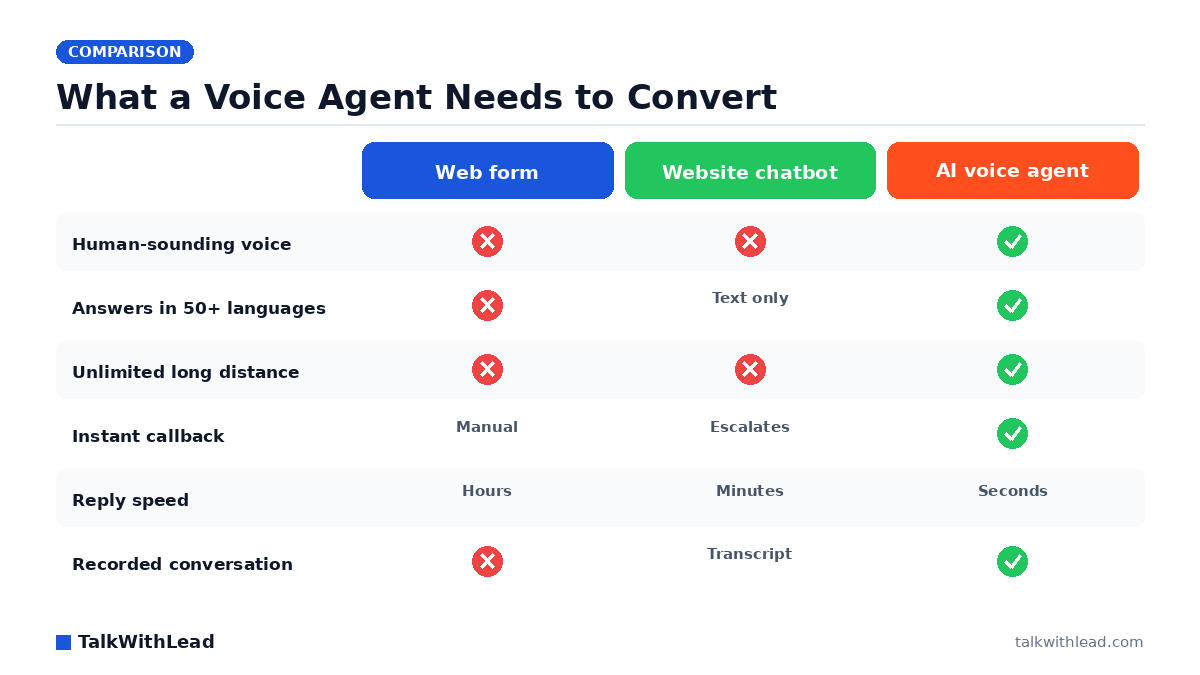
    What a Voice Agent Needs to Convert — TalkWithLead original infographic (comparison diagram).
    What a Voice Agent Needs to Convert

    Most AI voice tools fail for a boring reason: they sound wrong, they only speak one language, or they refuse to dial the caller’s area code. The three things an AI voice agent needs to convert a website visitor are a voice a human will stay on the line for, language coverage that matches the traffic you actually get, and calling that never stops at a border.

    TL;DR: An AI voice agent converts website visitors when it does three things well — speaks with a human-sounding voice that survives the first ten seconds, handles the visitor’s own language across 50+ options, and calls back anywhere without long-distance limits. Miss any one and the conversation ends before your sales team ever hears about it. TalkWithLead ships all three plus instant callbacks.

    What are the three things an AI voice agent needs to convert visitors?

    Strip away the demos and the dashboards. A website visitor converts when a real conversation happens — voice, in their language, on their phone. Everything else is packaging. The three requirements, in order of how fast they kill a lead when missing:

    • A human-sounding voice. The first ten seconds decide whether the visitor talks or hangs up.
    • Real multilingual coverage. A buyer who cannot explain their problem in their own words will not explain it at all.
    • Unlimited long-distance calling. A voice agent that cannot dial the number in front of it is a very expensive voicemail.

    Forms and chatbots fail on all three at once. A form takes text and a promise. A chatbot takes text and stalls. Voice takes the visitor straight to the outcome your business runs on: a phone conversation with someone who was on your pricing page thirty seconds ago.

    Thing one: a voice people do not hang up on

    Robotic prosody is the fastest exit ramp in lead conversion. Flat cadence, no breath, wrong emphasis — buyers recognize it instantly and treat it the way they treat an obvious robocall. Which is to say, they end the call. That is why voice quality belongs in the conversion column of your spreadsheet, not the branding column.

    An extremely human-sounding voice buys you the only thing that matters early: enough seconds for the visitor to say what they came for. Once they are talking, the agent can qualify, answer pricing questions, and book. Once they hang up, nothing downstream helps. Our own comparison of AI voice agents versus chatbots walks through where each one loses the visitor.

    Judge this with your ears, not a feature list. Call the agent yourself, interrupt it mid-sentence, ask something off-script, and listen to how it recovers. You can do exactly that on the TalkWithLead live demo — it takes about a minute and tells you more than any vendor page.

    Thing two: 50+ languages, because your traffic is not monolingual

    Look at your analytics by country and browser language. Unless you sell something hyper-local, a slice of your traffic is reading your English page in their second or third language — well enough to browse, not comfortably enough to negotiate. Those visitors bounce quietly and you log it as “low intent.”

    A voice agent that handles 50+ languages flips that. The visitor clicks, the agent greets them in their language, and the conversation happens at full fluency instead of at translation speed. That is not a nice-to-have in a market where a bilingual competitor is one search result away. We covered the same dynamic in French real estate leads in this breakdown of French-language voice capture.

    Picture a site pulling 4,000 monthly visitors where roughly one in eight prefers a language you do not answer in. Say even a tenth of that group would have booked a call if someone spoke their language — that is a handful of qualified conversations a month, gone, with no trace in your CRM to argue about. Framed math, not a measured statistic, but run it on your own numbers and the shape holds.

    Thing three: unlimited long-distance calling, or you are rejecting buyers by area code

    This is the requirement nobody puts on the shortlist and everybody regrets. Callback systems with metered or region-locked calling quietly decline the numbers that cost the most to dial. The visitor requested a call. Your system decided the call was too expensive. Nobody tells you.

    Unlimited long-distance calling removes that entire failure class. A prospect three time zones or one ocean away gets the same instant callback as someone across town. For anyone selling remotely — SaaS, brokerage, consulting, franchise services — that is not an edge case, it is a meaningful share of pipeline. The same logic drives SaaS demo request conversion on pricing pages, where the buyer’s location is essentially random.

    RequirementWeb formWebsite chatbotAI voice agent
    Human-sounding voiceNoneNoneYes, conversational
    Language coverageOne, as writtenText translation50+ spoken
    Long-distance reachNot applicableNot applicableUnlimited
    Time to first responseHours to daysMinutes, then queuedSeconds
    Output for sales teamForm fieldsChat transcriptLive phone conversation
    After-hours coverageCollects onlyDeflectsAnswers and books

    Why speed is the thread running through all three

    Each requirement exists to protect the same asset: the narrow window where a visitor is still interested. According to Harvard Business Review research, companies that reach a web lead within an hour are nearly 7× more likely to qualify it than those that wait even an hour longer. An agent that sounds human, speaks the visitor’s language, and can dial any number collapses that response window to seconds.

    The failure mode is easy to picture. A visitor fills out a form at 8:40 p.m. Your rep sees it at 9:15 the next morning. By then the visitor has talked to two competitors. Nothing about your product lost that deal — your response time did. That is the same argument we make in why the first 60 seconds win most deals.

    If you want to size the cost for your own business before changing anything, run your numbers through the free missed-call revenue calculator. It uses your inputs and states its assumptions instead of handing you a scary number with no math behind it.

    An illustrative ROI example

    Illustrative scenario, not a customer result. Assumptions are stated so you can swap in your own.

    Assume 3,000 monthly website visitors, an assumed 2% who would take a call if offered instantly (60 conversations), an assumed 25% of those becoming qualified opportunities (15), and an assumed close rate of 20% at an average deal value of $1,500. That works out to 3 closed deals a month, or roughly $4,500 in new revenue from conversations that previously ended as bounces. Change any assumption and the output changes — that is the point of showing the math instead of asserting a result.

    Against that, price the tooling honestly. Voice agent platforms in this category generally land in the tens-to-low-hundreds of dollars per month range depending on volume and features; you can see TalkWithLead’s tiers on the pricing page. The comparison worth making is not agent-versus-nothing, it is agent-versus-the-leads-you-are-currently-losing.

    Best for, and not the right fit if

    Best for: businesses with steady website traffic, a sales process that runs on phone conversations, and buyers spread across regions or languages — brokerages, agencies, clinics, contractors, and SaaS teams with self-serve traffic that needs a human nudge.

    Not the right fit if: your site gets very little traffic, your product genuinely closes without a conversation, or your buyers actively prefer async text and your existing chat already books at a rate you are happy with. A voice agent multiplies existing demand — it does not manufacture it.

    How to evaluate a voice agent in one afternoon

    Skip the feature matrix and test the three requirements directly:

    1. Call it and interrupt it. Talk over the greeting. A human-sounding agent yields; a script barrels on.
    2. Switch languages mid-call. Ask a question in Spanish, French, or Portuguese and hear whether it follows.
    3. Give it a distant number. Request a callback to an out-of-region or international line and confirm the call actually lands.
    4. Test after hours. Run the same three checks at 10 p.m. That is when your competitors’ forms are asleep.
    5. Check the handoff. A booked call is worthless if it does not reach the right person with context.

    If a tool passes all five, it will convert traffic you are already paying for. If it fails the third one, keep looking — long-distance limits are the defect you discover last and pay for longest. For a broader shortlist view, our general buyer’s guide to AI voice agents for small business covers the wider field.

    Ready to put all three on your own site? Start free with TalkWithLead, or try the live demo first and hear the voice your visitors would hear.

    FAQ

    What are the three things an AI voice agent needs to convert website visitors?

    A human-sounding voice that keeps the visitor on the line, spoken coverage across 50+ languages so buyers can talk in their own words, and unlimited long-distance calling so no callback is blocked by geography. Instant callback speed ties the three together.

    Does an AI voice agent really sound human enough to work?

    Modern voice models handle natural cadence, interruptions, and follow-up questions well enough that most visitors simply have a conversation. The honest test is to call one yourself and try to break it — interrupt it, change topics, ask something off-script.

    Why does unlimited long-distance calling matter for lead conversion?

    Metered or region-limited calling silently declines expensive numbers, so out-of-region buyers who requested a call never get one. You lose the lead and never see it in a report. Unlimited calling removes that failure mode entirely.

    Is an AI voice agent better than a chatbot for converting website traffic?

    For anything that closes over the phone, yes — voice reaches the outcome directly instead of collecting text and queuing a human. Chatbots still fit self-serve products with async buyers. Our voice versus chatbot conversion comparison breaks down where each wins.

    How fast should a voice agent call a website visitor back?

    Seconds, not minutes. The visitor is still on the page with the problem fresh in mind. Research on lead response consistently favors the fastest responder, and an AI agent answering instantly is the only way to hit that window at every hour of the day.

    How much does an AI voice agent cost?

    Pricing in this category typically scales with call volume and feature tier, landing in the tens-to-low-hundreds of dollars per month for most small and mid-sized businesses. TalkWithLead’s current tiers are listed on the pricing page.

  • AI Voice Agent vs Chatbot for Insurance Brokers

    AI Voice Agent vs Chatbot for Insurance Brokers

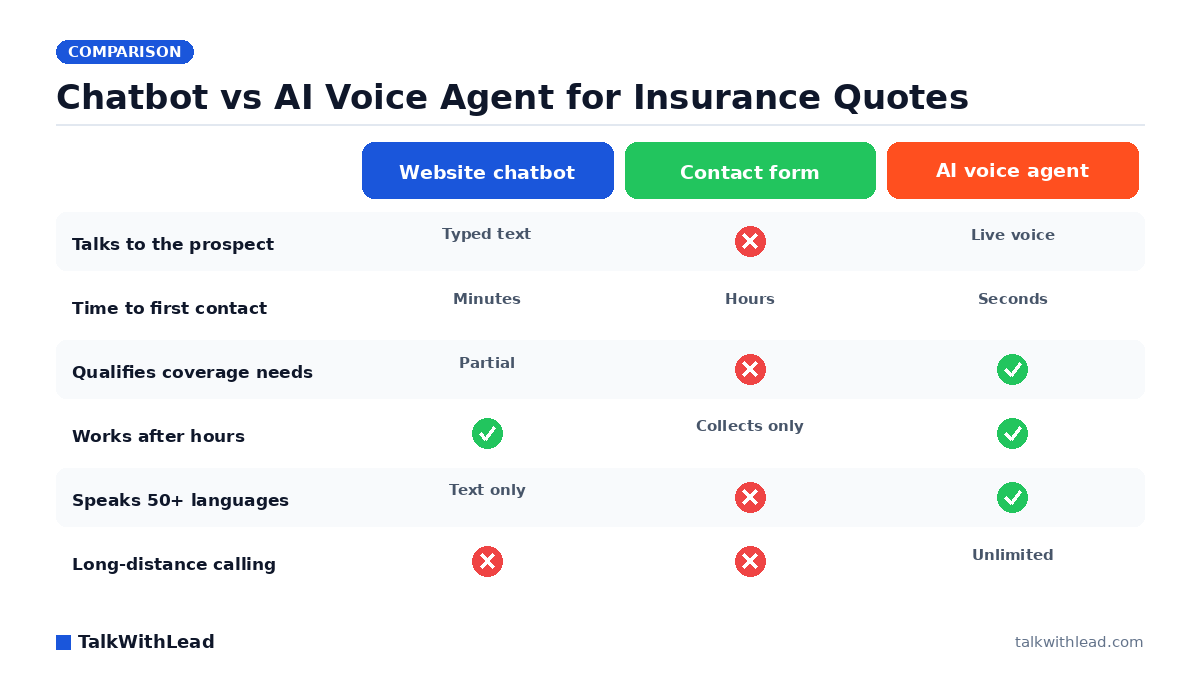
    Chatbot vs AI Voice Agent for Insurance Quotes — TalkWithLead original infographic (comparison diagram).
    Chatbot vs AI Voice Agent for Insurance Quotes

    An insurance shopper lands on your quote page at 8:40 p.m., types three questions into your chat widget, gets a canned answer about “a licensed agent will follow up,” and closes the tab. By morning they have quotes from two other brokers. The choice between an AI voice agent vs chatbot for insurance brokers is really a choice between talking to that person now or emailing them tomorrow.

    Short answer: a chatbot is better at answering policy questions in text; an AI voice agent is better at converting a quote-page visitor into a bound policy. Insurance is a comparison purchase with a short shopping window, so the broker who gets the prospect on the phone first usually wins. Most brokers should run voice as the primary conversion path and keep chat for support-style questions.

    Why insurance leads punish slow follow-up harder than most industries

    Insurance shopping is a session, not a journey. Someone whose renewal notice just arrived opens four or five tabs, requests quotes from each, and takes the first real conversation that happens. Nobody sits patiently waiting for the third broker’s callback on Thursday.

    The research backs the intuition. According to Harvard Business Review research, companies that reach a web lead within an hour are nearly 7× more likely to qualify it than those that wait even an hour longer. For a broker, “qualify” means finding out whether this is a $600 auto policy or a $9,000 commercial package before a competitor does.

    A chatbot does not shorten that window. It parks the lead in a CRM and waits for a human producer to notice. An AI voice agent removes the wait entirely: the visitor clicks, the phone rings, and a human-sounding voice is asking about their current carrier before they have finished reading your homepage. If you want the general version of this argument, we covered it in Speed to Lead: How Fast Should You Call a New Lead?.

    What is the actual difference between an AI voice agent and a chatbot?

    A chatbot is a text interface. It matches what the visitor types against a set of intents or a language model, replies in the chat window, and — at best — captures a name, email, and phone number for someone else to act on later. Everything it accomplishes happens through typing.

    An AI voice agent is a phone conversation that starts from your website. The visitor asks for a call, the agent dials them (or takes an inbound call), and they speak. TalkWithLead’s agent sounds human enough that prospects treat it like an after-hours staffer, handles 50+ languages, offers unlimited long-distance calling so an out-of-state or overseas prospect can talk without a toll charge, and can fire an instant callback the moment someone shows intent on a quote page.

    The practical gap shows up in qualification depth. Ask a prospect to type their current carrier, renewal date, coverage limits, prior claims, vehicle year, and property details and they abandon halfway. Ask the same questions out loud and it takes about ninety seconds.

    DimensionWebsite chatbotStatic quote formAI voice agent
    Contact mediumTyped textSubmitted fieldsLive phone conversation
    Typical time to first human-grade contactMinutes to hoursHours to next business daySeconds
    Depth of qualification capturedName, email, rough intentWhatever fields survive abandonmentCarrier, renewal date, coverage, claims history
    After-hours coverageAnswers, cannot closeCollects onlyAnswers, qualifies, books the producer
    Language coverageText translation, often narrowUsually English-only50+ spoken languages
    Long-distance / out-of-state prospectsN/AN/AUnlimited long-distance calling
    Best atPolicy FAQs, claims status, document lookupLow-cost lead captureConverting quote-page traffic into bound policies

    You can hear the difference faster than you can read about it — the live demo lets you run an insurance-style intake conversation against the agent yourself.

    Which one books more insurance quote calls?

    Voice, for the traffic that matters. Chat wins on volume of interactions; voice wins on volume of conversations with a licensed producer, and only the second one writes policies.

    Consider an illustrative broker site — the numbers below are assumptions for the sake of the math, not measured results. Say the site gets 1,200 visitors a month and 4% start a quote, which is 48 people. Imagine a chat widget captures contact details from 15 of them and a producer reaches 6 by phone over the following days. Now say a voice agent instead puts 20 of those 48 into an immediate call, qualifies 14, and books 9 with a producer. Same traffic, roughly 50% more real conversations — and the conversations happened while the prospect still had your tab open.

    Run your own version of that math with the free speed-to-lead ROI calculator, using your own quote-start rate and average commission per policy. If you would rather size the downside first, the missed-call revenue calculator covers the calls your office already drops.

    What about the calls your agency misses after 5 p.m.?

    Renewal panic is an evening event. So is a fender-bender, a mortgage closing that needs proof of homeowners coverage by morning, and a contractor discovering their certificate expired. Those prospects call, hit voicemail, and dial the next broker.

    A 411 Locals study of 85 small businesses across 58 industries found only 37.8% of incoming calls were answered by a live person — meaning roughly 6 out of 10 calls went unattended. An agency with three producers and no evening staff sits squarely in that pattern.

    An AI voice agent covers the gap without a night shift. It answers, confirms what the caller needs, collects policy details, checks whether the situation is urgent, and either books a morning slot with the right producer or escalates immediately. A chatbot can post office hours; it cannot take an intake. Brokers who want the answering-service framing will find the cost side in AI Receptionist vs Human Answering Service Cost, and the staffing comparison in AI Voice Agent vs Human Receptionist.

    Language coverage is a quiet revenue leak in insurance

    Personal lines skew heavily toward households where English is a second language — new arrivals buying their first auto policy, families insuring a first home, small business owners covering a first storefront. Those buyers overwhelmingly prefer to discuss deductibles and exclusions out loud, in their own language, because the stakes are financial and the vocabulary is technical.

    A translated chat widget handles the words but not the reassurance. A voice agent that speaks 50+ languages does both, and unlimited long-distance calling means a prospect calling from another state or country is not weighing the cost of the call against the value of the quote. For most brokerages this is not a niche — it is a segment competitors are silently handing over.

    Should you drop the chatbot entirely?

    No. Keep it, demote it. A chatbot is genuinely good at the jobs voice handles awkwardly: pulling up a policy document, checking claim status, explaining what an umbrella policy covers, linking a certificate of insurance. Those are reference tasks, and text is the better medium for reference.

    The sensible setup for a broker is voice as the primary path on quote and landing pages, chat as a secondary support surface on service pages and the client portal. Route intent to voice, route lookup to text. We laid out the general version of this split in Chatbot Alternative for Small Business.

    Best for: independent brokers and agencies whose quote pages already get traffic, who lose deals to whoever calls back first, and who have no evening or weekend phone coverage.

    Not the right fit if: your business is almost entirely renewals of existing books with no inbound web traffic, or you are a captive agent whose carrier controls the website and forbids third-party widgets. In those cases the voice agent has nothing to convert.

    What does it cost to add an AI voice agent to a broker website?

    Pricing for this category generally runs from a low monthly subscription for a single-location agency up to per-seat or per-minute plans for multi-office brokerages; current TalkWithLead tiers are on the pricing page.

    Here is a labeled ROI example with stated assumptions. Assume a monthly platform cost of $200. Assume your average bound personal-lines policy earns $180 in first-year commission, and your average small commercial account earns $900. If the agent produces just two extra bound personal policies a month, the tool has roughly covered itself. If it produces one extra commercial account in a quarter, the math stops being close. Your own numbers will differ — the point is that the break-even for a broker sits at a very small number of additional conversations, because insurance commissions recur.

    Installation is a snippet, not a project. You can start free, drop the widget on your quote page, and watch whether visitors who would have typed at a bot start talking to a producer instead. Then compare the two side by side using AI Voice Agent vs Chatbot Conversion Rate.

    FAQ

    Is an AI voice agent better than a chatbot for an insurance brokerage?

    For converting quote-page visitors, yes. Insurance buyers compare several brokers in one sitting, and a voice agent reaches them within seconds while a chatbot hands off to a producer who calls later. For policy-document lookups and claims-status questions, a chatbot is the better tool.

    Most brokerages get the best result running both: voice on quote and landing pages, chat on service and portal pages.

    Can an AI voice agent actually qualify an insurance lead?

    It can capture the fields a producer needs to price and prioritize: coverage type, current carrier, renewal date, prior claims, and vehicle or property basics. Spoken answers take about ninety seconds where the same questions in a form cause abandonment.

    Binding, underwriting judgment, and advice stay with your licensed producers. The agent’s job is to make sure the producer is talking to a warm, pre-qualified prospect instead of chasing a stale email address.

    Will prospects realize they are talking to an AI?

    The voice is close enough to human that most callers treat it as an after-hours staff member, and it can identify itself when your compliance policy requires it. What prospects notice more is that someone picked up at 9 p.m. instead of nobody.

    How fast should an insurance broker respond to a web quote request?

    Within minutes, and preferably within seconds while the prospect is still on the page. The MIT Lead Response Management study found you’re about 21× more likely to qualify a lead contacted within 5 minutes than one contacted at 30 minutes — a gap that matters enormously when the shopper has four other tabs open.

    Does it work for commercial lines, not just personal auto and home?

    Yes, and the economics are stronger there. Commercial prospects are harder to reach by email and their accounts carry far higher commission, so a single extra booked conversation covers a lot of subscription cost. The agent qualifies on business type, payroll or revenue band, existing coverage, and renewal timing, then routes to the right producer.

    Can it handle Spanish-speaking and out-of-state prospects?

    It speaks 50+ languages, so a Spanish-speaking household discusses deductibles in Spanish rather than fighting a translated text widget. Unlimited long-distance calling means a prospect in another state or country can have the conversation without worrying about the cost of the call.

  • SaaS Demo Request Conversion for SaaS Pricing Pages

    SaaS Demo Request Conversion for SaaS Pricing Pages

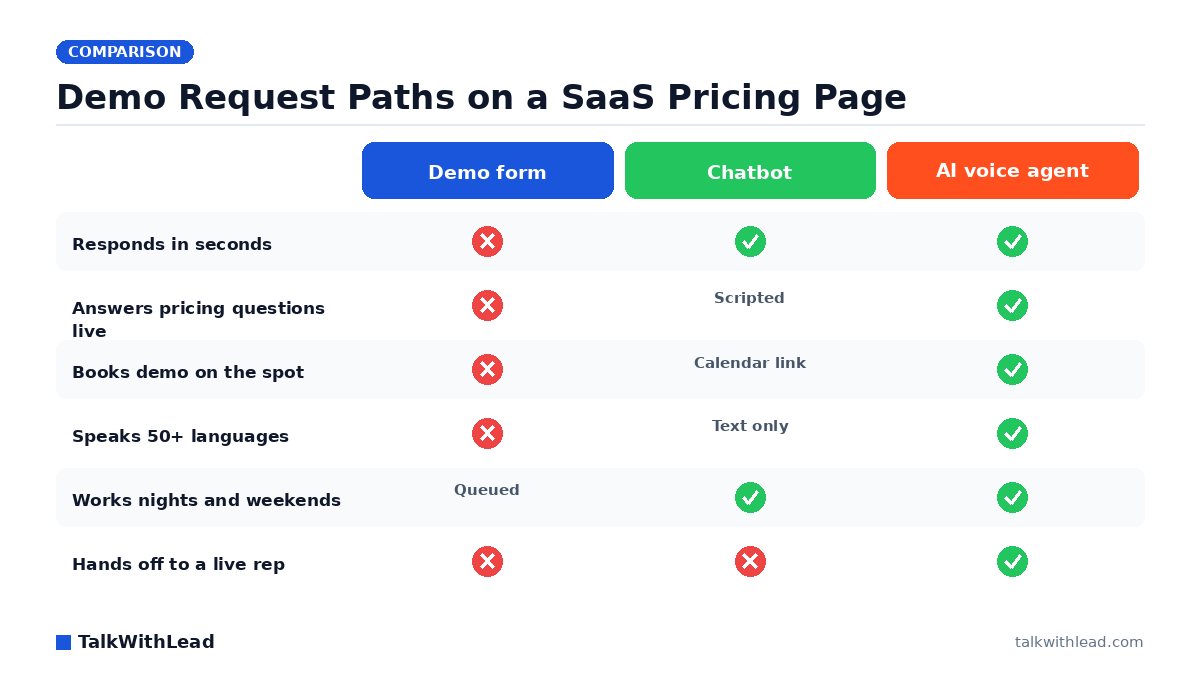
    Demo Request Paths on a SaaS Pricing Page — TalkWithLead original infographic (comparison diagram).
    Demo Request Paths on a SaaS Pricing Page

    Your pricing page is the most valuable real estate you own. Someone scrolling your tiers has already read the homepage, sized up a competitor, and started doing mental math on seats. Then they hit a “Request a demo” form, type their work email, and wait — and saas demo request conversion quietly dies in a queue.

    TL;DR: SaaS demo request conversion improves most when a pricing-page visitor can start a real conversation immediately instead of submitting a form and waiting. An AI voice agent picks up in seconds, answers pricing and fit questions in plain language, qualifies the buyer, and books the demo on the calendar before that visitor opens a competitor’s tab.

    Why do so few pricing-page visitors request a demo?

    Not because your product is unclear. Because the only action you offer is a delay. A demo form is a promise that someone will get back to them — later, on your schedule, after they have already asked three vendors the same question.

    Buyers on a pricing page have specific, blocking questions: does this scale past 50 seats, is SSO in the mid tier, what happens to our data on cancel. A form cannot answer any of them. A chatbot answers about half, badly, then drops a calendar link. Meanwhile the deal is being decided by whoever picks up first — research popularized by InsideSales / Dr. James Oldroyd found that roughly 35-50% of sales go to the company that responds first.

    Picture a SaaS site with 2,000 pricing-page sessions a month and 40 demo requests. Say even 1 in 10 of the visitors who left without acting would have talked to a human if one had been available in that moment — that is 196 conversations you never had, from traffic you already paid for.

    What actually moves saas demo request conversion?

    Three things, in order of impact:

    • Time to first human-quality response. Minutes, not hours. Harvard Business Review research found companies that reach a web lead within an hour are nearly 7× more likely to qualify it than those that wait even an hour longer.
    • Answering the blocking question. A buyer who cannot confirm fit will not book time with a rep. Resolve the objection and the demo request becomes obvious.
    • Removing the scheduling gap. Every step between “I’m interested” and “it’s on my calendar” leaks buyers.

    Voice collapses all three into one motion. The visitor clicks, an extremely human-sounding AI voice agent answers on the spot, handles the pricing question, confirms company size and use case, and drops the demo straight onto an AE’s calendar. No inbox round-trip. You can hear how that sounds on the TalkWithLead live demo.

    Form vs chatbot vs AI voice agent on a pricing page

    DimensionDemo request formWebsite chatbotAI voice agent
    Response timeHours to next business dayInstant, text onlySeconds, live conversation
    Handles pricing objectionsNoScripted answers onlyYes, conversationally
    Qualifies the buyerFields onlyBasic branchingNatural back-and-forth
    Books the demoRep does it laterCalendar link handoffBooks on the call
    Non-English buyersForm language onlyTranslated text50+ spoken languages
    International callersN/AN/AUnlimited long-distance
    After hoursQueuedAnswers, rarely booksAnswers and books

    Best for: SaaS teams with real pricing-page traffic, a sales-assisted motion, and an AE calendar that has open slots being wasted on no-shows and slow follow-up.

    Not the right fit if: you are pure self-serve with no demo motion at all, or your ACV is low enough that a phone conversation costs more than the account is worth.

    How fast should you respond to a demo request?

    Inside five minutes, and ideally inside five seconds. The MIT Lead Response Management study found you’re about 21× more likely to qualify a lead contacted within 5 minutes than one contacted at 30 minutes. Most SaaS teams cannot staff that window — someone is in a demo, it is 7pm in Berlin, it is Saturday.

    That is the gap an AI voice agent fills. It never queues. It answers the 2am pricing question from Singapore in the caller’s own language, and it stays on the line long enough to book. The same speed logic that drives how fast you should call a new lead applies with more force on a pricing page, because intent is at its peak right there.

    A labeled ROI example for a mid-market SaaS

    This is an illustrative model, not a customer result. Assume:

    • 2,000 pricing-page sessions per month
    • 2% currently request a demo → 40 requests
    • 30% of requests become held demos → 12 demos
    • 20% of held demos close → 2.4 new accounts
    • Assumed ACV: $9,000

    Now assume instant voice capture lifts demo requests from 2% to 3.2% and, because the AI qualifies and books live, held-demo rate rises from 30% to 45%. That is 64 requests, 28 held demos, 5.6 closes — roughly $28,800 in additional new ACV per month under those stated assumptions. Change any input and the math changes; the point is that the lever is the first sixty seconds, not the sales deck. Run your own numbers with the free speed-to-lead ROI calculator.

    Cost framing, plainly: an AI voice layer on a SaaS site typically lands well under the fully-loaded cost of a single SDR shift, and it covers every hour of the week. See current tiers on the TalkWithLead pricing page.

    How to wire voice into your pricing page without breaking the funnel

    Keep the form. Add a faster path beside it.

    1. Put the voice widget on pricing, feature, and comparison pages first — the pages where intent is highest, not the blog.
    2. Give the agent your real pricing logic. Tiers, seat minimums, what is gated, what is negotiable. Vague answers kill trust faster than silence.
    3. Define the qualification bar. Company size, use case, timeline. Above the bar, transfer live to an AE; below it, book a group demo or route to self-serve.
    4. Enable instant callback for visitors who would rather not talk in an open office — they enter a number, the agent calls back in seconds.
    5. Measure demo requests per pricing-page session and held-demo rate. Raw form fills will understate the lift because voice conversations do not create form fills.

    Teams switching away from text-first tools usually recognize the pattern described in our AI voice agent vs chatbot conversion comparison, and the same widget mechanics covered in callback widget vs click-to-call vs live chat apply directly to a SaaS pricing page.

    What about buyers who are not ready to talk?

    Some are not, and forcing them wastes both sides’ time. A good voice layer offers the conversation, accepts a no, and captures a callback time instead. The visitor picks the moment; the agent calls then. You lose nothing and you learn who is browsing versus buying.

    The trap is the opposite failure — assuming nobody wants to talk because nobody ever could. Most SaaS sites have never offered a real-time voice option, so “our buyers prefer async” is usually an untested assumption about a button that does not exist. Test it for a month on the pricing page. Start free and point it at your highest-intent page.

    FAQ

    What is a good demo request conversion rate for a SaaS pricing page?

    It varies widely by ACV and traffic quality, so treat any single benchmark carefully. The more useful measure is your own trend: demo requests divided by pricing-page sessions, tracked monthly, alongside the percentage of those requests that turn into demos actually held.

    Will an AI voice agent annoy enterprise buyers?

    Not when it is honest and useful. The agent sounds human, answers the pricing question directly, and hands off to a real AE when the deal warrants it. Buyers dislike being stalled far more than they dislike being helped quickly.

    Can an AI voice agent qualify leads before booking a demo?

    Yes. You set the qualification criteria — company size, use case, budget range, timeline — and the agent works them into a natural conversation, then books only the buyers who clear the bar. Everyone else gets a self-serve trial or a group session.

    How does this work for international SaaS traffic?

    The agent speaks 50+ languages and unlimited long-distance calling is included, so a prospect in São Paulo or Warsaw gets the same instant conversation as one in Chicago. No regional phone numbers to provision, no time-zone staffing plan.

    Does adding voice mean removing our demo form?

    No. Keep the form for buyers who prefer async. Voice runs beside it as the fast path, which is why raw form-fill counts alone will understate the impact — track total booked demos instead.

    How long does it take to set up on a pricing page?

    It is a script tag plus the pricing and qualification rules you feed the agent. Most teams point it at the pricing page first, watch a week of transcripts, tighten the answers, then expand to feature and comparison pages. You can hear the agent yourself on the live demo.

  • Dental Clinic Patient Callback for Dentists: After Hours

    Dental Clinic Patient Callback for Dentists: After Hours

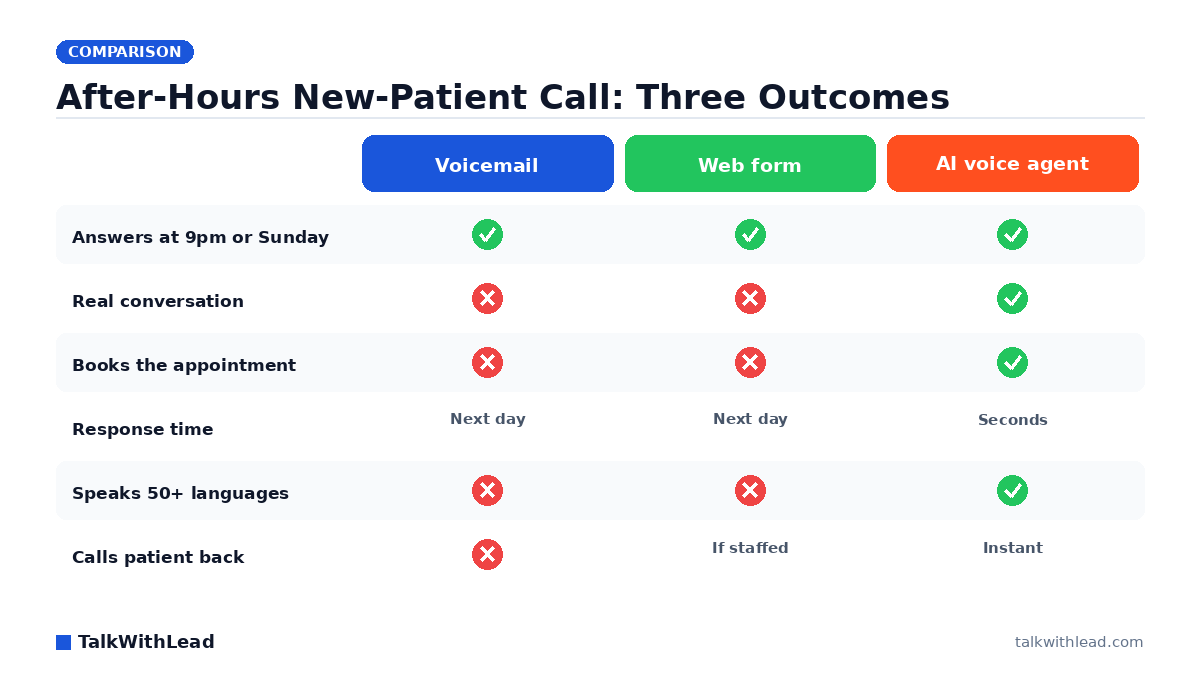
    After-Hours New-Patient Call: Three Outcomes — TalkWithLead original infographic (comparison diagram).
    After-Hours New-Patient Call: Three Outcomes

    Your front desk is one person with two hands, a check-out line, and a phone that rings hardest at the exact moment they are seating a patient. Every call that rolls to voicemail after 5pm is a new patient with a sore molar dialing the next practice on Google. A dental clinic patient callback system fixes that gap without hiring a night receptionist.

    TL;DR: A dental clinic patient callback system answers the call your front desk can’t — after hours, during lunch, or when both lines are busy — using a human-sounding AI voice agent that talks to the caller, captures their name, insurance, and reason for visiting, and books or confirms the appointment. It responds in seconds instead of the next business morning, which is when most new-patient calls are won or lost.

    Why dental front desks lose new patients at exactly the wrong moment

    Dental phone traffic clusters into the worst possible windows. Early morning before staff arrive. Lunch. The 5pm-to-9pm stretch when someone finally sits down and admits the pain isn’t going away. Weekends after a cracked filling. Your team isn’t slow — they’re outnumbered.

    The cost is invisible because nothing breaks. No error message. No angry email. The caller just hangs up, taps the next listing, and becomes someone else’s patient for the next decade. According to a 411 Locals study of 85 small businesses across 58 industries, only 37.8% of incoming calls were answered by a live person — meaning roughly 6 out of 10 calls went unattended. Dental practices, with one or two people covering intake, check-in, check-out, and insurance verification, are squarely in that pattern.

    The math is what stings. Picture a practice fielding 40 new-patient calls a month and missing a third of them. Say even a quarter of those missed callers would have booked, at an assumed first-year value of $900 per new patient. That’s roughly three lost patients and $2,700 a month — walking out through a phone line nobody answered. Run your own numbers with the free missed-call revenue calculator.

    What is a dental clinic patient callback, exactly?

    It’s a system that catches the call or the website visit your team can’t get to, then puts a real voice on the line within seconds. Not a chat bubble. Not a “we’ll get back to you within one business day” form receipt. A phone conversation.

    With TalkWithLead, a visitor on your site taps the widget and the AI voice agent calls them back immediately — or answers your overflow line directly. The agent sounds human, asks the questions your front desk would ask, and hands your team a clean summary in the morning: name, callback number, chief complaint, insurance carrier, preferred time. If you’ve compared the older options, the difference is stark against a live chat or chatbot setup, where the patient still has to type and still has to wait.

    • Answers in seconds, at 10pm on a Saturday as readily as 10am on a Tuesday.
    • Speaks 50+ languages, so a Spanish-speaking parent booking a child’s cleaning doesn’t hit a wall.
    • Unlimited long-distance calling, so a patient relocating from out of state can be called back with no per-minute anxiety.
    • Books, confirms, and reschedules instead of just collecting a message.

    You can hear how it handles a real conversation on the live demo — call it yourself and try to trip it up.

    How fast does a dental practice have to respond to a new-patient inquiry?

    Faster than most practices think, and faster than any human front desk can sustain across a full week. The MIT Lead Response Management study found you’re about 21× more likely to qualify a lead contacted within 5 minutes than one contacted at 30 minutes. A dental inquiry is even more time-sensitive than a typical web lead, because pain has its own clock.

    Think about what a patient with a throbbing tooth does at 8:40pm. They search. They call. If nobody picks up, they call the next number in the results within about ninety seconds. There is no nurture sequence that wins that patient back. The only variable you control is whether a voice answers on the first attempt. That’s the same principle behind speed to lead in every other industry — dentistry just has a shorter fuse.

    AI voice agent vs. voicemail vs. answering service: what actually books patients

    Practices generally choose between four things. Here’s how they compare on the dimensions that decide whether a new patient shows up in your chair.

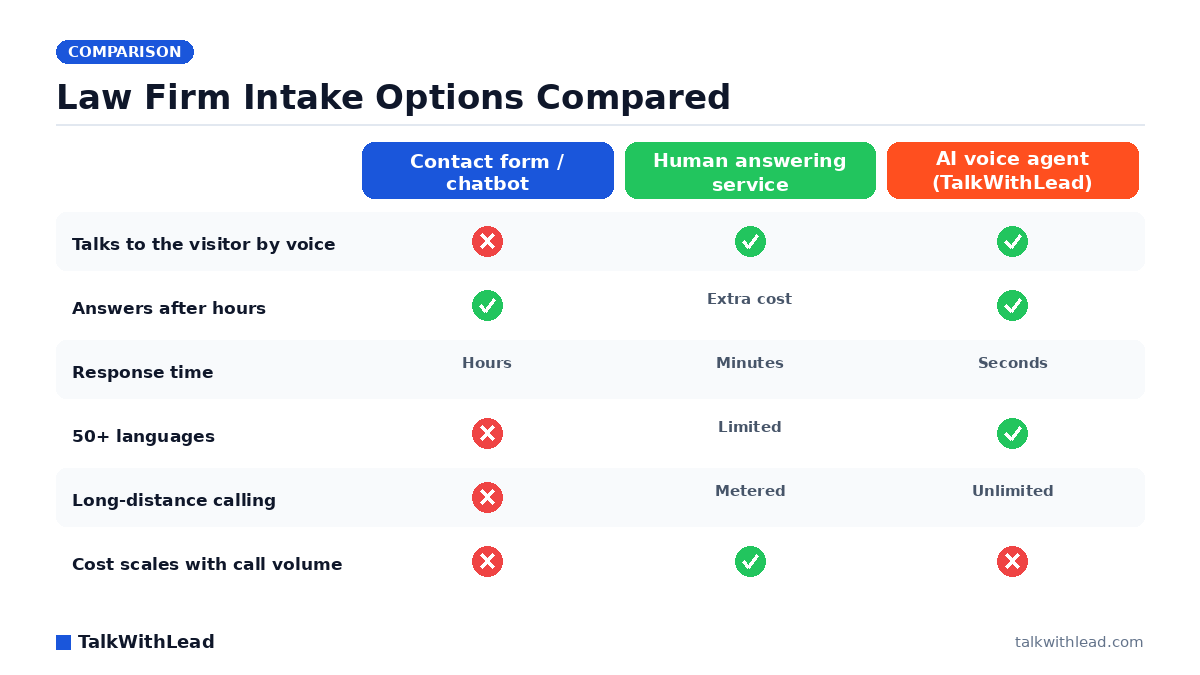
    CapabilityVoicemailWeb formHuman answering serviceTalkWithLead AI voice agent
    Available nights and weekendsYesYesUsually, at a premiumYes, always
    Two-way conversationNoNoYesYes
    Typical response timeNext business dayNext business daySeconds to minutesSeconds
    Handles simultaneous callersYes, poorlyYesLimited by staffingUnlimited
    Languages coveredNoneWhatever you translateOften English only50+
    Knows your hours, insurance list, servicesNoNoScript-dependentYes, configured
    Cost modelFreeFreePer minute or per callFlat monthly
    Long-distance callbacksN/AN/AOften billed extraUnlimited

    Human answering services do one thing genuinely well: empathy on a complicated call. They also bill by the minute, which quietly punishes you for a busy month. We broke that tradeoff down in detail in AI receptionist vs. human answering service cost.

    Best for: general, family, and cosmetic dental practices with one or two front-desk staff who are losing after-hours and overflow calls and want every new-patient inquiry answered by a voice within seconds.

    Not the right fit if: you’re a specialist referral practice where nearly all new patients arrive through referring dentists rather than the phone, or you already run a fully staffed 24/7 call center and your abandon rate is near zero.

    What the AI should handle — and what it should hand to a human

    Don’t hand the AI your clinical judgment. Hand it the repetitive intake work that consumes your front desk and stalls after 5pm.

    Let the voice agent own these:

    • New-patient intake: name, phone, email, reason for visit, referral source.
    • Scheduling, rescheduling, and confirming appointments.
    • Hours, location, parking, first-visit expectations.
    • Which insurance carriers you accept and what a self-pay exam runs.
    • Collecting details on a possible emergency and immediately alerting the on-call dentist.

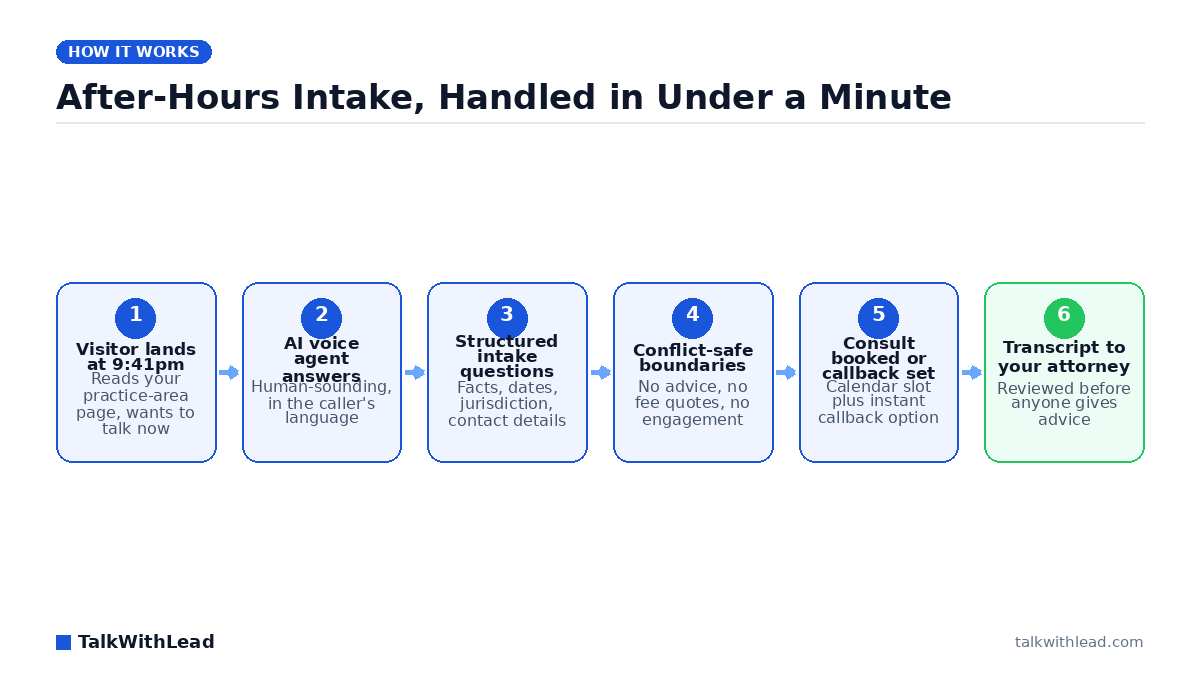
    Route to a human: active dental emergencies needing clinical triage, treatment-plan and sedation questions, billing disputes, and any caller who asks to speak to a person. A good system escalates without an argument. That boundary is the same one law firms draw for after-hours intake — see law firm intake automation for how the escalation pattern works in a comparable high-stakes vertical.

    An illustrative ROI example for a two-operatory practice

    The following is an illustrative scenario using stated assumptions, not data from a real practice.

    Assume 60 inbound calls a month, of which 22 are new-patient inquiries. Assume 8 of those 22 arrive outside staffed hours or while both lines are busy. Assume the AI voice agent converts 4 of those 8 into booked appointments, and 3 of the 4 actually show. At an assumed $900 first-year patient value, that’s $2,700 a month recovered from calls that previously produced nothing. Against a flat monthly subscription, the system pays for itself on the first recovered patient and the rest is margin.

    Change any assumption you disagree with — the conversion rate, the patient value, the missed-call count — and the shape holds. You are comparing “a voice answered” against “nobody answered.” See what the flat monthly cost looks like on the pricing page, then plug your own numbers into the speed-to-lead ROI calculator.

    Setting it up without disrupting the front desk

    The rollout that works best is boring and incremental. Start with overflow and after-hours only, so nothing your team currently handles changes on day one.

    1. Add the callback widget to your site. Visitors on your new-patient and emergency-dentist pages get an instant call instead of a form.
    2. Forward the practice line after hours and when both lines are busy. Your daytime workflow stays exactly as it is.
    3. Load the agent’s knowledge: hours, accepted carriers, services, new-patient exam pricing, parking, and your emergency protocol.
    4. Set escalation rules: which situations text or call the on-call dentist immediately.
    5. Review transcripts weekly for the first month. Every awkward answer becomes a knowledge update.

    Practices comparing vendors at this stage usually want the shortlist — best AI receptionist for dental offices covers who’s worth a demo. When you’re ready to try it on your own line, start free and point your after-hours forwarding at it this week.

    FAQ

    What is a dental clinic patient callback system?

    It’s a service that answers calls or website requests your front desk can’t reach and immediately calls the patient back with a live conversation. With an AI voice agent, the callback happens in seconds instead of the next business day, and the agent can book the appointment on the spot rather than just taking a message.

    Can an AI voice agent actually book dental appointments?

    Yes. The agent collects the caller’s name, number, insurance, and reason for visiting, offers open times based on the rules you set, and confirms the booking. Anything it isn’t configured to decide — clinical triage, sedation questions, billing disputes — gets escalated to your team or the on-call dentist.

    Will patients know they’re talking to an AI?

    The voice sounds human, and most callers focus on getting an appointment rather than identifying who’s speaking. You control disclosure: many practices have the agent identify itself as a virtual assistant for the practice up front, which sets expectations and still books the visit.

    How much does an AI answering service cost for a dental office?

    TalkWithLead runs on a flat monthly subscription rather than per-minute billing, so a busy month doesn’t produce a surprise invoice, and long-distance callbacks are included. Current tiers are listed on the pricing page. Compare that against per-minute human answering services, where costs scale with exactly the call volume you were hoping to grow.

    Does it handle Spanish-speaking and other non-English patients?

    Yes — the voice agent handles conversations in 50+ languages, so a caller who would have hung up on an English-only voicemail gets a real conversation and a booked appointment instead.

    What happens during a real dental emergency after hours?

    You define the escalation rules. The agent recognizes the situations you flag as urgent, collects the essential details, and immediately alerts your on-call dentist by call or text while giving the patient clear instructions. Routine scheduling stays with the agent so your on-call line only rings for things that matter.

    How long does setup take?

    Most practices start with after-hours and overflow forwarding plus the website callback widget, which is a same-week change. Loading hours, insurance carriers, and services into the agent’s knowledge takes an afternoon, and the first month of transcript reviews is where it gets sharp. Try it live on the demo line before you commit.

  • Chatbot Alternative for Small Business: For General Sites

    Chatbot Alternative for Small Business: For General Sites

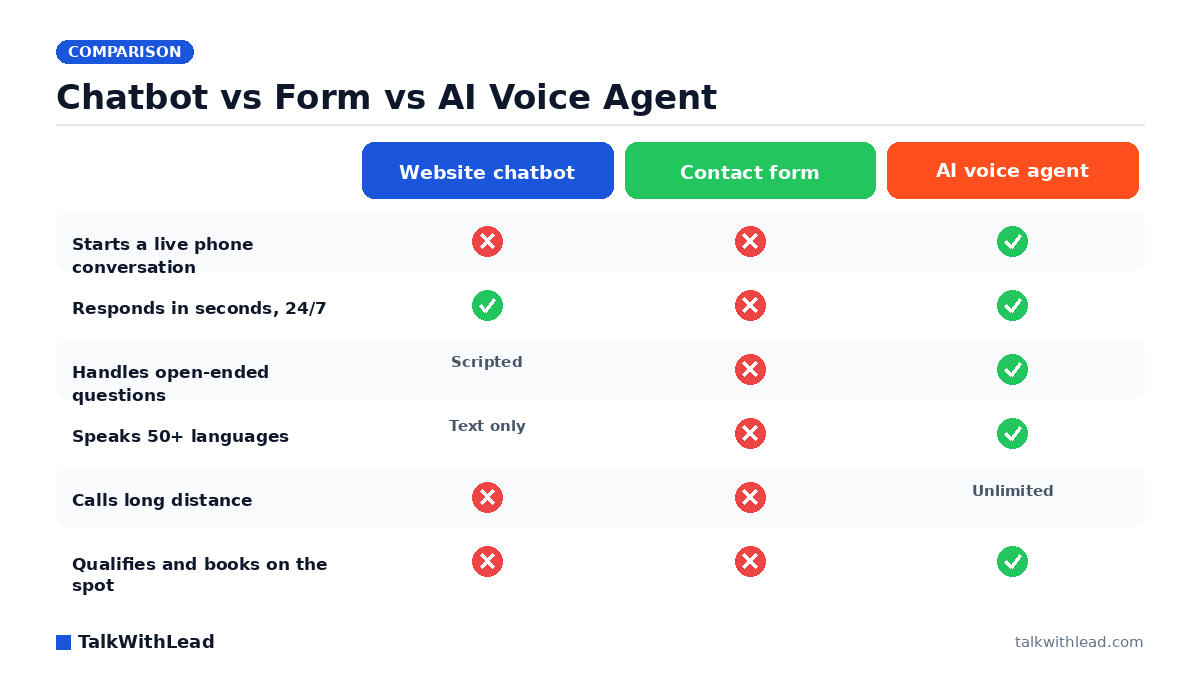
    Chatbot vs Form vs AI Voice Agent — TalkWithLead original infographic (comparison diagram).
    Chatbot vs Form vs AI Voice Agent

    Why your chatbot is quietly costing you calls

    A homeowner with a flooded basement does not want to type. A person comparing law firms at 9pm does not want a drip of scripted bubbles. They want somebody on the phone, right now — and the moment your bot asks for an email instead, they open the next tab. That is the real case for a chatbot alternative for small business websites.

    TL;DR: The best chatbot alternative for a small service business is an AI voice agent that offers the visitor an instant callback and holds a real spoken conversation — answering questions, qualifying the job, and booking the appointment while the visitor is still on the page. Chatbots collect text and hand you a lead to chase later; voice closes the gap between interest and conversation to seconds.

    Chatbots are not useless. They are just aimed at the wrong job. They were built for support deflection at companies with thousands of repeat questions. Service businesses have the opposite problem: low volume, high value, and a buyer who decides in minutes.

    What is the best chatbot alternative for a small business website?

    An AI voice agent. Instead of a text widget, the visitor sees an offer to talk. They enter a number (or click to connect), and a human-sounding AI voice agent calls them within seconds — greets them by business name, asks what they need, answers pricing and availability questions, and books the appointment or hands off to your team.

    The mechanics matter more than the label. Three things separate voice from every text-based widget:

    • It initiates. Nobody waits for a callback that arrives days later. The call fires while the tab is still open.
    • It absorbs mess. “I’ve got a leak under the sink but I rent, does that change anything?” breaks a decision tree. It does not break a conversation.
    • It removes friction the buyer never mentions. 50+ languages, so a Spanish-speaking caller is not filtered out by an English-only form. Unlimited long-distance calling, so a lead two provinces away is worth the same as one down the street.

    Curious what it sounds like before you read another word? Try the live demo and have the agent call you.

    Chatbot vs form vs AI voice agent: a side-by-side

    DimensionWebsite chatbotContact formAI voice agent
    Time to real conversationMinutes to hoursHours to daysSeconds
    ChannelTextEmailLive phone call
    Handles off-script questionsPoorlyNot at allYes
    After-hours coverageYesCollects onlyYes, answers and books
    Language coverageText translationNone50+ spoken languages
    Long-distance leadsN/AN/AUnlimited calling
    Best jobExisting-customer supportLow-intent inquiriesConverting new buyers

    Read that middle row again. For a service business, “handles off-script questions” is most of the conversation. Buyers ask about their specific driveway, their specific custody case, their specific insurance. A bot that can only route to five intents sends them to a form — which is where the lead goes cold. We broke the underlying conversion mechanics down further in AI Voice Agent vs Chatbot Conversion Rate.

    How fast do you actually have to respond?

    Faster than feels reasonable. The MIT Lead Response Management study found you’re about 21× more likely to qualify a lead contacted within 5 minutes than one contacted at 30 minutes. And research popularized by InsideSales / Dr. James Oldroyd found that roughly 35-50% of sales go to the company that responds first.

    Now compare that to how a chatbot lead actually moves through a small business. Visitor types a question at 7:40pm. Bot captures a name and email. The transcript lands in an inbox. Somebody sees it at 9:15 the next morning and calls at 11. That is roughly fifteen hours — and in a competitive service category the buyer has already spoken to two other companies.

    Here is illustrative math, with the assumptions stated plainly. Say your site gets 900 visitors a month and 3% show real buying intent — that’s 27 potential conversations. Imagine your chatbot converts a third of those into typed leads (9), and you reach half of them by phone before they hire someone else (roughly 4-5 conversations). If a voice agent instead put even 15 of those 27 straight onto a live call, you’d triple your conversation count without adding a single visitor. Plug your own numbers into the missed-call revenue calculator rather than trusting mine.

    Where chatbots genuinely lose service buyers

    Four failure points show up again and again on service-business sites:

    1. The typing tax. Someone on a phone, one-handed, in a parking lot, will not type six lines describing their problem. They’ll call a competitor who has a number in the header.
    2. The script wall. Every scripted bot has a boundary. Hit it and the buyer gets “Let me connect you with someone” — which means a form.
    3. The language filter. A text bot in English silently excludes anybody who’d rather explain the problem out loud in their own language. You never see those lost leads in analytics.
    4. No qualification. A transcript tells you someone asked about pricing. A call tells you it’s a 3-bedroom re-roof, insurance claim, needed in two weeks.

    Voice fixes all four at once because it changes the medium, not just the model. That is also why swapping one chatbot vendor for a smarter chatbot vendor rarely moves booked jobs. We covered the same trade-off from the chat side in Live Chat vs Chatbot: Pros, Cons, and the AI Voice Upgrade.

    Honest verdict: is an AI voice agent right for you?

    Best for: service businesses where a single new customer is worth hundreds or thousands of dollars and the sale starts with a phone conversation — contractors, clinics, law firms, agencies, real estate, insurance, home services. If your team already tries to call every web lead and keeps losing on speed, this is the fix.

    Not the right fit if: your product is self-serve and low-ticket, your buyers deliberately avoid the phone, or most of your inbound volume is existing customers asking “where’s my order?” Keep a chatbot or a help center for those. Voice earns its keep on new revenue, not on support deflection.

    Plenty of businesses run both: chat on the docs and support pages, voice on the homepage, service pages, and pricing page where buying decisions happen. That split usually beats picking a side.

    What it costs, and how to think about payback

    Plans are published openly — see TalkWithLead pricing — and land in the range of a modest monthly software subscription rather than a per-minute answering-service bill that scales with your busy season. For a broader cost frame, the AI receptionist vs human answering service cost comparison lays out both models.

    The payback question is simpler than it looks. Take your average job value, decide how many extra booked jobs a month would cover the subscription, and ask whether catching the buyers your chatbot currently hands to a form gets you there. For a roofer at a $9,000 average job, one recovered job a year likely pays for several years of the tool. For a clinic at $180 a visit, the number of recovered bookings has to be higher — so run your own math instead of accepting the headline.

    Setup is the part people overestimate. The widget drops onto WordPress or any site, the agent gets your services, hours, and service area, and it starts calling visitors. You can start free and watch it handle real traffic before you change anything else, or hear the voice agent first if you want proof before signup.

    FAQ

    What is the best chatbot alternative for a small business website?

    An AI voice agent that calls website visitors within seconds and holds a spoken conversation. It replaces the typing-and-waiting loop of a chatbot with an actual phone call, which is how most service buyers prefer to make a decision.

    The practical test: if your revenue depends on booked appointments rather than answered support tickets, voice is the better fit.

    Are chatbots bad for service businesses?

    Not bad — mismatched. Chatbots excel at deflecting repeat support questions for companies with high ticket volume. Service businesses have fewer, higher-value inquiries where speed to a live conversation decides who wins the job, and a text widget adds a step instead of removing one.

    Can an AI voice agent replace my receptionist?

    It can cover what a receptionist cannot: nights, weekends, lunch breaks, and every simultaneous caller during a busy stretch. Most small teams use it as first response — it answers, qualifies, and books, then routes anything complicated to a human.

    What happens if the visitor doesn’t speak English?

    The agent handles conversations in 50+ languages, so a caller can explain the problem in whatever language they’re comfortable with. Unlimited long-distance calling means a lead outside your local area code costs you nothing extra to reach.

    How fast does the callback actually happen?

    Seconds after the visitor requests it, while they’re still on your site. That timing is the whole point — the MIT lead-response research above shows how sharply qualification odds drop between the 5-minute mark and the 30-minute mark.

    Do I have to remove my chatbot to use a voice agent?

    No. A common setup keeps chat on support and documentation pages while voice runs on the homepage, service pages, and pricing page. Chat serves existing customers; voice converts new ones.

  • AI Receptionist vs Human Answering Service Cost

    AI Receptionist vs Human Answering Service Cost

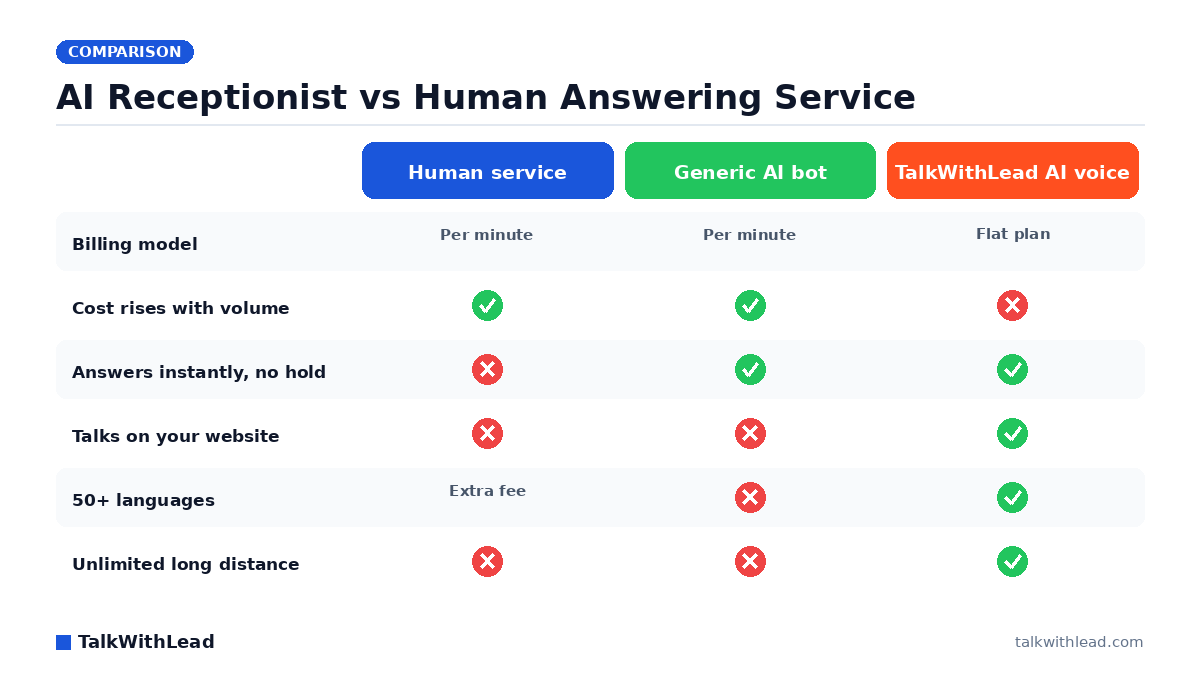
    AI Receptionist vs Human Answering Service — TalkWithLead original infographic (comparison diagram).
    AI Receptionist vs Human Answering Service

    Two quotes land on your desk. A human answering service wants a monthly minimum plus a per-minute rate. An AI receptionist wants a flat subscription. Both promise you will stop losing leads, and neither quote tells you what you will actually pay in a busy month.

    TL;DR: a fair ai receptionist vs human answering service cost comparison usually lands the same way. Human services typically bill per minute or per call on top of a monthly minimum, so your bill grows every time your marketing works. AI receptionists bill like software — a flat monthly plan that covers far more conversations — which makes high-volume months dramatically cheaper and quiet months predictable.

    How much does a human answering service cost?

    Almost every live answering service prices the same way: a monthly minimum that buys a bucket of minutes, then an overage rate once you burn through it. Rate cards in this category commonly run from roughly a hundred dollars a month at the small end to several hundred or more for real receptionist coverage, with per-minute overage on top. Check current published rates yourself before you sign anything, because they move.

    The rate card is not the problem. The billing unit is. You pay for minutes, not for booked jobs, and plenty of billed minutes produce nothing: the robocall that got answered, the existing customer asking about an invoice, the vendor, the wrong number, the caller who spent ninety seconds spelling their last name. Every one of those is revenue for the vendor and cost for you.

    Two more line items show up after the first invoice. Bilingual or after-hours coverage is often a surcharge rather than a default. And long-distance or toll handling can be billed separately, which quietly punishes you for having customers outside your area code.

    How much does an AI receptionist cost?

    An AI receptionist is software, so it prices like software: a flat monthly plan tied to seats, features, or a generous conversation allowance instead of a taxi meter. Entry plans in this category generally sit in the tens-of-dollars-per-month range and climb with features rather than with call volume. TalkWithLead publishes its plans on the pricing page so you can compare against your current answering-service invoice line by line.

    The structural difference is what happens on your best month. A per-minute vendor is rewarded when your ad spend spikes. A flat-rate AI receptionist is not. You can run a promotion, get featured somewhere, or double your traffic without opening a spreadsheet to model your support bill.

    TalkWithLead also removes two of the classic surcharges. Its AI voice agent handles conversations in 50+ languages without a bilingual upcharge, and unlimited long-distance calling means a prospect three time zones away is not a billing event. If you want to hear how human it sounds before you believe any of this, the live demo takes about a minute.

    Side-by-side: the cost comparison that matters

    DimensionHuman answering serviceAI receptionist (TalkWithLead)
    Billing unitPer minute or per call, over a monthly minimumFlat monthly plan
    Cost in a high-volume monthRises with every extra callEffectively unchanged
    Spam and wrong numbersBillable minutesHandled inside the plan
    After-hours and weekendsOften a surchargeAlways on, same price
    LanguagesBilingual usually costs extra50+ languages included
    Long distanceFrequently billed separatelyUnlimited
    Where it answersYour phone lineYour website, then the phone
    Hold timePossible during call spikesAnswers immediately, in parallel
    Judgment on unusual callsStrong — a real person adaptsGood on scripted intake, escalates the rest

    Read the last three rows twice. They are where the money actually is, and neither rate card mentions them.

    The cost nobody quotes you: the call that never got answered

    Answer rate beats rate card. A missed call does not cost you eighty cents of billed time — it costs you the entire job, and often to the competitor the caller phoned twelve seconds later. According to a 411 Locals study of 85 small businesses across 58 industries, only 37.8% of incoming calls were answered by a live person — meaning roughly 6 out of 10 calls went unattended.

    Speed compounds the same way on web leads. The MIT Lead Response Management study found you’re about 21× more likely to qualify a lead contacted within 5 minutes than one contacted at 30 minutes. A human answering service takes a message; that message still has to reach someone who calls back. An AI voice agent on your website starts the conversation while the visitor is still reading the page — which is the whole argument in how fast you should call a new lead.

    ROI math: an illustrative example

    The following is an illustrative scenario, not a customer result. Assume a services business that gets 200 inbound calls and website enquiries a month, closes at an assumed 20%, and books an average job worth $600.

    • Today: say 60 of those 200 go unanswered after hours or during call spikes. At an assumed 20% close rate, that is 12 jobs, or roughly $7,200 a month walking away.
    • Human answering service: assume it recovers half of those 60 as messages, and assume half of the messages get a timely callback. That is 15 recovered conversations, about 3 jobs, roughly $1,800 — against a bill that grows with every minute answered.
    • AI voice agent: imagine it engages nearly all 60 immediately on the site and by instant callback, no hold, no message queue. Even at the same assumed 20% close rate on the engaged share, the recovered revenue is a multiple of the human-service path, on a flat plan.

    Swap in your own numbers with the free missed-call revenue calculator — it takes about two minutes and it is usually the number that ends the debate. Contractors comparing the same two options can also read the vertical version in AI receptionist for contractors: cost and ROI.

    Honest verdict

    Best for: owners of service businesses and lead-gen sites who get most enquiries from their website and after hours, want a predictable flat bill as volume grows, and need callers handled instantly in multiple languages without hold time or long-distance charges.

    Not the right fit if: your calls are long, unscripted, emotionally sensitive, or legally delicate from the first sentence — think crisis intake or complex clinical triage. In that case, keep a human on the line and let AI cover only overflow and after-hours.

    Plenty of businesses run both. The AI voice agent answers on the website, qualifies, and books; anything unusual escalates to a person. That hybrid is exactly how the comparison plays out in AI voice agent vs human receptionist.

    How to run the comparison on your own numbers this week

    1. Pull your last three answering-service invoices and total the minutes actually billed, including overage.
    2. Divide the total cost by the number of booked jobs it produced. That is your real cost per booked job — not your per-minute rate.
    3. Count after-hours and weekend enquiries separately. That bucket is where AI wins hardest.
    4. Run the same volume through a flat AI plan on the pricing page.
    5. Test the caller experience yourself. Hold time and robotic scripting cost you conversions no rate card captures.

    If step five is where you are, start there: hear the voice agent on the live demo, then put it on your own site with a free signup and watch what happens to the enquiries you were previously converting into voicemail.

    FAQ

    Is an AI receptionist cheaper than a human answering service?

    Usually yes, and the gap widens with volume. Human services bill per minute or per call over a monthly minimum, so cost scales with activity. An AI receptionist bills as a flat monthly plan, so a busy month costs roughly what a slow month costs.

    What do answering services actually charge per minute?

    Rates vary by vendor and by whether you buy a receptionist tier or a message-taking tier, and they change often, so check the vendor’s current published rate card. The structural point holds regardless: you are billed for every answered minute, including spam calls and hold time.

    What hidden fees should I check before signing?

    Ask about overage rates past your included minutes, minimum billing increments per call, bilingual or after-hours surcharges, long-distance and toll handling, setup or script-change fees, and contract length. Those line items often move the effective price more than the headline rate does.

    Can an AI receptionist handle calls in Spanish or other languages?

    TalkWithLead’s AI voice agent converses in 50+ languages as part of the plan, with no bilingual surcharge. With a human service, multilingual coverage is typically a paid add-on and depends on which agents are on shift.

    Will callers know they are talking to AI?

    The voice is extremely human-sounding, and most callers simply get their question answered and book. Being upfront works fine too — what visitors reject is waiting on hold or typing into a slow chatbot, which is the comparison drawn in AI voice agent vs chatbot.

    Can I use both an AI receptionist and a human team?

    Yes, and it is a common setup. Let the AI voice agent answer instantly on the website, qualify, and book appointments, then route anything complex or sensitive to a person. You cut billed minutes on routine calls and keep human judgment where it earns its cost.

  • Best AI Receptionist for Law Firms: Client Intake (2026)

    Best AI Receptionist for Law Firms: Client Intake (2026)

    Law Firm Intake Options Compared — TalkWithLead original infographic (comparison diagram).
    Law Firm Intake Options Compared

    A prospective client with a car accident, a DUI, or a termination letter does not fill out a form and wait. They call three firms in ten minutes and hire whoever picks up. That single behavior is why choosing an ai receptionist for law firms best for client intake is now a caseload decision, not an office-admin decision.

    Short answer: the best AI receptionist for law firm client intake is one that answers by voice within seconds of a website visit or missed call, works nights and weekends, qualifies the matter type and conflicts basics, and books the consult on the calendar. AI voice agents like TalkWithLead do this; chatbots, contact forms, and per-minute answering services either delay the conversation or price it by the minute.

    What does an AI receptionist actually do for a law firm?

    An AI receptionist answers the phone or the website the moment a prospective client shows intent. It greets them, asks what happened, captures name, number, jurisdiction, and matter type, screens out the obvious non-fits, and either books a consult or hands a warm caller to an attorney. The good ones sound like a person, not a phone tree — they interrupt gracefully, handle a rambling story, and repeat a phone number back correctly.

    For intake specifically, three jobs matter more than everything else on the feature list: answer fast, keep the person talking, and get the appointment on the calendar. A tool that logs a transcript but loses the caller has failed intake, no matter how clean the dashboard looks. That is the lens used to compare every option below, and it is the same lens applied in our broader look at law firm intake automation and after-hours cases.

    Best AI receptionist for law firms: the options compared

    Four categories compete for legal intake budget: AI voice agents, human virtual receptionist services, website chatbots, and plain contact forms. They are not variations of the same product — they behave completely differently at 9pm on a Saturday.

    OptionChannelTypical response timeAfter-hoursLanguagesPricing modelBest intake use
    AI voice agent (TalkWithLead)Voice, from the website + instant callbackSecondsAlways on50+Flat subscription, unlimited long distanceWebsite visitors and missed calls that must become phone conversations now
    Human virtual receptionist (Smith.ai-style)Voice, forwarded callsMinutesOften a paid add-onUsually English + SpanishPer minute or per callFirms wanting a human voice and willing to meter cost
    Website chatbotTextInstant text, slow human handoffBot onlyVariesSeat or conversation basedSimple FAQ deflection, not urgent matters
    Contact formText, one directionWhenever staff reads itNoneOneFreeLow-urgency inquiries and document requests
    In-house receptionistVoiceSeconds while staffedNoOne or twoSalaryBusiness-hours reception plus firm operations

    Best for: small and mid-size firms — personal injury, family, criminal defense, immigration, employment — whose website already gets traffic and whose intake gap is nights, weekends, overflow, and non-English callers.

    Not the right fit if: your practice is appellate, transactional, or referral-driven with a handful of inbound inquiries a month that a paralegal already answers on the first ring. Automating five calls a month does not pay for itself, and you would be buying coverage you do not need.

    Why speed decides which firm signs the case

    Legal intake is a race, and the finish line is early. The MIT Lead Response Management study found you are about 21× more likely to qualify a lead contacted within 5 minutes than one contacted at 30 minutes. That gap is brutal for firms whose intake process is “the form emails the office manager, who calls back Monday.”

    The phone side is no kinder. According to a 411 Locals study of 85 small businesses across 58 industries, only 37.8% of incoming calls were answered by a live person — meaning roughly 6 out of 10 calls went unattended. Apply that pattern to a firm running paid search for “car accident lawyer near me” and you are paying for clicks whose calls nobody picks up.

    An AI voice agent attacks both numbers at once. The visitor never leaves your site to dial: they tap the widget, and a human-sounding voice is talking to them before the tab closes. If they do call and nobody is free, an instant callback fires within seconds. Our deeper breakdown of how fast you should call a new lead covers the response curve in detail.

    How much does an AI receptionist cost for a law firm?

    Legal intake coverage generally lands in one of three cost shapes: salary (an in-house receptionist, the highest fixed cost), metered (human answering services billing per minute or per call, which punishes a good marketing month), and flat subscription (AI voice agents, where a busy week costs the same as a quiet one). TalkWithLead sits in the third bucket, and long-distance calling is unlimited, so an out-of-state caller does not add a line item. Current tiers are on the pricing page.

    Illustrative ROI math — assumptions stated, not a customer result. Imagine a firm that gets 120 inbound website and phone inquiries a month and, between after-hours gaps and overflow, never connects with 30 of them. Assume a conservative 8% of connected consults sign, and assume an average matter value of $4,000. Recovering even half of those 30 missed conversations — 15 conversations, at 8%, is roughly 1.2 signed matters — is about $4,800 a month in new fee revenue in this example. Against a flat monthly subscription, one signed matter typically covers a year of coverage. Plug your own numbers into the free missed-call revenue calculator instead of trusting anyone’s averages, including ours.

    If you want the full cost-vs-value argument for legal specifically, we wrote it up separately in is an AI receptionist worth it for a law firm.

    Why chatbots and forms lose legal intake

    Chat looks like the safe modern choice. It is also the slowest possible channel for someone who was rear-ended two hours ago. Text intake asks an anxious person to type their story on a phone screen, one thumb at a time, while a bot asks for their email address. Picture a site where most visitors never make it past the third question — that is the realistic failure mode, and it is invisible in your analytics because a bounce looks identical to a lost case.

    Voice does the opposite. People explain a legal problem far faster than they type it, and the emotional register of a real conversation is what actually converts a scared caller into a booked consult. A voice agent also picks up the details a form field never asks for: date of the incident, whether police were involved, whether they have already spoken with an insurer. If you are weighing the two side by side, the numbers-first version of that argument lives in AI voice agent vs chatbot conversion rate.

    The other quiet loser is the multilingual caller. Immigration, personal injury, and employment practices field a steady stream of Spanish-speaking prospects, and a bot with a translate widget is not the same as an agent that answers in Spanish immediately. TalkWithLead handles 50+ languages out of the box, which means a 10pm call from a Spanish-speaking family does not become a message someone returns two days later.

    How to evaluate an AI receptionist for your firm in one week

    Do not buy on a feature grid. Test the thing your clients will actually experience.

    • Call it yourself, twice. Once calmly, once talking over it mid-sentence. If it cannot handle an interruption, it cannot handle an intake call.
    • Test at 11pm on a Sunday. After-hours is where the case volume hides, and it is the exact window your competitors leave uncovered.
    • Test a second language. Have someone call in Spanish and see whether the conversation continues or collapses into a callback promise.
    • Check the handoff. Does a qualified caller reach an attorney or a calendar, or just a transcript in an inbox?
    • Confirm the cost shape. Ask what a month with triple the calls costs. Metered services answer that question very differently than flat ones.
    • Verify what it will and will not say. An intake agent gathers facts and books consults; it must not give legal advice or quote outcomes.

    The fastest way to run that test on TalkWithLead is the live demo — you talk to the agent yourself and judge whether it sounds like someone you would let answer for your firm.

    Where an AI receptionist fits alongside your existing staff

    The best-performing setup we see described by firms is not replacement, it is coverage. The in-house receptionist owns business hours, walk-ins, and the relationships. The AI voice agent owns everything else: 6pm to 9am, weekends, holidays, overflow when two lines ring at once, and every website visitor who would otherwise have read the practice-areas page and left silently.

    That division has a second benefit. Your staff stops spending mornings on voicemail triage and starts the day with booked consults already on the calendar. Firms comparing this against a traditional per-minute service usually start with our Smith.ai alternative for law firms breakdown, and solo practitioners should read virtual receptionist for solo attorneys, which covers the one-lawyer case directly.

    If the math above matches your firm, the next step is small: put the widget on your site, point it at your intake criteria, and watch a week of after-hours traffic turn into phone conversations. You can start free and have voice intake answering tonight, or try the live demo first and hear it before you commit.

    FAQ

    What is the best AI receptionist for law firms for client intake?

    For website-driven intake, the best fit is an AI voice agent that answers by voice in seconds directly from your site, works 24/7, speaks the caller’s language, and books consults — TalkWithLead is built for exactly that pattern. If your intake is almost entirely forwarded phone calls and you specifically want a human on the line, a per-minute virtual receptionist service is the alternative, at a cost that rises with your call volume.

    Can an AI receptionist handle legal client intake without giving legal advice?

    Yes, when it is scoped correctly. An intake agent should collect facts — name, contact number, jurisdiction, matter type, date of incident, whether other counsel is involved — and book the consult. It should never assess a case’s merits, estimate damages, or answer a legal question. Set those boundaries in the agent’s instructions before you go live and test them deliberately.

    Will clients know they are talking to an AI?

    Modern voice agents sound remarkably human, and callers routinely complete a full intake conversation without friction. The honest practice is to be upfront: have the agent identify itself as the firm’s automated intake assistant and offer to connect a person. In legal specifically, transparency protects you and rarely costs the conversation.

    How fast should a law firm respond to a new website lead?

    Within minutes, ideally seconds. The MIT lead-response research cited above puts a 5-minute contact at roughly 21× the qualification odds of a 30-minute contact, and legal prospects shop several firms in a single sitting. An instant callback triggered from the website is the only mechanism that reliably hits that window overnight and on weekends.

    Does an AI receptionist work for Spanish-speaking clients?

    It should. TalkWithLead’s voice agent handles 50+ languages, so a Spanish-speaking caller gets a real conversation immediately rather than a callback promise. For firms in immigration, personal injury, and employment, that single capability often accounts for a meaningful share of the intake an English-only setup was quietly losing.

    How much does AI intake cost compared with hiring a receptionist?

    An in-house receptionist is a full salary plus benefits and covers roughly a third of the week. A per-minute answering service costs more in your busiest months, which are exactly the months you want more coverage. A flat AI subscription costs the same whether you take 50 calls or 500, and TalkWithLead includes unlimited long-distance calling. Current tiers are on the pricing page.

  • Law Firm Intake Automation for Lawyers: Capture After-Hours Cases

    Law Firm Intake Automation for Lawyers: Capture After-Hours Cases

    After-Hours Intake, Handled in Under a Minute — TalkWithLead original infographic (flow diagram).
    After-Hours Intake, Handled in Under a Minute

    Your best case this month probably called at 9:41 on a Tuesday night, heard voicemail, and dialed the next firm on the results page. That is the real intake problem at most practices, and law firm intake automation is how you close it without hiring a night shift or risking an ethics complaint.

    TL;DR: Law firm intake automation uses an AI voice agent to answer every website visitor and after-hours caller within seconds, collect structured intake facts, and book the consultation on your calendar. It stays compliant by gathering information only, never giving legal advice, quoting fees, or forming an attorney-client relationship. A licensed attorney reviews the transcript before any advice is given.

    Why after-hours legal intake leaks so much money

    Legal buyers are in distress. Someone was rear-ended, served, fired, or arrested, and the search happens at night or on a weekend. That caller is not comparison shopping over three days. They call two or three firms in ten minutes and retain whoever picks up and sounds capable.

    A 411 Locals study of 85 small businesses across 58 industries found that only 37.8% of incoming calls were answered by a live person. Law firms are not exempt from that math. Every unanswered ring at a firm with a five-figure average case value is a different order of loss than a missed haircut appointment.

    Speed is the whole game. The MIT Lead Response Management study found you are about 21× more likely to qualify a lead contacted within 5 minutes than one contacted at 30 minutes. Your answering service that takes a message and emails it to the office at 8am is competing against a firm that answered on ring two.

    What does law firm intake automation actually do?

    Automation here does not mean a robot practicing law. It means the mechanical half of intake runs itself, and the judgment half stays with your attorneys.

    A voice agent on your website and phone line handles the mechanical half:

    • Answers instantly, day or night, on the first ring, with a human-sounding voice rather than a menu tree.
    • Runs your intake script: incident date, jurisdiction, opposing party, injuries or damages, prior counsel, contact details.
    • Screens for the obvious disqualifiers your firm already defined, such as practice area, venue, or a statute date that has clearly passed.
    • Books the consult directly into the calendar or triggers an instant callback from the on-call attorney.
    • Delivers a clean transcript and summary so the attorney reads a structured file, not a sticky note.

    Everything requiring legal judgment stays out of scope by design. See how the same pattern works in adjacent trades in our guides to AI voice answering for dental clinics and virtual receptionists for solo attorneys.

    How do you automate intake without compromising compliance?

    This is the question that stops most managing partners, and it deserves a direct answer. The compliance risk in automated intake comes from four specific behaviors, and you configure the agent to refuse all four.

    Do not let the agent give legal advice. It collects facts and repeats your firm’s published information. If the caller asks “do I have a case,” the correct scripted response is that an attorney will review the details and follow up. That is a boundary you can hear on every recording.

    Do not let the agent form a relationship or quote fees. The agent states plainly that speaking with intake does not create an attorney-client relationship and that fee arrangements are set by the attorney in writing. No outcome predictions, no “cases like yours usually settle for” language, ever.

    Run conflicts before substance. The agent captures names of all parties early and flags the file. A human runs the conflicts check before an attorney engages on the merits, exactly as with a walk-in.

    Handle confidentiality deliberately. Callers volunteer sensitive facts, so treat every transcript as protected material: restricted access, retention limits, and a disclosure at the top of the call that the conversation is recorded and transcribed for intake purposes. Your state bar rules and advertising regulations govern what the agent may say about results and specialization, so the script gets reviewed by your ethics-responsible attorney before it goes live. Watch a boundary-scripted agent handle a live conversation on the TalkWithLead live demo.

    Voice, forms, or chatbot: which converts legal traffic?

    Practice-area pages usually offer a contact form and sometimes a chat bubble. Both ask a distressed person to type their worst week into a text box and wait.

    Intake dimensionContact formWebsite chatbotAI voice agent
    Response timeHours to next dayInstant, but text onlyInstant, live conversation
    Works after hoursCollects onlyYesYes, with booking
    Distressed caller experiencePoorFairStrong
    Follow-up detail capturedWhatever fits the fieldsShort typed repliesFull narrative plus transcript
    Non-English callersRarely supportedSometimes50+ languages
    Books the consult itselfNoSometimesYes, or instant callback

    Voice wins for legal because talking is how people explain a mess. TalkWithLead’s agent picks up the conversation on the page, speaks in 50+ languages, and includes unlimited long-distance calling, so a family calling about a cross-border matter reaches you the same way a local does. Our breakdown of AI voice agents versus chatbots covers the conversion mechanics in detail.

    Illustrative ROI math for a small firm

    These numbers are an illustration, not a customer result. Adjust them to your own case economics.

    Picture a four-attorney firm that gets 120 inbound inquiries a month, with 45 of them arriving outside staffed hours. Say even 1 in 5 of those after-hours inquiries would have signed if someone had answered live: that is 9 signed matters a month lost to voicemail. At an assumed average fee of $4,000 per signed matter, the annual gap is roughly $432,000. You do not need the assumption to be right; you need it to be closer to right than zero, which is what voicemail delivers. Run your own version with the free missed-call revenue calculator.

    Cost framing, plainly: after-hours legal answering services are typically priced per minute or per call and climb fast in a busy month, while an AI voice agent is priced as a flat monthly subscription regardless of call volume. Compare plans on the TalkWithLead pricing page, and see our analysis of whether an AI receptionist is worth it for a law firm.

    Best for, and not the right fit if

    Best for: consumer-facing practices with volume and urgency — personal injury, family, criminal defense, immigration, employment, and estate planning firms whose website traffic peaks at night and whose staff does not.

    Not the right fit if: your matters arrive entirely through referral relationships, your practice is transactional corporate work with no inbound web volume, or your state bar interpretation prohibits recorded automated intake without a specific consent process you are unwilling to implement.

    How to roll it out in two weeks

    1. Write the intake script by practice area. Pull the questions your best paralegal already asks. Mark the hard stops: no advice, no fees, no outcomes.
    2. Get ethics sign-off. One attorney reviews the script and the recording disclosure against your state rules before launch.
    3. Install the widget and route the phone line. Put the voice agent on every practice-area page, not just the contact page.
    4. Set escalation rules. Define which calls trigger an instant callback to the on-call attorney versus a next-morning consult slot.
    5. Review the first 50 transcripts. Tighten questions, fix pronunciation of local venue names, and cut anything that reads like advice.
    6. Measure one number. Signed consults per 100 after-hours inquiries, before and after. Everything else is vanity.

    The firms that win the 9:41pm call are not the ones with the best brochure. They are the ones that answered. Start free with TalkWithLead and let your next after-hours caller reach a voice instead of a beep. If you want to see the speed argument in numbers first, read our piece on how fast you should call a new lead.

    FAQ

    Is AI intake allowed under legal ethics rules?

    Bar rules generally permit non-lawyer staff and technology to gather information, so long as the system does not give legal advice, set fees, or hold itself out as a lawyer. The obligations that matter are supervision, confidentiality, conflicts screening, and truthful advertising. Configure the agent to collect facts and schedule only, disclose recording, and have an attorney review your script against your state’s rules before launch.

    Can an AI voice agent give legal advice to callers?

    No, and it should be configured to refuse. When a caller asks whether they have a case or what it is worth, the scripted answer is that an attorney will review the details and respond. That boundary is auditable on every transcript, which is easier to defend than an undertrained human receptionist improvising at midnight.

    How much does law firm intake automation cost?

    Legal answering services usually bill per minute or per call, so a heavy month costs more than a slow one. AI voice agents are generally sold as a flat monthly subscription that does not move with call volume, which makes budgeting predictable during ad campaigns. Compare current plans on the pricing page.

    Will clients be annoyed talking to an AI?

    Callers react to being helped, not to the technology label. A voice that answers on ring one, asks sensible questions, and books a real appointment beats a voicemail box or a hold queue. Disclose that it is an automated intake assistant, keep the handoff to a human fast, and the objection mostly disappears.

    Does it handle Spanish and other languages?

    TalkWithLead’s agent speaks 50+ languages and includes unlimited long-distance calling, so a Spanish-speaking caller or a family member calling from abroad gets the same intake quality as an English-speaking local. For firms in immigration or personal injury, that is often where the unclaimed case volume is sitting.

    What happens to the information the agent collects?

    It becomes a structured intake record: transcript, summary, contact details, and the calendar booking, delivered to your team for conflicts screening and attorney review. Treat it as confidential client material with restricted access and a retention policy, the same as any intake file. You can watch the full flow on the live demo.

Your next lead is on your site right now — ready to talk.

TalkWithLead’s AI voice agent picks up in seconds, qualifies the lead in their language, and books the call before the prospect can open a competitor’s tab. Forms are slow. Chatbots make people type. Voice closes.

Just curious about plans? See pricing →
This is the TalkWithLead Widget. Click to see how it will work on your website!