TalkWithLead
AI Voice-First Lead Conversion

AI Voice Agents That Turn Website Visitors Into Real Conversations

TalkWithLead is the AI voice-first widget that picks up the phone the moment a visitor lands on your site. Multilingual, extremely human-sounding, with unlimited long-distance calling so prospects anywhere can call you back. More calls. More leads. More closed deals.

Extremely human-sounding voice 50+ languages out of the box Unlimited long-distance calling Instant callback widget

Tag: ai voice agent

  • Smith.ai Alternative for Website Lead Conversion

    Smith.ai Alternative for Website Lead Conversion

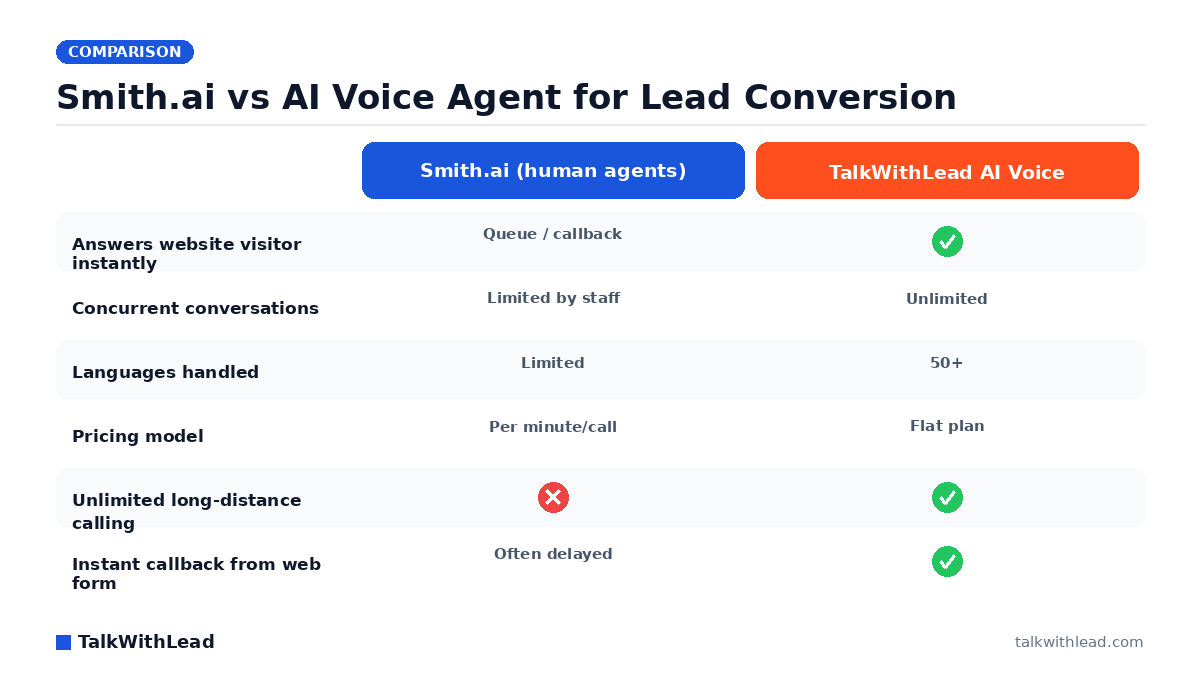
    Smith.ai vs AI Voice Agent for Lead Conversion — TalkWithLead original infographic (comparison diagram).
    Smith.ai vs AI Voice Agent for Lead Conversion

    Why business owners look for a Smith.ai alternative for website lead conversion

    You put a real phone number and a contact form on your site, signed up for Smith.ai to catch the calls, and the leads still trickle in slower than you want. The gap is rarely the agents themselves. It’s that a human-staffed answering service can only pick up so many calls at once, charges by the minute, and still leaves your website visitors waiting for someone to call them back. If you want a Smith.ai alternative for website lead conversion that talks to every visitor the instant they land, an AI voice-first platform answers that directly.

    TL;DR: Smith.ai is a human virtual receptionist and answering service billed per call or minute. The fastest-converting alternative is an AI voice agent that answers your website’s visitors instantly, holds a natural spoken conversation in 50+ languages, and triggers an immediate callback so a form-fill becomes a live phone call in seconds, all on a flat plan instead of per-minute fees.

    What does Smith.ai actually do, and where does it leave money on the table?

    Smith.ai connects your business to trained human receptionists who answer calls, qualify callers, and book appointments. For a firm that just needs missed phone calls covered, it works. The trouble starts when you measure it against the goal that matters: turning the traffic already hitting your website into booked conversations.

    Three structural limits show up fast:

    • It waits to be called. A receptionist answers an inbound ring. The visitor reading your pricing page right now has to decide to dial, then hope someone’s free. Most never do.
    • It bills by the minute. Every qualifying question, every hold, every transfer is metered. Busy months get expensive, so owners cap usage and miss calls anyway.
    • It throttles at peak. When five leads hit at once, humans queue them. The fourth and fifth caller hear hold music or get a callback later, which is exactly when buyers move on.

    Speed is the whole game here. According to Harvard Business Review research, companies that reach a web lead within an hour are nearly 7× more likely to qualify it than those that wait even an hour longer. A callback queue burns that hour. We dig deeper into this in Speed-to-Lead: Why the First 60 Seconds Win Most Deals.

    What is the best Smith.ai alternative for website lead conversion?

    The best alternative is the one that removes the wait entirely. Instead of routing a visitor toward a human who may or may not be available, TalkWithLead puts an extremely human-sounding AI voice agent directly on your website. A visitor clicks to talk, and within seconds they’re in a real spoken conversation, no form, no hold, no slow chatbot typing back one line at a time.

    That changes the math in four concrete ways:

    • Instant answer, every time. The AI voice agent never queues. Whether one visitor or fifty arrive at once, each gets a live conversation immediately.
    • 50+ languages, on the fly. A Spanish-speaking buyer and an English-speaking buyer both get answered in their own language without you staffing for either.
    • Unlimited long-distance calling. Prospects anywhere can reach you, and the agent can call them back, without per-minute long-distance charges eating the margin.
    • Instant callbacks. When a visitor leaves a number, the system rings them back in seconds while their interest is still hot, turning a passive form-fill into an active phone conversation.

    Want to hear it before you decide? Take the live demo and talk to the agent the way your own visitors would. For a side-by-side on conversion specifically, AI Voice Agent vs Chatbot: Which One Books More Calls? breaks down why voice beats typed chat for booking.

    Smith.ai vs an AI voice agent: a side-by-side comparison

    Here’s how the two stack up on the dimensions that decide whether a website visitor becomes a sales conversation.

    DimensionSmith.ai (human answering service)TalkWithLead (AI voice-first)
    Who answersHuman receptionistHuman-sounding AI voice agent
    Response to a website visitorInbound call or scheduled callbackInstant on-page conversation
    Concurrent conversationsLimited by staffingUnlimited, simultaneous
    LanguagesLimited set50+ languages
    Long-distance callingOften meteredUnlimited
    PricingPer call / per minuteFlat plan
    AvailabilityBusiness hours + plans24/7, no shift gaps

    Best for: a business with steady inbound website traffic that wants every visitor engaged in a real conversation the moment they arrive, in any language, without per-minute costs scaling against you.

    Not the right fit if: your lead flow is almost entirely complex calls that legally or practically require a licensed human (for example, certain regulated intake), and you specifically want a person, not an AI, on every first touch. In that case a human service like Smith.ai may suit you better, or you pair the two.

    How much does an AI voice agent cost versus a per-minute answering service?

    Per-minute pricing punishes exactly the months you grow. An AI voice-first platform flips that to a predictable flat plan, so a busy week costs the same as a slow one. You can see the public tiers on the pricing page.

    To make the ROI concrete, here’s an illustrative example (your numbers will differ). Say your site gets 1,000 visitors a month and, picture a setup where even 3 of every 100 visitors would talk to an instant voice agent. That’s roughly 30 live conversations a month you weren’t capturing before. If even a handful of those become customers at a few hundred dollars each, the flat plan pays for itself many times over, and every additional conversation after that is pure upside. Plug your own traffic and close rate into the free missed-call revenue calculator to see the gap for your business.

    There’s a trust angle too. According to a Five9 study of 4,000 US and UK consumers, 75% of people prefer talking to a real human over the phone for support. A natural-sounding voice conversation meets that preference far better than a typed chatbot does, which is the whole point of leading with voice instead of a chat widget. Ready to put it on your site? Start your free signup and have the agent live before your next traffic spike.

    Does this work for my industry?

    The pattern holds anywhere a fast phone conversation closes the deal. A law firm fielding consultation requests, a med spa booking appointments, a real estate team chasing showing requests, an insurance agency quoting policies, every one of them loses leads to slow follow-up. The AI voice agent answers the moment interest peaks instead of hours later.

    If you run a practice or agency, these breakdowns get specific: Smith.ai Alternative for Law Firms covers website intake, Is an AI Receptionist Worth It for a Law Firm? weighs the cost, and Speed to Lead Real Estate shows how instant callbacks book more showings. For the broader build-vs-buy view on people, AI Voice Agent vs Human Receptionist lays out the tradeoffs.

    FAQ

    What is the best Smith.ai alternative for converting website visitors?

    An AI voice-first platform like TalkWithLead is the strongest alternative when your goal is converting website traffic, because it answers every visitor instantly with a natural spoken conversation rather than routing them to a human queue or a callback. It handles unlimited simultaneous calls in 50+ languages on a flat plan.

    How is an AI voice agent different from Smith.ai?

    Smith.ai staffs human receptionists who answer inbound calls and bill per minute. An AI voice agent lives on your website, starts a live conversation the instant a visitor clicks, never queues at peak, supports 50+ languages, and runs on a predictable flat plan with unlimited long-distance calling.

    Is an AI voice agent cheaper than a per-minute answering service?

    For most websites with steady or growing traffic, yes, because a flat plan doesn’t scale costs against your busiest months the way per-minute billing does. Run your own traffic and close rate through the missed-call revenue calculator to compare against your current spend.

    Can an AI voice agent really handle leads in other languages?

    Yes. The TalkWithLead voice agent converses in 50+ languages automatically, so a visitor is answered in their own language without you hiring multilingual staff or buying separate plans per language.

    Will visitors know they’re talking to AI?

    The voice agent is built to sound natural and human, and it handles real back-and-forth conversation rather than scripted prompts. Many businesses pair it with instant callbacks so the visitor moves seamlessly into a phone conversation, which most people prefer over typing to a chatbot.

    Can I keep human receptionists and add an AI voice agent?

    Yes. Many businesses use the AI voice agent as the always-on first responder that engages every website visitor instantly, then route complex or high-value conversations to a human. That captures the leads a queue would have lost while keeping people on the calls that truly need them.
  • Is an AI Receptionist Worth It for a Law Firm?

    Is an AI Receptionist Worth It for a Law Firm?

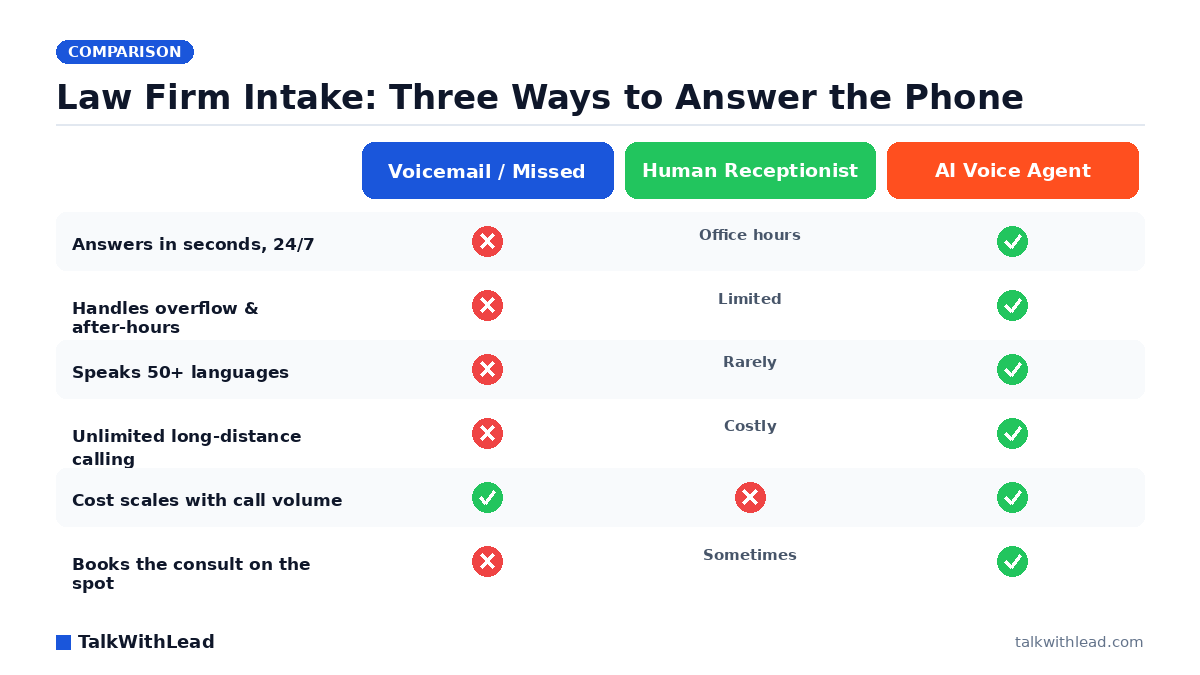
    Law Firm Intake: Three Ways to Answer the Phone — TalkWithLead original infographic (comparison diagram).
    Law Firm Intake: Three Ways to Answer the Phone

    A prospect with a $15,000 matter calls your firm at 7:40 p.m., gets voicemail, hangs up, and dials the next firm on the list. That is the real question behind “is an AI receptionist worth it for a law firm” — not whether the technology is impressive, but whether it stops calls like that one from walking out the door.

    TL;DR: For most small and mid-size firms, an AI receptionist is worth it when call volume is high enough that calls slip to voicemail after hours or during overflow. An AI voice agent answers every call in seconds, qualifies the caller, and books the consult — so if it captures even one or two extra signed matters a month, it pays for itself many times over. It is not worth it if you take only a handful of high-touch clients a year and answer every call yourself.

    What does an AI receptionist actually do for a law firm?

    An AI receptionist is a human-sounding AI voice agent that picks up the phone — or the call-back request on your website — and has a real conversation with the caller. It greets them, asks the intake questions you would ask, captures name, contact, matter type, and urgency, and either books a consultation or routes a genuine emergency to a live attorney.

    The difference from a chatbot or a web form is the channel. A form makes an injured or anxious prospect type. A chatbot makes them wait and click. A voice agent turns a website visitor into a phone conversation immediately, the way people actually want to reach a lawyer. If you want to see how those channels compare on conversion, our breakdown of AI voice agent vs chatbot conversion rate lays out the gap.

    It also runs 24/7. The phone gets answered on a Saturday, at midnight, and during the lunch hour when your front desk is slammed. According to Ada, 59% of consumers prefer instant, 24/7 AI service over waiting for a human — as long as the AI can actually handle the request. Intake qualification is exactly the kind of request it can handle.

    Is an AI receptionist worth it for a law firm? Run the ROI math

    The honest way to answer “worth it” is to put a number on the calls you miss. Here is an illustrative example — plug in your own figures, not these.

    Say your firm gets 200 inbound calls a month and, between after-hours, lunch, and overflow, 25% of them hit voicemail. That is 50 missed calls. Now assume a conservative slice convert: imagine even 1 in 10 of those missed callers was a real prospect who would have signed. That is 5 lost matters a month. If your average signed matter is worth $3,000 in fees, that is $15,000 of revenue leaking every single month.

    Against that, an AI voice agent typically costs a fraction of one paralegal’s hourly rate and a small fraction of a single signed case. The arithmetic usually is not close. If the tool recovers even one of those five matters, it has already paid for a year of itself. To pressure-test your own numbers, run them through the free missed-call revenue calculator before you commit to anything.

    Pricing for AI voice receptionists generally lands in the low-hundreds-per-month range for a small firm, scaling with call volume — far below the cost of a full-time receptionist and without the gaps a single human leaves on nights, weekends, and sick days. You can see TalkWithLead’s tiers on the pricing page.

    How does an AI receptionist book more consultations than voicemail?

    Speed is the whole game in legal intake. A prospect who reaches a person — or a voice that behaves like one — in the first minute is dramatically more likely to book than one who leaves a message and waits for a callback. The longer the gap, the colder the lead, and the more likely they have already called a competitor. Our piece on speed-to-lead and the first 60 seconds digs into why that window matters so much.

    An AI voice agent closes that gap three ways:

    • It never goes to voicemail. Every call and every website call-back request is answered on the first ring, day or night.
    • It qualifies instead of just collecting. The agent asks the right intake questions, screens out matters you do not take, and flags the urgent ones — so attorneys spend time on real opportunities.
    • It books on the spot. Instead of “someone will call you back,” the caller leaves with a scheduled consultation, which is the moment a lead becomes a client.

    This is the same logic behind missed-call automation for websites: capture the lead before they call the next firm, because the next firm is one tap away.

    Where an AI receptionist beats a human (and where it does not)

    A great human receptionist is warm, judgment-rich, and irreplaceable for complex, sensitive conversations. But one person cannot answer three calls at once, work 24 hours, or speak fluent Spanish, Mandarin, and Portuguese on demand. An AI voice agent handles intake in 50+ languages and offers unlimited long-distance calling, so a prospect anywhere can reach your firm without a toll barrier or a language wall.

    The realistic model for most firms is not “AI instead of people” — it is AI catching everything your team cannot: overflow, after-hours, weekends, and second-language callers. For a deeper side-by-side, see AI voice agent vs human receptionist, and if you are weighing a service like Smith.ai, our Smith.ai alternative for law firms comparison covers the intake-specific tradeoffs.

    DimensionVoicemail / MissedHuman ReceptionistAI Voice Agent
    Response timeHours or neverOffice hours onlySeconds, 24/7
    Simultaneous callsNoneOne at a timeMany at once
    LanguagesNoneUsually one50+
    Long-distance reachN/ACostlyUnlimited
    Monthly cost$0 (but lost revenue)Full salary + benefitsLow-hundreds, scales
    Books consult on callNoSometimesYes

    Best for: small and mid-size firms with steady call volume that lose intake calls to after-hours, lunch, overflow, or non-English speakers, and want every prospect booked instead of buried in voicemail.

    Not the right fit if: you handle only a few hand-selected, high-touch matters a year, answer every call personally, or require a licensed attorney to give legal advice on the very first contact.

    What to look for before you buy an AI receptionist

    The technology is moving fast — Gartner predicts agentic AI will autonomously resolve 80% of common customer service issues without human intervention by 2029, cutting operational costs by 30%. For a law firm, that future is only worth buying into if the tool fits how you actually intake clients. Check these before you sign up:

    • Does it sound human? A robotic voice gets hung up on. Test it yourself on a live call.
    • Can it book and route? Capturing a name is table stakes; scheduling the consult and escalating emergencies is what drives ROI.
    • Does it cover your callers’ languages and locations? 50+ languages and unlimited long-distance widen the client pool you can serve.
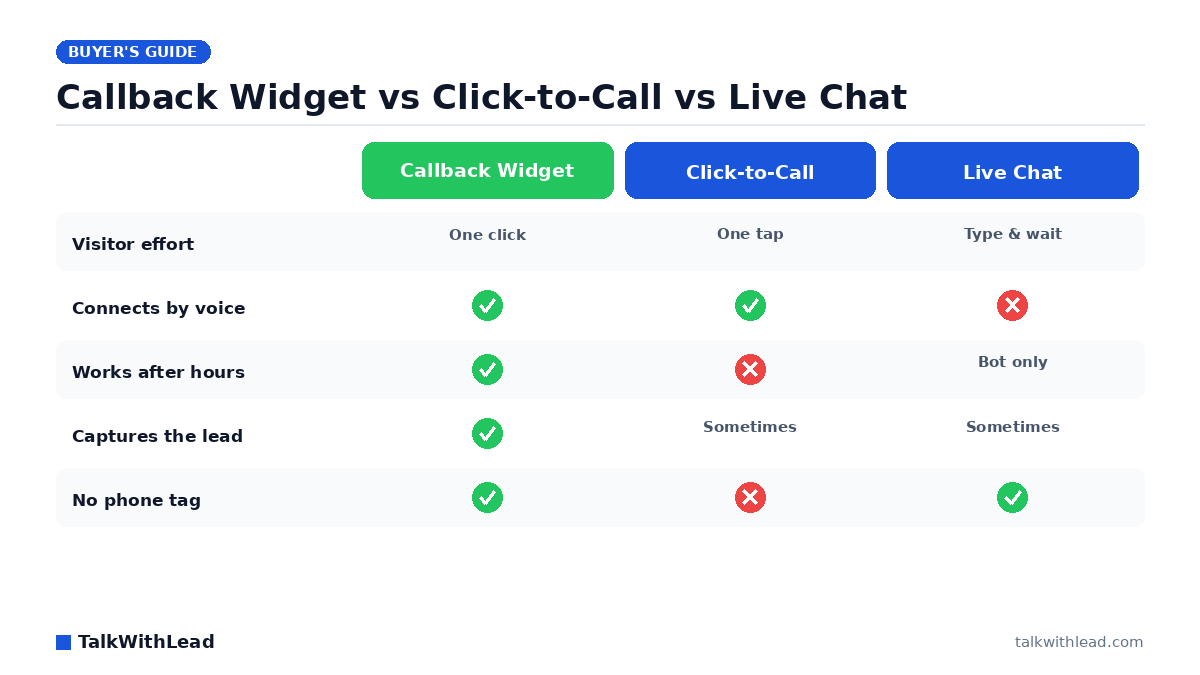
    • How fast does it answer the website visitor? Instant call-backs turn browsers into booked calls — compare the options in callback widget vs click-to-call vs live chat.

    The fastest way to judge worth is to hear it work on your own intake script. Try a live demo, then start capturing missed calls with a free signup and measure the booked consults against the math above.

    FAQ

    Is an AI receptionist worth it for a small law firm?

    For most small firms, yes — if you are losing calls to voicemail after hours, during lunch, or when the office is busy. The break-even is low: recover one or two signed matters a month and the tool pays for itself many times over. Run your own missed-call math first so the decision is a number, not a guess.

    How much does an AI receptionist cost for a law firm?

    AI voice receptionists generally run in the low hundreds of dollars per month for a small firm, scaling with call volume — far less than a full-time human receptionist’s salary and benefits. See current tiers on the pricing page and compare against the revenue you lose to missed calls.

    Can an AI receptionist replace my human front desk?

    For most firms it complements rather than replaces. A human handles warm, complex, in-office conversations; the AI voice agent catches everything one person cannot — overflow, nights, weekends, and second-language callers — so no intake call goes unanswered.

    Can an AI receptionist handle clients who do not speak English?

    Yes. A capable AI voice agent handles intake in 50+ languages and offers unlimited long-distance calling, so prospects in other languages or regions can reach your firm without a toll or language barrier — widening the pool of clients you can serve.

    Will an AI receptionist give legal advice to callers?

    No, and it should not. Its job is intake and scheduling: qualifying the matter, capturing details, booking the consultation, and escalating genuine emergencies to an attorney. Legal advice stays with your licensed lawyers.

    How do I know if an AI receptionist is right for my firm?

    Estimate your monthly missed-call volume, the share that are real prospects, and your average matter value. If the recovered revenue clearly exceeds the monthly cost, it is worth it. The free missed-call revenue calculator makes that estimate in a couple of minutes.

  • AI Answering Service Cost for Med Spas: Pricing & ROI

    AI Answering Service Cost for Med Spas: Pricing & ROI

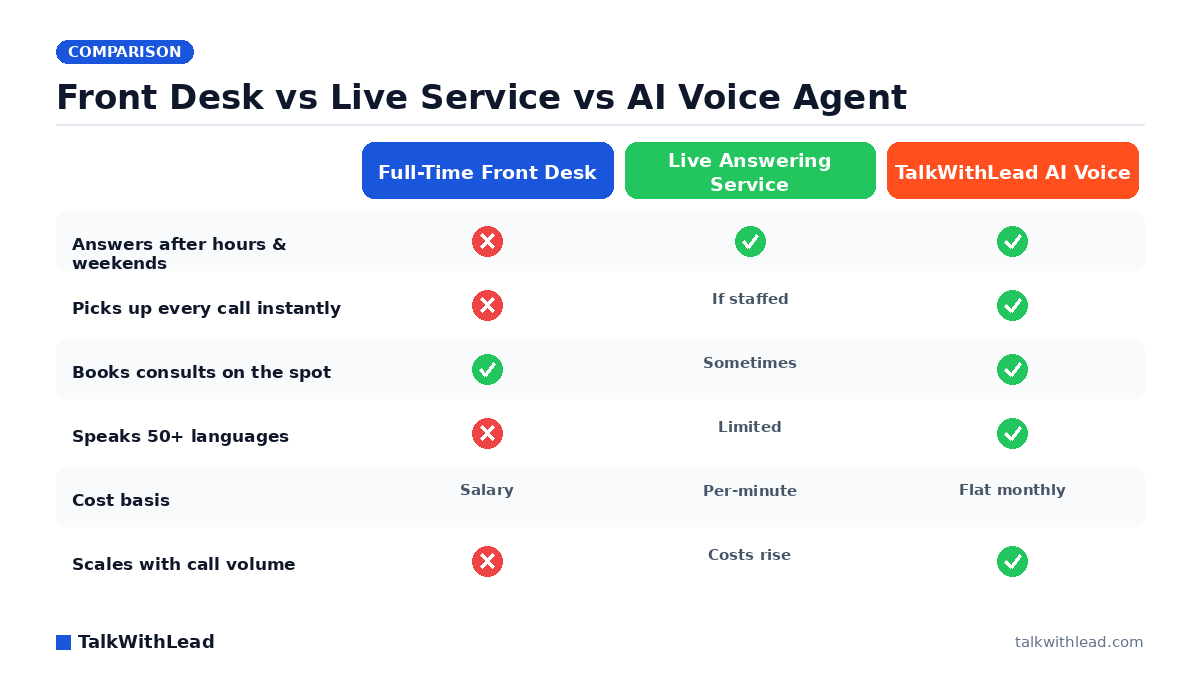
    Front Desk vs Live Service vs AI Voice Agent — TalkWithLead original infographic (comparison diagram).
    Front Desk vs Live Service vs AI Voice Agent

    A prospective client finds your med spa at 8:40 PM, ready to book a Botox consult. She calls, gets voicemail, hangs up, and books with the clinic two miles away that picked up. That single missed call is the real AI answering service cost for med spas question – not the monthly fee, but what every unanswered ring quietly costs you in booked consults.

    TL;DR: An AI answering service for a med spa usually costs a flat monthly subscription – typically a fraction of a full-time receptionist’s salary and often cheaper than per-minute live-agent services once call volume grows. The bigger number is ROI: because an AI voice agent answers every call instantly, 24/7, recovering even one or two consults a month often covers the cost several times over.

    How much does an AI answering service cost for a med spa?

    Pricing for AI answering services generally falls into three buckets. A full-time front-desk hire is the most expensive and only covers business hours. Traditional live answering services charge per minute or per call, so your bill climbs exactly when you get busy. An AI voice agent like TalkWithLead is usually a flat monthly subscription that does not balloon with volume – you can see current options on the pricing page.

    The flat-fee model matters for med spas specifically. Your call volume spikes after a promotion, a local influencer post, or a new-treatment launch. With a per-minute service, a great marketing week becomes a surprise invoice. With an AI voice agent, the same surge costs you nothing extra and every caller still gets a warm, immediate answer.

    Think in terms of value per booking rather than price per minute. If an average med spa client is worth several hundred dollars on the first visit and far more over a year of repeat treatments, the question stops being “what does this cost” and becomes “how many consults does it save.”

    Why missed calls cost more than the service itself

    Med spas live and die by the phone. People researching injectables, laser, or body contouring almost always call before they commit – they want reassurance, pricing, and a human voice. When that call goes to voicemail, most callers do not leave a message. They simply dial the next clinic.

    Picture a spa that gets 200 inbound calls a month and misses just a quarter of them after hours and during back-to-back appointments. Say even 1 in 10 of those missed calls was a ready-to-book client – that is several lost consults every single month, walking straight to a competitor. Run your own version of that math with our free missed-call revenue calculator and the monthly fee usually looks tiny next to the leak.

    Speed is the other half of the story. The faster you respond, the more likely the lead converts – a theme we cover in depth in Speed-to-Lead: Why the First 60 Seconds Win Most Deals. An AI voice agent’s response time is effectively zero, because it answers on the first ring, every time.

    What you actually get with an AI voice agent

    This is not a robotic phone tree. A modern AI voice agent sounds genuinely human, holds a natural back-and-forth conversation, answers common questions about treatments and pricing, and books the consult directly into your flow – no forms, no hold music, no “press 1.” It turns a website visitor or caller into a real phone conversation, which is exactly where med spa clients decide to commit.

    • Always on: evenings, weekends, holidays, and the moments your front desk is mid-treatment.
    • 50+ languages: a Spanish- or Mandarin-speaking caller gets answered in their own language without a transfer.
    • Unlimited long-distance calling: prospects anywhere can reach you, and the agent can call them back instantly.
    • Instant callbacks: a visitor on your site clicks, and the AI rings them in seconds while interest is hot.

    Want to hear how natural it sounds before comparing it to your current setup? Try the live demo and talk to the agent yourself.

    AI voice vs chatbots, forms, and live services

    Med spas have been told for years to add a chatbot or a contact form. The problem is that a person comparing lip filler clinics at 9 PM does not want to type into a widget and wait for an email reply the next morning. They want answers now, in a voice they trust. Voice converts because it matches how med spa buyers actually decide.

    According to an Ada study, 59% of consumers prefer instant, 24/7 AI customer service over waiting for a human – but only when the AI can actually resolve their issue. Booking a consult and answering treatment questions is exactly that kind of resolvable task. We break down the conversion gap further in AI Voice Agent vs Chatbot Conversion Rate and in Live Chat vs Chatbot: Pros, Cons, and the AI Voice Upgrade.

    DimensionFull-time front deskLive answering serviceAI voice agent
    After-hours coverageNoYesYes, always
    Cost basisSalary + benefitsPer minute / per callFlat monthly
    Scales with volumeNeeds more staffBill risesNo extra cost
    Languages1-2 typicallyLimited50+
    Books consult on the callYesSometimesYes

    The ROI math, with stated assumptions

    Here is an illustrative example – plug in your own numbers. Assume your med spa books an average first visit worth $400, and your AI answering service costs a flat monthly fee in the low hundreds. If the agent recovers just two consults a month that would otherwise have gone to voicemail, that is roughly $800 in new revenue against a fee well under that. Net positive in month one, and the gap widens with every repeat-visit client retained.

    Now layer in the bigger market shift. Gartner research predicts agentic AI will autonomously resolve 80% of common customer service issues without human intervention by 2029, cutting operational costs by 30%. The clinics adopting AI voice now are building that cost advantage early instead of paying overtime and missing calls.

    Best for: med spas and clinics losing after-hours and overflow calls, juggling high consult value, or serving multilingual neighborhoods. Not the right fit if: your front desk already answers every call live, books on the spot, and you have no after-hours or weekend inquiry volume to capture.

    If the math points your way, you can start without a sales call on the free signup. The same instant-response logic powers other high-stakes verticals too, like the intake playbook in Missed Call Automation for Websites.

    FAQ

    How much does an AI answering service cost for a med spa?

    Most AI answering services for med spas charge a flat monthly subscription rather than per-minute live-agent rates, which keeps the cost predictable even when call volume spikes. It is typically a fraction of a full-time receptionist’s salary, and you can review current TalkWithLead options on the pricing page.

    Is an AI voice agent worth it for a small med spa?

    For most small med spas, yes – because the cost of missed and after-hours calls usually outweighs the subscription fee. If recovering even one or two consults a month covers the cost, the agent pays for itself, and a small clinic without a 24/7 front desk has the most to gain.

    Will the AI sound robotic to my clients?

    No. A modern AI voice agent holds a natural, human-sounding conversation, answers treatment and pricing questions, and books the consult directly. The fastest way to judge it is to try the live demo and speak with the agent yourself.

    Can it handle calls in other languages?

    Yes. The AI voice agent speaks 50+ languages and responds to each caller in their own language without a transfer, which matters for med spas serving diverse local markets.

    How is this different from a chatbot or contact form?

    Chatbots and forms make a ready-to-book client type and wait, which loses people who want immediate answers. An AI voice agent turns that same visitor into a live phone conversation in seconds. See Callback Widget vs Click-to-Call vs Live Chat for a full comparison of the options.

    What does an AI answering service replace – my front desk?

    It does not have to replace anyone. Most med spas use it to cover the gaps: after hours, weekends, lunch breaks, and the busy stretches when staff are mid-treatment and calls go to voicemail. It captures the revenue that was already leaking out.

  • Smith.ai Alternative for Law Firms: Book More Consults

    Smith.ai Alternative for Law Firms: Book More Consults

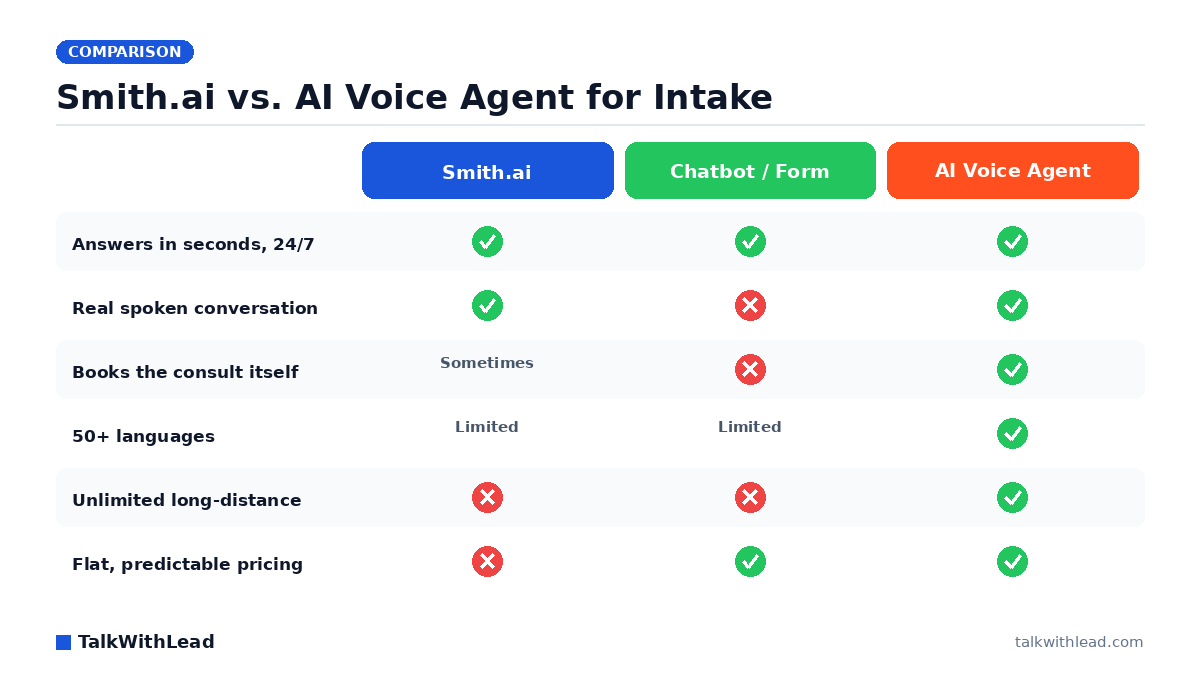
    Smith.ai vs. AI Voice Agent for Intake — TalkWithLead original infographic (comparison diagram).
    Smith.ai vs. AI Voice Agent for Intake

    A prospective client lands on your firm’s site at 9 p.m. with a DUI and a court date. They will not fill out a contact form and wait two days for a callback. They want to talk to someone now, and if your site can’t deliver that, the next firm in the search results will.

    That gap is exactly why so many practices shop for a Smith.ai alternative for law firms website intake. Smith.ai built a strong human-receptionist service, but human teams cost more per minute as call volume climbs, can queue callers at peak hours, and still hand most after-hours visitors to a form. The faster-growing option is an AI voice agent that picks up instantly, talks like a person, and books the consult on the spot.

    TL;DR: The best Smith.ai alternative for law firm intake is a human-sounding AI voice agent that answers your website visitors in seconds, every hour of every day, qualifies the matter, and books the consultation directly into your calendar. It converts better than chatbots or forms because people would rather speak than type their legal problem, and it bills at a flat rate instead of per minute.

    Why law firms outgrow a receptionist-only intake service

    Smith.ai and similar virtual-receptionist services solved a real problem: someone friendly answers the phone so attorneys can practice law. But three pressures push growing firms to look further.

    • Cost scales with conversation. Per-minute or per-call pricing means your bill rises right when intake volume rises. A busy month becomes an expensive month.
    • Peak-hour queues. Human teams handle a finite number of simultaneous callers. A marketing push, a local news story, or a Monday-morning rush can leave callers waiting.
    • Website visitors still get a form. Most receptionist services answer the phone but route web traffic to a chatbot or a contact form, which is the slowest path back to a real conversation.

    Speed is the whole game in legal intake. According to Harvard Business Review research, companies that reach a web lead within an hour are nearly 7× more likely to qualify it than those that wait even an hour longer. For a law firm, an hour is an eternity; the visitor has already called two competitors. Our deeper look at why the first 60 seconds win most deals walks through exactly how that window closes.

    What is the best Smith.ai alternative for law firm website intake?

    The strongest alternative is an AI voice agent that lives on your website and turns a click into a phone conversation in seconds. Instead of a chatbot that makes a stressed visitor type out their situation, the agent speaks, listens, and responds in a natural, human-sounding voice.

    Here is what a voice-first intake agent does that a receptionist queue or a form cannot:

    • Answers instantly, 24/7. No hold music, no “our office is closed,” no overnight gap. Every visitor gets a live conversation.
    • Speaks 50+ languages. A Spanish-speaking family with an immigration question gets answered in their own language without a transfer.
    • Offers instant callbacks. If a visitor would rather you call their phone, the agent connects the call immediately.
    • Includes unlimited long-distance calling, so a client across the country reaches you without anyone watching a meter.
    • Qualifies and books. It asks your intake questions, screens out matters you don’t take, and drops the qualified consult straight onto the calendar.

    Voice matters because of how people behave under stress. A Five9 study of 4,000 US and UK consumers found that 75% of people prefer talking to a real human over the phone for support. A human-sounding AI voice agent meets that preference at machine scale, while a chatbot fights it. We compared the conversion gap directly in AI voice agent vs. chatbot: which one books more calls?

    Want to hear it first? Try a live demo and judge the voice quality yourself before you change anything.

    Smith.ai vs. chatbot vs. AI voice agent: a side-by-side look

    Each option has a place. The question is which one books the most consults from your existing website traffic.

    Intake dimensionSmith.ai (human receptionist)Chatbot / web formAI voice agent
    Response timeFast when staffedInstant textInstant voice
    Real spoken conversationYesNoYes
    24/7 without queueLimited at peakYesYes
    Books the consult itselfSometimesRarelyYes
    LanguagesLimitedLimited50+
    Long-distance callingMeteredN/AUnlimited
    Pricing modelPer minute / per callFlat / cheapFlat

    The chatbot is cheap but loses the visitor who won’t type. The receptionist service is excellent on the phone but costly to scale and often leaves web traffic on a form. The AI voice agent combines instant text-speed availability with the conversion power of an actual conversation. For the broader comparison, see AI voice agent vs. chatbot conversion rate and live chat vs. chatbot, plus the AI voice upgrade.

    How much intake are you losing? Run the math

    Picture a firm whose website gets 200 visitors a week from paid search and referrals. Say even 1 in 20 of those visitors is a qualified case that arrives outside office hours or during a phone queue, and the visitor leaves without ever reaching a human. That’s roughly 10 lost conversations a week, or more than 500 a year, walking straight to a competitor.

    Now assume a single signed matter is worth a few thousand dollars in fees. Recovering even a handful of those lost conversations each month covers the cost of the intake system many times over. That is the ROI an always-on voice agent is built to capture. You can model your own numbers with the free missed-call revenue calculator using your real traffic and average case value.

    This is also why missed-call automation for websites matters so much for firms: every unanswered after-hours inquiry is a case you paid to attract and then let slip.

    Honest verdict: is an AI voice agent right for your firm?

    Best for: growing practices that get steady website traffic, run paid search, take after-hours or weekend inquiries, serve multilingual communities, or feel their per-minute receptionist bill climbing as volume grows.

    An AI voice agent isn’t a fit for everyone. A Five9 survey of 4,000 consumers found that 56% are frequently frustrated by AI customer-service chatbots, so voice quality is non-negotiable; a robotic agent will hurt you. The point of a modern voice agent is that it sounds genuinely human, which is why a live demo should come before any decision.

    Not the right fit if: your firm prefers a named human receptionist who knows every regular caller by name, your inquiry volume is low enough that a queue never forms, and predictable scaling cost is not a concern. In that case, a traditional service may serve you well.

    Pricing is straightforward and flat rather than metered; you can review the plans on the pricing page. When the math points to recovering lost consults, you can start with a free signup and have the agent live on your site quickly.

    How to switch without disrupting intake

    Moving off a receptionist-only setup is lower-risk than most firms expect because you can run the voice agent alongside your current process first.

    1. Test the voice. Book a live demo and confirm it sounds human enough to represent your firm.
    2. Script your intake. Feed it your screening questions, the matter types you accept, and your scheduling rules.
    3. Add the widget. Place it on your highest-traffic pages first: practice-area pages and the contact page.
    4. Measure. Watch consults booked, after-hours captures, and answered-versus-missed conversations against your old baseline.

    The same speed-to-lead logic that wins legal clients wins in other appointment-driven fields. Our speed-to-lead playbook for real estate shows the instant-callback pattern in action, and it maps cleanly onto consult booking.

    FAQ

    What is the best Smith.ai alternative for law firm website intake?

    For most growing firms, the best alternative is an AI voice agent that answers website visitors instantly with a human-sounding voice, qualifies the matter, and books the consult directly. It combines the conversion power of a real phone conversation with 24/7 availability and flat pricing, instead of routing web traffic to a form or a metered receptionist queue.

    Is an AI voice agent cheaper than a virtual receptionist service?

    It depends on volume. Receptionist services typically bill per minute or per call, so costs rise as intake grows. An AI voice agent uses flat, predictable pricing, which usually wins as call volume increases. Run your own numbers with the missed-call revenue calculator and compare against your current monthly bill.

    Can an AI voice agent actually book consultations on its own?

    Yes. A properly configured agent runs your intake script, screens out matters you don’t accept, and books qualified consultations onto your calendar without an attorney lifting a finger. It can also offer an instant callback if the visitor prefers you to call their phone.

    Will it sound robotic to my prospective clients?

    Modern AI voice agents are built to sound genuinely human, which is the entire reason they convert. Because many consumers distrust clunky chatbots, voice quality is the thing to test first; book a live demo and listen before you decide.

    Does it handle non-English-speaking callers?

    Yes. A voice-first agent can speak 50+ languages, so a Spanish-speaking or other non-English visitor is answered in their own language without a transfer or a callback delay, which is a major advantage for firms serving diverse communities.

    How fast can it be live on my website?

    After a free signup, you script your intake questions and drop the widget onto your site, typically your practice-area and contact pages first. Most firms can run it alongside their existing intake within a short setup window and measure the lift before fully switching over.

  • Speed to Lead Real Estate: Book More Showings

    Speed to Lead Real Estate: Book More Showings

    A buyer lands on your listing at 9:14 p.m., loves the kitchen, and wants to see the place this weekend. If you call back tomorrow morning, that buyer has already booked two showings with agents who answered first. Speed to lead in real estate is won in minutes, not mornings — and most agents are still losing it to a contact form and a 12-hour reply gap.

    TL;DR: The fastest way for real estate agents to book more showings is to replace slow web forms with an instant callback widget backed by a human-sounding AI voice agent. It calls the buyer back in seconds, answers questions in their language around the clock, and books the showing while interest is still hot — turning anonymous website traffic into real phone conversations before a competitor responds.

    Why does speed to lead matter so much in real estate?

    Real estate buyers shop in tabs. A single property search ends with five or six listings open at once, and the agent who turns that browsing into a live conversation first usually wins the relationship. The gap you are competing against is brutal: according to the MIT Lead Response Management study, you are roughly 21× more likely to qualify a lead contacted within 5 minutes than one contacted at 30 minutes. In a market where the listing itself is public, response speed is one of the few advantages you fully control.

    Now picture the inverse. Say even 1 in 10 of the after-hours inquiries you currently reply to “first thing tomorrow” was a ready buyer — that is a handful of booked showings a month walking straight to the agent who picked up first. The cost of slow is not theoretical; it is the listing down the street getting the offer.

    What is an instant callback widget, and how does it book showings?

    An instant callback widget is a small button on your website and landing pages that offers the visitor a phone call right now, with no form to fill out. The visitor taps it, and instead of waiting in a queue, they get a call back in seconds. When that call connects to a human-sounding callback widget powered by an AI voice agent, the conversation starts immediately — the buyer talks, the agent listens, and a showing time gets proposed before the buyer ever closes the tab.

    This is the core difference between voice-first and the slow alternatives. A web form collects a name and disappears into an inbox. A chatbot makes the buyer type, wait, and re-type. A voice callback does the one thing real estate runs on: it gets two people talking. See the side-by-side in our breakdown of AI voice agents vs chatbots for which actually converts website visitors.

    Best for: agents and teams who get steady website or listing-page traffic but lose after-hours and weekend inquiries to slow follow-up.
    Not the right fit if: you have almost no inbound web traffic yet — fix lead generation first, because a callback widget converts demand, it does not create it.

    How an AI voice agent covers the leads you can’t

    No agent can answer every call. You are at a closing, in a showing, asleep, or already on another line. That is exactly when the next buyer is browsing. A human-sounding AI voice agent answers those inquiries the moment they come in — 24/7, in 50+ languages — so a relocating buyer from another country or a night-shift worker scrolling at midnight gets a real conversation instead of a voicemail.

    Two real-estate-specific wins matter here:

    • 50+ languages — a multilingual market like Miami, Toronto, or Houston means buyers who would hang up on an English-only line instead get qualified in their own language.
    • Unlimited long-distance calling — out-of-state and international buyers relocating into your market reach you with zero toll friction, and you reach them right back.

    The AI voice agent qualifies the buyer, answers the obvious questions (price, square footage, is it still available, can I see it Saturday), and books or routes the showing. When you are free, it hands you a warm lead instead of a cold callback list. It is the difference between capturing the lead before they call a competitor and finding out Monday that they already toured three other homes.

    Want to hear how human it actually sounds? Try the live demo and have the AI voice agent call you the way it would call your next buyer.

    Voice-first vs forms and chatbots for real estate leads

    Most agent websites still funnel inquiries through a “Request Info” form or a typing chatbot. Both leak buyers at the exact moment intent peaks. Here is how the three stack up on what a showing actually depends on:

    CapabilityWeb formChatbotInstant callback + AI voice
    Response timeHoursMinutes of typingSeconds, by phone
    Works 24/7Collects onlyYesYes, and it talks
    50+ languages spokenNoLimitedYes
    Books a showing on the spotNoRarelyYes
    Long-distance buyers reachedNoNoUnlimited calling
    Becomes a real conversationNoNoYes

    The pattern is consistent: forms and chatbots are holding pens, while a voice callback is a conversation. For the deeper trade-offs between typing-based tools, our piece on live chat vs chatbot, and the AI voice upgrade walks through why voice closes the gap. And if you want the data behind responding inside the first minute, read why the first 60 seconds win most deals.

    What does this cost, and is it worth it for an agent?

    The honest framing: an instant callback tool runs a predictable monthly subscription, far below the cost of a single lost commission. To see whether it pencils out for your pipeline, here is illustrative ROI math (your numbers will differ):

    Example: Say your site gets 200 listing-page inquiries a month and your current form-and-follow-up flow converts 4% of them into showings — 8 showings. If answering instantly by voice lifts that to a still-modest 7%, that is 14 showings, or 6 extra showings a month. In real estate, even one of those turning into a closed deal can cover a year of the tool. Plug your own traffic and average commission into the free speed-to-lead ROI calculator to see your version of the number.

    The math leans this way because of who responds first. Research popularized by InsideSales and Dr. James Oldroyd found roughly 35-50% of sales go to the company that responds first — in real estate, “responds first” means “got the showing.” You can compare the plan tiers on the pricing page and start converting your existing traffic with a free signup.

    How to add speed to lead to your real estate site this week

    You do not need a website rebuild. A practical rollout looks like this:

    1. Put the callback widget on high-intent pages first — individual listings, the “book a showing” page, and any paid-ad landing page where buyers arrive ready.
    2. Set the AI voice agent to answer instantly after hours and overflow so nights and weekends, when buyers actually browse, stop going to voicemail.
    3. Turn on the languages your market speaks so multilingual buyers get qualified instead of dropping off.
    4. Let it book or route showings, then review the transcripts weekly to sharpen the questions it asks.

    The goal is simple and measurable: every inquiry becomes a phone conversation in seconds, not a form sitting in an inbox. If you want to compare voice against booking by chatbot specifically, our look at which one books more calls makes the case. When you are ready, run the live demo on your own phone before you put it in front of a buyer.

    FAQ

    What does speed to lead mean in real estate?

    Speed to lead is how fast you respond to a new buyer or seller inquiry from your website, ads, or listings. In real estate it usually decides who gets the showing, because the first agent to start a real conversation tends to win the relationship before competitors even reply.

    How fast should a real estate agent respond to a web lead?

    Within minutes, ideally seconds. Qualification rates drop sharply after the first five minutes, so an instant callback that connects the buyer to a live or AI voice conversation right away dramatically outperforms a same-day or next-morning reply.

    Can an AI voice agent really book showings for real estate?

    Yes. A human-sounding AI voice agent answers the inquiry instantly, qualifies the buyer, answers common questions about the property, and proposes or books a showing time. It works 24/7 in 50+ languages and hands you warm, already-engaged leads instead of a callback list.

    Is an instant callback widget better than a chatbot for real estate?

    For booking showings, voice usually wins. A chatbot makes the buyer type and wait, while a callback widget gets two people talking in seconds — which is how real estate deals actually move. Voice also handles tone, urgency, and follow-up questions that text struggles with.

    How much does an instant callback tool cost for agents?

    It is a monthly subscription, typically far less than a single lost commission. Whether it pays off depends on your traffic and conversion lift — you can estimate your own return with the free speed-to-lead ROI calculator before committing to a plan.

    Does it work for out-of-state or international buyers?

    Yes. Unlimited long-distance calling removes the toll barrier for relocating buyers, and support for 50+ languages means buyers who would hang up on an English-only line get qualified in their own language instead.

  • AI Voice Agent vs Chatbot Conversion Rate

    AI Voice Agent vs Chatbot Conversion Rate

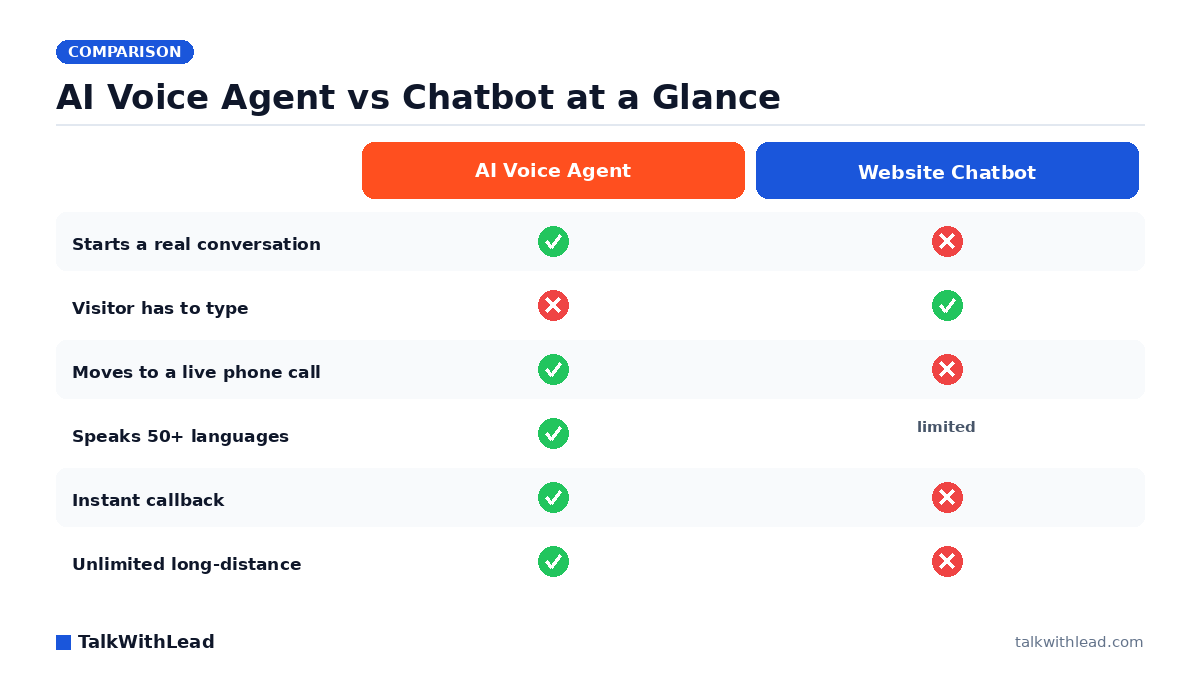
    <a href=AI Voice Agent vs Chatbot at a Glance — TalkWithLead original infographic (comparison diagram).”/>
    AI Voice Agent vs Chatbot at a Glance

    Why the conversion gap is bigger than it looks

    The ai voice agent vs chatbot conversion rate question usually gets answered with a feature checklist. The real answer is simpler: a voice agent starts a conversation, and a chatbot starts a chore. One asks a visitor to speak; the other asks them to read a greeting, type a question, wait, read again, and hope the bot understood. Every one of those extra steps is a place where a ready-to-buy visitor quietly leaves.

    That matters because the visitor who lands on your pricing page at 9:47 p.m. is not browsing. They are deciding. A human-sounding AI voice agent can answer them out loud in seconds and offer to put them on a call right then. A chatbot, at best, captures an email and adds them to a queue you will work tomorrow, which is often a day too late.

    How a chatbot actually loses high-intent visitors

    Chatbots are not useless. They deflect support tickets and answer FAQs at scale. The trouble shows up on conversion-focused pages, where the goal is not to inform a visitor but to win one. Here is where the friction stacks up:

    • Typing tax. Most people speak far faster than they thumb-type on a phone. Forcing a buyer to type their question slows the whole exchange to a crawl.
    • Scripted dead-ends. The moment a visitor asks something off-script, a rules-based bot stalls and the visitor blames your brand for it.
    • No handoff to a human. Even when a chatbot senses high intent, the usual next step is “leave your email” — not “talk to someone now.”
    • Language walls. A buyer who prefers Spanish, Tagalog, or Portuguese often gets an English-only widget and bounces.

    If you want a deeper breakdown of where text-based tools fall short, our piece on live chat versus chatbots and the AI voice upgrade walks through each option side by side.

    What an AI voice agent does differently

    An AI voice agent flips the interaction. Instead of waiting for the visitor to compose a message, it greets them in a natural, human-sounding voice and handles the back-and-forth out loud. The visitor talks the way they would to a salesperson on the showroom floor, and the agent listens, answers, qualifies, and offers the next step.

    Three capabilities change the math:

    • 50+ languages. The agent meets visitors in their own language, so a multilingual market stops being a leak in your funnel.
    • Instant callbacks. If a visitor would rather get a call in two minutes, the agent arranges it instead of dropping them into a form.
    • Unlimited long-distance calling. A prospect three time zones away connects with no concern about call cost on your side.

    The net effect is fewer steps between “interested visitor” and “live conversation.” That compression is the whole game. You can try a live demo and hear how the voice agent handles a real exchange before you decide anything.

    An illustrative conversion comparison

    The following numbers are an illustrative example, not measured results from a specific customer. They show how small per-step drop-offs compound differently for typing versus talking.

    Imagine 1,000 high-intent visitors hit a service page in a month. With a chatbot, suppose 12% open the widget, 60% of those actually type a question, 50% of those leave an email, and 35% of those emails turn into a booked call. That chain leaves you with roughly 13 booked calls.

    Now run the same 1,000 visitors past an AI voice agent. Suppose 12% engage, but because talking is effortless, 80% complete the conversation, and 55% of those accept an offer to connect to a live call or instant callback. That chain leaves you with roughly 53 booked calls from the same traffic. Same visitors, same intent — the difference is how much effort each path demands. Even if your real percentages differ, the shape holds: removing the typing tax and the email-then-wait gap raises the ai voice agent vs chatbot conversion rate every time.

    Speed is the hidden multiplier

    Conversion is not only about the channel; it is about the clock. A lead contacted within the first minute is far more likely to convert than one contacted an hour later, simply because intent decays fast. A chatbot that collects an email defers the real conversation. A voice agent has the conversation now.

    This is the core idea behind speed-to-lead and why the first 60 seconds win most deals. When the agent can move a visitor straight into a call, you are not racing a competitor’s callback queue — you have already started the relationship. And when a call does slip through, missed-call automation catches the lead before they dial someone else.

    When a chatbot is still the right call

    Voice is not the answer for every box on every page. A chatbot earns its place when:

    • The job is high-volume, low-stakes support (order status, password resets, store hours).
    • The visitor genuinely prefers async text and may be mid-meeting.
    • You need a searchable transcript trail for compliance or routing.

    The smart setup is layered: let text tools handle routine questions, and route the high-intent moments — pricing, demo requests, “talk to sales” — to a voice agent that can close the loop with a real call. If you are weighing widgets, the callback widget versus click-to-call versus live chat comparison helps you map each tool to the right page.

    How to decide for your own site

    Start with one question: on this page, is a captured email good enough, or do you actually want a conversation? On a blog post, an email is fine. On a pricing page for a high-ticket service, a booked call is worth many emails. Put the voice agent where the conversation is worth the most.

    Then check three things: do you serve multiple languages, do prospects reach you from far away, and does your current widget end most sessions with “we’ll get back to you”? If you answered yes to any of them, the voice path is likely leaving money on the table for you today. You can start free and put a voice agent on your highest-intent page this week, or review pricing to size it for your traffic.

    FAQ

    Is an AI voice agent really better than a chatbot for conversions?

    On high-intent pages, generally yes. A voice agent removes the typing tax and can move a visitor straight into a live call or instant callback, while most chatbots stop at capturing an email. The ai voice agent vs chatbot conversion rate gap is widest exactly where the visitor is closest to buying.

    Does the voice agent sound robotic?

    No. TalkWithLead’s agent is built to sound human and conversational, so visitors talk to it the way they would talk to a person, rather than navigating a menu. The fastest way to judge it is to hear it on a live demo.

    What about visitors who do not speak English?

    The voice agent handles 50+ languages, so a buyer who prefers another language gets a natural conversation instead of an English-only wall. For multilingual markets, that alone can recover leads a text widget would lose.

    Can I keep my existing chatbot and add a voice agent?

    Yes, and that is often the best setup. Let the chatbot handle routine support questions and route high-intent moments — pricing, demo, “talk to sales” — to the voice agent that can connect a real call.

    What happens if a visitor would rather be called back later?

    The agent can schedule an instant callback instead of forcing a live conversation, and unlimited long-distance calling means it can reach prospects anywhere without a cost concern on your end.

    How quickly can I test this on my own site?

    You can sign up free and place a voice agent on your highest-intent page in a single sitting, then compare its booked-call rate against your current chatbot before rolling it out everywhere.

  • AI Voice Agent vs Human Receptionist: Best for Insurance?

    AI Voice Agent vs Human Receptionist: Best for Insurance?

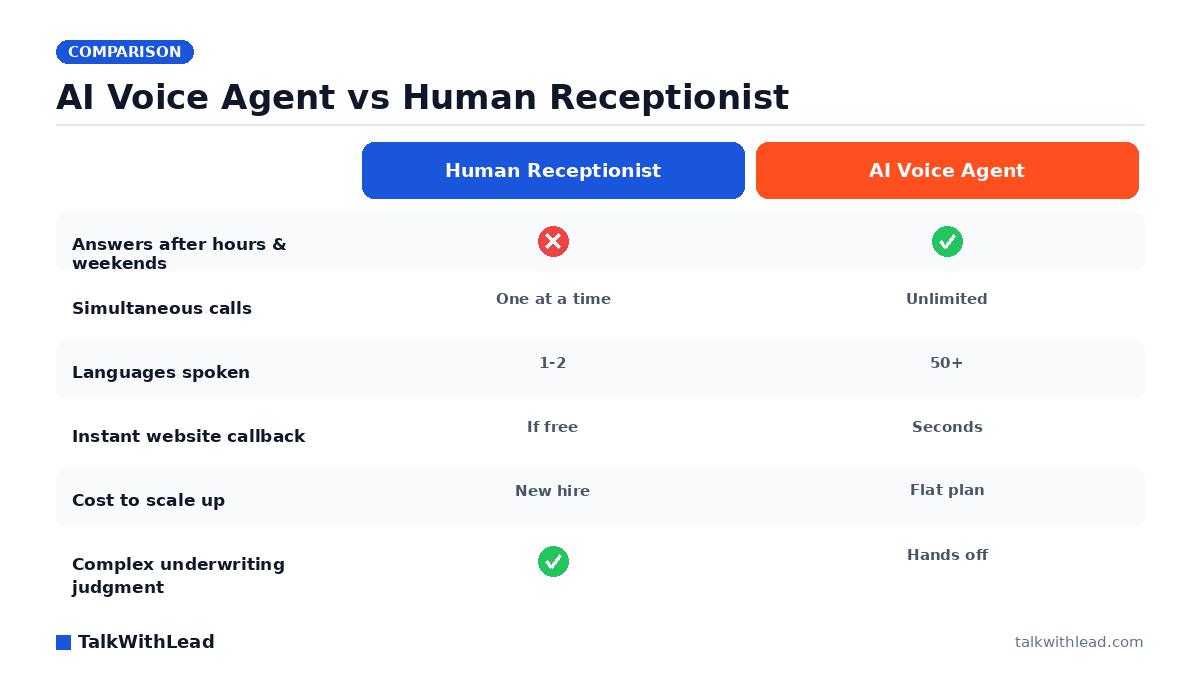
    AI Voice Agent vs Human Receptionist — TalkWithLead original infographic (comparison diagram).
    AI Voice Agent vs Human Receptionist

    The real question insurance owners are asking

    An insurance shopper lands on your site at 9:14 p.m., scans your auto and home page, and wants a quote now. Your receptionist went home at five. That gap is the whole debate. The ai voice agent vs human receptionist question is not really about technology preference — it is about which option actually answers the visitor while they still care.

    A human receptionist is warm, judgment-driven, and great on the phone. But she works set hours, holds one line at a time, and speaks one or two languages. An AI voice agent answers every visitor instantly, around the clock, in 50+ languages, and never puts a quote-ready prospect on hold. For an insurance agency that lives and dies on first contact, that difference shows up directly in bound policies.

    Short answer: An AI voice agent answers every web visitor and caller 24/7 — including nights, weekends, and lunch breaks — while a human receptionist covers only set hours. For an insurance agency, the AI agent is best for never missing an after-hours quote request and handling many callers at once in 50+ languages; a human receptionist is best for warm relationship moments and complex judgment calls. Most agencies get the best of both by using the AI voice agent to catch every lead instantly and routing the ones that need a person to a human.

    This matters because so much insurance shopping happens off-hours. According to MediaAlpha, the insurance lead marketplace, about 45% of leads are generated during nights and weekends — outside standard agency hours, exactly when a human front desk is closed but an AI voice agent still answers.

    Where a human receptionist still wins

    Let’s be fair to the front desk. A skilled receptionist reads tone, calms an upset claimant, and knows when a commercial policy needs a senior agent rather than a script. For relationship-heavy moments — a customer disputing a renewal, a referral from a long-time client, a complex multi-property quote — a human is the right answer.

    The limits are structural, not personal:

    • Coverage windows. Even a great receptionist covers maybe 45 of the 168 hours in a week. The other 123 hours of website traffic hit a voicemail.
    • One call at a time. During an open-enrollment rush or a storm-claim spike, callers four through ten get a busy signal or a callback promise that comes too late.
    • Language reach. Insurance buyers are often shopping in a second language. If your front desk speaks only English, you lose the Spanish, Mandarin, or Portuguese speaker to whoever answers in their language.

    None of this means fire your receptionist. It means stop asking one person to be the entire first-response layer for a 24/7 website.

    Where an AI voice agent pulls ahead

    An AI voice agent sits on your website and talks — out loud, in a natural human-sounding voice — the moment a visitor wants to engage. It is not a chatbot making people type, and not a form dumping leads into an inbox. It starts a real phone conversation, qualifies the lead, and either books the call or hands off a hot prospect.

    For insurance specifically, the advantages stack up:

    • Always on. The 9:14 p.m. auto-quote shopper gets answered, not a voicemail. Speed-to-lead is the single biggest lever in insurance, and we cover why in Speed-to-Lead: Why the First 60 Seconds Win Most Deals.
    • Unlimited simultaneous calls. Ten storm claims at once? Every caller gets a live conversation, not a queue.
    • 50+ languages. The agent switches to the visitor’s language automatically, so you stop forfeiting non-English shoppers.
    • Unlimited long-distance calling and instant callbacks. A prospect anywhere can reach you, and a visitor who half-fills a quote form gets a callback in seconds instead of next business day.

    Here is an illustrative example of the math. Say your agency site gets 1,200 visitors a month and 6% are quote-ready — that’s 72 high-intent prospects. If a receptionist-only setup catches the third who call during business hours, you talk to roughly 24. An always-on AI voice agent that engages even half the rest could start conversations with 50+. Same traffic, same ad budget, and in this example, potentially close to double the quote conversations. (Illustrative numbers, not a guarantee.) You can try a live demo and hear how the voice agent handles an insurance inquiry yourself.

    Cost: salary vs flat plan

    A full-time receptionist in many markets runs well past $40,000 a year before benefits, and that buys you single-threaded coverage for about a quarter of the week. To cover nights and weekends you are hiring two or three people or paying an answering service per minute.

    An AI voice agent is a flat monthly cost that covers all 168 hours, every language, and unlimited concurrent calls without a new hire each time volume jumps. The point is not to replace your team’s salary line — it is to stop paying for missed leads. Every after-hours quote shopper who hits a voicemail is acquisition spend you already paid for, leaking out the back. Compare what coverage actually costs on the pricing page.

    You don’t have to choose just one

    The framing of one versus the other is a trap. The best insurance front office runs both in layers:

    1. AI voice agent answers first — every visitor, every hour, every language. It qualifies, captures contact details, and books the quote call.
    2. Humans take the handoff — your licensed agents get warm, pre-qualified prospects instead of cold voicemails, and your receptionist handles the relationship and judgment calls AI shouldn’t.

    That’s the same logic behind catching calls you’d otherwise lose, which we break down in Missed Call Automation for Websites. The AI doesn’t compete with your people; it feeds them.

    What about chatbots and forms?

    Some agencies try to close the after-hours gap with a chatbot or a quote form. Both make the prospect do the work — typing, waiting, hoping someone follows up. A voice conversation is faster, warmer, and converts a hesitant shopper far better than a text box. We compared these head-to-head in Live Chat vs Chatbot: Pros, Cons, and the AI Voice Upgrade. The short version: voice beats typing when money and trust are on the line, and insurance is exactly that.

    If you want to put an always-on voice agent in front of your insurance traffic this week, you can start a free signup and have it talking to visitors fast.

    AI voice agent vs human receptionist: side-by-side

    AI voice agent vs human receptionist (insurance agency)
    FactorHuman receptionistAI voice agent (TalkWithLead)
    CoverageSet hours (~45 of 168 hours/week)24/7, including nights and weekends
    Simultaneous callersOne at a timeUnlimited simultaneous calls
    Speed to answer a web leadOnly when freeSeconds, every time
    LanguagesWhatever they speak50+ languages
    After-hours quote requestsGo to voicemailAnswered or called back instantly
    Relationship / judgment callsStrong — human nuanceRoutes complex cases to your team
    Cost shapeSalary + benefits (full-time)Flat plan; scales without new hires

    Bottom line.

    Best for: Insurance agencies that lose quote requests after hours, on weekends, or when the front desk is busy. An AI voice agent is the best fit for instant, always-on first contact and for handling many shoppers at once across languages — which matters because Harvard Business Review research found companies that reach a web lead within an hour are nearly 7× more likely to qualify it than those that wait even an hour longer, so a quote request sitting in voicemail until morning is usually a lost deal.

    Not the best fit for: It isn’t a full replacement for the human relationship side — complex judgment, sensitive claims conversations, and warm in-person service still belong with your team. The strongest setup pairs the AI agent for instant capture with humans for the high-touch moments.

    In one line: AI voice agent to catch every lead instantly and 24/7; humans for the relationship and judgment calls.

    FAQ

    Can an AI voice agent replace my insurance receptionist entirely?

    It can, but most agencies get better results keeping both. The AI voice agent handles instant first response, after-hours coverage, overflow, and non-English callers, while your receptionist and licensed agents handle complex underwriting, claims empathy, and relationship closing. Think layers, not a swap.

    Will insurance shoppers know they’re talking to an AI?

    The voice is designed to sound natural and human, and the conversation feels like a real phone call rather than a robotic menu. The goal is a smooth, helpful exchange that qualifies the lead and books the quote call — not to deceive anyone. Many agencies are upfront that callers are speaking with an AI assistant.

    How does an AI voice agent help with after-hours insurance leads?

    Most quote shopping happens evenings and weekends when your front desk is closed. The AI voice agent answers those visitors instantly, qualifies them, and either books a callback or hands a hot lead to your team for the morning — so traffic you already paid for doesn’t leak to a competitor who answered first.

    What languages can the AI voice agent handle for my agency?

    It speaks 50+ languages and switches automatically based on the visitor, so Spanish, Mandarin, Portuguese, and other shoppers get answered in their language. A single-language front desk simply can’t match that reach.

    Is an AI voice agent cheaper than hiring more receptionists?

    For most agencies, yes. One receptionist covers roughly a quarter of the week and one call at a time. An AI voice agent is a flat monthly cost covering all hours, unlimited concurrent calls, and every language — so you scale coverage without a new salary each time volume spikes. Check current plans on the pricing page.

    How many insurance leads come in after business hours?

    A large share. According to MediaAlpha, the insurance lead marketplace, about 45% of leads are generated during nights and weekends — outside standard agency hours. That’s exactly when a human receptionist isn’t there but an AI voice agent still answers, qualifies the shopper, and books the quote call.

    Can an AI voice agent handle multiple insurance callers at the same time?

    Yes. Unlike one receptionist who can take one call at a time, an AI voice agent handles unlimited simultaneous calls, so a rush of quote shoppers during a storm or a promotion never ends up in voicemail. Every caller gets a live conversation instead of a busy signal or a callback promise that arrives too late.

    What does an AI voice agent cost compared to hiring another receptionist?

    A full-time receptionist runs well past a salary plus benefits and still covers only set hours and one call at a time. An AI voice agent runs on a flat plan and scales to 24/7 coverage and unlimited simultaneous calls without a new hire each time volume spikes. (Treat any specific dollar figures as illustrative, not a quoted price — check current plans on the pricing page.)

  • Live Chat vs Chatbot: Pros, Cons, and the AI Voice Upgrade

    Live Chat vs Chatbot: Pros, Cons, and the AI Voice Upgrade

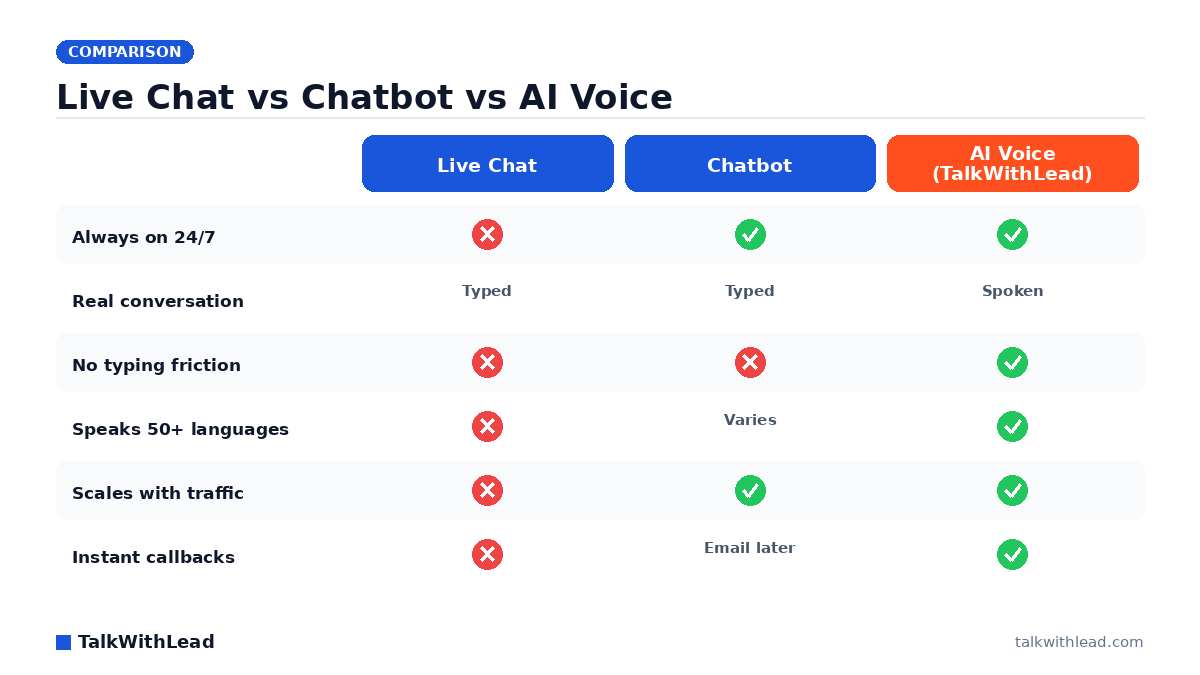
    Live Chat vs Chatbot vs AI Voice — TalkWithLead original infographic (comparison diagram).
    Live Chat vs Chatbot vs AI Voice

    Live chat vs chatbot: the wrong question most websites ask

    The debate over live chat vs chatbot usually comes down to one trade-off: pay humans to type with visitors all day, or install a bot that answers canned questions for free. Both choices leave your most interested prospects stuck typing into a small box, waiting on a reply — and a waiting visitor is a leaving visitor.

    There’s a third option that beats both: an AI voice agent that actually talks to people the moment they land on your site. Before you commit budget to either side of the live chat vs chatbot fight, it’s worth seeing where each one quietly leaks leads, and why a real voice conversation turns more of them into booked calls and sales conversations.

    Short answer

    Live chat means a human types replies in real time; a chatbot means software answers with automated text. Live chat gives better answers but only while someone is staffing the queue, so nights and weekends become dead zones; chatbots are always on but frustrate visitors when questions get nuanced. For converting high-intent visitors, the upgrade beyond both is an AI voice agent that talks instead of types — instant, 24/7, in 50+ languages.

    According to a Five9 study of 4,000 US and UK consumers, 75% of people prefer talking to a real human in person or over the phone for customer support.

    Live chat: pros and cons of human typing

    Live chat connects a visitor to a real teammate over text. Done well, it feels personal and handles oddball questions a script never anticipated. The catch is that it only works while a person is actually watching the queue — and most teams can’t watch it every hour of every day.

    Where live chat wins:

    • Human judgment. A trained rep reads nuance, calms a frustrated buyer, and improvises in a way no script can.
    • Trust. Visitors know they’re talking to a person, not a decision tree, so they open up.
    • Upsell instinct. Good reps spot buying signals and nudge toward a demo or a quote.

    Where live chat loses:

    • It’s only as fast as your staffing. Nights, weekends, and lunch breaks become dead zones — exactly when many buyers browse.
    • It doesn’t scale. One rep can juggle a few chats; a traffic spike means queues and abandoned conversations.
    • It’s still typing. Complex questions turn into slow back-and-forth, and the visitor is one tab away from a competitor.
    • Language limits. Your team speaks the languages it speaks, and not one word more.

    Chatbots: pros and cons of automated typing

    A chatbot swaps the human for a script or an AI model that replies instantly, around the clock, for a flat cost. That always-on speed is real — but speed to a generic answer isn’t the same as speed to a conversation, and buyers can tell the difference within seconds.

    Where chatbots win:

    • Always on. A 2 a.m. question gets an immediate reply instead of an empty queue.
    • Cheap at volume. One bot handles a thousand simultaneous chats without breaking a sweat.
    • Good at FAQs. Hours, pricing tiers, “do you serve my area” — bots handle these cleanly.

    Where chatbots lose:

    • Dead ends. Step outside the script and the visitor hits “let me connect you to a human” — who isn’t there.
    • Low trust. Buyers smell a bot fast and disengage when the stakes or the dollar amounts are high.
    • Still typing. The same friction as live chat: thumbs on a phone screen instead of a voice on a call.
    • Forms in disguise. Many “chatbots” just collect an email to follow up on later — long after the visitor’s interest has cooled.

    A Five9 survey of 4,000 consumers found that 56% are frequently frustrated by AI customer-service chatbots and 48% don’t trust the information those bots provide. That distrust is exactly why a typed bot struggles to close a high-intent buyer — and why a real conversation tends to win those moments.

    If you’re weighing these against other on-site tools, our breakdown of the callback widget vs click-to-call vs live chat shows how each one actually converts visitors.

    Live chat vs chatbot: a side-by-side look

    Strip away the marketing and the live chat vs chatbot comparison comes down to four things that decide whether a visitor becomes a lead:

    • Speed: Chatbots reply instantly; live chat replies when staffed. Both still make the buyer wait through typed turns.
    • Availability: Bots run 24/7; humans don’t. The gap is where after-hours leads vanish.
    • Depth: Humans handle complexity; bots stall on it and loop back to the same three buttons.
    • Cost: Bots are cheap to run but cheap-feeling; staffed chat is rich but expensive and hard to scale.

    Notice what’s missing from both columns: an actual conversation. Typing is the bottleneck on both sides. And the reason that matters is timing — as we explain in speed-to-lead: why the first 60 seconds win most deals, the lead you reach in the first minute is worth far more than the one you try to follow up with tomorrow.

    The AI voice upgrade: why talking beats typing

    Here’s the shift that ends the live chat vs chatbot debate. Instead of choosing between a human typist who clocks out and a bot that hits a wall, you put an AI voice agent on your site that actually speaks to visitors — and sounds startlingly human while doing it. The moment someone shows intent, they can be in a real phone conversation instead of a chat thread.

    That changes the math on every weakness above:

    • Always on, like a bot — but it talks, like your best rep. No staffing gaps, no dead 2 a.m. queue, no “we’ll get back to you.”
    • It speaks 50+ languages. A visitor in another country gets answered in their own language without you hiring a single multilingual rep.
    • Unlimited long-distance calling. Prospects anywhere can reach you, and you can call them back, with no per-minute anxiety.
    • Instant callbacks. If a visitor would rather be called, the agent triggers a callback in seconds — not “within 24 hours.”
    • No typing tax. People explain what they need far faster out loud than with their thumbs, and they trust a voice more than a text box.

    Want to hear how human it sounds before you decide anything? Take the live demo and talk to the agent yourself. For a closer look at the two automated approaches head-to-head, our AI voice agent vs chatbot breakdown goes deeper.

    Where typing still makes sense

    None of this means you should rip out live chat tomorrow. Some buyers genuinely prefer to type — they’re at work, on a quiet train, or just more comfortable in text. A quick FAQ bot still earns its keep for simple, repetitive questions, and a human chat rep is great for a long, detailed enterprise conversation.

    The smart move isn’t either/or. It’s making voice the default fast lane for high-intent visitors while keeping a text option for the people who want it. You stop forcing every motivated buyer through a typed bottleneck, and you stop losing the ones who would rather just talk.

    An illustrative ROI example

    The following is an illustrative example to show the mechanics, not a promise or a real customer result — your own numbers will differ.

    Imagine a service business with 1,000 website visitors a month, where 5% (50 people) show real buying intent. With a typed chatbot that mostly collects emails, say 20% book a call — 10 conversations. With staffed live chat that’s offline half the day, maybe 25% convert during business hours — but since much of the intent shows up after hours, call it 12 conversations. Now picture an AI voice agent that answers all 50 the instant they raise a hand, day or night, in their own language: even at a 40% talk-to-booking rate, that’s 20 conversations.

    In this illustration, the voice-first path roughly doubles booked conversations from the very same traffic — without buying a single extra click. If your average deal is worth a few hundred or a few thousand dollars, that gap compounds month after month. Missing the after-hours and other-language leads is the kind of quiet leak that caps growth without ever showing up in a report.

    Getting started without ripping out your stack

    You don’t have to fire your team or delete your chatbot to add voice. Most businesses keep live chat for the buyers who truly prefer to type and add an AI voice agent as the fast lane for everyone who’d rather just talk — which, in practice, is most high-intent buyers.

    You can compare plans and see what’s included on the pricing page, or skip straight to a free signup and have the voice agent live on your site today. Either way, the goal is the same: stop making your best leads type and wait, and start turning website visitors into real phone conversations.

    Live chat vs chatbot vs AI voice agent
    DimensionLive chatChatbotAI voice agent (TalkWithLead)
    Who answersA human typingAutomated text softwareA human-sounding AI voice agent
    AvailabilityOnly while staffed24/7 text24/7 voice and callbacks
    Answer quality on nuanceHigh (real person)Drops off on complex questionsConversational; routes to a human when needed
    Visitor effortType and waitType and waitJust talk
    Speed to a real conversationDepends on queue and staffingInstant text, but still typingSeconds to a live call or callback
    LanguagesWhoever is staffingVaries by setup50+ languages
    Best jobStaffed support and complex helpFAQ deflection / self-serveConverting high-intent visitors into calls

    Bottom line

    Best for: Use live chat when you can staff it for complex, human-touch support, and a chatbot for always-on FAQ deflection. To convert high-intent visitors into actual sales conversations — especially after hours, across languages, or for international leads — an AI voice agent is the best fit.

    Not the best fit for: An AI voice agent is more than you need for pure self-serve FAQ lookups; a chatbot handles those cheaply. Many sites keep chat/chatbot for support and add voice for the buying moment.

    In one line: Live chat for staffed support, chatbot for FAQ deflection, AI voice agent to convert high-intent visitors into calls. Start a free signup to add the voice agent today.

    FAQ

    What’s the difference between live chat and a chatbot?

    Live chat connects a visitor to a human teammate who types replies in real time, so it’s only available when someone is staffing it. A chatbot uses a script or AI model to reply automatically, 24/7, but it stalls on anything outside its programmed answers.

    The live chat vs chatbot trade-off is essentially human depth versus automated availability — and both keep the visitor typing instead of talking.

    Is a chatbot or live chat better for converting leads?

    Each wins in narrow cases: chatbots for instant, simple, after-hours answers; live chat for complex, high-trust conversations during business hours. But both lose the buyers who want a fast, real conversation rather than a typed exchange.

    An AI voice agent captures that middle ground by talking to visitors instantly, at any hour, which is why voice-first sites tend to book more calls from the same traffic.

    Can AI replace live chat and chatbots entirely?

    It can replace most of what they do and add what they can’t — a natural, human-sounding voice conversation in 50+ languages with instant callbacks. Many businesses keep a text option for visitors who prefer typing, while routing high-intent traffic to the voice agent because spoken conversations close faster.

    Does an AI voice agent work outside business hours?

    Yes. Like a chatbot, it’s always on, so a visitor at midnight or on a holiday gets a real spoken conversation or an instant callback instead of a “we’ll get back to you” form. That after-hours window is where staffed live chat quietly loses leads.

    How fast can I add an AI voice agent to my site?

    You can sign up and place the widget on your site the same day — no need to remove your existing live chat or chatbot first. Start with a live demo to hear the agent, then add it as the fast lane for your highest-intent visitors.

    Why do customers dislike chatbots?

    Mostly because bots stall on anything nuanced and feel impersonal. A Five9 survey of 4,000 consumers found that 56% are frequently frustrated by AI customer-service chatbots and 48% don’t trust the information those bots provide. So for high-intent moments, a real conversation converts better than a typed bot.

    Can an AI voice agent replace live chat and chatbots completely?

    Not always, and it doesn’t have to. An AI voice agent is the strongest tool for converting high-intent visitors into calls and for after-hours coverage, but live chat and chatbots still earn their place for staffed support and simple FAQ deflection. The honest answer is to layer them by page intent rather than rip anything out.

    Should I use live chat, a chatbot, or an AI voice agent?

    Match the tool to the job: live chat for staffed, complex support; a chatbot for always-on FAQ deflection; and an AI voice agent to convert high-intent visitors into real calls, especially after hours, across languages, or for international leads. Many sites run more than one — chat or a bot for support, and voice for the buying moment.

  • Missed Call Automation for Websites: How to Capture Leads Before They Call a Competitor

    Missed Call Automation for Websites: How to Capture Leads Before They Call a Competitor

    Every missed call on a small-business website has a dollar value, and most owners never put a number on it. Once you do, the math gets uncomfortable fast. This is a practical guide to missed call automation for websites in 2026: what the term actually means now, why the AI voice-first approach has overtaken the old “missed-call text-back” tools, and how to stop losing leads to whichever competitor’s phone rings first.

    Talk to TalkWithLead’s AI voice agent if you want to hear what an instantly answered call actually sounds like before you read on.

    The short answer: Missed call automation is a system that captures a caller or web visitor the moment your team can’t pick up, so the lead never goes to a competitor. The older approach is missed-call text-back, which sends an automatic SMS; the stronger approach is an AI voice-first agent that actually answers or calls the lead back in seconds, 24/7, in 50+ languages. Because a large share of calls to small businesses go unanswered, automating the recovery is often the single fastest way to stop losing booked revenue. According to a 411 Locals study of 85 small businesses across 58 industries, only 37.8% of incoming calls were answered by a live person — meaning roughly 6 out of 10 calls went unattended.

    The math of a missed call

    Numbers are illustrative — not a verified customer result. Picture a small home-services business: 250 inbound web/phone leads per month, 10% close rate, $1,400 average ticket. That’s 25 closed jobs and $35,000 in monthly revenue.

    Plenty of small businesses miss real inbound calls once after-hours, weekend, and overlap windows are counted — and every missed call can be real buying intent walking away. Even a conservative 20% miss rate on those 250 leads is 50 missed conversations a month. At a 10% close rate, that’s 5 jobs and $7,000 in monthly revenue — over $80,000 a year — quietly walking to whichever shop’s phone got answered.

    And the stakes aren’t small at the macro level either. According to BIA/Kelsey research, click-to-call and inbound phone calls influence more than $1 trillion in U.S. consumer spending each year — which is why every unanswered call is a slice of real, intent-rich revenue.

    You can’t promise that lift to any specific business and we won’t pretend to. But this is the shape of the cost. Now imagine an AI voice agent that picks up the moment a visitor clicks the widget on your site, in their language, with no toll cost — and you can see why “missed call automation” stopped being optional.

    Why your team misses calls

    After hours and weekends

    Inbound interest doesn’t clock out at 5 PM — plenty of it lands on evenings, weekends, and holidays. Most teams default to “we’ll see it Monday.” The lead is gone by Monday.

    Reps already on a call

    If your team has one or two people answering the phone, the second concurrent call is a missed call. Voicemail is a missed call. “I’ll call back in 20 minutes” is a missed call, because in 20 minutes the lead has already started a conversation with someone faster.

    Crews in the field

    If you have techs in the field — under a sink, on a roof, in a patient’s mouth, on a job site — they cannot answer. A missed call is the default.

    Language mismatch

    A prospect who speaks Spanish, Hindi, Mandarin, French, or Tagalog first will often hang up the moment the answer comes in a language they cannot work in. That call is missed even though somebody picked up.

    Long-distance fear

    Two leaks most teams never count: a prospect calling from a different country who worries about toll costs, and a prospect in a different region whose carrier may charge them a per-minute fee. They never dial. That’s a missed call you don’t even know you missed.

    How Missed-Call Automation Recaptures a Lead — TalkWithLead original infographic (missed call recovery diagram).
    How Missed-Call Automation Recaptures a Lead

    What “missed call automation” actually means today

    The 2018-era version was a text-back tool: if someone called your business and you didn’t pick up, an automated SMS would go out saying “sorry we missed you, leave a message.” Useful — but slow. The visitor still has to wait, type, hope.

    The 2026 version is an AI voice agent embedded directly in your website. The visitor never has to dial in the first place — they click the widget, and the AI voice agent picks up immediately. The conversation starts in the visitor’s language, in a voice that sounds human, with no toll cost to them. If a human on your team is free, the AI hands off cleanly. If not, the AI books the next step (a confirmed callback time, a calendar slot, a quote summary) and sends both you and the prospect a confirmation.

    That is what TalkWithLead does on day one. Start a free TalkWithLead trial if you want to run it on your own site this week.

    Why AI voice-first beats missed-call text-back tools

    • No call needed in the first place. The prospect clicks the widget and talks directly through the browser — no dialing, no toll, no IVR.
    • Instant pickup, not “we missed you.” In practice, response times under a minute outperform response times measured in hours by a margin that changes the unit economics of a business — every operator who watches their pipeline sees it. (See our deeper take on speed-to-lead.)
    • Multilingual. 50+ languages out of the box. A text-back tool defaults to whatever language your auto-template is written in.
    • Unlimited long-distance. The visitor never thinks about toll cost; TalkWithLead covers it.
    • Qualifies inline. The AI asks the right two or three questions during the conversation, so when a human gets the lead it’s already pre-qualified.
    • Sounds human. Modern AI voice handles interruptions, language switching, and clarification without sounding robotic. Try the Live Demo.

    How TalkWithLead handles a missed call

    The TalkWithLead widget sits on every page where conversions matter — your homepage, your pricing page, your demo-request page, your listing pages, your contact page. When a visitor clicks it, three things happen in parallel:

    1. The AI voice agent picks up immediately in the visitor’s language.
    2. The agent asks two or three qualifying questions tuned to your business (location, urgency, the specific service or product they need).
    3. The agent either books a callback into your real calendar, escalates to a human who is on shift, or completes the conversation on its own. The visitor gets a confirmation. Your team gets a clean lead summary.

    For visitors who prefer a phone call, the same widget can fall back to instant callback — your team’s phone rings, with the qualified context already attached.

    Before and after — same missed call, two outcomes

    Before

    • Tuesday 10:47 PM — a prospect on your service page tries to call. Voicemail.
    • 10:48 PM — they try the next two competitors in the search results. The second one answers.
    • Wednesday 8:35 AM — your office sees the missed call, dials back. The deal has been booked elsewhere.
    • Outcome: lead lost. Your team never knew the prospect existed until it was too late.

    After

    • Tuesday 10:47 PM — the prospect clicks the TalkWithLead widget. The AI voice agent picks up immediately in their language.
    • 10:48 PM — the agent asks two qualifying questions, confirms an 8:30 AM appointment, and texts the prospect the booking.
    • Wednesday 8:25 AM — your tech reviews the qualified intake on their phone and arrives at 8:30. The customer feels like the business genuinely picked up at 10:47 PM the night before.
    • Outcome: lead won, zero late-night work for the office team, no toll cost for the prospect even if they were dialing from another country.

    By industry — quick fits

    Home services

    An emergency caller on a Sunday picks whichever shop’s widget answers first. AI voice-first handles the call when your techs are mid-job and you can’t pick up.

    Real estate

    A listing-page form submission at 9 PM gets a live AI conversation in seconds. The buyer feels heard. The agent gets the qualified showing request the next morning. (We covered the Saturday-tour pattern in our speed-to-lead deep dive.)

    Mortgage and insurance

    Rate-shoppers compare three lenders or carriers in one sitting. The one whose phone (or AI voice agent) answers first usually closes. Recording-disclosure rules apply per jurisdiction; talk to your own compliance counsel.

    SaaS sales pages

    A Friday-afternoon “talk to sales” click becomes a Friday-afternoon real conversation instead of a Monday-morning SDR ping. Pipelines fill faster.

    How to roll this out in 48 hours

    1. Day 0: Sign up for a TalkWithLead trial and drop the widget on your three highest-conversion pages (homepage, demo or contact, pricing).
    2. Day 0 evening: Configure the qualifying questions you want the AI to ask. (For most businesses, 2 to 3 are enough — name, location, the single most important thing about the inquiry.)
    3. Day 1: Test with a friend who speaks a second language. Confirm the AI handles them in that language and that the callback fires correctly.
    4. Day 2: Watch the inbound volume. Compare your booked-call rate over the next two weeks against the prior two weeks. The honest math is whatever your numbers say.

    If the math is good, scale to every page that matters. See pricing if you want the cost side first.

    Missed-call text-back vs AI voice-first recovery

    Both approaches try to recover a lead you couldn’t answer live, but they recover very different things. Here’s the honest at-a-glance comparison.

    Missed-call text-back vs AI voice-first recovery
    CapabilityMissed-call text-back (SMS)AI voice-first (TalkWithLead)
    What the lead getsAn automated text messageA live voice conversation or instant callback
    Effort on the leadMust read and reply by textJust talks — closer to the call they wanted
    Qualifies the leadLimited; relies on back-and-forth textingYes — asks questions and routes in conversation
    After-hours / weekendsSends a text any timeAnswers and calls back 24/7
    LanguagesUsually English templates50+ languages
    International leadsSMS deliverability variesUnlimited long-distance calling included
    Best jobA holding message so the lead knows you saw themActually recovering and converting the missed lead

    Bottom line — which one to use

    Best for: Any business that takes inbound calls or web leads and can’t always answer live — home services, real estate, clinics, brokers, local businesses. An AI voice-first agent recovers missed calls into real conversations, which captures more booked jobs than a text-back alone.

    Not the best fit for: If you already answer essentially every call live and have full after-hours coverage, automation adds less. A text-back tool can be a lightweight first step, but it stops at a message rather than a conversation.

    In one line: Text-back tells the lead you saw them; an AI voice-first agent actually has the conversation and recovers the booking.

    More from the TalkWithLead Resources hub:

    FAQ

    What is missed call automation?

    Software that catches inbound calls or conversations your team would otherwise miss, and turns them into bookings, callbacks, or qualified leads automatically. In 2026, the strongest version is an AI voice agent on the website that picks up the conversation before the visitor ever needs to dial.

    Is missed-call text-back enough?

    For a tiny business with low volume, sometimes. For anyone serious about conversion, no — by the time the text arrives, the prospect is usually already in a conversation with a competitor.

    What happens after hours?

    TalkWithLead’s AI voice agent answers immediately, in the visitor’s language, and books a callback into your calendar for whenever you’ve said you’re available next morning.

    What about international leads?

    TalkWithLead covers unlimited long-distance, so a prospect anywhere in the world can talk to you without thinking about toll. Removing that friction removes the abandonment.

    Will customers know they’re talking to AI?

    The voice is extremely human-sounding, and the conversation feels natural. Many customers don’t realize for the first minute. If you’d prefer a human handoff after the qualifying questions, the AI can route the call through to your team.

    Does this replace my sales team?

    No. It removes the missed-conversation problem. Your team still owns closing, negotiation, and relationship work. The AI agent’s job is to make sure no real opportunity goes silent.

    How is this different from a callback widget?

    A callback widget still requires the visitor to wait for a human. The AI voice-first widget answers immediately. We compare the channels in detail in our callback widget vs. live chat buyer’s guide.

    How many calls do small businesses actually miss?

    More than owners expect. According to a 411 Locals study of 85 small businesses across 58 industries, only 37.8% of incoming calls were answered by a live person — meaning roughly 6 out of 10 calls went unattended. That gap is exactly the revenue missed-call automation recovers.

    Is missed-call text-back good enough on its own?

    It’s better than nothing, but a text only tells the lead you noticed them — it doesn’t have the conversation. An AI voice-first agent answers or calls back and actually qualifies and routes the lead in 50+ languages, which recovers more booked jobs than an SMS alone.

    Does missed call automation work after hours and on weekends?

    Yes. An AI voice-first agent answers and calls leads back 24/7, including nights and weekends, so the after-hours leads that normally leak to competitors get captured the moment they reach out.

    Where do I start?

    The Live Demo lets you talk to the agent yourself. Free signup is here. Pricing is here.


    Next step: Every quarter you spend without missed-call automation is a quarter of revenue walking to whoever picked up first. Talk to the Live AI Voice Demo. Start a free signup. See pricing.

  • Callback Widget vs Click-to-Call vs Live Chat: Which One Converts More Website Visitors?

    Callback Widget vs Click-to-Call vs Live Chat: Which One Converts More Website Visitors?

    If your website gets inbound interest, you have one job: turn that interest into a conversation before the visitor closes the tab. The tools that do that work fall into four camps: click-to-call, callback widget, live chat, and the newer AI voice-first widget. Same goal, very different conversion rates.

    Quick answer: Click-to-call, callback widgets, and live chat all try to convert website visitors, but they win in different situations. Click-to-call is best on mobile when the visitor is ready to dial now; a callback widget is best for capturing warm leads who can’t talk right that second; live chat is best for FAQ deflection and self-serve support. The highest-converting option for the buying moment is an AI voice-first widget, which combines instant calling, 24/7 callbacks, and 50+ languages so no high-intent visitor slips away. The reason speed matters this much: according to Harvard Business Review research, companies that reach a web lead within an hour are nearly 7× more likely to qualify it than those that wait even an hour longer.

    This is a buyer’s guide. No fluff, no unsupported numbers, no fake testimonials. Just where each tool wins, where each tool leaks leads, and how to pick. Talk to TalkWithLead’s AI voice agent yourself if you want to feel the difference before you read on.

    TL;DR — which one converts more, in 60 seconds

    • Click-to-call wins when the visitor is already on mobile and already ready to call. Loses everyone else.
    • Callback widget wins when the visitor will accept a phone call but not initiate one. Loses visitors who want answers now.
    • Live chat wins for self-serve product questions, FAQ deflection, and visitors who prefer typing. Loses high-intent buyers who want to talk.
    • AI voice-first widget (TalkWithLead) removes the “type into a box” or “wait for a callback” friction that stalls the other formats. The AI voice agent picks up immediately, in the visitor’s language, in a voice that actually sounds human. Hear it live.

    The four tools, plain English

    1. Click-to-call

    A button on your site that, when clicked from a mobile device, opens the phone dialer with your number. Cheap, simple. On desktop it does almost nothing — most desktops aren’t set up to make calls. And the visitor still has to do the call: dial, wait through your IVR, leave a voicemail if you’re busy.

    2. Callback widget

    A widget that asks the visitor for a phone number and triggers a callback in seconds. Better than click-to-call on desktop. Better than live chat for high-intent buyers. Still has one assumption: that a human on your team is free to take the call right now.

    3. Live chat

    A chat window that lets the visitor type questions and get typed answers. Excellent for self-service product questions, FAQ deflection, and account lookups. Terrible at high-intent service inquiries because the visitor has to read prompts, type, wait, read, type. Most chat funnels see the same drop-off pattern: the prospect starts typing, then realizes they’d rather just talk to someone, then closes the tab.

    4. AI voice-first widget (TalkWithLead)

    A widget that lets the visitor click once and immediately have a real spoken conversation with an AI voice agent — no form, no typing, no waiting. It sounds human. It handles 50+ languages out of the box. It qualifies the lead, books the next step, and also covers unlimited long-distance, so a prospect anywhere in the world can call you without thinking about the cost. If a human takes over, the AI hands off cleanly. If no human is available, the AI books the callback in a calendar slot the visitor confirms on the spot.

    That last difference is why the AI voice-first widget is the format that keeps high-intent visitors moving: it removes the “next step” friction that loses them in the other formats.

    Callback Widget vs Click-to-Call vs Live Chat — TalkWithLead original infographic (comparison diagram).
    Callback Widget vs Click-to-Call vs Live Chat

    Side-by-side comparison

    DimensionClick-to-callCallback widgetLive chatAI voice-first (TalkWithLead)
    Visitor effortClick + dial + listen to ringClick + type phone numberClick + read + type each turnClick + talk
    Works on desktopPoorYesYesYes
    First response timeDepends on you picking upSeconds to minutesSeconds (bot) or minutes (human)Instant — AI picks up immediately
    Works after hoursNo (your phone is closed)Only if you have on-call coverageOnly if staffed; otherwise a botYes — AI voice agent + scheduled callback
    MultilingualDepends on your teamDepends on your teamTranslation plugins; clunky50+ languages, native
    Long-distance cost to visitorVisitor paysYou pay (small)None (typed)None — unlimited long-distance covered
    Best forMobile + simple call routingVisitors who’ll accept a callbackFAQ deflection + self-serveHigh-intent conversion at the moment of interest
    Hands off to a humanIt IS the humanYes, when a human is freeYes, when a human is freeYes — AI qualifies first, then routes

    Once you see the table side by side, the question stops being “which legacy tool?” and starts being “do I want the upgrade or not?” If you’d like to compare the AI voice-first option against your current setup on your own pricing page, start a free TalkWithLead trial and run it in production.

    Where each one wins

    Click-to-call wins on a mobile checkout

    If your buyer is already on a phone and already decided they want to call, a tap-to-dial button on a “contact” page is the right answer. It’s a finisher, not a converter.

    Callback widget wins for warm leads who are at work

    A prospect researching at their desk who doesn’t want to make a call right now will happily request a callback for “in the next 15 minutes.” It’s faster than a form and friendlier than an inbound IVR. Speed still wins the race, though: Velocify research analyzing 3.5 million leads found that calling a lead within one minute makes them 391% more likely to convert — which is exactly why an instant, automated callback beats a human getting to it 15 minutes later.

    Live chat wins for SaaS support and FAQ deflection

    If your top use case is “does the product integrate with X?” or “where do I find my invoice?”, a chat box is great. A buyer in research mode with a typing-friendly question will take the chat. They’ll close the tab if they’re trying to book a tour or get an emergency tech out.

    AI voice-first widget wins the high-intent conversion moment

    This is the moment that decides quarterly numbers. A visitor on a real-estate listing page at 9 PM Saturday. A homeowner with a leaking water heater on a Sunday. A buyer on your pricing page who clicked “talk to sales” expecting an answer in the next 60 seconds. In every one of those cases, the AI voice-first widget converts more leads because it removes the part where the visitor has to wait or work for the conversation.

    Where each one loses leads

    • Click-to-call loses everyone on desktop, everyone with anxiety about phone IVRs, and every after-hours visitor.
    • Callback widget loses the visitor who wants an answer in the next minute, not in the next 15.
    • Live chat loses the visitor who came to talk, not to type. It also loses non-English speakers stuck with weak translation widgets and international visitors who would have been on the phone with a competitor before your live chat agent typed “Hi there, how can I help?”.
    • AI voice-first widget loses very little — it can still hand off to a human for nuanced sales conversations, and the AI agent answers the simple cases on its own.

    The AI-voice-first upgrade

    If you’ve been running click-to-call, a callback widget, or live chat on your site and you’ve watched the conversion rate plateau, the upgrade you’re looking for isn’t a new chat skin. It’s a different category. TalkWithLead’s widget answers the visitor’s first question in seconds, in their language, in a voice that doesn’t sound like a robot. A human-sounding voice keeps the conversation feeling natural — far less friction than typing into a bot.

    For the cases that need a human, the AI hands off cleanly with all the context already captured. For the cases that don’t, the AI books the next step and you don’t pay anybody to take a 30-second qualifying call.

    By industry — quick fits

    • Real estate: AI voice-first widget on every listing page. The Saturday-tour moment is the entire game. (See our deep dive on speed-to-lead.)
    • Home services: AI voice-first on the homepage and the booking page. Sunday emergency calls go to whichever shop’s widget picks up first.
    • Mortgage: AI voice-first on rate pages. Rate-shoppers compare three lenders in one sitting and close with whoever calls back fastest.
    • SaaS sales pages: live chat for self-serve product questions; AI voice-first on the demo-request and pricing pages.
    • Local businesses: AI voice-first widget — multilingual is a huge win in any city with a real immigrant population, and unlimited long-distance opens you up to traveling customers.
    • Lawyers, dentists, clinics: AI voice-first works here too, with extra care for compliance and recording disclosure. Talk to your own counsel before turning recording on; don’t let any AI conversation drift into giving legal, medical, or financial advice.

    For a primer on why one channel beats the other for serious buyers, see our companion piece AI Voice Agent vs Chatbot: Which One Books More Calls?

    Cost vs revenue (representative example)

    Numbers are illustrative — not a verified customer result. Picture a service business with 300 inbound web/phone leads per month and an 8% close rate at $1,500 average ticket. That’s about 24 closed jobs and $36,000 in revenue.

    Now imagine the AI voice-first widget catches even 25% more of the inbound moments — visitors who would have bounced from a chat box, abandoned a callback queue, or never tried calling from another country because of the toll. A 25% lift on those 24 closed jobs is 6 extra jobs at $1,500, or $9,000 a month — over $100,000 a year. We can’t promise that lift for any specific business and we won’t pretend to. But the framing is honest: an AI voice agent that catches conversations the legacy widgets miss almost always pays for itself before quarter-end.

    Want the cost side before the revenue side? See TalkWithLead pricing. Then run the math.

    How to decide in 10 minutes

    1. What is the highest-value conversion on your site — phone call, demo booked, or chat-resolved support ticket?
    2. Where does most of your inbound interest land — mobile, desktop, or both?
    3. What share of your prospects are international or speak a primary language other than English?
    4. What happens to your inbound inquiries between 5 PM and 9 AM, on weekends, and during peak call volume?
    5. Which feels more like a real conversation to your buyer — typing, leaving a number for a callback, dialing your IVR, or being answered by a voice in seconds?

    If your honest answers say “phone call / both / yes / it leaks / a voice in seconds,” the AI voice-first widget is the move.

    The bottom line: which tool to pick

    Best for: Use click-to-call for mobile “ready to dial” moments, a callback widget to capture warm leads who are busy, and live chat for support and FAQ deflection. For the highest-intent conversion moment — and to cover nights, weekends, languages, and international leads in one tool — an AI voice-first widget is the best fit.

    Not the best fit for: An AI voice-first widget is more than you need for a pure low-traffic FAQ page; plain live chat or click-to-call may suffice there. Most sites can run more than one of these together.

    One line: Click-to-call = mobile dial-now; callback widget = warm-lead capture; live chat = support; AI voice-first = win the high-intent conversion. Start a free TalkWithLead signup to test the voice-first option in your own pipeline.

    FAQ

    Is a callback widget better than live chat?

    For high-intent service buyers, yes — they prefer a phone call to typing. For self-serve product questions, live chat is fine. An AI voice-first widget covers both cases.

    Can I run more than one of these on my site?

    Yes. Many TalkWithLead customers keep a typed chat for product-page questions and use the AI voice-first widget on conversion pages (demo request, pricing, contact, key landing pages). The two are complementary.

    What if my prospect speaks a different language?

    The AI voice agent handles 50+ languages out of the box. It detects the prospect’s preferred language and answers in it — without you needing to staff a multilingual team.

    What about international leads and toll costs?

    TalkWithLead covers unlimited long-distance, so a prospect calling from anywhere in the world doesn’t worry about toll. Removing that “do I want to pay long-distance” moment removes the abandonment that legacy click-to-call setups suffer.

    Does the AI voice sound robotic?

    Modern AI voice is extremely human-sounding. TalkWithLead’s voice was tuned to feel like a person, handle interruptions, and switch languages cleanly. Try the Live Demo and judge for yourself.

    How fast can a callback actually happen?

    With TalkWithLead, typically within seconds of the visitor clicking the widget. If the AI voice option is enabled, the conversation starts immediately — no callback wait at all.

    What’s the simplest place to start?

    Install the AI voice-first widget on your two highest-conversion pages — usually your homepage and your demo/pricing page. Watch what happens to your booked-call rate over the next two weeks. Free signup is here.

    Which converts better, a callback widget or click-to-call?

    It depends on the visitor. Click-to-call wins when someone is on mobile and ready to dial immediately; a callback widget wins for desktop or busy visitors who want you to call them. An AI voice-first widget covers both moments plus after-hours, which is why it tends to capture more total leads.

    Do I have to choose just one of these tools?

    No. Many sites run more than one — for example click-to-call on mobile plus an AI voice-first widget for the high-intent buying moment. The goal is to never leave a ready-to-talk visitor without an instant path to a conversation.

    What happens to leads that come in after business hours?

    With staffed live chat or a manual callback, after-hours leads usually wait until morning — by which point many have contacted a competitor. An AI voice-first widget answers and calls back automatically 24/7, so nights and weekends stop being a dead zone.

    Where can I see TalkWithLead in action?

    The Live Demo page lets you talk to the AI voice agent right now. For a guided walkthrough, the same page books a 15-minute call. Pricing is here if you want the cost first.

    More from the TalkWithLead Resources hub:


    Next step: Stop comparing legacy widgets. Try the AI voice-first one against your current setup in your own pipeline. Talk to the Live AI Voice Demo, start your free signup, or see pricing first.

Your next lead is on your site right now — ready to talk.

TalkWithLead’s AI voice agent picks up in seconds, qualifies the lead in their language, and books the call before the prospect can open a competitor’s tab. Forms are slow. Chatbots make people type. Voice closes.

Just curious about plans? See pricing →
This is the TalkWithLead Widget. Click to see how it will work on your website!