
In this article
- What is the real difference between an AI voice agent and a chatbot?
- Which converts more SaaS demo requests?
- Side-by-side: chatbot, live chat, and AI voice agent
- How does an AI voice agent qualify a SaaS lead?
- What does slow response actually cost a SaaS team?
- Should you run both a chatbot and a voice agent?
- FAQ
Your SaaS pricing page gets the visit, the chatbot bubble pops up, and the buyer types “how much for 20 seats?” Twenty minutes later a rep replies to a form fill and the buyer is already demoing a competitor. That gap is the whole argument in ai voice agent vs chatbot for saas sales teams.
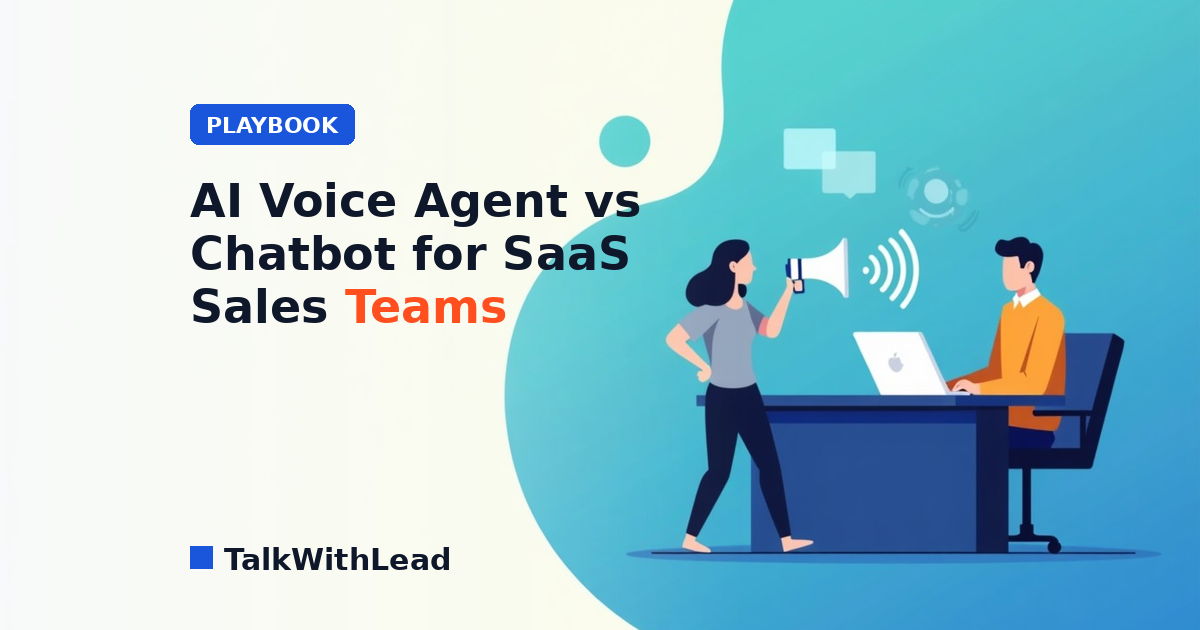
Short answer: a chatbot is a text-capture tool, while an AI voice agent is a conversation tool. For SaaS sales teams, the voice agent wins on high-intent traffic because it answers the pricing, security, and integration questions out loud in seconds and books the demo inside the same session. Keep the chatbot for documentation and low-intent FAQ deflection.
What is the real difference between an AI voice agent and a chatbot?
A chatbot waits for typing. It matches intent to a scripted branch, hands over an email field, and hopes the buyer stays. Every extra message is another exit point, and buyers on a pricing page are comparing three tabs at once.
An AI voice agent puts an extremely human-sounding voice in front of that same visitor. The visitor clicks once, the phone rings, and a real conversation starts — questions answered, objections heard, next step booked. TalkWithLead runs that agent in 50+ languages with unlimited long-distance calling, so a buyer in Berlin or Bogota gets the same instant answer as one in Boston. If nobody on your team is free, the agent handles it and triggers an instant callback the moment a rep is.
The distinction matters more in SaaS than almost anywhere else, because the qualifying questions are layered: seat count, current stack, integration needs, procurement timeline. Text drags that across days. Voice compresses it into four minutes.
Which converts more SaaS demo requests?
Speed is the variable that decides it. According to Harvard Business Review research, companies that reach a web lead within an hour are nearly 7× more likely to qualify it than those that wait even an hour longer. A chatbot does not reach anyone — it stores a message for a human to reach later. A voice agent reaches them while the pricing page is still open.
Consider an illustrative example. Say your site gets 1,000 pricing-page visits a month and your chatbot captures 40 emails. Assume your reps eventually connect with half of those and close 10% of the connections — that is two new accounts. Now assume a voice agent converts even 6% of those same 1,000 visits into live conversations: 60 real calls, and at the same 10% close rate that is six accounts from identical traffic. The math is illustrative, but the mechanism is not: conversations close, transcripts do not.
Want the reasoning in more depth? Our breakdown of AI voice agent vs chatbot conversion rate walks through the same comparison across page types, and SaaS demo request conversion for pricing pages covers placement specifically. You can also just watch it happen on the Live Demo — talk to the agent the way a prospect would.
Side-by-side: chatbot, live chat, and AI voice agent
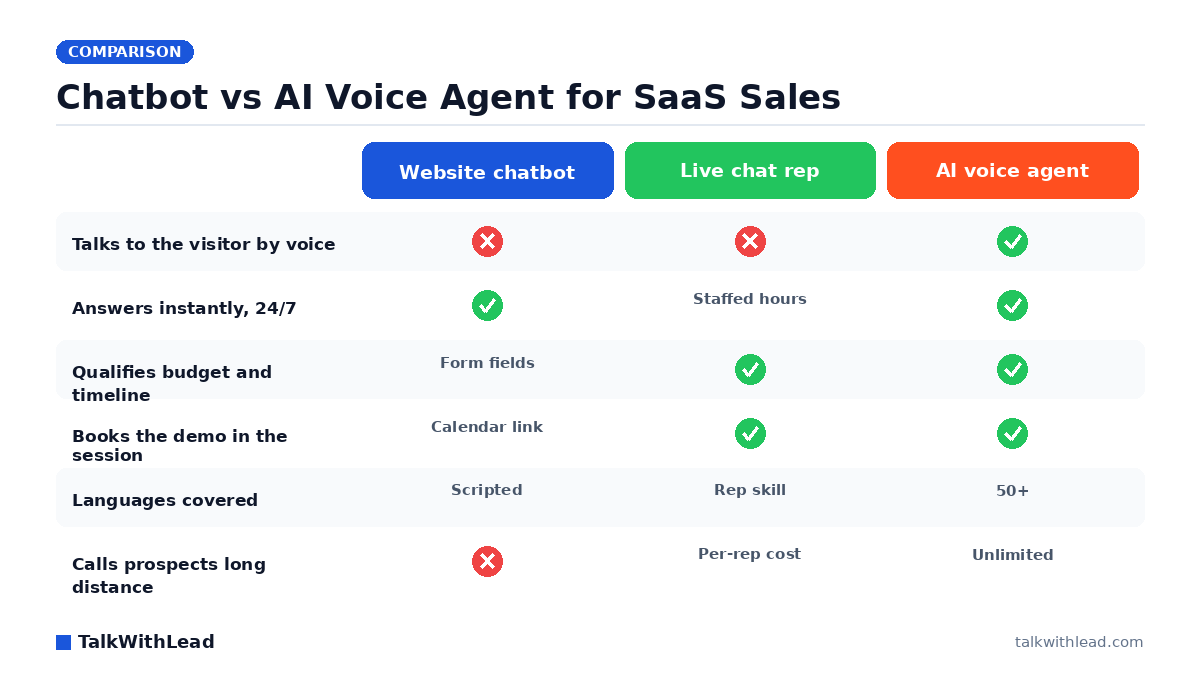
| Dimension | Website chatbot | Live chat rep | AI voice agent |
|---|---|---|---|
| Channel | Typed text | Typed text | Spoken conversation |
| Response time | Instant, but scripted | Minutes, if staffed | Instant, conversational |
| After-hours coverage | Yes, capture only | No | Yes, full conversation |
| Qualification depth | Form fields | Good, rep-dependent | Budget, seats, timeline, stack |
| Demo booking | Calendar link handoff | In-session | In-session, on the call |
| Language coverage | Pre-scripted strings | Whoever is on shift | 50+ languages |
| International prospects | Text only | Toll costs, time zones | Unlimited long-distance calling |
| Best use | Docs and FAQ deflection | Existing-customer support | High-intent buyer conversion |
Read the table as a routing map, not a scoreboard. Support traffic belongs in text. Buyer traffic belongs on the phone.
How does an AI voice agent qualify a SaaS lead?
SaaS qualification is a short list of hard questions, and buyers answer them more honestly out loud than in a form. A voice agent asks how many seats, which tools the team already runs, who signs off, and when the current contract renews. It logs the answers and routes the hot ones to a rep immediately.
- Intent capture at the moment of interest — the agent engages while the buyer is still reading your pricing tiers, not the next morning.
- Objection handling in real time — pricing pushback, SSO questions, migration worries get answered before the tab closes.
- Instant callback — if the buyer prefers a later slot, the agent schedules it and calls them, so the follow-up never depends on a rep remembering.
- Language match — the agent switches to the buyer’s language, which removes the quiet drop-off that kills international pipeline.
Compare that to the chatbot path: message, email field, thank-you screen, nurture sequence, silence. Our post on live chat vs chatbot covers why even staffed text falls short at the buying moment. If you want to price the swap, see pricing before you build another nurture flow.
What does slow response actually cost a SaaS team?
Put a number on it with stated assumptions rather than a guess. Say your product runs $400 per month per account with an average 18-month lifetime — roughly $7,200 in lifetime value. Assume your site produces 30 high-intent pricing-page sessions a week and your current text-only setup converts 5% into sales conversations. That is 1.5 conversations a week. Lift that to 12% with a voice agent and you get about 3.6 a week, or roughly 8 extra conversations a month. Close a quarter of them and you have added two accounts, about $14,400 in lifetime value, from traffic you already paid for.
Run your own version with the free speed-to-lead ROI calculator — put in your real traffic, deal size, and close rate. The assumptions above are illustrative, not a promise; the calculator makes them yours.
Best for: SaaS teams with real pricing-page traffic, a deal size above roughly $100 per month, international prospects, and fewer reps than inbound demand.
Not the right fit if: you sell a $9 self-serve tool where nobody expects a call, your traffic is overwhelmingly existing customers looking for docs, or your product is pre-launch with no pricing page yet. In those cases a chatbot and a good help center do more.
Should you run both a chatbot and a voice agent?
Usually yes, with clear routing. Keep the chatbot on documentation, changelog, and support pages where deflection is the goal. Put the voice agent on pricing, demo, comparison, and high-intent landing pages where a conversation is the goal. The two stop competing the moment you stop asking one tool to do both jobs.
One caution from watching sites do this badly: do not stack a chatbot bubble and a voice widget in the same corner of the same page. Pick one primary action per page type. Our comparison of click-to-call vs callback widget vs AI voice agent covers which control fits which intent.
Start where the money is. Put the voice agent on your pricing page first, measure demo bookings for two weeks, then expand. You can start free and have it live on the page today, or try the Live Demo first and hear exactly what your buyers would hear.
FAQ
Is an AI voice agent better than a chatbot for SaaS sales teams?
For high-intent buyer traffic, yes. A voice agent answers pricing and integration questions out loud and books the demo in the same session, while a chatbot mostly captures an email for later follow-up. For documentation and support traffic, a chatbot is still the cheaper, better fit.
Will an AI voice agent replace my SDRs?
It replaces the waiting, not the reps. The agent picks up every visitor instantly, qualifies on seats, budget, and timeline, and hands warm, pre-qualified conversations to your team — so SDRs spend their day on buyers who already said yes to a conversation instead of chasing cold form fills.
Can an AI voice agent handle international SaaS prospects?
Yes. TalkWithLead’s agent speaks 50+ languages and includes unlimited long-distance calling, so a prospect anywhere can have the conversation in their own language without your team covering extra time zones or paying per-minute international rates.
Where should I put the voice widget on a SaaS site?
Pricing page first, then the demo-request page and your competitor comparison pages. Those are the pages where a buyer already has a specific question and a specific objection. Leave documentation and support pages to your chatbot.
How fast do I actually need to respond to a SaaS lead?
Minutes, not hours. The MIT Lead Response Management study found you’re about 21× more likely to qualify a lead contacted within 5 minutes than one contacted at 30 minutes. A voice agent answers in seconds, which is the only reliable way to hit that window around the clock.
What does an AI voice agent cost compared with a chatbot?
Chatbots are typically the cheaper line item; a voice agent is priced as a conversion tool rather than a deflection tool. The honest way to judge it is per booked demo, not per month — current plans and tiers are on the pricing page.
Let’s Turn More Website Visitors Into Sales Conversations
TalkWithLead is the AI voice-first lead-conversion platform behind hundreds of high-intent business websites. See it on your own number in a 15-minute live demo, or spin one up free and have it running before lunch.