
In this article
What an AI voice agent actually does for a small business
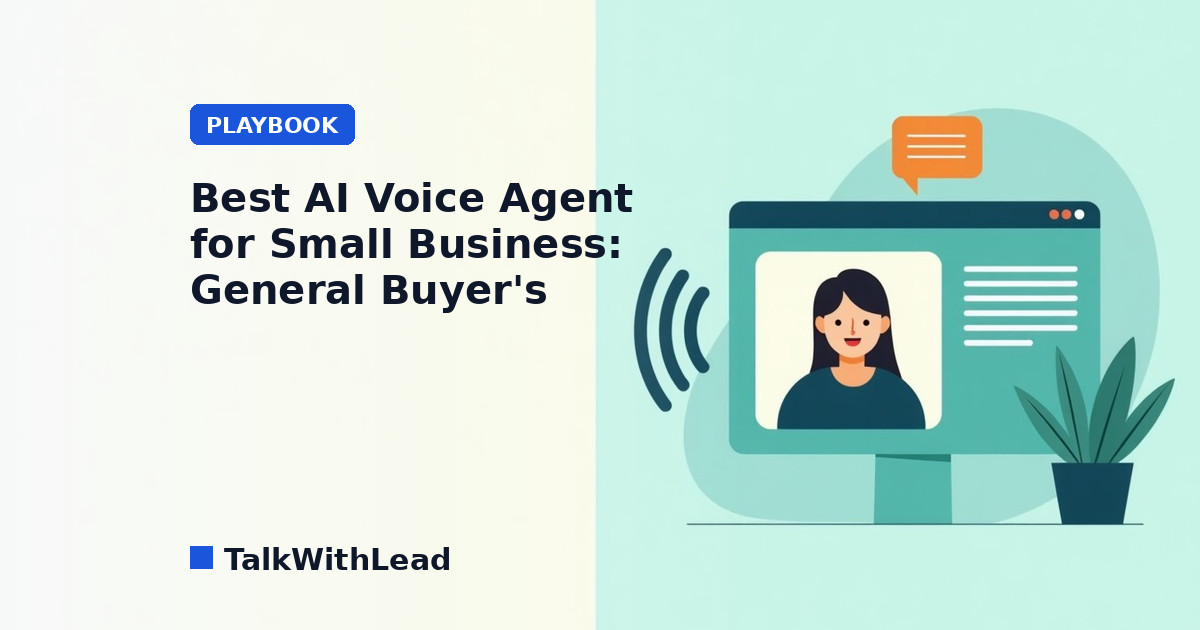
Most small business websites lose their hottest leads in the quiet minutes after a visitor decides they’re interested. The visitor has a question, sees a contact form or a sluggish chatbot, and leaves to call a competitor instead. The best AI voice agent for small business closes that gap: it talks to visitors the moment they want to talk, sounds convincingly human, and turns browsing into a real phone conversation.
TL;DR: An AI voice agent is software that answers your website visitors and callers by voice — instantly, 24/7, in 50+ languages — qualifies them, answers questions, and connects them to you through instant callbacks or unlimited long-distance calls. For a typical small business, it costs a flat monthly subscription (low-to-mid hundreds of dollars) and pays for itself if it rescues even a handful of missed leads per month.
Concretely, a good AI voice agent sits on your website as a small widget. A visitor clicks it, speaks naturally, and the agent handles the conversation: what the visitor needs, when they need it, whether they’re a fit, and how to reach them. It can trigger an instant callback to the visitor’s phone, so the conversation continues on a real line — no typing, no waiting on a form reply that arrives tomorrow. That speed matters more than almost anything else you can buy. According to Harvard Business Review research, companies that reach a web lead within an hour are nearly 7× more likely to qualify it than those that wait even an hour longer. An AI voice agent responds in seconds, every time, including at 9pm on a Sunday.
How much does an AI voice agent cost for a small business?
Plain answer: most small businesses should budget a flat monthly software subscription — typically in the low-to-mid hundreds of dollars per month — rather than the per-minute or per-call billing that human answering services use. Flat pricing matters because your best months (lots of calls) are exactly when per-minute billing punishes you. You can see TalkWithLead’s current pricing here.
Here’s a labeled example so you can sanity-check the math for your own numbers. This is an illustration with assumed rates, not a customer result. Say your average new customer is worth $600, and your website plus phone lines currently produce 40 inquiries a month. Imagine even 1 in 4 of those inquiries arrives when nobody can respond quickly — that’s 10 leads a month going cold. If a voice agent converts just 3 of those 10 into real conversations and you close one, that single rescued customer covers a typical monthly subscription with room to spare. Run your own numbers in the free missed-call revenue calculator — it takes about a minute and uses your inputs, not ours.
The cost of doing nothing is the number most owners underestimate. According to a 411 Locals study of 85 small businesses across 58 industries, only 37.8% of incoming calls were answered by a live person — meaning roughly 6 out of 10 calls went unattended. Every one of those unanswered moments is a buyer who was ready to talk.
AI voice agent vs chatbot vs contact form: which one converts?
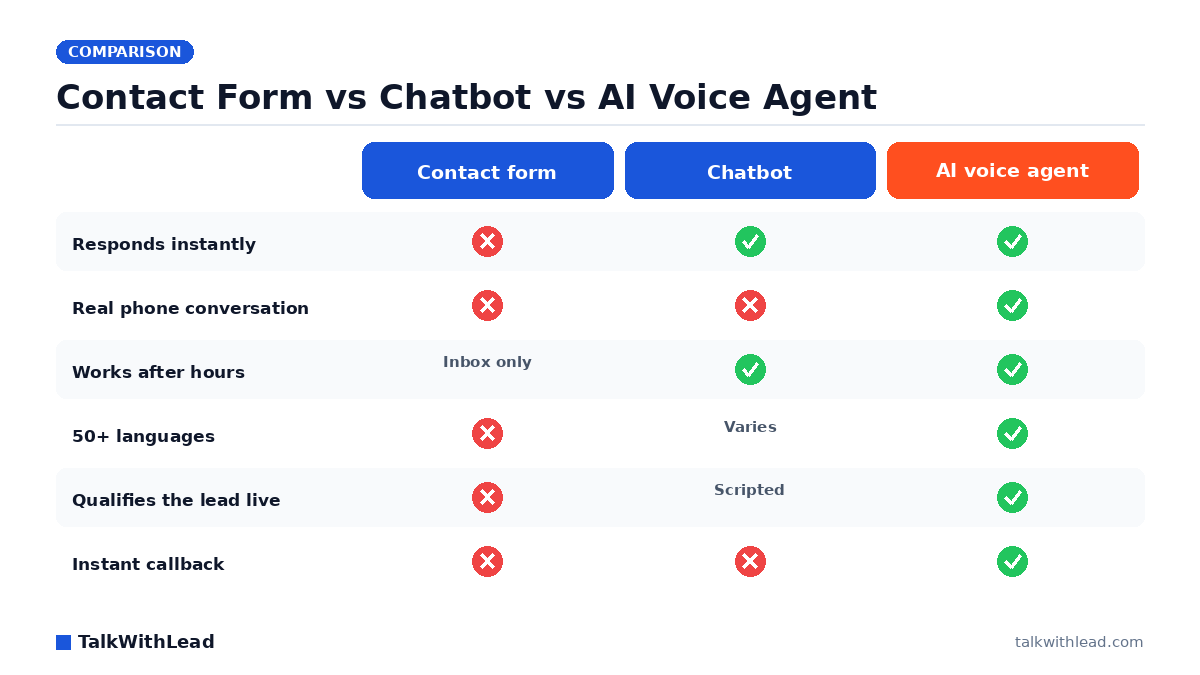
Forms and chatbots both make the visitor do the work. A form asks them to type, submit, and wait. A chatbot asks them to type into a script that usually ends with “someone will get back to you.” A voice agent flips it: the visitor just talks, the way they would with a great front-desk person, and the conversation moves toward a booked call while their intent is at its peak.
| Dimension | Contact form | Chatbot | AI voice agent |
|---|---|---|---|
| Response speed | Hours to days | Instant, but text-only | Instant, spoken |
| Effort for the visitor | High (typing, waiting) | Medium (typing, menus) | Low (just talk) |
| Ends in a phone conversation | Rarely | Rarely | Yes — instant callback or live call |
| Languages | Whatever you wrote | Limited, often stilted | 50+ languages, natural voice |
| After-hours coverage | Inbox pile-up | Scripted answers | Full conversations, 24/7 |
| Long-distance prospects | N/A | N/A | Unlimited long-distance calling |
If you want the deeper head-to-head, read AI Voice Agent vs Chatbot: Which One Books More Calls? The short version: text tools capture contact details; voice tools create sales conversations. Small businesses don’t close deals from a lead list — they close them on the phone.
Want to hear it rather than read about it? Try the live demo — talk to the agent yourself and judge whether it sounds human enough to represent your business.
What to avoid when choosing an AI voice agent
The category is crowded, and some products wearing the “AI voice” label will disappoint you. Watch for these traps:
- Message-takers in disguise. If the agent’s endgame is “I’ll pass along your message,” you’ve bought a voicemail box with better manners. Insist on instant callbacks and live call connection.
- English-only agents. If your market includes Spanish-speaking homeowners, international students, or overseas buyers, an English-only agent silently drops them. Look for genuine multilingual conversation — 50+ languages, not a translation widget.
- Robot voices. Callers hang up on anything that sounds synthetic. Test the voice yourself before you commit; if you can tell it’s a machine in the first two sentences, so can your prospects.
- Per-minute pricing surprises. Usage-based billing turns your best month into your biggest invoice. Prefer flat, predictable pricing.
- Chatbots with a voice bolted on. A decision tree that reads its menus aloud is not a voice agent. The tell: it can’t handle a question that isn’t in its script.
- No path from website to phone. The whole point is converting web visitors into phone conversations. If the tool only answers inbound calls and ignores your website traffic, you’re solving half the problem.
Speed is the other silent killer. Even a great tool loses if it responds slowly — the physics of lead response are unforgiving, as we break down in Speed-to-Lead: Why the First 60 Seconds Win Most Deals. And if your phones already ring more than your team can answer, start with missed call automation for websites — it’s the fastest leak to plug.
Is an AI voice agent worth it for your small business?
Best for: service businesses, local firms, and small teams whose revenue depends on inbound inquiries — contractors, law firms, clinics, real estate agents, agencies — especially if calls come in after hours, in multiple languages, or faster than the team can answer.
Not the right fit if: your business gets only a trickle of inquiries and you personally answer every one within minutes, or your sales happen entirely through e-commerce checkout with no conversation involved. In those cases, keep your money.
For everyone else, the decision comes down to one honest question: how many conversations are you missing right now? You don’t need to guess. Put a number on it with the calculator, listen to the agent in the live demo, and if the math works, start your free signup and put it on your site this week. The leads you’re losing today don’t come back tomorrow.
FAQ
What is the best AI voice agent for small business?
The best AI voice agent for small business is one that converts website visitors into phone conversations: it answers instantly by natural-sounding voice, speaks 50+ languages, offers instant callbacks and unlimited long-distance calling, and runs 24/7 on flat pricing. TalkWithLead is built specifically around that website-to-phone-call job, rather than general call answering.
Whatever you choose, judge it on booked calls per month — not on feature lists.
How much does an AI voice agent cost per month?
Most small-business AI voice agents run on a flat monthly subscription, typically in the low-to-mid hundreds of dollars, which is usually far below the cost of per-minute human answering services at any real call volume. Check current TalkWithLead pricing for exact numbers.
Can an AI voice agent really sound human?
Modern voice agents are close enough that many callers don’t realize they’re speaking with software — natural pacing, interruptions handled gracefully, and answers to unscripted questions. The only reliable test is to call one yourself, which is exactly what the live demo is for.
Is an AI voice agent better than a chatbot for getting leads?
For businesses that close deals over the phone, yes. Chatbots collect typed contact details and hand you a follow-up task; a voice agent holds the conversation immediately and moves the visitor onto a call while they’re still interested. Speed compounds the difference: leads reached quickly qualify at dramatically higher rates than leads reached hours later.
Do I need technical skills to add an AI voice agent to my website?
No. A voice agent installs as a small widget snippet on your website — the same effort as adding a live chat box. Setup is mostly business questions: what you offer, what to ask callers, and where to route the conversation.
Will an AI voice agent work for after-hours and weekend calls?
Yes — that’s where it earns its keep fastest. Evenings and weekends are when human answering is weakest and buyer research is heaviest. A voice agent answers every after-hours visitor and caller, qualifies them, and either books the next step or triggers a callback the moment you’re available.
Let’s Turn More Website Visitors Into Sales Conversations
TalkWithLead is the AI voice-first lead-conversion platform behind hundreds of high-intent business websites. See it on your own number in a 15-minute live demo, or spin one up free and have it running before lunch.