TalkWithLead
AI Voice-First Lead Conversion

AI Voice Agents That Turn Website Visitors Into Real Conversations

TalkWithLead is the AI voice-first widget that picks up the phone the moment a visitor lands on your site. Multilingual, extremely human-sounding, with unlimited long-distance calling so prospects anywhere can call you back. More calls. More leads. More closed deals.

Extremely human-sounding voice 50+ languages out of the box Unlimited long-distance calling Instant callback widget

Tag: showing bookings

  • AI Voice in French: Capture Real Estate Leads You Lose

    AI Voice in French: Capture Real Estate Leads You Lose

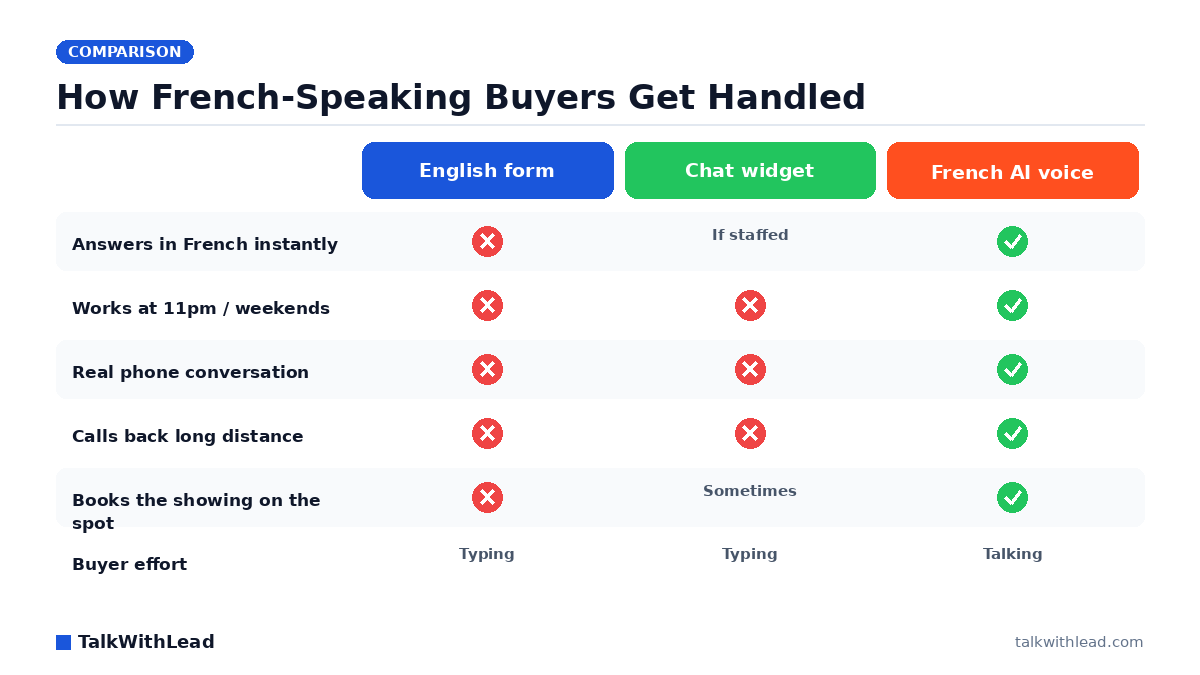
    How French-Speaking Buyers Get Handled — TalkWithLead original infographic (comparison diagram).
    How French-Speaking Buyers Get Handled

    A francophone buyer opens your listing page at 9:40pm, reads three lines of English, and closes the tab. No form. No call. Nothing in your CRM. That lead did not go cold — it never got warm, because nobody on your site spoke their language at the moment they were ready to talk.

    TL;DR: AI voice in French real estate means a human-sounding AI voice agent on your website greets a French-speaking visitor in French, holds a real spoken conversation, answers questions about the listing, and books a showing or calls them back instantly — 24/7, in 50+ languages, including long-distance. It converts visitors you currently lose to language friction and slow follow-up.

    Why French-speaking buyers vanish from English-only real estate sites

    Language friction is quiet. A buyer who cannot comfortably read your intake form does not complain, does not email, and does not call an English voicemail greeting. They go back to the search results and click the next agent. You never see the loss because there is no record of it.

    The pattern shows up wherever a market is genuinely bilingual: Montreal and the rest of Quebec, Ottawa-Gatineau, New Brunswick, francophone communities across Ontario and Manitoba, plus French buyers purchasing abroad — Florida, Morocco, the Caribbean. Picture a listing page that draws 400 visits a month and say a quarter of that traffic is more comfortable in French. That is 100 people a month deciding, in about four seconds, whether your business is for them.

    Adding a translated page helps discovery. It does not solve the conversation. The buyer still has to type into a form and wait for a callback that may arrive tomorrow, in English, from someone who mispronounces their name.

    How does an AI voice agent handle a French-speaking website visitor?

    The visitor clicks a call button on your listing page. Within seconds a natural-sounding AI voice agent picks up — in French, without a menu tree, without “press 1 for service en français.” It asks what they are looking for, which neighbourhood, what timeline, whether they are pre-approved. It answers the obvious questions about the property. Then it books the showing directly into your calendar or triggers an instant callback so the buyer is on the phone with your team while the listing is still open on their screen.

    Three things make that work in practice:

    • Voice, not typing. A buyer asking about a condo’s balcony, the school catchment, and whether the seller will move the closing date will say all of that in one breath. They will not type it.
    • 50+ languages on the same widget. You are not choosing between English and French. Spanish, Portuguese, Mandarin and Arabic buyers get the same treatment on the same page.
    • Unlimited long-distance calling. An overseas buyer looking at a Canadian property is not going to pay international rates to ask a question. The callback goes out from your side.

    The fastest way to judge tone and pacing is to hear it yourself — try the live demo and ask it a listing question the way a real buyer would.

    Why speed matters more than polish in real estate

    Property buyers shop in parallel. They open five agents’ pages in five tabs. Whoever gets into a real conversation first usually gets the showing, and the showing usually decides the relationship.

    The MIT Lead Response Management study found you’re about 21× more likely to qualify a lead contacted within 5 minutes than one contacted at 30 minutes. And according to Harvard Business Review research, companies that reach a web lead within an hour are nearly 7× more likely to qualify it than those that wait even an hour longer.

    Now layer language on top of that clock. If the francophone lead has to wait for the one bilingual person on your team to be free, your five-minute window is gone before anyone dials. An AI voice agent removes both delays at once — the language wait and the staffing wait. For a deeper look at the timing side alone, see Speed to Lead Real Estate: Book More Showings.

    French AI voice vs. the alternatives on your listing page

    CapabilityEnglish contact formBilingual live chatFrench AI voice agent
    Responds in French immediatelyNoOnly when a French-speaking agent is onlineYes, every time
    Available nights and weekendsCollects onlyUsually noYes, 24/7
    Format of the conversationTyped, one-wayTyped, back-and-forthSpoken, real-time
    Handles overseas buyersNo callingNo callingUnlimited long-distance callback
    Books a showing without youNoSometimesYes
    Effort asked of the buyerHighMediumLow

    Best for: agents, teams and brokerages with meaningful French-speaking or multilingual traffic who lose leads after hours and cannot staff a bilingual desk around the clock.

    Not the right fit if: your entire market speaks one language, your call volume is low enough that you personally answer every inquiry within minutes, or your leads come from referrals rather than your website.

    If you are weighing voice against a chat widget more broadly, Live Chat Alternative for Real Estate Agents breaks down where each one actually converts.

    What is this worth? A labeled ROI example

    This is an illustrative scenario, not a customer result. Assume a brokerage site gets 1,200 sessions a month and say roughly 300 of those visitors would rather speak French. Suppose 6% of French-speaking visitors will engage with a voice agent that greets them in their language — that is 18 conversations a month that previously produced silence. Say 1 in 4 of those becomes a booked showing: 4 or 5 extra showings. If one closes every couple of months at an average commission you can plug in yourself, the arithmetic tends to settle quickly.

    Run your own numbers instead of trusting mine — the free missed-call revenue calculator takes about a minute. Then compare that figure against TalkWithLead pricing, which sits in the ordinary monthly-software range rather than the per-hour range of a staffed bilingual answering desk.

    How to roll it out on a real estate site without breaking anything

    Start narrow and measure. The rollout that works looks like this:

    1. Put the widget on listing pages first. That is where intent is highest and where language friction costs the most.
    2. Write the French qualification script the way you actually speak. Neighbourhood, budget range, pre-approval status, timeline, best time to view.
    3. Decide the handoff rule. Some teams want every qualified francophone buyer transferred live; others prefer the agent to book the slot and send the brief.
    4. Turn on instant callback for after-hours. A 10pm inquiry that gets a call at 10:01pm feels like service, not automation.
    5. Track one number: booked showings per 100 French-speaking sessions. Chat transcripts and “engagements” are vanity; a calendar entry is not.

    The same three ingredients apply in every vertical — voice, languages, and long-distance reach — real estate just punishes their absence faster because listings move.

    If your francophone traffic is already there and going quiet, the setup is short: start free, drop the widget on your listing template, and let the next 9:40pm visitor hear a voice that speaks their language. Prefer to hear it before committing? The live demo takes two minutes.

    FAQ

    Can an AI voice agent really hold a natural conversation in French?

    Yes. The voice is designed to sound human rather than robotic, and it handles interruptions, follow-up questions and clarifications the way a person would. Most buyers treat it as a phone call, not a menu system.

    The practical test is whether it can answer a specific listing question and then book a time. That is what to check during a demo.

    What happens if a French-speaking buyer asks something the agent can’t answer?

    It escalates. The agent takes the question, captures contact details and the context, and either transfers the caller to your team or schedules an instant callback so a human closes the loop with the full conversation already summarized.

    Does it work for languages other than French?

    It covers 50+ languages on the same widget, so a Spanish-speaking buyer and a Mandarin-speaking buyer get the same instant treatment as a francophone one. You do not have to build a separate site or hire per language.

    Will this replace my bilingual assistant?

    It usually replaces the hours nobody covers — evenings, weekends, showings, vacations — rather than the person. Your assistant stops fielding “what’s the square footage” and starts working pre-qualified buyers who already have a showing booked.

    Can it call international buyers looking at properties here?

    Yes. Unlimited long-distance calling means the callback goes out from your side, so a buyer in France or Morocco pays nothing to have a conversation about a property in Canada.

    How fast can I get this live on my listing pages?

    Adding the widget is a snippet on your site template, so most agents are live the same day. The longer part is deciding your qualification questions and handoff rules, which is worth an hour of thought.
  • Best AI Voice Agent for Real Estate Agents (2026)

    Best AI Voice Agent for Real Estate Agents (2026)

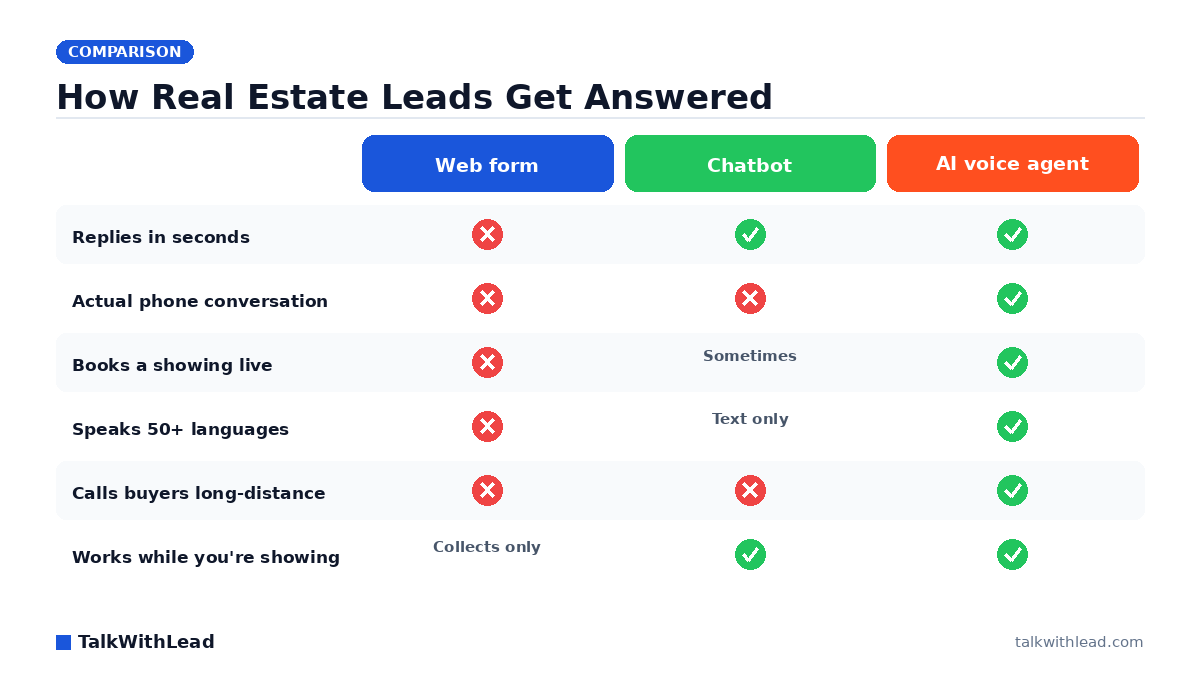
    How Real Estate Leads Get Answered — TalkWithLead original infographic (comparison diagram).
    How Real Estate Leads Get Answered

    A buyer finds your listing at 8:40pm, fills out your contact form, and waits. You see it at 10:15pm, after the second showing and the dinner you rescheduled twice. By then they’ve already talked to someone else on the phone. That’s the whole problem the best AI voice agent for real estate agents is built to solve: picking up the conversation the second a buyer raises their hand on your website.

    TL;DR: The best AI voice agent for real estate agents is the one that turns a website visitor into a live phone call within seconds, qualifies budget and timeline, and books the showing straight into your calendar. Prioritize instant callback speed, real spoken conversation over chat, multilingual coverage for relocation buyers, and unlimited long-distance calling. TalkWithLead is our pick for website-sourced leads; the alternatives below fit different situations.

    Why real estate is the worst possible business for slow lead response

    Real estate leads shop in parallel. A buyer inquiring on a listing is almost never inquiring on only that listing, and the agent who gets them on the phone first is the agent who frames the search, sets the budget expectation, and books the tour. Everyone else becomes the second opinion.

    The research is blunt about this. According to Harvard Business Review research, companies that reach a web lead within an hour are nearly 7× more likely to qualify it than those that wait even an hour longer. The MIT Lead Response Management study tightened it further: you’re about 21× more likely to qualify a lead contacted within 5 minutes than one contacted at 30 minutes.

    Agents don’t lose on effort. They lose on scheduling. You cannot be on a listing appointment, at an inspection, and on the phone with a new web lead at the same time — so the lead waits, and waiting is the loss. That gap is exactly what an AI voice agent covers. For the underlying math on response windows, see our breakdown of speed to lead in real estate.

    What actually separates a good real estate AI voice agent from a bad one

    Most “AI receptionist” products were designed for inbound phone calls to a business number. Real estate leads mostly arrive somewhere else — on your IDX site, your listing pages, your landing pages — and never dial anything. Judge every option on these five dimensions:

    • Website-triggered callback. Does it start a phone conversation from a page visit, or does it only answer a ringing phone? For agents, the website is where the lead is.
    • Voice quality. A buyer hangs up on a robot. The agent has to sound human enough that the conversation actually continues past ten seconds.
    • Showing capture. Qualifying is table stakes. Booking a time is the outcome you’re paying for.
    • Language coverage. Relocation, investor, and international buyers are the highest-value leads most agents silently discard because nobody could hold the conversation.
    • Calling reach and cost. Out-of-state and overseas buyers are normal in real estate. Per-minute long-distance charges quietly punish you for talking to your best prospects.

    Want to hear what the voice side sounds like before comparing spec sheets? Take the live demo — it takes about a minute and it settles the “does this sound like a robot” question faster than any feature table.

    Best AI voice agent for real estate agents: top 6 compared

    Six categories of tool compete for this job, and they are genuinely different products. Here’s how they line up on what matters to an agent working website leads.

    OptionPrimary strengthAnswers website leadsBooks showingsLanguage coverageBest fit
    TalkWithLeadInstant voice callback from your siteYes — built for itYes, live on the call50+ languagesAgents whose leads come from a website or IDX pages
    Human answering serviceReal people, nuancePhone line onlyYes, if trainedUsually English + SpanishTeams wanting humans and willing to pay per minute
    AI phone receptionist toolsAnswers your business numberNo — inbound calls onlyVariesVariesBrokerages with a busy main line
    Website chatbotCheap, always onText onlyRarelyText translationSites wanting FAQ deflection, not booked tours
    CRM auto-dialer / ISA add-onWorks your existing databaseAfter form submit, delayedSometimesLimitedTeams with a large aged lead database
    Voice AI dev platformsTotal customizationOnly if you build itOnly if you build itConfigurableBrokerages with in-house engineers

    Best for: Solo agents and small teams whose leads arrive on a website or listing page and who lose deals to response time rather than to lead volume.

    Not the right fit if: Your business is almost entirely referral and repeat, your phone rings maybe twice a week, and you already answer every one of those calls personally — automation solves a problem you don’t have.

    1. TalkWithLead — best for converting website visitors into phone calls

    TalkWithLead sits on your site as a widget. A visitor who’s interested talks to a human-sounding AI voice agent right there, or requests an instant callback and the phone rings within seconds. The agent handles the conversation in 50+ languages and unlimited long-distance calling means an out-of-state relocation buyer costs you nothing extra to talk to. It qualifies, it captures, and it hands you a live conversation instead of a form entry. Start free and put it on a single listing page first.

    2. Human answering services — best when nuance beats speed

    Trained humans handle emotional conversations well, which matters on the listing side. The tradeoffs are cost structure and coverage: per-minute billing, hold queues at peak hours, and a script that is only as good as the last training update. They also answer a phone line, so a website lead who never dials stays unanswered.

    3. AI phone receptionists — best for a busy brokerage main line

    These are strong at what they were built for: nobody misses an inbound call again. Worth having if your office number rings constantly. But they don’t touch the visitor sitting on your listing page at 11pm who was never going to dial in the first place. Compare the category in our general AI voice agent buyer’s guide.

    4. Website chatbots — cheapest, and it shows

    A chatbot collects a name and an email. It rarely books anything, and buyers treat it like a help desk. If you’re weighing this specifically, we’ve laid out the conversion difference in live chat alternatives for real estate agents.

    5. CRM dialers and ISA add-ons — best for an aged database

    If you have thousands of old leads, a dialer campaign is a legitimate play. For fresh website inquiries the sequencing is usually too slow — form submits, waits for a batch, then dials. Minutes matter and batches lose them.

    6. Voice AI developer platforms — best if you have engineers

    Maximum control, maximum build time. You are assembling telephony, prompts, calendar integrations, and failure handling yourself. Great for a brokerage with a dev team. Rough for an agent who wants leads answered this week.

    How much does an AI voice agent cost a real estate agent?

    Plainly: most website-focused AI voice tools land in the low hundreds per month, human answering services bill per minute and get expensive at volume, and developer platforms bill per usage plus your engineering time. See current TalkWithLead pricing for exact numbers.

    The math that actually decides it is commission math. Illustrative ROI example — assumed figures, not measured results: say your site gets 400 visitors a month and 30 of them show real buying intent. Assume you currently reach 12 of those 30 in time to matter, and assume faster response lifts that to 18. That’s 6 extra live conversations a month. If even 1 of those 6 becomes a closed transaction over a year at a $9,000 commission, the tool pays for itself many times over. Swap in your own average commission and conversion rate — the shape of the answer rarely changes. You can run your own numbers with the free speed-to-lead ROI calculator.

    The cost most agents ignore is the unanswered call. A 411 Locals study of 85 small businesses across 58 industries found only 37.8% of incoming calls were answered by a live person — meaning roughly 6 out of 10 calls went unattended. For an agent showing property all day, that ratio is not surprising. It’s just invisible until you price it.

    How to roll one out without breaking your pipeline

    Start narrow. Put the voice agent on your highest-traffic listing pages and your home valuation landing page, not the entire site, and listen to the first week of recordings yourself. You will find two or three questions the agent should ask that you never wrote down — school districts, financing status, whether they’ve toured with another agent.

    Then decide the handoff rule. Most agents route qualified buyers straight to their cell during working hours and let the AI book the showing after hours. Write down what “qualified” means before launch, or every lead becomes an interruption and you’ll turn it off inside a month.

    Finally, measure one number: booked showings from website leads, this month versus last. Not chat sessions, not form fills. Showings. If that number doesn’t move in 30 days, the problem is your routing or your pages, not the tool. Ready to test it on a page of your own? Try the live demo, then sign up free and start with one listing.

    FAQ

    What is the best AI voice agent for real estate agents in 2026?

    For agents whose leads come from a website, IDX search, or listing landing pages, TalkWithLead is the strongest fit because it converts an on-page visitor into a live phone conversation in seconds and handles it in 50+ languages. If your leads arrive mainly by phone to a brokerage main line, an AI phone receptionist is the better shape of tool.

    Can an AI voice agent actually book a property showing?

    Yes. A capable voice agent qualifies the buyer on the call — timeline, financing status, area — and books an available slot before hanging up, then passes you the recording and details. The point is that the booking happens during the conversation, not in a follow-up email the buyer never opens.

    Will buyers hang up when they realize it’s AI?

    Some will, and it’s worth being honest about that. In practice, the voice quality is the deciding variable: buyers stay on when it sounds human and conversational, and drop instantly when it sounds like a phone tree. Test the voice yourself before you commit, and always give the caller a fast path to a real agent.

    Is an AI voice agent better than a chatbot for real estate leads?

    For booking showings, yes. Chat collects contact details; voice creates a conversation where you can handle objections, gauge seriousness, and lock a time. We compare the two directly in our post on AI voice agents vs chatbots.

    How does this help with relocation and international buyers?

    Two ways. Support for 50+ languages means a buyer relocating from abroad gets a real conversation instead of a language barrier, and unlimited long-distance calling means you aren’t paying per minute to talk to your highest-value out-of-area prospects.

    How fast should I really call a new real estate lead?

    Within five minutes if you can, and seconds if you can automate it. The MIT lead response research shows qualification odds falling sharply between the 5-minute and 30-minute marks, which is why an automated instant callback usually outperforms a diligent agent who returns calls between appointments.

  • Speed to Lead Real Estate: Book More Showings

    Speed to Lead Real Estate: Book More Showings

    A buyer lands on your listing at 9:14 p.m., loves the kitchen, and wants to see the place this weekend. If you call back tomorrow morning, that buyer has already booked two showings with agents who answered first. Speed to lead in real estate is won in minutes, not mornings — and most agents are still losing it to a contact form and a 12-hour reply gap.

    TL;DR: The fastest way for real estate agents to book more showings is to replace slow web forms with an instant callback widget backed by a human-sounding AI voice agent. It calls the buyer back in seconds, answers questions in their language around the clock, and books the showing while interest is still hot — turning anonymous website traffic into real phone conversations before a competitor responds.

    Why does speed to lead matter so much in real estate?

    Real estate buyers shop in tabs. A single property search ends with five or six listings open at once, and the agent who turns that browsing into a live conversation first usually wins the relationship. The gap you are competing against is brutal: according to the MIT Lead Response Management study, you are roughly 21× more likely to qualify a lead contacted within 5 minutes than one contacted at 30 minutes. In a market where the listing itself is public, response speed is one of the few advantages you fully control.

    Now picture the inverse. Say even 1 in 10 of the after-hours inquiries you currently reply to “first thing tomorrow” was a ready buyer — that is a handful of booked showings a month walking straight to the agent who picked up first. The cost of slow is not theoretical; it is the listing down the street getting the offer.

    What is an instant callback widget, and how does it book showings?

    An instant callback widget is a small button on your website and landing pages that offers the visitor a phone call right now, with no form to fill out. The visitor taps it, and instead of waiting in a queue, they get a call back in seconds. When that call connects to a human-sounding callback widget powered by an AI voice agent, the conversation starts immediately — the buyer talks, the agent listens, and a showing time gets proposed before the buyer ever closes the tab.

    This is the core difference between voice-first and the slow alternatives. A web form collects a name and disappears into an inbox. A chatbot makes the buyer type, wait, and re-type. A voice callback does the one thing real estate runs on: it gets two people talking. See the side-by-side in our breakdown of AI voice agents vs chatbots for which actually converts website visitors.

    Best for: agents and teams who get steady website or listing-page traffic but lose after-hours and weekend inquiries to slow follow-up.
    Not the right fit if: you have almost no inbound web traffic yet — fix lead generation first, because a callback widget converts demand, it does not create it.

    How an AI voice agent covers the leads you can’t

    No agent can answer every call. You are at a closing, in a showing, asleep, or already on another line. That is exactly when the next buyer is browsing. A human-sounding AI voice agent answers those inquiries the moment they come in — 24/7, in 50+ languages — so a relocating buyer from another country or a night-shift worker scrolling at midnight gets a real conversation instead of a voicemail.

    Two real-estate-specific wins matter here:

    • 50+ languages — a multilingual market like Miami, Toronto, or Houston means buyers who would hang up on an English-only line instead get qualified in their own language.
    • Unlimited long-distance calling — out-of-state and international buyers relocating into your market reach you with zero toll friction, and you reach them right back.

    The AI voice agent qualifies the buyer, answers the obvious questions (price, square footage, is it still available, can I see it Saturday), and books or routes the showing. When you are free, it hands you a warm lead instead of a cold callback list. It is the difference between capturing the lead before they call a competitor and finding out Monday that they already toured three other homes.

    Want to hear how human it actually sounds? Try the live demo and have the AI voice agent call you the way it would call your next buyer.

    Voice-first vs forms and chatbots for real estate leads

    Most agent websites still funnel inquiries through a “Request Info” form or a typing chatbot. Both leak buyers at the exact moment intent peaks. Here is how the three stack up on what a showing actually depends on:

    CapabilityWeb formChatbotInstant callback + AI voice
    Response timeHoursMinutes of typingSeconds, by phone
    Works 24/7Collects onlyYesYes, and it talks
    50+ languages spokenNoLimitedYes
    Books a showing on the spotNoRarelyYes
    Long-distance buyers reachedNoNoUnlimited calling
    Becomes a real conversationNoNoYes

    The pattern is consistent: forms and chatbots are holding pens, while a voice callback is a conversation. For the deeper trade-offs between typing-based tools, our piece on live chat vs chatbot, and the AI voice upgrade walks through why voice closes the gap. And if you want the data behind responding inside the first minute, read why the first 60 seconds win most deals.

    What does this cost, and is it worth it for an agent?

    The honest framing: an instant callback tool runs a predictable monthly subscription, far below the cost of a single lost commission. To see whether it pencils out for your pipeline, here is illustrative ROI math (your numbers will differ):

    Example: Say your site gets 200 listing-page inquiries a month and your current form-and-follow-up flow converts 4% of them into showings — 8 showings. If answering instantly by voice lifts that to a still-modest 7%, that is 14 showings, or 6 extra showings a month. In real estate, even one of those turning into a closed deal can cover a year of the tool. Plug your own traffic and average commission into the free speed-to-lead ROI calculator to see your version of the number.

    The math leans this way because of who responds first. Research popularized by InsideSales and Dr. James Oldroyd found roughly 35-50% of sales go to the company that responds first — in real estate, “responds first” means “got the showing.” You can compare the plan tiers on the pricing page and start converting your existing traffic with a free signup.

    How to add speed to lead to your real estate site this week

    You do not need a website rebuild. A practical rollout looks like this:

    1. Put the callback widget on high-intent pages first — individual listings, the “book a showing” page, and any paid-ad landing page where buyers arrive ready.
    2. Set the AI voice agent to answer instantly after hours and overflow so nights and weekends, when buyers actually browse, stop going to voicemail.
    3. Turn on the languages your market speaks so multilingual buyers get qualified instead of dropping off.
    4. Let it book or route showings, then review the transcripts weekly to sharpen the questions it asks.

    The goal is simple and measurable: every inquiry becomes a phone conversation in seconds, not a form sitting in an inbox. If you want to compare voice against booking by chatbot specifically, our look at which one books more calls makes the case. When you are ready, run the live demo on your own phone before you put it in front of a buyer.

    FAQ

    What does speed to lead mean in real estate?

    Speed to lead is how fast you respond to a new buyer or seller inquiry from your website, ads, or listings. In real estate it usually decides who gets the showing, because the first agent to start a real conversation tends to win the relationship before competitors even reply.

    How fast should a real estate agent respond to a web lead?

    Within minutes, ideally seconds. Qualification rates drop sharply after the first five minutes, so an instant callback that connects the buyer to a live or AI voice conversation right away dramatically outperforms a same-day or next-morning reply.

    Can an AI voice agent really book showings for real estate?

    Yes. A human-sounding AI voice agent answers the inquiry instantly, qualifies the buyer, answers common questions about the property, and proposes or books a showing time. It works 24/7 in 50+ languages and hands you warm, already-engaged leads instead of a callback list.

    Is an instant callback widget better than a chatbot for real estate?

    For booking showings, voice usually wins. A chatbot makes the buyer type and wait, while a callback widget gets two people talking in seconds — which is how real estate deals actually move. Voice also handles tone, urgency, and follow-up questions that text struggles with.

    How much does an instant callback tool cost for agents?

    It is a monthly subscription, typically far less than a single lost commission. Whether it pays off depends on your traffic and conversion lift — you can estimate your own return with the free speed-to-lead ROI calculator before committing to a plan.

    Does it work for out-of-state or international buyers?

    Yes. Unlimited long-distance calling removes the toll barrier for relocating buyers, and support for 50+ languages means buyers who would hang up on an English-only line get qualified in their own language instead.

Your next lead is on your site right now — ready to talk.

TalkWithLead’s AI voice agent picks up in seconds, qualifies the lead in their language, and books the call before the prospect can open a competitor’s tab. Forms are slow. Chatbots make people type. Voice closes.

Just curious about plans? See pricing →
This is the TalkWithLead Widget. Click to see how it will work on your website!