A person who just got rear-ended does not fill out a contact form and wait. They open three law firm websites, and they retain whichever one actually picks up. If your site answers with a text box and a promise to respond within one business day, you already lost that case.
AI voice-first lead conversion for law firms means the website itself starts a real phone conversation instead of collecting a form. A human-sounding AI voice agent answers the visitor within seconds, screens the matter using your intake script, speaks 50+ languages, and either books the consult or connects the caller straight to an attorney over unlimited long-distance calling. The result is a live intake call rather than a lead sitting in an inbox overnight.
Why legal intake breaks at exactly the wrong moment
Most firms have decent traffic and terrible capture. The receptionist is at lunch, in a deposition prep, or gone at 5:01. Meanwhile the highest-value legal searches — accident, arrest, eviction, custody emergency — happen at night and on weekends, because that is when bad things happen to people.
The gap is not marketing spend. It is answering. According to a 411 Locals study of 85 small businesses across 58 industries, only 37.8% of incoming calls were answered by a live person — meaning roughly 6 out of 10 calls went unattended. Apply that pattern to a personal injury practice and the leak is not a rounding error; it is the case list.
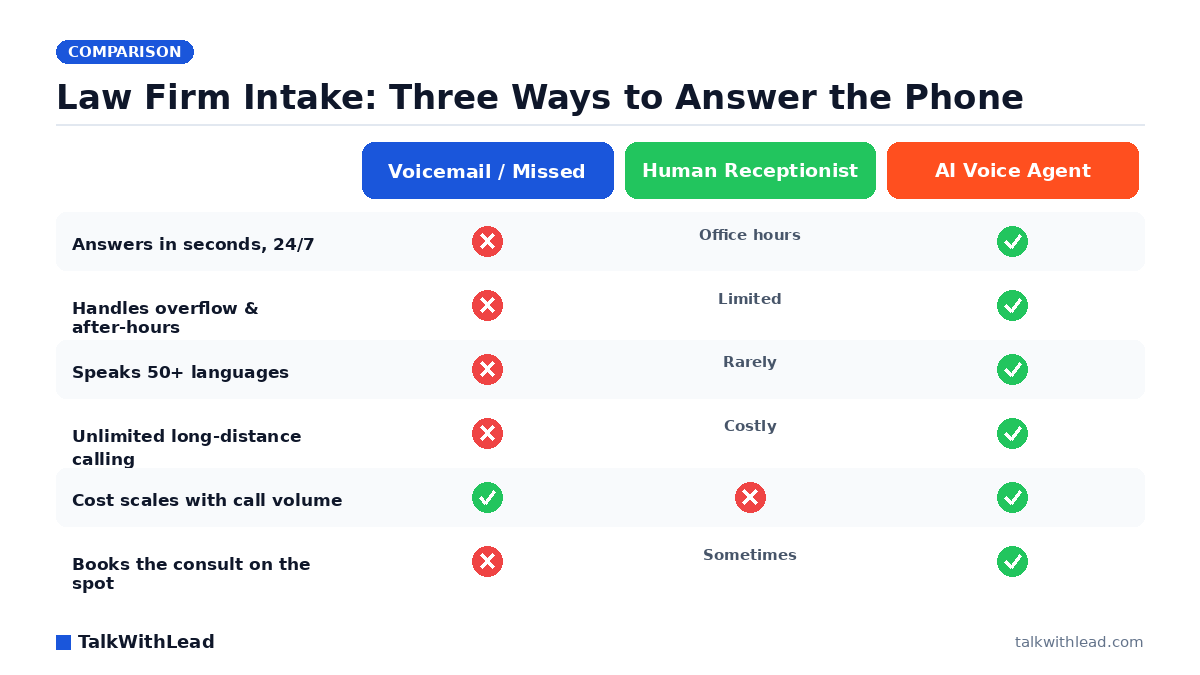
Voicemail makes it worse. A prospective client who reaches a recording rarely leaves a message. They go back to the search results and click the next firm.
How does AI voice-first lead conversion work for a law firm website?
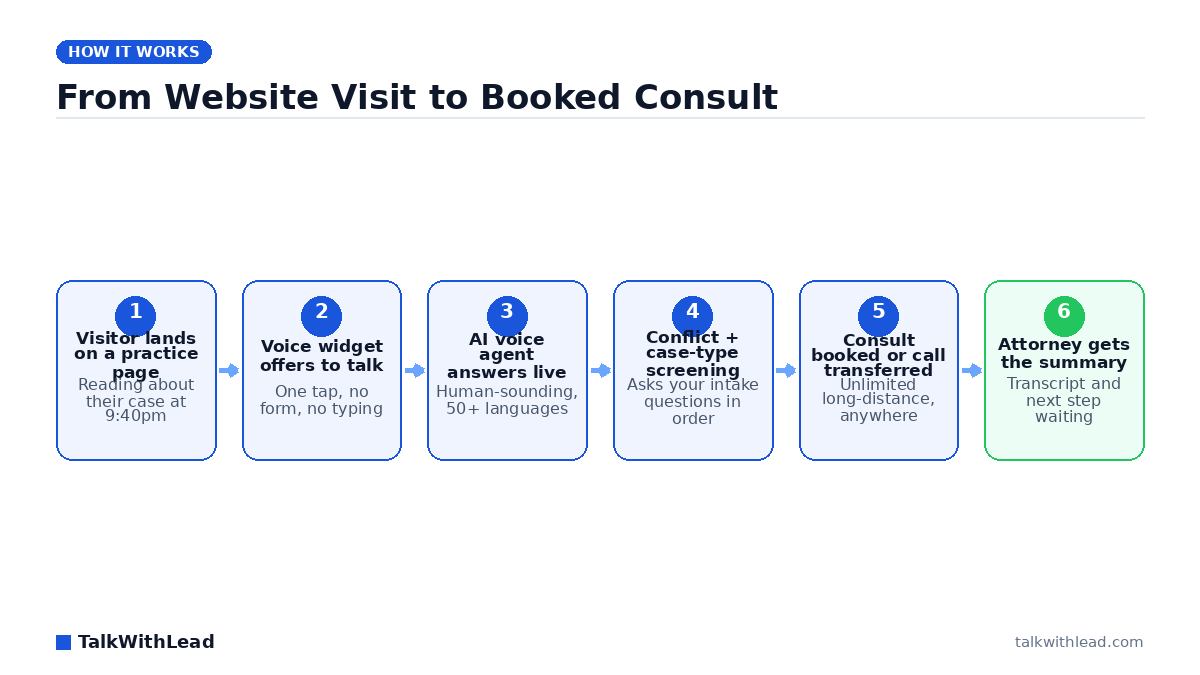
A voice widget sits on your practice-area pages. When a visitor taps it, an AI voice agent answers immediately and talks — no typing, no queue, no “an agent will be with you shortly.” It introduces the firm, asks what happened, and walks the caller through the same qualifying questions your intake coordinator would ask: date of incident, jurisdiction, injuries, insurance, opposing party, prior counsel.
From there it does one of three things: book a consult on the calendar, transfer the call live to whoever is on rotation, or trigger an instant callback if the caller wants a moment. Every conversation lands as a transcript and summary so an attorney reads the matter in thirty seconds instead of re-interviewing the client. You can hear the difference in tone on the live demo — the voice is the whole product, so it is worth listening to before deciding.
The mechanics of what makes voice convert are broken down further in AI Voice Agents for Law Firms Websites and in Law Firm Intake Automation for Lawyers.
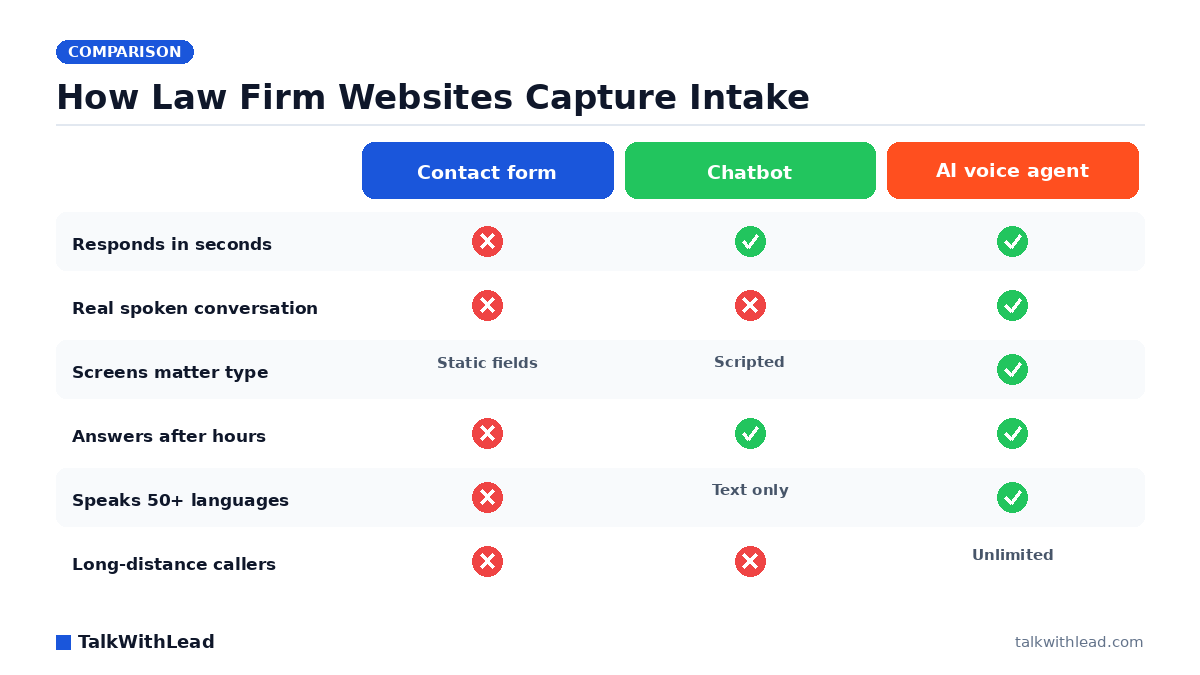
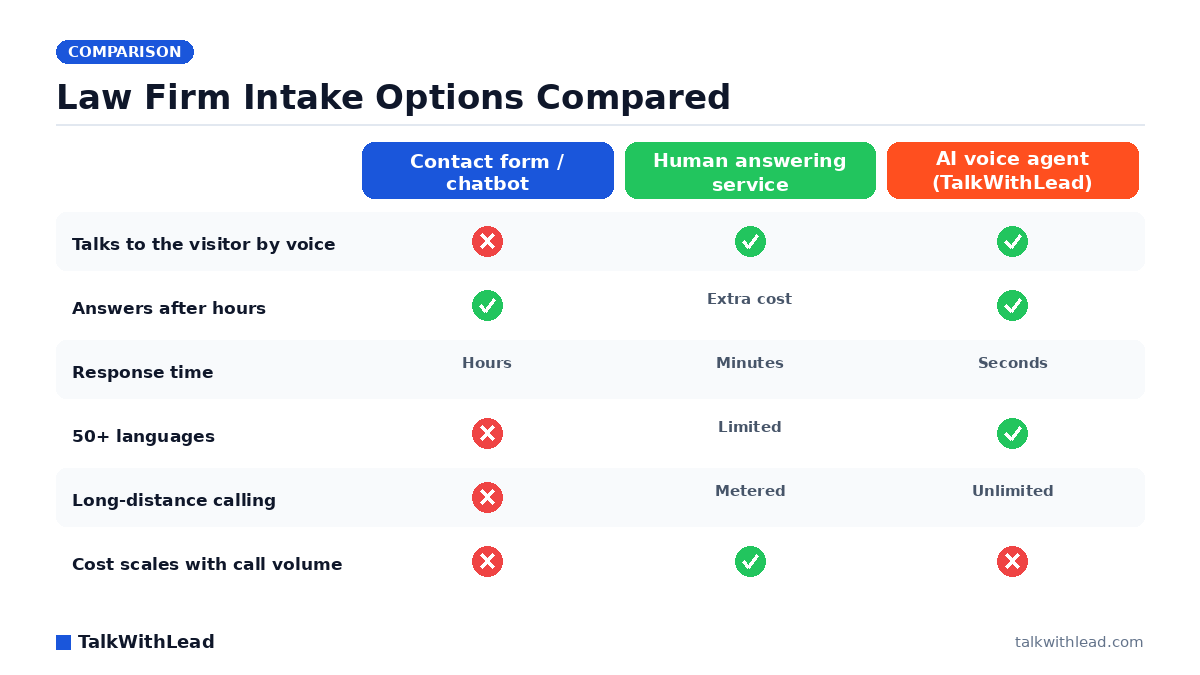
Voice agent vs chatbot vs contact form vs answering service
Firms usually have one of four things on the site. They are not equivalent.
| Capability | Contact form | Website chatbot | Human answering service | AI voice agent |
|---|---|---|---|---|
| Response time | Hours to a day | Instant, in text | Ring queue | Seconds, in voice |
| Answers at 2am | No | Yes | Sometimes | Yes |
| Actually a phone conversation | No | No | Yes | Yes |
| Follows your intake script every time | No | Partly | Varies by rep | Yes |
| Languages covered | One | Text only | Limited | 50+ spoken |
| Long-distance / out-of-state caller | N/A | N/A | Metered | Unlimited |
| Scales at 11pm Friday | N/A | Yes | Costly | Yes |
Best for: firms that already get meaningful website traffic and know they are missing calls after hours, during hearings, or in a second language.
Not the right fit if: your intake volume is tiny and a single paralegal answers every call within one ring — then the gain is marginal, and you should fix marketing before intake.
What does the missed-case math actually look like?
Here is an illustrative example, not a client result. Say a firm gets 600 website visitors a month and 90 of them tap to talk. Assume half arrive outside staffed hours, so 45 conversations currently die in voicemail or a form. Now assume a conservative signing rate of 12% on those conversations — that would be roughly 5 or 6 cases a month never opened. Put your own average case value against that number and the intake gap stops being an operations detail.
Run your own version with the free missed-call revenue calculator, which uses your inputs rather than ours. On cost framing: an AI voice agent is priced as a flat monthly subscription rather than per-minute or per-lead, which is the opposite of how most answering services bill — see current tiers on the pricing page. Firms comparing the two models will also want AI Receptionist vs Human Answering Service Cost.
Speed is the whole game in legal intake
Response time is the single lever with the most evidence behind it. The MIT Lead Response Management study found you’re about 21× more likely to qualify a lead contacted within 5 minutes than one contacted at 30 minutes. Legal is a harsher version of that curve, because a claimant with a fresh injury is calling several firms in one sitting.
A voice-first widget collapses that window to zero. There is no form submission, no CRM routing delay, no callback queue. The visitor is talking while they are still on the page reading about your practice area — which is the moment their intent is highest and their comparison shopping has not started yet.
Multilingual intake is a case-volume decision, not a nicety
A Spanish-speaking construction worker with a workplace injury is a serious matter, and most firms lose that call at hello. Same with Mandarin, Punjabi, Tagalog, Haitian Creole. Hiring bilingual intake staff for every language your market speaks is not realistic. An AI voice agent that handles 50+ languages simply answers in whatever the caller speaks, screens the matter, and hands your attorney a summary in English.
Unlimited long-distance matters for the same structural reason. Mass tort, class action, and multi-state practices get calls from everywhere, and metered per-minute answering costs quietly discourage the long screening conversations that surface the best cases.
Rolling it out without disrupting the firm
Start narrow and measure. A practical sequence:
- After-hours only first. Let staff keep daytime calls; point evenings, weekends, and holidays at the voice agent. This is where the leaked value already sits.
- Load your real intake script. Conflict-check questions, case-type disqualifiers, statute-of-limitations screening, jurisdiction. The agent should ask what your best intake coordinator asks.
- Set clear escalation. Certain triggers — a caller in custody, an imminent filing deadline — should transfer to a human immediately rather than book a Tuesday consult.
- Read the transcripts weekly. They are the cheapest client-research you will ever get, and they tell you which practice pages attract the wrong matters.
- Then expand to daytime overflow. Second and third simultaneous callers stop hitting hold music.
Nothing here requires replacing your case management system or retraining staff on new software. The widget goes on the site, the calls route where you say, and the intake team stops losing the ones that arrive at 10pm. You can put it on a practice-area page and watch the first week of transcripts by starting a free signup, or listen to the agent first on the live demo.
FAQ
What is AI voice-first lead conversion for law firms?
It is an intake approach where the firm’s website starts a live phone conversation with a visitor instead of collecting a contact form. An AI voice agent answers in seconds, screens the matter with the firm’s own intake questions, and books a consult or transfers the caller to an attorney.
Can an AI voice agent handle legal client intake properly?
For first-touch screening, yes — it asks case type, date of incident, jurisdiction, injuries, and conflict-check questions consistently every time. It is a qualification and scheduling layer, not a substitute for legal advice; attorneys still evaluate the matter and give counsel.
Will callers know they are talking to an AI?
The voice is designed to sound natural rather than robotic, and the agent identifies itself as the firm’s virtual intake assistant. Most callers care far more that someone answered at all than about which side of the line is automated.
How is this different from a website chatbot?
A chatbot collects typed text and usually ends with “someone will reach out.” A voice agent produces the actual phone conversation the caller wanted. For a fuller side-by-side, see AI Voice Agent vs Chatbot: Which One Books More Calls?
Does it work for Spanish-speaking or out-of-state callers?
Yes. The agent handles 50+ spoken languages and includes unlimited long-distance calling, so a Spanish-speaking claimant or an out-of-state inquiry gets a full screening conversation instead of a language barrier or a metered-minute cutoff.
How much does an AI voice agent cost for a small firm?
It is billed as a flat monthly subscription rather than per minute or per lead, which makes the cost predictable regardless of call volume. Current tiers are listed on the pricing page, and you can estimate the offsetting value with the missed-call revenue calculator.