
TalkWithLead
AI Voice-First Lead Conversion

AI Voice Agents That Turn Website Visitors Into Real Conversations

TalkWithLead is the AI voice-first widget that picks up the phone the moment a visitor lands on your site. Multilingual, extremely human-sounding, with unlimited long-distance calling so prospects anywhere can call you back. More calls. More leads. More closed deals.

Extremely human-sounding voice 50+ languages out of the box Unlimited long-distance calling Instant callback widget

Tag: legal intake

  • Law Firm Intake Automation for Lawyers: Capture After-Hours Cases

    Law Firm Intake Automation for Lawyers: Capture After-Hours Cases

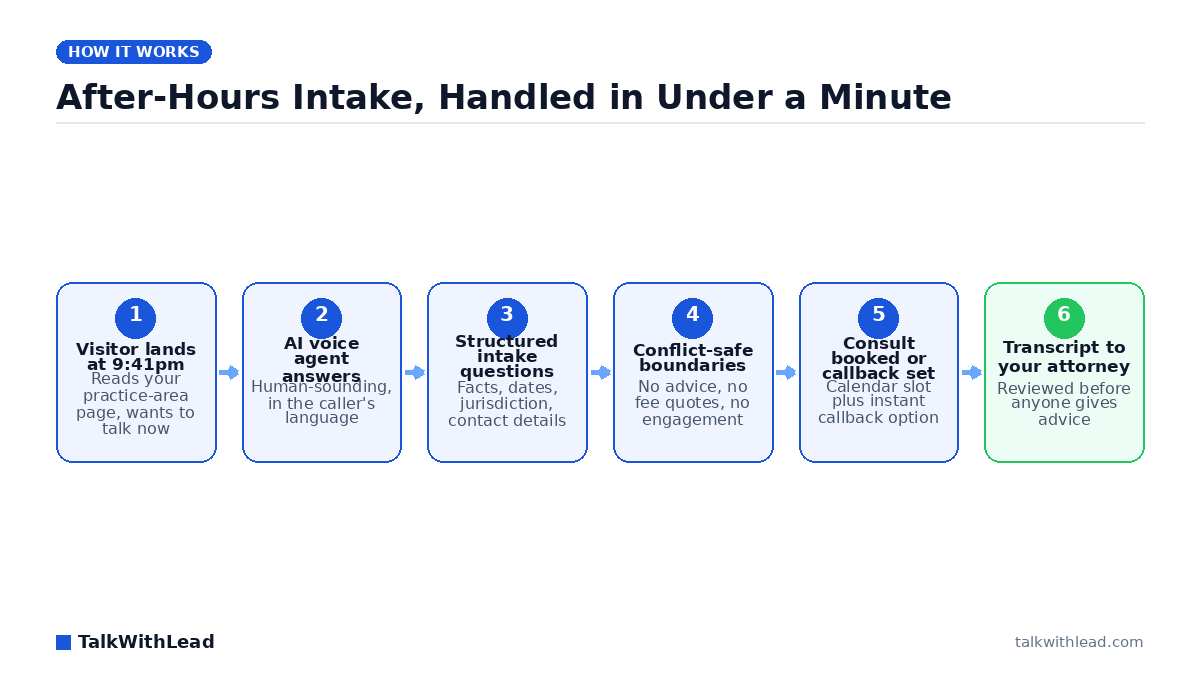
    After-Hours Intake, Handled in Under a Minute — TalkWithLead original infographic (flow diagram).
    After-Hours Intake, Handled in Under a Minute

    Your best case this month probably called at 9:41 on a Tuesday night, heard voicemail, and dialed the next firm on the results page. That is the real intake problem at most practices, and law firm intake automation is how you close it without hiring a night shift or risking an ethics complaint.

    TL;DR: Law firm intake automation uses an AI voice agent to answer every website visitor and after-hours caller within seconds, collect structured intake facts, and book the consultation on your calendar. It stays compliant by gathering information only, never giving legal advice, quoting fees, or forming an attorney-client relationship. A licensed attorney reviews the transcript before any advice is given.

    Why after-hours legal intake leaks so much money

    Legal buyers are in distress. Someone was rear-ended, served, fired, or arrested, and the search happens at night or on a weekend. That caller is not comparison shopping over three days. They call two or three firms in ten minutes and retain whoever picks up and sounds capable.

    A 411 Locals study of 85 small businesses across 58 industries found that only 37.8% of incoming calls were answered by a live person. Law firms are not exempt from that math. Every unanswered ring at a firm with a five-figure average case value is a different order of loss than a missed haircut appointment.

    Speed is the whole game. The MIT Lead Response Management study found you are about 21× more likely to qualify a lead contacted within 5 minutes than one contacted at 30 minutes. Your answering service that takes a message and emails it to the office at 8am is competing against a firm that answered on ring two.

    What does law firm intake automation actually do?

    Automation here does not mean a robot practicing law. It means the mechanical half of intake runs itself, and the judgment half stays with your attorneys.

    A voice agent on your website and phone line handles the mechanical half:

    • Answers instantly, day or night, on the first ring, with a human-sounding voice rather than a menu tree.
    • Runs your intake script: incident date, jurisdiction, opposing party, injuries or damages, prior counsel, contact details.
    • Screens for the obvious disqualifiers your firm already defined, such as practice area, venue, or a statute date that has clearly passed.
    • Books the consult directly into the calendar or triggers an instant callback from the on-call attorney.
    • Delivers a clean transcript and summary so the attorney reads a structured file, not a sticky note.

    Everything requiring legal judgment stays out of scope by design. See how the same pattern works in adjacent trades in our guides to AI voice answering for dental clinics and virtual receptionists for solo attorneys.

    How do you automate intake without compromising compliance?

    This is the question that stops most managing partners, and it deserves a direct answer. The compliance risk in automated intake comes from four specific behaviors, and you configure the agent to refuse all four.

    Do not let the agent give legal advice. It collects facts and repeats your firm’s published information. If the caller asks “do I have a case,” the correct scripted response is that an attorney will review the details and follow up. That is a boundary you can hear on every recording.

    Do not let the agent form a relationship or quote fees. The agent states plainly that speaking with intake does not create an attorney-client relationship and that fee arrangements are set by the attorney in writing. No outcome predictions, no “cases like yours usually settle for” language, ever.

    Run conflicts before substance. The agent captures names of all parties early and flags the file. A human runs the conflicts check before an attorney engages on the merits, exactly as with a walk-in.

    Handle confidentiality deliberately. Callers volunteer sensitive facts, so treat every transcript as protected material: restricted access, retention limits, and a disclosure at the top of the call that the conversation is recorded and transcribed for intake purposes. Your state bar rules and advertising regulations govern what the agent may say about results and specialization, so the script gets reviewed by your ethics-responsible attorney before it goes live. Watch a boundary-scripted agent handle a live conversation on the TalkWithLead live demo.

    Voice, forms, or chatbot: which converts legal traffic?

    Practice-area pages usually offer a contact form and sometimes a chat bubble. Both ask a distressed person to type their worst week into a text box and wait.

    Intake dimensionContact formWebsite chatbotAI voice agent
    Response timeHours to next dayInstant, but text onlyInstant, live conversation
    Works after hoursCollects onlyYesYes, with booking
    Distressed caller experiencePoorFairStrong
    Follow-up detail capturedWhatever fits the fieldsShort typed repliesFull narrative plus transcript
    Non-English callersRarely supportedSometimes50+ languages
    Books the consult itselfNoSometimesYes, or instant callback

    Voice wins for legal because talking is how people explain a mess. TalkWithLead’s agent picks up the conversation on the page, speaks in 50+ languages, and includes unlimited long-distance calling, so a family calling about a cross-border matter reaches you the same way a local does. Our breakdown of AI voice agents versus chatbots covers the conversion mechanics in detail.

    Illustrative ROI math for a small firm

    These numbers are an illustration, not a customer result. Adjust them to your own case economics.

    Picture a four-attorney firm that gets 120 inbound inquiries a month, with 45 of them arriving outside staffed hours. Say even 1 in 5 of those after-hours inquiries would have signed if someone had answered live: that is 9 signed matters a month lost to voicemail. At an assumed average fee of $4,000 per signed matter, the annual gap is roughly $432,000. You do not need the assumption to be right; you need it to be closer to right than zero, which is what voicemail delivers. Run your own version with the free missed-call revenue calculator.

    Cost framing, plainly: after-hours legal answering services are typically priced per minute or per call and climb fast in a busy month, while an AI voice agent is priced as a flat monthly subscription regardless of call volume. Compare plans on the TalkWithLead pricing page, and see our analysis of whether an AI receptionist is worth it for a law firm.

    Best for, and not the right fit if

    Best for: consumer-facing practices with volume and urgency — personal injury, family, criminal defense, immigration, employment, and estate planning firms whose website traffic peaks at night and whose staff does not.

    Not the right fit if: your matters arrive entirely through referral relationships, your practice is transactional corporate work with no inbound web volume, or your state bar interpretation prohibits recorded automated intake without a specific consent process you are unwilling to implement.

    How to roll it out in two weeks

    1. Write the intake script by practice area. Pull the questions your best paralegal already asks. Mark the hard stops: no advice, no fees, no outcomes.
    2. Get ethics sign-off. One attorney reviews the script and the recording disclosure against your state rules before launch.
    3. Install the widget and route the phone line. Put the voice agent on every practice-area page, not just the contact page.
    4. Set escalation rules. Define which calls trigger an instant callback to the on-call attorney versus a next-morning consult slot.
    5. Review the first 50 transcripts. Tighten questions, fix pronunciation of local venue names, and cut anything that reads like advice.
    6. Measure one number. Signed consults per 100 after-hours inquiries, before and after. Everything else is vanity.

    The firms that win the 9:41pm call are not the ones with the best brochure. They are the ones that answered. Start free with TalkWithLead and let your next after-hours caller reach a voice instead of a beep. If you want to see the speed argument in numbers first, read our piece on how fast you should call a new lead.

    FAQ

    Is AI intake allowed under legal ethics rules?

    Bar rules generally permit non-lawyer staff and technology to gather information, so long as the system does not give legal advice, set fees, or hold itself out as a lawyer. The obligations that matter are supervision, confidentiality, conflicts screening, and truthful advertising. Configure the agent to collect facts and schedule only, disclose recording, and have an attorney review your script against your state’s rules before launch.

    Can an AI voice agent give legal advice to callers?

    No, and it should be configured to refuse. When a caller asks whether they have a case or what it is worth, the scripted answer is that an attorney will review the details and respond. That boundary is auditable on every transcript, which is easier to defend than an undertrained human receptionist improvising at midnight.

    How much does law firm intake automation cost?

    Legal answering services usually bill per minute or per call, so a heavy month costs more than a slow one. AI voice agents are generally sold as a flat monthly subscription that does not move with call volume, which makes budgeting predictable during ad campaigns. Compare current plans on the pricing page.

    Will clients be annoyed talking to an AI?

    Callers react to being helped, not to the technology label. A voice that answers on ring one, asks sensible questions, and books a real appointment beats a voicemail box or a hold queue. Disclose that it is an automated intake assistant, keep the handoff to a human fast, and the objection mostly disappears.

    Does it handle Spanish and other languages?

    TalkWithLead’s agent speaks 50+ languages and includes unlimited long-distance calling, so a Spanish-speaking caller or a family member calling from abroad gets the same intake quality as an English-speaking local. For firms in immigration or personal injury, that is often where the unclaimed case volume is sitting.

    What happens to the information the agent collects?

    It becomes a structured intake record: transcript, summary, contact details, and the calendar booking, delivered to your team for conflicts screening and attorney review. Treat it as confidential client material with restricted access and a retention policy, the same as any intake file. You can watch the full flow on the live demo.
  • Smith.ai Alternative for Law Firms: Book More Consults

    Smith.ai Alternative for Law Firms: Book More Consults

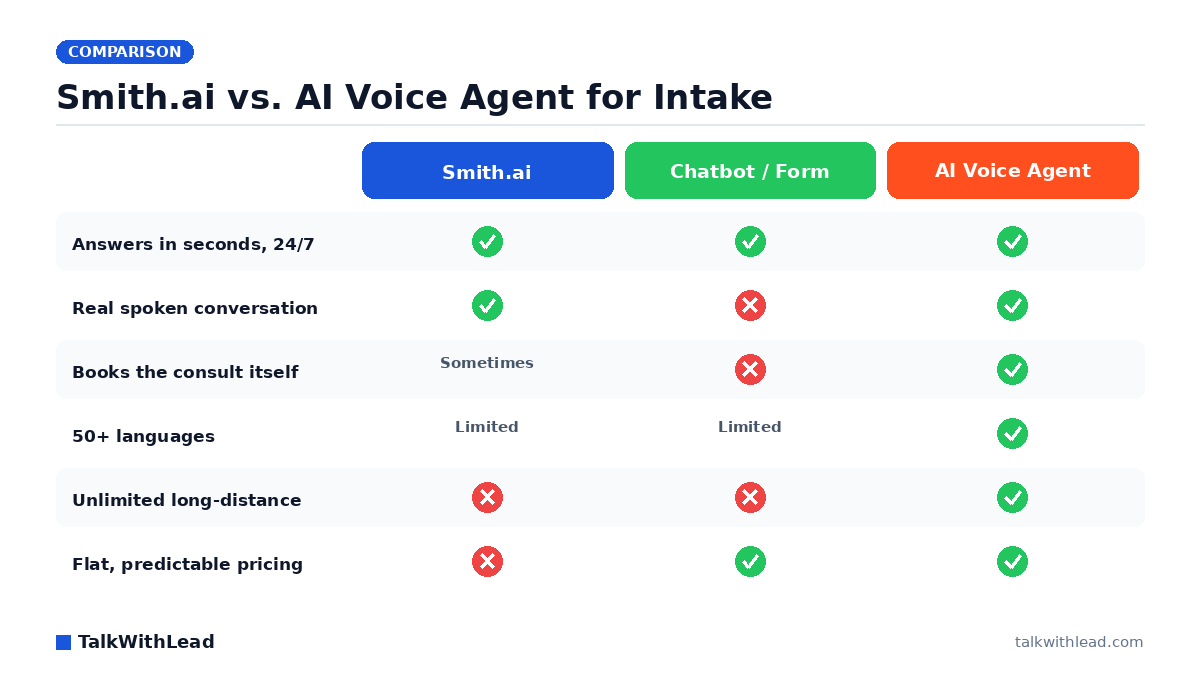
    Smith.ai vs. AI Voice Agent for Intake — TalkWithLead original infographic (comparison diagram).
    Smith.ai vs. AI Voice Agent for Intake

    A prospective client lands on your firm’s site at 9 p.m. with a DUI and a court date. They will not fill out a contact form and wait two days for a callback. They want to talk to someone now, and if your site can’t deliver that, the next firm in the search results will.

    That gap is exactly why so many practices shop for a Smith.ai alternative for law firms website intake. Smith.ai built a strong human-receptionist service, but human teams cost more per minute as call volume climbs, can queue callers at peak hours, and still hand most after-hours visitors to a form. The faster-growing option is an AI voice agent that picks up instantly, talks like a person, and books the consult on the spot.

    TL;DR: The best Smith.ai alternative for law firm intake is a human-sounding AI voice agent that answers your website visitors in seconds, every hour of every day, qualifies the matter, and books the consultation directly into your calendar. It converts better than chatbots or forms because people would rather speak than type their legal problem, and it bills at a flat rate instead of per minute.

    Why law firms outgrow a receptionist-only intake service

    Smith.ai and similar virtual-receptionist services solved a real problem: someone friendly answers the phone so attorneys can practice law. But three pressures push growing firms to look further.

    • Cost scales with conversation. Per-minute or per-call pricing means your bill rises right when intake volume rises. A busy month becomes an expensive month.
    • Peak-hour queues. Human teams handle a finite number of simultaneous callers. A marketing push, a local news story, or a Monday-morning rush can leave callers waiting.
    • Website visitors still get a form. Most receptionist services answer the phone but route web traffic to a chatbot or a contact form, which is the slowest path back to a real conversation.

    Speed is the whole game in legal intake. According to Harvard Business Review research, companies that reach a web lead within an hour are nearly 7× more likely to qualify it than those that wait even an hour longer. For a law firm, an hour is an eternity; the visitor has already called two competitors. Our deeper look at why the first 60 seconds win most deals walks through exactly how that window closes.

    What is the best Smith.ai alternative for law firm website intake?

    The strongest alternative is an AI voice agent that lives on your website and turns a click into a phone conversation in seconds. Instead of a chatbot that makes a stressed visitor type out their situation, the agent speaks, listens, and responds in a natural, human-sounding voice.

    Here is what a voice-first intake agent does that a receptionist queue or a form cannot:

    • Answers instantly, 24/7. No hold music, no “our office is closed,” no overnight gap. Every visitor gets a live conversation.
    • Speaks 50+ languages. A Spanish-speaking family with an immigration question gets answered in their own language without a transfer.
    • Offers instant callbacks. If a visitor would rather you call their phone, the agent connects the call immediately.
    • Includes unlimited long-distance calling, so a client across the country reaches you without anyone watching a meter.
    • Qualifies and books. It asks your intake questions, screens out matters you don’t take, and drops the qualified consult straight onto the calendar.

    Voice matters because of how people behave under stress. A Five9 study of 4,000 US and UK consumers found that 75% of people prefer talking to a real human over the phone for support. A human-sounding AI voice agent meets that preference at machine scale, while a chatbot fights it. We compared the conversion gap directly in AI voice agent vs. chatbot: which one books more calls?

    Want to hear it first? Try a live demo and judge the voice quality yourself before you change anything.

    Smith.ai vs. chatbot vs. AI voice agent: a side-by-side look

    Each option has a place. The question is which one books the most consults from your existing website traffic.

    Intake dimensionSmith.ai (human receptionist)Chatbot / web formAI voice agent
    Response timeFast when staffedInstant textInstant voice
    Real spoken conversationYesNoYes
    24/7 without queueLimited at peakYesYes
    Books the consult itselfSometimesRarelyYes
    LanguagesLimitedLimited50+
    Long-distance callingMeteredN/AUnlimited
    Pricing modelPer minute / per callFlat / cheapFlat

    The chatbot is cheap but loses the visitor who won’t type. The receptionist service is excellent on the phone but costly to scale and often leaves web traffic on a form. The AI voice agent combines instant text-speed availability with the conversion power of an actual conversation. For the broader comparison, see AI voice agent vs. chatbot conversion rate and live chat vs. chatbot, plus the AI voice upgrade.

    How much intake are you losing? Run the math

    Picture a firm whose website gets 200 visitors a week from paid search and referrals. Say even 1 in 20 of those visitors is a qualified case that arrives outside office hours or during a phone queue, and the visitor leaves without ever reaching a human. That’s roughly 10 lost conversations a week, or more than 500 a year, walking straight to a competitor.

    Now assume a single signed matter is worth a few thousand dollars in fees. Recovering even a handful of those lost conversations each month covers the cost of the intake system many times over. That is the ROI an always-on voice agent is built to capture. You can model your own numbers with the free missed-call revenue calculator using your real traffic and average case value.

    This is also why missed-call automation for websites matters so much for firms: every unanswered after-hours inquiry is a case you paid to attract and then let slip.

    Honest verdict: is an AI voice agent right for your firm?

    Best for: growing practices that get steady website traffic, run paid search, take after-hours or weekend inquiries, serve multilingual communities, or feel their per-minute receptionist bill climbing as volume grows.

    An AI voice agent isn’t a fit for everyone. A Five9 survey of 4,000 consumers found that 56% are frequently frustrated by AI customer-service chatbots, so voice quality is non-negotiable; a robotic agent will hurt you. The point of a modern voice agent is that it sounds genuinely human, which is why a live demo should come before any decision.

    Not the right fit if: your firm prefers a named human receptionist who knows every regular caller by name, your inquiry volume is low enough that a queue never forms, and predictable scaling cost is not a concern. In that case, a traditional service may serve you well.

    Pricing is straightforward and flat rather than metered; you can review the plans on the pricing page. When the math points to recovering lost consults, you can start with a free signup and have the agent live on your site quickly.

    How to switch without disrupting intake

    Moving off a receptionist-only setup is lower-risk than most firms expect because you can run the voice agent alongside your current process first.

    1. Test the voice. Book a live demo and confirm it sounds human enough to represent your firm.
    2. Script your intake. Feed it your screening questions, the matter types you accept, and your scheduling rules.
    3. Add the widget. Place it on your highest-traffic pages first: practice-area pages and the contact page.
    4. Measure. Watch consults booked, after-hours captures, and answered-versus-missed conversations against your old baseline.

    The same speed-to-lead logic that wins legal clients wins in other appointment-driven fields. Our speed-to-lead playbook for real estate shows the instant-callback pattern in action, and it maps cleanly onto consult booking.

    FAQ

    What is the best Smith.ai alternative for law firm website intake?

    For most growing firms, the best alternative is an AI voice agent that answers website visitors instantly with a human-sounding voice, qualifies the matter, and books the consult directly. It combines the conversion power of a real phone conversation with 24/7 availability and flat pricing, instead of routing web traffic to a form or a metered receptionist queue.

    Is an AI voice agent cheaper than a virtual receptionist service?

    It depends on volume. Receptionist services typically bill per minute or per call, so costs rise as intake grows. An AI voice agent uses flat, predictable pricing, which usually wins as call volume increases. Run your own numbers with the missed-call revenue calculator and compare against your current monthly bill.

    Can an AI voice agent actually book consultations on its own?

    Yes. A properly configured agent runs your intake script, screens out matters you don’t accept, and books qualified consultations onto your calendar without an attorney lifting a finger. It can also offer an instant callback if the visitor prefers you to call their phone.

    Will it sound robotic to my prospective clients?

    Modern AI voice agents are built to sound genuinely human, which is the entire reason they convert. Because many consumers distrust clunky chatbots, voice quality is the thing to test first; book a live demo and listen before you decide.

    Does it handle non-English-speaking callers?

    Yes. A voice-first agent can speak 50+ languages, so a Spanish-speaking or other non-English visitor is answered in their own language without a transfer or a callback delay, which is a major advantage for firms serving diverse communities.

    How fast can it be live on my website?

    After a free signup, you script your intake questions and drop the widget onto your site, typically your practice-area and contact pages first. Most firms can run it alongside their existing intake within a short setup window and measure the lift before fully switching over.

Your next lead is on your site right now — ready to talk.

TalkWithLead’s AI voice agent picks up in seconds, qualifies the lead in their language, and books the call before the prospect can open a competitor’s tab. Forms are slow. Chatbots make people type. Voice closes.

Just curious about plans? See pricing →
This is the TalkWithLead Widget. Click to see how it will work on your website!