TalkWithLead
AI Voice-First Lead Conversion

AI Voice Agents That Turn Website Visitors Into Real Conversations

TalkWithLead is the AI voice-first widget that picks up the phone the moment a visitor lands on your site. Multilingual, extremely human-sounding, with unlimited long-distance calling so prospects anywhere can call you back. More calls. More leads. More closed deals.

Extremely human-sounding voice 50+ languages out of the box Unlimited long-distance calling Instant callback widget

Tag: client intake

  • AI Voice-First Lead Conversion for Law Firms

    AI Voice-First Lead Conversion for Law Firms

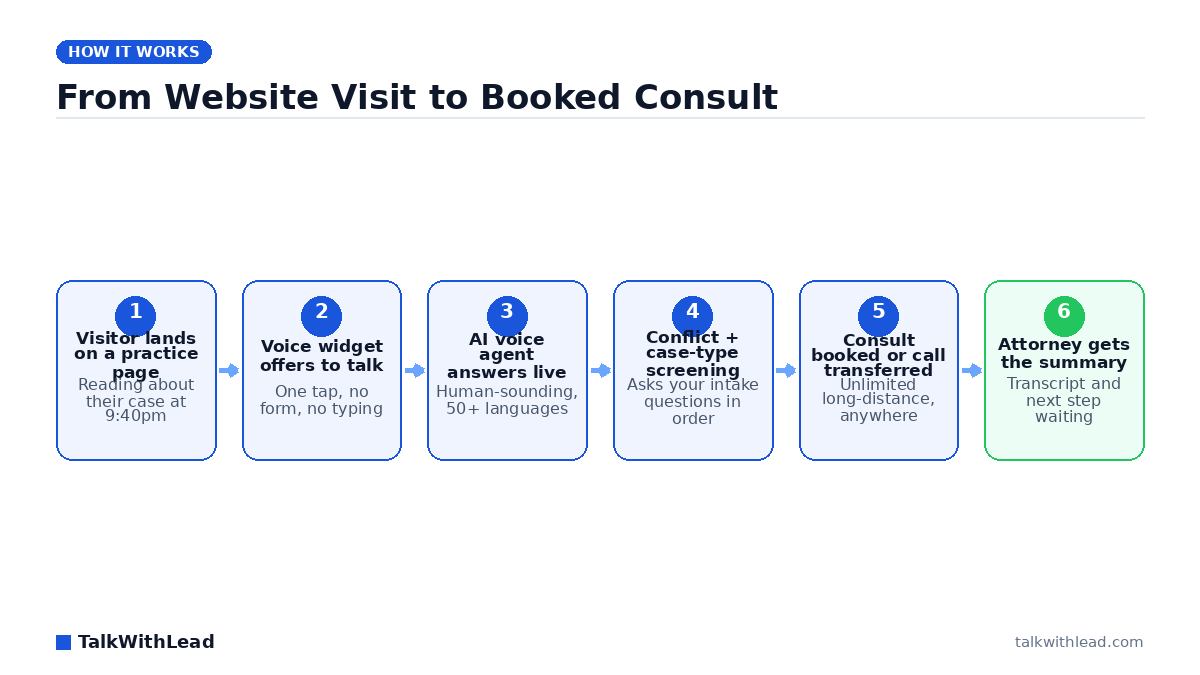
    From Website Visit to Booked Consult — TalkWithLead original infographic (flow diagram).
    From Website Visit to Booked Consult

    A person who just got rear-ended does not fill out a contact form and wait. They open three law firm websites, and they retain whichever one actually picks up. If your site answers with a text box and a promise to respond within one business day, you already lost that case.

    AI voice-first lead conversion for law firms means the website itself starts a real phone conversation instead of collecting a form. A human-sounding AI voice agent answers the visitor within seconds, screens the matter using your intake script, speaks 50+ languages, and either books the consult or connects the caller straight to an attorney over unlimited long-distance calling. The result is a live intake call rather than a lead sitting in an inbox overnight.

    Why legal intake breaks at exactly the wrong moment

    Most firms have decent traffic and terrible capture. The receptionist is at lunch, in a deposition prep, or gone at 5:01. Meanwhile the highest-value legal searches — accident, arrest, eviction, custody emergency — happen at night and on weekends, because that is when bad things happen to people.

    The gap is not marketing spend. It is answering. According to a 411 Locals study of 85 small businesses across 58 industries, only 37.8% of incoming calls were answered by a live person — meaning roughly 6 out of 10 calls went unattended. Apply that pattern to a personal injury practice and the leak is not a rounding error; it is the case list.

    Voicemail makes it worse. A prospective client who reaches a recording rarely leaves a message. They go back to the search results and click the next firm.

    How does AI voice-first lead conversion work for a law firm website?

    A voice widget sits on your practice-area pages. When a visitor taps it, an AI voice agent answers immediately and talks — no typing, no queue, no “an agent will be with you shortly.” It introduces the firm, asks what happened, and walks the caller through the same qualifying questions your intake coordinator would ask: date of incident, jurisdiction, injuries, insurance, opposing party, prior counsel.

    From there it does one of three things: book a consult on the calendar, transfer the call live to whoever is on rotation, or trigger an instant callback if the caller wants a moment. Every conversation lands as a transcript and summary so an attorney reads the matter in thirty seconds instead of re-interviewing the client. You can hear the difference in tone on the live demo — the voice is the whole product, so it is worth listening to before deciding.

    The mechanics of what makes voice convert are broken down further in AI Voice Agents for Law Firms Websites and in Law Firm Intake Automation for Lawyers.

    Voice agent vs chatbot vs contact form vs answering service

    Firms usually have one of four things on the site. They are not equivalent.

    CapabilityContact formWebsite chatbotHuman answering serviceAI voice agent
    Response timeHours to a dayInstant, in textRing queueSeconds, in voice
    Answers at 2amNoYesSometimesYes
    Actually a phone conversationNoNoYesYes
    Follows your intake script every timeNoPartlyVaries by repYes
    Languages coveredOneText onlyLimited50+ spoken
    Long-distance / out-of-state callerN/AN/AMeteredUnlimited
    Scales at 11pm FridayN/AYesCostlyYes

    Best for: firms that already get meaningful website traffic and know they are missing calls after hours, during hearings, or in a second language.

    Not the right fit if: your intake volume is tiny and a single paralegal answers every call within one ring — then the gain is marginal, and you should fix marketing before intake.

    What does the missed-case math actually look like?

    Here is an illustrative example, not a client result. Say a firm gets 600 website visitors a month and 90 of them tap to talk. Assume half arrive outside staffed hours, so 45 conversations currently die in voicemail or a form. Now assume a conservative signing rate of 12% on those conversations — that would be roughly 5 or 6 cases a month never opened. Put your own average case value against that number and the intake gap stops being an operations detail.

    Run your own version with the free missed-call revenue calculator, which uses your inputs rather than ours. On cost framing: an AI voice agent is priced as a flat monthly subscription rather than per-minute or per-lead, which is the opposite of how most answering services bill — see current tiers on the pricing page. Firms comparing the two models will also want AI Receptionist vs Human Answering Service Cost.

    Speed is the whole game in legal intake

    Response time is the single lever with the most evidence behind it. The MIT Lead Response Management study found you’re about 21× more likely to qualify a lead contacted within 5 minutes than one contacted at 30 minutes. Legal is a harsher version of that curve, because a claimant with a fresh injury is calling several firms in one sitting.

    A voice-first widget collapses that window to zero. There is no form submission, no CRM routing delay, no callback queue. The visitor is talking while they are still on the page reading about your practice area — which is the moment their intent is highest and their comparison shopping has not started yet.

    Multilingual intake is a case-volume decision, not a nicety

    A Spanish-speaking construction worker with a workplace injury is a serious matter, and most firms lose that call at hello. Same with Mandarin, Punjabi, Tagalog, Haitian Creole. Hiring bilingual intake staff for every language your market speaks is not realistic. An AI voice agent that handles 50+ languages simply answers in whatever the caller speaks, screens the matter, and hands your attorney a summary in English.

    Unlimited long-distance matters for the same structural reason. Mass tort, class action, and multi-state practices get calls from everywhere, and metered per-minute answering costs quietly discourage the long screening conversations that surface the best cases.

    Rolling it out without disrupting the firm

    Start narrow and measure. A practical sequence:

    • After-hours only first. Let staff keep daytime calls; point evenings, weekends, and holidays at the voice agent. This is where the leaked value already sits.
    • Load your real intake script. Conflict-check questions, case-type disqualifiers, statute-of-limitations screening, jurisdiction. The agent should ask what your best intake coordinator asks.
    • Set clear escalation. Certain triggers — a caller in custody, an imminent filing deadline — should transfer to a human immediately rather than book a Tuesday consult.
    • Read the transcripts weekly. They are the cheapest client-research you will ever get, and they tell you which practice pages attract the wrong matters.
    • Then expand to daytime overflow. Second and third simultaneous callers stop hitting hold music.

    Nothing here requires replacing your case management system or retraining staff on new software. The widget goes on the site, the calls route where you say, and the intake team stops losing the ones that arrive at 10pm. You can put it on a practice-area page and watch the first week of transcripts by starting a free signup, or listen to the agent first on the live demo.

    FAQ

    What is AI voice-first lead conversion for law firms?

    It is an intake approach where the firm’s website starts a live phone conversation with a visitor instead of collecting a contact form. An AI voice agent answers in seconds, screens the matter with the firm’s own intake questions, and books a consult or transfers the caller to an attorney.

    Can an AI voice agent handle legal client intake properly?

    For first-touch screening, yes — it asks case type, date of incident, jurisdiction, injuries, and conflict-check questions consistently every time. It is a qualification and scheduling layer, not a substitute for legal advice; attorneys still evaluate the matter and give counsel.

    Will callers know they are talking to an AI?

    The voice is designed to sound natural rather than robotic, and the agent identifies itself as the firm’s virtual intake assistant. Most callers care far more that someone answered at all than about which side of the line is automated.

    How is this different from a website chatbot?

    A chatbot collects typed text and usually ends with “someone will reach out.” A voice agent produces the actual phone conversation the caller wanted. For a fuller side-by-side, see AI Voice Agent vs Chatbot: Which One Books More Calls?

    Does it work for Spanish-speaking or out-of-state callers?

    Yes. The agent handles 50+ spoken languages and includes unlimited long-distance calling, so a Spanish-speaking claimant or an out-of-state inquiry gets a full screening conversation instead of a language barrier or a metered-minute cutoff.

    How much does an AI voice agent cost for a small firm?

    It is billed as a flat monthly subscription rather than per minute or per lead, which makes the cost predictable regardless of call volume. Current tiers are listed on the pricing page, and you can estimate the offsetting value with the missed-call revenue calculator.
  • AI Voice Agents for Law Firms Websites: Win More Cases

    AI Voice Agents for Law Firms Websites: Win More Cases

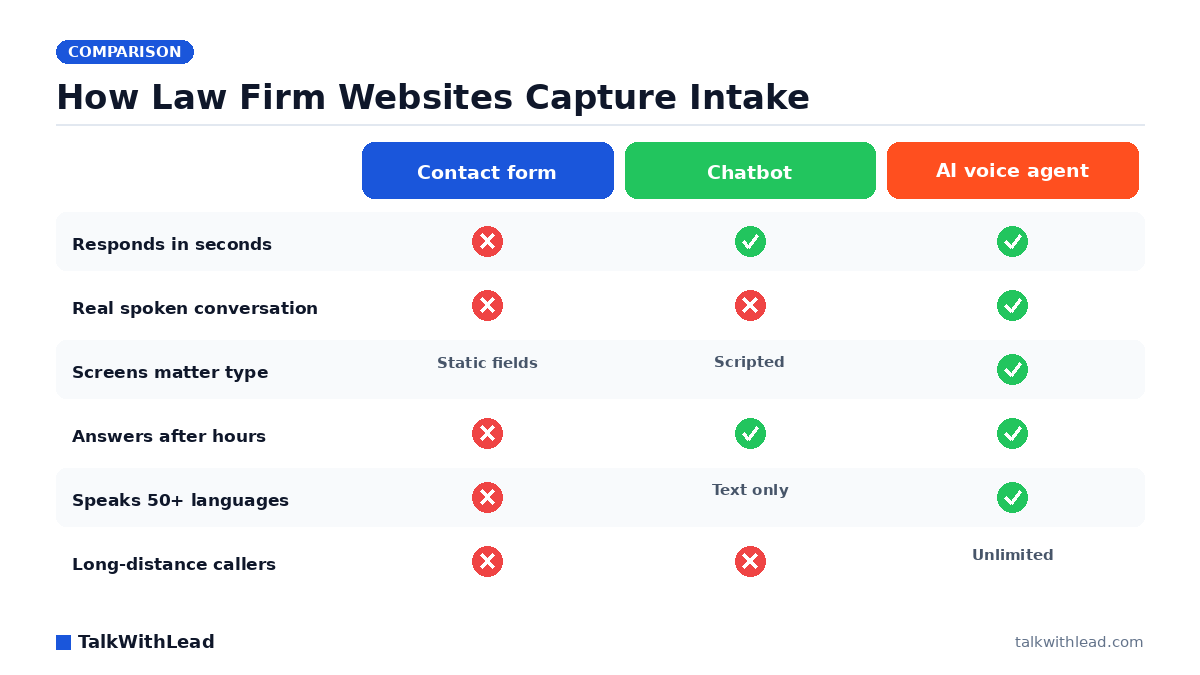
    How Law Firm Websites Capture Intake — TalkWithLead original infographic (comparison diagram).
    How Law Firm Websites Capture Intake

    A person who just got rear-ended, fired, or served with papers does not want to fill out a form. They want to talk to someone right now — and if your website makes them type and wait, they will call the firm three results down the page. That is the exact gap AI voice agents for law firms websites close.

    TL;DR: An AI voice agent on a law firm website answers a visitor by voice within seconds, asks the intake questions a paralegal would ask, screens the matter type and jurisdiction, and either books the consultation or connects the caller to an attorney. It runs after hours, speaks 50+ languages, and places unlimited long-distance calls — so no qualified case is lost to a voicemail box.

    Why law firm websites leak cases

    Most legal sites are built to look credible, not to start conversations. The visitor gets a phone number that rings a front desk between 9 and 5, a contact form that promises a reply “within one business day,” and maybe a chat widget staffed by an offshore typist. Every one of those is a delay, and legal intent does not wait.

    Legal buyers shop in parallel. Picture a personal injury search where a visitor opens four firm websites in four tabs and calls whichever one answers first — that is the ordinary behavior of someone in distress, not an edge case. Research popularized by InsideSales / Dr. James Oldroyd found that roughly 35-50% of sales go to the company that responds first. In legal intake, “responds first” means picks up the phone.

    The other leak is the phone itself. According to a 411 Locals study of 85 small businesses across 58 industries, only 37.8% of incoming calls were answered by a live person — meaning roughly 6 out of 10 calls went unattended. A small firm with two attorneys in depositions all afternoon is exactly the business that study describes.

    What is an AI voice agent on a law firm website?

    It is a widget that sits on every page and, when a visitor taps it, starts a real spoken conversation with an extremely human-sounding AI voice. The visitor talks. The agent listens, answers, and asks the next question. No download, no phone tag, no typing on a cracked phone screen in a hospital parking lot.

    For a law firm, the agent is scripted around intake rather than sales chatter. A practical flow looks like this:

    • Greet and identify the matter — car accident, divorce, employment dispute, immigration, estate.
    • Screen the basics — where the incident happened, roughly when, whether another firm is already involved.
    • Flag urgency — statute deadlines, an arrest, a court date this week.
    • Book or transfer — put a consultation on the calendar, or ring the on-call attorney immediately for a high-value matter.
    • Hand off clean notes — the attorney opens the consult already knowing the story.

    You can hear that flow rather than imagine it — the Live Demo lets you talk to the agent the same way a prospective client would.

    AI voice agent vs chatbot vs answering service for legal intake

    Firms usually compare three options. They are not equivalent.

    DimensionContact formChatbot / live chatHuman answering serviceAI voice agent
    Response timeHours to a daySeconds, by textRings out, then queueSeconds, by voice
    InteractionFieldsTypingPhone callPhone conversation
    After-hours coverCollects onlyUsually scriptedOften premium-pricedAlways on
    Legal-specific screeningStatic questionsShallowDepends on operatorTrained on your intake script
    LanguagesOneText translationLimited bilingual staff50+ spoken
    Out-of-state callersN/AN/AMetered minutesUnlimited long distance
    Cost behaviorLow, low yieldPer seatPer minute / per callFlat subscription

    Best for: solo and small-to-midsize firms that get real website traffic, cannot staff a receptionist past 5pm, and lose consults to whoever answers first.

    Not the right fit if: your practice is referral-only with almost no web traffic, or your matters require privileged, attorney-only first contact from the very first sentence — in that case use voice purely to route and schedule, not to screen.

    If you want the head-to-head on cost specifically, we broke it down in AI Receptionist vs Human Answering Service Cost and Is an AI Receptionist Worth It for a Law Firm?.

    How much is a missed intake call actually worth?

    Legal is unforgiving math because one signed case can outweigh a year of software cost. Here is a labeled illustration, not a claim about any real firm.

    Illustrative ROI example. Assume a firm’s website produces 120 inbound intake attempts a month. Assume half arrive outside staffed hours or while the line is busy — that is 60 unanswered attempts. Say even a small slice of those, imagine roughly one in twelve, was a viable matter, and the firm signs half of the viable ones: that is roughly 2 to 3 signed cases a month never reaching an attorney. At an assumed average case value of $3,000, that is $6,000 to $9,000 of monthly fee revenue leaving through an unanswered phone. Every number in that paragraph is an assumption you should replace with your own.

    Run your own version with the free missed-call revenue calculator — it takes your call volume and case value and shows the gap. The plain framing: an AI voice agent is a flat monthly subscription rather than a per-minute bill, so the cost does not spike in the month your marketing works. Current tiers are on the pricing page.

    Speed to lead is the whole game in legal intake

    Intake speed is not a nice-to-have metric. According to Harvard Business Review research, companies that reach a web lead within an hour are nearly 7× more likely to qualify it than those that wait even an hour longer. A firm that returns Friday-evening form submissions on Monday morning is not competing on that curve at all.

    An AI voice agent collapses the gap to zero because there is no gap — the visitor is already on the site, already motivated, and the conversation starts on the spot instead of being scheduled. The deeper mechanics of that timing advantage are in Speed to Lead: How Fast Should You Call a New Lead?

    Instant callback matters too. Some visitors will not tap a widget but will leave a number. The agent calls them back within seconds rather than adding them to a list someone works through tomorrow.

    Languages and long distance: the cases most firms quietly refuse

    Immigration, personal injury, employment, and family law all draw callers whose first language is not English. Today those calls often end with “can you call back when Maria is in?” — and the caller does not call back. A voice agent that speaks 50+ languages takes that same call in Spanish, Mandarin, Punjabi, Portuguese, or Tagalog, screens it properly, and hands the attorney a summary in English.

    Unlimited long-distance calling covers the other version of the same loss: an out-of-state family member calling about a relative’s accident, or a prospective client who moved. The firm can talk to them without watching a per-minute meter. Our team wrote about the same pattern in other verticals in AI Voice Agent vs Chatbot for Local Businesses.

    How to roll it out without disrupting the firm

    Deployment is a website change, not a practice-management migration. A sane sequence:

    1. Write the intake script you already use. Whatever your paralegal asks in the first three minutes becomes the agent’s script.
    2. Define what the agent must never do. No fee quotes, no legal advice, no opinion on the merits — screen and schedule only.
    3. Set routing rules. High-urgency matter types ring an attorney immediately; everything else books a consult slot.
    4. Install the widget site-wide, with extra prominence on practice-area and “contact” pages where intent peaks.
    5. Review transcripts weekly for the first month and tighten questions that produced vague answers.

    Most firms are live the same week. You can start on the free signup, or talk to the agent first through the Live Demo and decide from there. If you want the intake-automation view rather than the widget view, see Law Firm Intake Automation for Lawyers.

    FAQ

    What is an AI voice agent for a law firm website?

    It is a widget on the firm’s site that starts a spoken conversation with a visitor in seconds. The AI voice screens the matter, captures contact details and case basics, and either books a consultation or transfers the caller to an attorney — 24 hours a day.

    Can an AI voice agent replace my legal receptionist?

    It replaces the unanswered calls, not the person. Most firms keep their receptionist for daytime relationship work and let the agent cover evenings, weekends, lunch hours, and overflow when every line is busy — the windows where intake usually disappears.

    Is it ethical for an AI to handle legal intake?

    Screening and scheduling are administrative tasks that non-attorney staff already perform. The safeguard is scope: configure the agent to identify itself, collect facts, and book time with a lawyer, and explicitly bar it from giving legal advice, evaluating the merits, or quoting fees. Confirm the wording against your jurisdiction’s advertising and unauthorized-practice rules.

    How much does an AI voice agent cost for a small firm?

    TalkWithLead is a flat monthly subscription with unlimited long-distance calling rather than a per-minute answering-service bill, so the cost stays predictable as call volume grows. Current tiers are listed on the pricing page.

    Will it work for Spanish-speaking clients?

    Yes. The agent handles conversations in 50+ languages, so a Spanish-speaking caller gets a full intake conversation instead of a callback promise, and the attorney receives the summary in English.

    How is this different from the chatbot already on my site?

    A chatbot asks a stressed person to type. A voice agent lets them talk, which surfaces detail a text box never captures — tone, urgency, the part of the story they would not have typed. Voice conversations also convert into booked consults because the prospect is already, functionally, on the phone with your firm.

  • Best AI Receptionist for Law Firms: Client Intake (2026)

    Best AI Receptionist for Law Firms: Client Intake (2026)

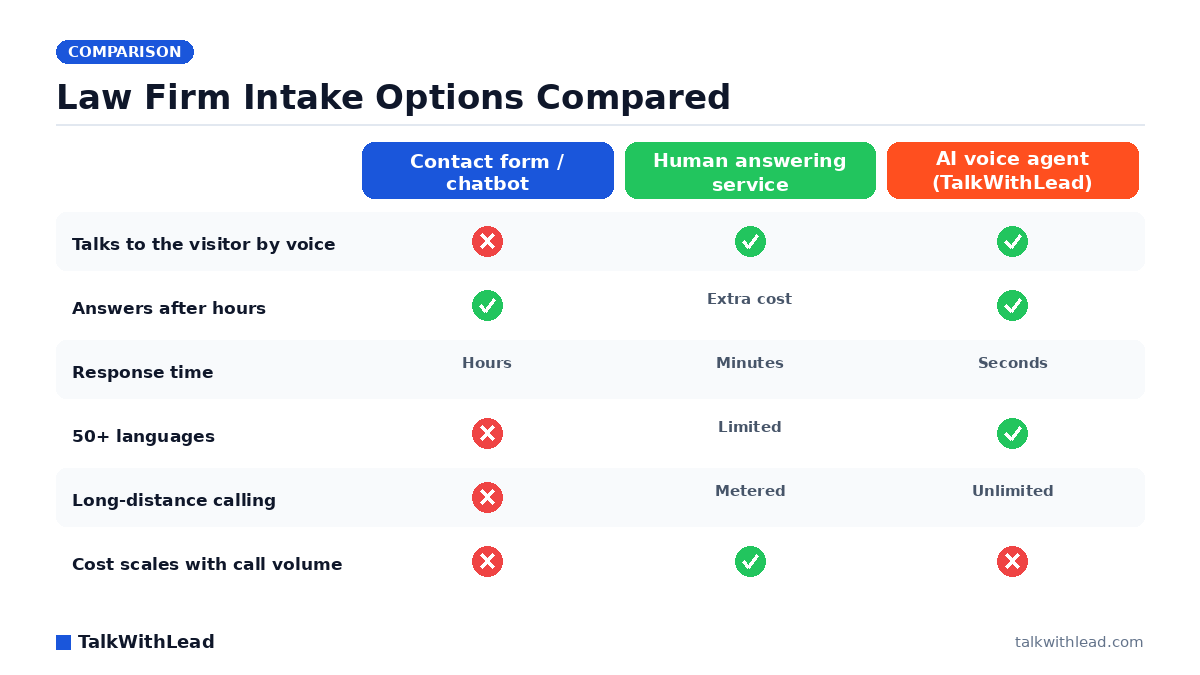
    Law Firm Intake Options Compared — TalkWithLead original infographic (comparison diagram).
    Law Firm Intake Options Compared

    A prospective client with a car accident, a DUI, or a termination letter does not fill out a form and wait. They call three firms in ten minutes and hire whoever picks up. That single behavior is why choosing an ai receptionist for law firms best for client intake is now a caseload decision, not an office-admin decision.

    Short answer: the best AI receptionist for law firm client intake is one that answers by voice within seconds of a website visit or missed call, works nights and weekends, qualifies the matter type and conflicts basics, and books the consult on the calendar. AI voice agents like TalkWithLead do this; chatbots, contact forms, and per-minute answering services either delay the conversation or price it by the minute.

    What does an AI receptionist actually do for a law firm?

    An AI receptionist answers the phone or the website the moment a prospective client shows intent. It greets them, asks what happened, captures name, number, jurisdiction, and matter type, screens out the obvious non-fits, and either books a consult or hands a warm caller to an attorney. The good ones sound like a person, not a phone tree — they interrupt gracefully, handle a rambling story, and repeat a phone number back correctly.

    For intake specifically, three jobs matter more than everything else on the feature list: answer fast, keep the person talking, and get the appointment on the calendar. A tool that logs a transcript but loses the caller has failed intake, no matter how clean the dashboard looks. That is the lens used to compare every option below, and it is the same lens applied in our broader look at law firm intake automation and after-hours cases.

    Best AI receptionist for law firms: the options compared

    Four categories compete for legal intake budget: AI voice agents, human virtual receptionist services, website chatbots, and plain contact forms. They are not variations of the same product — they behave completely differently at 9pm on a Saturday.

    OptionChannelTypical response timeAfter-hoursLanguagesPricing modelBest intake use
    AI voice agent (TalkWithLead)Voice, from the website + instant callbackSecondsAlways on50+Flat subscription, unlimited long distanceWebsite visitors and missed calls that must become phone conversations now
    Human virtual receptionist (Smith.ai-style)Voice, forwarded callsMinutesOften a paid add-onUsually English + SpanishPer minute or per callFirms wanting a human voice and willing to meter cost
    Website chatbotTextInstant text, slow human handoffBot onlyVariesSeat or conversation basedSimple FAQ deflection, not urgent matters
    Contact formText, one directionWhenever staff reads itNoneOneFreeLow-urgency inquiries and document requests
    In-house receptionistVoiceSeconds while staffedNoOne or twoSalaryBusiness-hours reception plus firm operations

    Best for: small and mid-size firms — personal injury, family, criminal defense, immigration, employment — whose website already gets traffic and whose intake gap is nights, weekends, overflow, and non-English callers.

    Not the right fit if: your practice is appellate, transactional, or referral-driven with a handful of inbound inquiries a month that a paralegal already answers on the first ring. Automating five calls a month does not pay for itself, and you would be buying coverage you do not need.

    Why speed decides which firm signs the case

    Legal intake is a race, and the finish line is early. The MIT Lead Response Management study found you are about 21× more likely to qualify a lead contacted within 5 minutes than one contacted at 30 minutes. That gap is brutal for firms whose intake process is “the form emails the office manager, who calls back Monday.”

    The phone side is no kinder. According to a 411 Locals study of 85 small businesses across 58 industries, only 37.8% of incoming calls were answered by a live person — meaning roughly 6 out of 10 calls went unattended. Apply that pattern to a firm running paid search for “car accident lawyer near me” and you are paying for clicks whose calls nobody picks up.

    An AI voice agent attacks both numbers at once. The visitor never leaves your site to dial: they tap the widget, and a human-sounding voice is talking to them before the tab closes. If they do call and nobody is free, an instant callback fires within seconds. Our deeper breakdown of how fast you should call a new lead covers the response curve in detail.

    How much does an AI receptionist cost for a law firm?

    Legal intake coverage generally lands in one of three cost shapes: salary (an in-house receptionist, the highest fixed cost), metered (human answering services billing per minute or per call, which punishes a good marketing month), and flat subscription (AI voice agents, where a busy week costs the same as a quiet one). TalkWithLead sits in the third bucket, and long-distance calling is unlimited, so an out-of-state caller does not add a line item. Current tiers are on the pricing page.

    Illustrative ROI math — assumptions stated, not a customer result. Imagine a firm that gets 120 inbound website and phone inquiries a month and, between after-hours gaps and overflow, never connects with 30 of them. Assume a conservative 8% of connected consults sign, and assume an average matter value of $4,000. Recovering even half of those 30 missed conversations — 15 conversations, at 8%, is roughly 1.2 signed matters — is about $4,800 a month in new fee revenue in this example. Against a flat monthly subscription, one signed matter typically covers a year of coverage. Plug your own numbers into the free missed-call revenue calculator instead of trusting anyone’s averages, including ours.

    If you want the full cost-vs-value argument for legal specifically, we wrote it up separately in is an AI receptionist worth it for a law firm.

    Why chatbots and forms lose legal intake

    Chat looks like the safe modern choice. It is also the slowest possible channel for someone who was rear-ended two hours ago. Text intake asks an anxious person to type their story on a phone screen, one thumb at a time, while a bot asks for their email address. Picture a site where most visitors never make it past the third question — that is the realistic failure mode, and it is invisible in your analytics because a bounce looks identical to a lost case.

    Voice does the opposite. People explain a legal problem far faster than they type it, and the emotional register of a real conversation is what actually converts a scared caller into a booked consult. A voice agent also picks up the details a form field never asks for: date of the incident, whether police were involved, whether they have already spoken with an insurer. If you are weighing the two side by side, the numbers-first version of that argument lives in AI voice agent vs chatbot conversion rate.

    The other quiet loser is the multilingual caller. Immigration, personal injury, and employment practices field a steady stream of Spanish-speaking prospects, and a bot with a translate widget is not the same as an agent that answers in Spanish immediately. TalkWithLead handles 50+ languages out of the box, which means a 10pm call from a Spanish-speaking family does not become a message someone returns two days later.

    How to evaluate an AI receptionist for your firm in one week

    Do not buy on a feature grid. Test the thing your clients will actually experience.

    • Call it yourself, twice. Once calmly, once talking over it mid-sentence. If it cannot handle an interruption, it cannot handle an intake call.
    • Test at 11pm on a Sunday. After-hours is where the case volume hides, and it is the exact window your competitors leave uncovered.
    • Test a second language. Have someone call in Spanish and see whether the conversation continues or collapses into a callback promise.
    • Check the handoff. Does a qualified caller reach an attorney or a calendar, or just a transcript in an inbox?
    • Confirm the cost shape. Ask what a month with triple the calls costs. Metered services answer that question very differently than flat ones.
    • Verify what it will and will not say. An intake agent gathers facts and books consults; it must not give legal advice or quote outcomes.

    The fastest way to run that test on TalkWithLead is the live demo — you talk to the agent yourself and judge whether it sounds like someone you would let answer for your firm.

    Where an AI receptionist fits alongside your existing staff

    The best-performing setup we see described by firms is not replacement, it is coverage. The in-house receptionist owns business hours, walk-ins, and the relationships. The AI voice agent owns everything else: 6pm to 9am, weekends, holidays, overflow when two lines ring at once, and every website visitor who would otherwise have read the practice-areas page and left silently.

    That division has a second benefit. Your staff stops spending mornings on voicemail triage and starts the day with booked consults already on the calendar. Firms comparing this against a traditional per-minute service usually start with our Smith.ai alternative for law firms breakdown, and solo practitioners should read virtual receptionist for solo attorneys, which covers the one-lawyer case directly.

    If the math above matches your firm, the next step is small: put the widget on your site, point it at your intake criteria, and watch a week of after-hours traffic turn into phone conversations. You can start free and have voice intake answering tonight, or try the live demo first and hear it before you commit.

    FAQ

    What is the best AI receptionist for law firms for client intake?

    For website-driven intake, the best fit is an AI voice agent that answers by voice in seconds directly from your site, works 24/7, speaks the caller’s language, and books consults — TalkWithLead is built for exactly that pattern. If your intake is almost entirely forwarded phone calls and you specifically want a human on the line, a per-minute virtual receptionist service is the alternative, at a cost that rises with your call volume.

    Can an AI receptionist handle legal client intake without giving legal advice?

    Yes, when it is scoped correctly. An intake agent should collect facts — name, contact number, jurisdiction, matter type, date of incident, whether other counsel is involved — and book the consult. It should never assess a case’s merits, estimate damages, or answer a legal question. Set those boundaries in the agent’s instructions before you go live and test them deliberately.

    Will clients know they are talking to an AI?

    Modern voice agents sound remarkably human, and callers routinely complete a full intake conversation without friction. The honest practice is to be upfront: have the agent identify itself as the firm’s automated intake assistant and offer to connect a person. In legal specifically, transparency protects you and rarely costs the conversation.

    How fast should a law firm respond to a new website lead?

    Within minutes, ideally seconds. The MIT lead-response research cited above puts a 5-minute contact at roughly 21× the qualification odds of a 30-minute contact, and legal prospects shop several firms in a single sitting. An instant callback triggered from the website is the only mechanism that reliably hits that window overnight and on weekends.

    Does an AI receptionist work for Spanish-speaking clients?

    It should. TalkWithLead’s voice agent handles 50+ languages, so a Spanish-speaking caller gets a real conversation immediately rather than a callback promise. For firms in immigration, personal injury, and employment, that single capability often accounts for a meaningful share of the intake an English-only setup was quietly losing.

    How much does AI intake cost compared with hiring a receptionist?

    An in-house receptionist is a full salary plus benefits and covers roughly a third of the week. A per-minute answering service costs more in your busiest months, which are exactly the months you want more coverage. A flat AI subscription costs the same whether you take 50 calls or 500, and TalkWithLead includes unlimited long-distance calling. Current tiers are on the pricing page.

  • Law Firm Intake Automation for Lawyers: Capture After-Hours Cases

    Law Firm Intake Automation for Lawyers: Capture After-Hours Cases

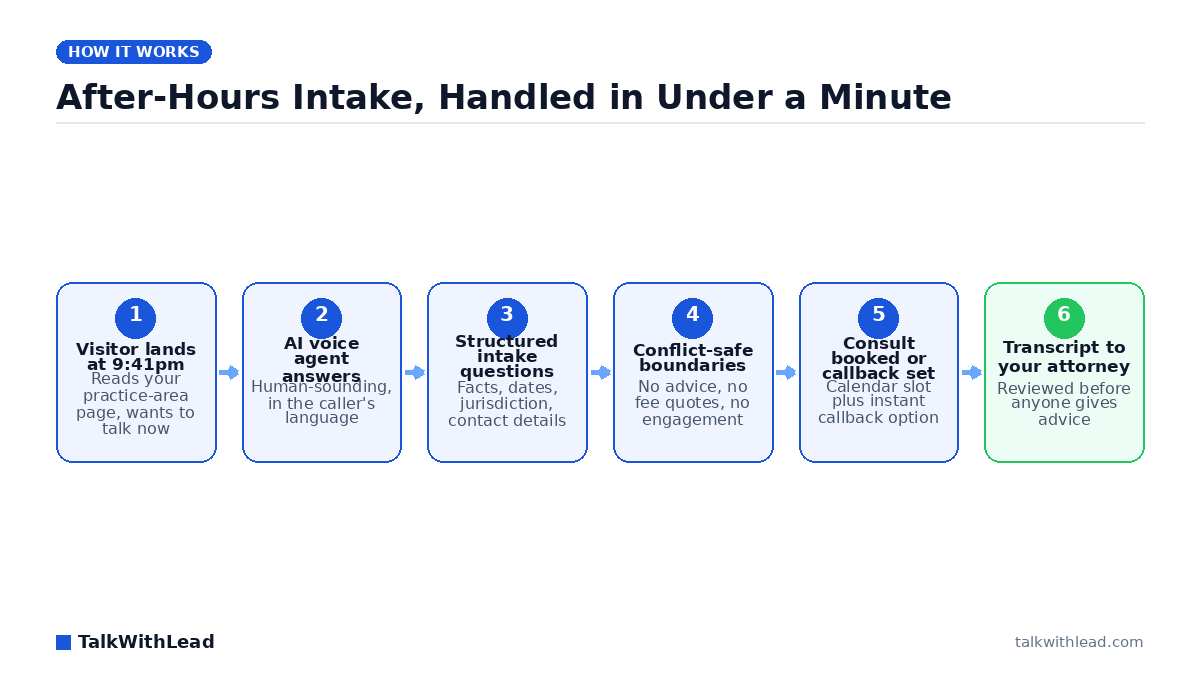
    After-Hours Intake, Handled in Under a Minute — TalkWithLead original infographic (flow diagram).
    After-Hours Intake, Handled in Under a Minute

    Your best case this month probably called at 9:41 on a Tuesday night, heard voicemail, and dialed the next firm on the results page. That is the real intake problem at most practices, and law firm intake automation is how you close it without hiring a night shift or risking an ethics complaint.

    TL;DR: Law firm intake automation uses an AI voice agent to answer every website visitor and after-hours caller within seconds, collect structured intake facts, and book the consultation on your calendar. It stays compliant by gathering information only, never giving legal advice, quoting fees, or forming an attorney-client relationship. A licensed attorney reviews the transcript before any advice is given.

    Why after-hours legal intake leaks so much money

    Legal buyers are in distress. Someone was rear-ended, served, fired, or arrested, and the search happens at night or on a weekend. That caller is not comparison shopping over three days. They call two or three firms in ten minutes and retain whoever picks up and sounds capable.

    A 411 Locals study of 85 small businesses across 58 industries found that only 37.8% of incoming calls were answered by a live person. Law firms are not exempt from that math. Every unanswered ring at a firm with a five-figure average case value is a different order of loss than a missed haircut appointment.

    Speed is the whole game. The MIT Lead Response Management study found you are about 21× more likely to qualify a lead contacted within 5 minutes than one contacted at 30 minutes. Your answering service that takes a message and emails it to the office at 8am is competing against a firm that answered on ring two.

    What does law firm intake automation actually do?

    Automation here does not mean a robot practicing law. It means the mechanical half of intake runs itself, and the judgment half stays with your attorneys.

    A voice agent on your website and phone line handles the mechanical half:

    • Answers instantly, day or night, on the first ring, with a human-sounding voice rather than a menu tree.
    • Runs your intake script: incident date, jurisdiction, opposing party, injuries or damages, prior counsel, contact details.
    • Screens for the obvious disqualifiers your firm already defined, such as practice area, venue, or a statute date that has clearly passed.
    • Books the consult directly into the calendar or triggers an instant callback from the on-call attorney.
    • Delivers a clean transcript and summary so the attorney reads a structured file, not a sticky note.

    Everything requiring legal judgment stays out of scope by design. See how the same pattern works in adjacent trades in our guides to AI voice answering for dental clinics and virtual receptionists for solo attorneys.

    How do you automate intake without compromising compliance?

    This is the question that stops most managing partners, and it deserves a direct answer. The compliance risk in automated intake comes from four specific behaviors, and you configure the agent to refuse all four.

    Do not let the agent give legal advice. It collects facts and repeats your firm’s published information. If the caller asks “do I have a case,” the correct scripted response is that an attorney will review the details and follow up. That is a boundary you can hear on every recording.

    Do not let the agent form a relationship or quote fees. The agent states plainly that speaking with intake does not create an attorney-client relationship and that fee arrangements are set by the attorney in writing. No outcome predictions, no “cases like yours usually settle for” language, ever.

    Run conflicts before substance. The agent captures names of all parties early and flags the file. A human runs the conflicts check before an attorney engages on the merits, exactly as with a walk-in.

    Handle confidentiality deliberately. Callers volunteer sensitive facts, so treat every transcript as protected material: restricted access, retention limits, and a disclosure at the top of the call that the conversation is recorded and transcribed for intake purposes. Your state bar rules and advertising regulations govern what the agent may say about results and specialization, so the script gets reviewed by your ethics-responsible attorney before it goes live. Watch a boundary-scripted agent handle a live conversation on the TalkWithLead live demo.

    Voice, forms, or chatbot: which converts legal traffic?

    Practice-area pages usually offer a contact form and sometimes a chat bubble. Both ask a distressed person to type their worst week into a text box and wait.

    Intake dimensionContact formWebsite chatbotAI voice agent
    Response timeHours to next dayInstant, but text onlyInstant, live conversation
    Works after hoursCollects onlyYesYes, with booking
    Distressed caller experiencePoorFairStrong
    Follow-up detail capturedWhatever fits the fieldsShort typed repliesFull narrative plus transcript
    Non-English callersRarely supportedSometimes50+ languages
    Books the consult itselfNoSometimesYes, or instant callback

    Voice wins for legal because talking is how people explain a mess. TalkWithLead’s agent picks up the conversation on the page, speaks in 50+ languages, and includes unlimited long-distance calling, so a family calling about a cross-border matter reaches you the same way a local does. Our breakdown of AI voice agents versus chatbots covers the conversion mechanics in detail.

    Illustrative ROI math for a small firm

    These numbers are an illustration, not a customer result. Adjust them to your own case economics.

    Picture a four-attorney firm that gets 120 inbound inquiries a month, with 45 of them arriving outside staffed hours. Say even 1 in 5 of those after-hours inquiries would have signed if someone had answered live: that is 9 signed matters a month lost to voicemail. At an assumed average fee of $4,000 per signed matter, the annual gap is roughly $432,000. You do not need the assumption to be right; you need it to be closer to right than zero, which is what voicemail delivers. Run your own version with the free missed-call revenue calculator.
    Cost framing, plainly: after-hours legal answering services are typically priced per minute or per call and climb fast in a busy month, while an AI voice agent is priced as a flat monthly subscription regardless of call volume. Compare plans on the TalkWithLead pricing page, and see our analysis of whether an AI receptionist is worth it for a law firm.

    Best for, and not the right fit if

    Best for: consumer-facing practices with volume and urgency — personal injury, family, criminal defense, immigration, employment, and estate planning firms whose website traffic peaks at night and whose staff does not.

    Not the right fit if: your matters arrive entirely through referral relationships, your practice is transactional corporate work with no inbound web volume, or your state bar interpretation prohibits recorded automated intake without a specific consent process you are unwilling to implement.

    How to roll it out in two weeks

    1. Write the intake script by practice area. Pull the questions your best paralegal already asks. Mark the hard stops: no advice, no fees, no outcomes.
    2. Get ethics sign-off. One attorney reviews the script and the recording disclosure against your state rules before launch.
    3. Install the widget and route the phone line. Put the voice agent on every practice-area page, not just the contact page.
    4. Set escalation rules. Define which calls trigger an instant callback to the on-call attorney versus a next-morning consult slot.
    5. Review the first 50 transcripts. Tighten questions, fix pronunciation of local venue names, and cut anything that reads like advice.
    6. Measure one number. Signed consults per 100 after-hours inquiries, before and after. Everything else is vanity.

    The firms that win the 9:41pm call are not the ones with the best brochure. They are the ones that answered. Start free with TalkWithLead and let your next after-hours caller reach a voice instead of a beep. If you want to see the speed argument in numbers first, read our piece on how fast you should call a new lead.

    FAQ

    Is AI intake allowed under legal ethics rules?

    Bar rules generally permit non-lawyer staff and technology to gather information, so long as the system does not give legal advice, set fees, or hold itself out as a lawyer. The obligations that matter are supervision, confidentiality, conflicts screening, and truthful advertising. Configure the agent to collect facts and schedule only, disclose recording, and have an attorney review your script against your state’s rules before launch.

    Can an AI voice agent give legal advice to callers?

    No, and it should be configured to refuse. When a caller asks whether they have a case or what it is worth, the scripted answer is that an attorney will review the details and respond. That boundary is auditable on every transcript, which is easier to defend than an undertrained human receptionist improvising at midnight.

    How much does law firm intake automation cost?

    Legal answering services usually bill per minute or per call, so a heavy month costs more than a slow one. AI voice agents are generally sold as a flat monthly subscription that does not move with call volume, which makes budgeting predictable during ad campaigns. Compare current plans on the pricing page.

    Will clients be annoyed talking to an AI?

    Callers react to being helped, not to the technology label. A voice that answers on ring one, asks sensible questions, and books a real appointment beats a voicemail box or a hold queue. Disclose that it is an automated intake assistant, keep the handoff to a human fast, and the objection mostly disappears.

    Does it handle Spanish and other languages?

    TalkWithLead’s agent speaks 50+ languages and includes unlimited long-distance calling, so a Spanish-speaking caller or a family member calling from abroad gets the same intake quality as an English-speaking local. For firms in immigration or personal injury, that is often where the unclaimed case volume is sitting.

    What happens to the information the agent collects?

    It becomes a structured intake record: transcript, summary, contact details, and the calendar booking, delivered to your team for conflicts screening and attorney review. Treat it as confidential client material with restricted access and a retention policy, the same as any intake file. You can watch the full flow on the live demo.

  • Smith.ai Alternative for Law Firms: Book More Consults

    Smith.ai Alternative for Law Firms: Book More Consults

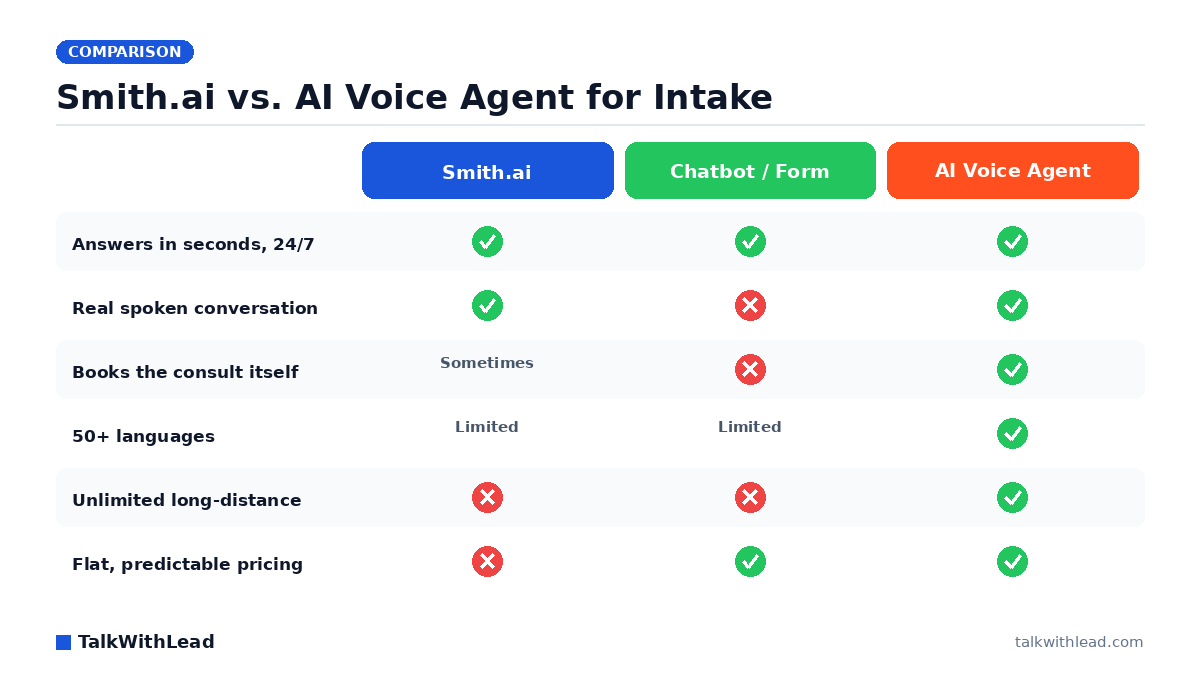
    Smith.ai vs. AI Voice Agent for Intake — TalkWithLead original infographic (comparison diagram).
    Smith.ai vs. AI Voice Agent for Intake

    A prospective client lands on your firm’s site at 9 p.m. with a DUI and a court date. They will not fill out a contact form and wait two days for a callback. They want to talk to someone now, and if your site can’t deliver that, the next firm in the search results will.

    That gap is exactly why so many practices shop for a Smith.ai alternative for law firms website intake. Smith.ai built a strong human-receptionist service, but human teams cost more per minute as call volume climbs, can queue callers at peak hours, and still hand most after-hours visitors to a form. The faster-growing option is an AI voice agent that picks up instantly, talks like a person, and books the consult on the spot.

    TL;DR: The best Smith.ai alternative for law firm intake is a human-sounding AI voice agent that answers your website visitors in seconds, every hour of every day, qualifies the matter, and books the consultation directly into your calendar. It converts better than chatbots or forms because people would rather speak than type their legal problem, and it bills at a flat rate instead of per minute.

    Why law firms outgrow a receptionist-only intake service

    Smith.ai and similar virtual-receptionist services solved a real problem: someone friendly answers the phone so attorneys can practice law. But three pressures push growing firms to look further.

    • Cost scales with conversation. Per-minute or per-call pricing means your bill rises right when intake volume rises. A busy month becomes an expensive month.
    • Peak-hour queues. Human teams handle a finite number of simultaneous callers. A marketing push, a local news story, or a Monday-morning rush can leave callers waiting.
    • Website visitors still get a form. Most receptionist services answer the phone but route web traffic to a chatbot or a contact form, which is the slowest path back to a real conversation.

    Speed is the whole game in legal intake. According to Harvard Business Review research, companies that reach a web lead within an hour are nearly 7× more likely to qualify it than those that wait even an hour longer. For a law firm, an hour is an eternity; the visitor has already called two competitors. Our deeper look at why the first 60 seconds win most deals walks through exactly how that window closes.

    What is the best Smith.ai alternative for law firm website intake?

    The strongest alternative is an AI voice agent that lives on your website and turns a click into a phone conversation in seconds. Instead of a chatbot that makes a stressed visitor type out their situation, the agent speaks, listens, and responds in a natural, human-sounding voice.

    Here is what a voice-first intake agent does that a receptionist queue or a form cannot:

    • Answers instantly, 24/7. No hold music, no “our office is closed,” no overnight gap. Every visitor gets a live conversation.
    • Speaks 50+ languages. A Spanish-speaking family with an immigration question gets answered in their own language without a transfer.
    • Offers instant callbacks. If a visitor would rather you call their phone, the agent connects the call immediately.
    • Includes unlimited long-distance calling, so a client across the country reaches you without anyone watching a meter.
    • Qualifies and books. It asks your intake questions, screens out matters you don’t take, and drops the qualified consult straight onto the calendar.

    Voice matters because of how people behave under stress. A Five9 study of 4,000 US and UK consumers found that 75% of people prefer talking to a real human over the phone for support. A human-sounding AI voice agent meets that preference at machine scale, while a chatbot fights it. We compared the conversion gap directly in AI voice agent vs. chatbot: which one books more calls?

    Want to hear it first? Try a live demo and judge the voice quality yourself before you change anything.

    Smith.ai vs. chatbot vs. AI voice agent: a side-by-side look

    Each option has a place. The question is which one books the most consults from your existing website traffic.

    Intake dimensionSmith.ai (human receptionist)Chatbot / web formAI voice agent
    Response timeFast when staffedInstant textInstant voice
    Real spoken conversationYesNoYes
    24/7 without queueLimited at peakYesYes
    Books the consult itselfSometimesRarelyYes
    LanguagesLimitedLimited50+
    Long-distance callingMeteredN/AUnlimited
    Pricing modelPer minute / per callFlat / cheapFlat

    The chatbot is cheap but loses the visitor who won’t type. The receptionist service is excellent on the phone but costly to scale and often leaves web traffic on a form. The AI voice agent combines instant text-speed availability with the conversion power of an actual conversation. For the broader comparison, see AI voice agent vs. chatbot conversion rate and live chat vs. chatbot, plus the AI voice upgrade.

    How much intake are you losing? Run the math

    Picture a firm whose website gets 200 visitors a week from paid search and referrals. Say even 1 in 20 of those visitors is a qualified case that arrives outside office hours or during a phone queue, and the visitor leaves without ever reaching a human. That’s roughly 10 lost conversations a week, or more than 500 a year, walking straight to a competitor.

    Now assume a single signed matter is worth a few thousand dollars in fees. Recovering even a handful of those lost conversations each month covers the cost of the intake system many times over. That is the ROI an always-on voice agent is built to capture. You can model your own numbers with the free missed-call revenue calculator using your real traffic and average case value.

    This is also why missed-call automation for websites matters so much for firms: every unanswered after-hours inquiry is a case you paid to attract and then let slip.

    Honest verdict: is an AI voice agent right for your firm?

    Best for: growing practices that get steady website traffic, run paid search, take after-hours or weekend inquiries, serve multilingual communities, or feel their per-minute receptionist bill climbing as volume grows.

    An AI voice agent isn’t a fit for everyone. A Five9 survey of 4,000 consumers found that 56% are frequently frustrated by AI customer-service chatbots, so voice quality is non-negotiable; a robotic agent will hurt you. The point of a modern voice agent is that it sounds genuinely human, which is why a live demo should come before any decision.

    Not the right fit if: your firm prefers a named human receptionist who knows every regular caller by name, your inquiry volume is low enough that a queue never forms, and predictable scaling cost is not a concern. In that case, a traditional service may serve you well.

    Pricing is straightforward and flat rather than metered; you can review the plans on the pricing page. When the math points to recovering lost consults, you can start with a free signup and have the agent live on your site quickly.

    How to switch without disrupting intake

    Moving off a receptionist-only setup is lower-risk than most firms expect because you can run the voice agent alongside your current process first.

    1. Test the voice. Book a live demo and confirm it sounds human enough to represent your firm.
    2. Script your intake. Feed it your screening questions, the matter types you accept, and your scheduling rules.
    3. Add the widget. Place it on your highest-traffic pages first: practice-area pages and the contact page.
    4. Measure. Watch consults booked, after-hours captures, and answered-versus-missed conversations against your old baseline.

    The same speed-to-lead logic that wins legal clients wins in other appointment-driven fields. Our speed-to-lead playbook for real estate shows the instant-callback pattern in action, and it maps cleanly onto consult booking.

    FAQ

    What is the best Smith.ai alternative for law firm website intake?

    For most growing firms, the best alternative is an AI voice agent that answers website visitors instantly with a human-sounding voice, qualifies the matter, and books the consult directly. It combines the conversion power of a real phone conversation with 24/7 availability and flat pricing, instead of routing web traffic to a form or a metered receptionist queue.

    Is an AI voice agent cheaper than a virtual receptionist service?

    It depends on volume. Receptionist services typically bill per minute or per call, so costs rise as intake grows. An AI voice agent uses flat, predictable pricing, which usually wins as call volume increases. Run your own numbers with the missed-call revenue calculator and compare against your current monthly bill.

    Can an AI voice agent actually book consultations on its own?

    Yes. A properly configured agent runs your intake script, screens out matters you don’t accept, and books qualified consultations onto your calendar without an attorney lifting a finger. It can also offer an instant callback if the visitor prefers you to call their phone.

    Will it sound robotic to my prospective clients?

    Modern AI voice agents are built to sound genuinely human, which is the entire reason they convert. Because many consumers distrust clunky chatbots, voice quality is the thing to test first; book a live demo and listen before you decide.

    Does it handle non-English-speaking callers?

    Yes. A voice-first agent can speak 50+ languages, so a Spanish-speaking or other non-English visitor is answered in their own language without a transfer or a callback delay, which is a major advantage for firms serving diverse communities.

    How fast can it be live on my website?

    After a free signup, you script your intake questions and drop the widget onto your site, typically your practice-area and contact pages first. Most firms can run it alongside their existing intake within a short setup window and measure the lift before fully switching over.

Your next lead is on your site right now — ready to talk.

TalkWithLead’s AI voice agent picks up in seconds, qualifies the lead in their language, and books the call before the prospect can open a competitor’s tab. Forms are slow. Chatbots make people type. Voice closes.

Just curious about plans? See pricing →
This is the TalkWithLead Widget. Click to see how it will work on your website!