
A prospect with a $15,000 matter calls your firm at 7:40 p.m., gets voicemail, hangs up, and dials the next firm on the list. That is the real question behind “is an AI receptionist worth it for a law firm” — not whether the technology is impressive, but whether it stops calls like that one from walking out the door.
TL;DR: For most small and mid-size firms, an AI receptionist is worth it when call volume is high enough that calls slip to voicemail after hours or during overflow. An AI voice agent answers every call in seconds, qualifies the caller, and books the consult — so if it captures even one or two extra signed matters a month, it pays for itself many times over. It is not worth it if you take only a handful of high-touch clients a year and answer every call yourself.
What does an AI receptionist actually do for a law firm?
An AI receptionist is a human-sounding AI voice agent that picks up the phone — or the call-back request on your website — and has a real conversation with the caller. It greets them, asks the intake questions you would ask, captures name, contact, matter type, and urgency, and either books a consultation or routes a genuine emergency to a live attorney.
The difference from a chatbot or a web form is the channel. A form makes an injured or anxious prospect type. A chatbot makes them wait and click. A voice agent turns a website visitor into a phone conversation immediately, the way people actually want to reach a lawyer. If you want to see how those channels compare on conversion, our breakdown of AI voice agent vs chatbot conversion rate lays out the gap.
It also runs 24/7. The phone gets answered on a Saturday, at midnight, and during the lunch hour when your front desk is slammed. According to Ada, 59% of consumers prefer instant, 24/7 AI service over waiting for a human — as long as the AI can actually handle the request. Intake qualification is exactly the kind of request it can handle.
Is an AI receptionist worth it for a law firm? Run the ROI math
The honest way to answer “worth it” is to put a number on the calls you miss. Here is an illustrative example — plug in your own figures, not these.
Say your firm gets 200 inbound calls a month and, between after-hours, lunch, and overflow, 25% of them hit voicemail. That is 50 missed calls. Now assume a conservative slice convert: imagine even 1 in 10 of those missed callers was a real prospect who would have signed. That is 5 lost matters a month. If your average signed matter is worth $3,000 in fees, that is $15,000 of revenue leaking every single month.
Against that, an AI voice agent typically costs a fraction of one paralegal’s hourly rate and a small fraction of a single signed case. The arithmetic usually is not close. If the tool recovers even one of those five matters, it has already paid for a year of itself. To pressure-test your own numbers, run them through the free missed-call revenue calculator before you commit to anything.
Pricing for AI voice receptionists generally lands in the low-hundreds-per-month range for a small firm, scaling with call volume — far below the cost of a full-time receptionist and without the gaps a single human leaves on nights, weekends, and sick days. You can see TalkWithLead’s tiers on the pricing page.
How does an AI receptionist book more consultations than voicemail?
Speed is the whole game in legal intake. A prospect who reaches a person — or a voice that behaves like one — in the first minute is dramatically more likely to book than one who leaves a message and waits for a callback. The longer the gap, the colder the lead, and the more likely they have already called a competitor. Our piece on speed-to-lead and the first 60 seconds digs into why that window matters so much.
An AI voice agent closes that gap three ways:
- It never goes to voicemail. Every call and every website call-back request is answered on the first ring, day or night.
- It qualifies instead of just collecting. The agent asks the right intake questions, screens out matters you do not take, and flags the urgent ones — so attorneys spend time on real opportunities.
- It books on the spot. Instead of “someone will call you back,” the caller leaves with a scheduled consultation, which is the moment a lead becomes a client.
This is the same logic behind missed-call automation for websites: capture the lead before they call the next firm, because the next firm is one tap away.
Where an AI receptionist beats a human (and where it does not)
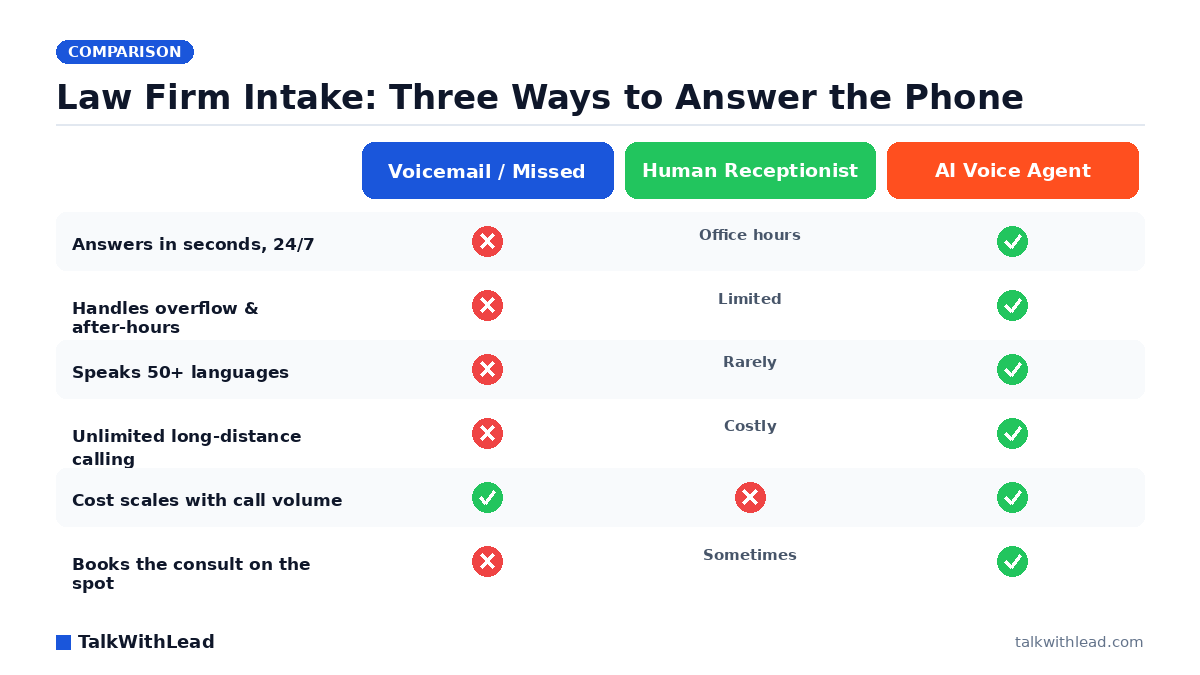
A great human receptionist is warm, judgment-rich, and irreplaceable for complex, sensitive conversations. But one person cannot answer three calls at once, work 24 hours, or speak fluent Spanish, Mandarin, and Portuguese on demand. An AI voice agent handles intake in 50+ languages and offers unlimited long-distance calling, so a prospect anywhere can reach your firm without a toll barrier or a language wall.
The realistic model for most firms is not “AI instead of people” — it is AI catching everything your team cannot: overflow, after-hours, weekends, and second-language callers. For a deeper side-by-side, see AI voice agent vs human receptionist, and if you are weighing a service like Smith.ai, our Smith.ai alternative for law firms comparison covers the intake-specific tradeoffs.
| Dimension | Voicemail / Missed | Human Receptionist | AI Voice Agent |
|---|---|---|---|
| Response time | Hours or never | Office hours only | Seconds, 24/7 |
| Simultaneous calls | None | One at a time | Many at once |
| Languages | None | Usually one | 50+ |
| Long-distance reach | N/A | Costly | Unlimited |
| Monthly cost | $0 (but lost revenue) | Full salary + benefits | Low-hundreds, scales |
| Books consult on call | No | Sometimes | Yes |
Best for: small and mid-size firms with steady call volume that lose intake calls to after-hours, lunch, overflow, or non-English speakers, and want every prospect booked instead of buried in voicemail.
Not the right fit if: you handle only a few hand-selected, high-touch matters a year, answer every call personally, or require a licensed attorney to give legal advice on the very first contact.
What to look for before you buy an AI receptionist
The technology is moving fast — Gartner predicts agentic AI will autonomously resolve 80% of common customer service issues without human intervention by 2029, cutting operational costs by 30%. For a law firm, that future is only worth buying into if the tool fits how you actually intake clients. Check these before you sign up:
- Does it sound human? A robotic voice gets hung up on. Test it yourself on a live call.
- Can it book and route? Capturing a name is table stakes; scheduling the consult and escalating emergencies is what drives ROI.
- Does it cover your callers’ languages and locations? 50+ languages and unlimited long-distance widen the client pool you can serve.
- How fast does it answer the website visitor? Instant call-backs turn browsers into booked calls — compare the options in callback widget vs click-to-call vs live chat.
The fastest way to judge worth is to hear it work on your own intake script. Try a live demo, then start capturing missed calls with a free signup and measure the booked consults against the math above.
FAQ
Is an AI receptionist worth it for a small law firm?
For most small firms, yes — if you are losing calls to voicemail after hours, during lunch, or when the office is busy. The break-even is low: recover one or two signed matters a month and the tool pays for itself many times over. Run your own missed-call math first so the decision is a number, not a guess.
How much does an AI receptionist cost for a law firm?
AI voice receptionists generally run in the low hundreds of dollars per month for a small firm, scaling with call volume — far less than a full-time human receptionist’s salary and benefits. See current tiers on the pricing page and compare against the revenue you lose to missed calls.
Can an AI receptionist replace my human front desk?
For most firms it complements rather than replaces. A human handles warm, complex, in-office conversations; the AI voice agent catches everything one person cannot — overflow, nights, weekends, and second-language callers — so no intake call goes unanswered.
Can an AI receptionist handle clients who do not speak English?
Yes. A capable AI voice agent handles intake in 50+ languages and offers unlimited long-distance calling, so prospects in other languages or regions can reach your firm without a toll or language barrier — widening the pool of clients you can serve.
Will an AI receptionist give legal advice to callers?
No, and it should not. Its job is intake and scheduling: qualifying the matter, capturing details, booking the consultation, and escalating genuine emergencies to an attorney. Legal advice stays with your licensed lawyers.
How do I know if an AI receptionist is right for my firm?
Estimate your monthly missed-call volume, the share that are real prospects, and your average matter value. If the recovered revenue clearly exceeds the monthly cost, it is worth it. The free missed-call revenue calculator makes that estimate in a couple of minutes.
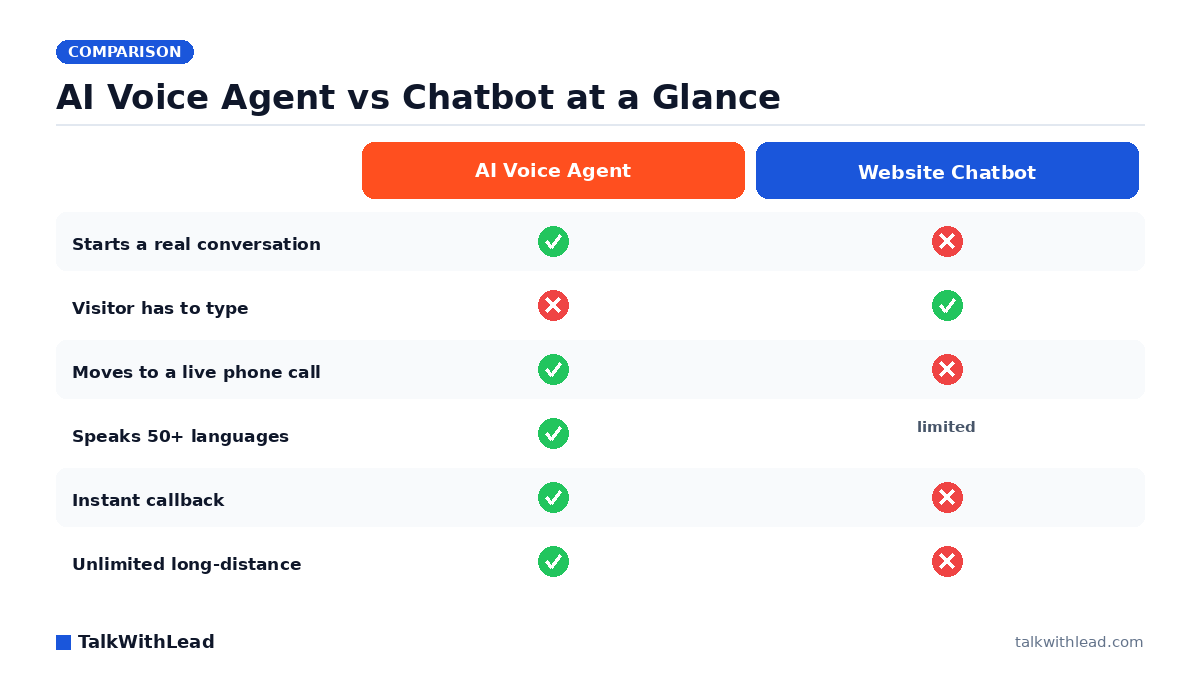 AI Voice Agent vs Chatbot at a Glance — TalkWithLead original infographic (comparison diagram).”/>