
How much revenue am I losing from missed calls?
Every unanswered ring is a person who wanted to give you money and couldn’t. If you’ve ever typed “how much revenue am I losing from missed calls” into a search bar, you already suspect the number is bigger than you’d like — and you’re probably right.
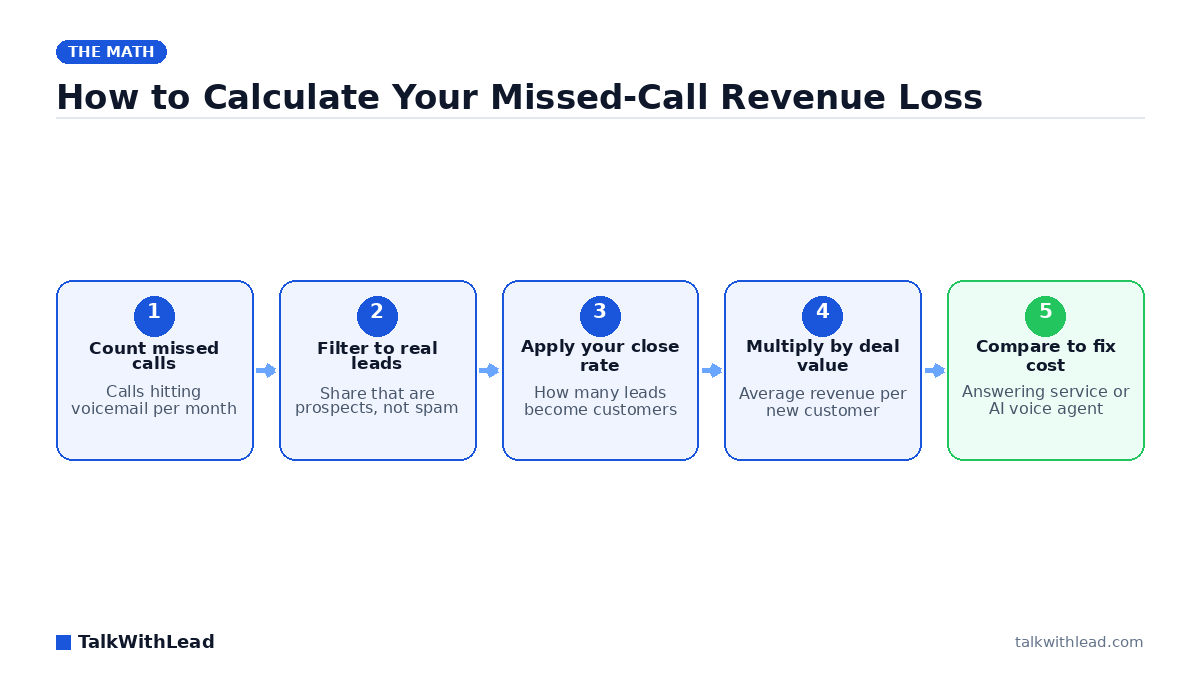
TL;DR: Your missed-call revenue loss equals missed calls per month × the share that are genuine leads × your close rate × your average customer value. For most local and service businesses, that formula produces a four- or five-figure monthly number. You can get your exact figure in under a minute with the free missed-call revenue calculator.
The math is simple. The hard part is being honest about the inputs. This breakdown walks through both — and then shows the fastest way to shut the leak off.
The missed-call loss formula, explained
Four numbers determine what missed calls cost you:
- Missed calls per month. Check your phone system’s logs or call your carrier. Count everything that went to voicemail, rang out, or hit a busy signal — including after-hours and lunchtime calls.
- Lead percentage. Not every missed call is a buyer. Some are spam or vendors. Be conservative and count only the share that would have been a real prospect.
- Close rate. Of the prospects you actually talk to, how many become customers?
- Average customer value. Use lifetime value if you know it; first-transaction value if you don’t.
Multiply the four together and you have your monthly loss. Annualize it and the number usually stings. The reason this formula understates reality: it ignores referrals those lost customers would have sent, and it ignores the reviews and repeat business that compound over years.
A worked example (illustrative — plug in your own numbers)
Picture a plumbing company that misses 40 calls a month. Say half of those are genuine service requests, the company closes 6 in 10 of the prospects it actually speaks with, and an average job is worth $450. The math: 40 × 0.5 × 0.6 × $450 = $5,400 a month, or roughly $64,800 a year — from calls that already came in. No extra ad spend, no new marketing. Just answering the phone.
Now run the same structure for a law firm where a signed client is worth $3,500, or a med spa where a new patient’s first year is worth $1,200. The per-call stakes climb fast. That’s why we built the free missed-call revenue calculator — enter your own volume, lead share, close rate, and customer value, and it shows your monthly and annual loss with every assumption labeled. Nothing is hidden and nothing is invented; it’s your data, multiplied out.
Once you see your number, put it next to the cost of fixing it. Answering every call with an AI voice agent typically costs a small fraction of one recovered deal — you can see exact plans on the TalkWithLead pricing page.
Why do so many business calls go unanswered?
Missed calls aren’t a character flaw — they’re a math problem. You’re on a job site, with a patient, in court, or it’s 9 p.m. and the office closed five hours ago. Meanwhile the caller doesn’t distinguish between “busy” and “doesn’t care.”
The scale of the problem is documented. According to a 411 Locals study of 85 small businesses across 58 industries, only 37.8% of incoming calls were answered by a live person — meaning roughly 6 out of 10 calls went unattended. If your business is anywhere near typical, the majority of your inbound phone demand never reaches a human.
And voicemail doesn’t rescue it. Think about your own behavior: when a business sends you to voicemail, do you leave a message and wait — or do you tap the next Google result? Most buyers do the second. A missed call isn’t a delayed conversation; it’s usually a competitor’s new customer.
Speed multiplies the loss
Even calls you return quickly lose value while they wait. The MIT Lead Response Management study found you’re about 21× more likely to qualify a lead contacted within 5 minutes than one contacted at 30 minutes. A voicemail returned “first thing tomorrow” is competing against whoever picked up today.
This is the same dynamic that governs web leads, which is why the phone problem and the website problem are really one problem: prospects reward whoever responds first, in any channel. We break down the response-time economics in Speed-to-Lead: Why the First 60 Seconds Win Most Deals — the short version is that “we’ll call you back” is where deals go to die.
How to stop the leak: answer every call and every visitor, instantly
You have three realistic options, and they aren’t equal.
| Option | Coverage | Typical monthly cost | Speed to answer | Languages |
|---|---|---|---|---|
| Hire more staff | Business hours only | Thousands (salary + benefits) | When someone’s free | Whatever staff speak |
| Human answering service | Depends on plan/minutes | Hundreds, scales with volume | Queue-dependent | Usually 1–2 |
| AI voice agent (TalkWithLead) | 24/7, calls + website | Flat software cost | Instant, every time | 50+ |
TalkWithLead’s AI voice agent sounds remarkably human, answers instantly around the clock, and holds a real conversation in 50+ languages — qualifying the caller, answering questions, and booking the appointment instead of taking a message. Unlimited long-distance calling means a prospect three time zones away costs you nothing extra to convert. And because it lives on your website too, it catches the visitors who never would have dialed at all: they click, talk, and get an instant callback instead of filling out a form and hoping. Hear it yourself in a two-minute live demo — it’s the fastest way to judge whether “human-sounding” is marketing or reality.
If your leak is specifically the phone line, missed call automation for websites shows how the pieces fit together. If you’re weighing widget options, see callback widget vs click-to-call vs live chat for how each one converts.
Best for: local and service businesses (contractors, law firms, clinics, agencies, real estate) that miss calls after hours or during jobs and can trace real revenue to each answered lead.
Not the right fit if: your phone rings a handful of times a month and your website gets little traffic — fix demand generation first, then fix answer rates.
Turn your number into a decision
Run the calculator. If your monthly loss comes back at $2,000, $5,000, or more, you’re not deciding whether to spend money — you’re deciding whether to keep donating that revenue to competitors who answer faster. The fix costs a flat software fee (see pricing), takes minutes to add to your site, and starts answering the very next call. You can sign up free and have an AI voice agent greeting visitors today, or start with the live demo and let it convince you the way it will convince your callers.
FAQ
How do I calculate how much revenue I’m losing from missed calls?
Multiply four numbers: missed calls per month × the share that are genuine leads × your close rate × average customer value. A business missing 40 calls with half being real leads, a 60% close rate, and $450 jobs loses about $5,400 a month in that illustrative scenario. The free calculator does the math with your own inputs.
What percentage of calls do small businesses actually answer?
According to a 411 Locals study of 85 small businesses across 58 industries, only 37.8% of incoming calls were answered by a live person. If you haven’t audited your own answer rate, assume it’s lower than you think — especially after hours.
Do missed callers leave voicemails or call a competitor?
Most buyers with an immediate need don’t wait. Picture your own behavior: hit voicemail, hang up, tap the next search result. That’s why counting voicemails dramatically undercounts your loss — the callers who mattered most are the least likely to leave one.
Is an AI voice agent better than a human answering service for missed calls?
For coverage and cost, usually yes. An AI voice agent answers instantly, 24/7, in 50+ languages, at a flat software price — while human services bill by minutes and can queue callers at peak times. Humans still win for complex, emotionally sensitive conversations, which the AI can route to you. Compare the tradeoffs in AI voice agent vs human receptionist.
How fast should I respond to a missed call or web lead?
Within minutes. The MIT Lead Response Management study found leads contacted within 5 minutes are about 21× more likely to qualify than those contacted at 30 minutes. Instant answering — human or AI — is worth far more than a diligent next-morning callback routine.
What does it cost to stop missing calls with TalkWithLead?
It’s flat-fee software rather than per-minute billing — current plans are on the pricing page. As illustrative ROI math: if your calculator result shows even one recovered $450 job a month, the software typically pays for itself several times over.