An insurance shopper lands on your quote page at 8:40 p.m., types three questions into your chat widget, gets a canned answer about “a licensed agent will follow up,” and closes the tab. By morning they have quotes from two other brokers. The choice between an AI voice agent vs chatbot for insurance brokers is really a choice between talking to that person now or emailing them tomorrow.
Short answer: a chatbot is better at answering policy questions in text; an AI voice agent is better at converting a quote-page visitor into a bound policy. Insurance is a comparison purchase with a short shopping window, so the broker who gets the prospect on the phone first usually wins. Most brokers should run voice as the primary conversion path and keep chat for support-style questions.
Why insurance leads punish slow follow-up harder than most industries
Insurance shopping is a session, not a journey. Someone whose renewal notice just arrived opens four or five tabs, requests quotes from each, and takes the first real conversation that happens. Nobody sits patiently waiting for the third broker’s callback on Thursday.
The research backs the intuition. According to Harvard Business Review research, companies that reach a web lead within an hour are nearly 7× more likely to qualify it than those that wait even an hour longer. For a broker, “qualify” means finding out whether this is a $600 auto policy or a $9,000 commercial package before a competitor does.
A chatbot does not shorten that window. It parks the lead in a CRM and waits for a human producer to notice. An AI voice agent removes the wait entirely: the visitor clicks, the phone rings, and a human-sounding voice is asking about their current carrier before they have finished reading your homepage. If you want the general version of this argument, we covered it in Speed to Lead: How Fast Should You Call a New Lead?.
What is the actual difference between an AI voice agent and a chatbot?
A chatbot is a text interface. It matches what the visitor types against a set of intents or a language model, replies in the chat window, and — at best — captures a name, email, and phone number for someone else to act on later. Everything it accomplishes happens through typing.
An AI voice agent is a phone conversation that starts from your website. The visitor asks for a call, the agent dials them (or takes an inbound call), and they speak. TalkWithLead’s agent sounds human enough that prospects treat it like an after-hours staffer, handles 50+ languages, offers unlimited long-distance calling so an out-of-state or overseas prospect can talk without a toll charge, and can fire an instant callback the moment someone shows intent on a quote page.
The practical gap shows up in qualification depth. Ask a prospect to type their current carrier, renewal date, coverage limits, prior claims, vehicle year, and property details and they abandon halfway. Ask the same questions out loud and it takes about ninety seconds.
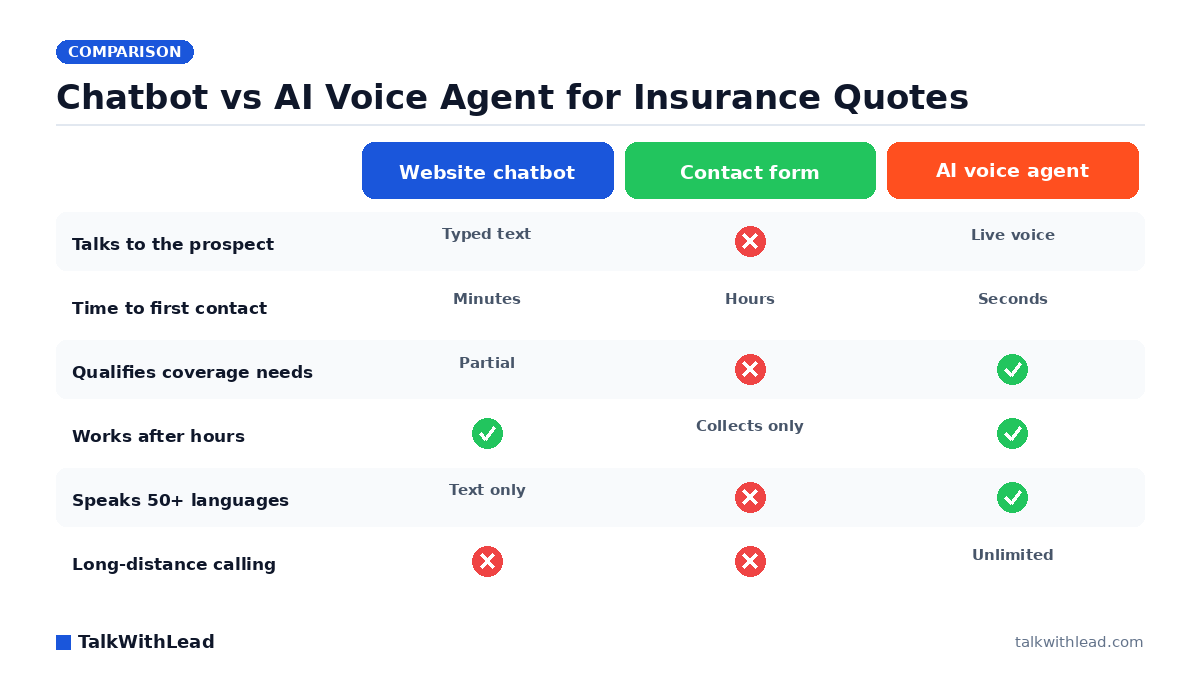
| Dimension | Website chatbot | Static quote form | AI voice agent |
|---|---|---|---|
| Contact medium | Typed text | Submitted fields | Live phone conversation |
| Typical time to first human-grade contact | Minutes to hours | Hours to next business day | Seconds |
| Depth of qualification captured | Name, email, rough intent | Whatever fields survive abandonment | Carrier, renewal date, coverage, claims history |
| After-hours coverage | Answers, cannot close | Collects only | Answers, qualifies, books the producer |
| Language coverage | Text translation, often narrow | Usually English-only | 50+ spoken languages |
| Long-distance / out-of-state prospects | N/A | N/A | Unlimited long-distance calling |
| Best at | Policy FAQs, claims status, document lookup | Low-cost lead capture | Converting quote-page traffic into bound policies |
You can hear the difference faster than you can read about it — the live demo lets you run an insurance-style intake conversation against the agent yourself.
Which one books more insurance quote calls?
Voice, for the traffic that matters. Chat wins on volume of interactions; voice wins on volume of conversations with a licensed producer, and only the second one writes policies.
Consider an illustrative broker site — the numbers below are assumptions for the sake of the math, not measured results. Say the site gets 1,200 visitors a month and 4% start a quote, which is 48 people. Imagine a chat widget captures contact details from 15 of them and a producer reaches 6 by phone over the following days. Now say a voice agent instead puts 20 of those 48 into an immediate call, qualifies 14, and books 9 with a producer. Same traffic, roughly 50% more real conversations — and the conversations happened while the prospect still had your tab open.
Run your own version of that math with the free speed-to-lead ROI calculator, using your own quote-start rate and average commission per policy. If you would rather size the downside first, the missed-call revenue calculator covers the calls your office already drops.
What about the calls your agency misses after 5 p.m.?
Renewal panic is an evening event. So is a fender-bender, a mortgage closing that needs proof of homeowners coverage by morning, and a contractor discovering their certificate expired. Those prospects call, hit voicemail, and dial the next broker.
A 411 Locals study of 85 small businesses across 58 industries found only 37.8% of incoming calls were answered by a live person — meaning roughly 6 out of 10 calls went unattended. An agency with three producers and no evening staff sits squarely in that pattern.
An AI voice agent covers the gap without a night shift. It answers, confirms what the caller needs, collects policy details, checks whether the situation is urgent, and either books a morning slot with the right producer or escalates immediately. A chatbot can post office hours; it cannot take an intake. Brokers who want the answering-service framing will find the cost side in AI Receptionist vs Human Answering Service Cost, and the staffing comparison in AI Voice Agent vs Human Receptionist.
Language coverage is a quiet revenue leak in insurance
Personal lines skew heavily toward households where English is a second language — new arrivals buying their first auto policy, families insuring a first home, small business owners covering a first storefront. Those buyers overwhelmingly prefer to discuss deductibles and exclusions out loud, in their own language, because the stakes are financial and the vocabulary is technical.
A translated chat widget handles the words but not the reassurance. A voice agent that speaks 50+ languages does both, and unlimited long-distance calling means a prospect calling from another state or country is not weighing the cost of the call against the value of the quote. For most brokerages this is not a niche — it is a segment competitors are silently handing over.
Should you drop the chatbot entirely?
No. Keep it, demote it. A chatbot is genuinely good at the jobs voice handles awkwardly: pulling up a policy document, checking claim status, explaining what an umbrella policy covers, linking a certificate of insurance. Those are reference tasks, and text is the better medium for reference.
The sensible setup for a broker is voice as the primary path on quote and landing pages, chat as a secondary support surface on service pages and the client portal. Route intent to voice, route lookup to text. We laid out the general version of this split in Chatbot Alternative for Small Business.
Best for: independent brokers and agencies whose quote pages already get traffic, who lose deals to whoever calls back first, and who have no evening or weekend phone coverage.
Not the right fit if: your business is almost entirely renewals of existing books with no inbound web traffic, or you are a captive agent whose carrier controls the website and forbids third-party widgets. In those cases the voice agent has nothing to convert.
What does it cost to add an AI voice agent to a broker website?
Pricing for this category generally runs from a low monthly subscription for a single-location agency up to per-seat or per-minute plans for multi-office brokerages; current TalkWithLead tiers are on the pricing page.
Here is a labeled ROI example with stated assumptions. Assume a monthly platform cost of $200. Assume your average bound personal-lines policy earns $180 in first-year commission, and your average small commercial account earns $900. If the agent produces just two extra bound personal policies a month, the tool has roughly covered itself. If it produces one extra commercial account in a quarter, the math stops being close. Your own numbers will differ — the point is that the break-even for a broker sits at a very small number of additional conversations, because insurance commissions recur.
Installation is a snippet, not a project. You can start free, drop the widget on your quote page, and watch whether visitors who would have typed at a bot start talking to a producer instead. Then compare the two side by side using AI Voice Agent vs Chatbot Conversion Rate.
FAQ
Is an AI voice agent better than a chatbot for an insurance brokerage?
For converting quote-page visitors, yes. Insurance buyers compare several brokers in one sitting, and a voice agent reaches them within seconds while a chatbot hands off to a producer who calls later. For policy-document lookups and claims-status questions, a chatbot is the better tool.
Most brokerages get the best result running both: voice on quote and landing pages, chat on service and portal pages.
Can an AI voice agent actually qualify an insurance lead?
It can capture the fields a producer needs to price and prioritize: coverage type, current carrier, renewal date, prior claims, and vehicle or property basics. Spoken answers take about ninety seconds where the same questions in a form cause abandonment.
Binding, underwriting judgment, and advice stay with your licensed producers. The agent’s job is to make sure the producer is talking to a warm, pre-qualified prospect instead of chasing a stale email address.
Will prospects realize they are talking to an AI?
The voice is close enough to human that most callers treat it as an after-hours staff member, and it can identify itself when your compliance policy requires it. What prospects notice more is that someone picked up at 9 p.m. instead of nobody.
How fast should an insurance broker respond to a web quote request?
Within minutes, and preferably within seconds while the prospect is still on the page. The MIT Lead Response Management study found you’re about 21× more likely to qualify a lead contacted within 5 minutes than one contacted at 30 minutes — a gap that matters enormously when the shopper has four other tabs open.
Does it work for commercial lines, not just personal auto and home?
Yes, and the economics are stronger there. Commercial prospects are harder to reach by email and their accounts carry far higher commission, so a single extra booked conversation covers a lot of subscription cost. The agent qualifies on business type, payroll or revenue band, existing coverage, and renewal timing, then routes to the right producer.
Can it handle Spanish-speaking and out-of-state prospects?
It speaks 50+ languages, so a Spanish-speaking household discusses deductibles in Spanish rather than fighting a translated text widget. Unlimited long-distance calling means a prospect in another state or country can have the conversation without worrying about the cost of the call.