Your front desk is one person with two hands, a check-out line, and a phone that rings hardest at the exact moment they are seating a patient. Every call that rolls to voicemail after 5pm is a new patient with a sore molar dialing the next practice on Google. A dental clinic patient callback system fixes that gap without hiring a night receptionist.
TL;DR: A dental clinic patient callback system answers the call your front desk can’t — after hours, during lunch, or when both lines are busy — using a human-sounding AI voice agent that talks to the caller, captures their name, insurance, and reason for visiting, and books or confirms the appointment. It responds in seconds instead of the next business morning, which is when most new-patient calls are won or lost.
Why dental front desks lose new patients at exactly the wrong moment
Dental phone traffic clusters into the worst possible windows. Early morning before staff arrive. Lunch. The 5pm-to-9pm stretch when someone finally sits down and admits the pain isn’t going away. Weekends after a cracked filling. Your team isn’t slow — they’re outnumbered.
The cost is invisible because nothing breaks. No error message. No angry email. The caller just hangs up, taps the next listing, and becomes someone else’s patient for the next decade. According to a 411 Locals study of 85 small businesses across 58 industries, only 37.8% of incoming calls were answered by a live person — meaning roughly 6 out of 10 calls went unattended. Dental practices, with one or two people covering intake, check-in, check-out, and insurance verification, are squarely in that pattern.
The math is what stings. Picture a practice fielding 40 new-patient calls a month and missing a third of them. Say even a quarter of those missed callers would have booked, at an assumed first-year value of $900 per new patient. That’s roughly three lost patients and $2,700 a month — walking out through a phone line nobody answered. Run your own numbers with the free missed-call revenue calculator.
What is a dental clinic patient callback, exactly?
It’s a system that catches the call or the website visit your team can’t get to, then puts a real voice on the line within seconds. Not a chat bubble. Not a “we’ll get back to you within one business day” form receipt. A phone conversation.
With TalkWithLead, a visitor on your site taps the widget and the AI voice agent calls them back immediately — or answers your overflow line directly. The agent sounds human, asks the questions your front desk would ask, and hands your team a clean summary in the morning: name, callback number, chief complaint, insurance carrier, preferred time. If you’ve compared the older options, the difference is stark against a live chat or chatbot setup, where the patient still has to type and still has to wait.
- Answers in seconds, at 10pm on a Saturday as readily as 10am on a Tuesday.
- Speaks 50+ languages, so a Spanish-speaking parent booking a child’s cleaning doesn’t hit a wall.
- Unlimited long-distance calling, so a patient relocating from out of state can be called back with no per-minute anxiety.
- Books, confirms, and reschedules instead of just collecting a message.
You can hear how it handles a real conversation on the live demo — call it yourself and try to trip it up.
How fast does a dental practice have to respond to a new-patient inquiry?
Faster than most practices think, and faster than any human front desk can sustain across a full week. The MIT Lead Response Management study found you’re about 21× more likely to qualify a lead contacted within 5 minutes than one contacted at 30 minutes. A dental inquiry is even more time-sensitive than a typical web lead, because pain has its own clock.
Think about what a patient with a throbbing tooth does at 8:40pm. They search. They call. If nobody picks up, they call the next number in the results within about ninety seconds. There is no nurture sequence that wins that patient back. The only variable you control is whether a voice answers on the first attempt. That’s the same principle behind speed to lead in every other industry — dentistry just has a shorter fuse.
AI voice agent vs. voicemail vs. answering service: what actually books patients
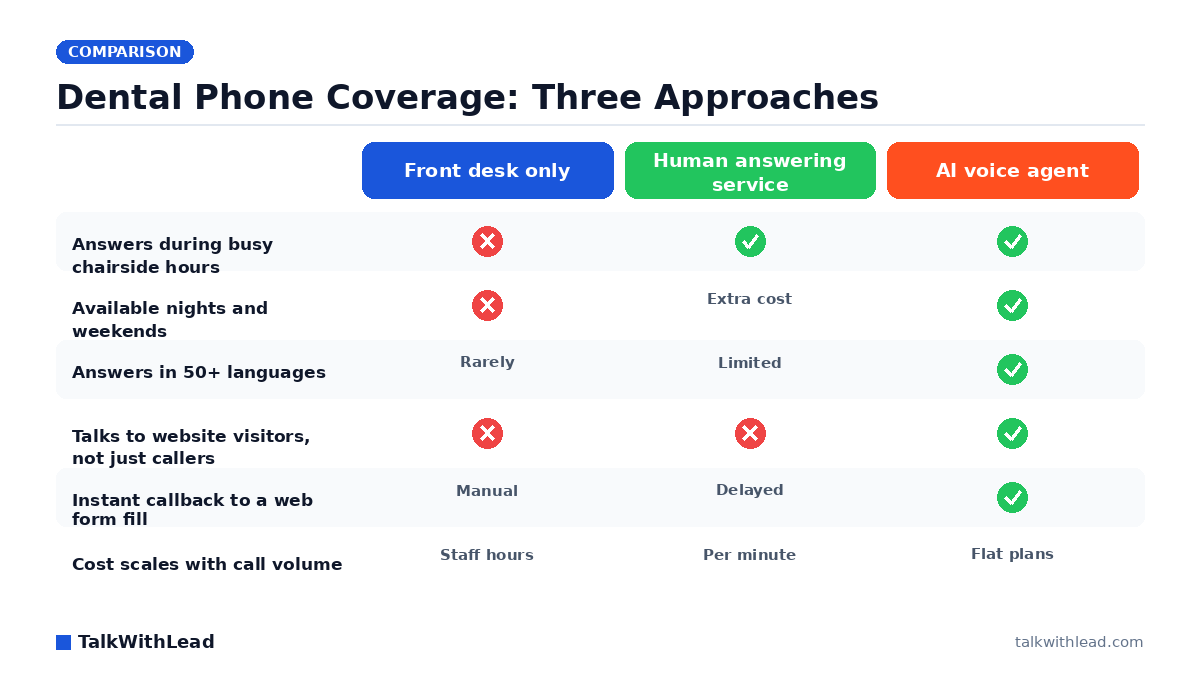
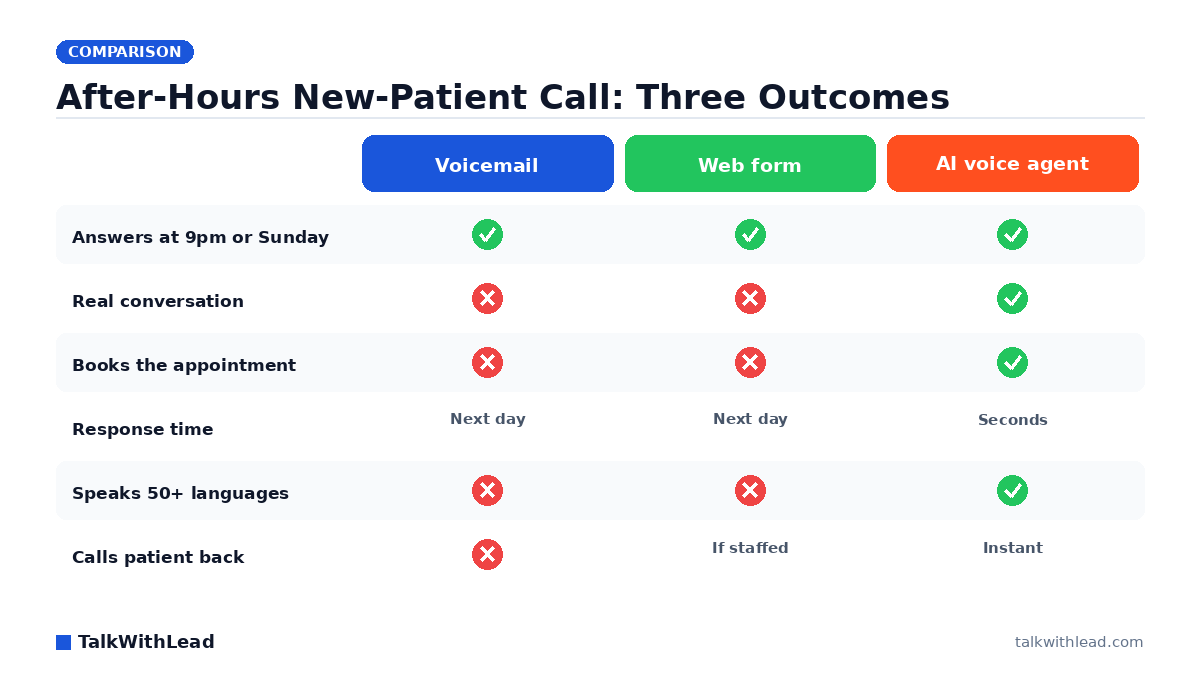
Practices generally choose between four things. Here’s how they compare on the dimensions that decide whether a new patient shows up in your chair.
| Capability | Voicemail | Web form | Human answering service | TalkWithLead AI voice agent |
|---|---|---|---|---|
| Available nights and weekends | Yes | Yes | Usually, at a premium | Yes, always |
| Two-way conversation | No | No | Yes | Yes |
| Typical response time | Next business day | Next business day | Seconds to minutes | Seconds |
| Handles simultaneous callers | Yes, poorly | Yes | Limited by staffing | Unlimited |
| Languages covered | None | Whatever you translate | Often English only | 50+ |
| Knows your hours, insurance list, services | No | No | Script-dependent | Yes, configured |
| Cost model | Free | Free | Per minute or per call | Flat monthly |
| Long-distance callbacks | N/A | N/A | Often billed extra | Unlimited |
Human answering services do one thing genuinely well: empathy on a complicated call. They also bill by the minute, which quietly punishes you for a busy month. We broke that tradeoff down in detail in AI receptionist vs. human answering service cost.
Best for: general, family, and cosmetic dental practices with one or two front-desk staff who are losing after-hours and overflow calls and want every new-patient inquiry answered by a voice within seconds.
Not the right fit if: you’re a specialist referral practice where nearly all new patients arrive through referring dentists rather than the phone, or you already run a fully staffed 24/7 call center and your abandon rate is near zero.
What the AI should handle — and what it should hand to a human
Don’t hand the AI your clinical judgment. Hand it the repetitive intake work that consumes your front desk and stalls after 5pm.
Let the voice agent own these:
- New-patient intake: name, phone, email, reason for visit, referral source.
- Scheduling, rescheduling, and confirming appointments.
- Hours, location, parking, first-visit expectations.
- Which insurance carriers you accept and what a self-pay exam runs.
- Collecting details on a possible emergency and immediately alerting the on-call dentist.
Route to a human: active dental emergencies needing clinical triage, treatment-plan and sedation questions, billing disputes, and any caller who asks to speak to a person. A good system escalates without an argument. That boundary is the same one law firms draw for after-hours intake — see law firm intake automation for how the escalation pattern works in a comparable high-stakes vertical.
An illustrative ROI example for a two-operatory practice
The following is an illustrative scenario using stated assumptions, not data from a real practice.
Assume 60 inbound calls a month, of which 22 are new-patient inquiries. Assume 8 of those 22 arrive outside staffed hours or while both lines are busy. Assume the AI voice agent converts 4 of those 8 into booked appointments, and 3 of the 4 actually show. At an assumed $900 first-year patient value, that’s $2,700 a month recovered from calls that previously produced nothing. Against a flat monthly subscription, the system pays for itself on the first recovered patient and the rest is margin.
Change any assumption you disagree with — the conversion rate, the patient value, the missed-call count — and the shape holds. You are comparing “a voice answered” against “nobody answered.” See what the flat monthly cost looks like on the pricing page, then plug your own numbers into the speed-to-lead ROI calculator.
Setting it up without disrupting the front desk
The rollout that works best is boring and incremental. Start with overflow and after-hours only, so nothing your team currently handles changes on day one.
- Add the callback widget to your site. Visitors on your new-patient and emergency-dentist pages get an instant call instead of a form.
- Forward the practice line after hours and when both lines are busy. Your daytime workflow stays exactly as it is.
- Load the agent’s knowledge: hours, accepted carriers, services, new-patient exam pricing, parking, and your emergency protocol.
- Set escalation rules: which situations text or call the on-call dentist immediately.
- Review transcripts weekly for the first month. Every awkward answer becomes a knowledge update.
Practices comparing vendors at this stage usually want the shortlist — best AI receptionist for dental offices covers who’s worth a demo. When you’re ready to try it on your own line, start free and point your after-hours forwarding at it this week.
FAQ
What is a dental clinic patient callback system?
It’s a service that answers calls or website requests your front desk can’t reach and immediately calls the patient back with a live conversation. With an AI voice agent, the callback happens in seconds instead of the next business day, and the agent can book the appointment on the spot rather than just taking a message.
Can an AI voice agent actually book dental appointments?
Yes. The agent collects the caller’s name, number, insurance, and reason for visiting, offers open times based on the rules you set, and confirms the booking. Anything it isn’t configured to decide — clinical triage, sedation questions, billing disputes — gets escalated to your team or the on-call dentist.
Will patients know they’re talking to an AI?
The voice sounds human, and most callers focus on getting an appointment rather than identifying who’s speaking. You control disclosure: many practices have the agent identify itself as a virtual assistant for the practice up front, which sets expectations and still books the visit.
How much does an AI answering service cost for a dental office?
TalkWithLead runs on a flat monthly subscription rather than per-minute billing, so a busy month doesn’t produce a surprise invoice, and long-distance callbacks are included. Current tiers are listed on the pricing page. Compare that against per-minute human answering services, where costs scale with exactly the call volume you were hoping to grow.
Does it handle Spanish-speaking and other non-English patients?
Yes — the voice agent handles conversations in 50+ languages, so a caller who would have hung up on an English-only voicemail gets a real conversation and a booked appointment instead.
What happens during a real dental emergency after hours?
You define the escalation rules. The agent recognizes the situations you flag as urgent, collects the essential details, and immediately alerts your on-call dentist by call or text while giving the patient clear instructions. Routine scheduling stays with the agent so your on-call line only rings for things that matter.
How long does setup take?
Most practices start with after-hours and overflow forwarding plus the website callback widget, which is a same-week change. Loading hours, insurance carriers, and services into the agent’s knowledge takes an afternoon, and the first month of transcript reviews is where it gets sharp. Try it live on the demo line before you commit.