The Real Question Behind This Comparison
Every one of these widgets makes the same promise: turn an anonymous website visitor into a lead before they hit the back button. But the ai voice agent vs callback widget vs live chat decision is really a decision about who answers, and how fast. Pick wrong, and your best prospects click away to a competitor who picked right.
TL;DR: Live chat converts only when a trained human is actually online. A callback widget captures phone numbers but inserts a delay between intent and conversation. An AI voice agent removes both weaknesses — it answers every visitor instantly with a human-sounding voice, in 50+ languages, at any hour — so for most businesses it converts more visitors into real sales conversations than either alternative.
How Each Option Actually Works
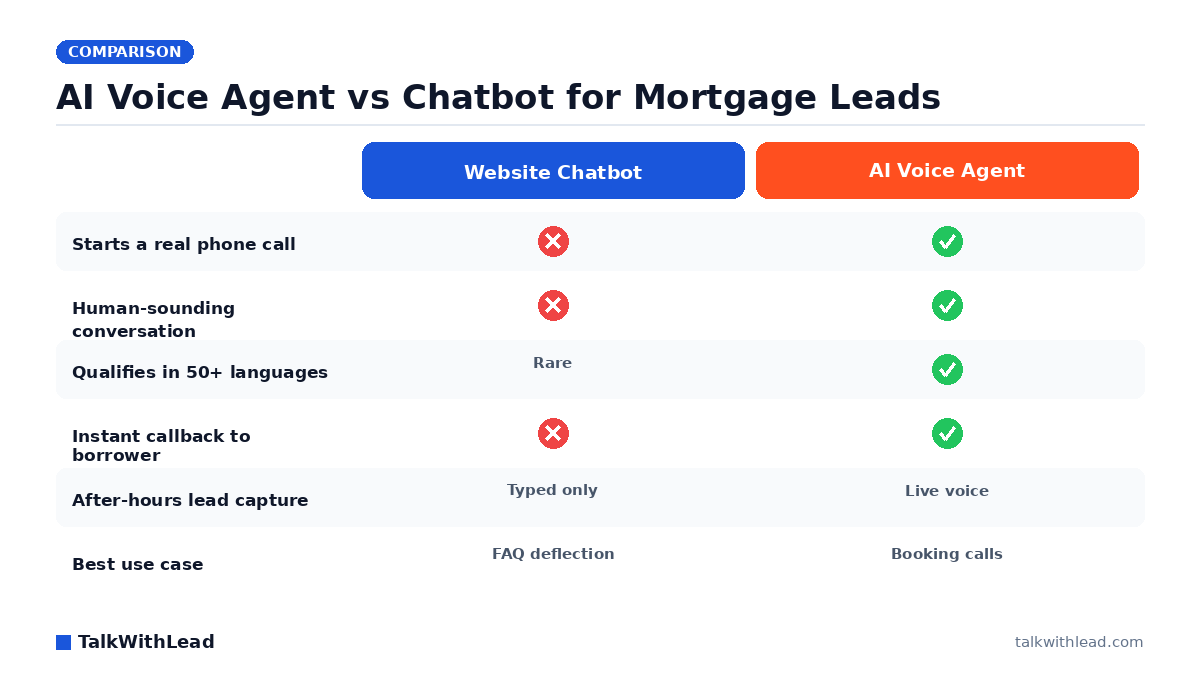
Live chat puts a text box in the corner of your site. When a visitor types, someone on your team is supposed to reply within seconds. In practice, chat sits unmanned during lunch, after 5 p.m., on weekends, and whenever the person covering it is on the phone. The visitor types a question, watches the cursor blink, and leaves. Even when it works, you get a typed exchange — not the phone call where deals actually close. We broke down that gap in Live Chat vs Chatbot: Pros, Cons, and the AI Voice Upgrade.
A callback widget flips the interaction: the visitor enters their number, and your team calls them back. It respects a truth live chat ignores — serious buyers want to talk. But it still depends on a human dialing back quickly. If the callback lands in 30 seconds, it converts well. If it lands in an hour, the lead has often gone cold or gone shopping.
An AI voice agent collapses the whole sequence. The visitor clicks, and an extremely human-sounding AI voice answers immediately — no number form, no queue, no waiting for a rep. It handles the conversation naturally, answers questions, qualifies the lead, books the demo or appointment, and offers an instant callback to the visitor’s phone if they prefer. Because it speaks 50+ languages and supports unlimited long-distance calling, a prospect in Madrid or Mumbai gets the same instant conversation as one down the street. You can hear it live in a two-minute demo — the fastest way to understand why voice beats a text box.
Which Converts More Website Visitors: AI Voice Agent, Callback Widget, or Live Chat?
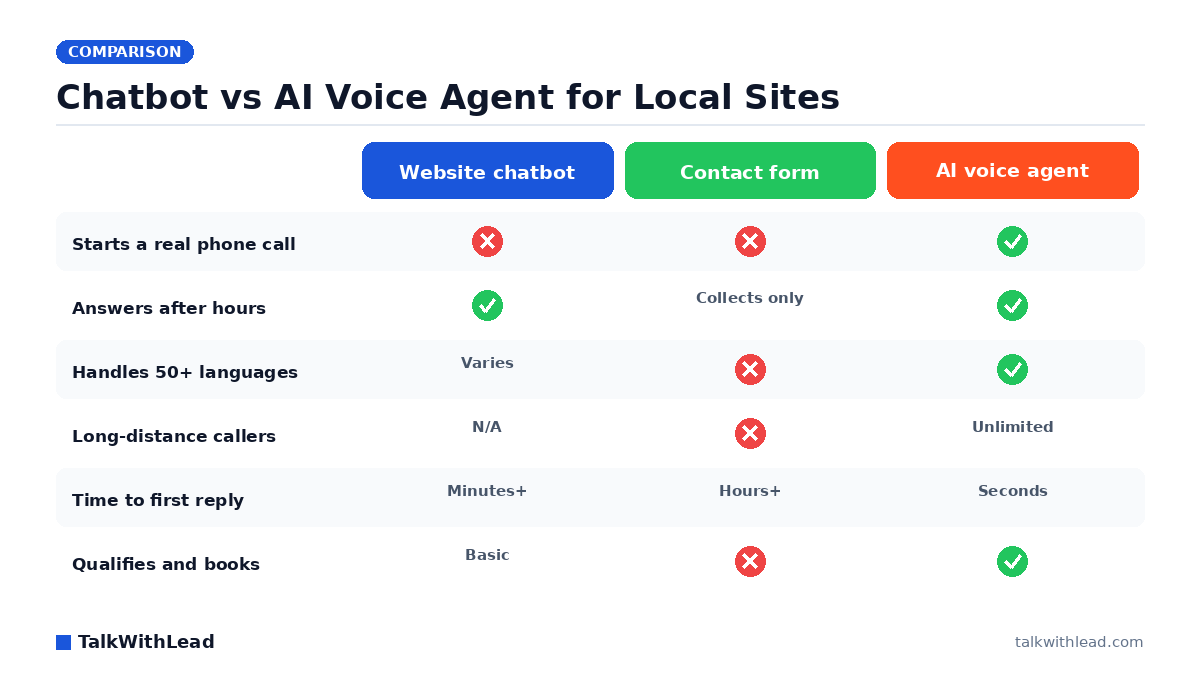
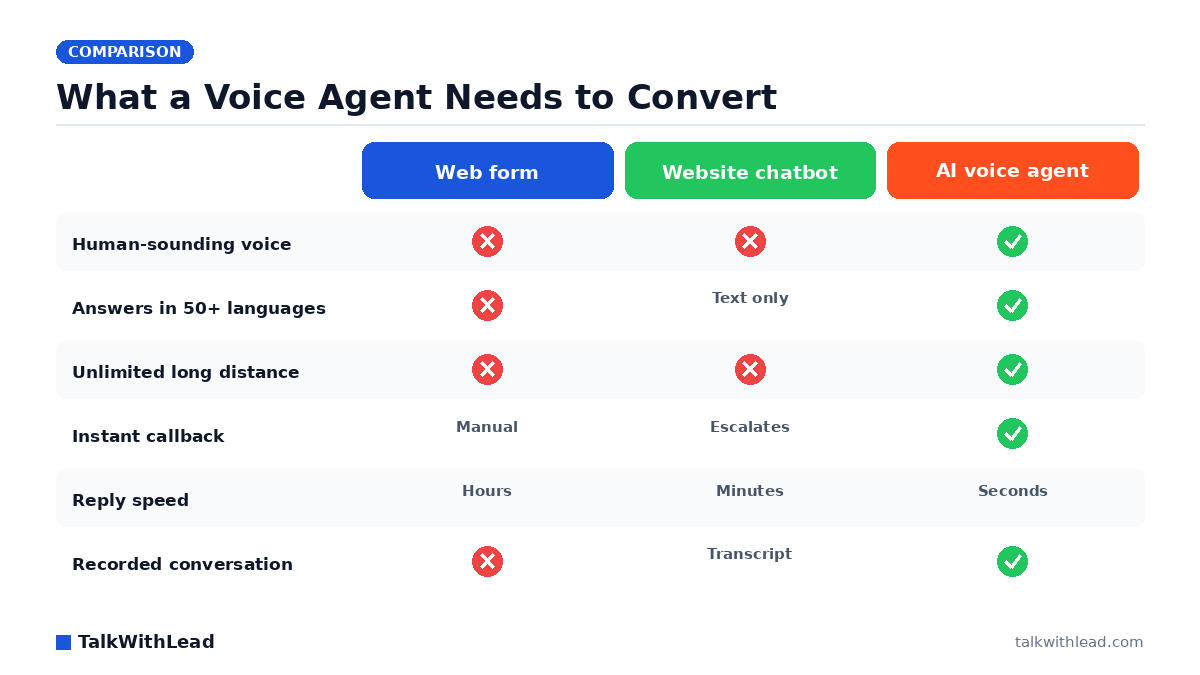
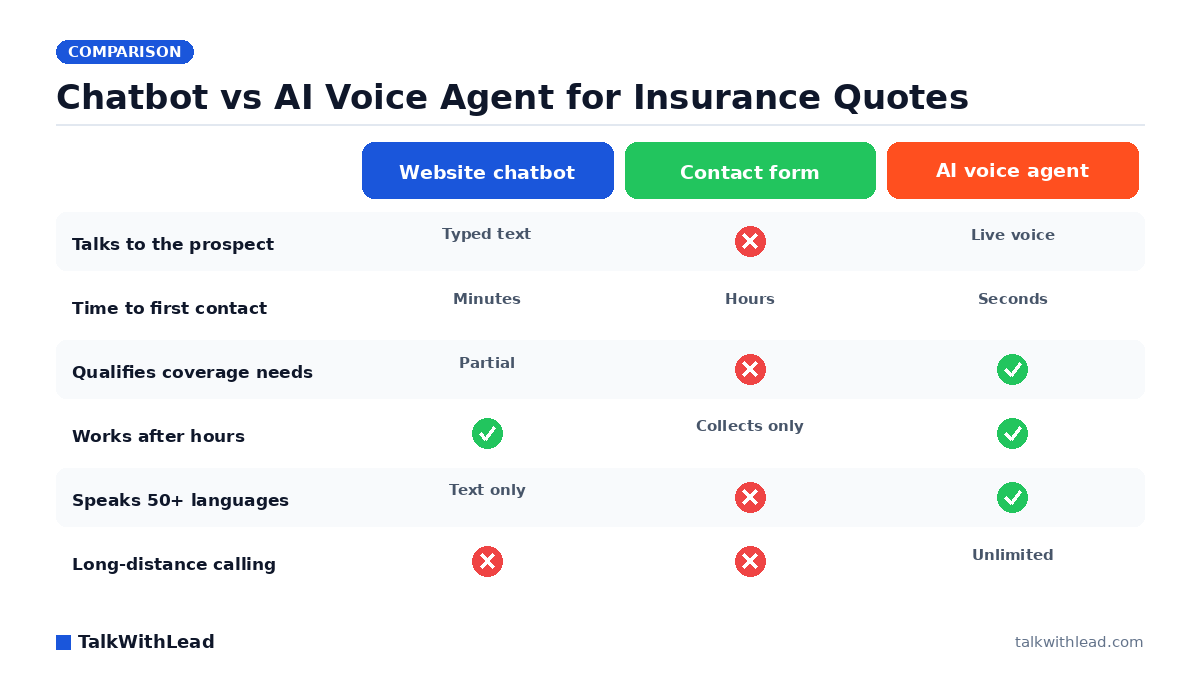
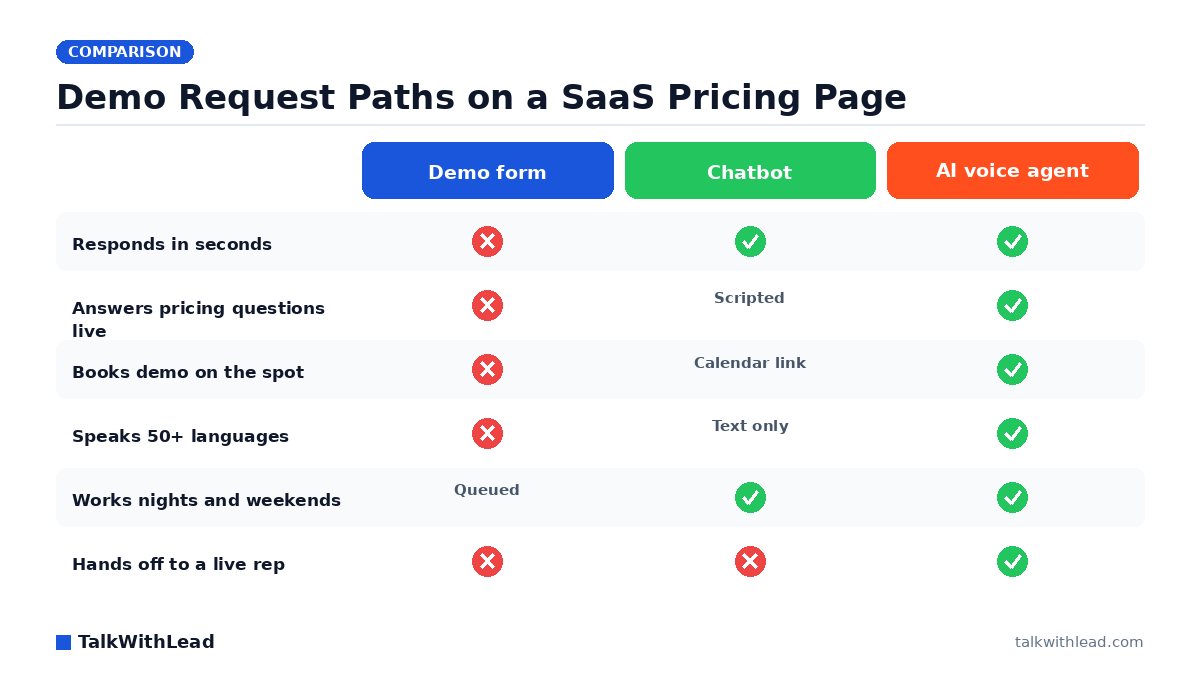
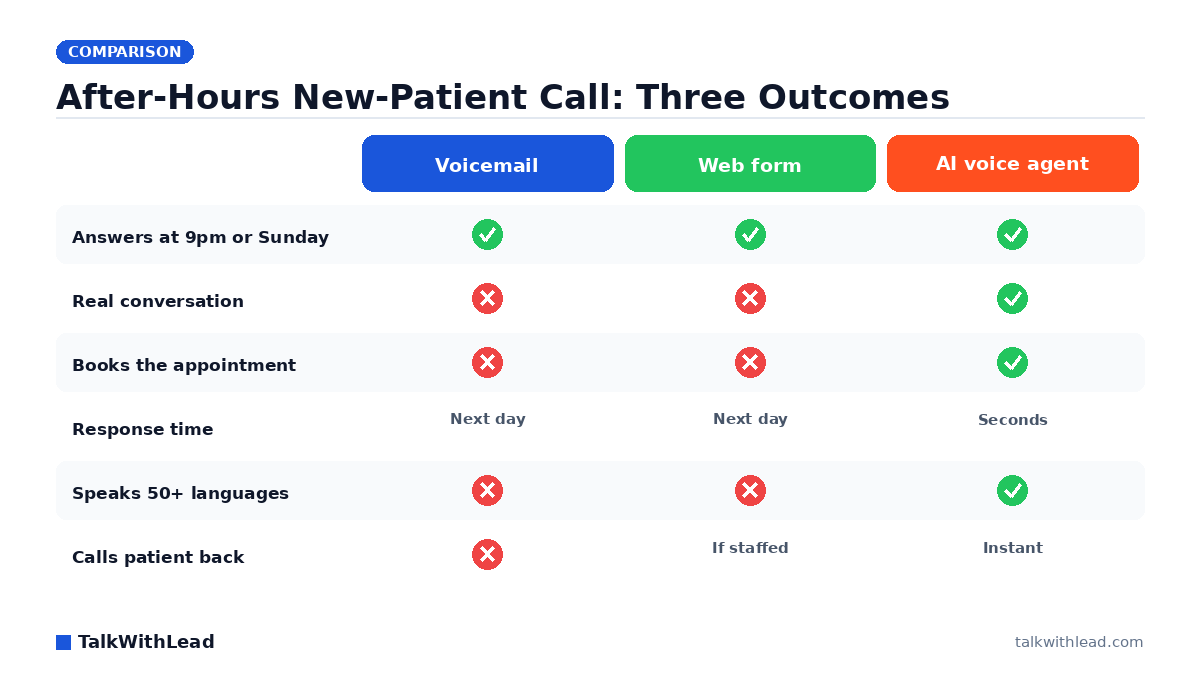
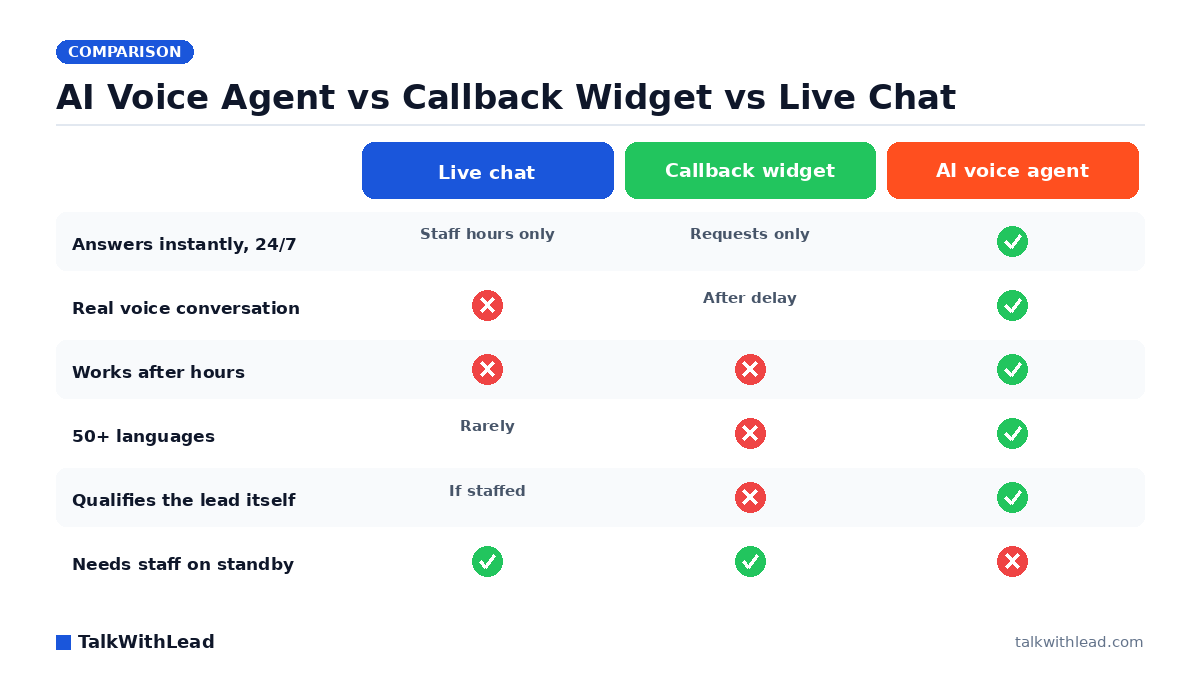
Conversion in this category comes down to three variables: response speed, conversation quality, and coverage. Here is how the three options compare on the dimensions that decide whether a visitor becomes a booked call:
| Dimension | Live chat | Callback widget | AI voice agent |
|---|---|---|---|
| Response speed | Seconds — if staffed | Minutes to hours | Instant, always |
| After-hours coverage | None (or a bot) | Captures number only | Full conversations 24/7 |
| Conversation medium | Text | Voice, delayed | Voice, immediate |
| Languages | Whatever your team speaks | Whatever your team speaks | 50+ languages |
| Lead qualification | Manual, if staffed | Manual, after callback | Automatic, in the call |
| Staffing required | Constant | On-call | None |
| Long-distance prospects | Text only | Toll costs apply | Unlimited long-distance included |
Why does speed dominate this table? Because the research on lead response is brutal. The MIT Lead Response Management study found you’re about 21× more likely to qualify a lead contacted within 5 minutes than one contacted at 30 minutes. Live chat can hit that window only during staffed hours. A callback widget hits it only when someone drops everything to dial. An AI voice agent hits it every single time, because “response time” is the time it takes the visitor to click. We go deeper on the speed math in Speed-to-Lead: Why the First 60 Seconds Win Most Deals.
And the answer-rate problem is worse than most owners think. According to a 411 Locals study of 85 small businesses across 58 industries, only 37.8% of incoming calls were answered by a live person — meaning roughly 6 out of 10 calls went unattended. A callback widget that routes into that same overloaded team inherits that same failure rate.
The ROI Math: What a Delay Actually Costs
Here is an illustrative example — your numbers will differ, so plug in your own. Say your site gets 2,000 visitors a month, and imagine just 2% would talk to someone if a real conversation were one click away. That’s 40 potential conversations. Now assume a widget that depends on human availability catches only the ones arriving during staffed weekday hours — say half — and that delayed callbacks lose a further share to cooled-off interest. You could easily be having 15 conversations instead of 40. If even a modest fraction of those conversations become customers worth $1,000 each, the gap between the two setups is tens of thousands of dollars a year — from the same traffic you already paid to acquire.
Don’t take the hypothetical on faith: run your own visitor count, close rate, and deal size through the free missed-call revenue calculator. It uses your inputs and labeled assumptions, and it takes about a minute.
When Each Option Is the Right Choice
Choose live chat if you have trained staff genuinely available during all your traffic hours and your buyers prefer typing — some support-heavy audiences do. Just be honest about coverage: an unmanned chat box converts worse than no widget at all, because it advertises a promise you’re breaking in real time.
Choose a plain callback widget if your team reliably returns calls within a few minutes and your traffic is concentrated in business hours. It’s a real upgrade over a contact form. If you’re evaluating this route, our teardown of Callback Widget vs Click-to-Call vs Live Chat covers the implementation details.
Choose an AI voice agent if you want every visitor — after-hours, weekend, overseas, or Spanish-speaking — to get an instant, human-sounding phone conversation without adding headcount. It’s the only option in this comparison where conversion doesn’t degrade when your team is busy, asleep, or on vacation. TalkWithLead’s agent also offers instant callbacks, so visitors who want the call on their own phone still skip the waiting.
Best for: businesses whose leads arrive around the clock or from multiple countries, and any owner tired of paying for traffic that never becomes a conversation.
Not the right fit if: your buyers must speak to a licensed or credentialed human on the first touch for regulatory reasons, and you already have that human answering within seconds during every hour your site gets traffic.
How to Test This on Your Own Site This Week
You don’t need a committee to settle the ai voice agent vs callback widget question — you need a week of your own data. First, try the live demo and judge the voice quality yourself; skepticism about “robotic AI” usually ends about ten seconds in. Second, check pricing against what one recovered deal is worth in your business — for most, a single saved lead covers months of the widget. Third, create a free account, drop the widget on your site, and count booked conversations after seven days. If you want the deeper comparison against text-based bots before you start, read AI Voice Agent vs Chatbot Conversion Rate.
FAQ
Is an AI voice agent better than a callback widget?
For most businesses, yes — because it removes the delay a callback widget depends on. A callback widget captures a phone number and waits for a human; an AI voice agent starts the conversation the moment the visitor clicks, then can still place an instant callback to the visitor’s phone. You keep everything a callback widget offers and eliminate its weakest link.
Does live chat or a voice conversation convert more website visitors?
Voice tends to win for sales-intent visitors because phone conversations carry tone, urgency, and trust that typed chat can’t. Live chat also fails silently whenever no one is staffing it. A voice-first widget converts the same click into an actual sales conversation instead of a text thread that ends with “someone will follow up.”
Do AI voice agents sound robotic to callers?
Modern AI voice agents are strikingly human — natural pacing, interruptions handled gracefully, and conversational answers rather than scripted menus. The honest test is to listen for yourself: TalkWithLead’s live demo lets you have the exact conversation your visitors would.
Can an AI voice agent handle visitors who don’t speak English?
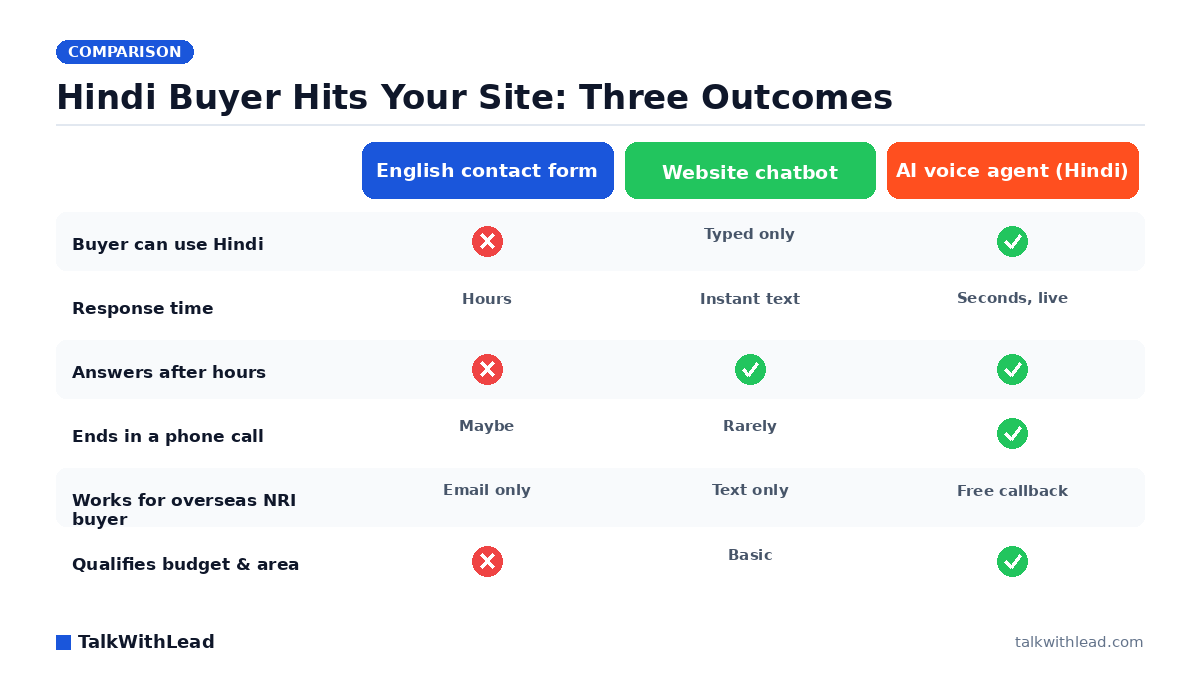
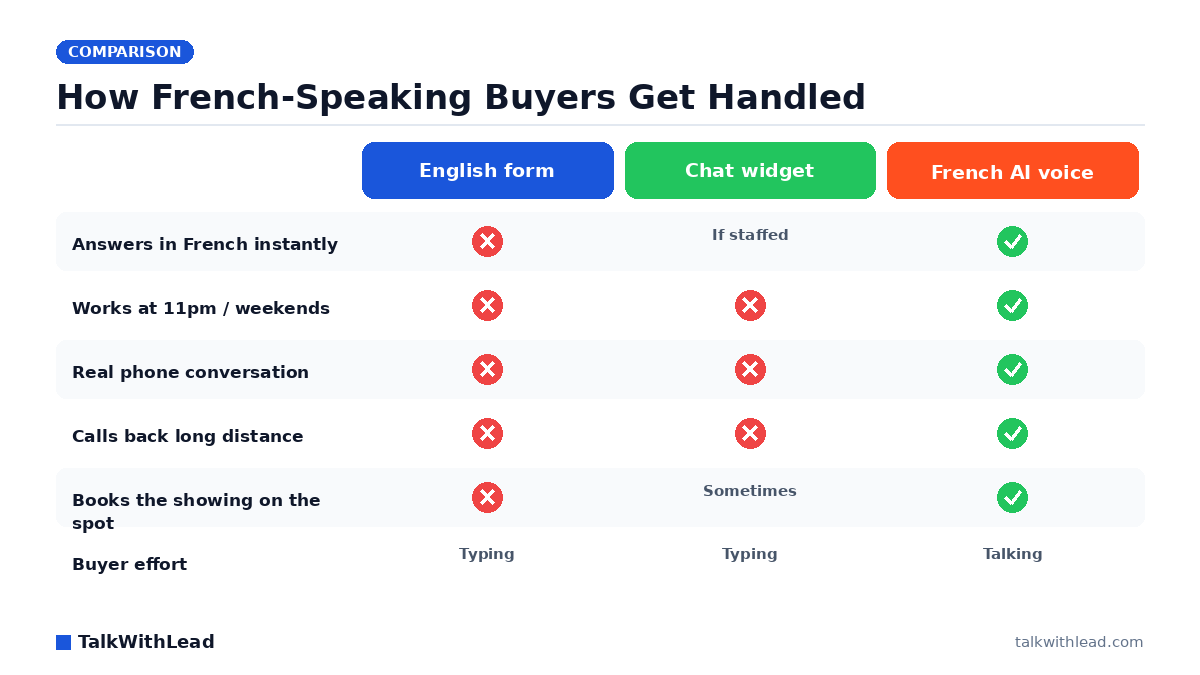
Yes. TalkWithLead’s agent conducts full conversations in 50+ languages, so a Spanish-, Hindi-, or French-speaking visitor gets the same instant experience as an English speaker — without you hiring multilingual staff. Combined with unlimited long-distance calling, international prospects can reach you as easily as local ones.
What happens to leads that arrive after business hours?
With live chat, they usually bounce. With a callback widget, they leave a number and wait until morning — often after contacting a competitor. An AI voice agent answers at 2 a.m. exactly as it does at 2 p.m.: it holds the conversation, qualifies the lead, and books the appointment so your team starts the day with warm leads instead of cold voicemails.
How much does an AI voice agent cost compared to staffing live chat?
Staffing live chat across real coverage hours means salaries; an AI voice agent is a flat software subscription that never sleeps. As a one-line framing: it typically costs a small fraction of one part-time employee. Check the current plans on the TalkWithLead pricing page and weigh it against the value of a single recovered deal.