
Your pricing page is the most valuable real estate you own. Someone scrolling your tiers has already read the homepage, sized up a competitor, and started doing mental math on seats. Then they hit a “Request a demo” form, type their work email, and wait — and saas demo request conversion quietly dies in a queue.
TL;DR: SaaS demo request conversion improves most when a pricing-page visitor can start a real conversation immediately instead of submitting a form and waiting. An AI voice agent picks up in seconds, answers pricing and fit questions in plain language, qualifies the buyer, and books the demo on the calendar before that visitor opens a competitor’s tab.
Why do so few pricing-page visitors request a demo?
Not because your product is unclear. Because the only action you offer is a delay. A demo form is a promise that someone will get back to them — later, on your schedule, after they have already asked three vendors the same question.
Buyers on a pricing page have specific, blocking questions: does this scale past 50 seats, is SSO in the mid tier, what happens to our data on cancel. A form cannot answer any of them. A chatbot answers about half, badly, then drops a calendar link. Meanwhile the deal is being decided by whoever picks up first — research popularized by InsideSales / Dr. James Oldroyd found that roughly 35-50% of sales go to the company that responds first.
Picture a SaaS site with 2,000 pricing-page sessions a month and 40 demo requests. Say even 1 in 10 of the visitors who left without acting would have talked to a human if one had been available in that moment — that is 196 conversations you never had, from traffic you already paid for.
What actually moves saas demo request conversion?
Three things, in order of impact:
- Time to first human-quality response. Minutes, not hours. Harvard Business Review research found companies that reach a web lead within an hour are nearly 7× more likely to qualify it than those that wait even an hour longer.
- Answering the blocking question. A buyer who cannot confirm fit will not book time with a rep. Resolve the objection and the demo request becomes obvious.
- Removing the scheduling gap. Every step between “I’m interested” and “it’s on my calendar” leaks buyers.
Voice collapses all three into one motion. The visitor clicks, an extremely human-sounding AI voice agent answers on the spot, handles the pricing question, confirms company size and use case, and drops the demo straight onto an AE’s calendar. No inbox round-trip. You can hear how that sounds on the TalkWithLead live demo.
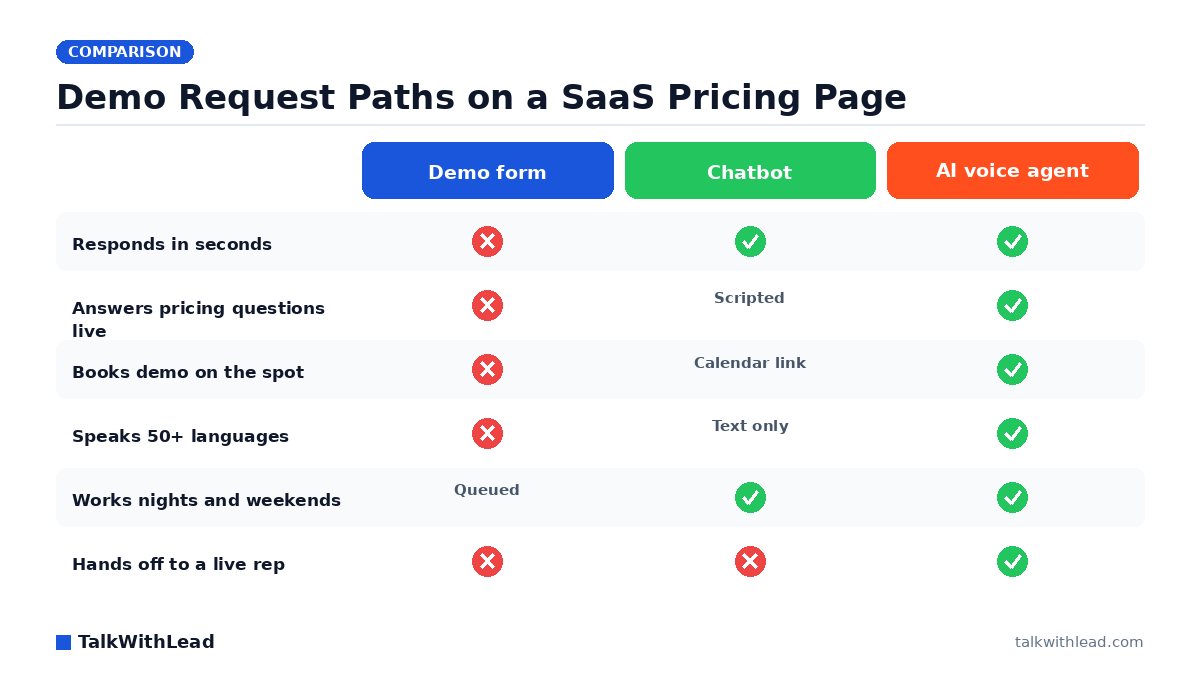
Form vs chatbot vs AI voice agent on a pricing page
| Dimension | Demo request form | Website chatbot | AI voice agent |
|---|---|---|---|
| Response time | Hours to next business day | Instant, text only | Seconds, live conversation |
| Handles pricing objections | No | Scripted answers only | Yes, conversationally |
| Qualifies the buyer | Fields only | Basic branching | Natural back-and-forth |
| Books the demo | Rep does it later | Calendar link handoff | Books on the call |
| Non-English buyers | Form language only | Translated text | 50+ spoken languages |
| International callers | N/A | N/A | Unlimited long-distance |
| After hours | Queued | Answers, rarely books | Answers and books |
Best for: SaaS teams with real pricing-page traffic, a sales-assisted motion, and an AE calendar that has open slots being wasted on no-shows and slow follow-up.
Not the right fit if: you are pure self-serve with no demo motion at all, or your ACV is low enough that a phone conversation costs more than the account is worth.
How fast should you respond to a demo request?
Inside five minutes, and ideally inside five seconds. The MIT Lead Response Management study found you’re about 21× more likely to qualify a lead contacted within 5 minutes than one contacted at 30 minutes. Most SaaS teams cannot staff that window — someone is in a demo, it is 7pm in Berlin, it is Saturday.
That is the gap an AI voice agent fills. It never queues. It answers the 2am pricing question from Singapore in the caller’s own language, and it stays on the line long enough to book. The same speed logic that drives how fast you should call a new lead applies with more force on a pricing page, because intent is at its peak right there.
A labeled ROI example for a mid-market SaaS
This is an illustrative model, not a customer result. Assume:
- 2,000 pricing-page sessions per month
- 2% currently request a demo → 40 requests
- 30% of requests become held demos → 12 demos
- 20% of held demos close → 2.4 new accounts
- Assumed ACV: $9,000
Now assume instant voice capture lifts demo requests from 2% to 3.2% and, because the AI qualifies and books live, held-demo rate rises from 30% to 45%. That is 64 requests, 28 held demos, 5.6 closes — roughly $28,800 in additional new ACV per month under those stated assumptions. Change any input and the math changes; the point is that the lever is the first sixty seconds, not the sales deck. Run your own numbers with the free speed-to-lead ROI calculator.
Cost framing, plainly: an AI voice layer on a SaaS site typically lands well under the fully-loaded cost of a single SDR shift, and it covers every hour of the week. See current tiers on the TalkWithLead pricing page.
How to wire voice into your pricing page without breaking the funnel
Keep the form. Add a faster path beside it.
- Put the voice widget on pricing, feature, and comparison pages first — the pages where intent is highest, not the blog.
- Give the agent your real pricing logic. Tiers, seat minimums, what is gated, what is negotiable. Vague answers kill trust faster than silence.
- Define the qualification bar. Company size, use case, timeline. Above the bar, transfer live to an AE; below it, book a group demo or route to self-serve.
- Enable instant callback for visitors who would rather not talk in an open office — they enter a number, the agent calls back in seconds.
- Measure demo requests per pricing-page session and held-demo rate. Raw form fills will understate the lift because voice conversations do not create form fills.
Teams switching away from text-first tools usually recognize the pattern described in our AI voice agent vs chatbot conversion comparison, and the same widget mechanics covered in callback widget vs click-to-call vs live chat apply directly to a SaaS pricing page.
What about buyers who are not ready to talk?
Some are not, and forcing them wastes both sides’ time. A good voice layer offers the conversation, accepts a no, and captures a callback time instead. The visitor picks the moment; the agent calls then. You lose nothing and you learn who is browsing versus buying.
The trap is the opposite failure — assuming nobody wants to talk because nobody ever could. Most SaaS sites have never offered a real-time voice option, so “our buyers prefer async” is usually an untested assumption about a button that does not exist. Test it for a month on the pricing page. Start free and point it at your highest-intent page.
FAQ
What is a good demo request conversion rate for a SaaS pricing page?
It varies widely by ACV and traffic quality, so treat any single benchmark carefully. The more useful measure is your own trend: demo requests divided by pricing-page sessions, tracked monthly, alongside the percentage of those requests that turn into demos actually held.
Will an AI voice agent annoy enterprise buyers?
Not when it is honest and useful. The agent sounds human, answers the pricing question directly, and hands off to a real AE when the deal warrants it. Buyers dislike being stalled far more than they dislike being helped quickly.
Can an AI voice agent qualify leads before booking a demo?
Yes. You set the qualification criteria — company size, use case, budget range, timeline — and the agent works them into a natural conversation, then books only the buyers who clear the bar. Everyone else gets a self-serve trial or a group session.
How does this work for international SaaS traffic?
The agent speaks 50+ languages and unlimited long-distance calling is included, so a prospect in São Paulo or Warsaw gets the same instant conversation as one in Chicago. No regional phone numbers to provision, no time-zone staffing plan.
Does adding voice mean removing our demo form?
No. Keep the form for buyers who prefer async. Voice runs beside it as the fast path, which is why raw form-fill counts alone will understate the impact — track total booked demos instead.
How long does it take to set up on a pricing page?
It is a script tag plus the pricing and qualification rules you feed the agent. Most teams point it at the pricing page first, watch a week of transcripts, tighten the answers, then expand to feature and comparison pages. You can hear the agent yourself on the live demo.