Two quotes land on your desk. A human answering service wants a monthly minimum plus a per-minute rate. An AI receptionist wants a flat subscription. Both promise you will stop losing leads, and neither quote tells you what you will actually pay in a busy month.
TL;DR: a fair ai receptionist vs human answering service cost comparison usually lands the same way. Human services typically bill per minute or per call on top of a monthly minimum, so your bill grows every time your marketing works. AI receptionists bill like software — a flat monthly plan that covers far more conversations — which makes high-volume months dramatically cheaper and quiet months predictable.
How much does a human answering service cost?
Almost every live answering service prices the same way: a monthly minimum that buys a bucket of minutes, then an overage rate once you burn through it. Rate cards in this category commonly run from roughly a hundred dollars a month at the small end to several hundred or more for real receptionist coverage, with per-minute overage on top. Check current published rates yourself before you sign anything, because they move.
The rate card is not the problem. The billing unit is. You pay for minutes, not for booked jobs, and plenty of billed minutes produce nothing: the robocall that got answered, the existing customer asking about an invoice, the vendor, the wrong number, the caller who spent ninety seconds spelling their last name. Every one of those is revenue for the vendor and cost for you.
Two more line items show up after the first invoice. Bilingual or after-hours coverage is often a surcharge rather than a default. And long-distance or toll handling can be billed separately, which quietly punishes you for having customers outside your area code.
How much does an AI receptionist cost?
An AI receptionist is software, so it prices like software: a flat monthly plan tied to seats, features, or a generous conversation allowance instead of a taxi meter. Entry plans in this category generally sit in the tens-of-dollars-per-month range and climb with features rather than with call volume. TalkWithLead publishes its plans on the pricing page so you can compare against your current answering-service invoice line by line.
The structural difference is what happens on your best month. A per-minute vendor is rewarded when your ad spend spikes. A flat-rate AI receptionist is not. You can run a promotion, get featured somewhere, or double your traffic without opening a spreadsheet to model your support bill.
TalkWithLead also removes two of the classic surcharges. Its AI voice agent handles conversations in 50+ languages without a bilingual upcharge, and unlimited long-distance calling means a prospect three time zones away is not a billing event. If you want to hear how human it sounds before you believe any of this, the live demo takes about a minute.
Side-by-side: the cost comparison that matters
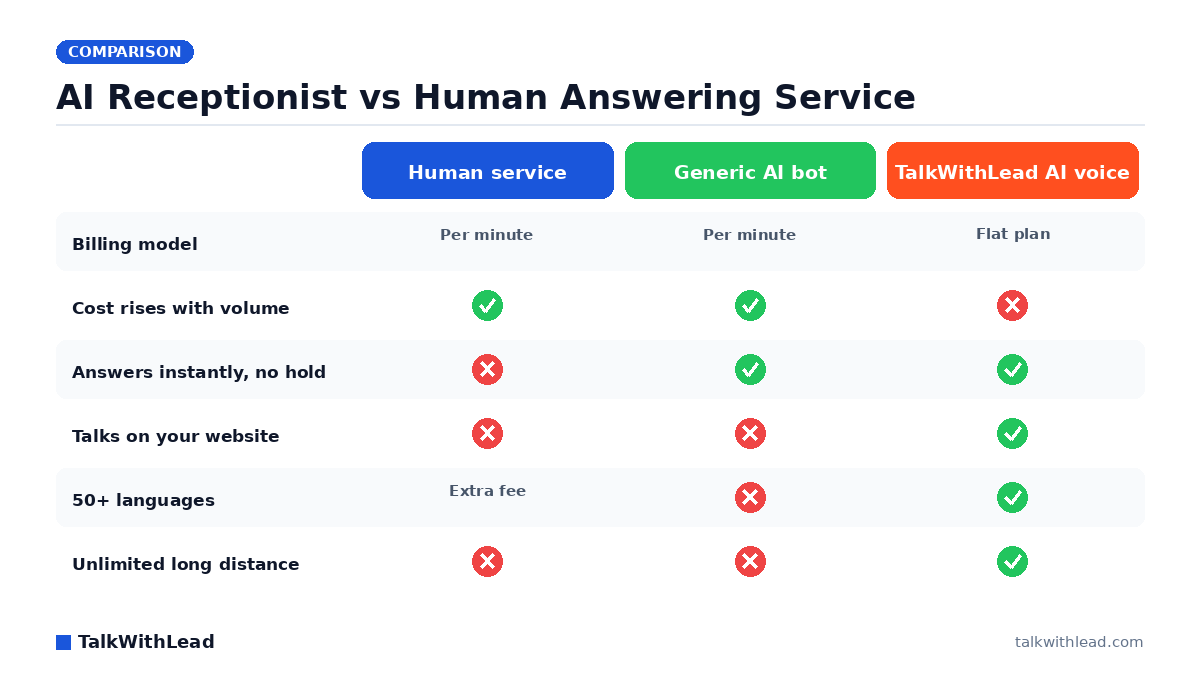
| Dimension | Human answering service | AI receptionist (TalkWithLead) |
|---|---|---|
| Billing unit | Per minute or per call, over a monthly minimum | Flat monthly plan |
| Cost in a high-volume month | Rises with every extra call | Effectively unchanged |
| Spam and wrong numbers | Billable minutes | Handled inside the plan |
| After-hours and weekends | Often a surcharge | Always on, same price |
| Languages | Bilingual usually costs extra | 50+ languages included |
| Long distance | Frequently billed separately | Unlimited |
| Where it answers | Your phone line | Your website, then the phone |
| Hold time | Possible during call spikes | Answers immediately, in parallel |
| Judgment on unusual calls | Strong — a real person adapts | Good on scripted intake, escalates the rest |
Read the last three rows twice. They are where the money actually is, and neither rate card mentions them.
The cost nobody quotes you: the call that never got answered
Answer rate beats rate card. A missed call does not cost you eighty cents of billed time — it costs you the entire job, and often to the competitor the caller phoned twelve seconds later. According to a 411 Locals study of 85 small businesses across 58 industries, only 37.8% of incoming calls were answered by a live person — meaning roughly 6 out of 10 calls went unattended.
Speed compounds the same way on web leads. The MIT Lead Response Management study found you’re about 21× more likely to qualify a lead contacted within 5 minutes than one contacted at 30 minutes. A human answering service takes a message; that message still has to reach someone who calls back. An AI voice agent on your website starts the conversation while the visitor is still reading the page — which is the whole argument in how fast you should call a new lead.
ROI math: an illustrative example
The following is an illustrative scenario, not a customer result. Assume a services business that gets 200 inbound calls and website enquiries a month, closes at an assumed 20%, and books an average job worth $600.
- Today: say 60 of those 200 go unanswered after hours or during call spikes. At an assumed 20% close rate, that is 12 jobs, or roughly $7,200 a month walking away.
- Human answering service: assume it recovers half of those 60 as messages, and assume half of the messages get a timely callback. That is 15 recovered conversations, about 3 jobs, roughly $1,800 — against a bill that grows with every minute answered.
- AI voice agent: imagine it engages nearly all 60 immediately on the site and by instant callback, no hold, no message queue. Even at the same assumed 20% close rate on the engaged share, the recovered revenue is a multiple of the human-service path, on a flat plan.
Swap in your own numbers with the free missed-call revenue calculator — it takes about two minutes and it is usually the number that ends the debate. Contractors comparing the same two options can also read the vertical version in AI receptionist for contractors: cost and ROI.
Honest verdict
Best for: owners of service businesses and lead-gen sites who get most enquiries from their website and after hours, want a predictable flat bill as volume grows, and need callers handled instantly in multiple languages without hold time or long-distance charges.
Not the right fit if: your calls are long, unscripted, emotionally sensitive, or legally delicate from the first sentence — think crisis intake or complex clinical triage. In that case, keep a human on the line and let AI cover only overflow and after-hours.
Plenty of businesses run both. The AI voice agent answers on the website, qualifies, and books; anything unusual escalates to a person. That hybrid is exactly how the comparison plays out in AI voice agent vs human receptionist.
How to run the comparison on your own numbers this week
- Pull your last three answering-service invoices and total the minutes actually billed, including overage.
- Divide the total cost by the number of booked jobs it produced. That is your real cost per booked job — not your per-minute rate.
- Count after-hours and weekend enquiries separately. That bucket is where AI wins hardest.
- Run the same volume through a flat AI plan on the pricing page.
- Test the caller experience yourself. Hold time and robotic scripting cost you conversions no rate card captures.
If step five is where you are, start there: hear the voice agent on the live demo, then put it on your own site with a free signup and watch what happens to the enquiries you were previously converting into voicemail.
FAQ
Is an AI receptionist cheaper than a human answering service?
Usually yes, and the gap widens with volume. Human services bill per minute or per call over a monthly minimum, so cost scales with activity. An AI receptionist bills as a flat monthly plan, so a busy month costs roughly what a slow month costs.
What do answering services actually charge per minute?
Rates vary by vendor and by whether you buy a receptionist tier or a message-taking tier, and they change often, so check the vendor’s current published rate card. The structural point holds regardless: you are billed for every answered minute, including spam calls and hold time.
What hidden fees should I check before signing?
Ask about overage rates past your included minutes, minimum billing increments per call, bilingual or after-hours surcharges, long-distance and toll handling, setup or script-change fees, and contract length. Those line items often move the effective price more than the headline rate does.
Can an AI receptionist handle calls in Spanish or other languages?
TalkWithLead’s AI voice agent converses in 50+ languages as part of the plan, with no bilingual surcharge. With a human service, multilingual coverage is typically a paid add-on and depends on which agents are on shift.
Will callers know they are talking to AI?
The voice is extremely human-sounding, and most callers simply get their question answered and book. Being upfront works fine too — what visitors reject is waiting on hold or typing into a slow chatbot, which is the comparison drawn in AI voice agent vs chatbot.
Can I use both an AI receptionist and a human team?
Yes, and it is a common setup. Let the AI voice agent answer instantly on the website, qualify, and book appointments, then route anything complex or sensitive to a person. You cut billed minutes on routine calls and keep human judgment where it earns its cost.