Your site gets the visit at 8:47pm. The furnace is dead, the homeowner has three tabs open, and whoever answers first gets the job. That is the real question behind ai voice agent vs live chat for contractors — not which widget looks nicer, but which one is actually awake when the money shows up.
TL;DR: For contractors, an AI voice agent beats live chat because it answers every visitor instantly, 24/7, and converts the visit into a real phone conversation instead of a typing session. Live chat only performs when a human is free to reply, which almost never describes a crew in the field. Keep live chat for quiet browsing questions; put voice in front of urgent, high-ticket work.
Why live chat quietly underperforms for trades
Live chat was built for teams that sit at desks. Contractors do not. The office manager is invoicing, the owner is on a ladder, and the phone is in a truck cup holder. When nobody picks up the chat within a minute, that window becomes a form — and a form is just a slower way of saying “we’ll call you back eventually.”
The timing math is brutal, and it is well documented. According to Harvard Business Review research, companies that reach a web lead within an hour are nearly 7× more likely to qualify it than those that wait even an hour longer. A chat that goes unanswered until morning is not a slow lead. It is somebody else’s job.
Then there is what typing does to a service inquiry. A homeowner describing a sewer smell, a soft spot in a subfloor, or a breaker that trips only when the dryer runs is not going to type it well. They will type six words, wait, and leave. Voice gets the whole story in twenty seconds.
What an AI voice agent actually does on a contractor site
TalkWithLead puts an extremely human-sounding AI voice agent on your website. A visitor clicks, and instead of a chat box, a conversation starts — out loud. The agent greets them, asks what is going on, captures the address and the trade, checks whether it is an emergency, and either books the slot or triggers an instant callback so a human closes it while the intent is still hot.
Three things matter more for contractors than for almost any other vertical:
- After-hours coverage. No-heat, no-water, and no-power calls arrive at night and on weekends. The voice agent never clocks out.
- 50+ languages. Service areas are not monolingual. A crew that can only intake in English is turning away paying neighborhoods, which is exactly the problem we break down in our bilingual Spanish AI answering service for contractors guide.
- Unlimited long-distance calling. Out-of-state landlords, relocating buyers, and property managers calling about a unit three time zones away all reach you without a toll worry.
Want to hear the difference before you decide anything? Take the live demo and talk to the agent the way a homeowner would.
Which is better for contractors: AI voice agent or live chat?
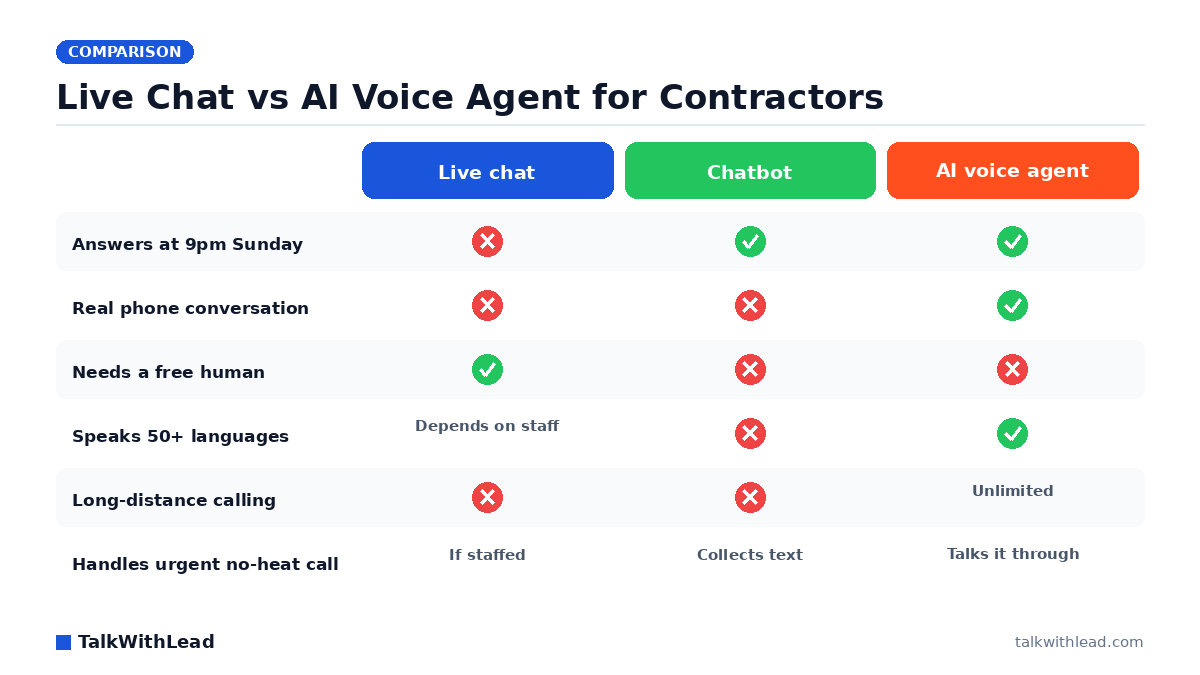
Better depends on what the visitor came to do. Someone comparing tankless water heaters at lunch is happy to type. Someone standing in two inches of water is not. Contractors skew heavily toward the second group, and the second group is where the ticket size lives.
| Dimension | Live chat (human) | Chatbot | AI voice agent |
|---|---|---|---|
| Response speed | Fast when staffed, dead when not | Instant but scripted | Instant, every hour |
| Coverage | Business hours | 24/7 | 24/7 |
| Detail captured | Good, if the visitor types | Whatever the form fields allow | Full spoken description |
| Emergency triage | Possible | Weak | Strong — asks and escalates |
| Languages | Limited to staff | Text translation | 50+ spoken languages |
| Ends in a phone call | Rarely | Almost never | By design |
| Staffing cost | Per seat, per shift | Low | Flat subscription |
Best for: emergency and high-ticket trades — HVAC, plumbing, roofing, restoration, electrical — where the visitor wants to talk now and the first contractor to answer usually wins the job.
Not the right fit if: your work is low-ticket, scheduled weeks out, and your buyers genuinely prefer async text — or if you already have a fully staffed intake desk answering chats in under a minute, every hour you advertise.
The revenue you are already leaving on the table
Run the arithmetic on your own numbers instead of trusting a vendor claim. Illustrative example, assumptions stated: say your site gets 600 visitors a month, and imagine only 4 of every 100 ever contact you — that is 24 inquiries. Now say half of those arrive outside office hours and go unanswered because live chat was offline. If your average job is worth $1,400 and you would have closed a third of the 12 you missed, that is roughly $5,600 a month walking to a competitor. Those are assumed rates, not measured results — plug in your real ticket and close rate with the missed-call revenue calculator and see what your own gap looks like.
The pattern behind that math is not speculative. A 411 Locals study of 85 small businesses across 58 industries found that only 37.8% of incoming calls were answered by a live person — meaning roughly 6 out of 10 calls went unattended. Contractors are the archetype for that failure: the work itself makes answering impossible.
Pricing on the voice side is a flat monthly subscription rather than a per-shift staffing line, which is what makes the comparison lopsided for small crews. See the pricing page for the current tiers, and our AI receptionist cost and ROI breakdown for contractors for the full accounting.
How to run both without cannibalizing either
You do not have to choose one and delete the other. The setup that works looks like this:
- Voice first on money pages. Emergency service, main service pages, and your city landing pages get the voice agent front and center.
- Chat on quiet pages. Blog posts, financing explainers, and “about us” can keep live chat or a simple text widget for low-urgency questions.
- Instant callback as the safety net. If a visitor will not talk right then, capture the number and fire a callback in minutes, not hours.
- Track which one books jobs. Tag the source on every booked call. Within a month you will know exactly which widget pays for itself.
If you are still weighing widget types generally, the click-to-call vs callback widget vs AI voice agent comparison covers the mechanics of each. And if speed is the part you keep losing on, read how fast you should call a new lead before you change anything else.
When you are ready to stop losing after-hours jobs, start free and put a voice on your site tonight — or try the live demo first and hear what your visitors would hear.
FAQ
Is an AI voice agent better than live chat for a contractor website?
For most contractors, yes. Live chat depends on a human being free to type, which rarely happens when the crew is on site. An AI voice agent answers instantly at any hour and turns the visitor into a phone conversation, which is how service work actually gets booked.
Can an AI voice agent handle emergency service calls?
It can triage them. The agent asks what is wrong, how urgent it is, and where the property is, then either books the appointment or escalates to an on-call technician with the details already captured. That beats a chat transcript nobody reads until morning.
Will homeowners actually talk to an AI voice agent?
Many do, because it is faster than typing and faster than waiting on hold. The voice is extremely human-sounding, and for anyone in an urgent situation, speaking is the path of least resistance. Visitors who prefer not to talk can still request an instant callback.
Do I need to drop live chat if I add an AI voice agent?
No. Run voice on emergency and service pages where urgency is high, and keep chat on informational pages where visitors are browsing. Tag your booked jobs by source and let the data decide where each one belongs.
What about customers who do not speak English?
The voice agent handles conversations in 50+ languages, so your intake is not limited to whoever is staffing the phone that day. For crews serving mixed-language service areas, this is often the single biggest lift in captured leads.
How much does an AI voice agent cost compared to staffing live chat?
Live chat costs per seat and per shift, and covering nights and weekends means paying for coverage you may barely use. A voice agent is a flat monthly subscription with unlimited long-distance calling included. Current tiers are on the pricing page.