
A francophone buyer opens your listing page at 9:40pm, reads three lines of English, and closes the tab. No form. No call. Nothing in your CRM. That lead did not go cold — it never got warm, because nobody on your site spoke their language at the moment they were ready to talk.
TL;DR: AI voice in French real estate means a human-sounding AI voice agent on your website greets a French-speaking visitor in French, holds a real spoken conversation, answers questions about the listing, and books a showing or calls them back instantly — 24/7, in 50+ languages, including long-distance. It converts visitors you currently lose to language friction and slow follow-up.
Why French-speaking buyers vanish from English-only real estate sites
Language friction is quiet. A buyer who cannot comfortably read your intake form does not complain, does not email, and does not call an English voicemail greeting. They go back to the search results and click the next agent. You never see the loss because there is no record of it.
The pattern shows up wherever a market is genuinely bilingual: Montreal and the rest of Quebec, Ottawa-Gatineau, New Brunswick, francophone communities across Ontario and Manitoba, plus French buyers purchasing abroad — Florida, Morocco, the Caribbean. Picture a listing page that draws 400 visits a month and say a quarter of that traffic is more comfortable in French. That is 100 people a month deciding, in about four seconds, whether your business is for them.
Adding a translated page helps discovery. It does not solve the conversation. The buyer still has to type into a form and wait for a callback that may arrive tomorrow, in English, from someone who mispronounces their name.
How does an AI voice agent handle a French-speaking website visitor?
The visitor clicks a call button on your listing page. Within seconds a natural-sounding AI voice agent picks up — in French, without a menu tree, without “press 1 for service en français.” It asks what they are looking for, which neighbourhood, what timeline, whether they are pre-approved. It answers the obvious questions about the property. Then it books the showing directly into your calendar or triggers an instant callback so the buyer is on the phone with your team while the listing is still open on their screen.
Three things make that work in practice:
- Voice, not typing. A buyer asking about a condo’s balcony, the school catchment, and whether the seller will move the closing date will say all of that in one breath. They will not type it.
- 50+ languages on the same widget. You are not choosing between English and French. Spanish, Portuguese, Mandarin and Arabic buyers get the same treatment on the same page.
- Unlimited long-distance calling. An overseas buyer looking at a Canadian property is not going to pay international rates to ask a question. The callback goes out from your side.
The fastest way to judge tone and pacing is to hear it yourself — try the live demo and ask it a listing question the way a real buyer would.
Why speed matters more than polish in real estate
Property buyers shop in parallel. They open five agents’ pages in five tabs. Whoever gets into a real conversation first usually gets the showing, and the showing usually decides the relationship.
The MIT Lead Response Management study found you’re about 21× more likely to qualify a lead contacted within 5 minutes than one contacted at 30 minutes. And according to Harvard Business Review research, companies that reach a web lead within an hour are nearly 7× more likely to qualify it than those that wait even an hour longer.
Now layer language on top of that clock. If the francophone lead has to wait for the one bilingual person on your team to be free, your five-minute window is gone before anyone dials. An AI voice agent removes both delays at once — the language wait and the staffing wait. For a deeper look at the timing side alone, see Speed to Lead Real Estate: Book More Showings.
French AI voice vs. the alternatives on your listing page
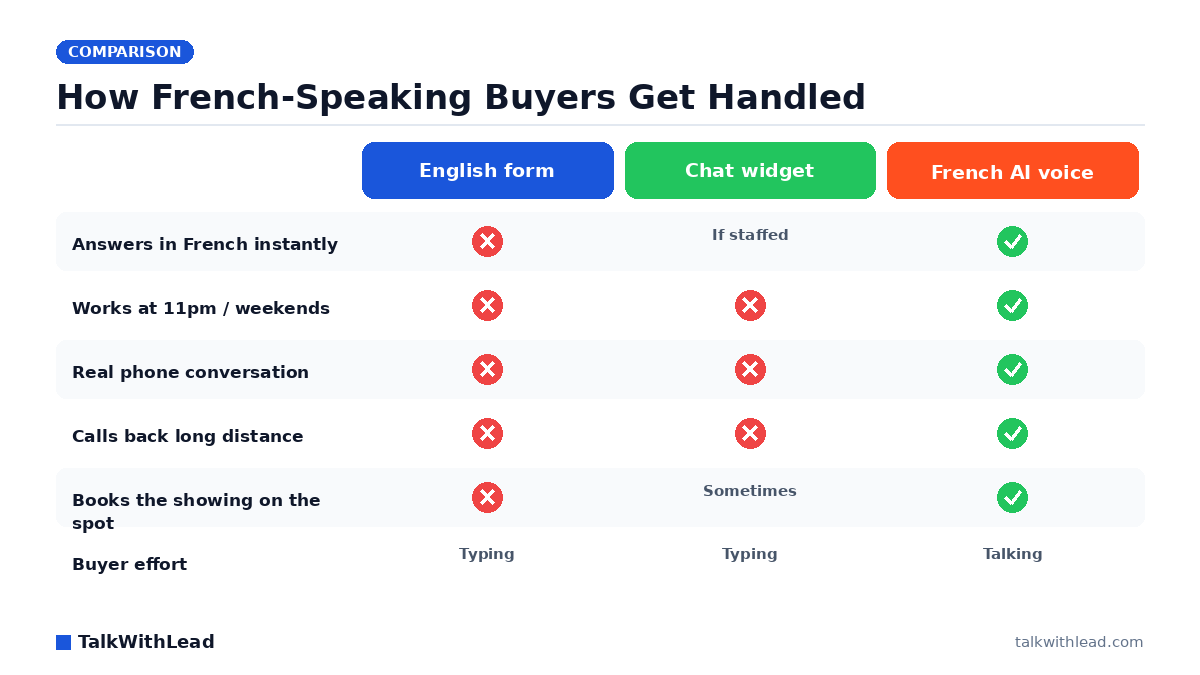
| Capability | English contact form | Bilingual live chat | French AI voice agent |
|---|---|---|---|
| Responds in French immediately | No | Only when a French-speaking agent is online | Yes, every time |
| Available nights and weekends | Collects only | Usually no | Yes, 24/7 |
| Format of the conversation | Typed, one-way | Typed, back-and-forth | Spoken, real-time |
| Handles overseas buyers | No calling | No calling | Unlimited long-distance callback |
| Books a showing without you | No | Sometimes | Yes |
| Effort asked of the buyer | High | Medium | Low |
Best for: agents, teams and brokerages with meaningful French-speaking or multilingual traffic who lose leads after hours and cannot staff a bilingual desk around the clock.
Not the right fit if: your entire market speaks one language, your call volume is low enough that you personally answer every inquiry within minutes, or your leads come from referrals rather than your website.
If you are weighing voice against a chat widget more broadly, Live Chat Alternative for Real Estate Agents breaks down where each one actually converts.
What is this worth? A labeled ROI example
This is an illustrative scenario, not a customer result. Assume a brokerage site gets 1,200 sessions a month and say roughly 300 of those visitors would rather speak French. Suppose 6% of French-speaking visitors will engage with a voice agent that greets them in their language — that is 18 conversations a month that previously produced silence. Say 1 in 4 of those becomes a booked showing: 4 or 5 extra showings. If one closes every couple of months at an average commission you can plug in yourself, the arithmetic tends to settle quickly.
Run your own numbers instead of trusting mine — the free missed-call revenue calculator takes about a minute. Then compare that figure against TalkWithLead pricing, which sits in the ordinary monthly-software range rather than the per-hour range of a staffed bilingual answering desk.
How to roll it out on a real estate site without breaking anything
Start narrow and measure. The rollout that works looks like this:
- Put the widget on listing pages first. That is where intent is highest and where language friction costs the most.
- Write the French qualification script the way you actually speak. Neighbourhood, budget range, pre-approval status, timeline, best time to view.
- Decide the handoff rule. Some teams want every qualified francophone buyer transferred live; others prefer the agent to book the slot and send the brief.
- Turn on instant callback for after-hours. A 10pm inquiry that gets a call at 10:01pm feels like service, not automation.
- Track one number: booked showings per 100 French-speaking sessions. Chat transcripts and “engagements” are vanity; a calendar entry is not.
The same three ingredients apply in every vertical — voice, languages, and long-distance reach — real estate just punishes their absence faster because listings move.
If your francophone traffic is already there and going quiet, the setup is short: start free, drop the widget on your listing template, and let the next 9:40pm visitor hear a voice that speaks their language. Prefer to hear it before committing? The live demo takes two minutes.
FAQ
Can an AI voice agent really hold a natural conversation in French?
Yes. The voice is designed to sound human rather than robotic, and it handles interruptions, follow-up questions and clarifications the way a person would. Most buyers treat it as a phone call, not a menu system.
The practical test is whether it can answer a specific listing question and then book a time. That is what to check during a demo.
What happens if a French-speaking buyer asks something the agent can’t answer?
It escalates. The agent takes the question, captures contact details and the context, and either transfers the caller to your team or schedules an instant callback so a human closes the loop with the full conversation already summarized.
Does it work for languages other than French?
It covers 50+ languages on the same widget, so a Spanish-speaking buyer and a Mandarin-speaking buyer get the same instant treatment as a francophone one. You do not have to build a separate site or hire per language.
Will this replace my bilingual assistant?
It usually replaces the hours nobody covers — evenings, weekends, showings, vacations — rather than the person. Your assistant stops fielding “what’s the square footage” and starts working pre-qualified buyers who already have a showing booked.
Can it call international buyers looking at properties here?
Yes. Unlimited long-distance calling means the callback goes out from your side, so a buyer in France or Morocco pays nothing to have a conversation about a property in Canada.
How fast can I get this live on my listing pages?
Adding the widget is a snippet on your site template, so most agents are live the same day. The longer part is deciding your qualification questions and handoff rules, which is worth an hour of thought.